
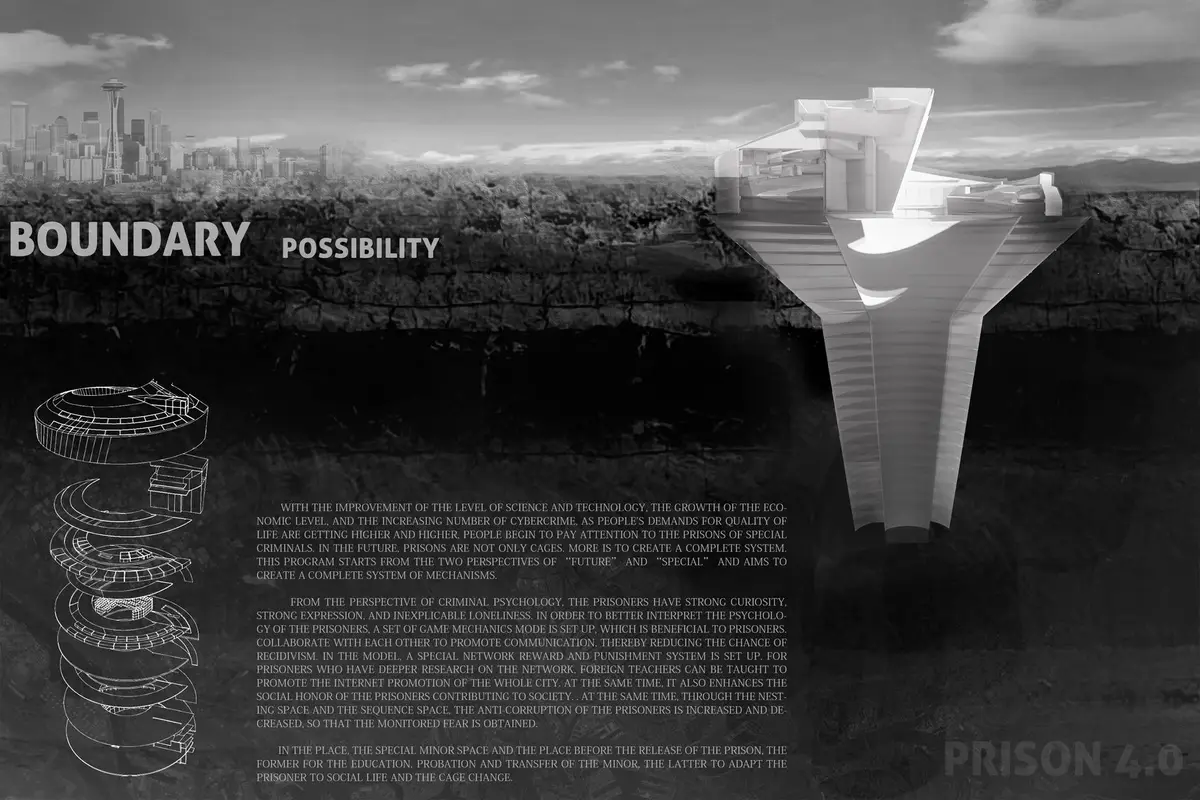
Boundary Possibility: A Vertical Prison for Cybercriminals in The Hague
An hourglass-shaped correctional tower sorts inmates by behavioral typology, layering theaters, restaurants, and exhibition spaces above detention zones.


What does a prison look like when the crime has no physical scene? When the offense is a stolen dataset, a phishing operation, or a piece of malware manufactured and deployed entirely through screens? Boundary Possibility starts from the premise that cybercrime demands a fundamentally different carceral architecture: one that sorts inmates not by the severity of violence, but by behavioral and psychological typology. The result is an hourglass-shaped civic tower in The Hague that stacks cultural programming above correctional space, deliberately collapsing the boundary between confinement and public life.
Designed by Chengpeng Li, the project was shortlisted in the Switching Prisons competition. It responds to a provocation about the future of incarceration by focusing on the specific characteristics of digital offenders: scam operators, data thieves, software manipulators, and privacy violators. Rather than a fortress of isolation, Li proposes a hybrid structure where rehabilitation, surveillance, education, and civic engagement coexist within a single vertical infrastructure.
Corridors and Cell Blocks as Behavioral Landscapes
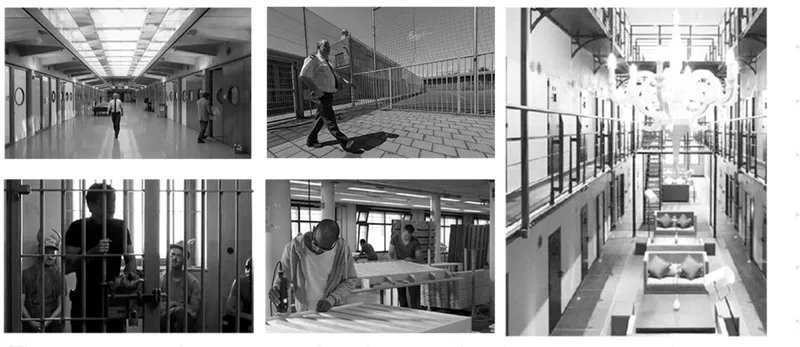
The interior views reveal multi-level cell blocks and corridors populated with figures moving through spaces that feel more institutional than punitive. There are no bars visible in the traditional sense. Instead, the architecture relies on spatial layering and visual transparency to maintain oversight. Li's approach draws from a diagrammatic analysis of global cybercrime patterns, mapping categories like malware manufacturing and digital goods trafficking onto distinct spatial zones. Inmates driven by ideological motivations occupy different areas than those driven by economic disparity, turning behavioral diagnosis into a zoning tool.
An Hourglass Section: Culture Above, Correction Below
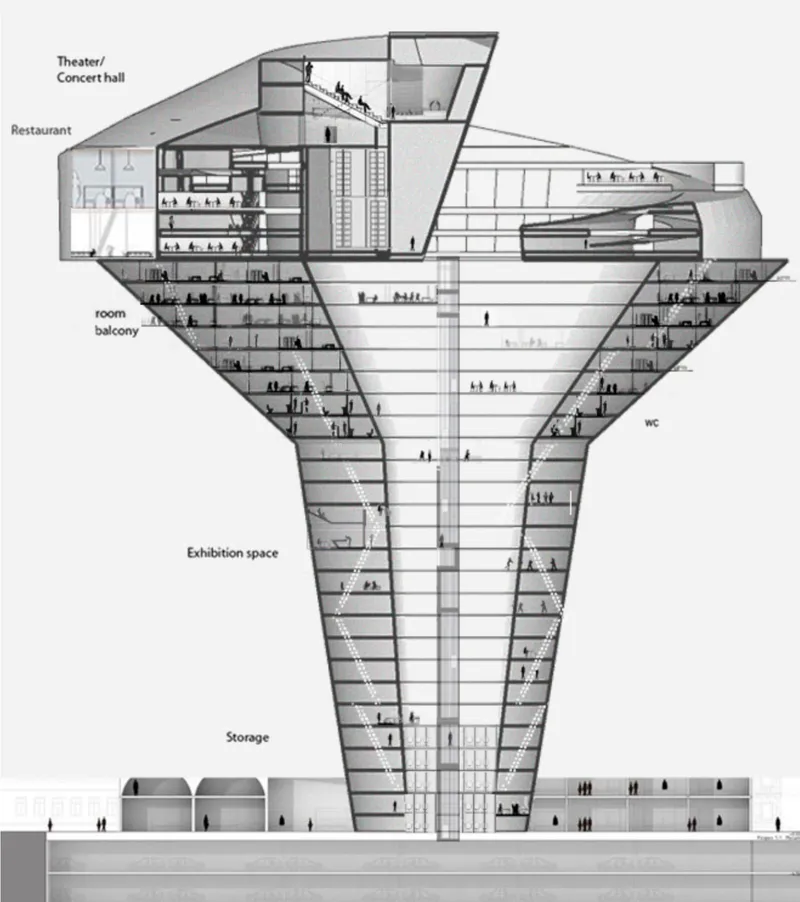
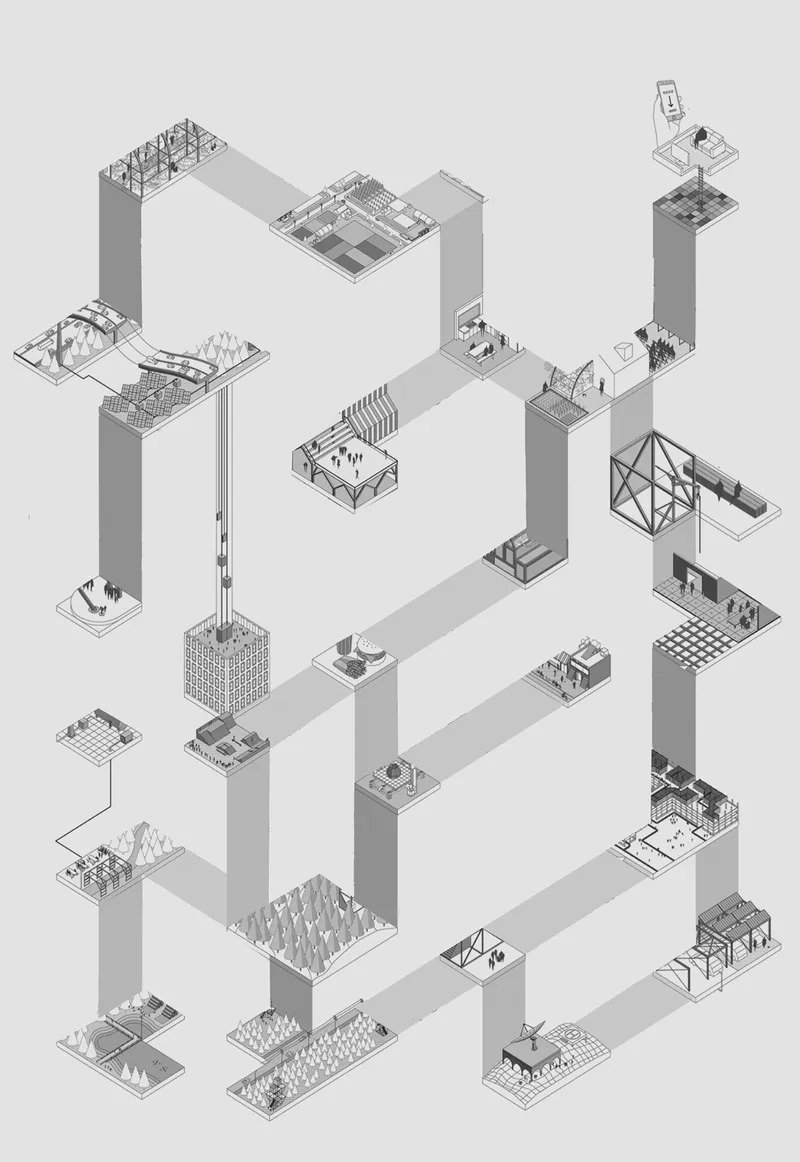
The section drawing makes the building's logic explicit. Wide upper levels house cultural functions: theaters, restaurants, exhibition spaces, and balconies that enable indirect interaction between inmates and the public. The structure narrows at its midsection before expanding again into lower tiers dedicated to storage and core correctional programs. This inversion of the typical prison model, which buries public functions at the perimeter and puts cells at the center, is deliberate. Li positions the prison as a civic monolith, dense and multifunctional, where society participates visibly in the process of reform rather than outsourcing it behind walls.
The axonometric drawing reinforces this reading, showing multiple platform levels connected by vertical towers with varied spatial programs. Each platform operates at a different scale and density, suggesting that movement through the building is itself a form of graduated reintegration. The contrast with historical fortress-like models of medieval and modern prisons is stark and intentional.
Cell Units Configured for Cognitive Rehabilitation
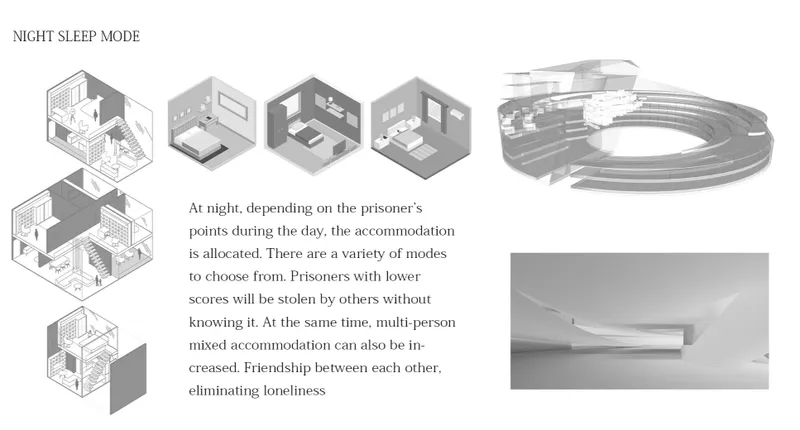
At the smallest scale, Li details nighttime sleeping configurations through isometric cell units accompanied by plan views. These are not simply dormitories. The diagrams suggest spatial strategies that distinguish between physical incarceration and cognitive rehabilitation, a distinction central to the project's thesis. For cybercriminals whose offenses are entirely non-material, the architecture of the cell itself becomes a question: what exactly are you containing, and what are you trying to restore?
Jury Responses: Abstraction, Geography, and Green Space
The jury's response was mixed, revealing the tension between the project's conceptual ambition and its practical resolution. Adrian Iredale (Director, iredale pedersen hook architects) noted that the design "creates a highly abstract and competitive environment that encourages reward and punishment at the expense of rehabilitation." Misak Terzibasiyan (Founder and CEO, UArchitects) questioned the geographic specificity of the site analysis. Michael Spight (Director, TAG Architects) offered a more targeted critique, observing that "the integration of some green space would be an asset to this generally well-handled scheme. Light and contact with the environment is essential." These readings collectively highlight a gap between the project's sophisticated typological thinking and the experiential qualities of light, landscape, and warmth that any correctional environment ultimately requires.
Why This Project Matters
Boundary Possibility is most compelling as a provocation. It asks whether the architecture of justice can be reorganized around the nature of the offense rather than the body of the offender. In a world where cybercrime is growing faster than any other category of criminal activity, that question is not abstract; it is urgent. Li's proposal to zone a prison by behavioral diagnosis rather than security level represents a genuinely novel contribution to the discourse on carceral architecture.
Where the project strains is in the distance between its diagrammatic clarity and the lived experience of inhabiting such a building. The jury's call for green space and environmental contact points to a deeper issue: that even the most intellectually rigorous prison design must ultimately reckon with the sensory and emotional needs of human beings. Still, as a speculative framework for rethinking what prisons could become when crime migrates entirely into digital space, Boundary Possibility opens territory worth exploring further.
View the Full Project
About the Designers
Designer: Chengpeng Li
Enter a Design Competition on uni.xyz
uni.xyz runs architecture and design competitions year-round that reward proposals with spatial conviction and real site intelligence.
Project credits: Boundary Possibility, by Chengpeng Li Switching Prisons (uni.xyz).


Popular Articles
Popular articles from the community


Singing Woman: Contemporary Architecture Inspired by Estonia’s Voice and the Sea
Singing Woman turns Estonia’s song culture into flowing opera house architecture, blending public life, landscape, sea, and national memory.

Extended Shell: Retrofitting Kolkata's Balconies as Living Urban Thresholds
A modular retrofit system recovers the social and environmental intelligence of Kolkata's historic verandas for contemporary Park Street residents.

Tsunami Convergenics: Turning Catastrophic Ocean Forces into Underwater Housing Infrastructure
A speculative underwater settlement off the coast of Onagawa, Japan, treats tsunamis and typhoons as energy sources rather than threats.

The Amber Palace Opera: A Geological Fiction Surfaces on Tallinn's Baltic Waterfront
Pierre Brillard reimagines a Baltic legend as a public landscape, opera house, and waterfront promenade rooted in Tallinn's coastal identity.

Similar Reads
You might also enjoy these articles

Day and Night Park: A Time-Based Urban Newsstand in Beijing
A temporary urban newsstand in Beijing blending travel, light, and reading through poetic colors, compact form, and community-focused design.

Modernist Patio Renovation in El Masnou, Barcelona by Oliver Segura Arquitectura + Cebrià Arquitectura
Modernist patio renovation blending tradition and innovation with a movable pool, leveled floors, and Catalan materials in El Masnou.

Alto Residencial Coop: Cooperative Housing Development in Santiago de Compostela by Carbajo Barrios Arquitectos
A linear cooperative housing complex blending white volumes and perforated metal façades, enhancing community living, natural light, privacy, and urban integration.
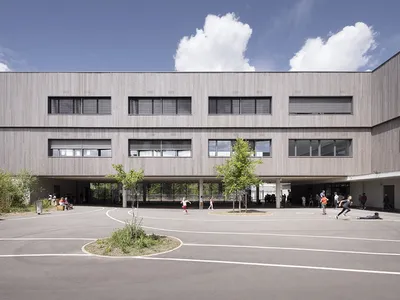
Vil Genis School by BPA ARCHITECTURE – Massy, France
Vil Genis School in Massy, France, features sustainable design, south-facing classrooms, community integration, accessible spaces, and modern educational architecture.


Comments (0)
Please login or sign up to add comments
No comments yet. Be the first to comment!