
Breathe Architecture Splits a House into Three Pavilions on a Melbourne Creek Escarpment
Edgars Creek House in Coburg uses rammed earth, raw ironbark, and screw piles to nest into a steep bushland site without disturbing it.

Suburban Melbourne is not short of houses that frame views. What it is short of is houses that genuinely participate in their sites. Edgars Creek House, designed by Breathe Architecture on a steep escarpment above Edgars Creek in Coburg, does something rare: it breaks a domestic program into three freestanding pavilions, links them with an open-air brise soleil spine, and steps the whole assembly down the slope so that moving between rooms means moving through weather, light, and landscape. The 275 square metre home sits on land once occupied by a Kodak factory, demolished and subdivided roughly a decade before construction began. What remains today is an encounter between suburban infrastructure and remnant bushland, sandstone cliffs, and mature ironbark trees along the creek.
The project is interesting not because of its materials, though those are carefully chosen, but because of what it refuses to do. It refuses to seal itself from the outside. It refuses to use fossil fuels. It refuses to fix its materials permanently, instead screwing and bolting every piece of cladding and decking so that the whole thing can, in theory, be dismantled and reused. Built on screw piles to avoid destabilizing the slope, it treats the escarpment as a collaborator rather than a foundation to conquer. On Wurundjeri Country of the Kulin Nation, that posture carries weight.
Three Pavilions, One Landscape
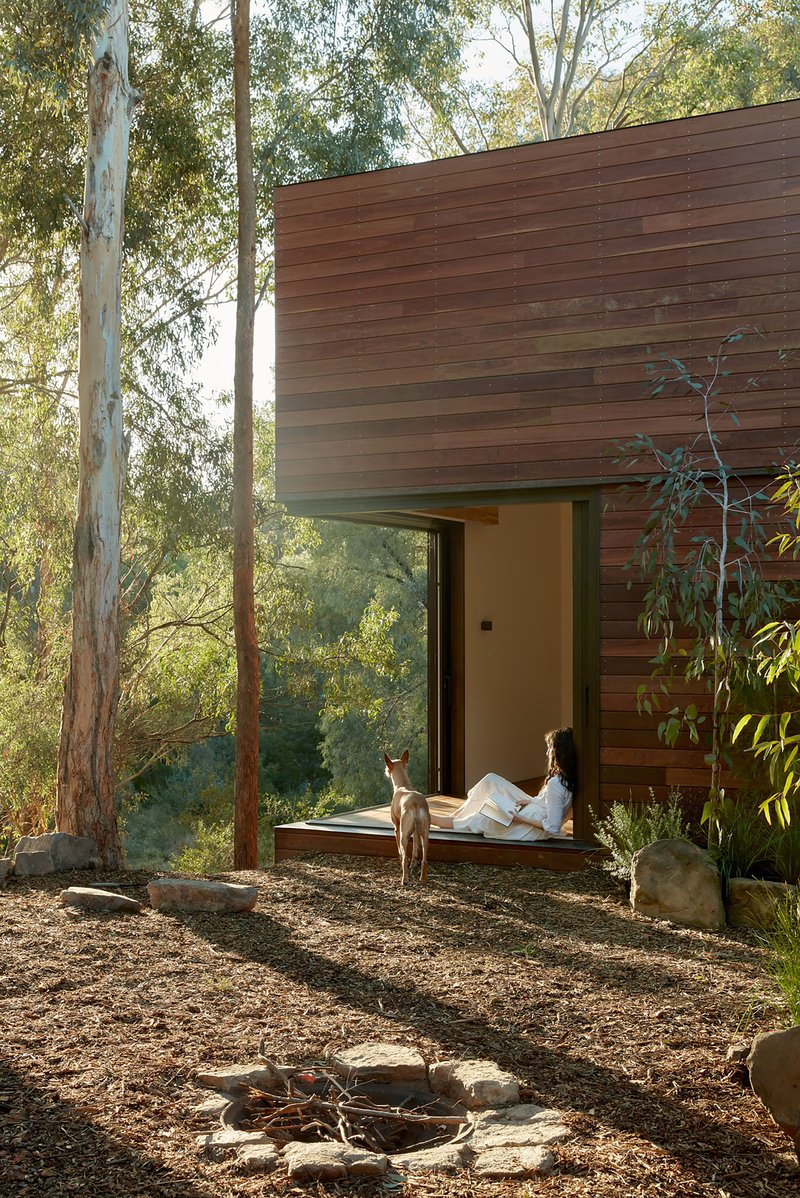
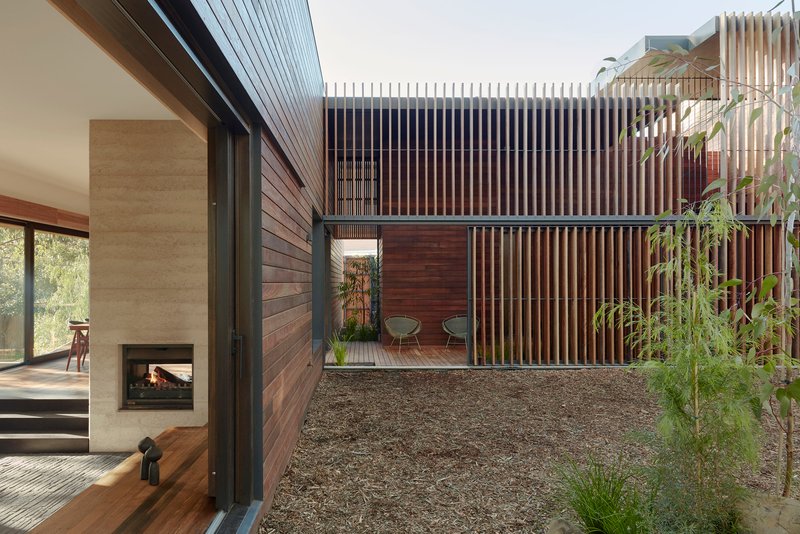
The three pavilions, one for sleeping, one for bathing, one for living, frame a central courtyard and step down along the contour of the land. Each building is structurally independent, with lightweight decking spanning between them. The effect is less compound than choreography: the house unfolds as a sequence of enclosed and exposed moments. You leave one room, pass through dappled light filtered by vertical slat screens and planted beds, and enter the next. It is a fundamentally different experience from walking down a hallway.
The cantilevered sleeping pavilion, clad in raw ironbark, projects toward the eucalyptus canopy with a calm confidence. Mature gum trees were preserved through careful placement of each volume, so the house reads as inserted into the landscape rather than cleared against it. The gravel courtyard, lined with bamboo and horizontal timber cladding, serves as the spatial hinge between pavilions, a place that belongs neither fully inside nor fully outside.
Rammed Earth as Geological Echo
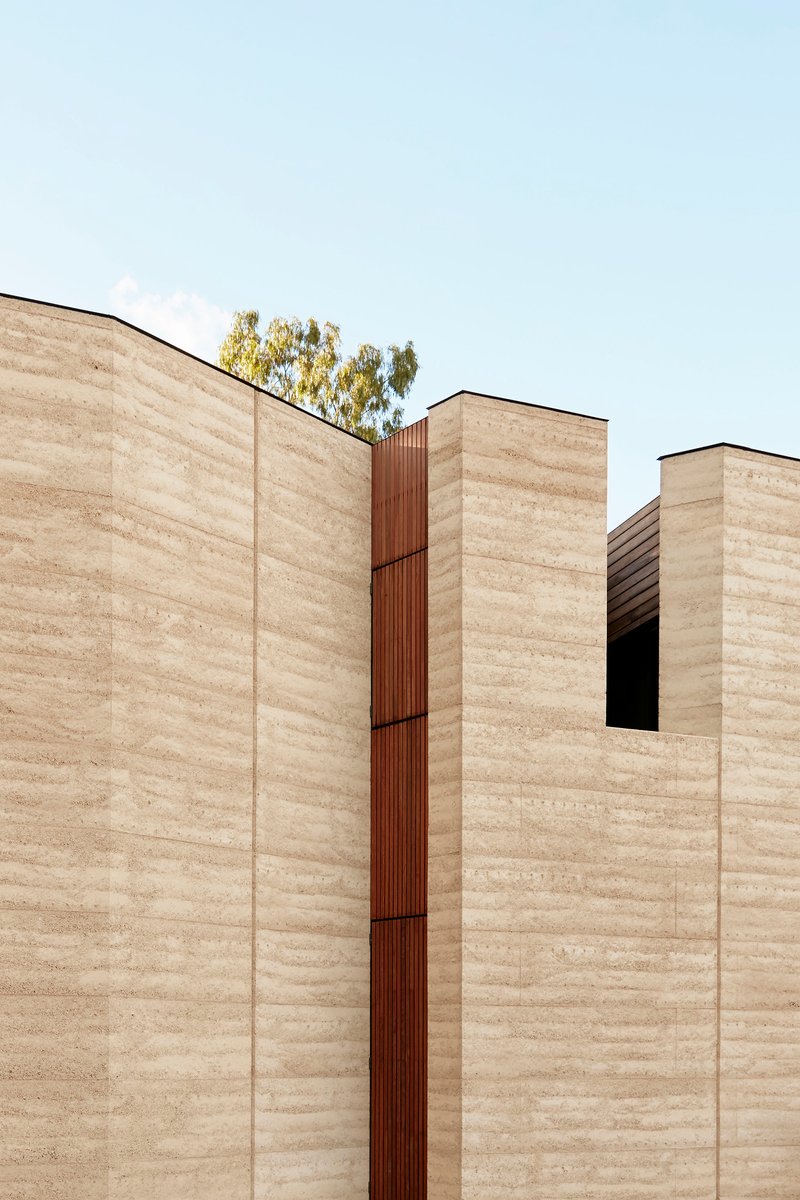
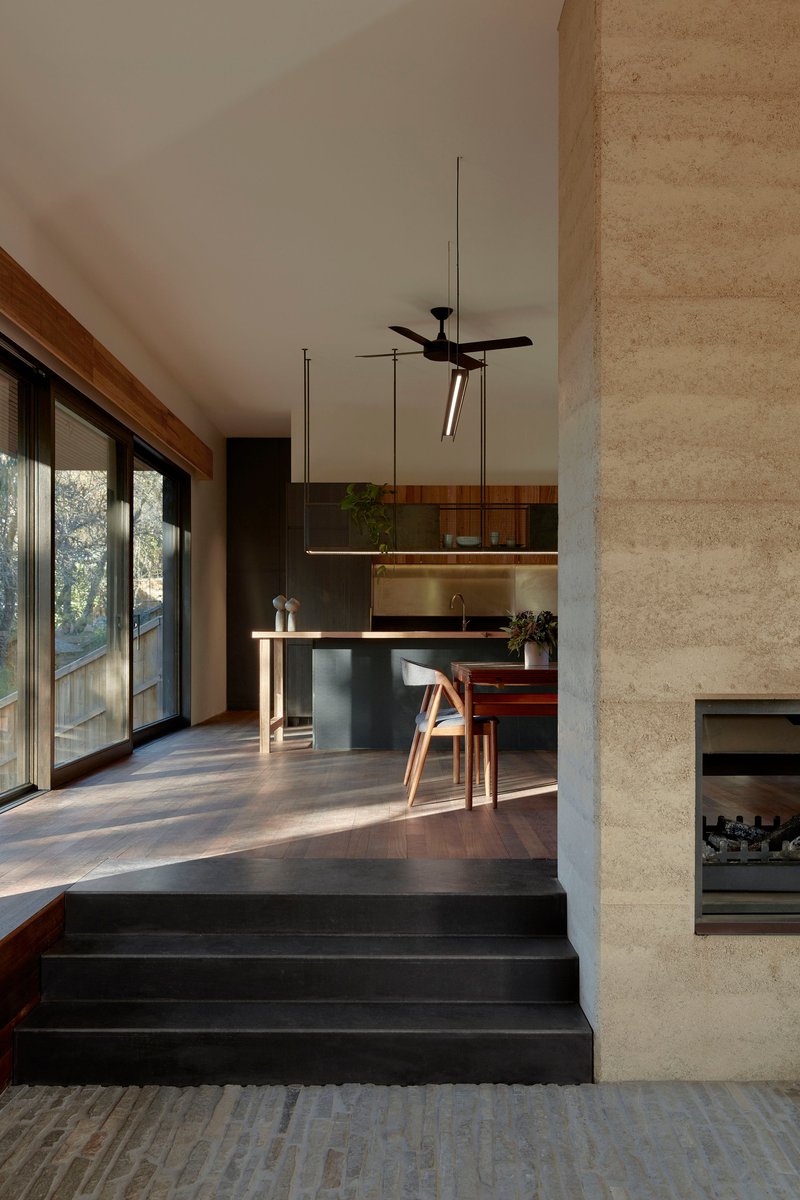
The south-facing rammed earth wall is the project's geological anchor. Layered to reflect the textures of the sandstone cliffs along the creek below, it uses local and recycled content to achieve something that goes beyond aesthetics. The wall provides thermal mass, absorbing and slowly releasing heat to regulate internal temperatures. It also shields the south face of the house, creating a protective edge that contrasts with the openness toward the west and the creek.
In the kitchen, morning sunlight catches the rammed earth surface and throws warm light across the stone flooring. A vertical timber slot detail punched into the facade acts as a carefully framed aperture rather than a panoramic opening. Breathe's strategy throughout is to capture key outlooks through specific, controlled openings rather than wrapping the house in glass. The approach treats views as events, not wallpaper.
The Brise Soleil Spine
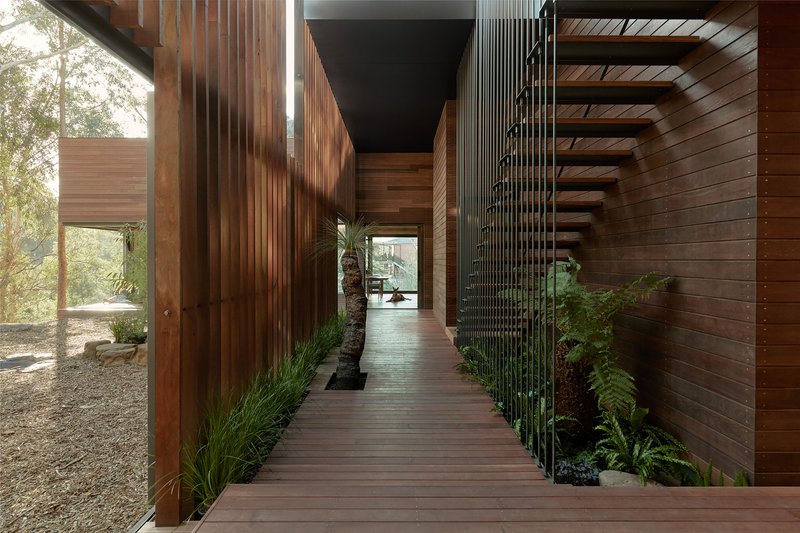
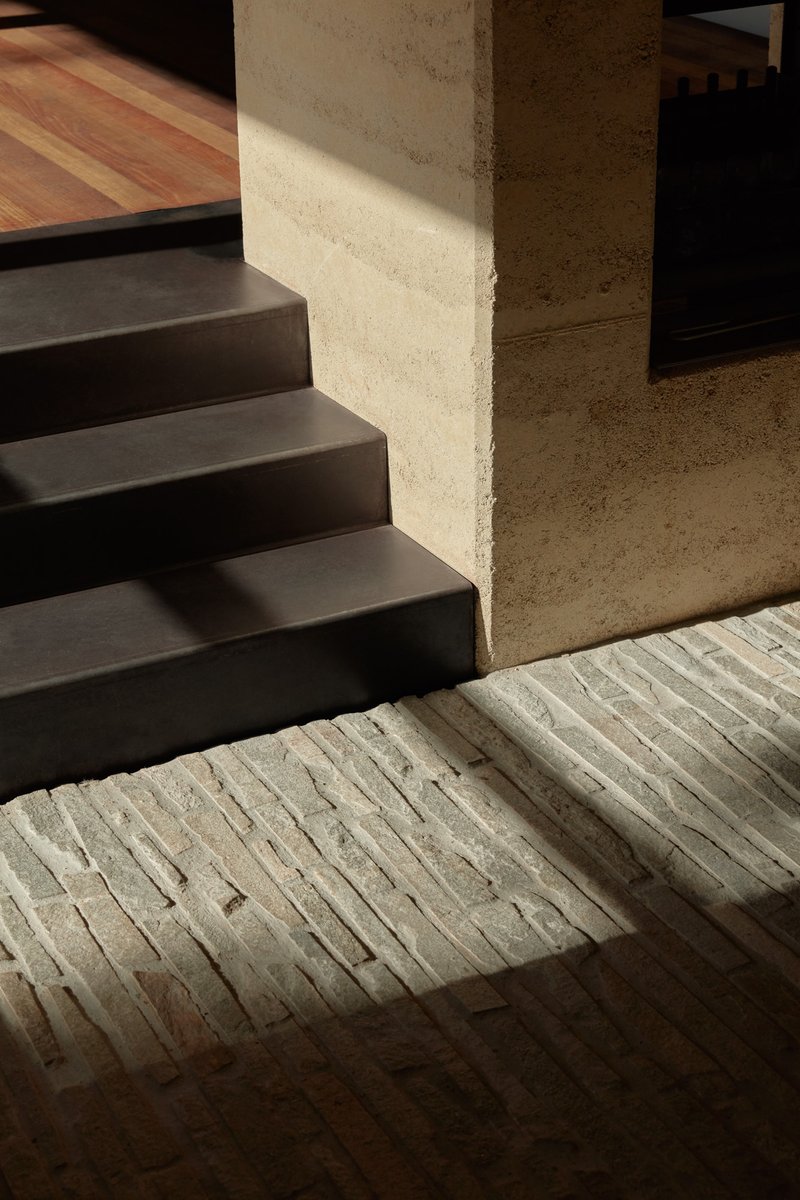
Connecting the three pavilions is the brise soleil, a slatted timber corridor that functions simultaneously as circulation, shading device, and garden. Vertical slat screens filter western sun while allowing cross-ventilation, eliminating the need for mechanical cooling. Planted beds run alongside the open staircase, creating a corridor that has its own internal ecology. The steel stairs meet ridged concrete paving where sunlight catches the textured surface, a detail that reveals how precisely the transitions between materials have been handled.
The spine is the design's most radical proposition. By refusing to enclose the circulation, the architects ensure that inhabitants must physically engage with the site every time they move between sleeping, bathing, and living. Rain, wind, the smell of eucalyptus, the temperature of the air: all of these become part of daily domestic life. It is an idea that sounds poetic in description but requires real commitment from the people who live here.
Living Among the Canopy
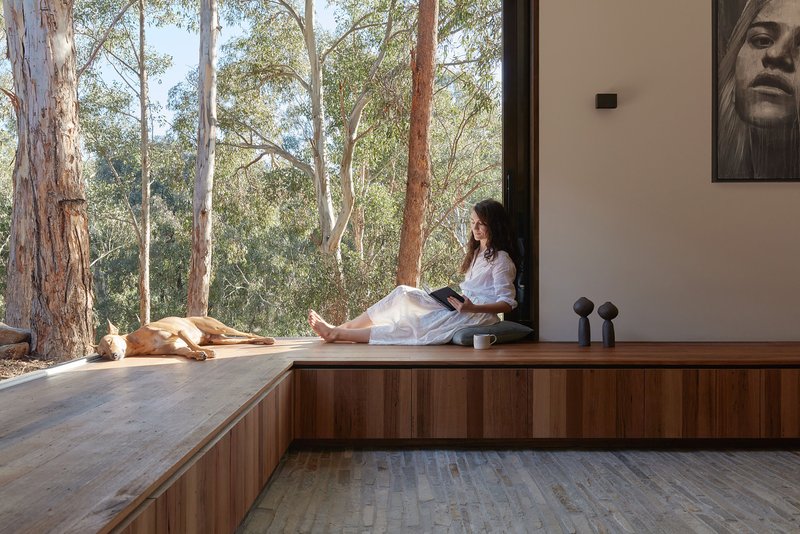
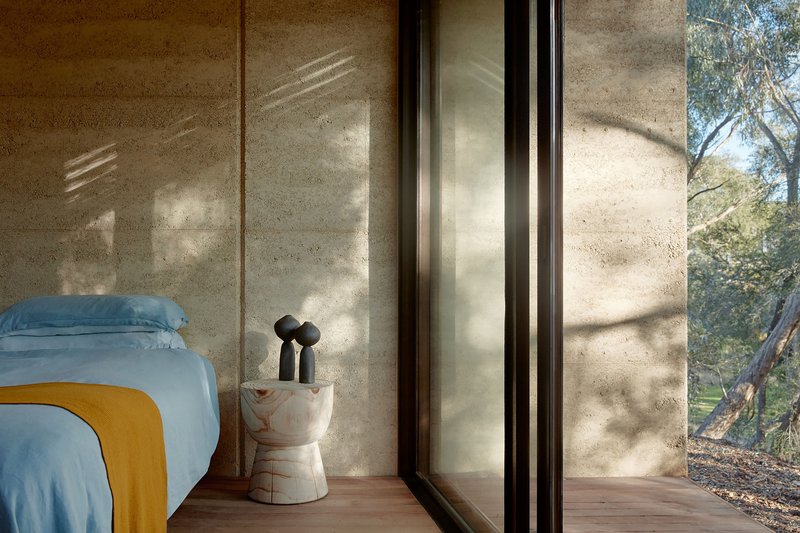
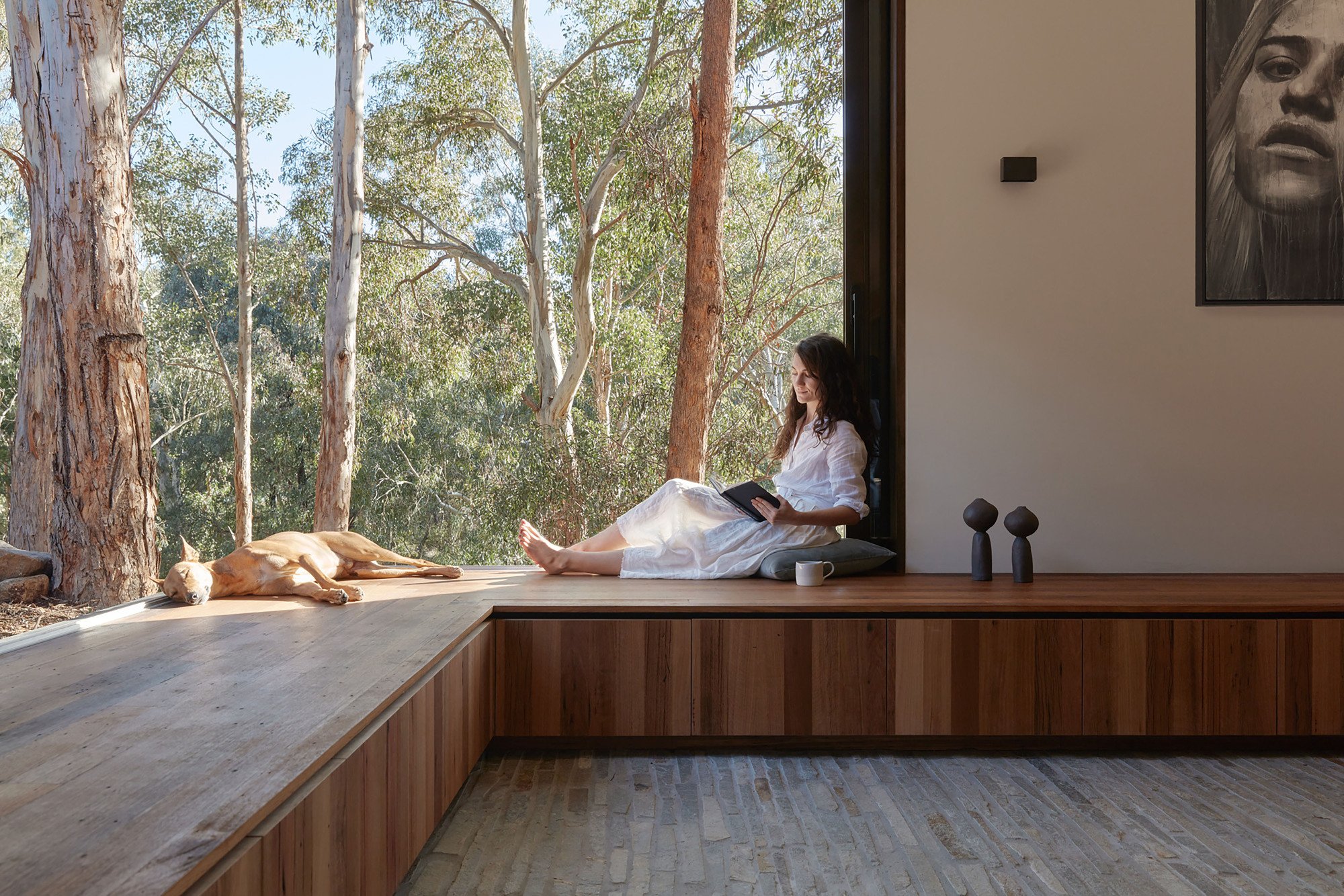
All three pavilions frame views to the west, through ironbark trees toward the creek. In the bedroom, floor-to-ceiling glazing and rammed earth walls create a space where dappled afternoon shadows animate the interior surfaces. The double-glazed tilt-and-turn windows and lift-and-slide doors are high performance, but the mood is one of restraint rather than technology. A window seat in the upper level places a reader directly in the tree canopy, surrounded by eucalyptus, with the creek valley dropping away below.
The material palette reinforces the site relationship at every turn. Reclaimed Tasmanian Oak flooring, spotted gum decking, a recycled Messmate benchtop, a copper kitchen sink. Wet areas are lined in Australian ironbark decking instead of tiles, a choice that is both unusual and logical given the timber's extraordinary durability. The ironbark cladding on the exterior will weather indefinitely without painting or oiling, aging alongside the ironbark trees it faces.
Fossil Fuel Free and Reversible
The sustainability strategy is comprehensive but not performative. The house is designed to be fossil fuel free, relying on an electric heat pump for hot water and provisions for hydronic heating and rooftop solar. A 5,000 litre underground rainwater tank addresses water harvesting. The screw pile foundation, chosen for the unstable slope, also means the structure makes minimal permanent impact on the ground.
Perhaps the most provocative sustainability decision is the assembly logic. Every piece of cladding and decking is screwed and bolted rather than glued, cemented, or permanently fixed. The entire house is designed for disassembly. In a construction industry that treats buildings as permanent interventions, Breathe Architecture proposes something closer to a very good tent: durable, comfortable, and ultimately reversible.
Plans and Drawings
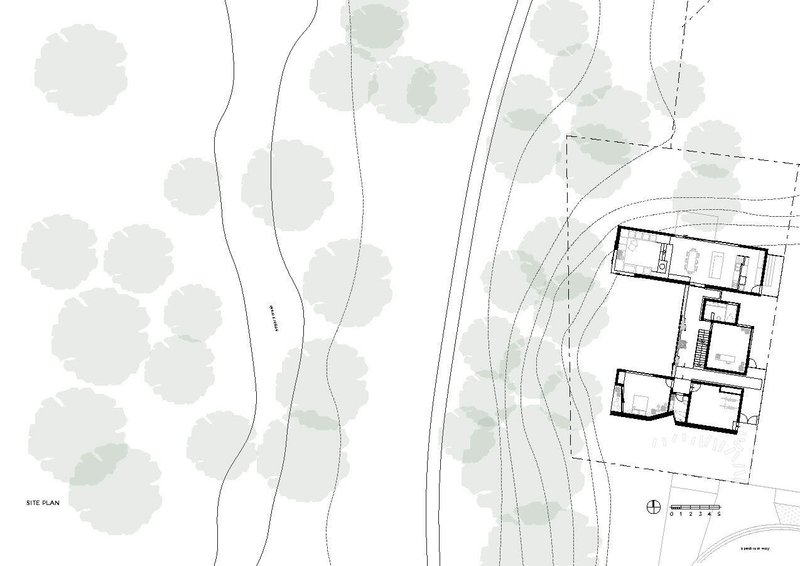
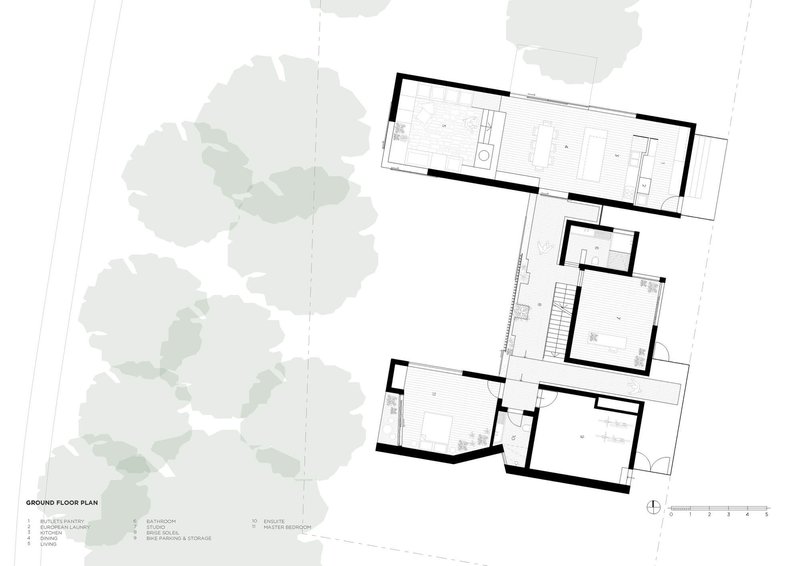
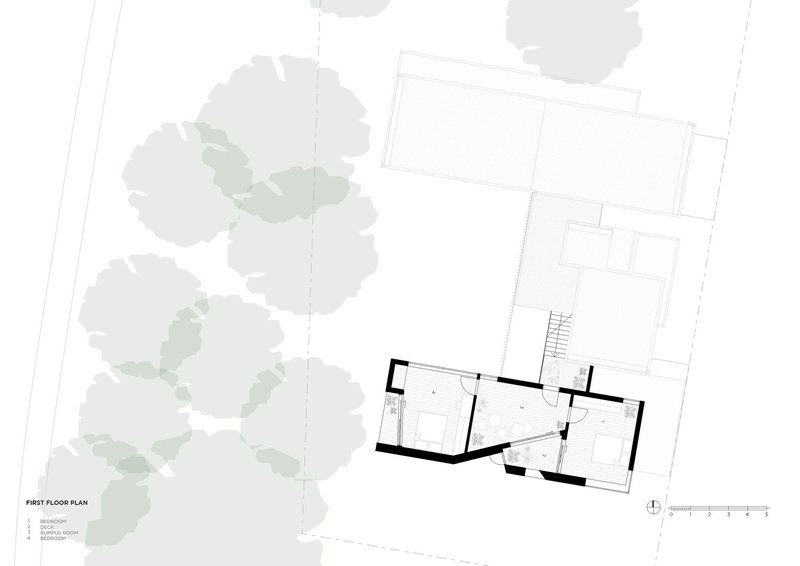
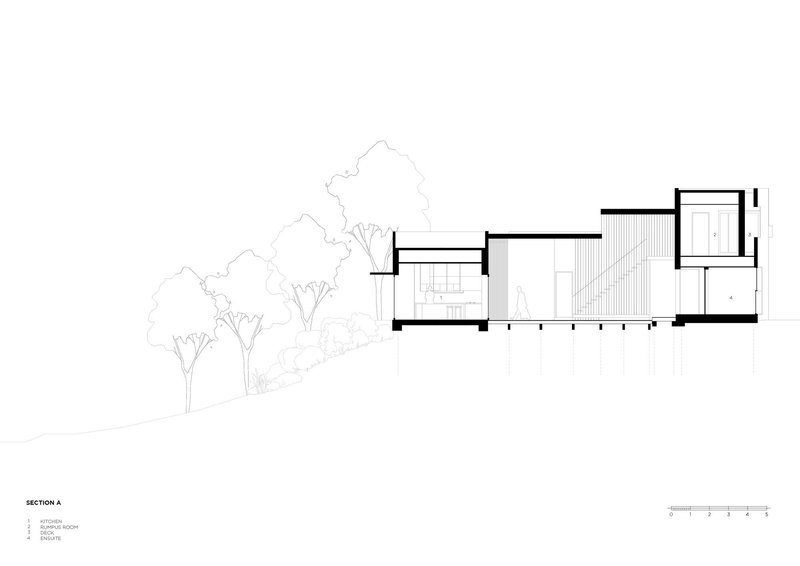
The site plan reveals how precisely the three pavilions negotiate the existing tree canopy, with contour lines showing the steep fall of the escarpment toward the creek. The ground floor plan shows rectangular volumes arranged around a central staircase, while the first floor plan positions bedroom and study spaces within the surrounding tree canopy. The section drawing is particularly telling: stepped roof forms descend the slope, each pavilion calibrated to a different level, so the house reads as a series of terraces rather than a single object imposed on the land.
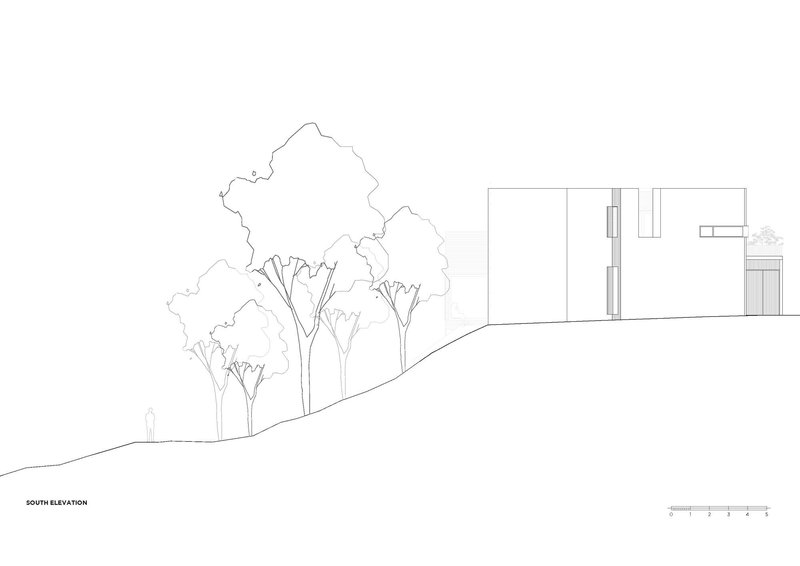
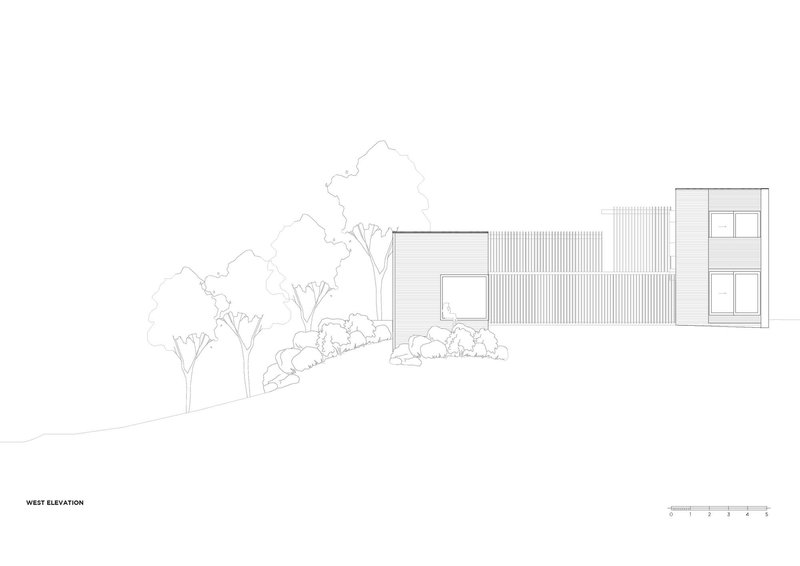
The south and west elevation drawings confirm the project's dual character. From the south, it presents a relatively closed, rammed earth face against the weather. From the west, horizontal cladding and stacked volumes open toward the landscape. The elevations also make clear how much of the site's mature vegetation has been retained, with trees drawn at full scale to emphasize that the architecture has been fitted around them, not the other way around.
Why This Project Matters
Edgars Creek House matters because it makes a persuasive case that suburban houses do not need to be hermetic boxes. By splitting the program into three pavilions and linking them through open air, Breathe Architecture creates a home where the line between architecture and landscape dissolves, not through grand glazed walls, but through genuine porosity. The decision to leave circulation exposed to the elements is a design commitment that most clients would reject, and its presence here suggests a shared ambition between architect and inhabitant that is worth paying attention to.
More broadly, the project demonstrates that working with local materials, passive climate strategies, and design for disassembly does not require sacrifice. The spaces are generous, the detailing is precise, and the relationship to the creek and its ironbark trees is genuinely moving. On a former factory site in Coburg, where the built environment has steadily encroached on bushland, this house quietly argues that the process can run in reverse.
Edgars Creek House by Breathe Architecture, Coburg, Australia. 275 m². Completed 2019. Photography by Tom Ross.
About the Studio
Share Your Own Work on uni.xyz
If projects like this are the kind of work you want to make, uni.xyz is a place to publish your own, find collaborators, and enter design competitions.




Popular Articles
Popular articles from the community

Inside a Timeless Mumbai Residence by Aether Studio
Aether Studio's 2,250 sq ft apartment in Malad, Mumbai uses marble, brass, boucle, and disciplined restraint to build a quiet retreat from the city.

Milan Crossover: Sustainable Architecture for a New Fashion Culture in Milan
Milan Crossover transforms fashion culture through sustainable architecture, linking material libraries, remake studios, and public runways.
Reincarnation Weaves a Three-Story Retreat into the Green Landscape of Rural Bangladesh
Ara Manor in Narsingdi dissolves the line between domestic architecture and its lush surroundings through screens, courtyards, and planted rooftops.
Eco Chapel: A Green Architecture Pavilion Designed in Symbiosis with the Forest
Eco Chapel uses green architecture to weave prayer, learning and reuse into a forest pavilion shaped by modular hexagonal canopies for life.

Similar Reads
You might also enjoy these articles
Freebird Residence by Alexis Dornier: A Tropical Modernist Sanctuary in Bali
Floating living pavilion above pool anchors H-shaped tropical villa, blending Japanese minimalism, sustainable strategies, lush landscape, and sculptural interiors.
127af Flips a Tiny Bagnolet Rowhouse Upside Down with a Handcrafted Roof Extension
A 55-square-meter terraced house on the edge of Paris gains a luminous upper living floor through lightweight timber and steel.
1.61 Design Workshop Wraps a 600-Square-Meter Café in Vietnam in Sculptural Burgundy Drama
Reden Café & Bistro pairs a helical staircase, mosaic floors, and deep red interiors to rethink Vietnamese hospitality space.

The Unbound Brain: A School Shaped by Cognitive Architecture
Cylindrical learning pods radiate like neurons from a central cortex, turning the floor plan into a spatial model of human thought.


Explore Sustainable Design Competitions
Discover active competitions in this discipline




The Global Benchmark for Architecture Dissertation Awards


Challenge to design mud housing for contemporary communities


Design challenge to reuse E-waste
Comments (0)
Please login or sign up to add comments
No comments yet. Be the first to comment!