

Brückner & Brückner Architekten Strip a 17th-Century Capuchin Church Back to Luminous Essence
In Neumarkt in der Oberpfalz, clay plaster and reed-mat vaults turn a monastery relic into a vessel of quiet, democratic light.


A building that has served as a Capuchin monastery chapel, a grain store, a military hospital, a bakery, and a residential house before finally becoming a Protestant church does not lack for narrative. What it does lack, after three and a half centuries of layering, is legibility. Brückner & Brückner Architekten (Atelier Brückner) took on the Christuskirche in Neumarkt in der Oberpfalz with the opposite impulse of most heritage conversions: instead of adding, they subtracted, peeling away decades of accretions to find the original spatial logic of the 1674 structure and then pushing it, gently, toward a 21st-century use.
The result is an 866 m² interior that reads almost monolithically white, a single continuous surface of clay plaster and mineral screed that dissolves corners, obscures joints, and lets light do most of the architectural work. The chancel, which had been subdivided and severed from the nave, is reunited. The floor is raised to create a seamless threshold. LED strips hidden behind tensioned fabric on window sills produce a glow that seems to emanate from the walls themselves. It is architecture as atmosphere, and the atmosphere is, quite deliberately, one of arrival.
A Monastery Reborn on the Fränkische Alb
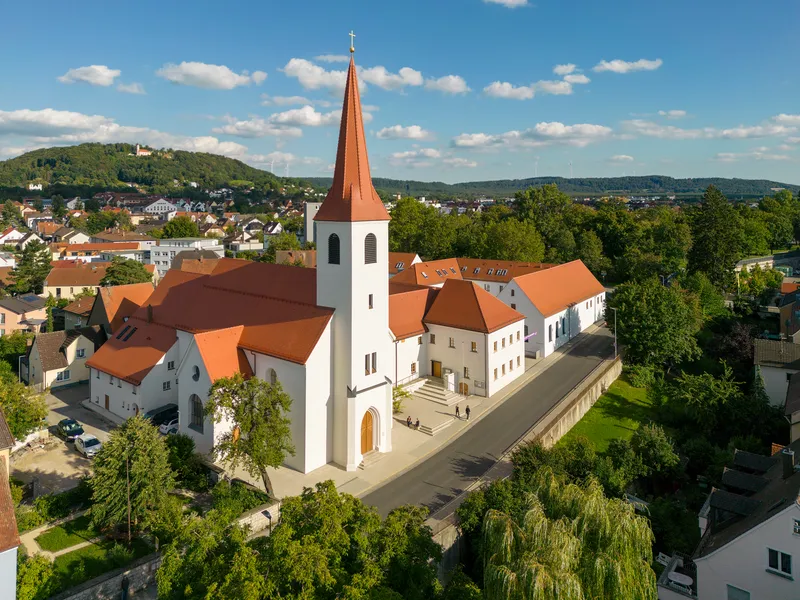

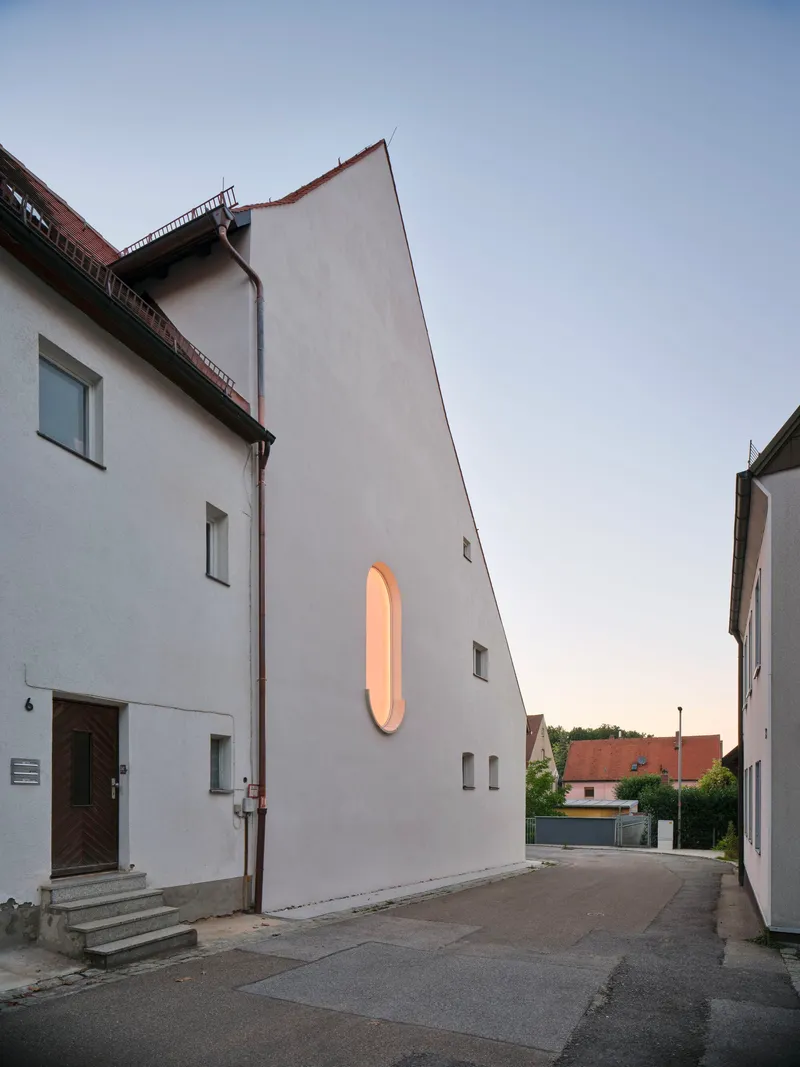
From the outside, the Christuskirche remains a modest presence on the western edge of the Fränkische Alb. Its white rendered walls and terracotta spire sit flush with the old town fabric, exactly as a Capuchin building should: unassuming, almost anonymous. The new oak-and-glass portal is the only overt signal of intervention, and even that is restrained. At dusk, the oval window on the street facade glows like a lantern, offering passersby a single warm clue to what has happened inside.
This reticence is a design decision, not an oversight. The Brückner teams understood that the power of this project would come from the contrast between a familiar exterior and a radically simplified interior. You walk in expecting a 1930s church fitout. You get something closer to a James Turrell installation, funded in part by the congregation itself through a crowdfunding campaign.
The Nave as Open Platform


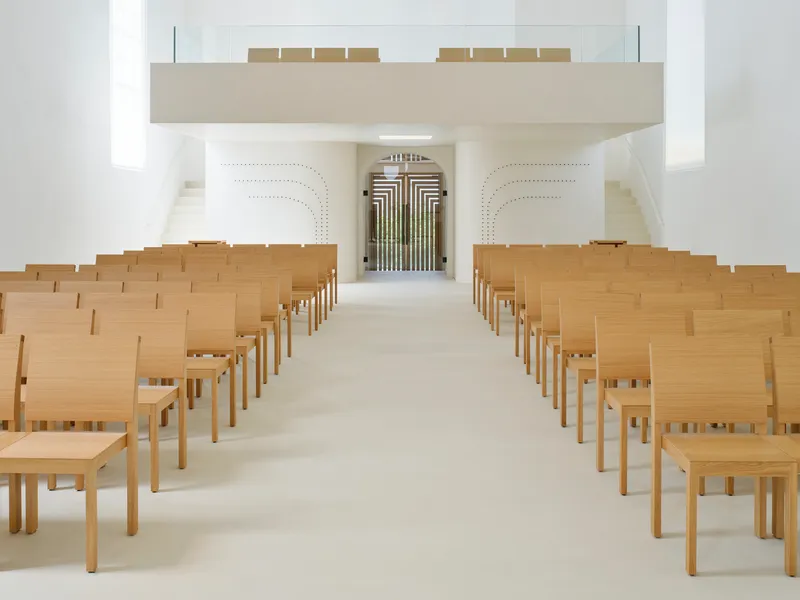
The nave is the most overtly flexible space. Its barrel-vaulted ceiling, now finished in wood-fired marble slaked lime in broken white, arches over timber pews that can be rearranged for services, concerts, shared meals, or exhibitions. A cantilevered gallery holds the organ pipes behind a perforated choir screen, and the seating below it faces the apse with a directness that older pew layouts rarely achieve. The floor, a continuous mineral screed, extends up the walls to a height of 2.60 meters, erasing the junction between horizontal and vertical planes.
What makes the nave genuinely interesting is its refusal to privilege one program over another. A church that can host a dinner with equal dignity to a Sunday service is making a statement about community that goes beyond liturgical reform. The human being, not the altar, is positioned as the measure of the room.
Into the Light: The Chancel Sequence
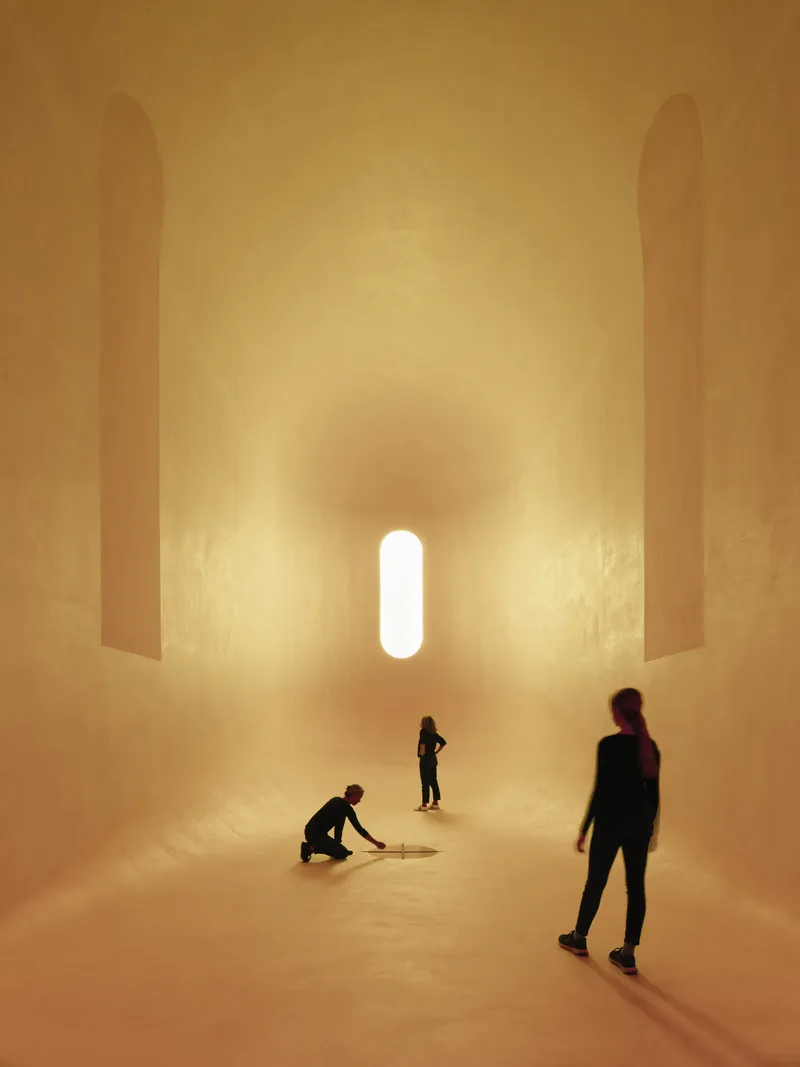


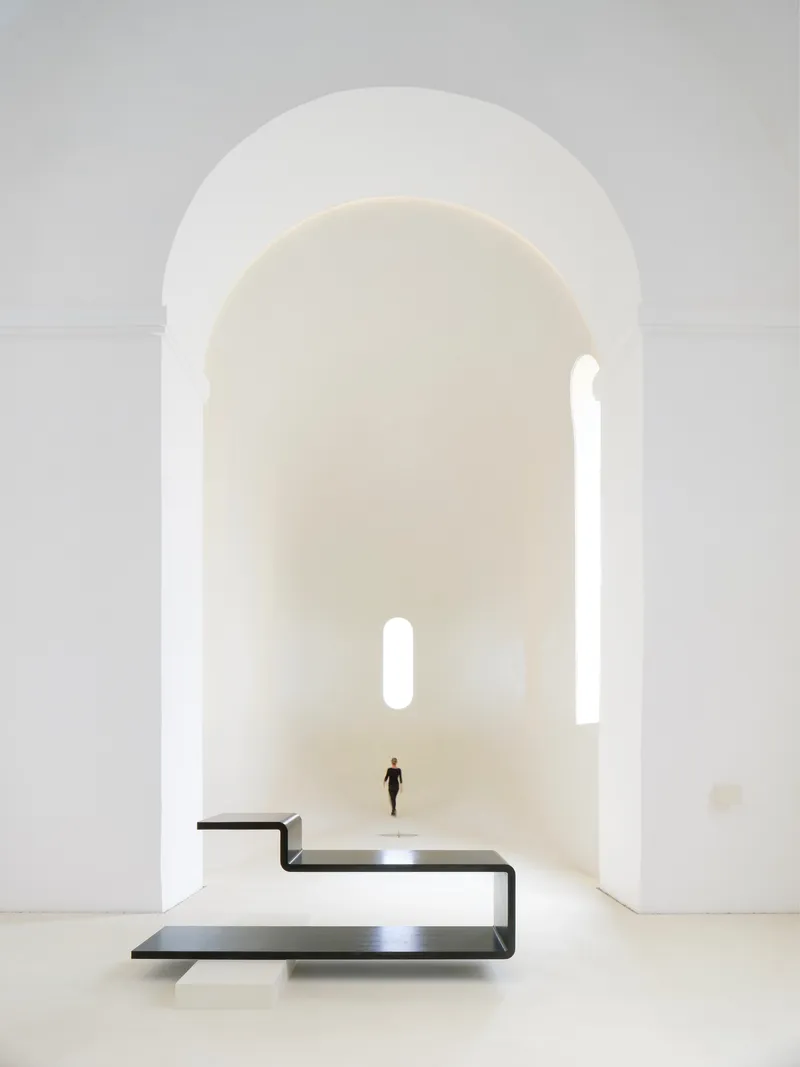
The chancel is where the project's title earns its meaning. Originally a long, narrow space cut off from the congregation, it has been reopened and relined with curved wooden ribs clad in planks, over which a double-layer reed mat is wrapped before receiving clay base plaster, leveling plaster, decorative plaster, and a natural wax finish. The result is a softly organic enclosure that narrows toward a new semicircular window at its far end. Light enters through tensioned fabric layered over retained stained glass, producing a diffuse golden glow that intensifies as you move deeper into the apse.
A cantilevered black steel platform hovers in this space, offering a place for silent prayer, meditation, or small gatherings. The baptismal font is recessed into the choir floor, not raised on a plinth. These are deliberate inversions of traditional ecclesiastical hierarchy: the sacred is embedded in the ground, not elevated above it. The path from nave to chancel functions as a spatial metaphor for resurrection, moving from communal openness to concentrated, enveloping light.
Clay, Reed, and the Argument for Natural Materials
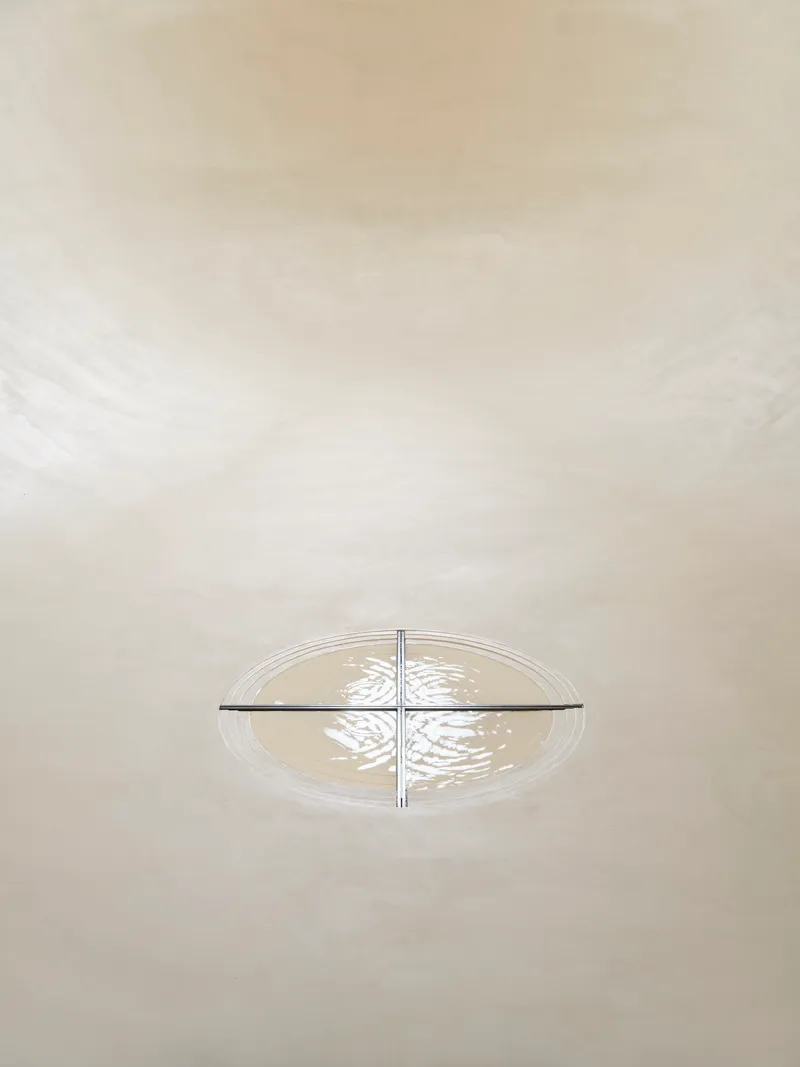

The material palette is almost aggressively simple. Clay plaster on walls. Reed mats on the vault substructure. Mineral screed on the floor. Oak for seating and doors. Limestone at the foundations. No composite panels, no acoustic tiles, no suspended ceilings. The 70-stem reed mat was chosen specifically because it conforms to the curved wooden substructure of the vault, and the layered clay plaster system (base, leveling, decorative, wax) gives the surface a depth that paint simply cannot replicate.
There is a practical dimension to these choices as well. The original 17th-century walls suffer from rising moisture, and the diffusion-open plaster system installed in the base zone allows the masonry to breathe rather than trapping dampness behind a vapor barrier. It is conservation logic applied with ecological conviction, and the acoustic result, shaped with input from Müller BBM, is a room that absorbs just enough to remain warm without losing clarity.
Lighting as Architecture
The lighting design, by Die Lichtplaner of Limburg-Staffel, deserves its own discussion. LED strips are concealed on sloped window sills, directly behind the choir arch, and around the interior of the choir window. Every wall opening is covered with tensioned fabric so that no single light source is ever directly visible. The effect is ambient rather than directional: walls seem to emit light rather than receive it. The existing stained-glass windows are retained but reinterpreted through a layer of semi-transparent textile, transforming them from narrative panels into chromatic filters.
At night, the capsule-shaped apse window becomes the building's signature image from the street. During the day, it is the primary source of natural light in the chancel, drawing the eye forward along the nave axis. The architects have essentially made light the primary building material, and clay plaster the surface most willing to accept it.
Plans and Drawings

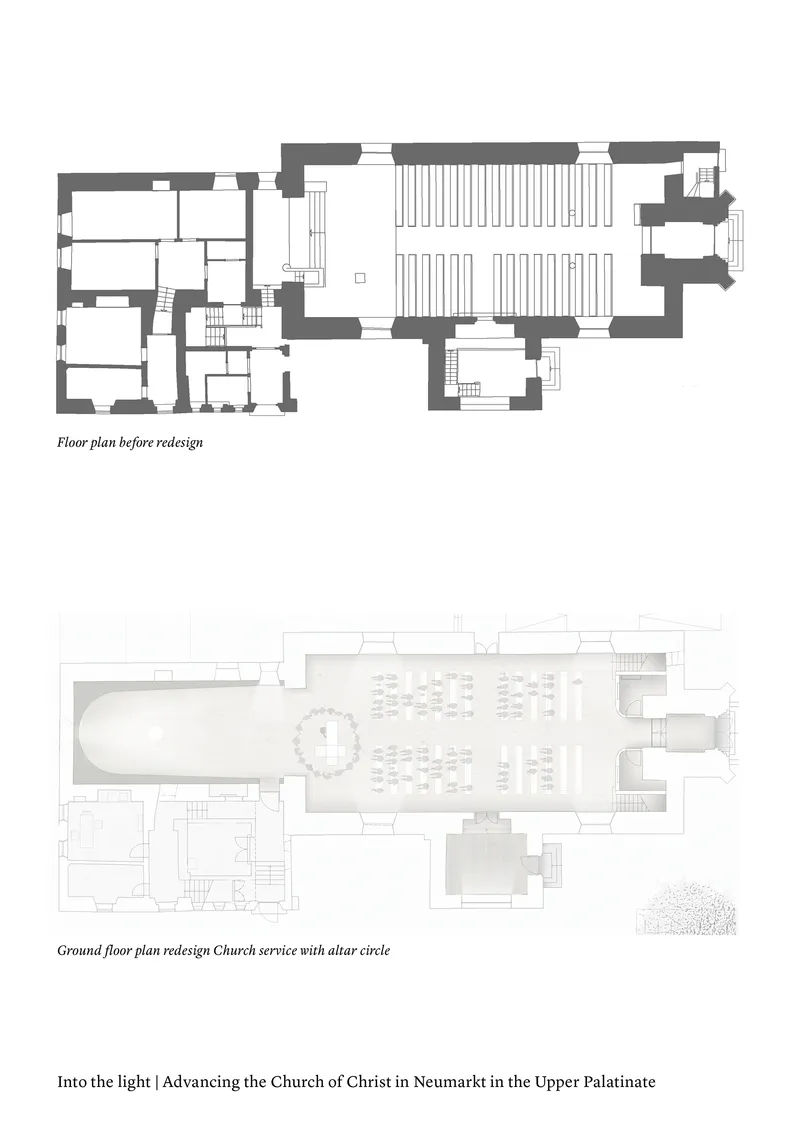

The site plan reveals how tightly the Christuskirche sits within its urban block, its footprint modest compared to the surrounding residential fabric. The floor plan comparison between existing and redesigned states is the clearest illustration of the project's central move: the chancel, previously compartmentalized, is merged back into the nave, and the altar circle replaces a rigid longitudinal axis. Three seating configuration drawings show the nave set up for concerts, worship, and communal meals, confirming that flexibility is not an afterthought but the organizing principle.


The longitudinal sections are particularly revealing. The existing section shows a subdivided chancel with a mezzanine level and a disconnected relationship to the nave. The proposed section eliminates the mezzanine, raises the nave floor, and introduces the new semicircular window at the apse terminus. Six sectional diagrams illustrate different spatial configurations with human silhouettes, reinforcing the project's stated philosophy of placing the human body at the center of every design decision. The isometric drawing of the barrel vault structure, paired with construction photographs of the curved wooden trusses, documents the craft behind what reads, in the finished space, as effortless simplicity.
Why This Project Matters
Church renovation in Europe often falls into one of two traps: nostalgic restoration that freezes a building in a past it never fully inhabited, or aggressive modernization that treats the existing structure as an inconvenience. The Christuskirche avoids both. By stripping away later additions and relying on natural, diffusion-open materials, Brückner & Brückner Architekten have created a space that is genuinely contemporary without denying its 350-year-old bones. The building breathes, literally and figuratively.
More broadly, the project offers a model for how religious architecture can remain socially relevant. A nave that hosts dinners and exhibitions alongside liturgy, a chancel designed for meditation and toddler-friendly worship alike, a congregation that crowdfunded its own transformation: these are not just design decisions, they are institutional ones. The architecture simply makes them legible. In a small Bavarian town caught between Nürnberg, Ingolstadt, and Regensburg, the Christuskirche argues that the most radical thing a sacred space can do in 2023 is welcome everyone in.
Into the Light, Christus Church, Neumarkt in der Oberpfalz, Germany. Design by Brückner & Brückner Architekten, with design team members Christian Brückner, Peter Brückner, Stephanie Sauer, and Alexandra Heger. 866 m². Completed 2023. Photography by Constantin Meyer, mju-fotografie, and EKD Scheermesser-Hendriks.
About the Studio
Share Your Own Work on uni.xyz
If projects like this are the kind of work you want to make, uni.xyz is a place to publish your own, find collaborators, and enter design competitions.


Popular Articles
Popular articles from the community


Cube Design Draws an Ecological Corridor Between Two Shenzhen Hills with the Nankai Building
Beside Shenzhen's container docks, the Nankai Building pairs stacked balconies with a climbing green screen to connect two hillsides across its height.

David Ortega Stacks a Two-Story Mexico City Penthouse Around a Steel Stair and a Pergola-Shaded Roof Terrace
In Colonia Roma, a 300 m² penthouse uses oak joinery, a planted steel stair and a slatted roof pergola to make a new-build apartment feel like a house.


Opera on the Sea: Driftwood Logic Shapes a Timber Opera House on Estonia's Coast
Trevor Orgill's opera house translates the entangled drift of floating timber into a civic building where wood, water, and music converge.

The Amber Palace Opera: A Geological Fiction Surfaces on Tallinn's Baltic Waterfront
Pierre Brillard reimagines a Baltic legend as a public landscape, opera house, and waterfront promenade rooted in Tallinn's coastal identity.

Similar Reads
You might also enjoy these articles

LAVA Architecten Gives Vocational Education a Sawtooth-Roofed Face on a Mechelen School Campus
In Mechelen, Belgium, a 2,053 m² STEM school on a 6×6 m grid turns workshops and classrooms into rooms that can be rearranged as teaching changes.

KEMA Studio Turns a Derelict Marvila Attic into a 60 m² Lighthouse Apartment Above Lisbon
In Lisbon's Marvila district, a rebuilt roof, four skylights and two plywood volumes turn an unlivable attic into a bright home facing the Tagus.

Pixel Gardens: One Repeated Module Stacked Into a Terraced Social Housing Tower for Famagusta
Salem Bader's shortlisted housing tower builds a vertical neighbourhood from one repeated module, offsetting units to carve terraces, light and air.

Bao Huynh Watercolor Atelier: A Serene Art Retreat in Hội An
Bao Huynh Watercolor Atelier in Hội An blends multifunctional art spaces, sustainable design, local materials, and family-friendly living in a serene environment.


Comments (0)
Please login or sign up to add comments
No comments yet. Be the first to comment!