

Brut Deluxe Suspends a 2,000 Square Meter LED Iris Over a Madrid Plaza
A mesh of 102,600 LEDs transforms Plaza Canalejas into a hovering, galaxy-scaled eye for Madrid's holiday season.


Christmas light installations in major European cities tend to play it safe: garlands on lampposts, snowflake projections on facades, maybe a big tree. Brut Deluxe, led by designer Ben Busche, took a fundamentally different approach for Madrid's Plaza Canalejas in 2022. IRIS is a site-specific canopy of 2 kilometers of red and blue LED rope, two 1-meter illuminated spheres, and 102,600 individually addressable LEDs, all stretched across the full 50-meter diameter of the circular plaza at a height of 9 meters. The result is not decoration draped onto a city; it is a new spatial event manufactured from light alone.
The conceit is simple and ambitious at once. Seen from below, the radial mesh of colored rope reads like a close-up of a human iris, its grooves and striations rendered in red and blue. Seen from above, the same geometry collapses into something astronomical, a glowing disc embedded in the urban fabric like a distant galaxy caught mid-spin. That optical double reading, intimate biology and cosmic scale occupying the same form, is what separates IRIS from spectacle for spectacle's sake.
Reading the Iris from Below
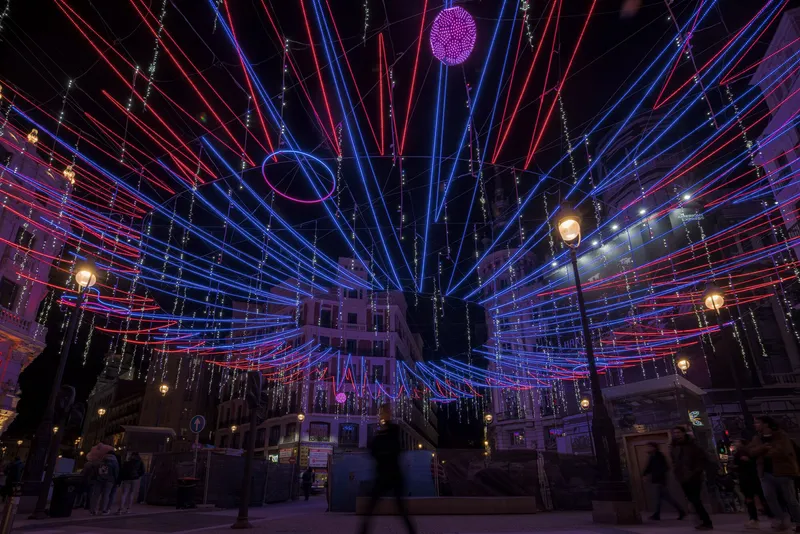
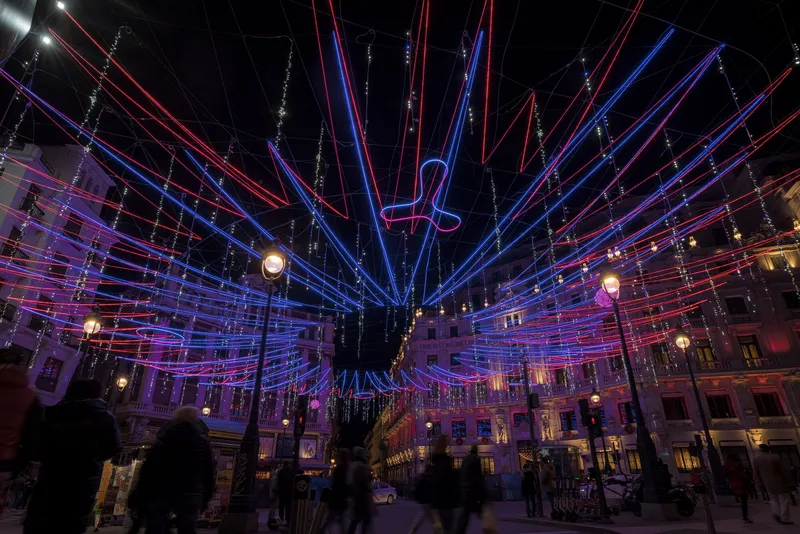
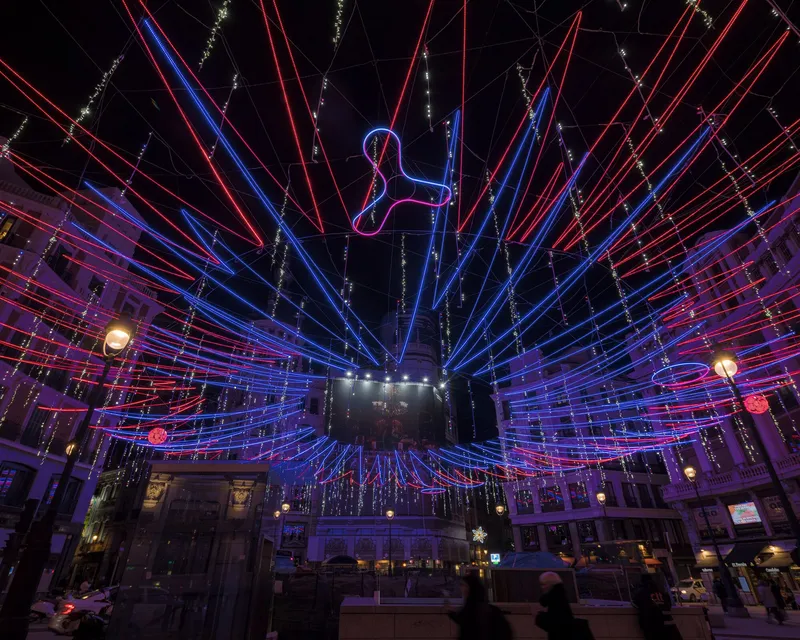
The ground-level experience is enveloping. Pedestrians walk beneath a radial ceiling of tightly spaced LED ropes that converge toward a central pendant, their red and blue wavelengths mixing into violet gradients at the intersections. The ropes are not random; they describe concentric rings and radial grooves that mimic the muscular fibers of an actual iris. The two 1-meter spheres, each packed with 1,800 RGB LEDs, hang like the pupil's bright anchor points, giving the composition a center of gravity that your eye locks onto immediately.
What works here is the scale calibration. At 9 meters overhead, the canopy sits just high enough to feel like atmosphere rather than a ceiling, but low enough that you can trace individual strands and register the color shifts. The historic facades of Canalejas frame the installation on every side, turning the round plaza into something like a roofless rotunda whose dome happens to be made of light.
Aerial Geometry
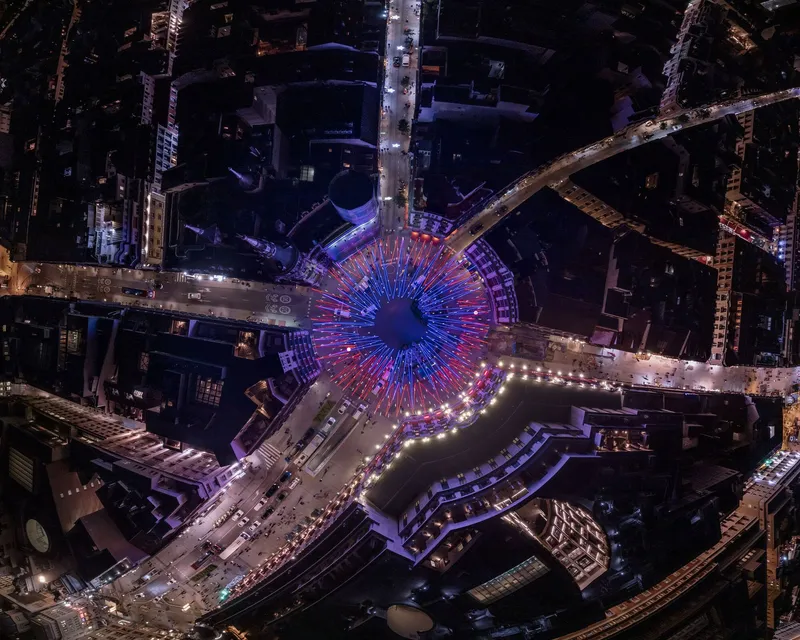
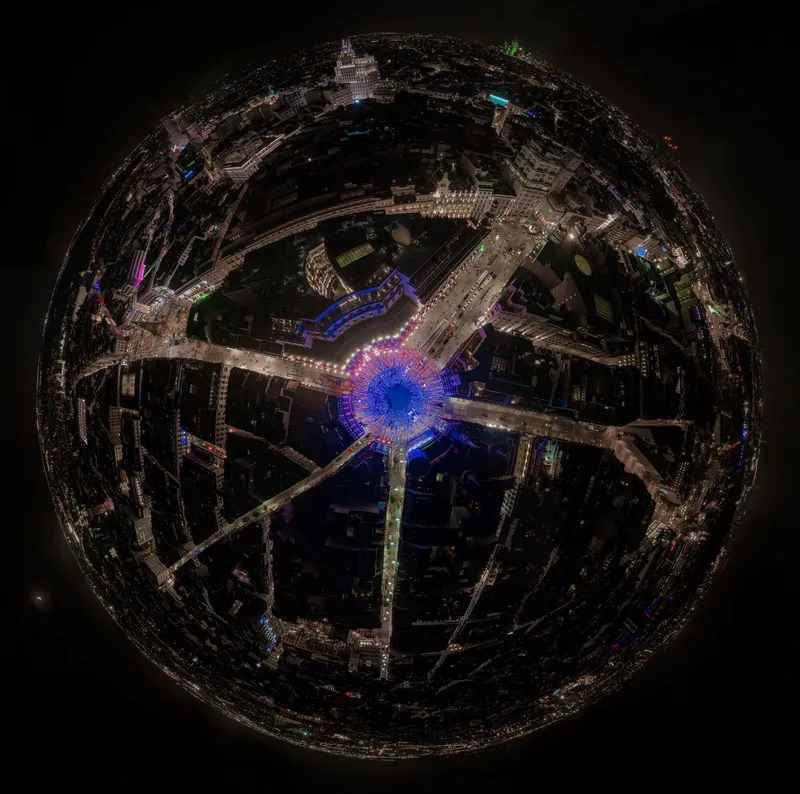
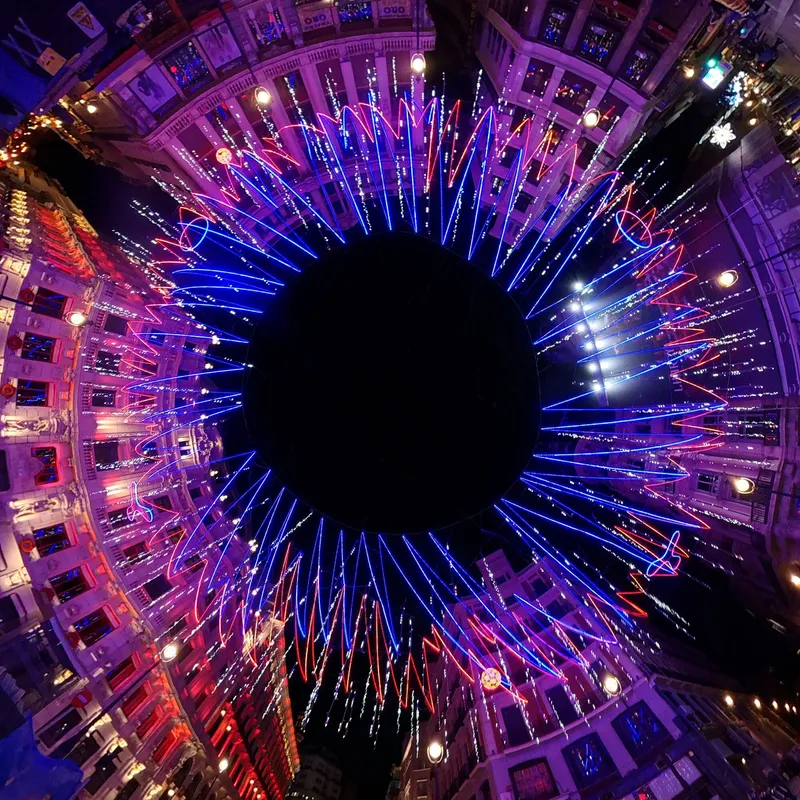
From a bird's-eye perspective, IRIS becomes a different project entirely. The circular plaza registers as a perfect disc of light punched into the city grid, with blue and red strands radiating outward along adjacent streets like neural pathways branching from a retina. The aerial photographs reveal how precisely Brut Deluxe exploited the site's geometry: Plaza Canalejas is an anomaly in Madrid's otherwise orthogonal blocks, and the radial pattern of the installation amplifies that singularity rather than fighting it.
The drone views also expose the installation's remarkable energy discipline. The entire 2,000-square-meter canopy consumes just 2.1 kW/h, a figure so low it borders on implausible until you consider that modern LED rope draws a fraction of what even a modest chandelier requires. Brut Deluxe turned a constraint, the city's reasonable demand for energy efficiency during the holidays, into a proof of concept: maximum visual impact and minimal draw.
Details at Close Range
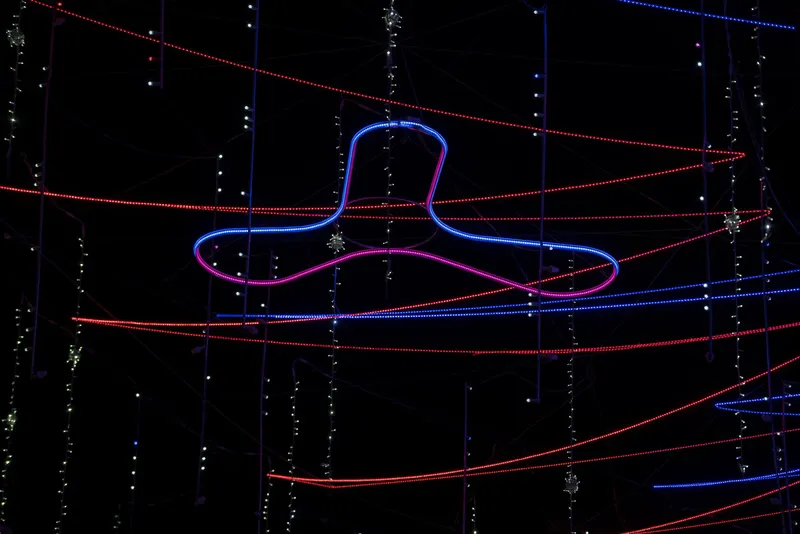
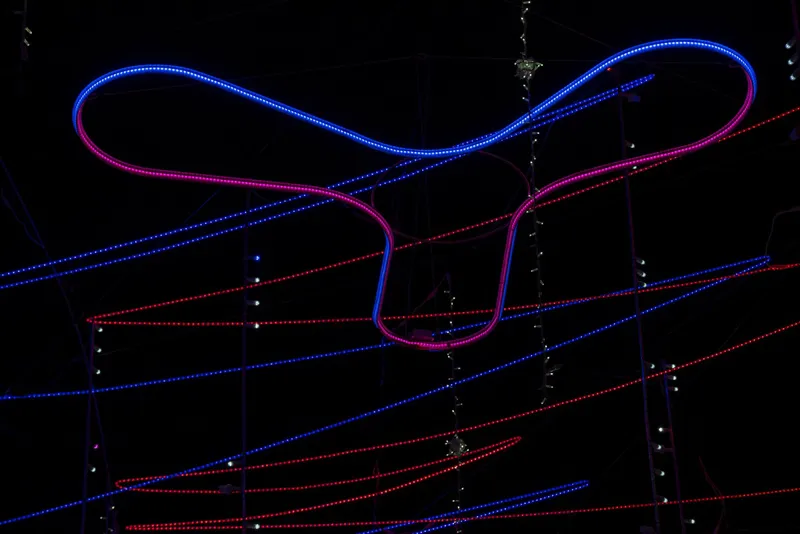
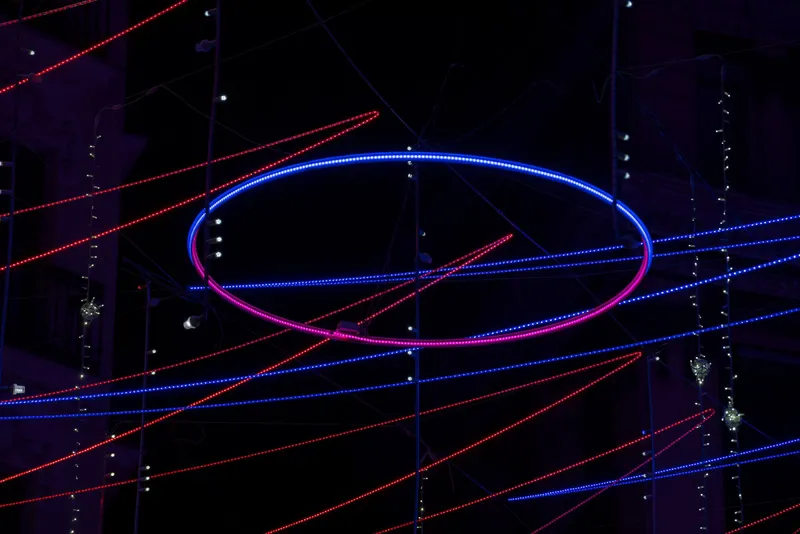
The macro shots of IRIS are where the iris metaphor becomes most legible. Looping gestures in the LED rope mimic the collarette folds of a real eye, while elliptical rings of blue and magenta light play the role of the limbal boundary between iris and sclera. Brut Deluxe's team, including Philip Baumann and Elisa Luda, clearly studied ophthalmic imagery closely; the "freckles, wrinkles, and other disturbances" they describe are not random variations but deliberate formal moves that give the installation texture and imperfection.
These close-range details matter because they reward the pedestrian who lingers. A holiday light installation that only works at a distance is a billboard. One that sustains interest at 2 meters and at 200 meters is spatial design.
Central Spheres and Vertical Elements


The two pendant spheres are the formal fulcrum of the entire installation. Each one concentrates 1,800 RGB LEDs into a 1-meter globe that hangs below the canopy plane, creating a focal depth that prevents the installation from reading as flat. The radial ropes converge toward these spheres, and the resulting perspective compression, dozens of colored lines rushing to a single luminous point, is genuinely disorienting when viewed from directly below.
Vertically placed light bulbs scattered through the mesh add a secondary scale. Where the ropes define the macro grooves of the iris, the bulbs operate as point sources, flecks and moles in the iris's surface. It is a layered composition: line, point, and surface all performing at once, constructed and installed by the Ximenez Group with what appears to be exceptional rigging precision.
Dusk Transitions
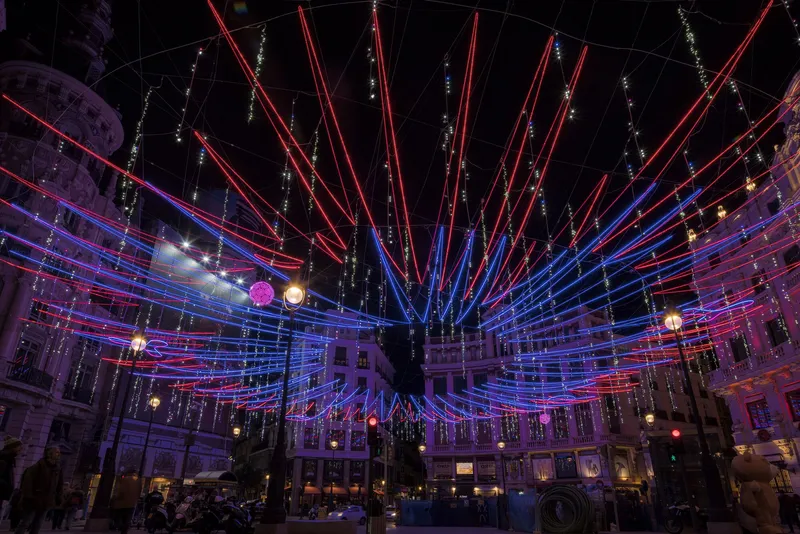
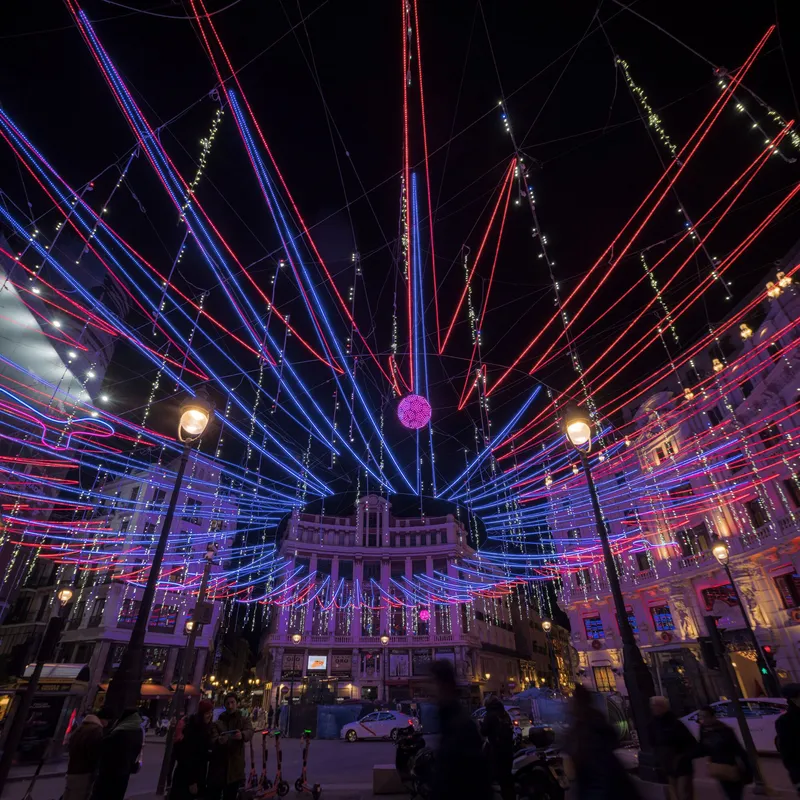
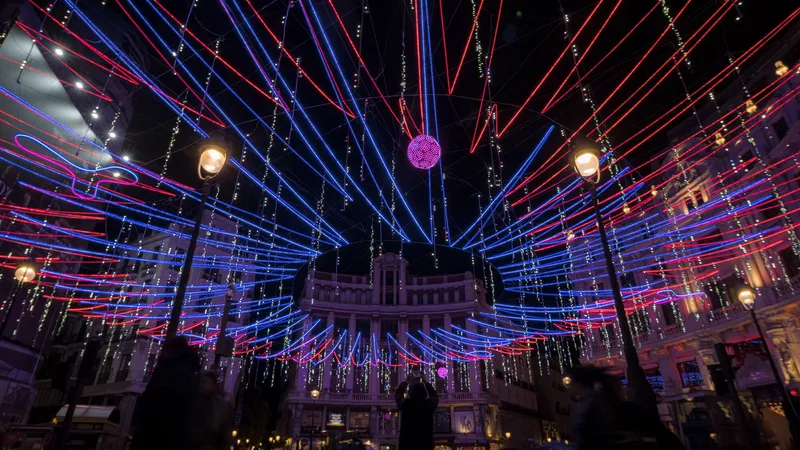
The installation is most revealing during the transition between daylight and darkness. At dusk, the LED ropes compete with residual sky light, and the historic stone facades of the surrounding buildings remain visible. The canopy reads as a translucent veil rather than an opaque ceiling, and the radial pattern becomes a kind of armature through which you can still see clouds. As full night arrives, the balance inverts: the architecture recedes and the light field takes over, turning the plaza into an interior without walls.
The dusk photographs also show something important about public engagement. People gather under the installation but they also stand at the perimeter, looking in. IRIS creates both a place to occupy and a spectacle to observe, which is exactly the dual role a successful temporary intervention should play in a city center.
Elliptical Ring Detail
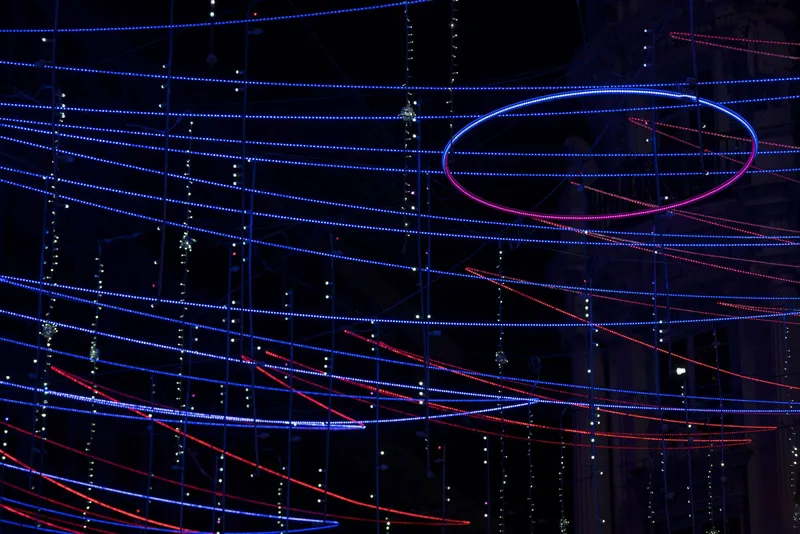
One of the most striking individual elements is the tilted elliptical ring that sits among the horizontal strands. Lit in graduated blue and pink, it reads as a portal or a lens floating within the broader field of the iris. Its angle relative to the flat canopy plane introduces a sculptural tension that the rest of the installation deliberately avoids. Everything else lies on the horizontal mesh; this ring breaks through it, creating a moment of spatial rupture that draws your gaze upward at a steeper angle.
Plans and Drawings
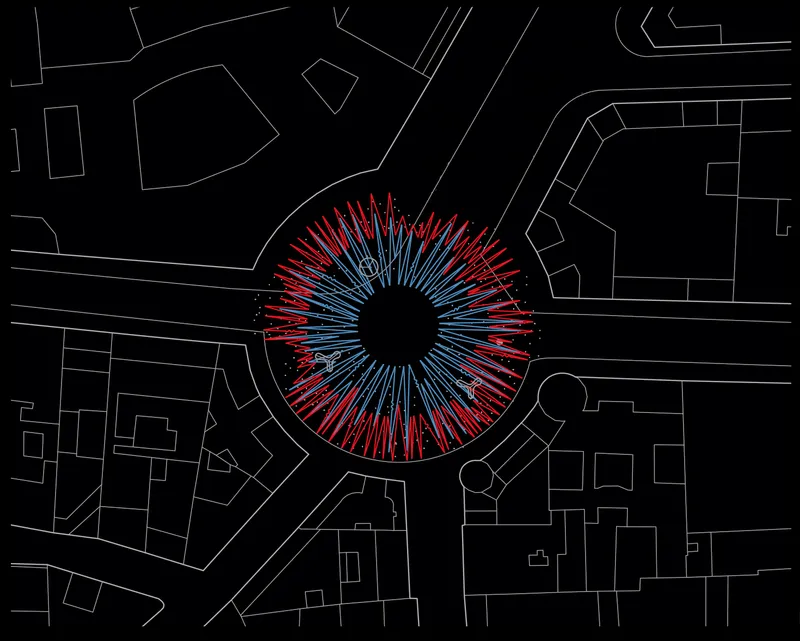
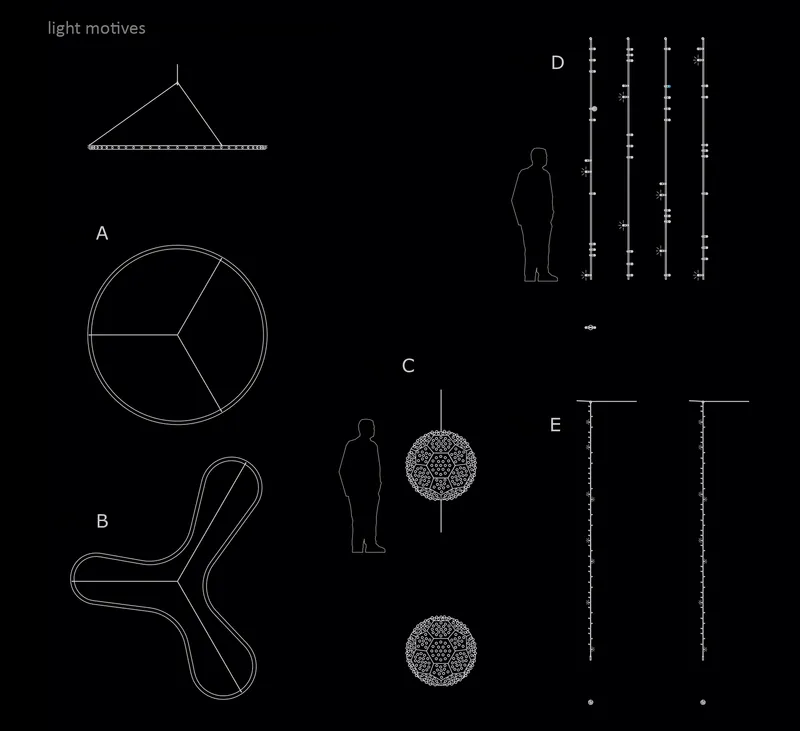
The site plan confirms what the aerial photographs suggest: the installation maps perfectly onto the circular footprint of Plaza Canalejas, with radial extensions reaching into the surrounding street network. The technical diagram breaks the system down into its component types: radial tubes, spherical pendants, and vertical strand assemblies, each drawn with human-scale figures for reference. At 9 meters above grade, the canopy clears double-decker buses and delivery trucks, a pragmatic detail that determines the entire spatial character of the piece.
What the drawings also reveal is the density of the radial spacing. The ropes are not evenly distributed; they cluster more tightly near the center and splay outward at the edges, exactly as the muscle fibers of a real iris do. This is the kind of biomimetic precision that separates a conceptual sketch from a resolved project.
Why This Project Matters
Holiday light installations are among the most ephemeral commissions an architect or designer can receive, and they are usually treated accordingly: a few weeks of spectacle, then dismantled and forgotten. Brut Deluxe treated IRIS with the spatial rigor of a permanent pavilion. The site analysis is real, the energy budget is disciplined, the formal system operates at multiple scales, and the metaphor holds together whether you are standing beneath it or looking down from a rooftop. That level of commitment to a temporary project is rare and worth studying.
More broadly, IRIS demonstrates that light installations do not need to be either minimal art or gaudy decoration. There is a middle register where light becomes architecture: it defines volume, directs movement, creates focal points, and engages the body at the scale of a room even when the room is an open plaza. Brut Deluxe found that register in Madrid, and the result is one of the most convincing arguments for temporary urbanism we have seen in recent years.
IRIS Light Installation by Brut Deluxe (design by Ben Busche, with Philip Baumann and Elisa Luda). Plaza Canalejas, Madrid, Spain. 2,000 sq m. Completed 2022. Constructor: Ximenez Group. Photography by Imagen Subliminal (Miguel de Guzmán + Rocío Romero).
About the Studio
Share Your Own Work on uni.xyz
If projects like this are the kind of work you want to make, uni.xyz is a place to publish your own, find collaborators, and enter design competitions.


Popular Articles
Popular articles from the community

Tsunami Convergenics: Turning Catastrophic Ocean Forces into Underwater Housing Infrastructure
A speculative underwater settlement off the coast of Onagawa, Japan, treats tsunamis and typhoons as energy sources rather than threats.

The Amber Palace Opera: A Geological Fiction Surfaces on Tallinn's Baltic Waterfront
Pierre Brillard reimagines a Baltic legend as a public landscape, opera house, and waterfront promenade rooted in Tallinn's coastal identity.
Cloaked Colonization: A Mobile Underwater Habitat That Moves Like a Fish
Micah Abaya's shortlisted EHC Pacific entry reimagines ocean settlement as a dispersed network of self-sustaining architectural organisms.
Temporary Home for Dogs: A Reversed Zoo Rethinks Animal Shelter Architecture
In Bucharest, a sinuous corridor and freed landscape flip the logic of containment, designing a shelter that works to make itself unnecessary.

Similar Reads
You might also enjoy these articles

Bao Huynh Watercolor Atelier: A Serene Art Retreat in Hội An
Bao Huynh Watercolor Atelier in Hội An blends multifunctional art spaces, sustainable design, local materials, and family-friendly living in a serene environment.

Atelier Macri Concept Store Interior Design by CASE-REAL
Atelier Macri store features a "ko" counter, walnut wood details, cork displays, blending retail, gallery, and seamless customer experiences.

Manuel Vargas Izquierdo Stadium and High-Performance Sports Center: Architectural Excellence in Jalpa de Méndez
The Manuel Vargas Izquierdo Stadium blends sustainable design, inclusive sports facilities, and cultural-inspired architecture, revitalizing Jalpa de Méndez’s public spaces.

KAKR Buluh Awar Hall: Revitalizing Community and Ecology Through Bamboo Architecture
Community built bamboo hall revitalizes Buluh Awar village, empowering youth, restoring ecology, celebrating vernacular craftsmanship through sustainable architecture and culture.

Explore Lighting Competitions
Discover active competitions in this discipline

Challenge to design a portable theatre

Challenge to design a portable music platform

Challenge to design an open learning module for the elderly

Challenge to reimagine the Iron Throne
Comments (0)
Please login or sign up to add comments
No comments yet. Be the first to comment!