
Building Beyond Borders Crafts a Reversible Timber Pavilion from Salvaged Materials in Rural Belgium
In the overgrown garden of an abandoned vicarage in Helchteren, reclaimed wood and handmade shingles become a communal retreat.


A village split in half by a major road, a vicarage left empty for years, and a brass band looking for a home: that is the unlikely starting point for one of the more thoughtful small-scale projects to come out of a European design-build program recently. Building Beyond Borders, the postgraduate program at Hasselt University, dropped a timber pavilion and a freestanding earth oven into the garden of De Pastorie in Helchteren, Belgium. Neither structure poured a single drop of concrete into the ground. Together they model what reversible, community-driven construction can look like when local sourcing is treated not as a branding exercise but as a genuine constraint.
The project is interesting for what it refuses to do as much as for what it accomplishes. It refuses to treat a temporary pavilion as disposable. It refuses to import materials when reclaimed and regional ones are available. And it refuses to separate the act of building from the people who will use the finished space. Students, residents, and local businesses all participated in the construction through workshops and a building festival, turning the process itself into a catalyst for the community center the village had been missing since the Noord-Zuid road carved its urban fabric apart.
A Peaked Frame Among the Trees
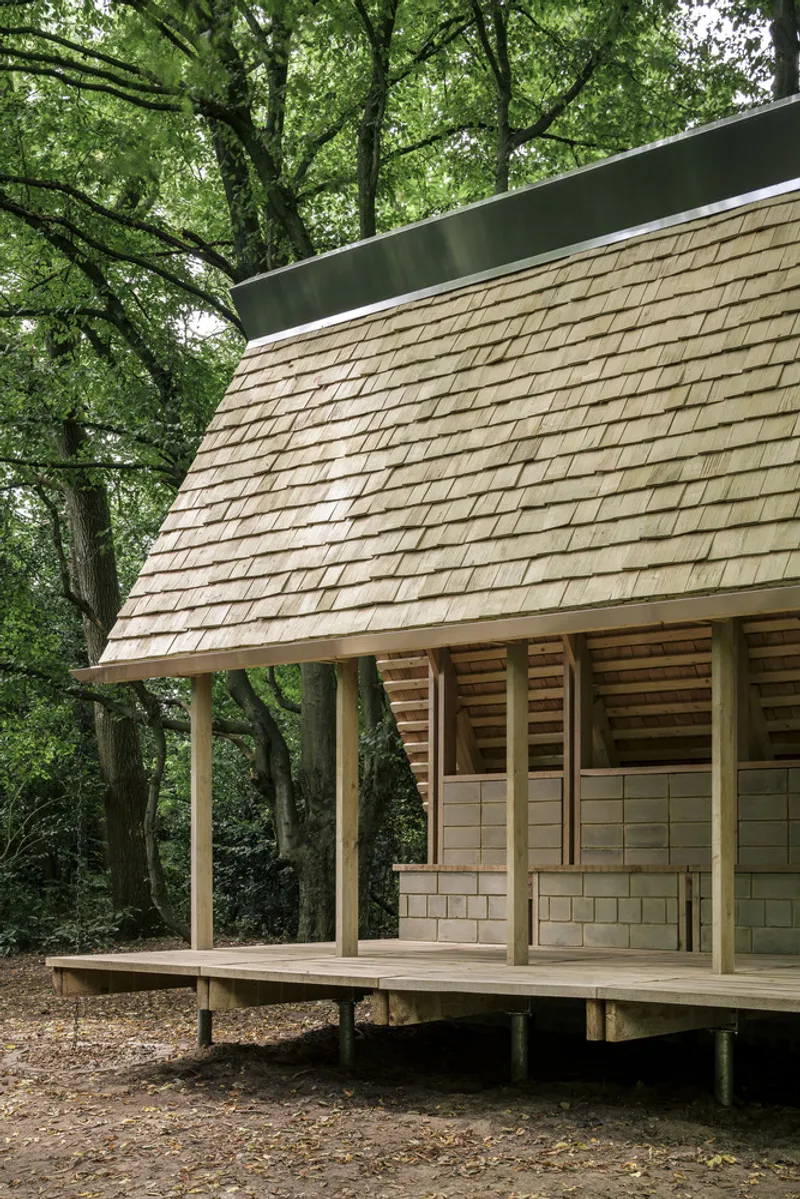
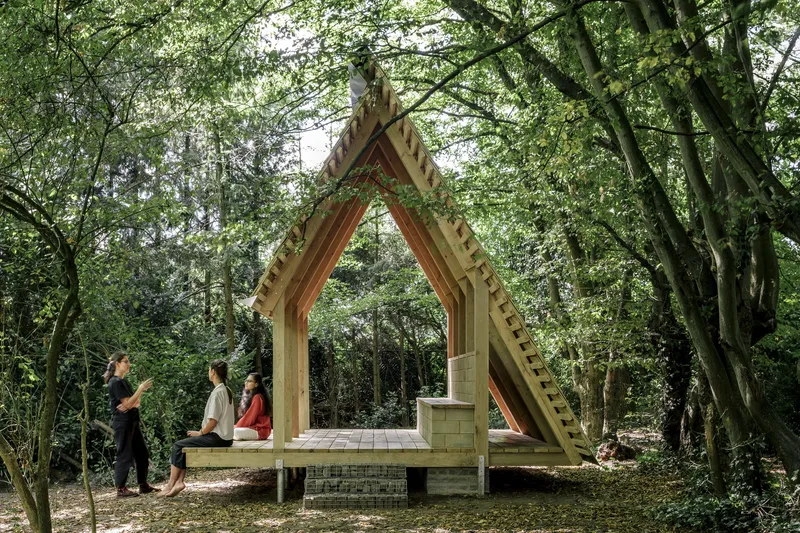

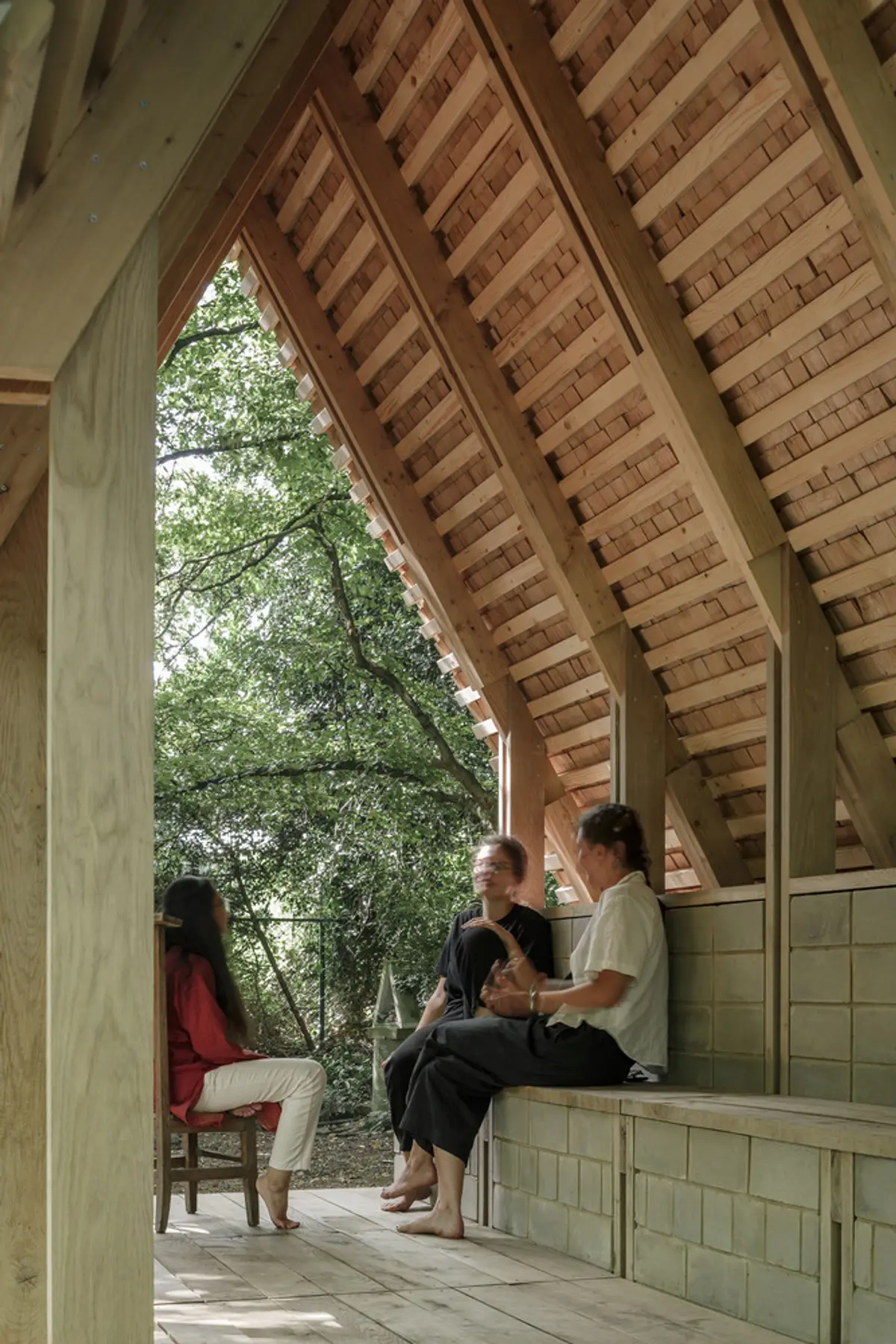
The pavilion sits deep in the garden's existing tree canopy, its steeply pitched form reading like an oversized tent rather than a conventional building. Elevated on a hybrid foundation of screw piles on one side and reclaimed sand, gravel, and paving stones on the other, it barely touches the earth. The timber frame is assembled entirely from reused wood donated by a local construction company. The proportions are deliberate: narrow enough to slip between mature trunks, tall enough to create a sense of enclosure without competing with the canopy overhead.
Positioning the pavilion among the trees rather than on open lawn was a quiet but significant decision. It makes the structure feel discovered, not announced, which suits a project whose purpose is to draw a fractured community back toward a shared center.
Handmade Shingles and Honest Joinery


The roof is clad in wooden shakes that were manually split from logs harvested during sustainable management operations in Meerdaal forest near Leuven. Some of these shakes were cut in school workshops with help from local companies, folding education into production. Up close the surface has a rough, varied grain that mass-produced shingles never achieve. A metal cap traces the ridge, and a simple chain hangs from the eave, likely a rain chain doing double duty as drainage and ornament.
The detailing throughout favors legibility. Post-and-beam connections are left exposed, the structural logic visible from every angle. There is no cladding to hide behind. When every board has been salvaged, clarity of assembly becomes both an ethical statement and a practical one: you need to be able to take this apart again someday without destroying the components.
Earth, Brick, and the Weight That Holds It Down
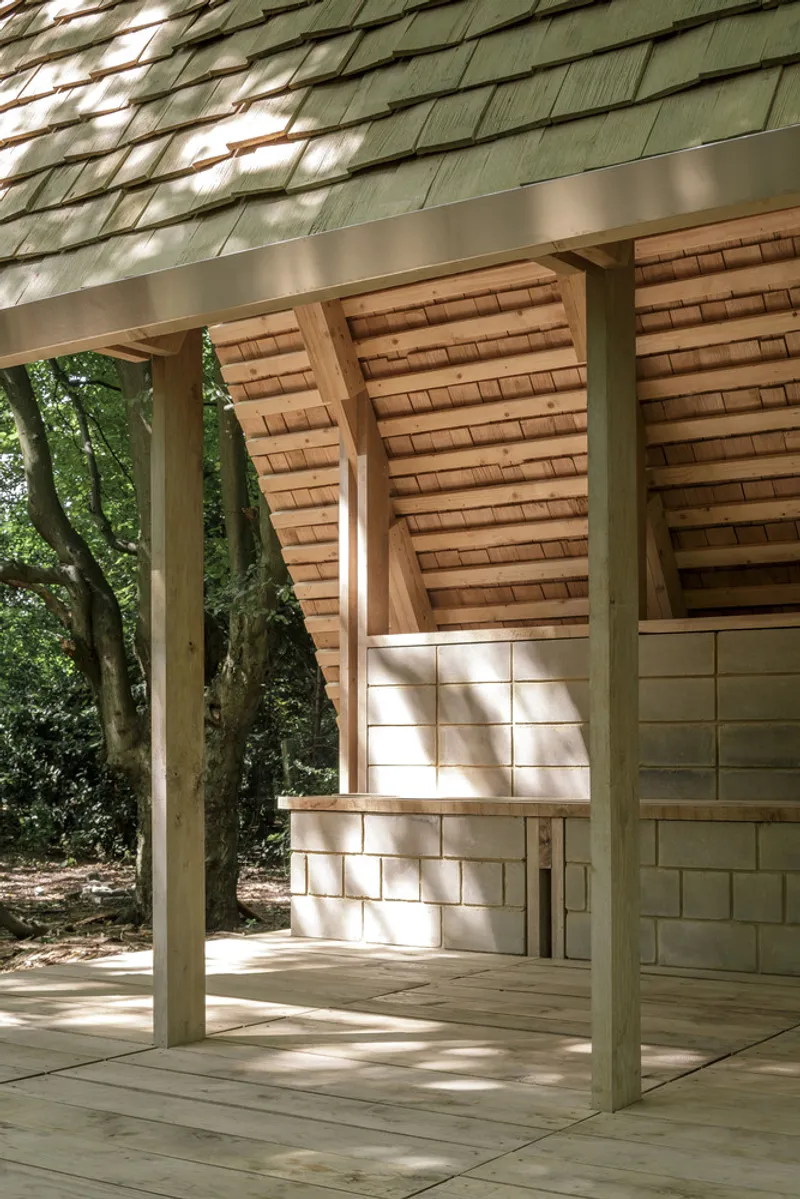
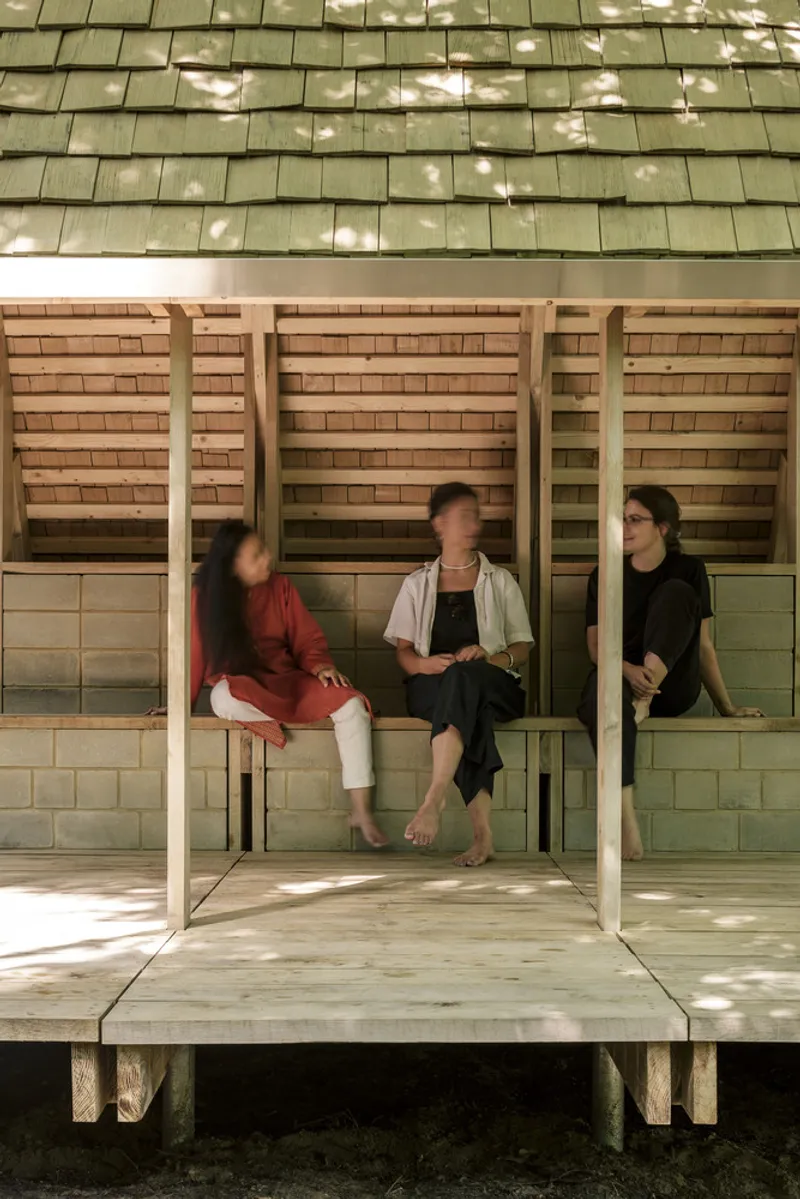

Inside the pavilion, a long bench made from compressed earth bricks (CEBs) supplied by BC Materials lines the interior. The bench is more than seating. Its mass works with the screw foundations to anchor the lightweight timber frame against wind uplift, turning a piece of furniture into structural ballast. It is a clever piece of integrated thinking: the heaviest element in the building is the one you sit on, and its weight is what keeps the roof over your head.
Brick infill walls at the lower portions of the frame give the pavilion's open sides a sense of threshold without sealing the interior off from the garden. The covered porch zone, with its columns and dappled light, creates the kind of in-between space that encourages lingering. Three people seated casually in the shade tell you everything about how the space performs.
The Earth Oven as Public Landmark
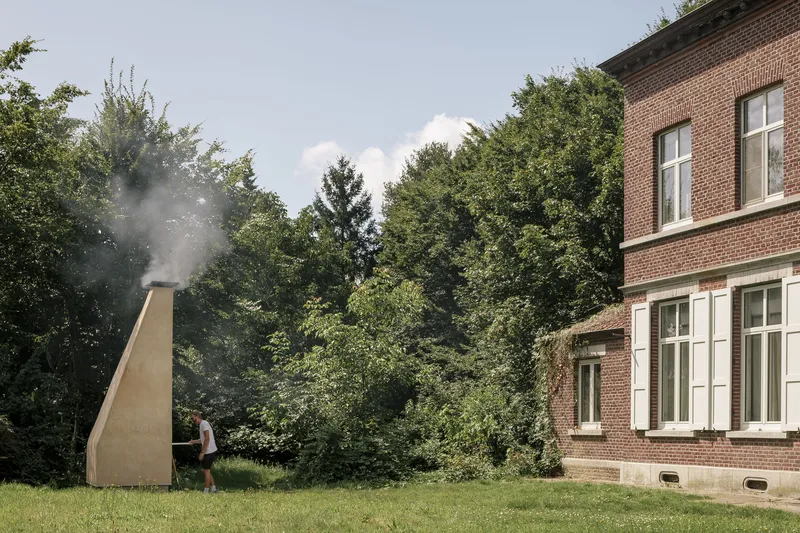
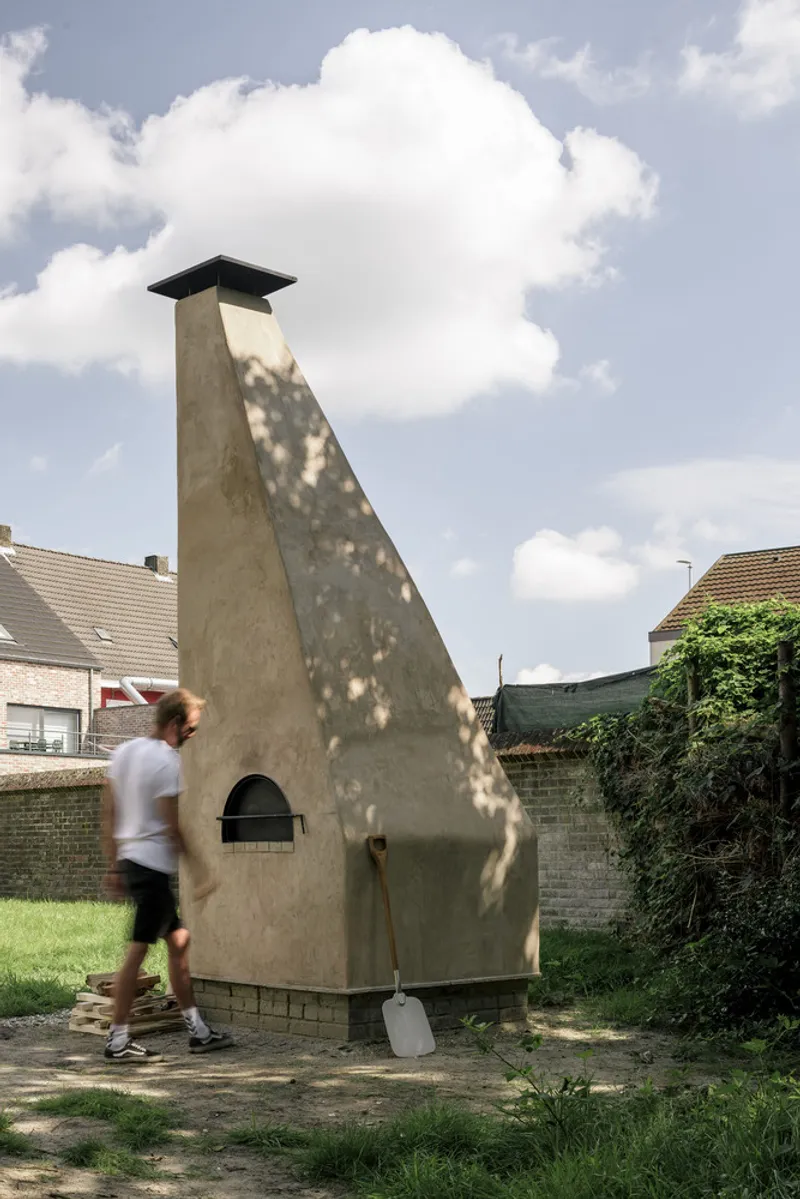
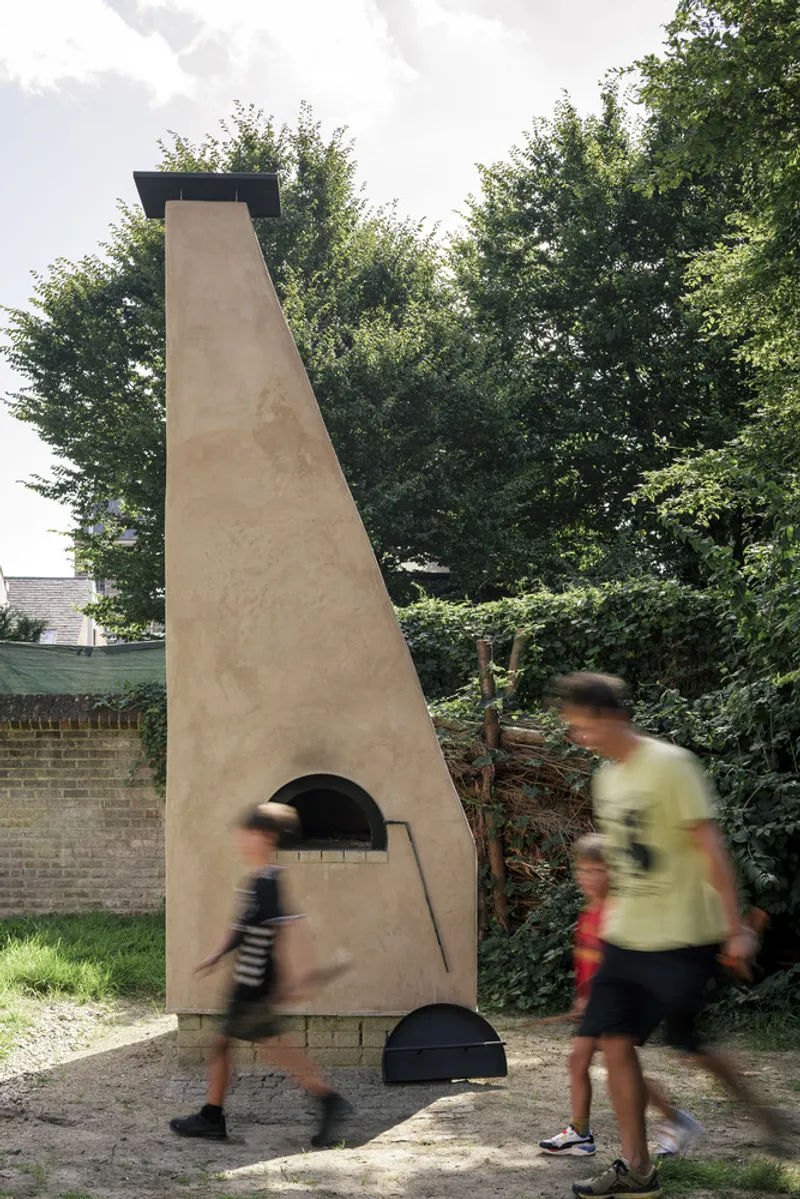
While the pavilion retreats into the garden, the earth oven steps forward. Positioned closer to the street and the Pastorie building, it is meant to be seen from the road, a tapered, pyramidal form that signals activity and reawakening. Built from molded earth bricks and finished in lime plaster, the oven has a sculptural presence that reads almost totemic against the domestic brick of the vicarage behind it.
The two-part strategy is smart. The oven is the public face, the thing that catches your eye from the sidewalk and draws you in. The pavilion is the reward, the quieter space you find once you commit to entering the garden. Programming and placemaking are built into the site plan, not applied afterward.
Fire and Gathering
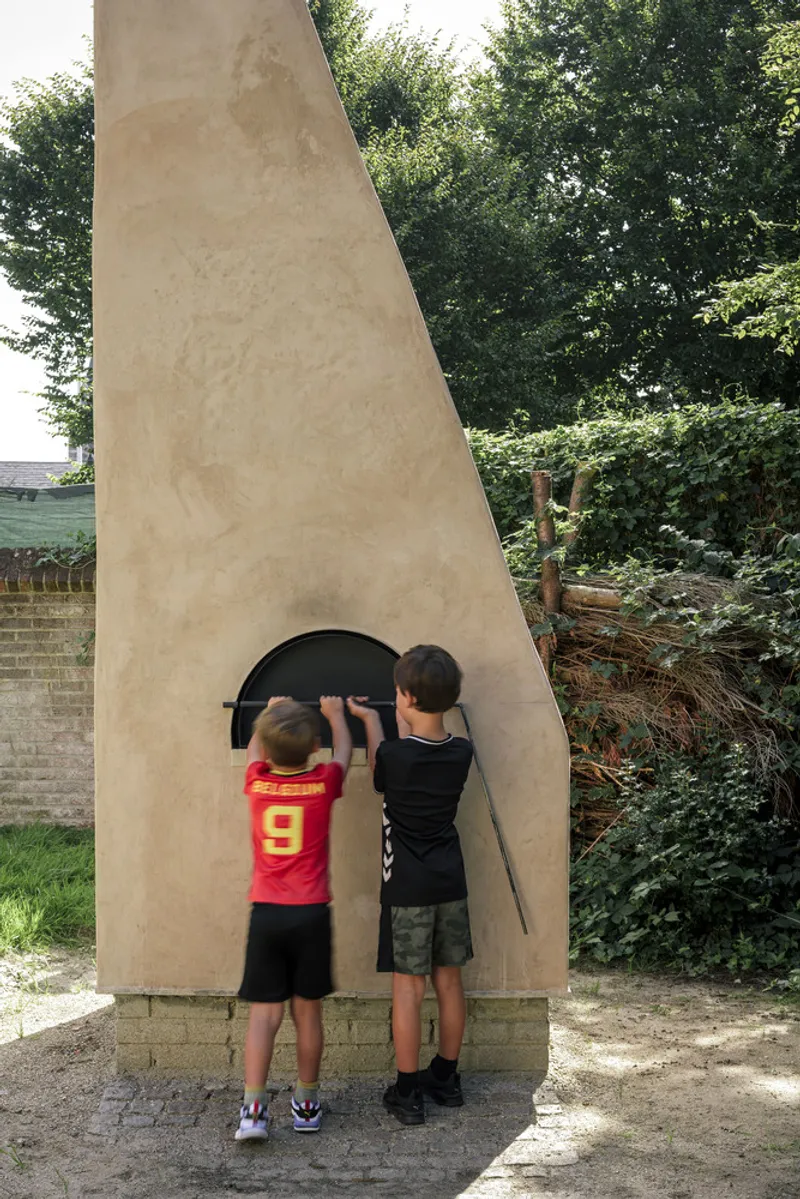
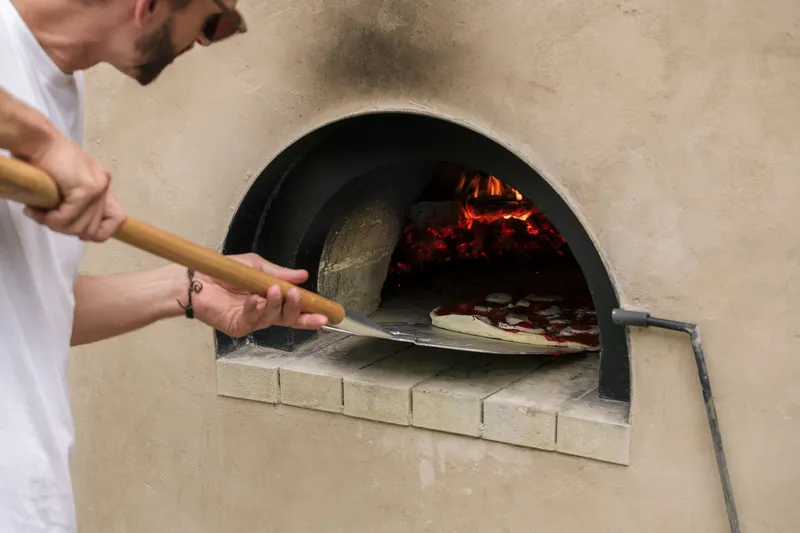

An oven is the oldest technology for turning a group of strangers into a group of neighbors. The arched opening here is scaled generously enough for pizza peels and bread loaves, and the images of children peering into the firebox and hands sliding dough toward glowing embers are proof that it works as intended. The domed chamber retains heat efficiently, and the tapered chimney draws smoke cleanly upward.
It is worth noting that the oven's material palette, earth bricks and lime plaster, connects it to pre-industrial building traditions in the region without resorting to nostalgia. These are contemporary bricks made with contemporary knowledge about compression ratios and thermal mass. The tradition being honored is resourcefulness, not aesthetics.
The Oven in the Landscape


Seen from a distance, the conical oven sits on its lawn like a cairn, its flat metal cap and tapered silhouette unmistakable among the surrounding garden vegetation. The form is so simple it borders on archetypical. A brick base, a plastered body, a chimney: nothing more. Its restraint is what gives it presence. In a village that lost its center, this small vertical marker does real spatial work, anchoring the garden to the street and giving passersby a reason to look twice.
Plans and Drawings
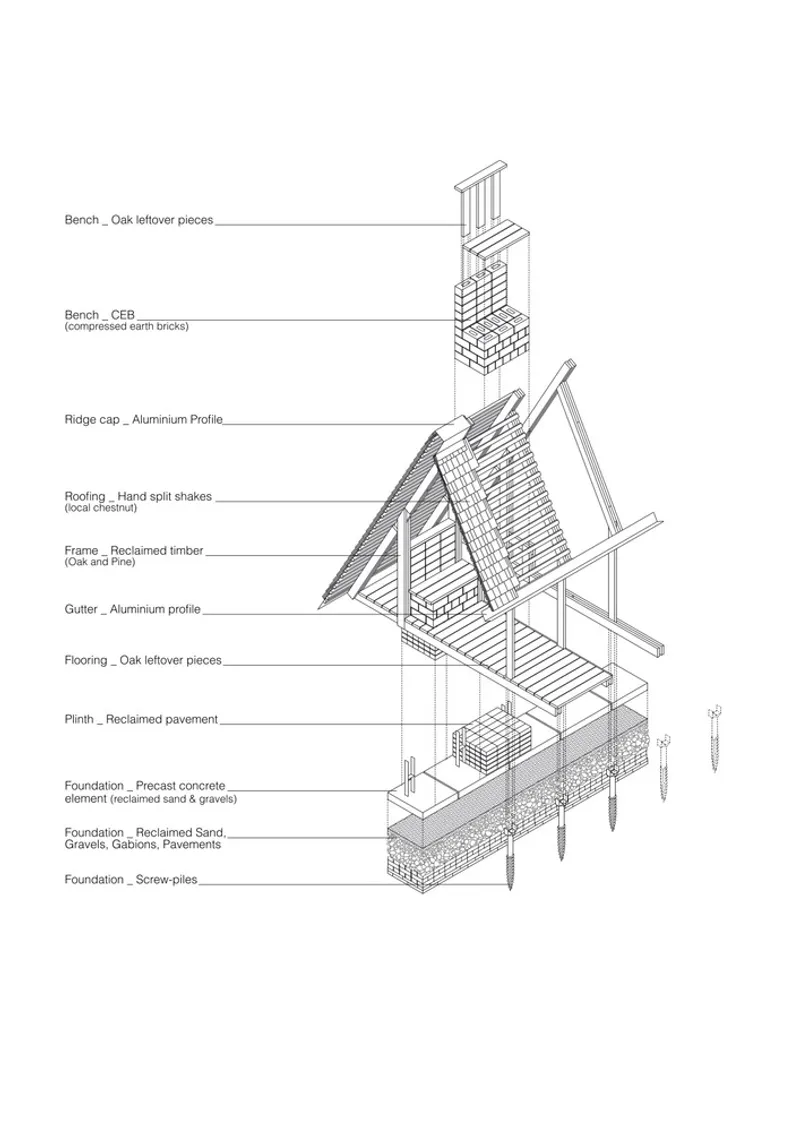

The exploded axonometric is the most revealing drawing in the set. It peels the pavilion apart layer by layer, from the screw foundations at the base through the reclaimed-material subgrade, up through the timber frame, CEB bench, and shingle skin to the chimney cap at the top. Every material is called out, and the assembly sequence is legible at a glance. For a project that stakes its reputation on reversibility, this transparency is essential: you should be able to read the drawing and understand not just how the building was put together but how it can be taken apart.
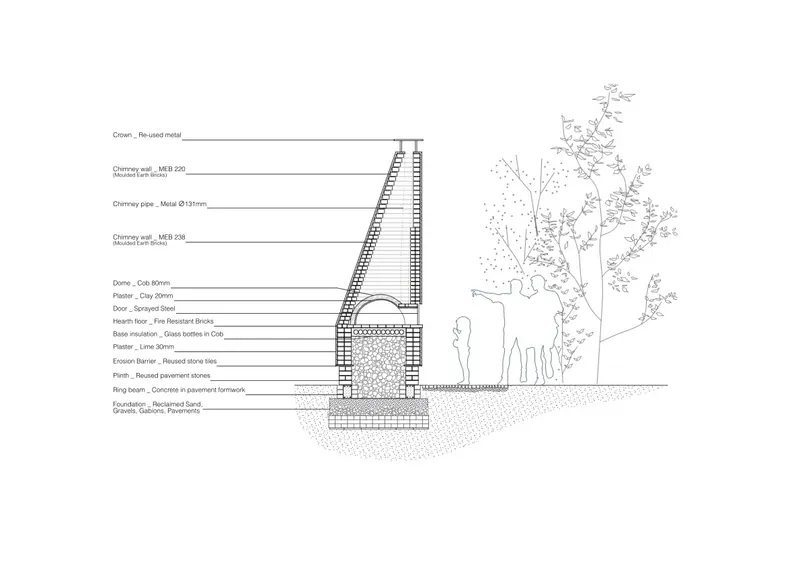
The elevation and section drawings reinforce the pavilion's relationship to the trees. Figures are shown seated inside, roughly at the scale of the surrounding trunks, which makes the point that the structure is a guest in the landscape rather than a protagonist. Material annotations in the section confirm the mix of reclaimed, bio-based, and geo-based components, offering a concise inventory of the project's circular ambitions.
Why This Project Matters
Design-build programs often produce charming objects that stay within the academy's orbit, admired by peers but disconnected from lasting impact. The Pastorie Pavilion escapes that pattern because it addresses a genuine civic absence. Helchteren lost its gathering place when the Noord-Zuid road severed its center. The pavilion and oven do not pretend to heal that wound, but they offer a working prototype for what communal space can be when a community participates in making it. The fact that nothing was poured into the ground means the gesture is generous rather than possessive: the garden can be returned to its previous state if circumstances change.
More broadly, the project demonstrates that reversible construction and reclaimed materials do not have to mean provisional or crude. The shingle roof is beautiful. The CEB bench is substantial. The earth oven functions superbly. Quality of craft and circularity of resources are not in tension here; they reinforce each other. For architects and students looking for a practical model of low-impact, community-embedded design, this small project in a Belgian village garden is worth studying closely.
Building Beyond Pastorie Pavilion by Building Beyond Borders (Hasselt University). Located in Helchteren, Belgium. Photography by Olmo Peeters.
About the Studio
Share Your Own Work on uni.xyz
If projects like this are the kind of work you want to make, uni.xyz is a place to publish your own, find collaborators, and enter design competitions.


Popular Articles
Popular articles from the community


Jaramillo Van Sluys Arquitectura and Urbanismo Turn a Demolished Registry Lot in Quito into an Orchard Plaza
In Quito's Centro Histórico, a 2,800 m² plaza exposes the San Agustín convent wall and redraws its lost Augustinian orchard in volcanic stone.

longwave studio Reorganizes a 112 m² Tainan Apartment Around the Daily Routines of a Family and Two Cats
In Tainan, Taiwan, birch plywood, rust-red furniture and a freestanding plaster wall link arrival, storage, work and family life in one apartment.

Architekt Andreas Gruber Scatters 23 Dark Timber Chalets Across a South Tyrolean Forest Edge
In Molini di Tures, Amonti Chalets breaks a resort into a hamlet of gabled timber houses, with parking, storage and services pushed into the slope.

Juan García Correa, John González and Claudia Rueda Sink a Circular Amphitheater into a Manizales Engineering Building
On the La Nubia campus in Manizales, Colombia, the S1 Building folds labs and offices into a hillside of ramped lawns that double as a campus route.

Similar Reads
You might also enjoy these articles

Gil Mello Arquitetura Tilts a Single Roof Toward the Waterfalls on a Plateau Above Aiuruoca, Brazil
In Aiuruoca, Minas Gerais, a 200 m² house of local labor and reclaimed poles pairs a low valley veranda with a tall mountain one.

U.GA Architects Wraps an Oval Rooftop Pool in Curved Board-Formed Concrete on Busan's Jeollidan-gil
In Busan's Jeonpo-dong, a 454 m² mixed-use block stacks a neighborhood facility, guest rooms and an oval rooftop pool inside spiraling concrete walls.

Felipe Hess Arquitetos Turns a Blind Stone Wall to the Street and Opens a Brazilian House onto a Courtyard and Canal
A canal-front house in Brazil hides behind painted stone and planting, then opens to an olive-tree courtyard, a reed-ceilinged porch and a curving pool.

David Macias Steps a Doorless Stone and Plaster House Down a Tropical Colombian Hillside
In the humid hills of Colombia, Threshold House replaces the front door with an open void and terraces its 850 m² down the slope instead of fighting it.

Explore Sustainable Features Competitions
Discover active competitions in this discipline

Challenge to design mud housing for contemporary communities

Challenge to reimagine the Iron Throne

Photograph architecture without architects

Illustrate the lost glory of Angkor Wat - Render Challenge
Comments (0)
Please login or sign up to add comments
No comments yet. Be the first to comment!