
MAT Office Turns a Village Courtyard on Yangma Island into a Steel-Framed Boutique Hotel
On a wind-battered island in the North Yellow Sea, granite, glass brick, and exposed steel replace whitewashed resort clichés.


Yangma Island sits off the coast of Yantai, backed by Kunyu Mountain and facing the North Yellow Sea. Its villages are defined by gray tile roofs, stone walls, and windbreak forests, a material language shaped by centuries of exposure to salt air and seasonal storms. When MAT Office was commissioned to convert a disused square courtyard in Mabuya Village into a 950-square-meter boutique hotel, the obvious move would have been to paint it white and call it coastal. They did the opposite.
The Bushe Boutique Hotel rejects the island's prevailing resort aesthetic in favor of something darker, heavier, and more rooted. Granite slabs, textured paint matched to the color of reef stone, and a continuous steel structure replace the board houses that once enclosed the courtyard. The result is a building that reads as both contemporary and indigenous, an architecture that borrows the island's own palette rather than importing a Mediterranean fantasy. What makes it genuinely interesting is how the structural system, a series of variable-section steel beams cantilevered into arc-shaped eaves, does double duty as spatial choreography, framing views, filtering light, and defining the threshold between guest rooms and the courtyard at every turn.
Courtyard as Organizing Principle
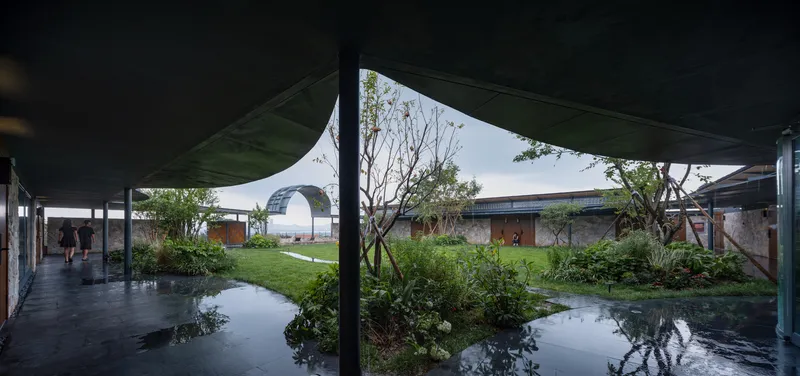
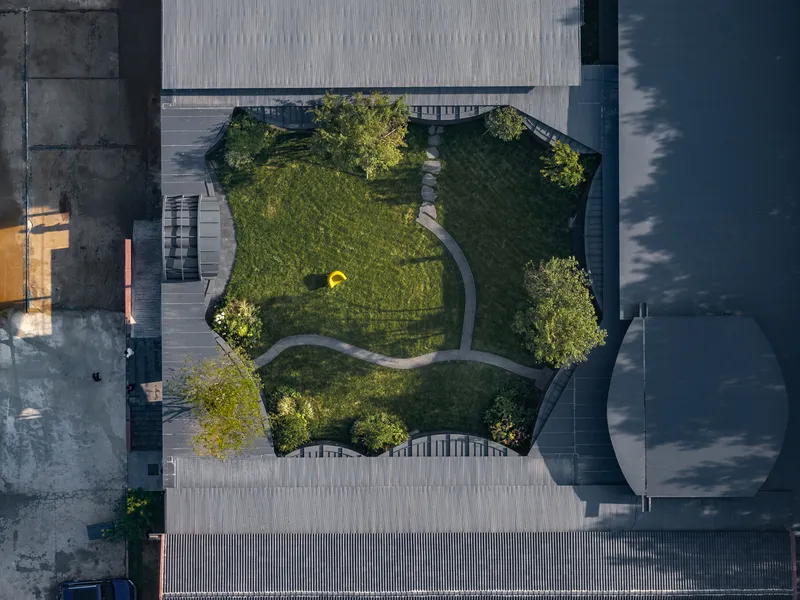
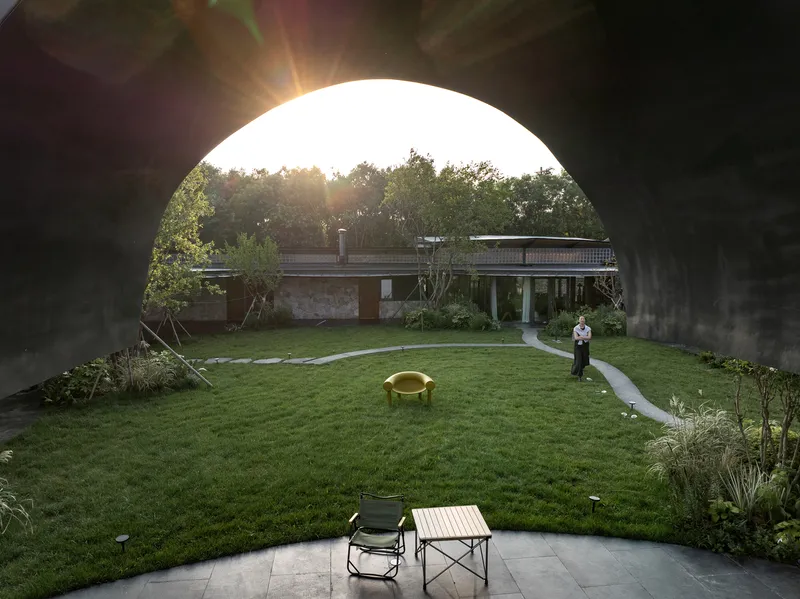
The original site was a square courtyard enclosed by tile houses and board houses. MAT Office kept the courtyard as the fundamental organizing device but rebuilt everything around it except the northern tile house. The western and southern wings were replaced with single-slope steel structures angled inward, creating elevated eaves that shelter a continuous outer corridor. From above, the composition reads as a three-lobed form, the curved pathways and lawn contained within concrete and metal roof planes that slope toward the center.
The courtyard is not decorative. It is the fulcrum around which the entire program rotates: guest rooms face the western forest, the reception and living areas bridge the courtyard and the woods via floor-to-ceiling glass, and the corridor serves as a buffer that deepens the spatial experience between public and private zones. Standing in the courtyard after rain, you can see reflecting pools, planted beds, and the full sweep of the surrounding roofline, a controlled landscape framed by architecture rather than fenced off from it.
The Anti-White House
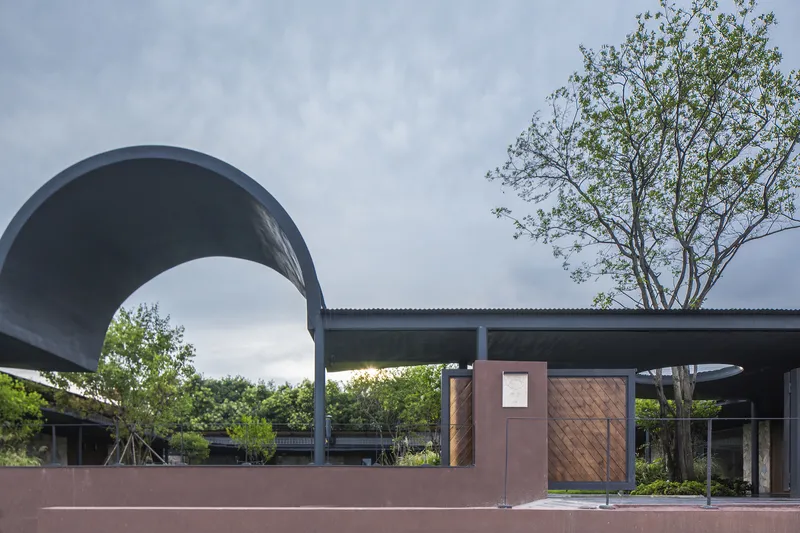
The perimeter wall, finished in a warm stucco that MAT Office describes with a textured paint referencing island reef colors, immediately sets the hotel apart from the whitewashed boxes proliferating across Chinese coastal tourism. The entry sequence is deliberate: a curved metal canopy shelters timber gate panels, framing arrival as a passage from the open road into a compressed, darker threshold. The pink-toned stucco reads as earthy rather than decorative, more geological than cosmetic.
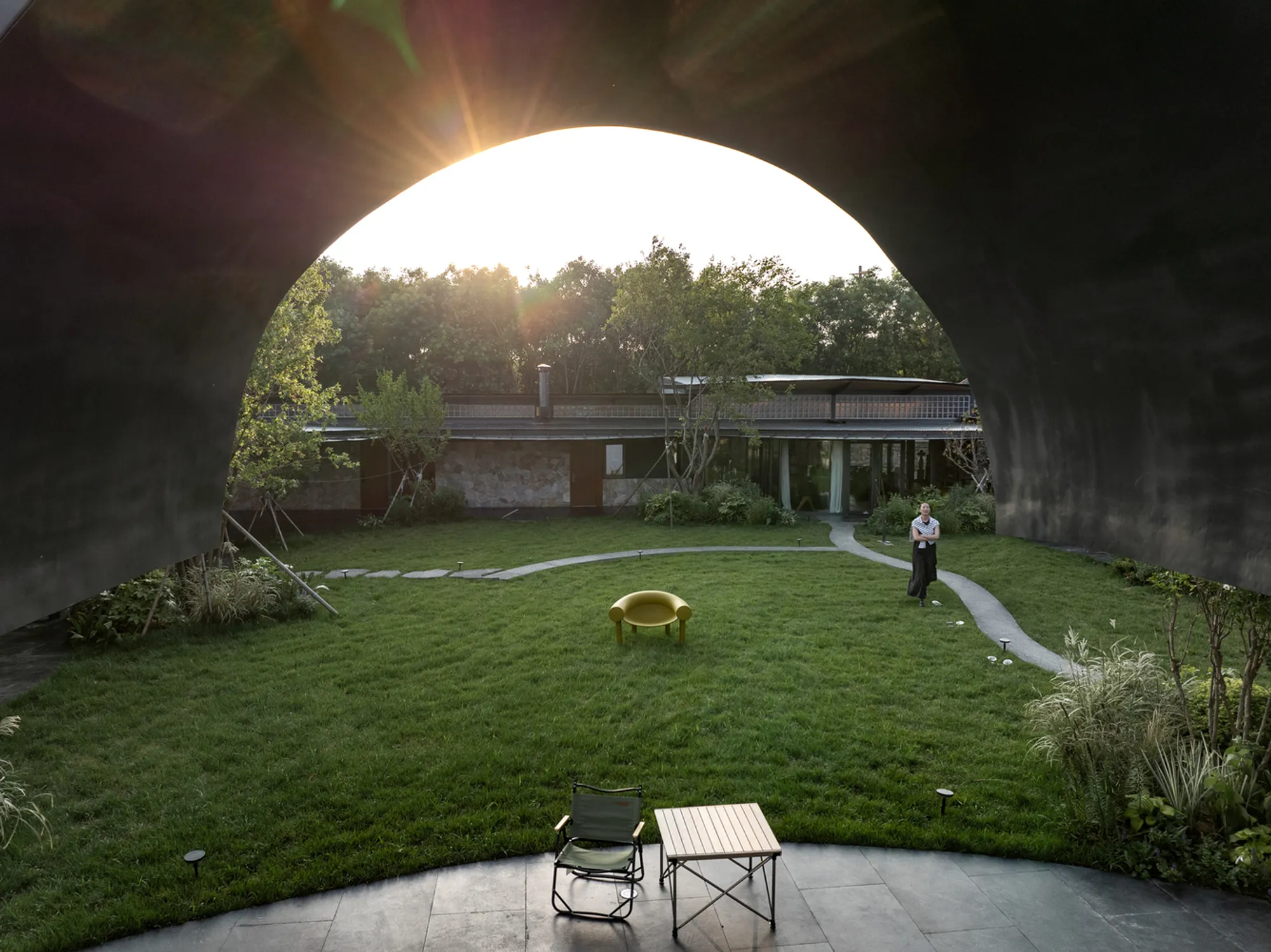
At dusk, the curved concrete archway opening onto the grassed courtyard becomes the project's most cinematic moment. The arch is not ornamental; it sits on axis with the distant Kunyu Mountain range, turning a simple corridor into a viewing device. MAT Office widened the corridor on the east side to form this main entrance, then arched it upward so the mountain view is framed at the precise moment you step through. It is a move borrowed from Chinese garden design, the borrowed landscape compressed into a steel and concrete aperture.
Steel Structure as Spatial Language
With the exception of the retained northern tile house, the entire hotel is steel-framed. MAT Office used square steel beams as the primary structural element, integrating different cross-sections from large to small to form a continuous overall framework. The cantilevered eaves grow larger toward the center of each wing, an arc that gives the roofline its distinctive sweep. Round columns support the outer corridor, tying back to the main structure and creating a generous covered walkway beneath.
The steel is not hidden. Exposed variable-section beams support both the high and low slope roof eaves, making the structural logic legible from every vantage point. Steel plate ribs, spaced at 600mm intervals, hang from the corridor ceiling, casting rhythmic shadow lines across the dark gray floor. This repetition transforms engineering into atmosphere: the corridor is not just a passage but a calibrated light instrument, modulating the dazzling seaside sun into something softer and more directional.
Interior Atmosphere and the Cone Fireplace
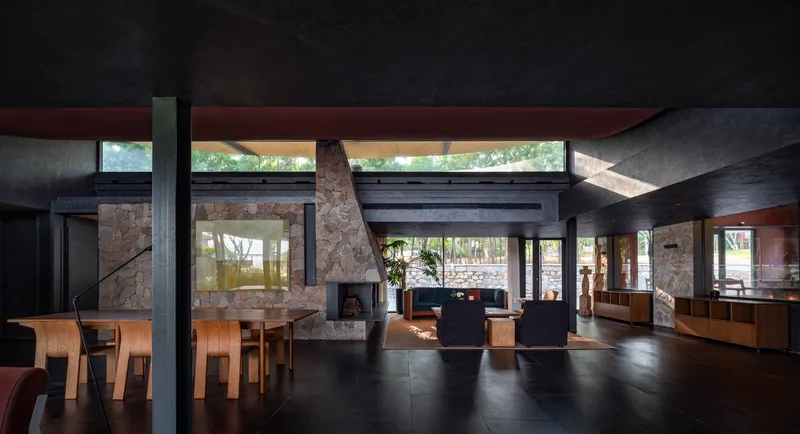
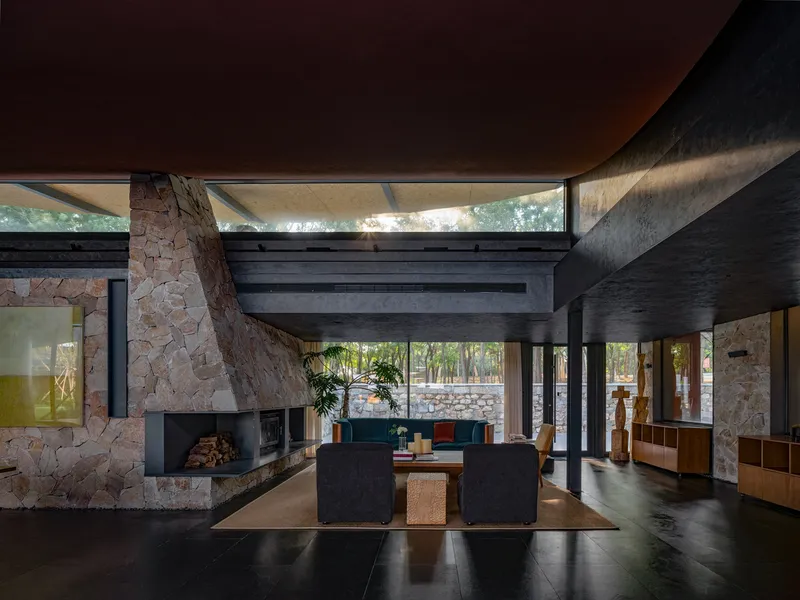
The living room and reception hall achieve their height through a double-eave roof, a structural move that also creates the opportunity for clerestory glazing. Glass bricks set into the beams between the two eave layers bring diffused natural light into the public area without the harshness of direct sun. Long high windows offer views of treetops through both roof layers, so the forest canopy becomes a permanent fixture of the interior.
The cone-shaped stone fireplace anchors the living room with a sculptural verticality that MAT Office describes as increasing the "wild" quality of a mountain architectural prototype. The angled stone wall, raw and unfinished in its texture, pushes against the refinement of the steel and glass around it. In late afternoon, clerestory glazing throws raking light across the stone surface, and the fireplace reads less like a hospitality amenity and more like a geological intrusion, a piece of the island brought indoors.
Light, Glass Brick, and the Corridor System
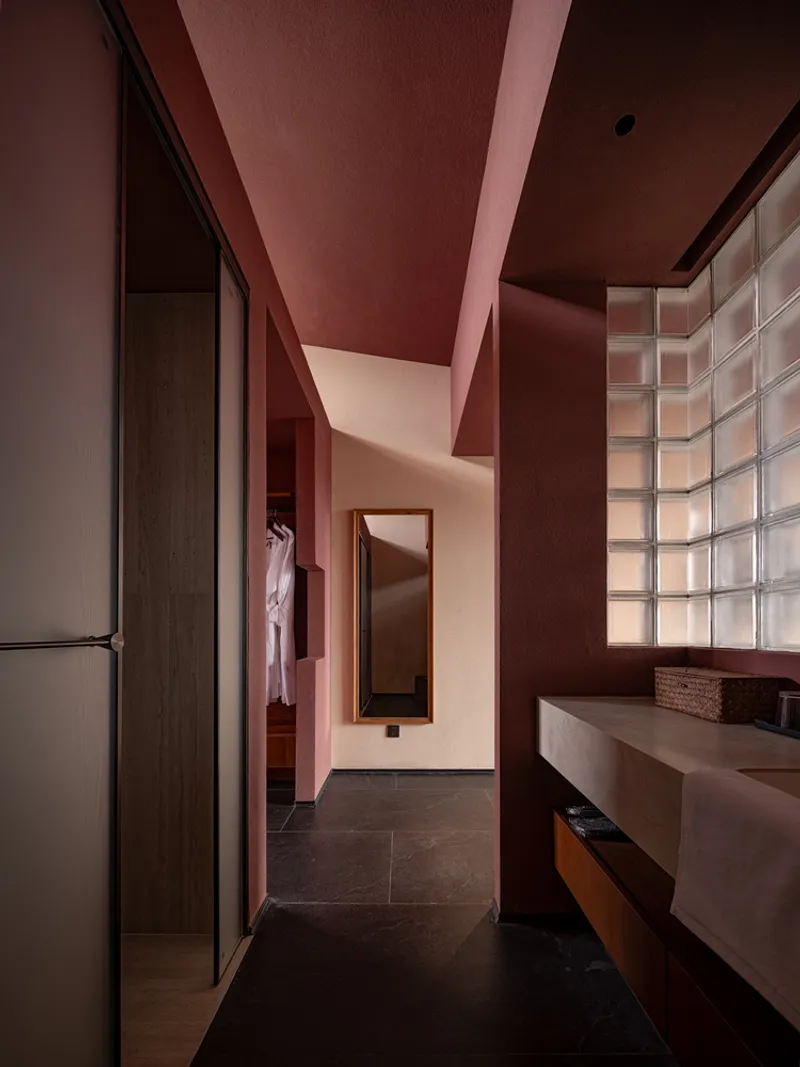
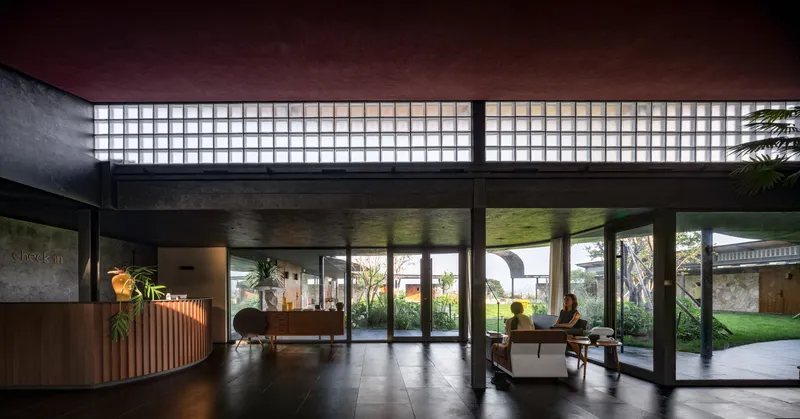
MAT Office uses glass brick consistently across the project, not as a retro stylistic choice but as a light management tool. In the reception lobby, a gridded glass block clerestory runs the full width of the ceiling, casting even, luminous light onto the full-height glazing below. The effect is a layered transparency: the courtyard garden is visible through the lower glass, while the sky filters through the upper blocks, separating direct view from ambient glow.
In the bathroom corridor, the strategy shifts. A terracotta-painted ceiling compresses the space while a glass block wall provides privacy without darkness. The concrete vanity counter sits heavy and grounded against these lighter surfaces, and the color palette, warm earth tones against translucent block, maintains the project's commitment to the island's material identity even in the most utilitarian spaces. Nothing here defaults to the polished white surfaces that dominate boutique hotel interiors elsewhere.
Why This Project Matters
The Bushe Boutique Hotel matters because it demonstrates that hospitality architecture in coastal China does not have to choose between nostalgia and spectacle. MAT Office found a third path: using the actual materials and spatial logic of the island, gray tiles, stone, reef-colored surfaces, windbreak forests, and reinterpreting them through a precise steel structure and a carefully controlled light strategy. The building neither mimics the village vernacular nor ignores it. It absorbs the local condition and gives it back in a form that is legible, comfortable, and structurally honest.
For a project of only 950 square meters, designed and built in a single year, the level of tectonic resolution is remarkable. Every steel rib, glass brick, and cantilevered eave serves at least two purposes: structural and atmospheric, functional and scenic. In a market saturated with resort hotels that treat context as optional, this project insists that place is the design brief. That insistence, quiet but absolute, is what makes the Bushe Boutique Hotel worth studying.
Bushe Boutique Hotel by MAT Office. Mabuya Village, Yangma Island, Muping District, Yantai, China. 950 sqm. Completed 2024. Photography by Qingshan Wu.
About the Studio
Share Your Own Work on uni.xyz
If projects like this are the kind of work you want to make, uni.xyz is a place to publish your own, find collaborators, and enter design competitions.




Popular Articles
Popular articles from the community


Co-life: Sustainable Architecture for Age-Friendly Community Living
Co-life reimagines sustainable architecture for seniors through courtyards, rammed earth, shared gardens, and spaces designed for belonging.

Riyadh For All: Intergenerational Urban Design for Active Aging in Rabat
Riyadh For All reimagines urban design in Rabat with intergenerational co-living, adaptive courtyards, and Moroccan cultural exchange today.

Hill & Cross Opera: Sculptural Opera House Architecture Shaped by Tallinn’s Landscape and Identity
Hill & Cross Opera reimagines opera house architecture in Tallinn through its sculptural hill, civic plaza, glass wave and a luminous cross.

The Musturak Paradise: Senior Living Architecture for a Connected Future in Temara, Morocco
The Musturak Paradise reimagines senior living architecture in Temara via private homes, social spaces, culture, community, and shared care.

Similar Reads
You might also enjoy these articles


Hodi-Mandai Geram
Project Function: Preservation and revitalization of the Intangible heritage and socio-spatial identity of the Hodi by Housing, Cultural Memory Center, Sacred Grove, landscape, local tourism economy


Olio Towers: A Mid-Rise for Performers That Fuses Housing, Rehearsal, and Stage
Located blocks from Houston's Theater District, this modular tower stacks living units around a central performance atrium.

Oasis: Modular Green Housing Carved into Dhaka's Urban Fabric
A shortlisted Plugin Housing entry reclaims unauthorized settlements in Dhaka with stepped concrete volumes, green roofs, and ventilation-driven design.

Black Hole: A Floating Megastructure for the Post-Physical Era
Emiliano Mazzarotto envisions a spherical, self-scaling arena where e-sports, digital hotels, and holographic stadiums replace traditional public space.

Explore Hospitality Building Competitions
Discover active competitions in this discipline



Challenge to reimagine the Iron Throne


Photograph architecture without architects


Illustrate the lost glory of Angkor Wat - Render Challenge


Design challenge to reuse E-waste
Comments (0)
Please login or sign up to add comments
No comments yet. Be the first to comment!