
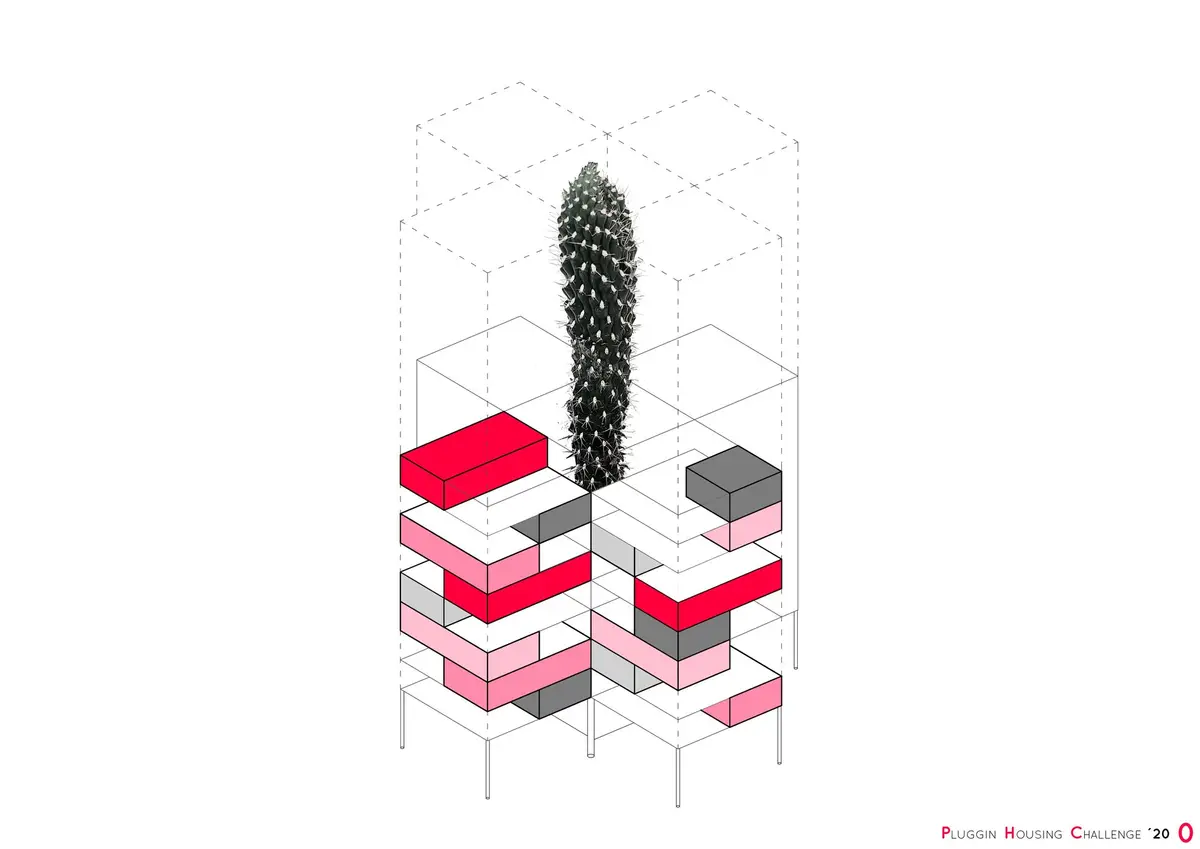
Cactus Adaptability: Modular Housing That Learns from Desert Ecology
A shortlisted Plugin Housing entry applies cactus-inspired logic to flexible, stackable units for vulnerable urban populations.


What can a cactus teach us about housing? Quite a lot, it turns out. The cactus stores water efficiently, adapts its form to harsh climates, and thrives with minimal resources. Cactus Adaptability takes those principles and translates them into a modular residential framework: stackable, customizable units designed to serve vulnerable populations who rely on temporary housing subsidies. The result is architecture that treats adaptability not as an afterthought but as the foundational logic of the entire system.
Designed by Paula Ugarriza, the project was shortlisted in the Plugin Housing Challenge 2020, a competition that asked designers to rethink how modular construction can respond to contemporary urban pressures. Ugarriza's entry stands out for its clarity of concept: draw from a biological model, extract spatial principles, and deploy them at the scale of community housing.
Desert Logic as Design Framework
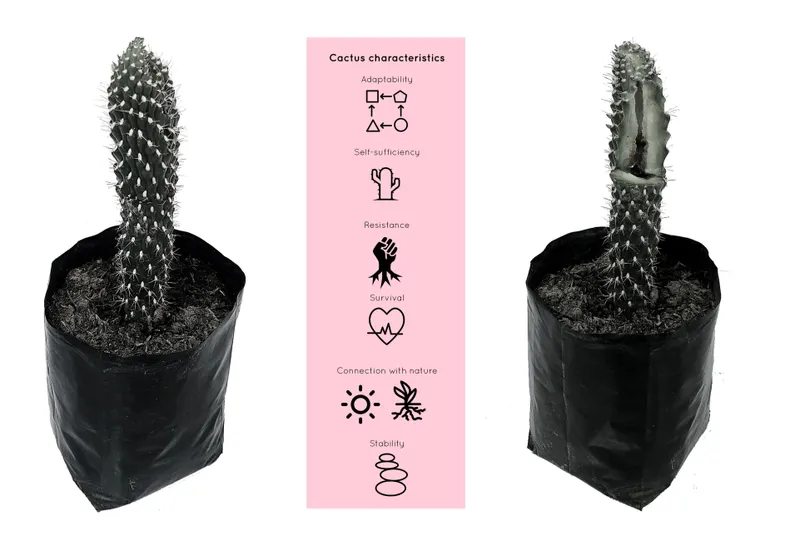
The project opens with a direct visual analogy. Two potted cacti flank a pink diagram that catalogs the plant's key characteristics: efficient resource use, adaptability to environment, and resilience under stress. Ugarriza doesn't treat this as mere metaphor. Instead, the cactus becomes a checklist of performance criteria that the housing system must meet. Each trait maps onto an architectural ambition: flexibility in unit configuration, reduced environmental impact through modular construction, and the capacity to grow or contract based on the needs of its inhabitants.
Unit Variations Across Plan and Section
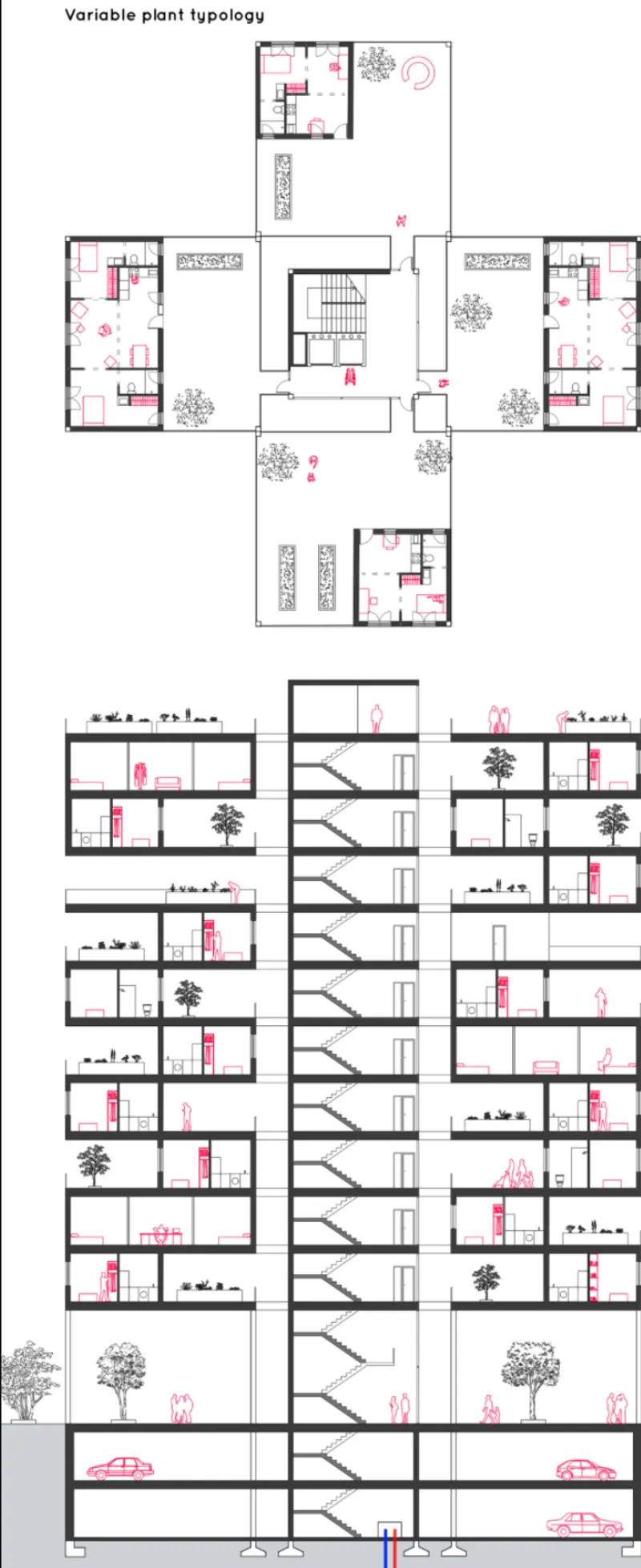
The plan and section drawings reveal how the modular system operates at the unit scale. Multiple residential variations stack across floors, connected by stairs and punctuated by trees that integrate greenery directly into the building's cross-section. The sectional logic is clear: each unit plugs into a shared structural frame, but its internal configuration remains independent. This allows the building to accommodate diverse household types without requiring a complete redesign of the structural system.
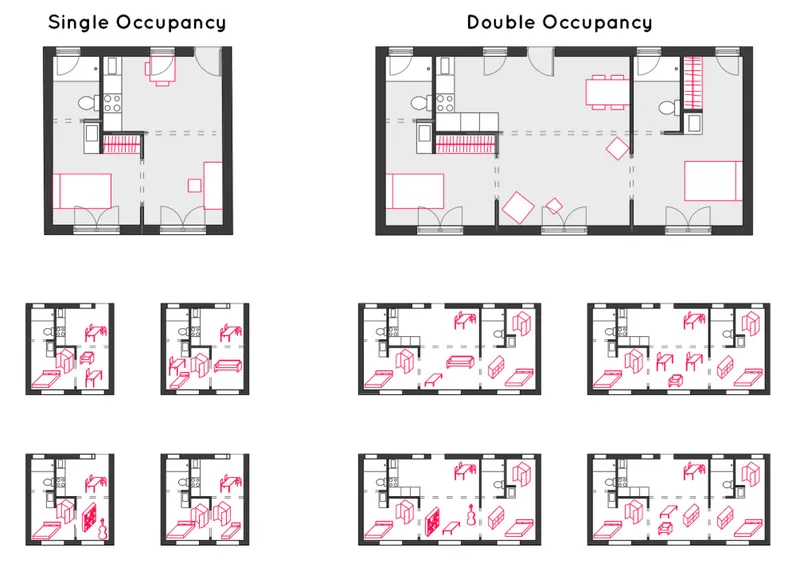
The floor plan diagrams push this further by comparing single and double occupancy layouts side by side. Furniture arrangements, drawn in pink outlines, demonstrate how the same modular footprint can serve a solo occupant or a pair. The efficiency here is not about shrinking space but about making one spatial module do multiple jobs. It is an honest response to the economic reality facing temporary housing recipients: their needs are real, varied, and subject to change.
A Street Presence Built from Repetition and Variation
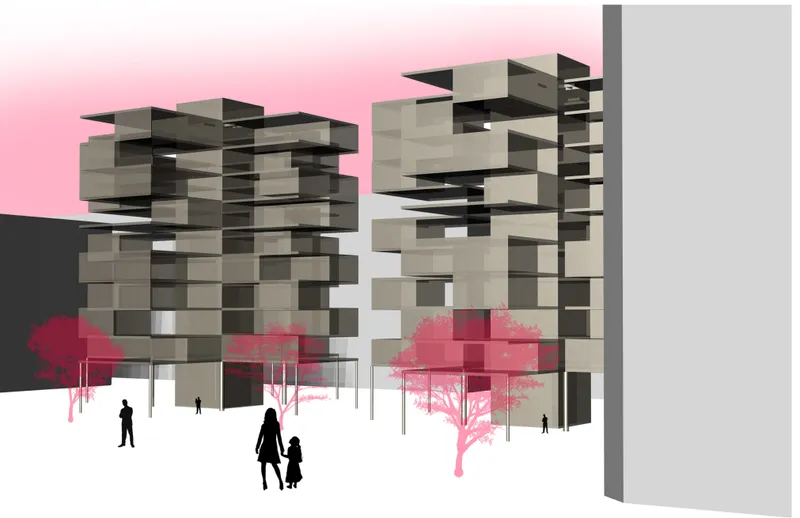
The rendered elevation shows the stacked residential volumes as they would appear from the street. Projecting balconies break up the facade into a rhythm of solid and void, while pink trees and pedestrians at ground level give the composition a sense of inhabitation and scale. The effect is modular without being monotonous. Each unit reads as part of a larger system, but the variation in balcony depths and positions creates enough visual interest to avoid the uniformity that plagues many prefab housing schemes. The ground plane, populated with people and vegetation, signals that this is housing conceived as part of an urban neighborhood, not an isolated block.
Clustering Units Around Shared Ground
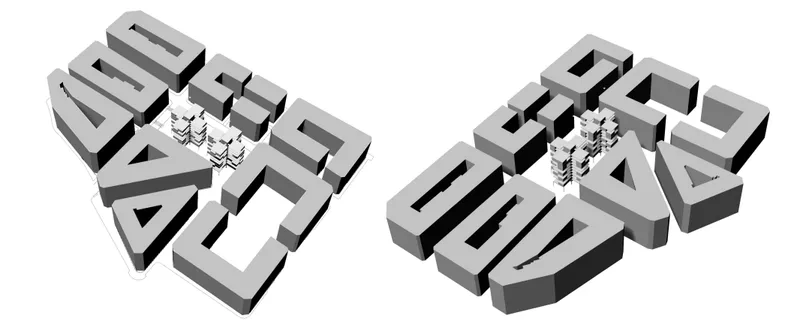
The axonometric drawing pulls back to the scale of the site, presenting two massing options for how the housing blocks can be clustered around a central courtyard. Trees fill the shared open space, reinforcing the project's commitment to communal amenity and environmental comfort. The two configurations suggest that the system is not locked into a single site geometry; it can wrap, extend, or compress depending on the plot and program. This is where the cactus analogy pays its fullest dividend: the architecture adapts its form to the conditions it finds, rather than imposing a rigid template.
Why This Project Matters
Modular housing proposals too often fall into one of two traps: they are either so generic that they could land anywhere, or so tightly optimized for a single scenario that they lose the flexibility they claim to offer. Cactus Adaptability navigates between these poles by anchoring its modularity in a biological model that inherently balances efficiency with variation. The cactus does not grow the same way twice, but it always grows within a recognizable logic. Ugarriza applies this principle at every scale, from the furniture layout within a single unit to the massing strategy across an entire courtyard block.
For a competition focused on plugin housing, the entry delivers exactly what the brief demands: architecture that can be inserted, reconfigured, and scaled to meet the shifting realities of urban populations. By grounding the work in the needs of vulnerable communities receiving temporary subsidies, Ugarriza keeps the stakes concrete. The result is not a theoretical exercise in modularity but a proposal that takes the social contract of housing seriously, asking how design can offer dignity, community, and resilience within systems built for change.
View the Full Project
About the Designers
Designer: Paula Ugarriza
Enter a Design Competition on uni.xyz
uni.xyz runs architecture and design competitions year-round that reward proposals with spatial conviction and real site intelligence.
Project credits: Cactus Adaptability by Paula Ugarriza Plugin Housing Challenge 2020 (uni.xyz).


Popular Articles
Popular articles from the community


The Amber Palace Opera: A Geological Fiction Surfaces on Tallinn's Baltic Waterfront
Pierre Brillard reimagines a Baltic legend as a public landscape, opera house, and waterfront promenade rooted in Tallinn's coastal identity.

Aquadapt: An Underwater Habitat That Rewrites Its Rooms by the Hour
Curved modules ring the seabed while one shell shifts from breakfast room to cinema, farm and football pitch as residents' needs change.

Singing Woman: An Opera House That Performs Before the Curtain Rises
Ovidiu Cristian Pavel's conceptual opera house translates Estonia's choral identity into a sculpted waterfront landmark facing the Baltic Sea.


graciastudio Turns a Viewless Tijuana Lot Inward Around a Courtyard of Concrete, Timber and Trees
In Tijuana, Jorge Gracia's GA2 House stacks a timber-clad private floor over exposed concrete and replaces a missing view with a planted interior patio.

Similar Reads
You might also enjoy these articles

Vereda Arquitetos Renovates a 40-Square-Meter Apartment Inside Niemeyer's Copan Building
A compact unit in São Paulo's most iconic residential tower gets a material overhaul that pairs exposed concrete with bold blue Formica.

Shakur's House: Exposed Brick as an Interior Organiser in a 168 m² Mashhad Residence
Brick moves indoors in this Mashhad residence, where masonry walls, glass partitions and teal planes sequence a compact home without closing it off.

Day and Night Park: A Time-Based Urban Newsstand in Beijing
A temporary urban newsstand in Beijing blending travel, light, and reading through poetic colors, compact form, and community-focused design.

Modernist Patio Renovation in El Masnou, Barcelona by Oliver Segura Arquitectura + Cebrià Arquitectura
Modernist patio renovation blending tradition and innovation with a movable pool, leveled floors, and Catalan materials in El Masnou.


Comments (0)
Please login or sign up to add comments
No comments yet. Be the first to comment!