
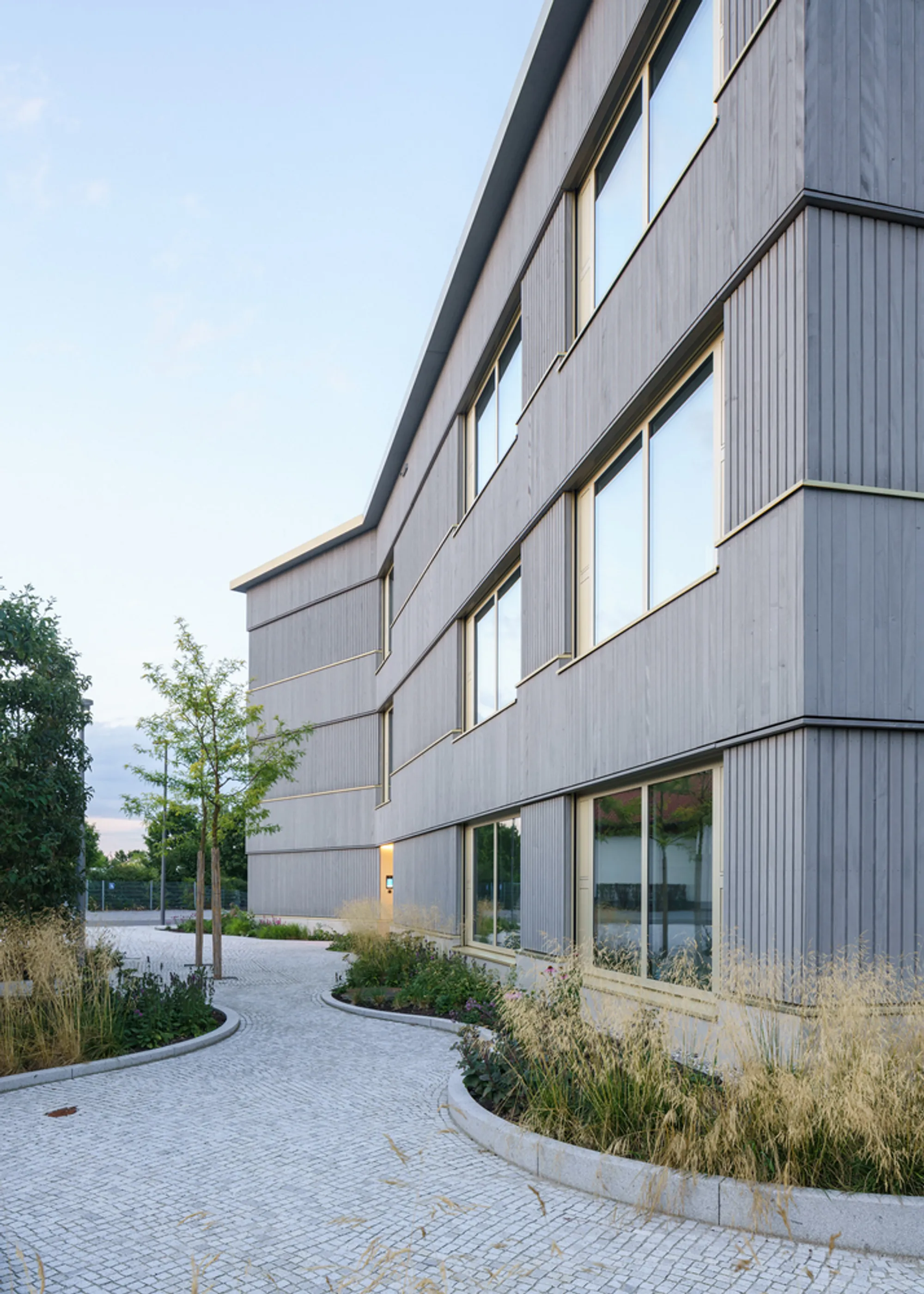
nbundm* Wraps a Three-Wing Office Building in Ribbed Cladding and Coral Accents Outside Munich
The CADFEM Head Office in Grafing bei München clusters angular volumes around a courtyard, blending timber interiors with a tough exterior shell.


Corporate headquarters rarely earn a second look, but the new CADFEM Head Office by nbundm* is an exception worth studying. Located in Grafing bei München, the building replaces the generic office park playbook with a three-wing plan that wraps itself around a landscaped courtyard, giving every workspace a view of either the shared garden or the surrounding meadow. The massing is angular and deliberate: three volumes collide at slightly skewed angles, creating small outdoor pockets, framed vistas, and a kind of geometric tension that keeps the composition from ever feeling static.
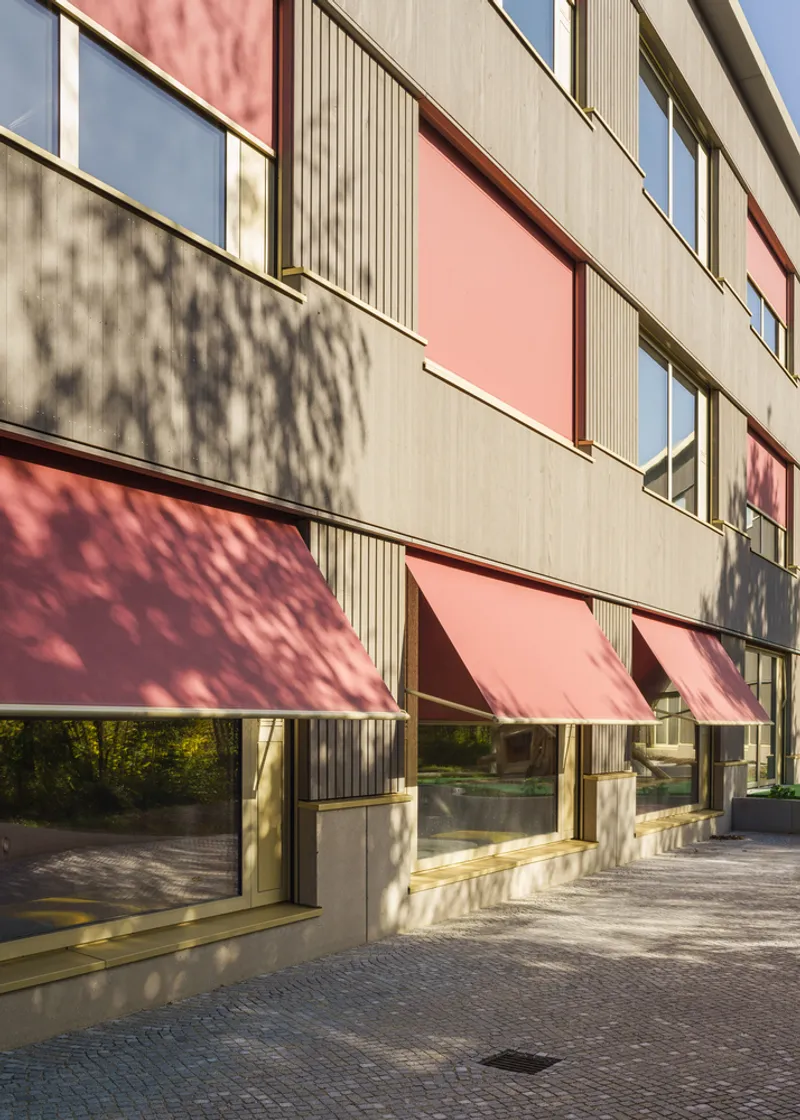
What makes the project genuinely interesting is the gap between its exterior persona and its interior temperament. Outside, the building is clad floor to ceiling in ribbed grey metal panels that read as industrial and hard-edged, punctuated by coral-pink awnings that seem to dare the Bavarian countryside to lighten up. Inside, the mood flips entirely: warm timber ceilings, plywood cabinetry, polished concrete floors, and generous double-height atriums create spaces that feel closer to a well-funded co-working loft than a simulation-software company's headquarters. That duality, the tough shell protecting something softer and more social, is the central idea of the project.
A Hard Shell with Color
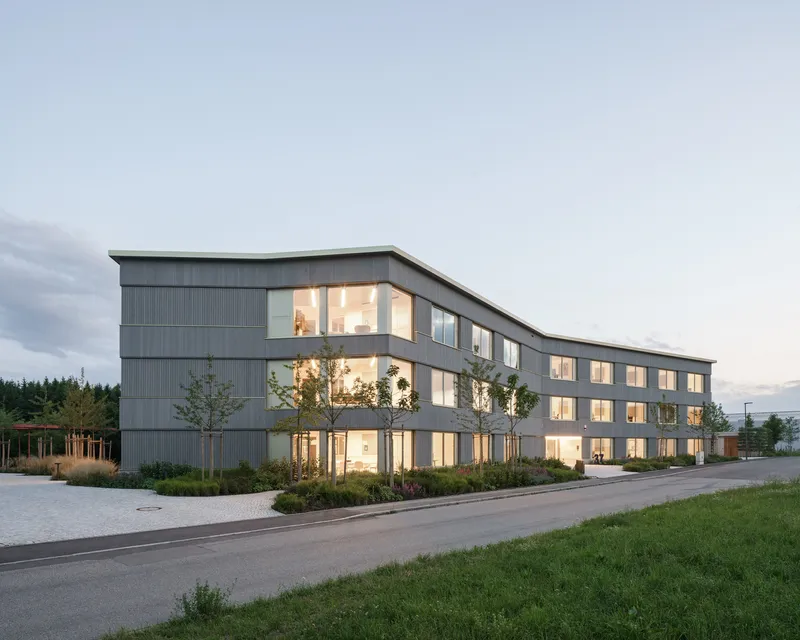


The ribbed metal cladding wraps the building with near-total consistency, eliminating material changes at corners and giving each wing a monolithic presence. At dusk, the grey panels absorb the sky's color while the illuminated windows punch bright rectangles through the surface, turning the facade into a lantern. The choice to keep the cladding uniform across three stories means the building reads as a single object rather than stacked floors, which is a harder thing to pull off than it sounds.
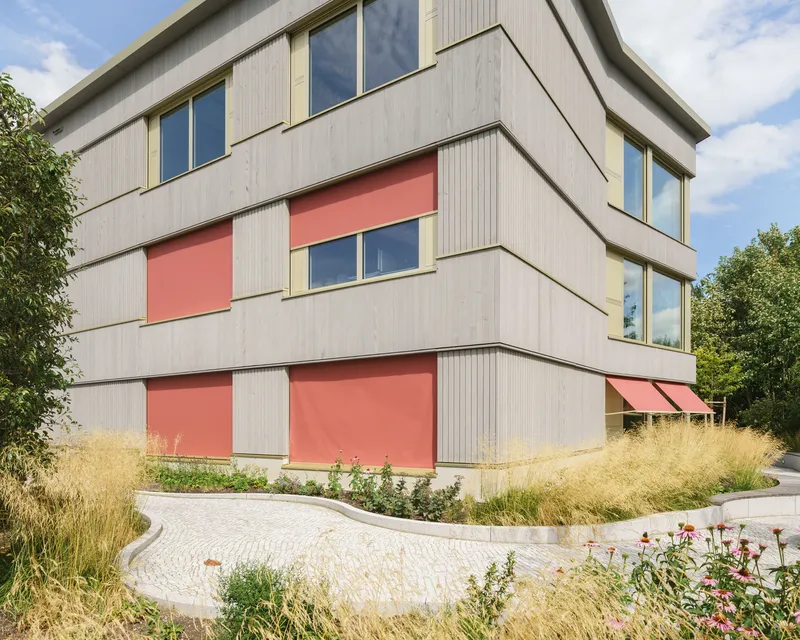
The coral-colored awnings are doing real work here, not just blocking sun but breaking the palette's austerity. They appear sparingly enough to feel intentional, like a signature repeated just often enough to become a motif. Against the silver-grey ribs, the color sings without shouting.
Landscape as Architecture


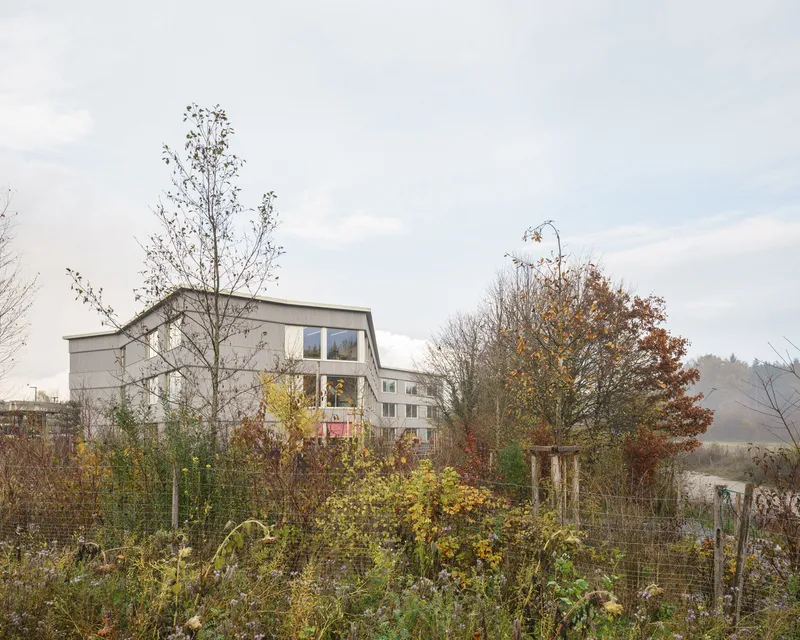
The courtyard between the two main wings is not an afterthought. Curved paved paths, deciduous trees, and a series of concrete planting terraces filled with ornamental grasses give the central space a topographic quality, as though the landscape is carving its own small geography independent of the building footprint. In autumn, the warm tones of the plantings soften the surrounding metal surfaces.
Outside the courtyard, the building meets a wildflower meadow that stretches toward the horizon. nbundm* clearly understood that a building this angular needs room to breathe, and the naturalized perimeter does exactly that. The curved planting beds at the base of the facade act as a transition zone, pulling the meadow right up to the building's skin.
The Courtyard Canopy and Exterior Details

A curved timber canopy supported on red steel columns shelters a portion of the courtyard, creating a covered outdoor zone that feels semi-domestic: part porch, part garden pavilion. The red columns pick up the coral thread from the awnings and pull it down to ground level, anchoring the color story. It is a small gesture that transforms a paved gap between buildings into a genuine gathering space.
On the south-facing facades, dappled tree shadows play across the ribbed panels in the afternoon, softening the industrial texture with a layer of organic pattern. The interplay between the rigid vertical ribs and the shifting leaf shadows produces the kind of accidental beauty that only happens when architects leave room for nature to participate.
Timber Warmth Inside


Step inside and the metal shell disappears. The double-height lobby is lined in timber, with a slatted screen concealing a kitchenette and clerestory windows pouring light from above. The material shift is immediate and total: where the exterior insists on a cool industrial register, the interior replies with the grain and warmth of wood.
The central atrium is the building's social engine. A timber staircase with white railings connects the floors visually, while planted seating areas at the base encourage informal occupation. A skylight overhead delivers daylight deep into the plan, compensating for the angular footprint that might otherwise leave interior zones too dark. Corridors are finished in pale timber panelling with flush doors, keeping sightlines clean and clutter minimal.
Work Spaces and Shared Kitchens
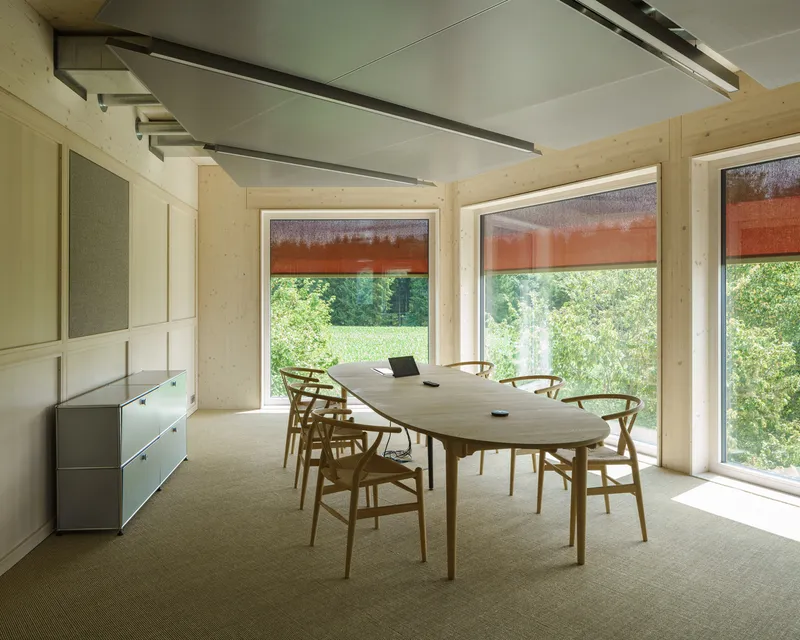
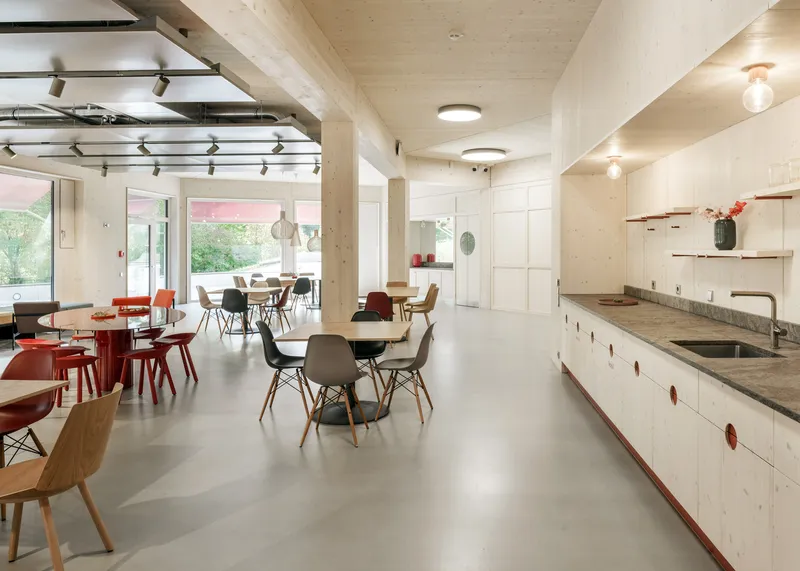

Meeting rooms are straightforward but well considered: exposed timber ceilings, generous windows overlooking greenery, and enough acoustic mass in the concrete floors to keep conversations contained. The palette stays restrained. Wood, concrete, glass. There is no feature wall competing for attention, which lets the views of the surrounding landscape do the decorative heavy lifting.
The communal kitchen and dining area occupies a ground-floor position with direct access to the courtyard terrace through glass doors. A dark stone countertop and polished concrete floor give the space a slightly more robust finish than the upper levels, acknowledging that this is where coffee spills and lunch crowds actually happen. It is a practical choice dressed up just enough to feel intentional.
Circulation and Detail Moments

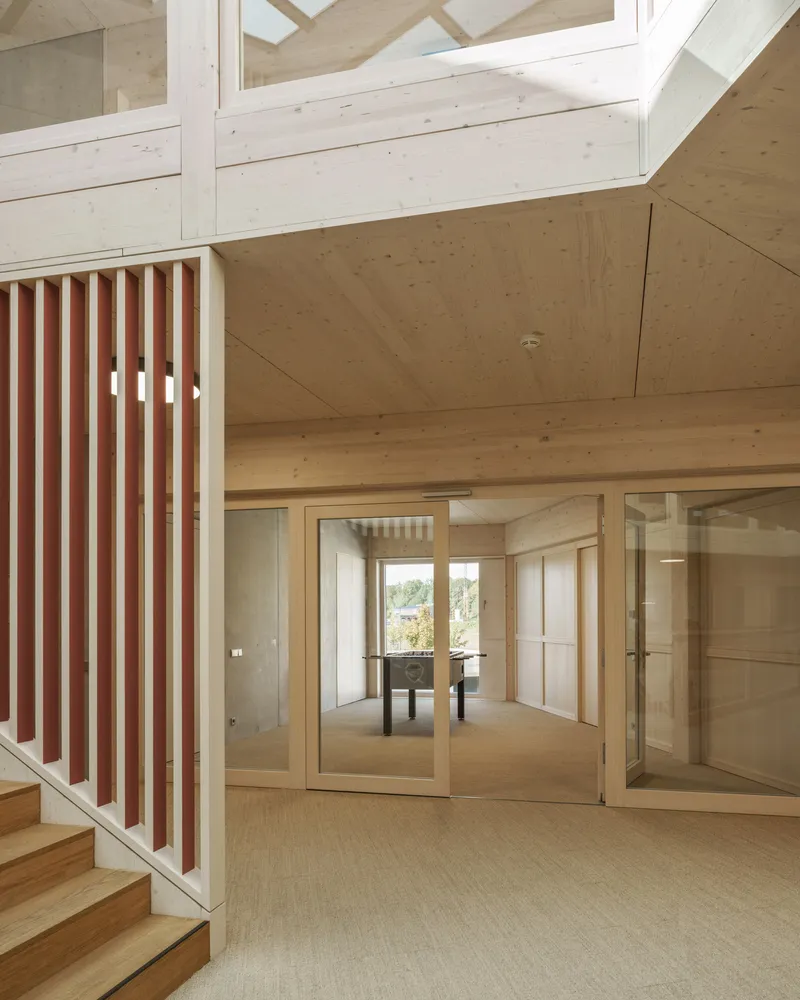
The stairwells reveal a quieter side of the design. Concrete walls meet angled wooden handrails, while vertical red metal slats line the balustrade, carrying the exterior color palette indoors in a compressed, graphic way. These are not showpiece stairs; they are honest vertical connections that happen to be beautifully detailed.
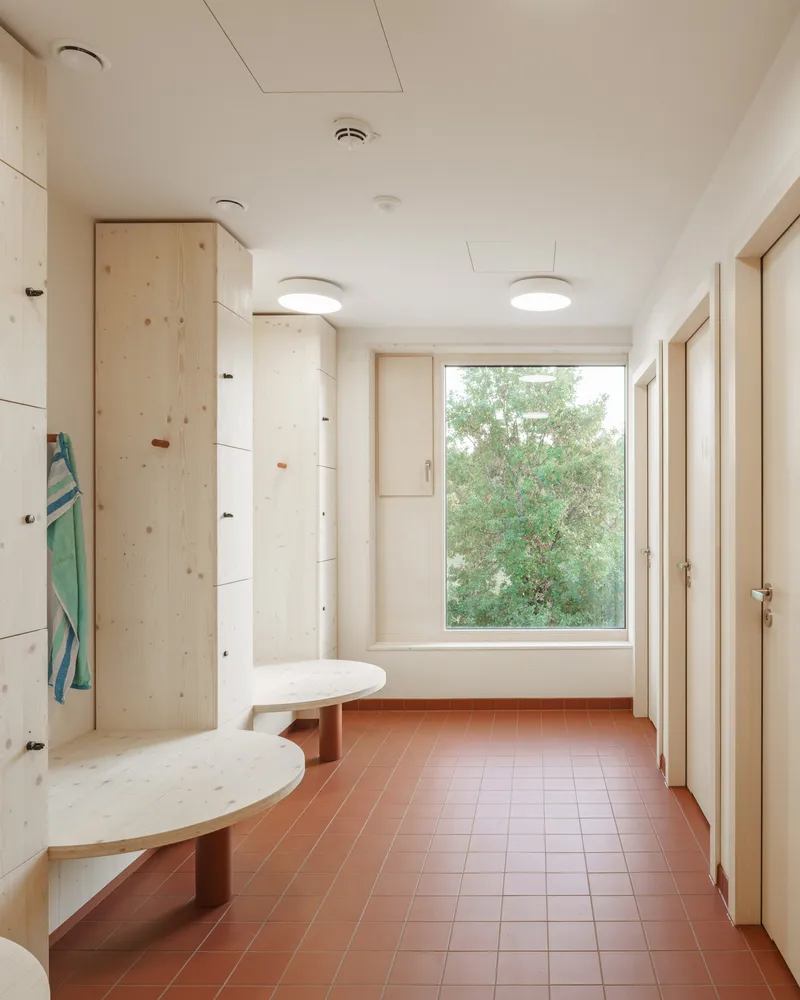
The entrance hall, with its terracotta tile floor and plywood storage cabinets, sets the tone before the atrium opens up. There is a deliberate sequence at work: the compressed arrival space yields to the double-height interior, and the material progression from tile to timber to concrete maps that transition physically. Even small moments, like a washroom with orange cabinetry and a round mirror, show a willingness to push color into unexpected corners.

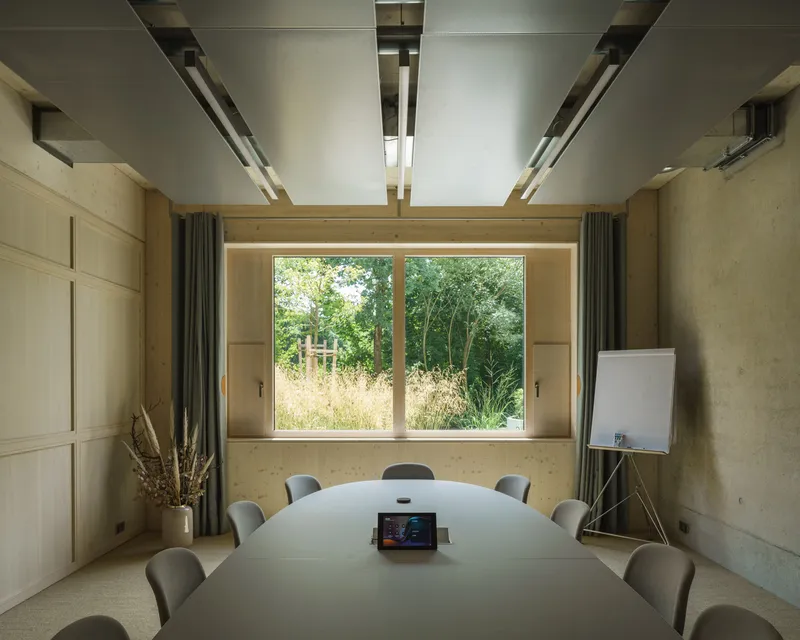
The conference room with its oval table and ceiling-mounted linear lighting is perhaps the most corporate space in the building, yet even here the window frames a view of the meadow that feels almost cinematic. nbundm* has calibrated each room so that the landscape is never more than a glance away.
Plans and Drawings
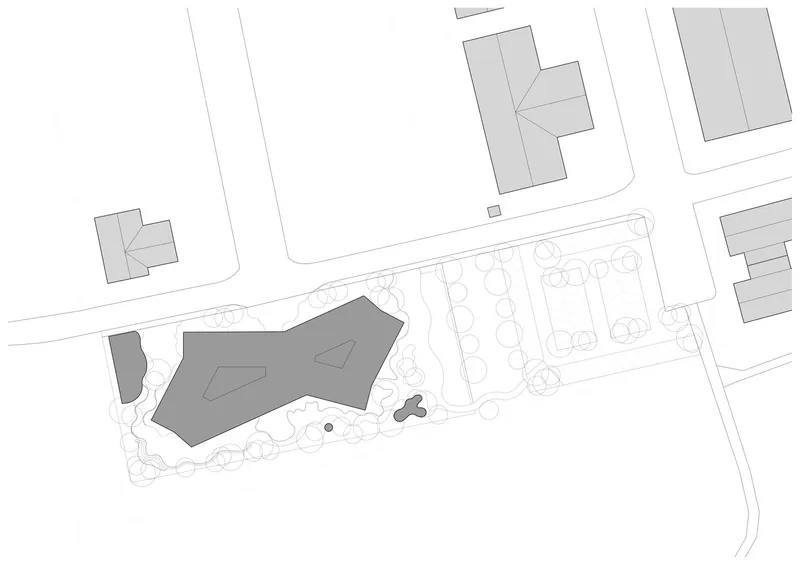


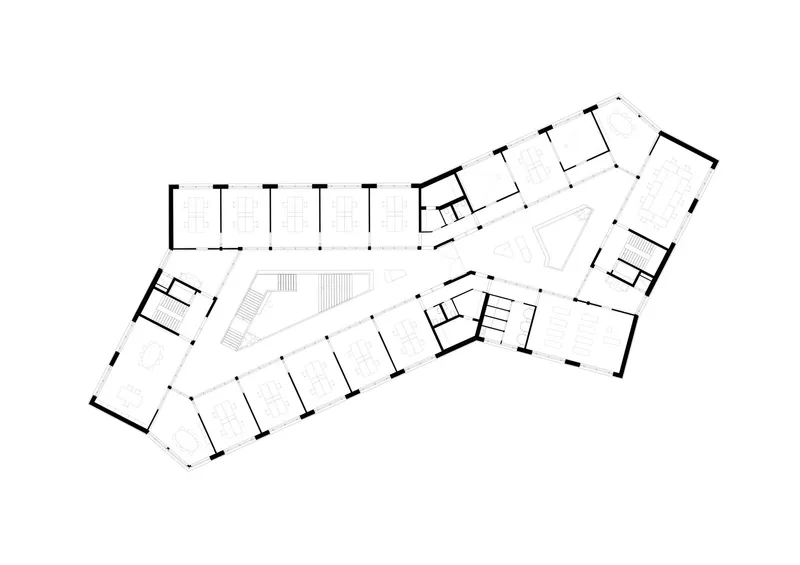
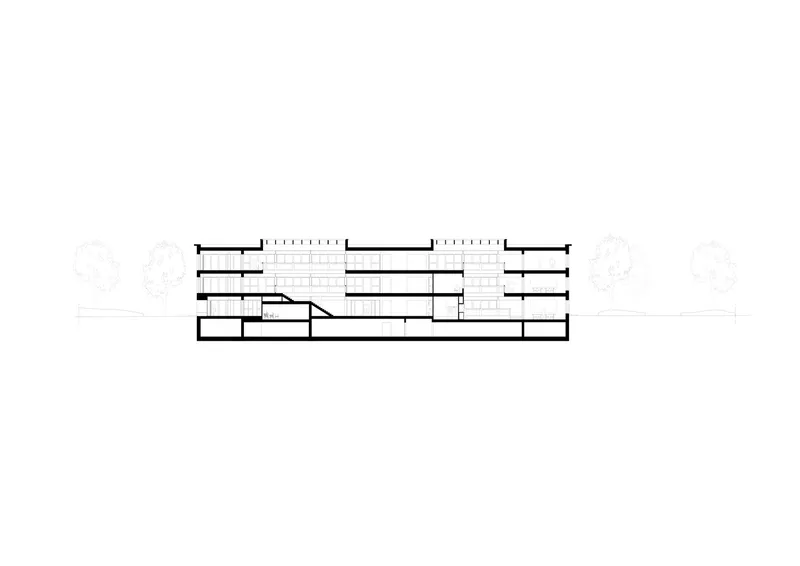
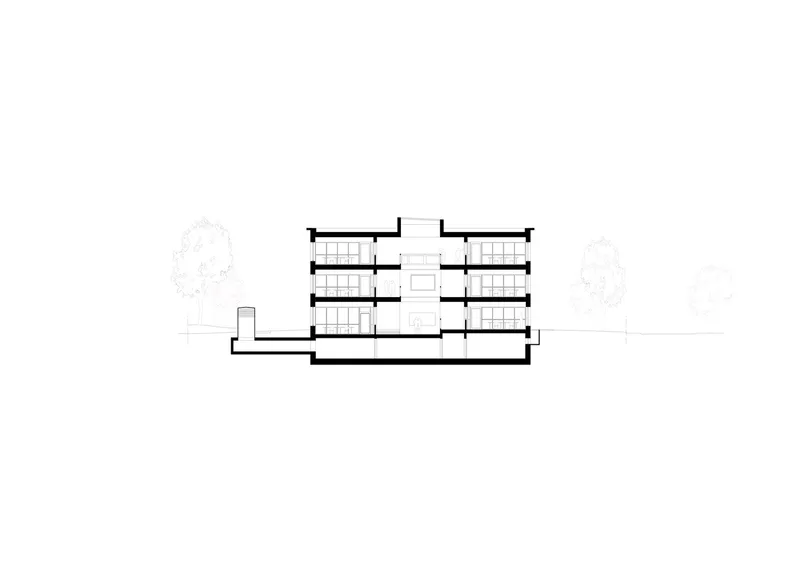
The site plan reveals how the three wings radiate from a central courtyard, each skewed at a slightly different angle to respond to the neighboring structures and the contours of the terrain. The floor plans show a diagonal circulation spine connecting the wings, with a central stair acting as the hinge point. Columns are arranged on a regular grid that allows for open floor plates within each wing, while the angular geometry at the junctions creates the kind of leftover pockets that become alcoves, breakout zones, or planted niches.
The sections are particularly telling. The longitudinal cut shows how the diagonal stair stitches together floor plates at slightly different levels, accommodating grade changes across the site. The cross section confirms a four-story structure with a generous central stairwell flanked by trees in elevation, reinforcing the idea that landscape and architecture are co-designed rather than applied sequentially.
Why This Project Matters
The CADFEM Head Office matters because it refuses the default logic of suburban office design: a flat site, a rectangular plan, a curtain wall, a parking lot. Instead, nbundm* has produced a building that responds to topography, creates social outdoor space, and uses a limited material vocabulary to maximum effect. The three-wing plan is not arbitrary geometry; it is a strategy for giving every desk natural light and a landscape view, which in turn supports the kind of focused, comfortable work environment that retains talent.
The project also demonstrates that sustainable ambition and architectural character are not mutually exclusive. The ribbed cladding, the timber structure, the courtyard microclimate, and the meadow perimeter all contribute to the building's environmental performance, but none of them look like a concession. They look like design decisions made by architects who believe a workplace should be specific to its place, generous to its occupants, and precise in its details. That sounds simple, but very few office buildings actually deliver all three.
CADFEM Head Office by nbundm*, Grafing bei München, Germany. Photography by Sebastian Schels.
About the Studio
Share Your Own Work on uni.xyz
If projects like this are the kind of work you want to make, uni.xyz is a place to publish your own, find collaborators, and enter design competitions.



Popular Articles
Popular articles from the community


The Ocean Hive: Sustainable Architecture for a Self-Sufficient Civilization at Sea
The Ocean Hive imagines sustainable architecture at sea, where modular habitats, algae, wave power and ocean waste sustain a growing colony.

Conexión: Biophilic Design Reimagines High-Rise Living in Hong Kong
Conexión reimagines high-rise living in Hong Kong through biophilic design, green facades, shared spaces, daylight, water and nature within.

Co-Life: Senior Housing Design That Reconnects Older Adults With the City
Co-Life reimagines senior housing design through healing gardens, shared streets, workshops, and a sustainable community across generations.

AL-JANNAH: Sustainable Architecture and Permaculture for Afghan Widows
AL-JANNAH uses sustainable architecture and permaculture to create resilient oasis of housing, learning, work and renewal for Afghan widows.


Similar Reads
You might also enjoy these articles


Hodi-Mandai Geram
Project Function: Preservation and revitalization of the Intangible heritage and socio-spatial identity of the Hodi by Housing, Cultural Memory Center, Sacred Grove, landscape, local tourism economy


Olio Towers: A Mid-Rise for Performers That Fuses Housing, Rehearsal, and Stage
Located blocks from Houston's Theater District, this modular tower stacks living units around a central performance atrium.

Oasis: Modular Green Housing Carved into Dhaka's Urban Fabric
A shortlisted Plugin Housing entry reclaims unauthorized settlements in Dhaka with stepped concrete volumes, green roofs, and ventilation-driven design.

Black Hole: A Floating Megastructure for the Post-Physical Era
Emiliano Mazzarotto envisions a spherical, self-scaling arena where e-sports, digital hotels, and holographic stadiums replace traditional public space.


Explore Office De Architects Competitions
Discover active competitions in this discipline



Challenge to reimagine the Iron Throne


Photograph architecture without architects


Illustrate the lost glory of Angkor Wat - Render Challenge


Design challenge to reuse E-waste
Comments (0)
Please login or sign up to add comments
No comments yet. Be the first to comment!