
Calmm Architecture Replaces a Tiny Warehouse with a Light-Filled Townhouse in Boulogne-Billancourt
A 60 square meter warehouse gives way to a 140 square meter home organized around voids, courtyards, and borrowed greenery on a Parisian lane.


Villa Ronsard is one of those quiet side streets that punctuate the commercial spine of Boulevard Jean Jaurès in Boulogne-Billancourt. It reads almost bucolic, a few meters removed from the traffic and retail bustle. On a plot that formerly held a 60 square meter warehouse, Calmm architecture, led by Luis Masia Massoni and Fabio Cavaterra, has completed a 140 square meter townhouse that more than doubles the original footprint while keeping scrupulously to the warehouse's existing perimeter. The trick is vertical: the project stacks three levels plus a basement, then carves voids through them to let light sink deep into the plan.
What makes this house genuinely interesting is how it refuses to treat its tight urban lot as a constraint to overcome. Instead, the design leans into the compression. Courtyards, clerestories, and north-facing terraces are precisely positioned so that daylight structures not just the rooms but the path you take through them. The result is a home where every turn introduces a different quality of light, a different framed view, whether that is tree canopy overhead or an ivy-covered garden wall next door.
Courtyards as Light Wells
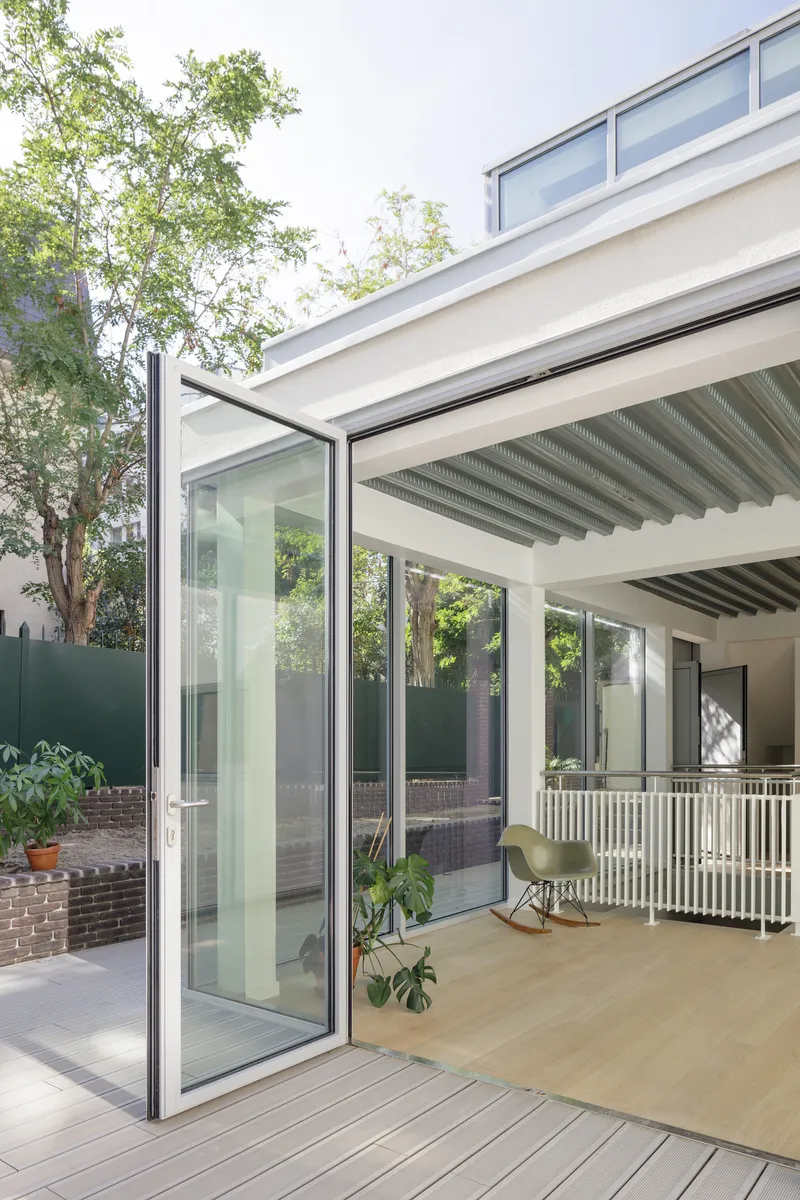

The courtyard is the engine of the house. Timber decking wraps around a glazed facade that opens almost entirely, blurring the line between interior and exterior at ground level. Potted palms and planted beds lean against the neighboring concrete party wall, borrowing its neutral surface as a backdrop and, frankly, making it look better than it has any right to. The tree canopy overhead filters light into a dappled pattern that changes through the day, a kinetic ceiling you never tire of.
Because the plan holds to the old warehouse's perimeter, the courtyard is carved from within the envelope rather than appended to it. This is a smart move: it means the outdoor space is sheltered on all sides, protected from the wind while still pulling light and ventilation into the deepest rooms.
The Glass Pavilion Between Neighbors


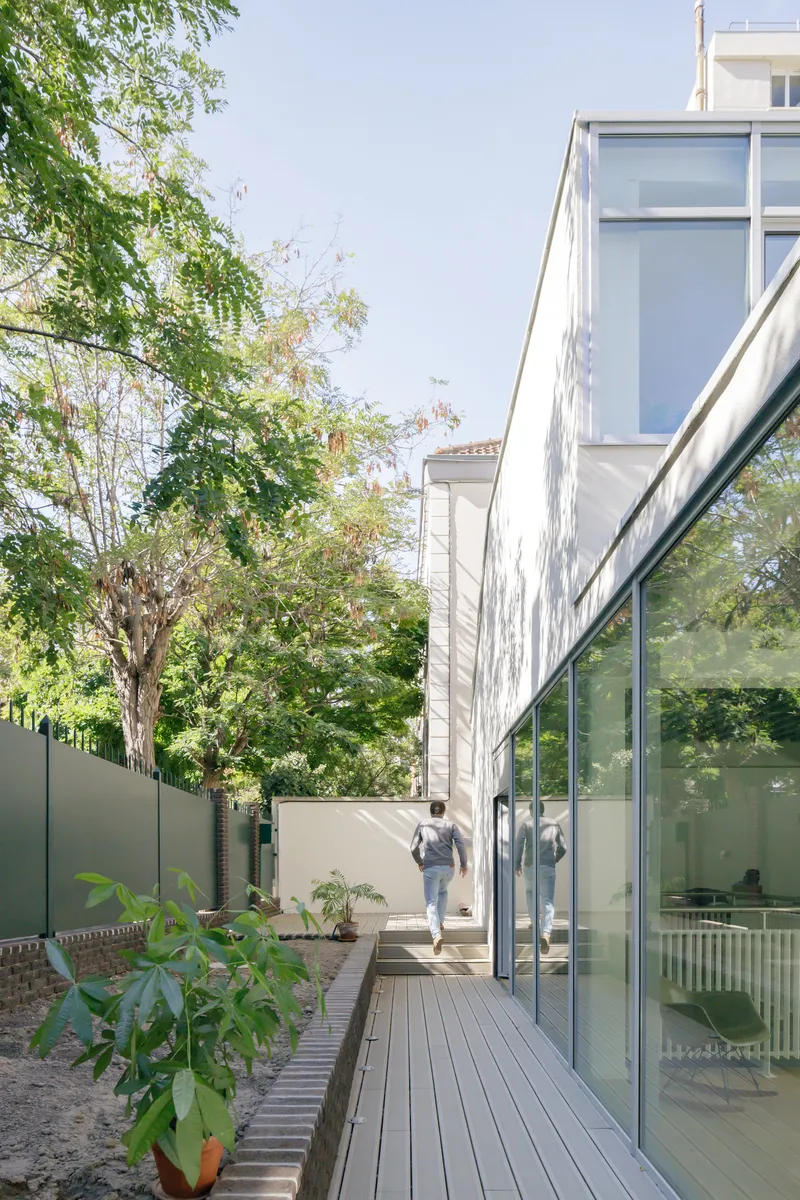
Seen from the garden, the house reads as a glass pavilion slipped between two white residential walls. A sloped skylight caps the volume, pitching light into the living spaces below while keeping the roofline respectful of neighboring buildings. The consultation with neighbors to straighten the roof section was clearly productive: the result sits comfortably in the streetscape without ceding any interior ambition.
Full-height glazing along the rear facade turns the timber deck into an extension of the living room. An ivy-covered wall and mature trees form the far boundary, giving the house a borrowed landscape that would cost a fortune to plant from scratch. Calmm's exhaustive site analysis evidently included a reading of these existing assets, and the architecture is positioned to maximize them.
Voids That Connect Every Level

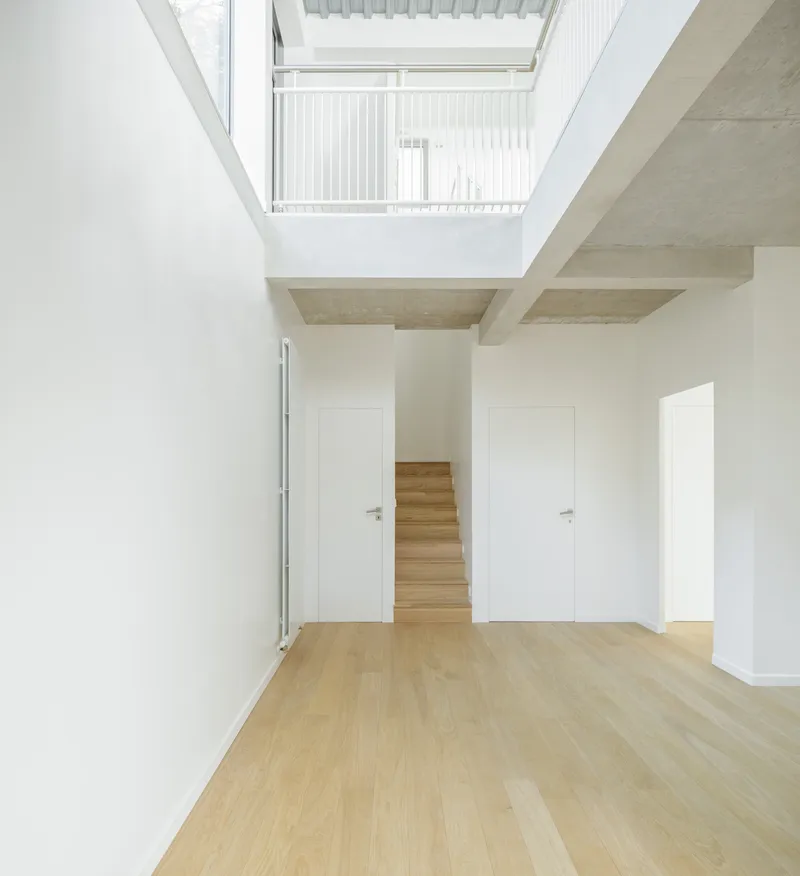
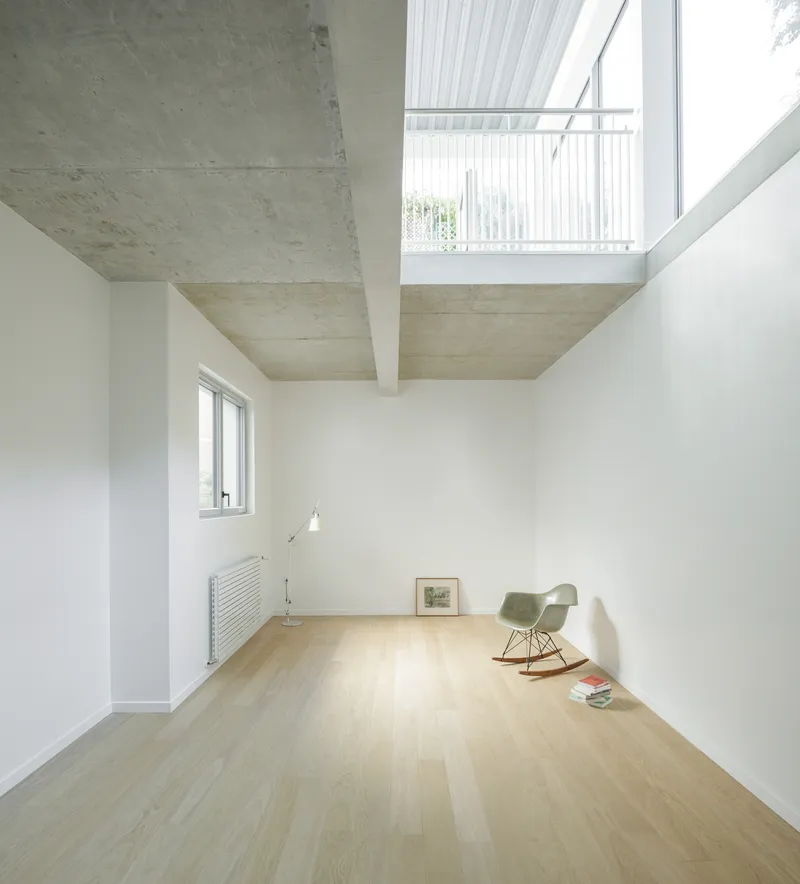
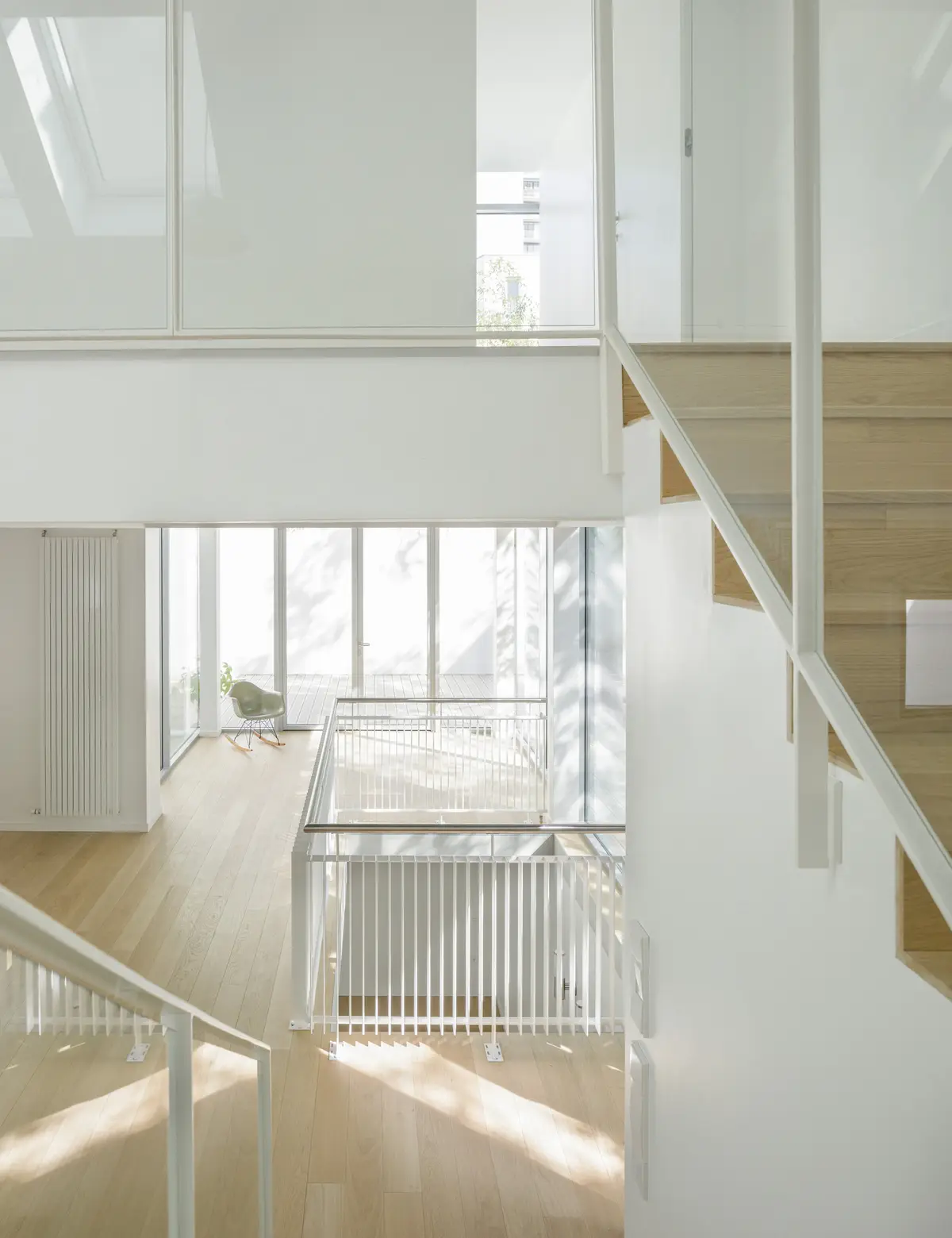
The multi-level atrium is the heart of the section. Light wood floors and slender metal railings keep the palette restrained, allowing the natural daylight pouring through the upper voids to do the visual heavy lifting. At the double-height living space, exposed concrete beams frame a skylight that opens to the upper floor balcony, connecting the domestic scale of the bedrooms to the generosity of the living volume below.
These voids are doing real environmental work, not just performing openness. North-oriented terraces and vertical cuts through the section ensure that even the basement receives natural light. In a house this compact, that is the difference between a livable lower level and a dark storage pit.
Thresholds and Filtered Views
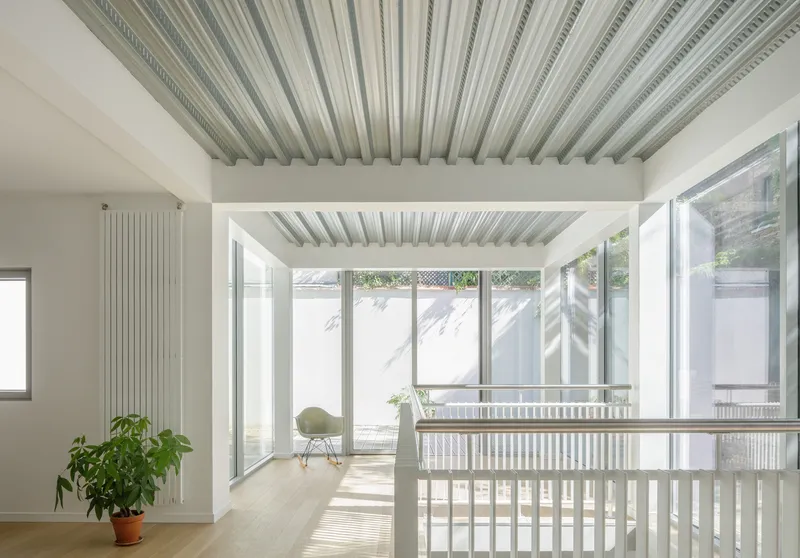

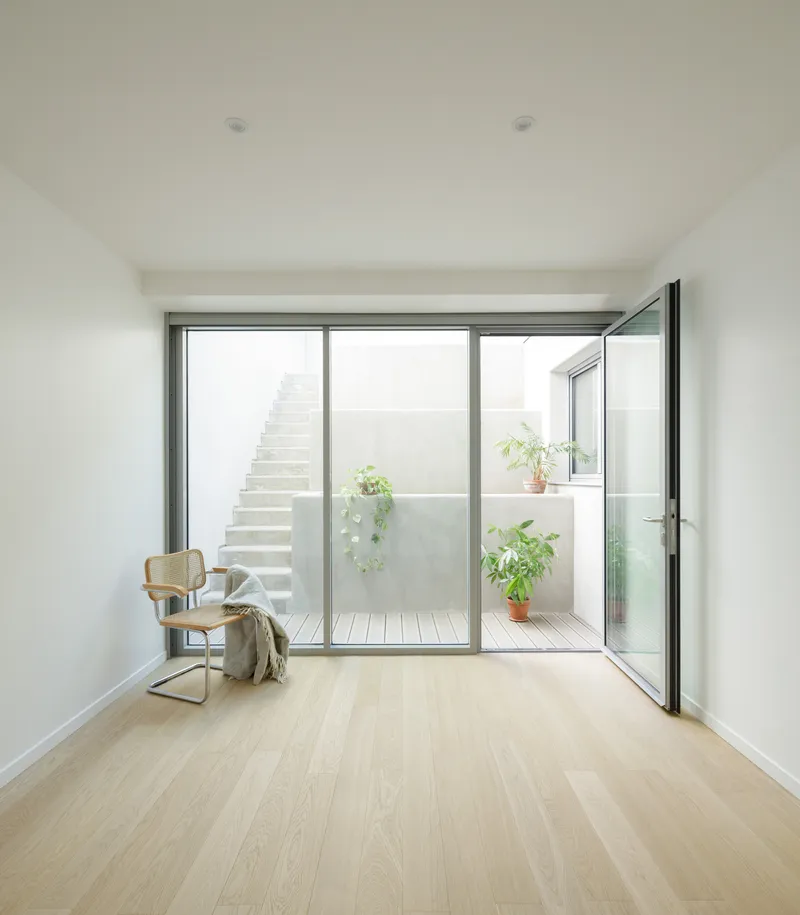
White painted timber slats recur throughout the house as a filtering device. They border stairwell openings, line balustrades, and create a layered depth between the interior and the courtyard beyond. Dappled sunlight passes through them and casts striped shadows on the floor, reinforcing the garden atmosphere that Calmm has cultivated inside the envelope.
The glazed courtyard doors pivot open to the deck, but even when closed they maintain visual continuity. Potted plants, a stair, timber decking: these elements read as a single landscape whether you are inside or out. The threshold is present architecturally but dissolved experientially.
The Intimate Rooms

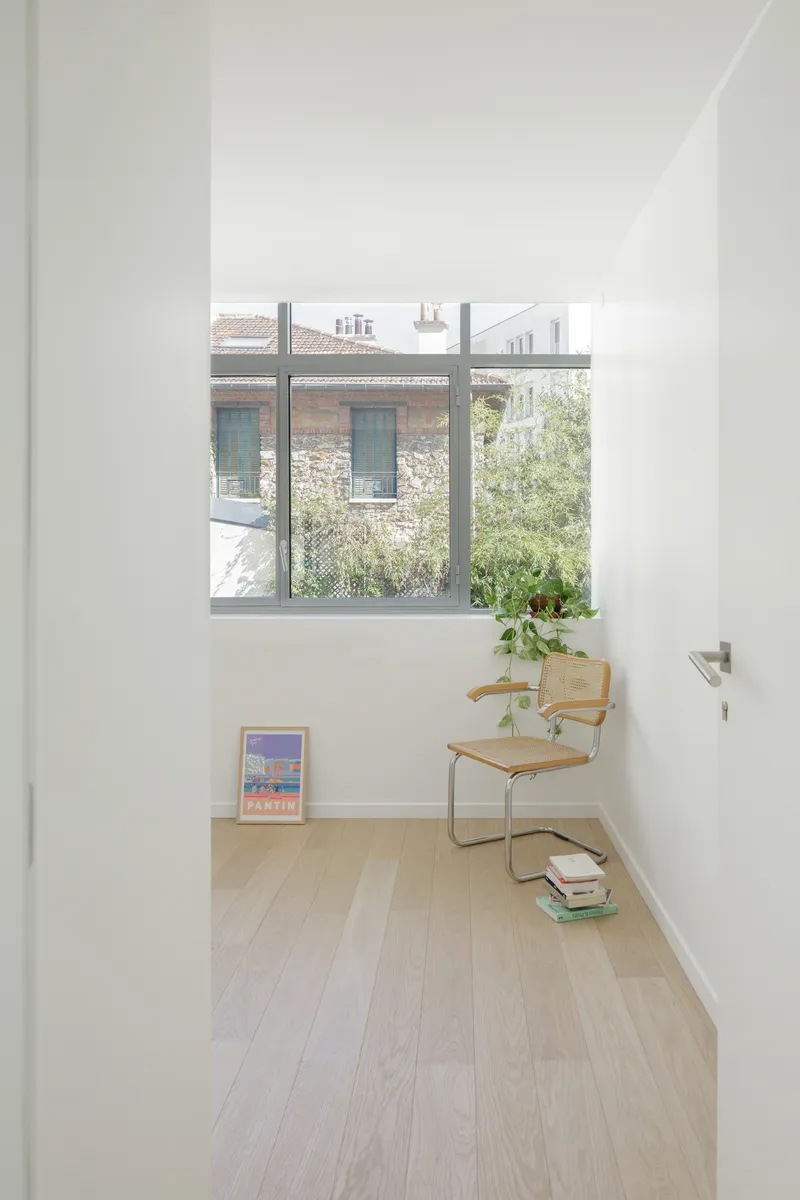
Not every space in the house is expansive. The bedrooms, integrated into the roof section, are deliberately compact. Clerestory windows frame the tree canopy above, turning the view into a kind of living painting. A vertical radiator beside the timber floor is about as utilitarian as the detailing gets, and even that object benefits from the soft daylight washing down the wall.
A narrow room on the upper level overlooks a neighboring masonry building and its garden, catching the quiet side of the plot. The softness of the light here is a direct product of the orientation strategy: north-facing openings provide consistent, glare-free illumination that suits a bedroom better than the dramatic south light flooding the living spaces.
Plans and Drawings


The axonometric section reveals the full strategy: a tight perimeter enclosing stacked living volumes, with the courtyard punched through to bring light to the basement. The floor plans, from basement to first floor, show how the central staircase acts as both a void and a pivot point, distributing circulation efficiently while maintaining visual connections between levels. The south elevation drawing confirms the modest scale, with hatched cladding and a single tree marking the boundary.
The constructive section is particularly instructive. It shows the planted courtyards as integral structural elements, not afterthoughts, and makes clear how the multi-level voids thread natural light through the entire building height. Every level benefits from at least two directions of daylight, a feat on a site this constrained.
Why This Project Matters
Villa Ronsard demonstrates that extraordinary domestic architecture does not require an extraordinary site. A nondescript warehouse plot on a Parisian side street becomes, through careful sectional thinking and an honest reading of context, a house that is both generous with light and precise with space. Calmm architecture has avoided the temptation to impose a form on the site and instead let the existing conditions, the perimeter, the neighbors, the trees, generate the design.
The broader lesson here is about urban densification done right. Replacing 60 square meters with 140 without expanding the footprint, without stealing light from the neighbors, and without sacrificing any quality of living space is a model for how European cities can grow from within. It is quiet architecture, in the best sense: it speaks through its spaces rather than its surfaces.
Villa Ronsard, designed by Calmm architecture (Luis Masia Massoni and Fabio Cavaterra), Boulogne-Billancourt, France. 142 m². Completed in 2022. Photography by Rodrigo Apolaya.
About the Studio
Share Your Own Work on uni.xyz
If projects like this are the kind of work you want to make, uni.xyz is a place to publish your own, find collaborators, and enter design competitions.


Popular Articles
Popular articles from the community


Cube Design Draws an Ecological Corridor Between Two Shenzhen Hills with the Nankai Building
Beside Shenzhen's container docks, the Nankai Building pairs stacked balconies with a climbing green screen to connect two hillsides across its height.

David Macias Steps a Doorless Stone and Plaster House Down a Tropical Colombian Hillside
In the humid hills of Colombia, Threshold House replaces the front door with an open void and terraces its 850 m² down the slope instead of fighting it.

LT2A and OPEN Architectes Thread a Brick and Glass High School Through a Wooded Belgian Campus
In Braine-l'Alleud, a 3,000 m² wing for Collège Cardinal Mercier pairs pale brick with a glazed colonnade, deferring to a small chapel and a dense wood.

U.GA Architects Wraps an Oval Rooftop Pool in Curved Board-Formed Concrete on Busan's Jeollidan-gil
In Busan's Jeonpo-dong, a 454 m² mixed-use block stacks a neighborhood facility, guest rooms and an oval rooftop pool inside spiraling concrete walls.

Similar Reads
You might also enjoy these articles


LAVA Architecten Gives Vocational Education a Sawtooth-Roofed Face on a Mechelen School Campus
In Mechelen, Belgium, a 2,053 m² STEM school on a 6×6 m grid turns workshops and classrooms into rooms that can be rearranged as teaching changes.

KEMA Studio Turns a Derelict Marvila Attic into a 60 m² Lighthouse Apartment Above Lisbon
In Lisbon's Marvila district, a rebuilt roof, four skylights and two plywood volumes turn an unlivable attic into a bright home facing the Tagus.

Pixel Gardens: One Repeated Module Stacked Into a Terraced Social Housing Tower for Famagusta
Salem Bader's shortlisted housing tower builds a vertical neighbourhood from one repeated module, offsetting units to carve terraces, light and air.

Bao Huynh Watercolor Atelier: A Serene Art Retreat in Hội An
Bao Huynh Watercolor Atelier in Hội An blends multifunctional art spaces, sustainable design, local materials, and family-friendly living in a serene environment.

Explore Villa Vernacular Competitions
Discover active competitions in this discipline

Comments (0)
Please login or sign up to add comments
No comments yet. Be the first to comment!