
CambridgeSeven and Gulf Consult Wrap a Kuwait University Campus in a Modern Mashrabiya
A 74,000-square-meter college in Ardiya reinterprets traditional Kuwaiti screens and wind towers to shield 3,500 students from the desert sun.


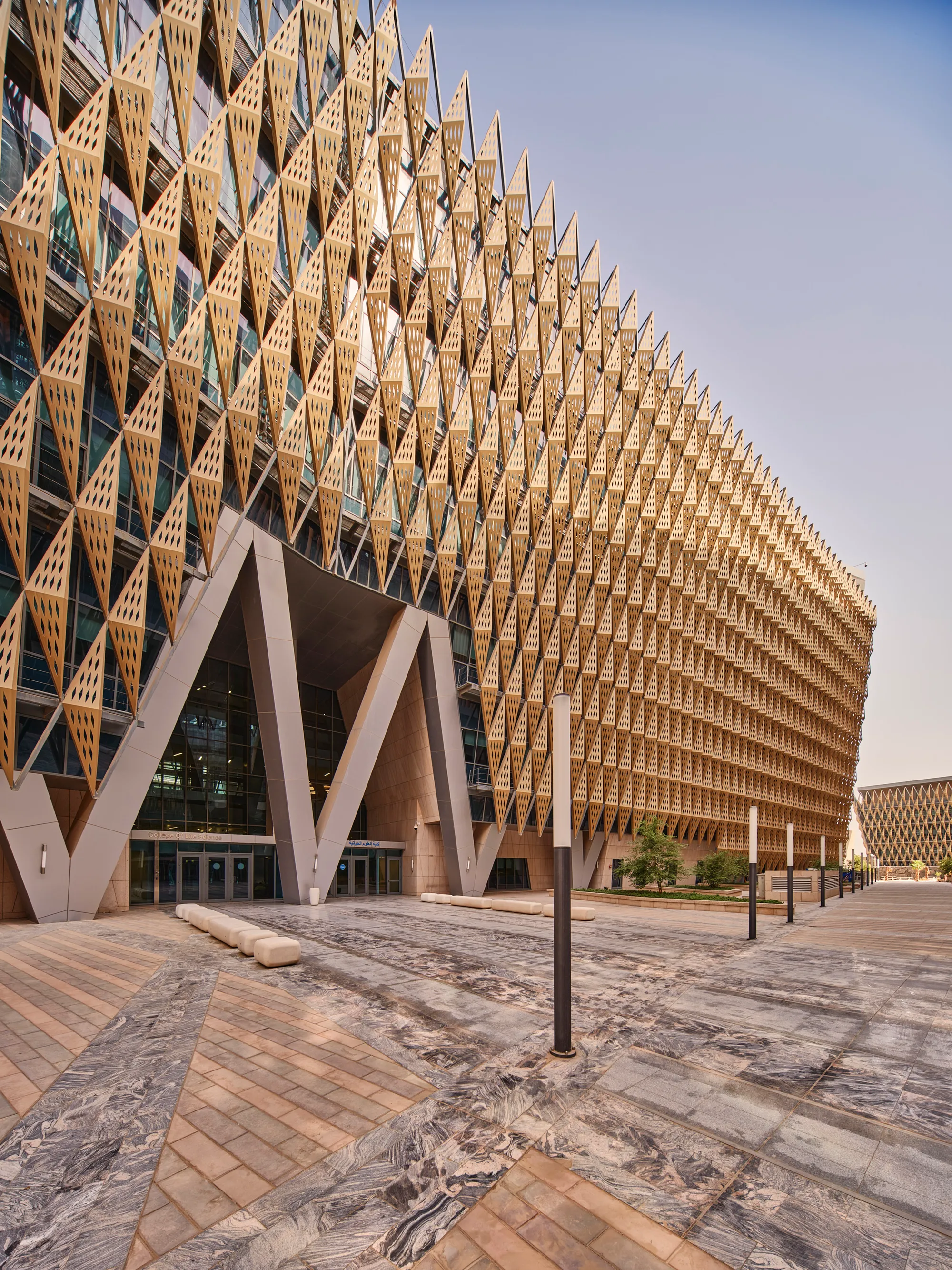
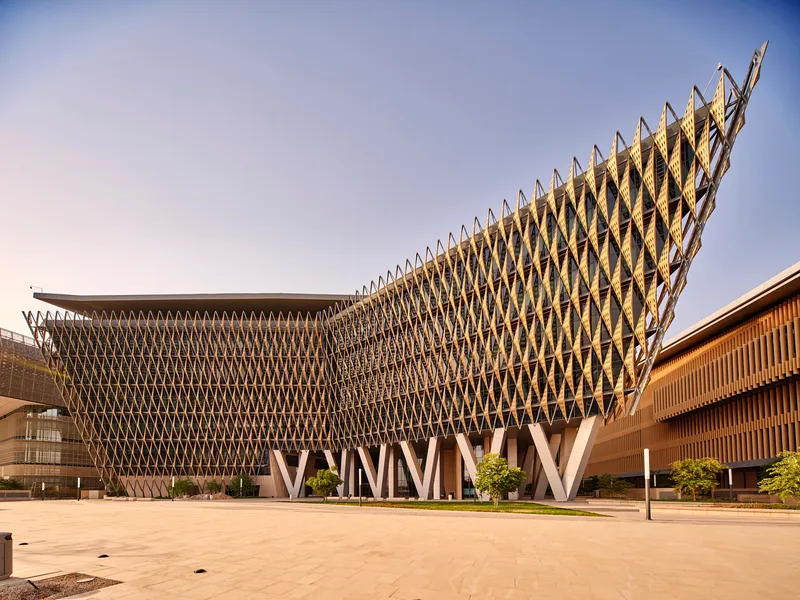
University buildings in the Gulf too often treat climate as an afterthought, sealing their interiors behind curtain walls and compensating with industrial air conditioning. The College of Life Sciences at Kuwait University's Sabah Al-Salem University City takes a different path. Designed by CambridgeSeven and Gulf Consult, the 74,322-square-meter complex wraps two buildings in a continuous skin of perforated aluminum panels arranged in a diamond pattern, a contemporary reworking of the mashrabiya that filters light, blocks dust, and manages solar gain across every orientation. The result is a campus that looks like it belongs in its environment rather than fighting it.
What makes the project genuinely interesting is the degree to which a single design idea, the perforated screen, organizes everything from the building's silhouette to its landscape to its interior atmosphere. The walls incline outward as they rise, creating self-shading geometry that reduces heat load on the progressively cantilevered slabs behind them. Inside, conical atria spiral upward through the section, drawing warm air to domed skylights and flooding interior floors with controlled daylight. It is a building whose form is the climate strategy, not a box with sustainability features bolted on.
The Screen as Architecture
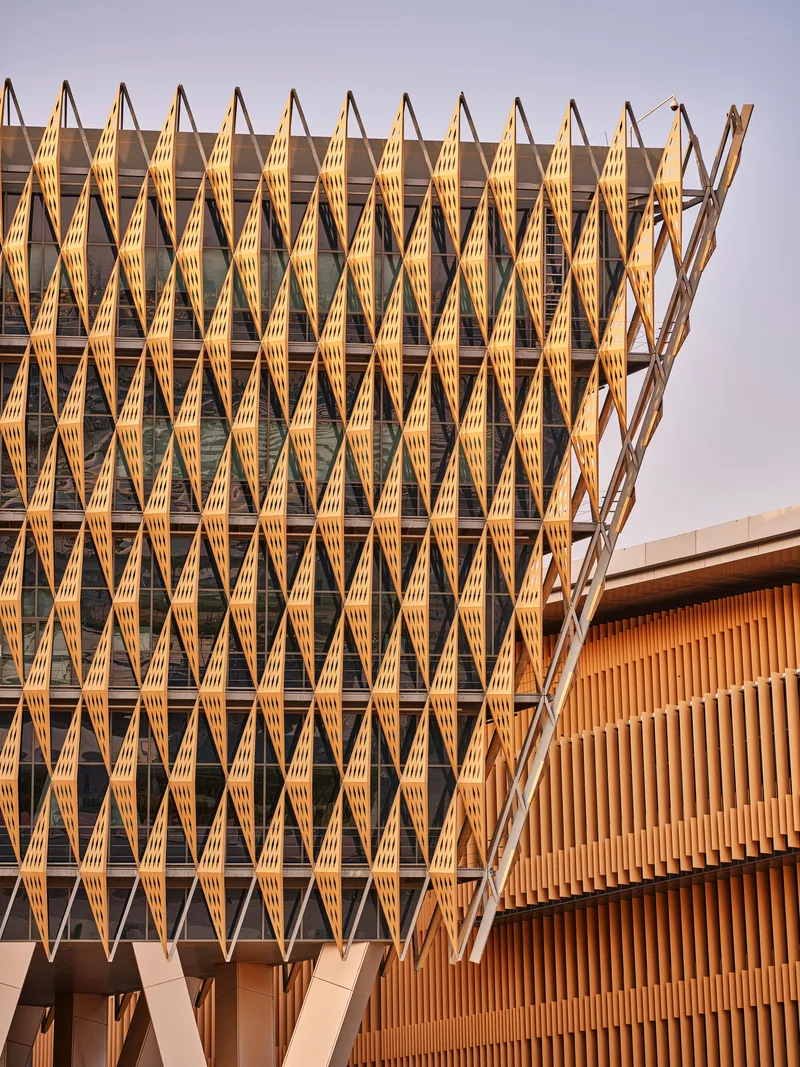
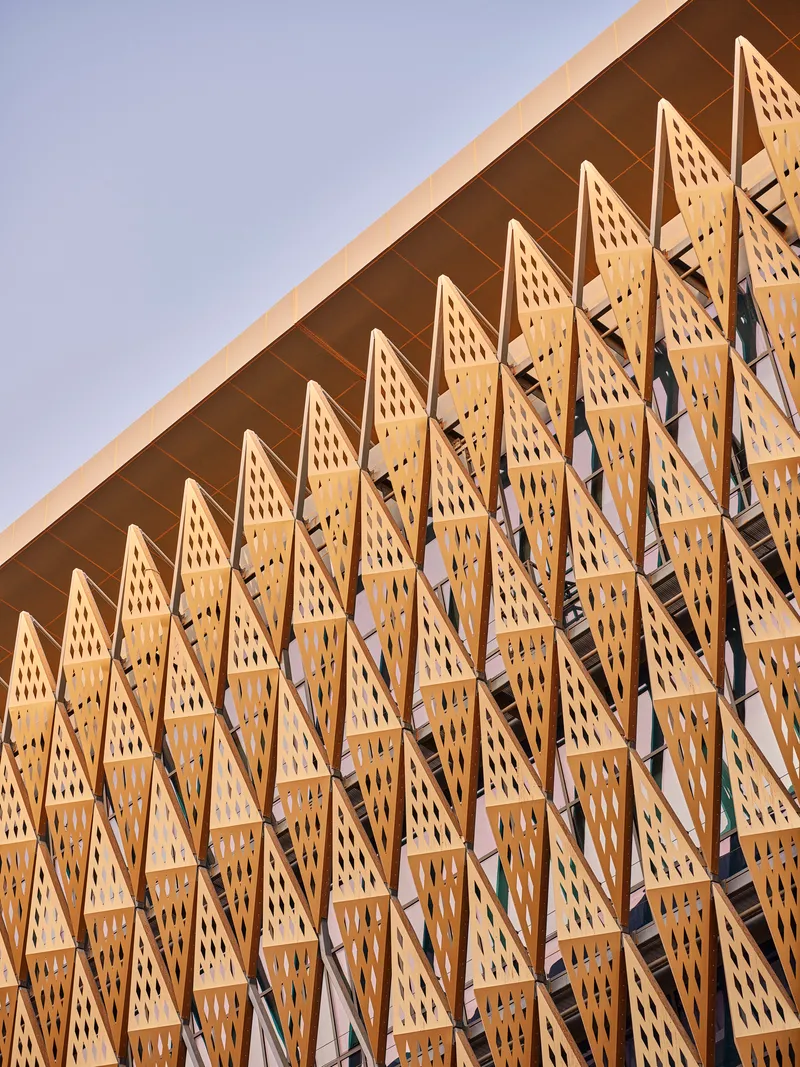
The diamond-shaped aluminum panels are the building's defining element and its most sophisticated piece of engineering. Each panel is 1/8-inch-thick aluminum, bent along its center line to catch and deflect light, with diamond-shaped perforations that modulate transparency. Parametric modeling stretched the diagonal grid so panels meet cleanly at corners, avoiding the awkward clipping that plagues many patterned facades. Aluminum was chosen over glass or terracotta specifically to reduce dead load on the cantilevered structure, a pragmatic decision that also delivers corrosion resistance in Kuwait's saline coastal air.
The panels are not uniform. On the southern and western facades, the louver system tightens, blocking the harshest direct radiation while still permitting views outward. On the north, the screen opens up to admit softer, diffused light. The effect is a building that reads as a single continuous envelope but actually performs differently on each face, responding to sun angles with the same logic that traditional Kuwaiti architecture used for centuries.
The Outward Lean
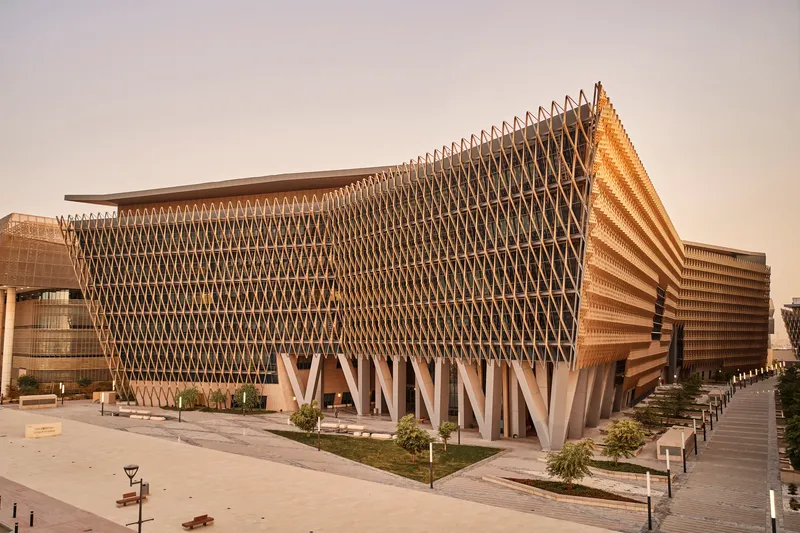
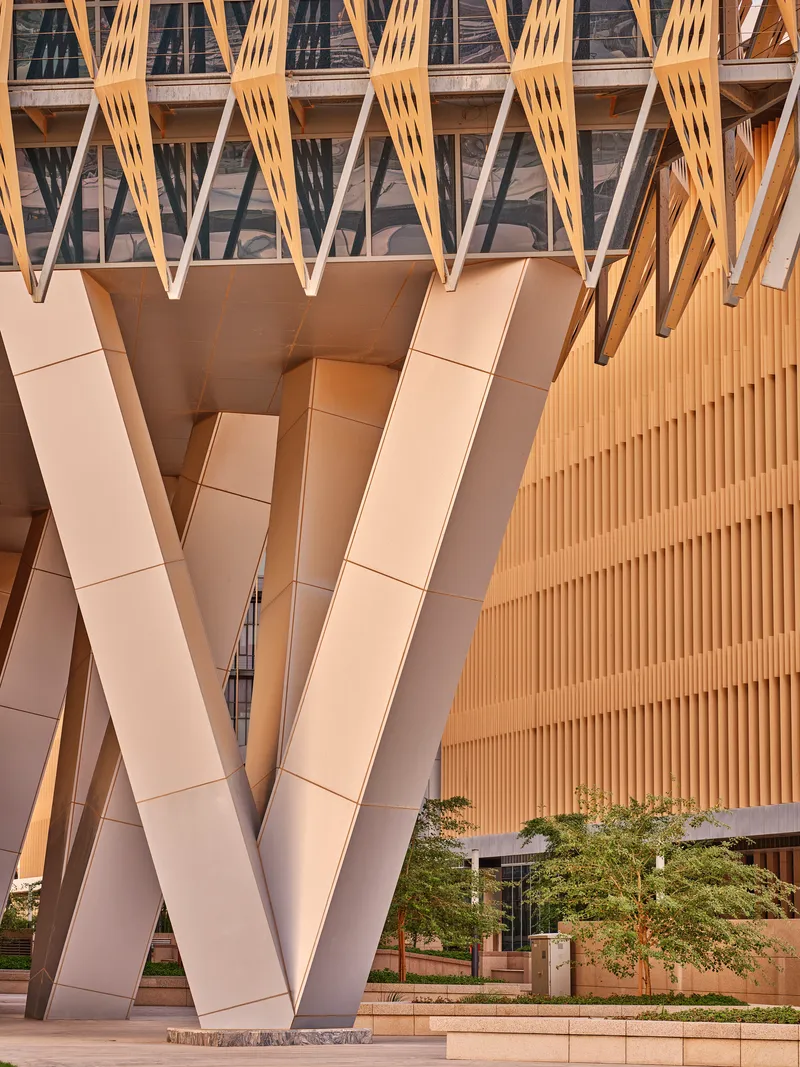
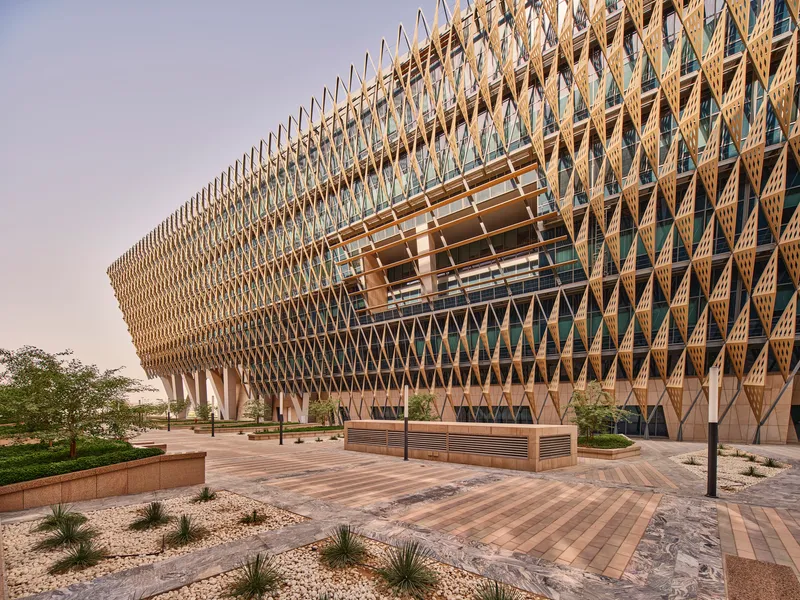
From the ground, the most striking formal move is the outward incline of the facades. As the floors rise, each slab cantilevers progressively beyond the one below, tilting the curtain wall away from vertical. The visual consequence is a building that appears to bloom upward from its base, supported at ground level by angular concrete columns that branch beneath the screen like the ribs of a tent. The structural consequence is equally important: the incline means upper floors shade lower ones, reducing solar exposure on the glass behind the screen without any added mechanical device.
Tubular steel outriggers extend from the glazing line to support the screen wall, with a secondary diagonal grid of smaller steel tubing holding individual panels in place. There is a clear visual separation between the inhabited glass volume and its protective outer layer, making the double-skin legible to anyone standing at the base. The 67,000 square meters of curtain wall across both buildings represent one of the largest such installations in the region, fabricated and installed by Wuhan Lingyun Building Decoration Engineering Co. Ltd.
Spiraling Atria
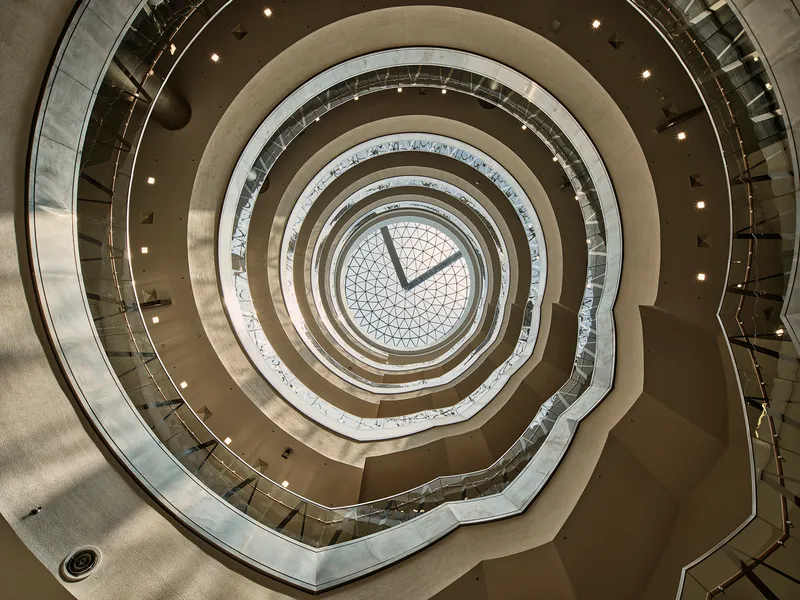
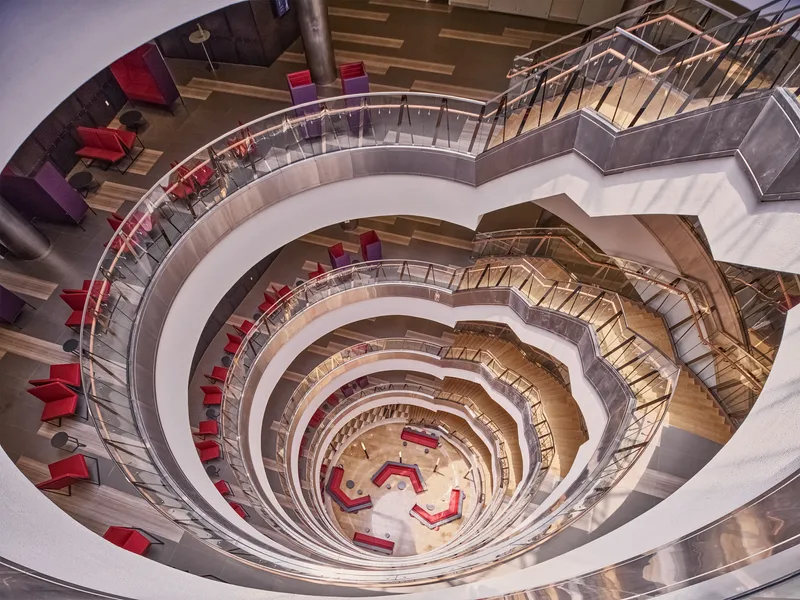
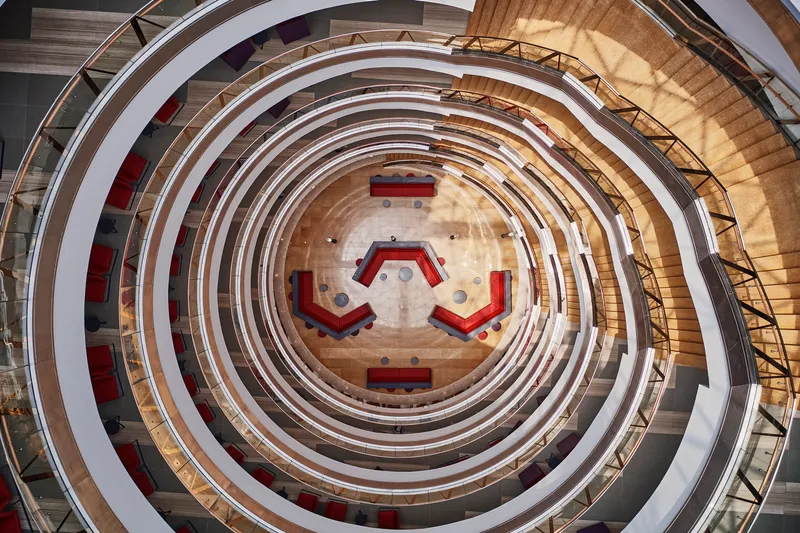
The interior section is organized around two multi-level conical atria, one in each building. A gently sloping spiral staircase encircles each void, connecting every level from ground to a domed skylight oculus at the top. Looking straight up, the concentric balcony rings create a tightening geometry that pulls the eye toward the daylight above. Looking down, the voids reveal the social life of each building: red upholstered seating pods, study clusters, and informal meeting spots arranged across the ground floors.
The two atria serve different programs. One centers on student services, housing a food court and casual meeting areas that function as the college's social heart. The other is publicly oriented, showcasing student work from labs and practicum clinics. The separation reflects the broader organization of the complex into two buildings for male and female students, each with its own entrance sequence and interior world, united by a shared architectural language.
Interior Atmosphere
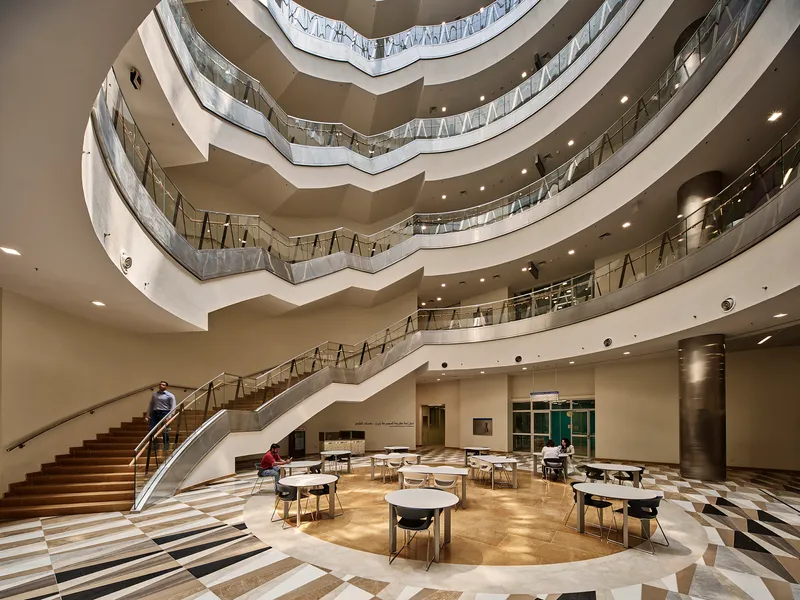
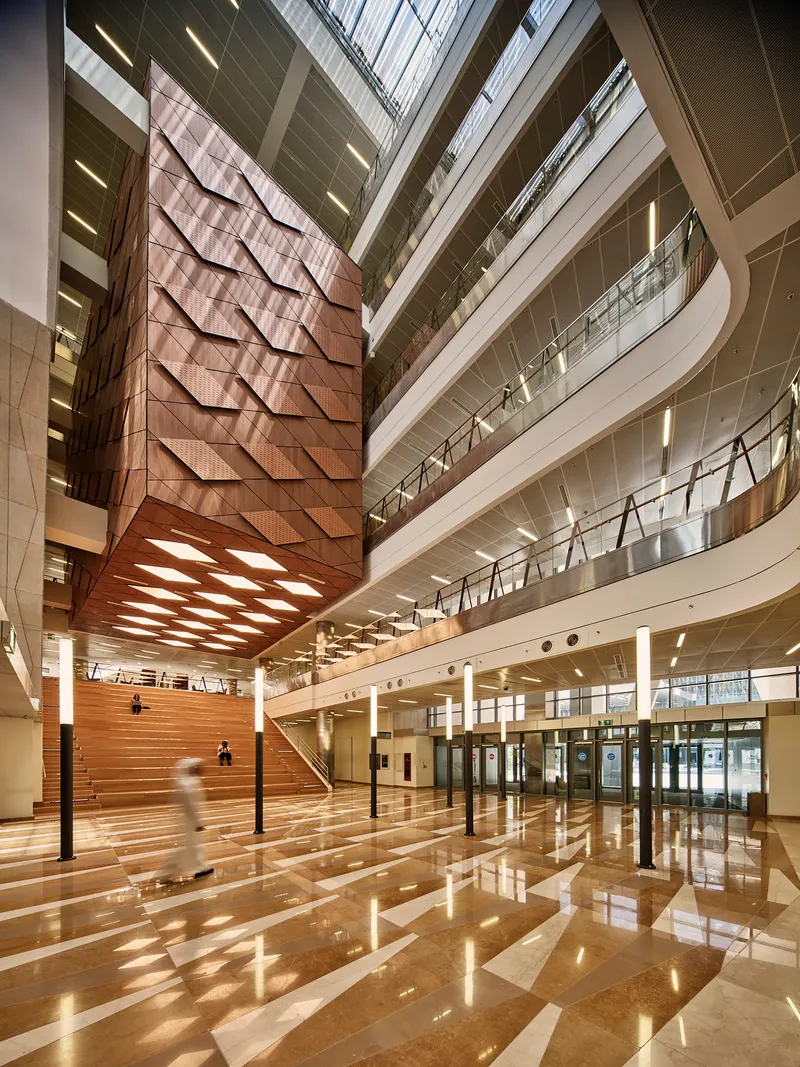
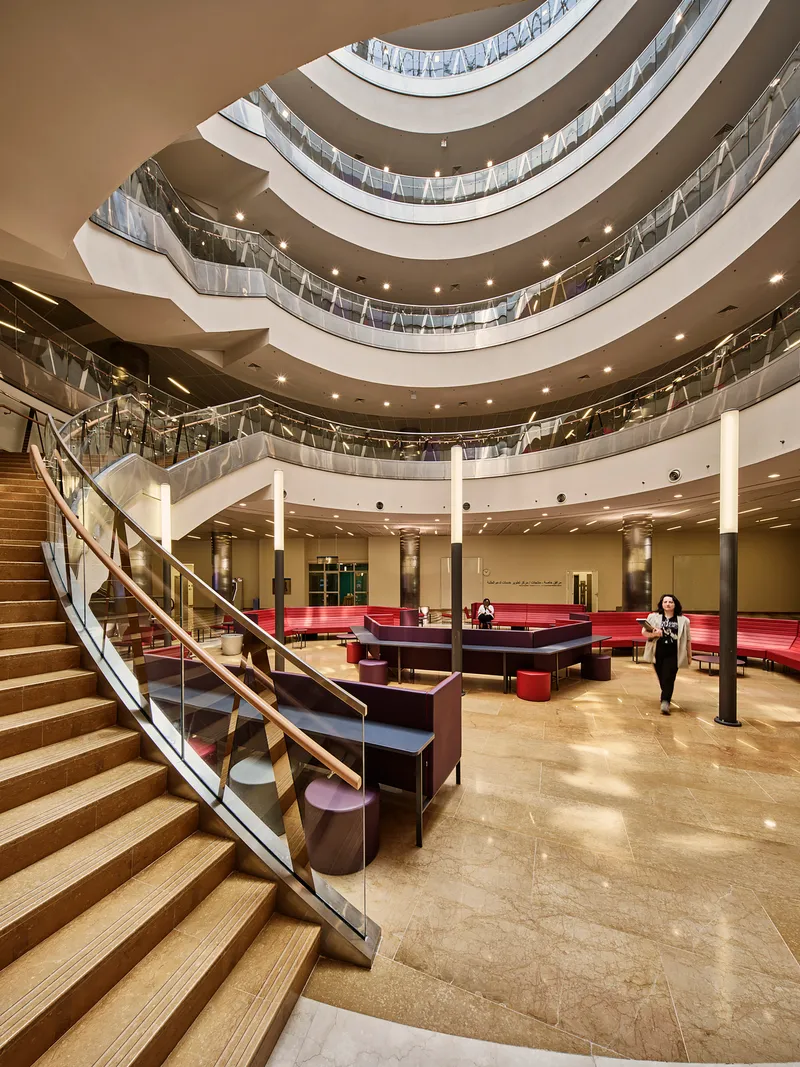
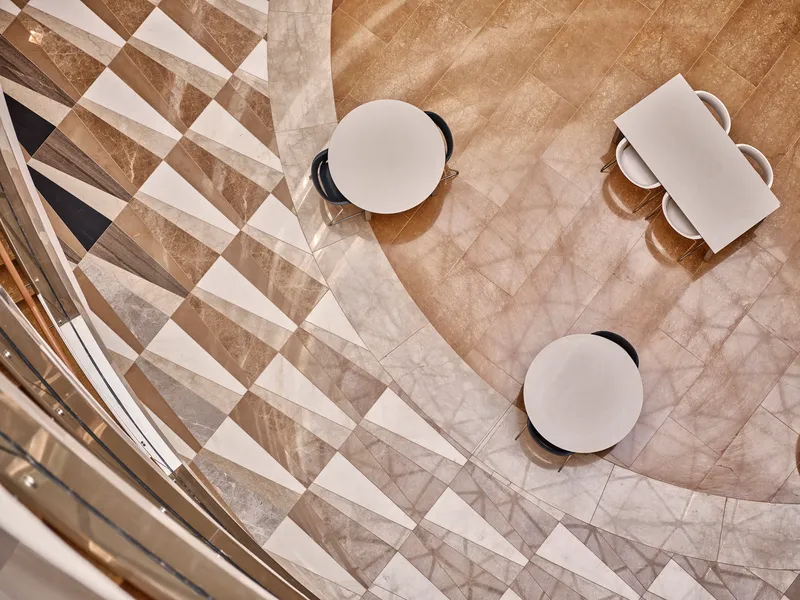
Inside the atria, the material palette shifts from the aluminum exterior to timber-clad surfaces, polished stone floors, and glass balustrades. Patterned stone flooring picks up the diamond geometry of the facade, creating visual continuity between outer skin and inner ground. Stepped timber seating platforms replace conventional furniture in some zones, encouraging students to occupy the atrium floors as landscapes rather than corridors. Diagonal shadow patterns cast by the skylight move across the marble floors throughout the day, an effect that reads as deliberate choreography rather than accident.
Specialized Rooms
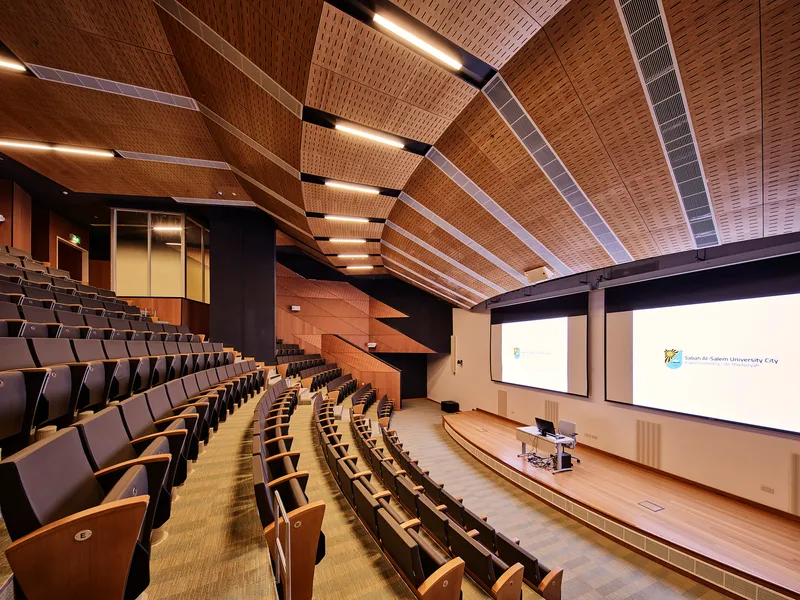
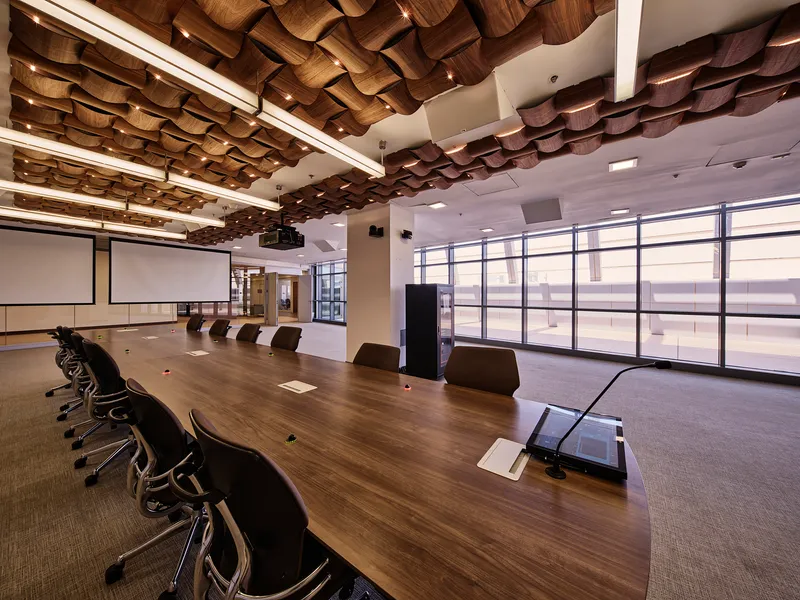
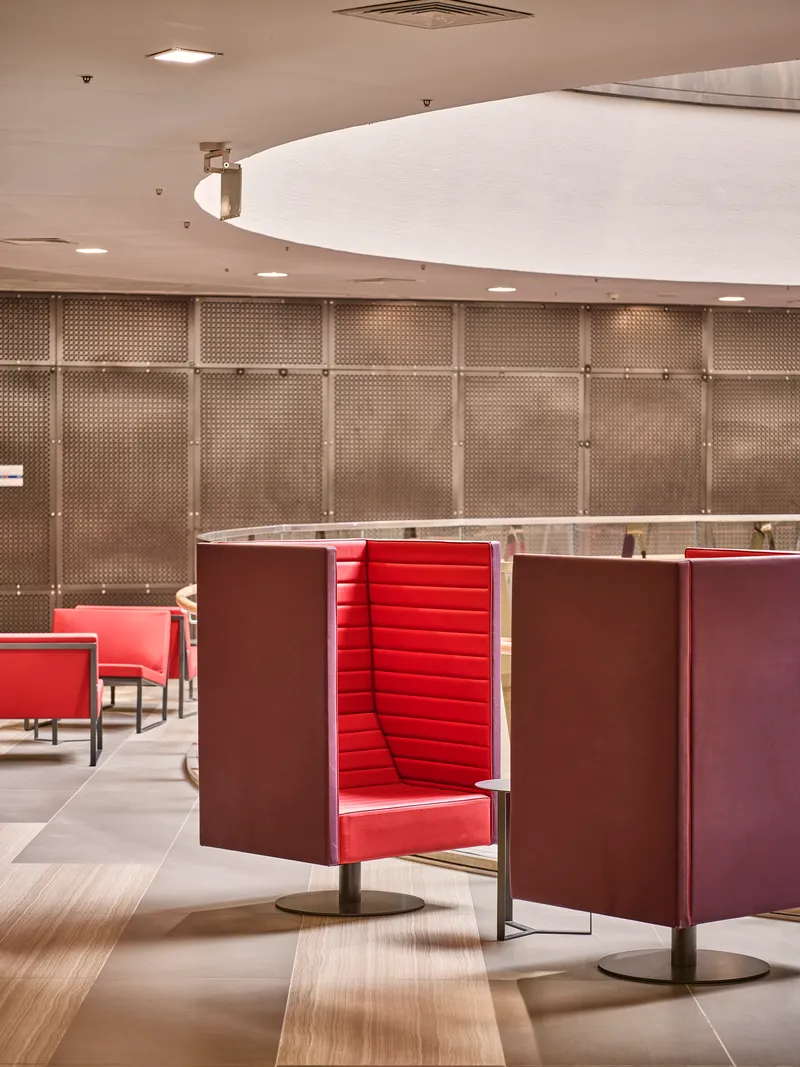
Beyond the atria, the college houses five departments, Art and Design, Communication Science and Language, Environmental Technology, Family Sciences, and Information Science, along with laboratories, lecture halls, an exhibit hall, prayer rooms, and a Food Production Demonstration Facility. The auditorium features tiered seating beneath a woven timber ceiling with integrated linear lighting, a warm acoustic shell that contrasts sharply with the bright, airy atrium spaces. A conference room wraps its occupants in sculptural ceiling panels above a full-height glass curtain wall, bringing the exterior screen into close visual proximity.
Red upholstered booth seating with privacy screens appears in informal study zones, offering acoustic separation beneath curved white ceiling soffits. These smaller-scale spaces acknowledge that a campus designed for 3,000 undergraduates and 300 graduate students needs both spectacle and intimacy.
Ground Plane and Landscape
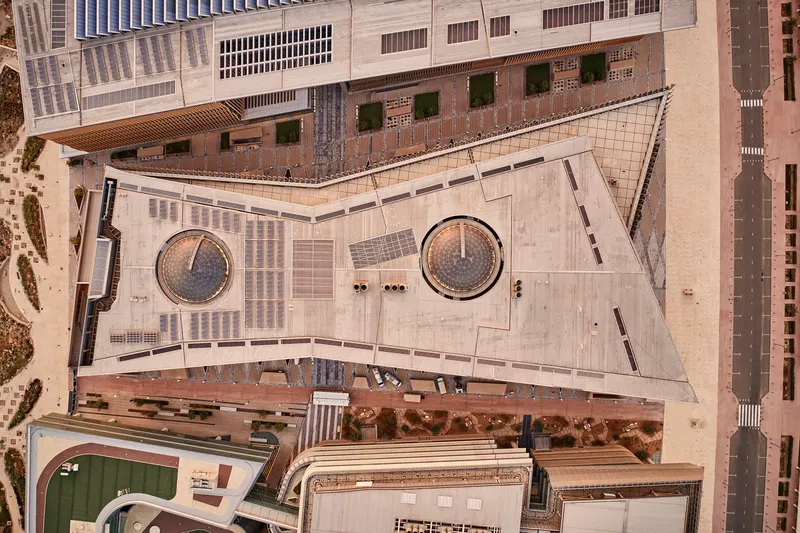
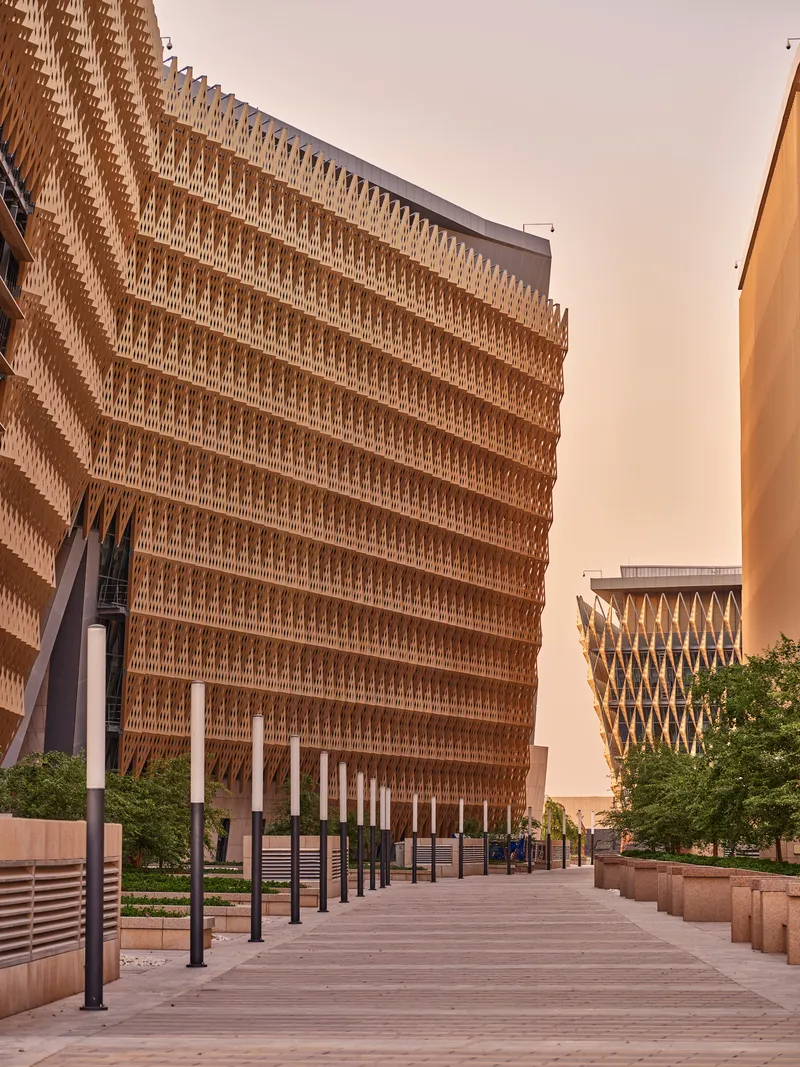
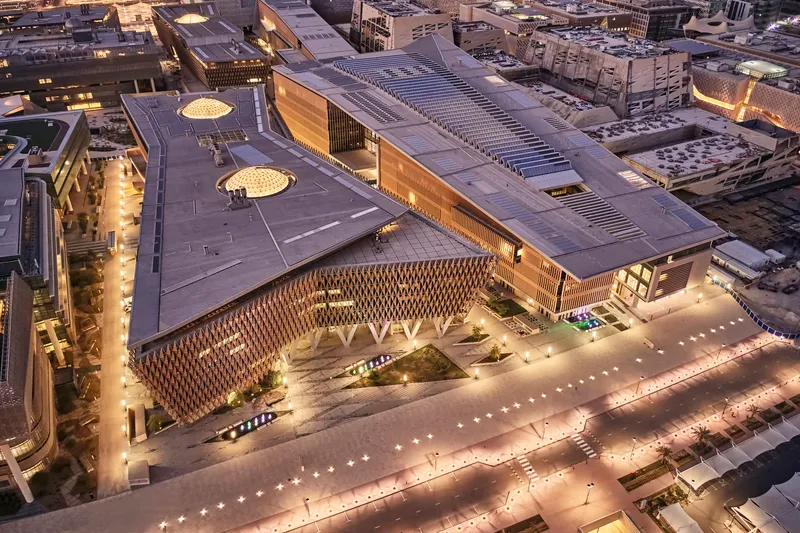
The angular geometry of the panel array carries into the building footprint and surrounding landscape. A triangular concrete plaza with circular planters establishes the entry sequence, its sharp angles echoing the diamond module of the facade. A planted corridor separates the two buildings, providing a shaded pedestrian spine that links them at ground level. At dusk, the illuminated plaza and the warm glow through the perforated screens transform the complex into a lantern visible across the flat Ardiya terrain. Young trees planted in the hardscape will, over time, soften the mineral palette, though in Kuwait's climate they will always read as deliberate interventions rather than natural growth.
Facade Detail
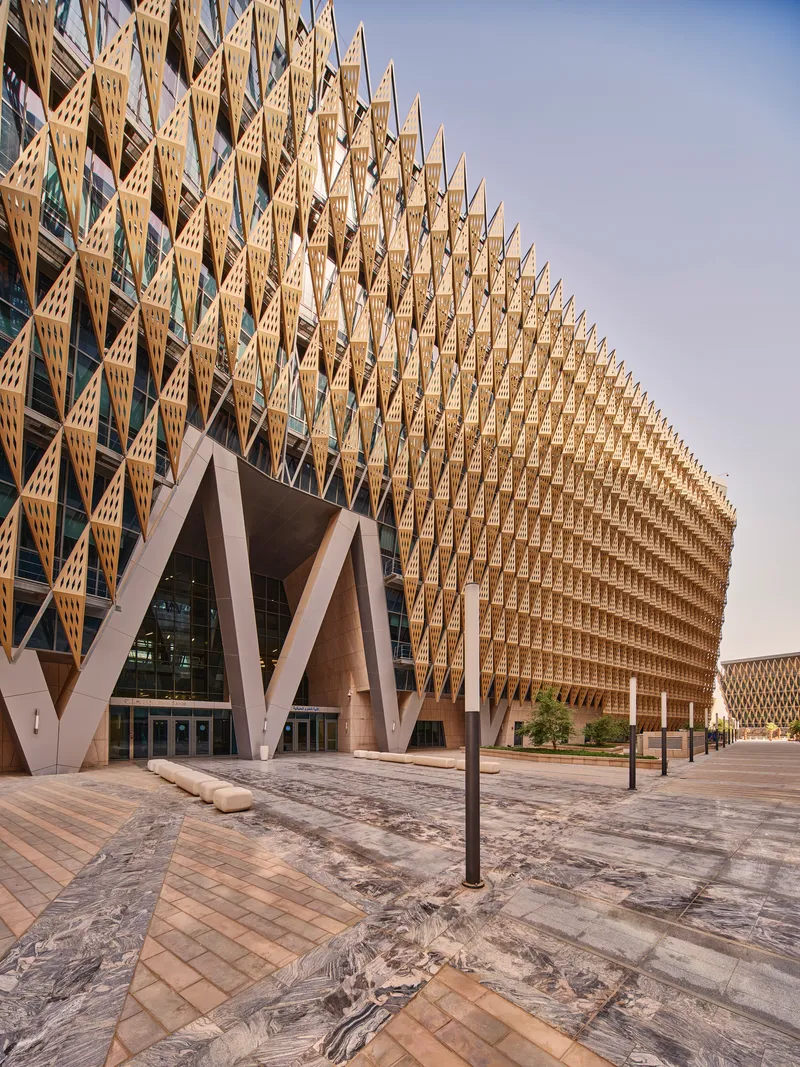
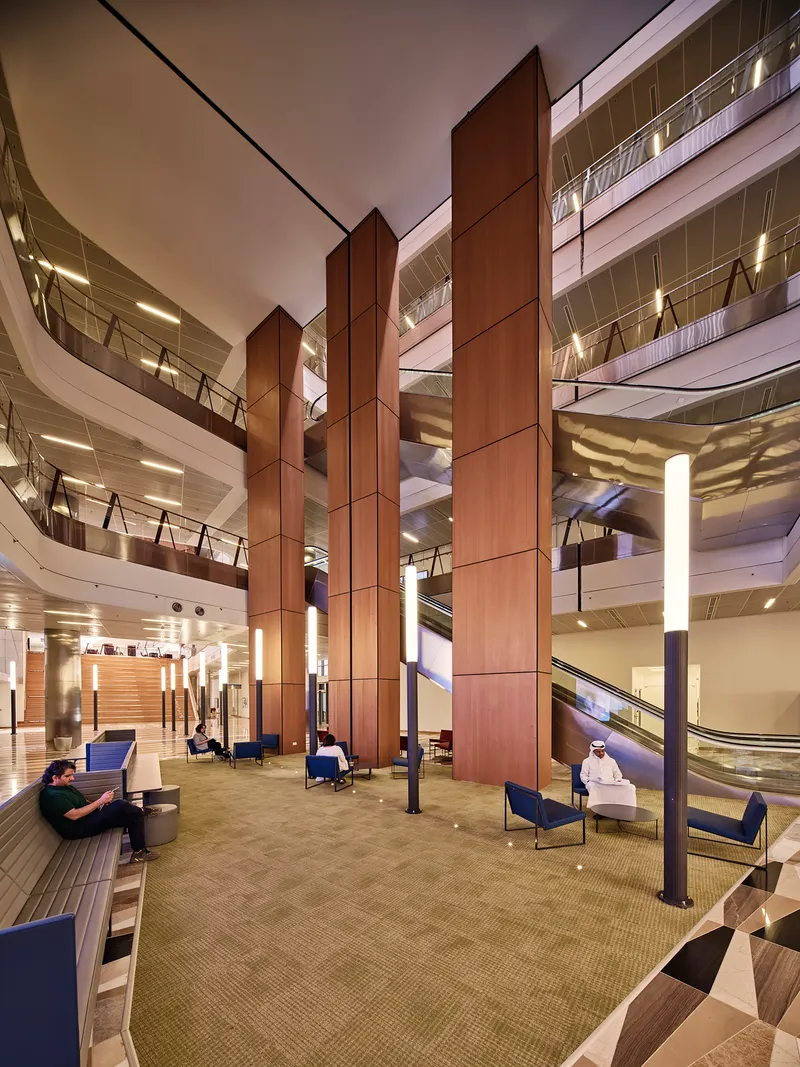
The dusk views reveal the layered depth of the facade system most clearly. Branching concrete columns at ground level create a porous base, allowing air and pedestrians to flow beneath the screen. Above, the aluminum panels read as a continuous textile draped over the building's mass, their perforations glowing with interior light. The lobby spaces behind the screen, with tall timber-paneled columns and carpeted seating, benefit from a quality of light that is neither fully interior nor fully exterior, a threshold condition that recalls the filtered privacy of the mashrabiya in domestic architecture.
Plans and Drawings
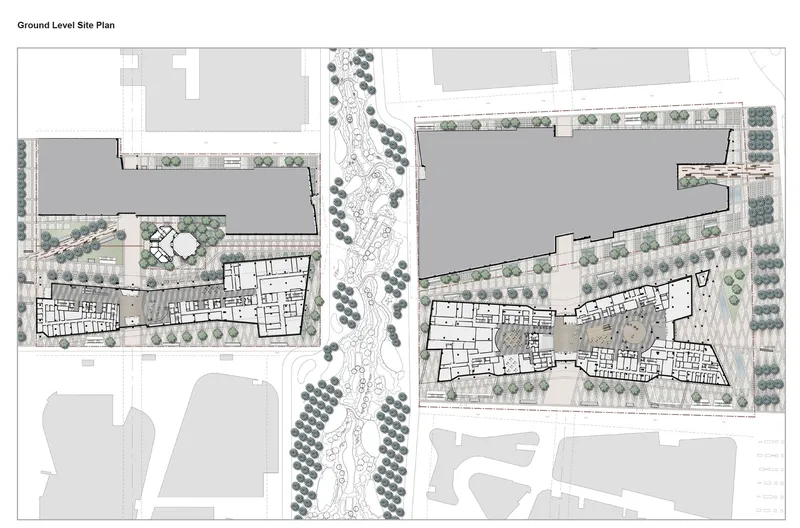
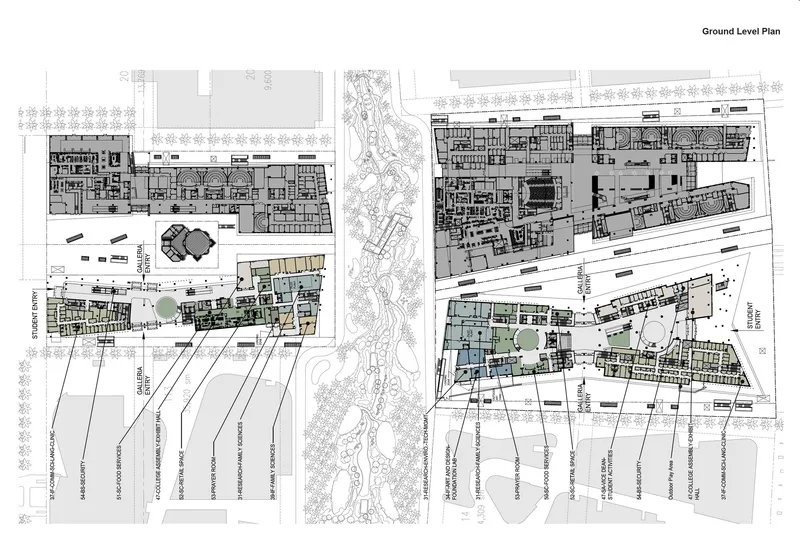
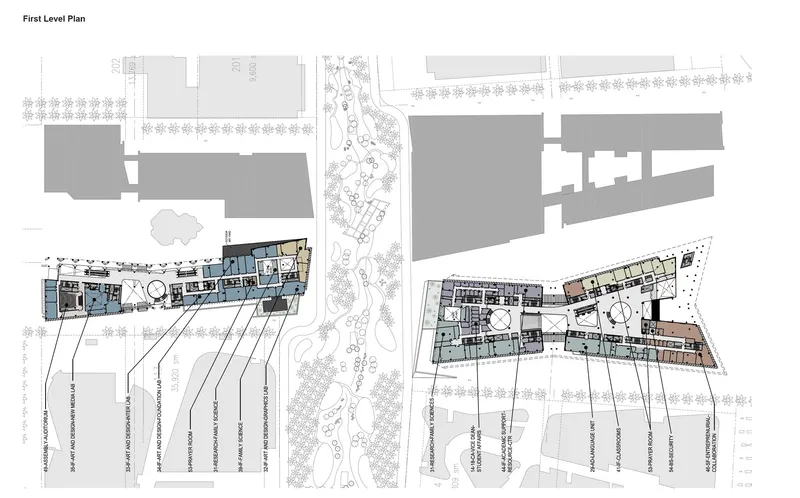
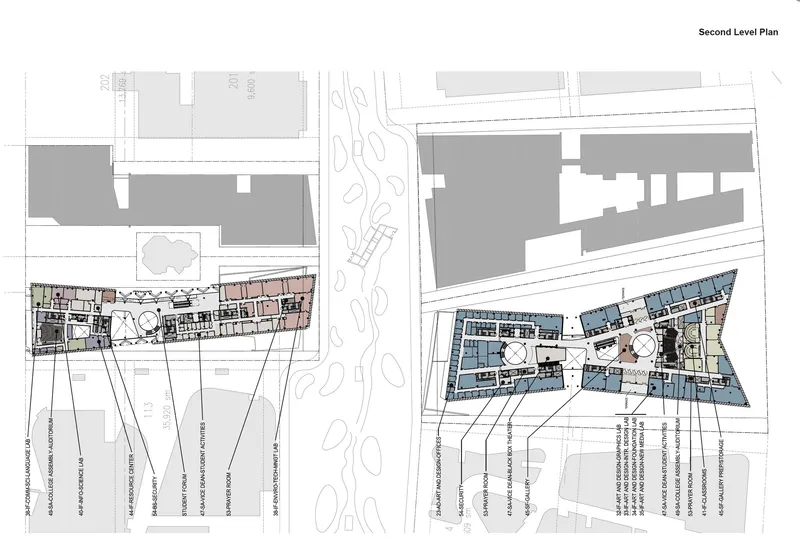
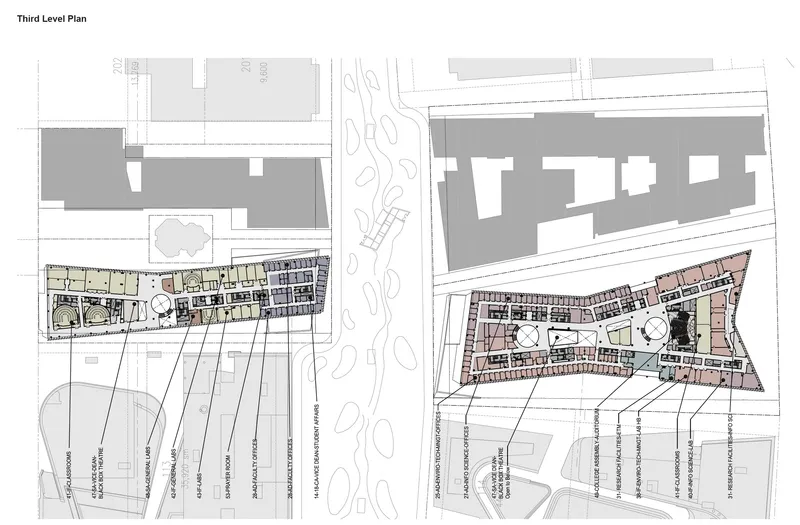
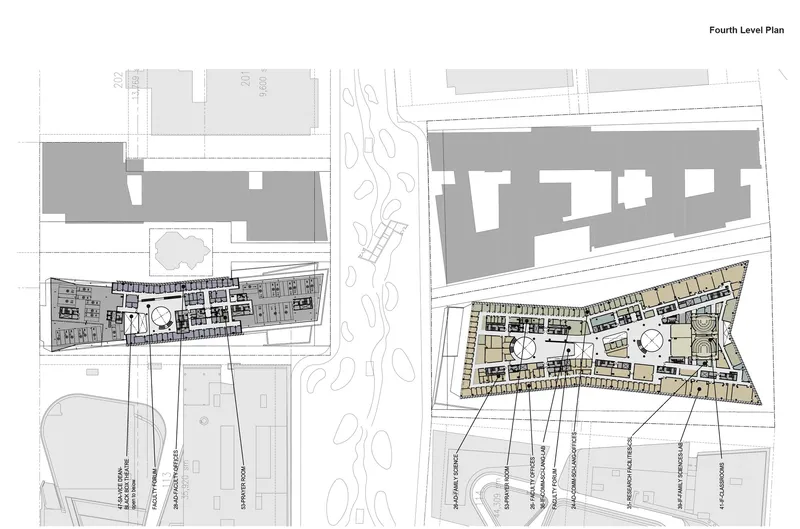
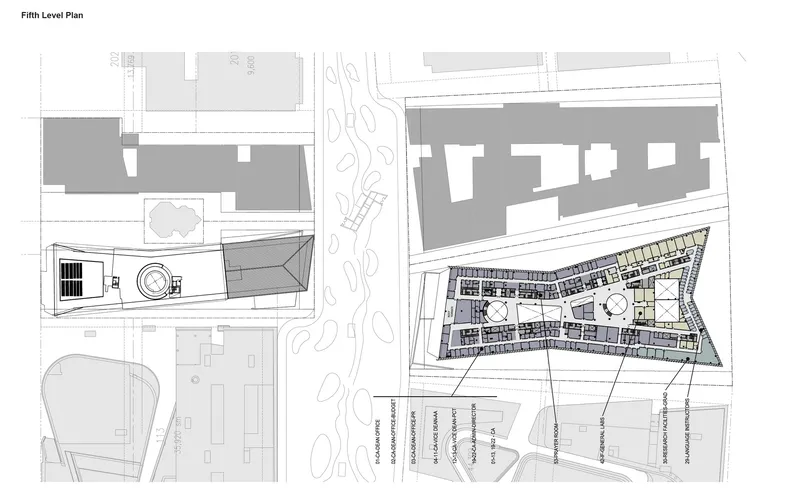
The site plan confirms the two-building strategy: paired volumes flanking a central planted corridor, each with its own circular atrium core. The ground-level plan reveals the separation of program zones by department, with color-coded areas indicating labs, classrooms, and administrative suites. As the plans ascend through the upper floors, the footprints pinch and reduce, reflecting the outward cantilever of the facade and the narrowing of program toward faculty offices and specialized rooms at the top. The fifth-level plan shows the reduced floor area at roof level, where voids and mechanical equipment replace habitable space. The diagonal street annotations on the second-level plan locate the buildings within the larger grid of Sabah Al-Salem University City.
Why This Project Matters
The College of Life Sciences matters because it demonstrates that environmental performance and formal ambition can be the same thing. The perforated screen is not a decorative appliqué; it is the building's primary climate device, its structural logic, and its cultural reference simultaneously. In a region where universities have often defaulted to imported typologies, sealed glass boxes with oversized cooling plants, this project proves that looking backward to vernacular strategies like the mashrabiya and the wind tower can produce architecture that is technically advanced and spatially generous.
CambridgeSeven and Gulf Consult have also made a convincing argument for the double-skin facade in extreme heat climates, not as a luxury specification but as a practical response to solar radiation, dust, and wind. The parametric refinement of the panel array, calibrated facade by facade for orientation, moves well beyond the performative parametricism that dominated Gulf architecture in the 2010s. Here, computation serves climate, and climate shapes form. That equation, simple as it sounds, remains rare.
Kuwait University College of Life Sciences, designed by CambridgeSeven and Gulf Consult. Located in Ardiya, Kuwait. 74,322 square meters. Completed in 2020. Photography by Mohammad Taqi.
About the Studio
Share Your Own Work on uni.xyz
If projects like this are the kind of work you want to make, uni.xyz is a place to publish your own, find collaborators, and enter design competitions.




Popular Articles
Popular articles from the community


Conexión: Biophilic Design Reimagines High-Rise Living in Hong Kong
Conexión reimagines high-rise living in Hong Kong through biophilic design, green facades, shared spaces, daylight, water and nature within.

The Musturak Paradise: Senior Living Architecture for a Connected Future in Temara, Morocco
The Musturak Paradise reimagines senior living architecture in Temara via private homes, social spaces, culture, community, and shared care.

Riyadh For All: Intergenerational Urban Design for Active Aging in Rabat
Riyadh For All reimagines urban design in Rabat with intergenerational co-living, adaptive courtyards, and Moroccan cultural exchange today.

Hill & Cross Opera: Sculptural Opera House Architecture Shaped by Tallinn’s Landscape and Identity
Hill & Cross Opera reimagines opera house architecture in Tallinn through its sculptural hill, civic plaza, glass wave and a luminous cross.


Similar Reads
You might also enjoy these articles

Bao Huynh Watercolor Atelier: A Serene Art Retreat in Hội An
Bao Huynh Watercolor Atelier in Hội An blends multifunctional art spaces, sustainable design, local materials, and family-friendly living in a serene environment.

Atelier Macri Concept Store Interior Design by CASE-REAL
Atelier Macri store features a "ko" counter, walnut wood details, cork displays, blending retail, gallery, and seamless customer experiences.

Manuel Vargas Izquierdo Stadium and High-Performance Sports Center: Architectural Excellence in Jalpa de Méndez
The Manuel Vargas Izquierdo Stadium blends sustainable design, inclusive sports facilities, and cultural-inspired architecture, revitalizing Jalpa de Méndez’s public spaces.

KAKR Buluh Awar Hall: Revitalizing Community and Ecology Through Bamboo Architecture
Community built bamboo hall revitalizes Buluh Awar village, empowering youth, restoring ecology, celebrating vernacular craftsmanship through sustainable architecture and culture.





Comments (0)
Please login or sign up to add comments
No comments yet. Be the first to comment!