

Angela Castilho Builds a Wabi-Sabi Retreat in Brazil's Cerrado Highlands
Capim Cidró House in Alto Paraíso de Goiás pairs raw materials and bioclimatic strategy with the Japanese philosophy of imperfection.


Alto Paraíso de Goiás sits on the edge of the Chapada dos Veadeiros plateau, a region of red-earth cerrado, quartz-rich soil, and mountain horizons that stretch to a vanishing point. It is the kind of landscape that makes buildings feel either entirely right or embarrassingly wrong. Angela Castilho Arquitetura e Interiores chose to make Capim Cidró House feel inevitable: two offset volumes linked by pergolas and bamboo-covered walkways, framing courtyards that pull the plateau's light and air directly into the plan.
What makes the project worth studying is not the Wabi-Sabi label, which risks becoming a marketing shorthand, but the discipline with which the team actually commits to it. Every surface here is either raw or aging: concrete left to patina, timber beams exposed to the sun, woven reed ceilings that will shift color over the years. Automation technology runs quietly underneath, but nothing in the material palette signals newness for its own sake. The result, at 3,358 square feet, is a house that reads as both a finished object and a process still underway.
Two Volumes, One Conversation

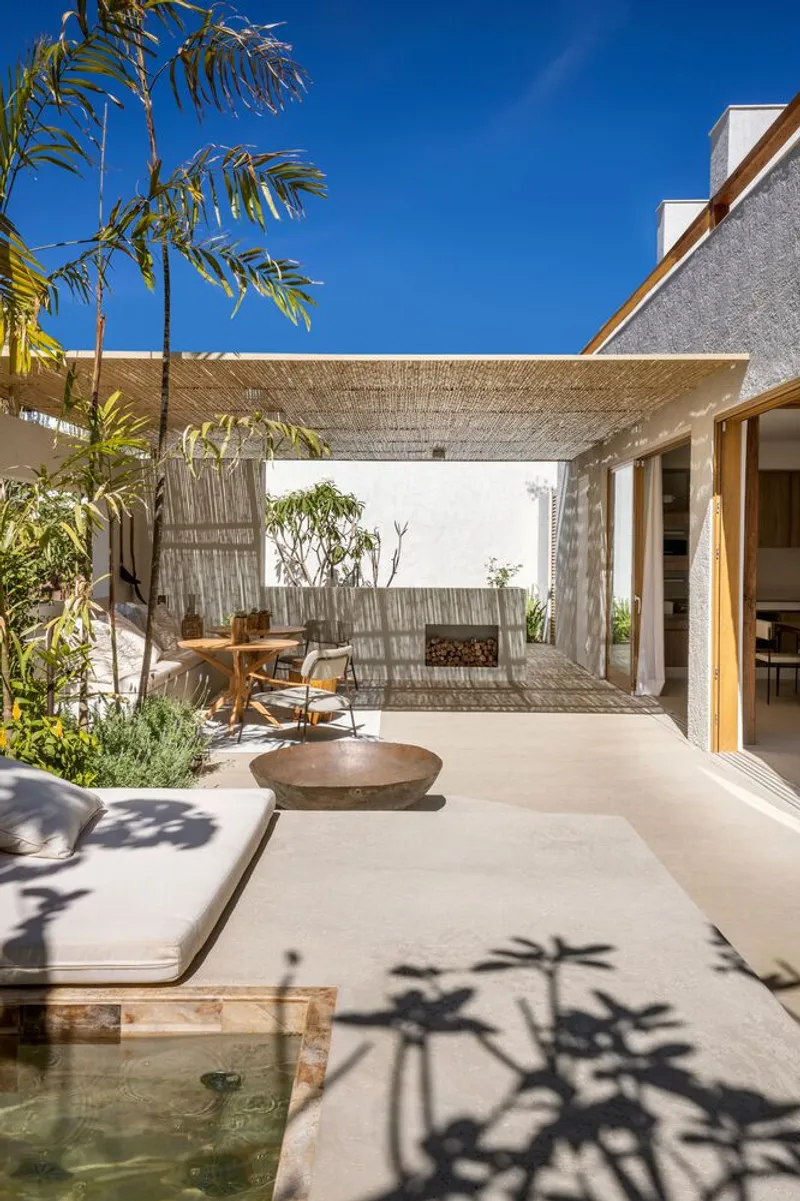
The street facade is deliberately reticent: white stucco walls, timber garage doors, and an upper volume that registers as a simple box against the sky. It gives almost nothing away. Walk through the threshold and the architecture opens up completely into a courtyard defined by a woven reed pergola, a shallow reflecting pool, and clusters of palms. The shift from closed to open is total and immediate.
By splitting the program into two offset volumes, Castilho generates cross-ventilation paths and multiple courtyard conditions without relying on a single large footprint. The metallic pergolas that connect the volumes act as climate buffers: shaded but open, they mediate between interior cool and exterior heat in a way that a sealed corridor never could.
Courtyards as Rooms Without Ceilings
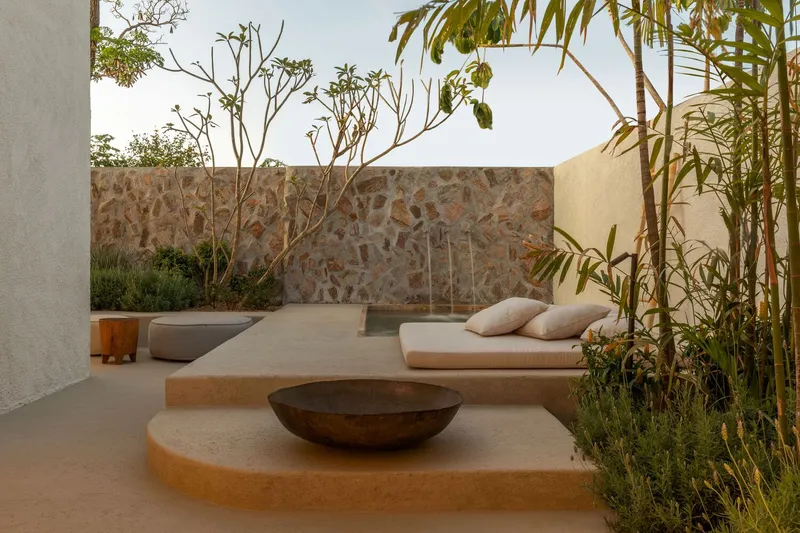
The courtyards at Capim Cidró are not leftover space between buildings. They are the most deliberately designed rooms in the house. A stone mosaic wall and built-in concrete seating turn one courtyard into a gathering space that feels carved rather than assembled. Landscaping by Paulo Prata introduces native planting that roots the project in its cerrado context rather than importing a generic tropical garden.
The second courtyard, with its reed pergola and reflecting pool, serves the social program of the ground floor: the dining table sits directly beneath the woven canopy, and the pool catches afternoon light and throws it back onto the surrounding walls. It is outdoor living in the truest sense, where climate and program align without air conditioning.
Timber, Concrete, and the Texture of Time
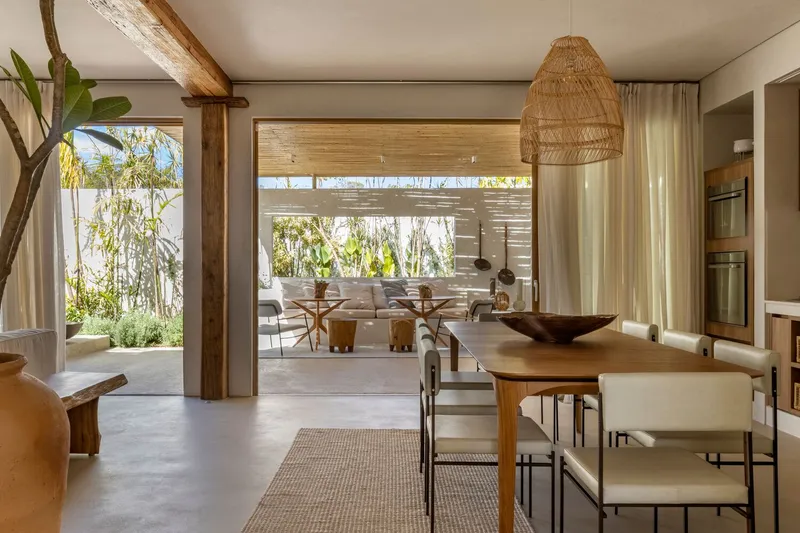

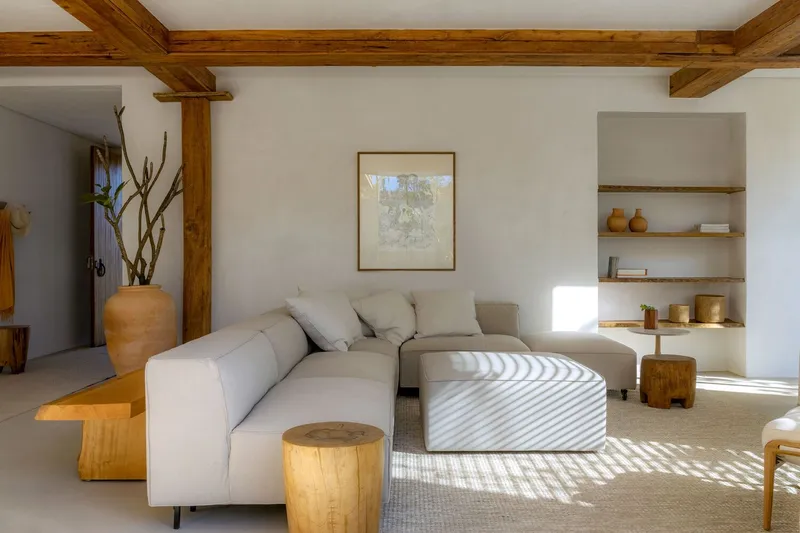
The material strategy is restrained to a fault, and that is the point. Concrete floors run continuously through the ground level, absorbing thermal mass and providing a cool base during hot months. Timber beams span the ceilings in their natural grain, unfinished and warm against the grey concrete below. A woven pendant light in the dining zone echoes the reed ceilings elsewhere, creating a through-line of artisanal craft.
In the living room, open shelving and timber cabinetry replace upper walls, keeping sight lines long and allowing light to pass through the plan. The neutral palette is not about minimalism as an aesthetic preference. It is functional: every surface is calibrated to age gracefully without maintenance, so the house will look better at ten years than at one. That is the real promise of Wabi-Sabi, and Castilho's team delivers on it structurally, not just decoratively.
Light as Material
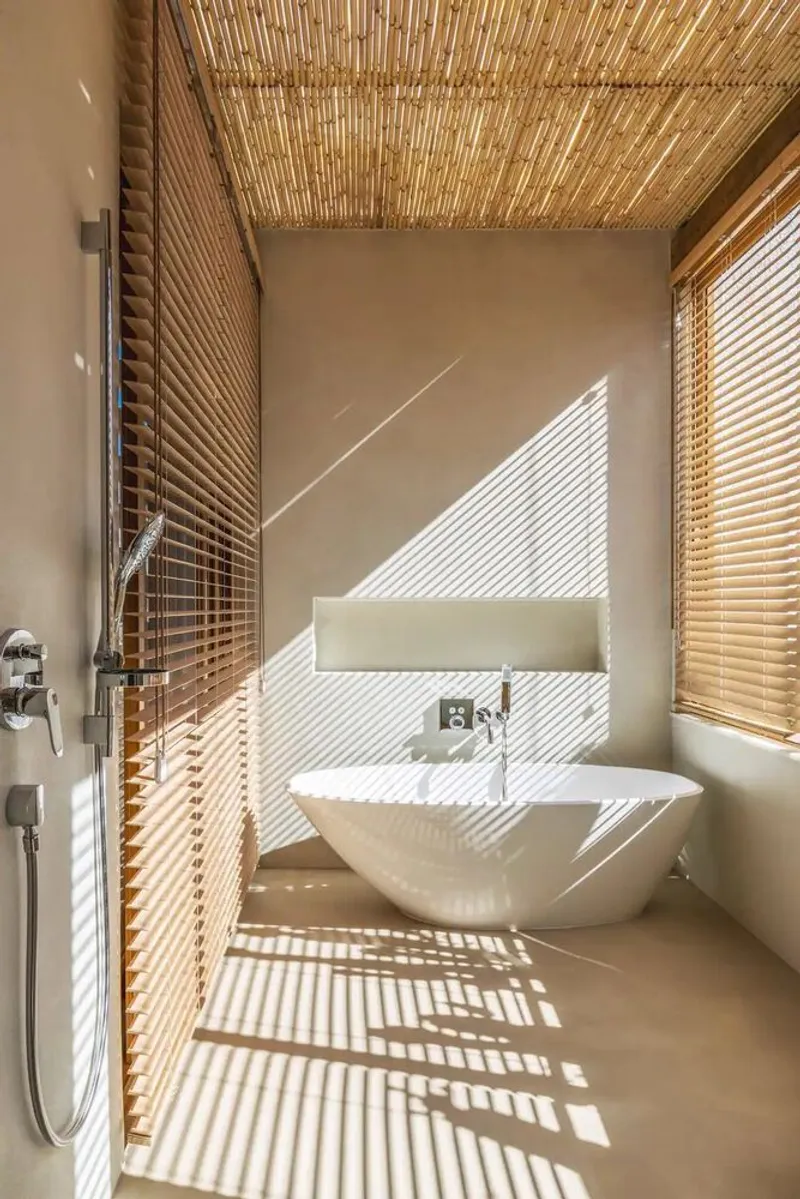
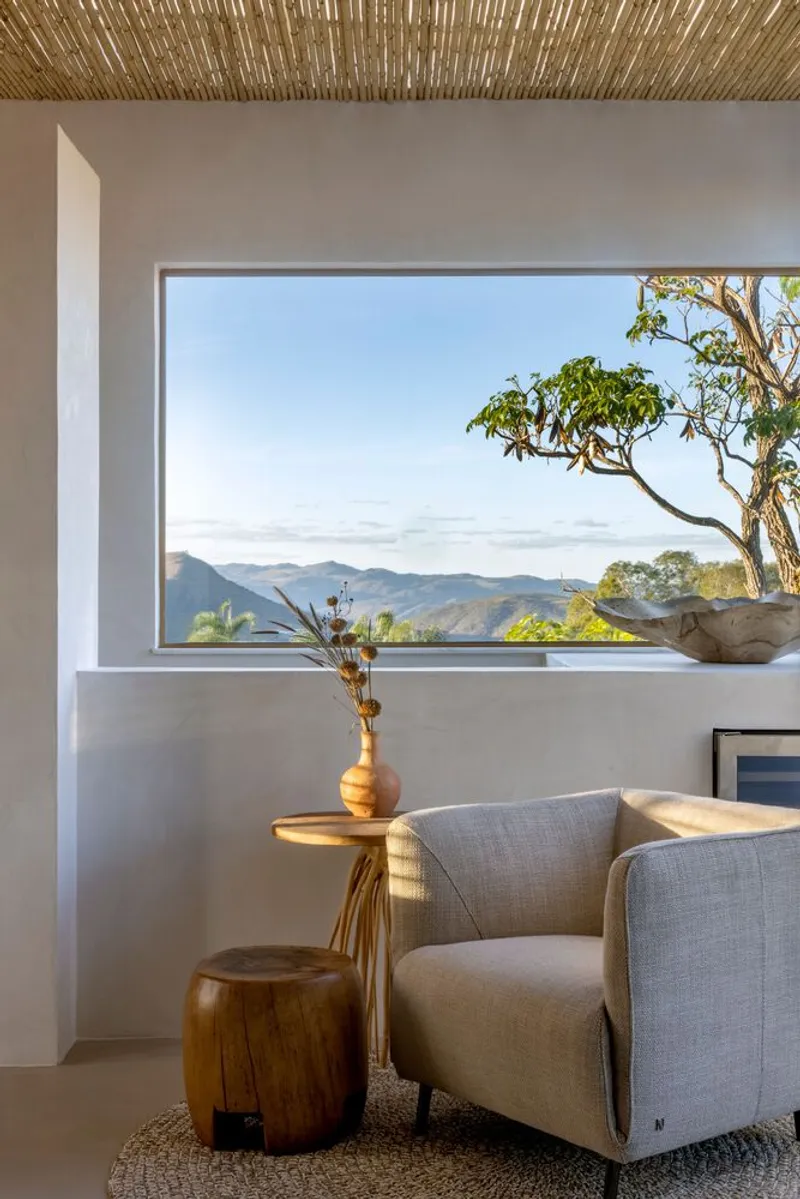
Two images in particular reveal how seriously the architects treat sunlight as a building material. In the bathroom, timber blinds and a woven reed ceiling collaborate to cast striped shadows across a freestanding tub, turning an everyday room into a cinematic event that changes hourly. In an interior corner upstairs, a horizontal window frames the mountain horizon while the reed ceiling above filters light into a soft, dappled texture.
These effects are not accidental. The house is oriented to maximize natural light penetration while using bamboo shading and deep overhangs to manage the cerrado's intense solar gain. The result is an interior where you always know what time of day it is, a quality that slow-living retreats often promise but rarely achieve through architecture alone.
Private Quarters and the Upper Veranda

The two bedrooms and three bathrooms are distributed between the volumes, keeping the private program quiet and separate from the social ground floor. A hallway framed by timber louvered doors and a compact desk niche shows how carefully the interstitial spaces are treated: nothing is wasted, and every threshold doubles as a moment of visual framing.
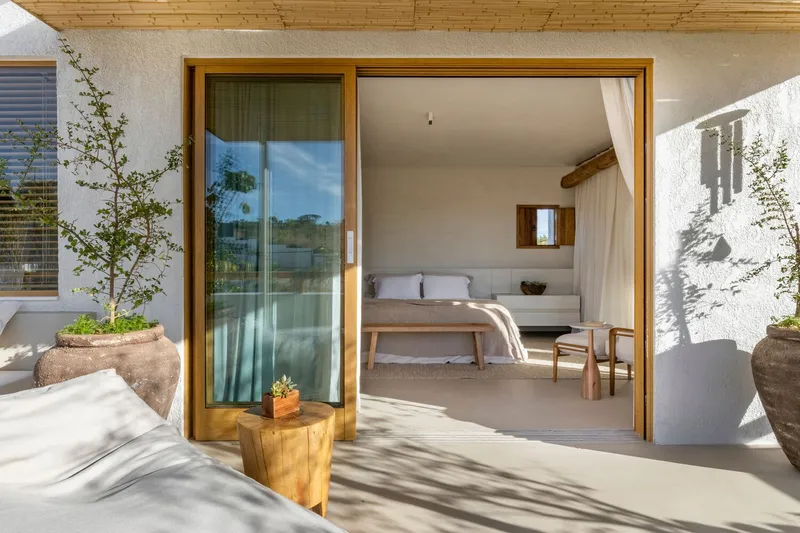
Upstairs, a generous veranda opens directly to the mountain panorama. Timber-framed glazed doors fold back to erase the boundary between terrace and bedroom, and a wood plank soffit extends the interior ceiling plane outward, so the transition feels continuous rather than abrupt. It is a simple move, executed precisely, and it gives the upper level a quality of weightlessness that the grounded lower floor deliberately avoids.
Why This Project Matters
The real achievement of Capim Cidró House is not that it applies a Japanese aesthetic philosophy to a Brazilian landscape. It is that the philosophy is embedded in the construction logic itself. Bioclimatic orientation, natural ventilation paths, aging-friendly materials, and courtyard-driven planning are all strategies rooted in climatic common sense. Wabi-Sabi here is not a mood board; it is an argument for building less and building better.
Angela Castilho's team proves that a retreat does not need spectacle to command attention. In a market saturated with resort-scale vacation homes clad in imported stone and forced luxury, this 3,358 square-foot house in the cerrado highlands makes a convincing case for restraint, honesty, and the slow accumulation of character over time.
Capim Cidró House by Angela Castilho Arquitetura e Interiores. Alto Paraíso de Goiás, Brazil. 3,358 sq ft. Completed 2023. Landscaping by Paulo Prata. Engineering by Marco Antônio Soares de Camargo Filho. Photography by Edgard Cesar.
About the Studio
Share Your Own Work on uni.xyz
If projects like this are the kind of work you want to make, uni.xyz is a place to publish your own, find collaborators, and enter design competitions.




Popular Articles
Popular articles from the community


Riyadh For All: Intergenerational Urban Design for Active Aging in Rabat
Riyadh For All reimagines urban design in Rabat with intergenerational co-living, adaptive courtyards, and Moroccan cultural exchange today.

Play: Fragments of Their World
Familiar architecture becomes modular playground design, creating safe spaces where displaced children can learn, connect, imagine and play.

Conexión: Biophilic Design Reimagines High-Rise Living in Hong Kong
Conexión reimagines high-rise living in Hong Kong through biophilic design, green facades, shared spaces, daylight, water and nature within.

Lunar Spiral: Space Architecture Shaped by the Mathematics of the Universe
Lunar Spiral reimagines space architecture through Fibonacci geometry, lunar regolith, levitating habitats, and self-sustaining Moon living.


Similar Reads
You might also enjoy these articles


Hodi-Mandai Geram
Project Function: Preservation and revitalization of the Intangible heritage and socio-spatial identity of the Hodi by Housing, Cultural Memory Center, Sacred Grove, landscape, local tourism economy


Olio Towers: A Mid-Rise for Performers That Fuses Housing, Rehearsal, and Stage
Located blocks from Houston's Theater District, this modular tower stacks living units around a central performance atrium.

Oasis: Modular Green Housing Carved into Dhaka's Urban Fabric
A shortlisted Plugin Housing entry reclaims unauthorized settlements in Dhaka with stepped concrete volumes, green roofs, and ventilation-driven design.

Black Hole: A Floating Megastructure for the Post-Physical Era
Emiliano Mazzarotto envisions a spherical, self-scaling arena where e-sports, digital hotels, and holographic stadiums replace traditional public space.


Explore Architecture Competitions
Discover active competitions in this discipline



Challenge to reimagine the Iron Throne


Photograph architecture without architects


Illustrate the lost glory of Angkor Wat - Render Challenge


Design challenge to reuse E-waste
Comments (0)
Please login or sign up to add comments
No comments yet. Be the first to comment!