
Caramel Architekten Folds a Green Roof Down to Earth in an Austrian Hilltop House
House Mesh in Hagenberg im Mühlkreis wraps lightweight timber and corrugated aluminum around a five-meter living room open to the landscape.

Most green roofs sit flat, a polite ecological gesture that disappears the moment you step inside. House Mesh by Caramel Architekten treats its planted surface as the largest space-forming element of the entire building, folding and cutting the landscape so that it slopes down to meet the terrain on one side and cantilevers over a double-height living room on the other. The vegetation layer stripped during excavation was literally returned to the roof, closing a material loop that also serves as the primary sun and heat shield for the southwest facade.
Located in Hagenberg im Mühlkreis near Linz, the house reads as two interlocking volumes: a raw corrugated aluminum box perched on the slope, and a glass-walled living pavilion sheltered beneath the overhanging roof. The brief called for a future-oriented approach to materials and a building that belonged to its site. Caramel answered with lightweight timber framing, partially exposed steel, a polished concrete ground slab that doubles as thermal mass, and frameless glazing that dissolves the boundary between a five-meter-high interior and a terrace with pool. Construction ran from August 2018 to June 2019, with outdoor facilities completed by September 2020.
Topography as Architecture
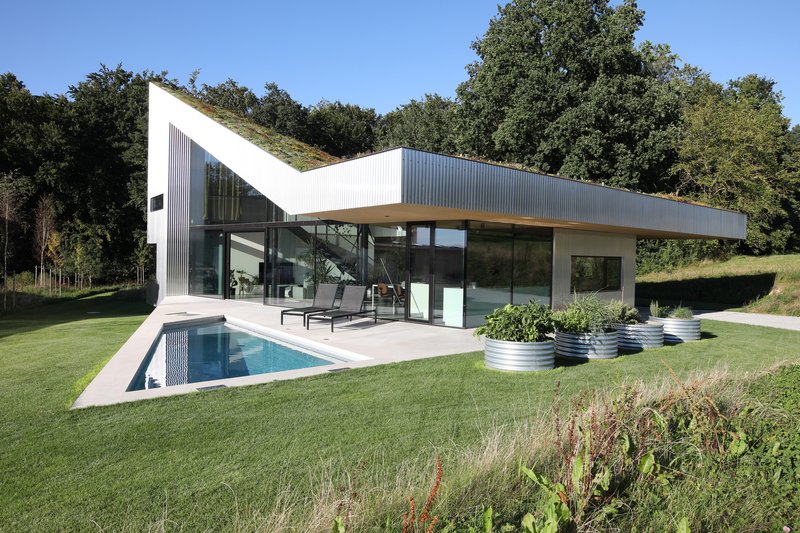
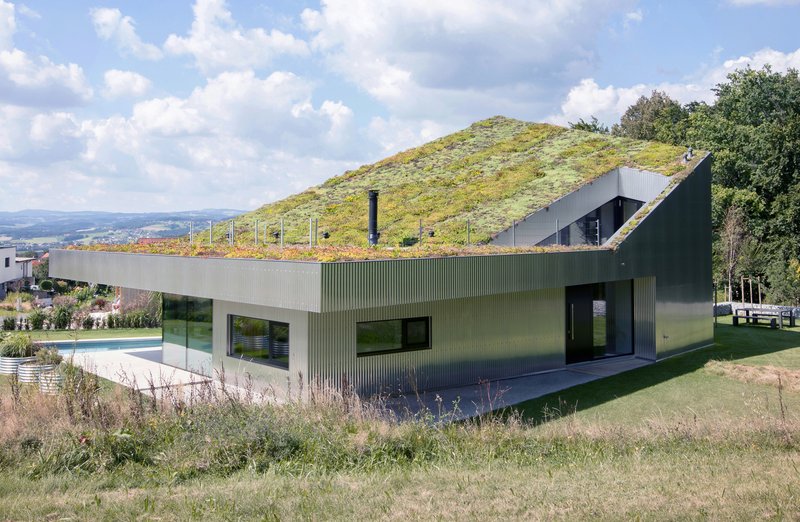
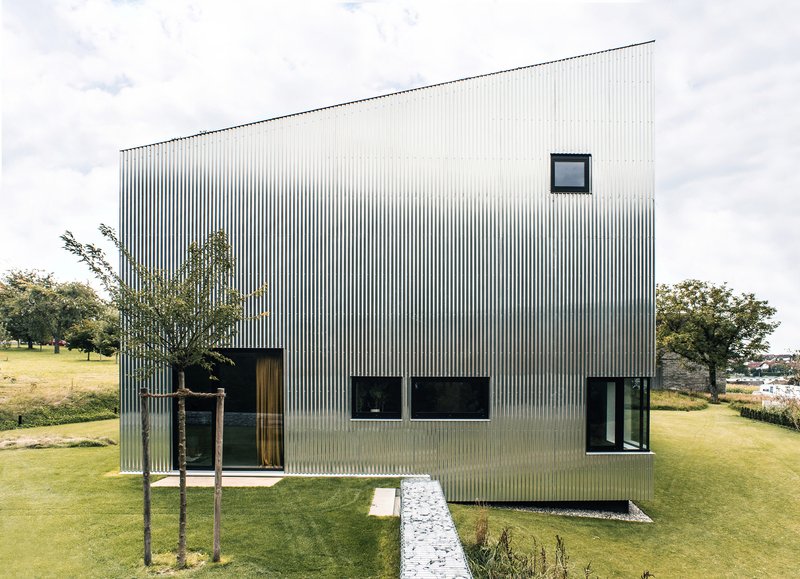
The site falls away to the north and west, and Caramel used that gradient to dramatic effect. From the garden side, the green roof appears to be a continuation of the hillside itself, sloping across the corrugated metal volume before tapering into a deep overhang. The planted layer is not decorative: it regulates the building's climate passively, absorbing solar gain in summer and insulating in winter. Because the house partially adapts to the topography rather than sitting on a leveled platform, its north and west elevations lift off the ground, exposing the lightweight structure beneath.
Young trees planted on the lawn reinforce the idea that the building is slowly being absorbed back into its context. The corrugated aluminum catches light differently throughout the day, shifting from matte grey to bright silver, so the house never looks quite the same twice against its green surroundings.
The Five-Meter Living Room
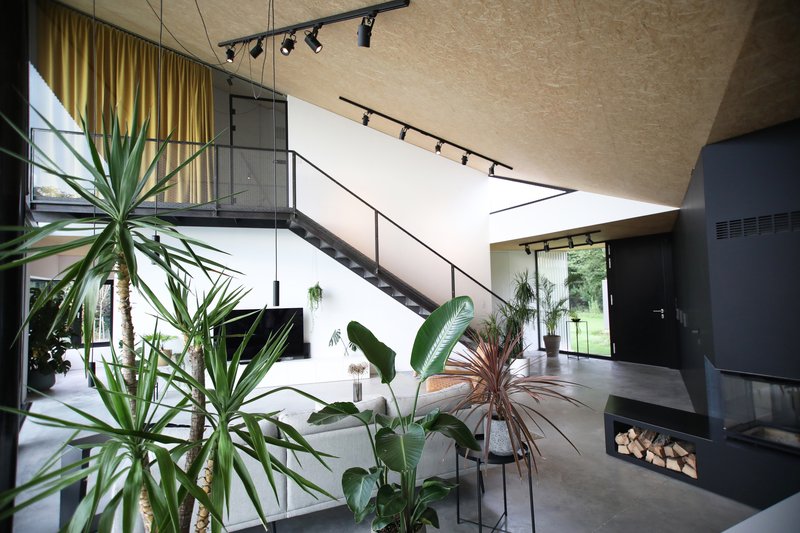
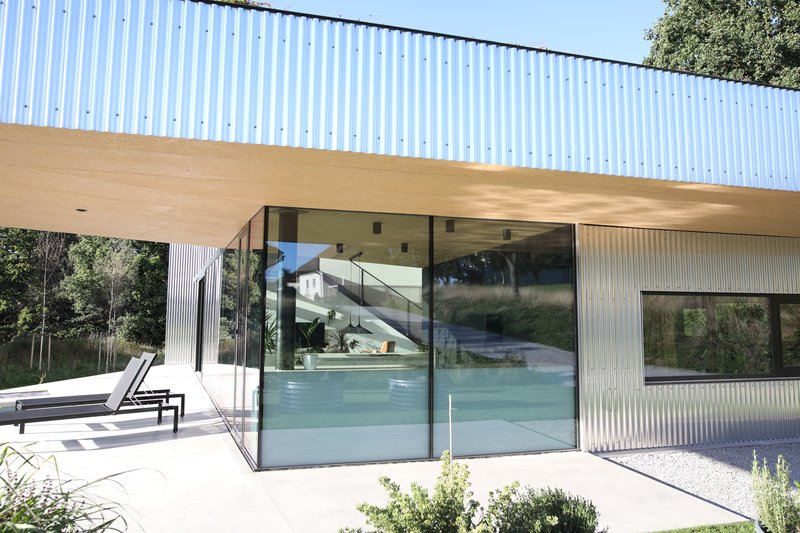
The heart of House Mesh is a double-height living space that rises a full five meters. Every room, the garden, and the terrace plateau with pool are accessible from this single volume, making it the social and circulatory nucleus of the plan. A metal staircase climbs one wall to reach a tent-like sleeping and relaxation area on the upper floor, which in turn connects to a roof terrace cut into the green roof.
Polished and waxed concrete underfoot serves as both finished surface and thermal storage, compensating for the lightness of the timber roof construction above. Track lighting, tropical plants, and the raw materiality of exposed structure give the space an almost loft-like quality, unusual for a family house in rural Austria. The frameless glass facade allows the concrete floor plane and roof soffit to extend continuously from inside to outside, collapsing the distinction between living room and terrace.
Raw Aluminum and Frameless Glass
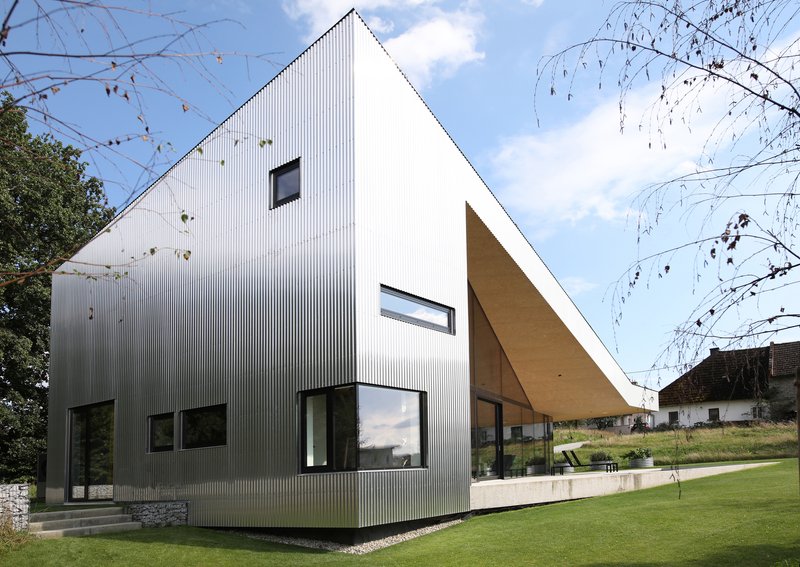
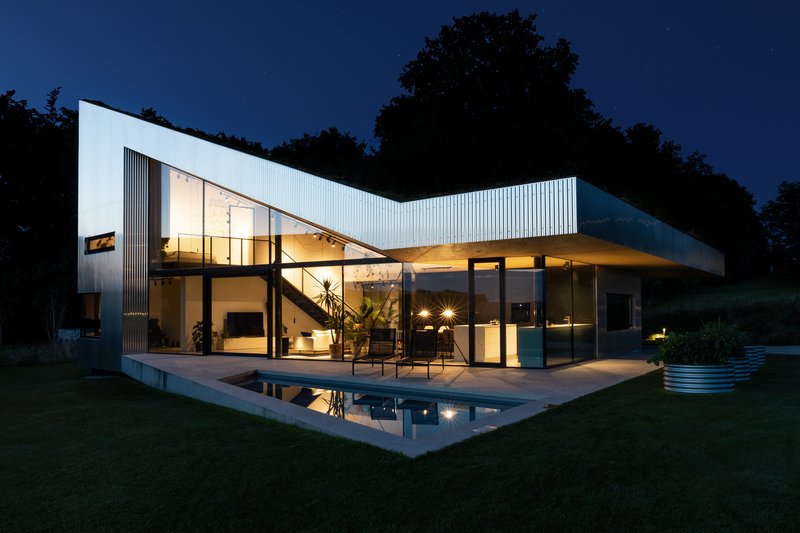
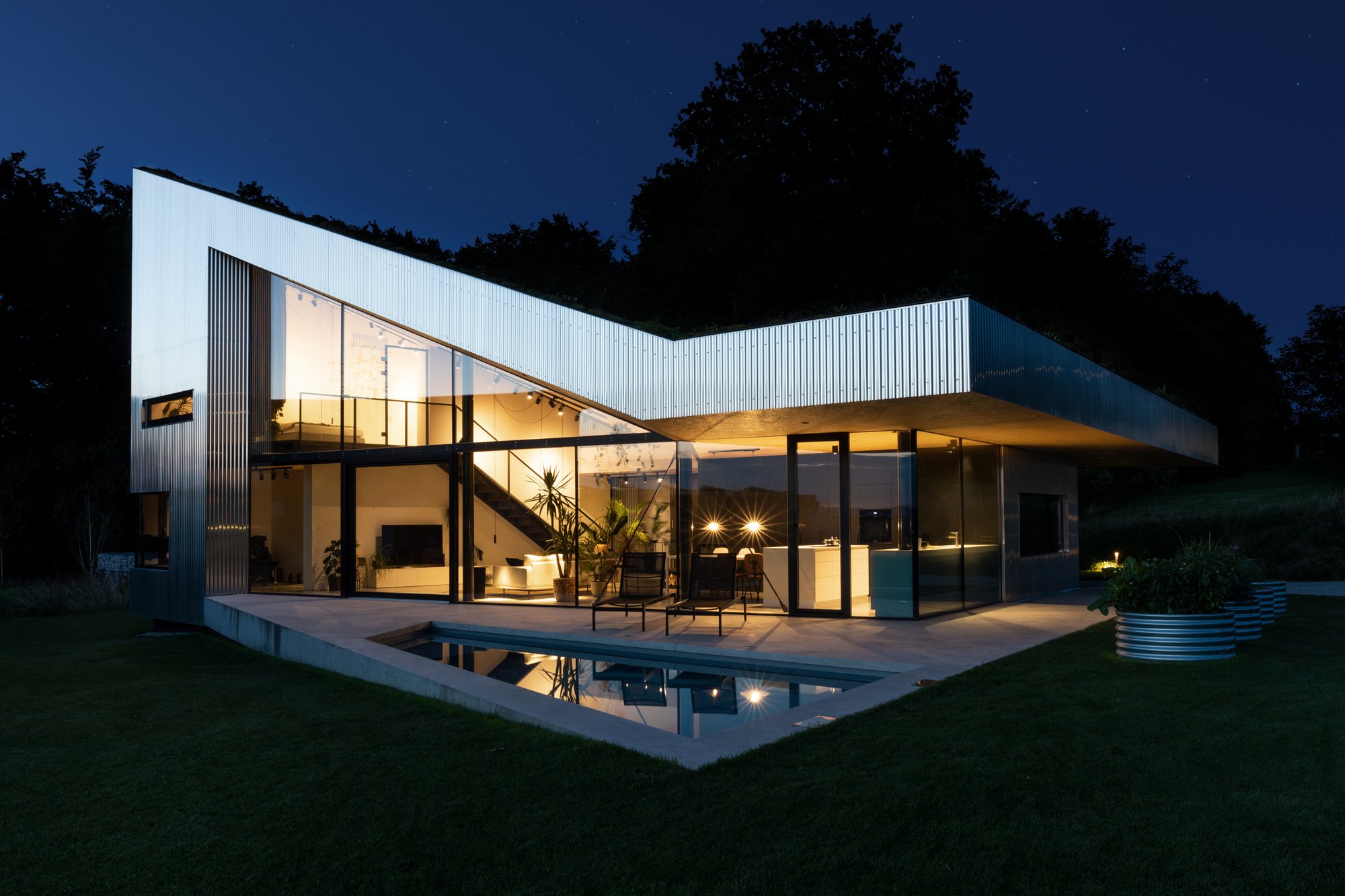
The facade is untreated corrugated aluminum sheet, ventilated from behind and suspended on the timber structure. It is deliberately raw: no paint, no anodizing, no pretense. Scattered punched windows on the vertical faces give the metal box a quiet rhythm, while the south and west elevations open almost entirely to glass. At night, the contrast between the opaque metal shell and the illuminated glass pavilion beneath it sharpens into something closer to an urban bar or gallery than a domestic building.
A three-sided chimney stove sits between the living and working spaces, growing directly out of the wall construction. Its glass combustion chamber offers a view straight through into the study, a small detail that reinforces Caramel's interest in visual and spatial connectivity within a compact plan.
Inside the Metal Shell
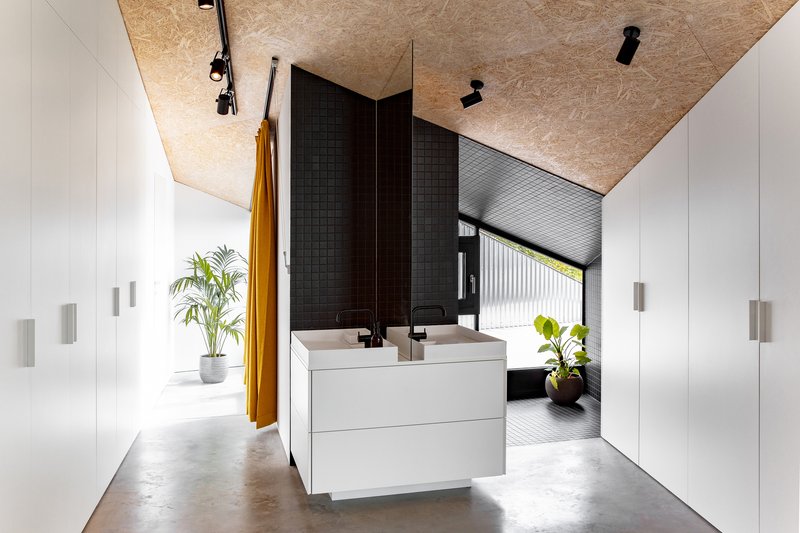
Interiors are handled with the same material honesty. Oriented strand board lines the bathroom ceiling, untreated wood appears in cabinetry, and a bold orange curtain adds the only saturated color in sight. The palette is disciplined but never austere. Black tile partitions in the wet rooms, the waxed concrete floor throughout, and the steel structure left exposed where it meets the eye all reinforce a consistent logic: every material is what it appears to be.
The base area of 246 square meters yields 205 square meters of usable space, an efficient ratio for a house that feels far larger than its footprint suggests, thanks mostly to the five-meter ceiling and the visual extension through glass into the landscape.
Plans and Drawings
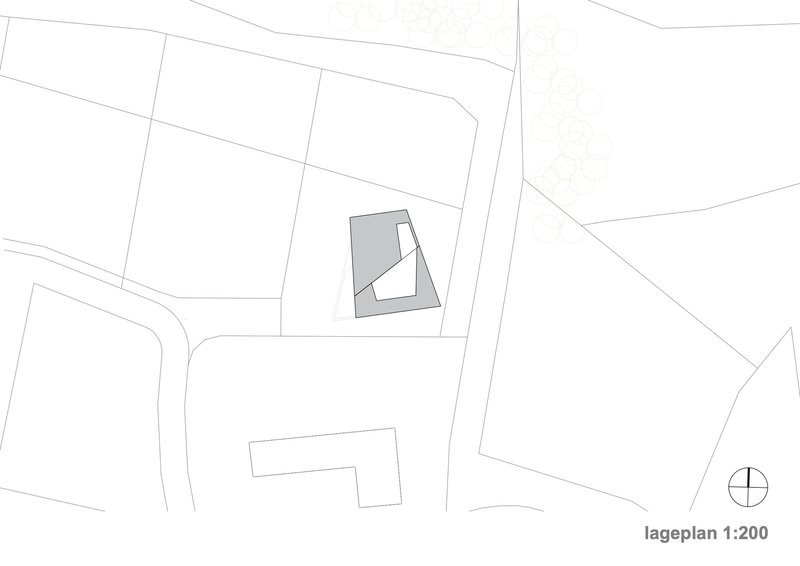
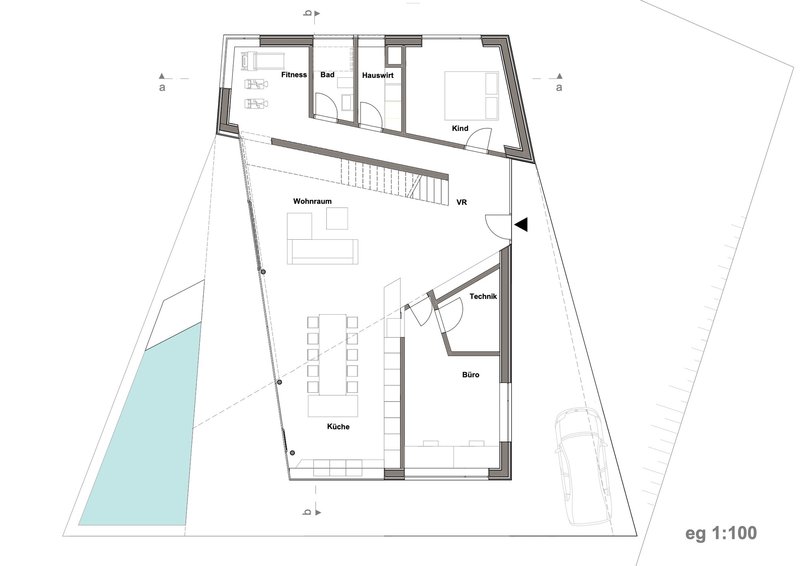
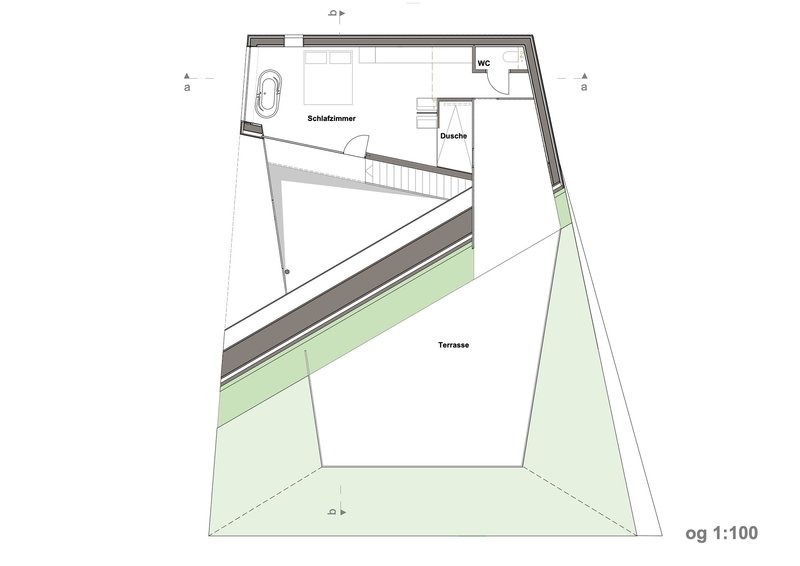
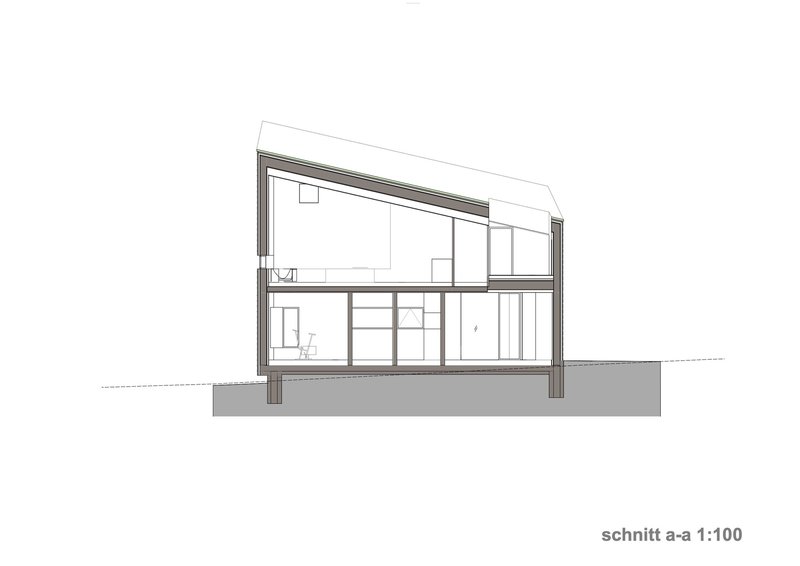
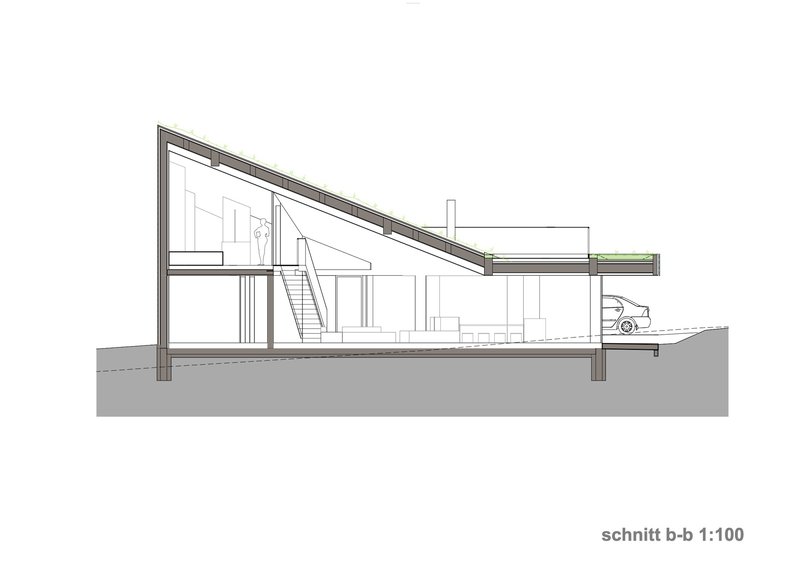
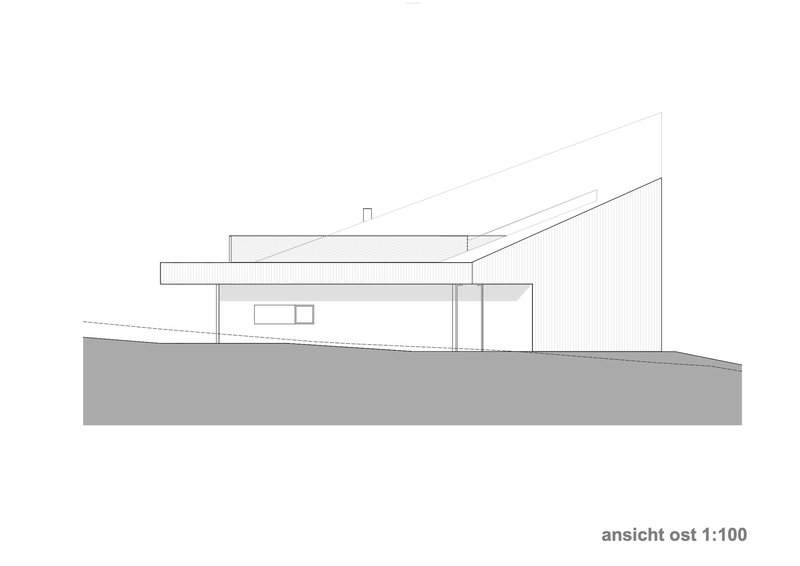
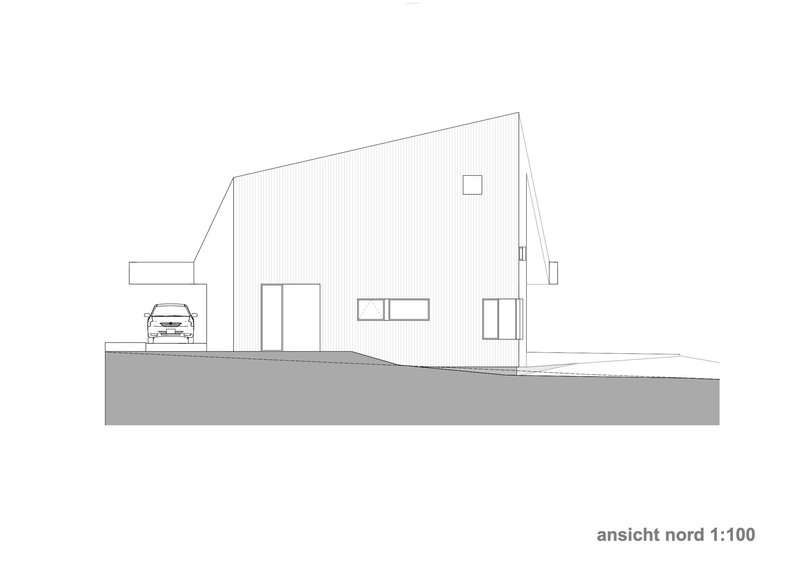
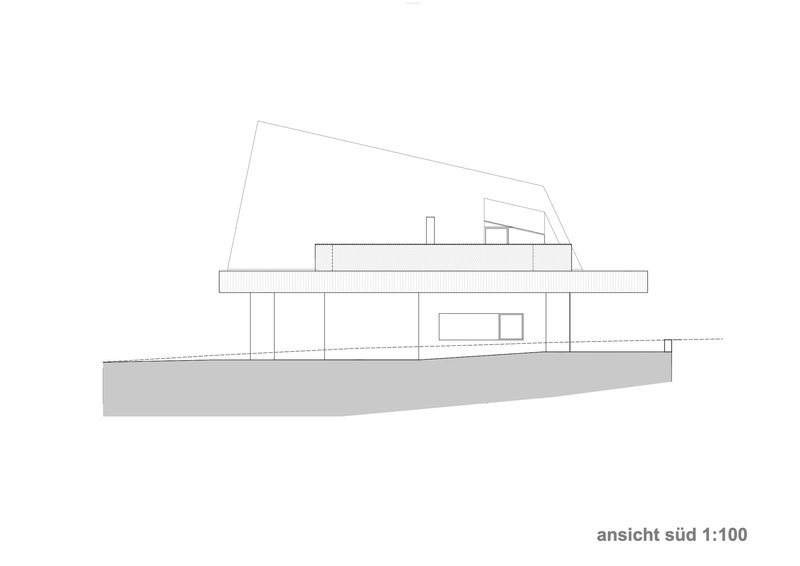
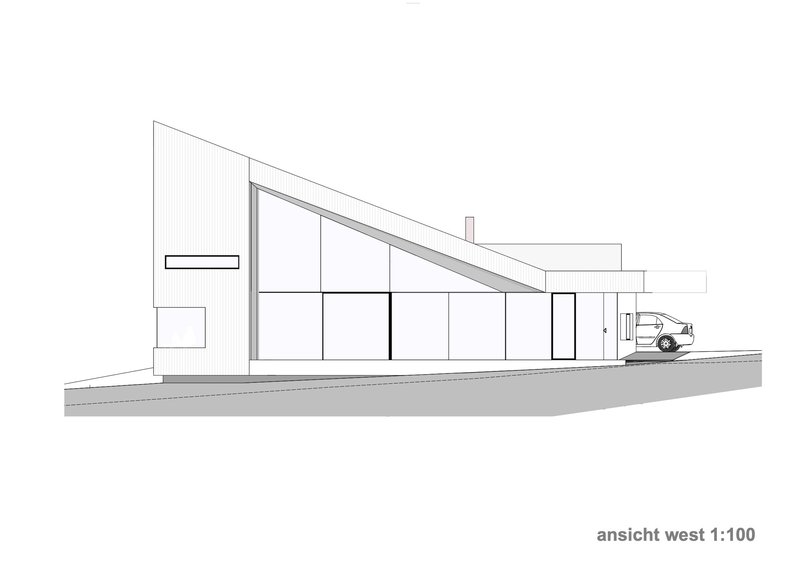
The site plan reveals the angled footprint that allows the house to address the slope diagonally rather than head-on, maximizing views to the southwest while tucking the carport and entry under the north gable. The ground floor plan confirms the open plan: living, dining, and kitchen flow into one another without partition walls, with service rooms gathered in a compact band along the northeast edge. Upstairs, the bedroom suite occupies a smaller footprint, leaving the stairwell void open to the living room below and the roof terrace open to the sky.
Sections through the building make the structural logic legible. The sloped roof is not a single plane but a composite of timber framing, insulation, and planted substrate, all carried on the lightweight frame and stabilized by the concrete slab at grade. The carport tucks beneath the cantilever on the north side, using the building's own overhang as shelter without adding structure. Elevations show how the corrugated cladding wraps the upper volume consistently on all four sides, while the glazed living level recedes, giving the metal box a hovering quality.
Why This Project Matters
House Mesh demonstrates that sustainable ambition and spatial generosity are not opposing goals. The green roof is not a token gesture but the primary architectural move, shaping the section, shading the glass, and returning excavated earth to the site. The combination of lightweight timber, thermal-mass concrete, and ventilated aluminum cladding creates a layered environmental strategy without any visible mechanical complexity. Every material choice pulls double duty: structure and finish, insulation and expression.
Caramel Architekten have built a house that is both blunt and refined, a corrugated aluminum box that somehow disappears into a hillside while commanding a five-meter-high glass room open to the sky. In a residential market saturated with performative minimalism, House Mesh offers something rarer: a building whose restraint is structural, not stylistic, and whose relationship to its site goes all the way down to the soil on its roof.
House Mesh by Caramel Architekten, Hagenberg im Mühlkreis, Austria. Land area: 852 m², usable area: 205 m². Completed 2020. Photography by Kerstin O and Paul Eis.
About the Studio
Share Your Own Work on uni.xyz
If projects like this are the kind of work you want to make, uni.xyz is a place to publish your own, find collaborators, and enter design competitions.



Popular Articles
Popular articles from the community

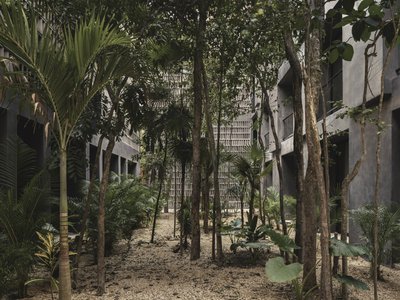
Three Studios Build 200 Affordable Units for Tulum's Displaced Hospitality Workers
Casa Selva embeds dark concrete housing blocks into Yucatán rainforest, offering dignified shelter to those priced out by the tourism they serve.
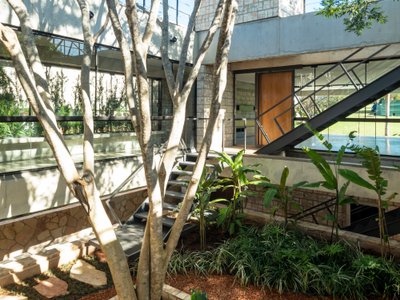
OMCM arquitectos Builds a Summer House in Paraguay from Quarry Waste Blocks and Three Sacred Trees
In the young hillside neighborhood of Altos, a 696-square-meter concrete volume hovers on six pillars around three preserved native Yvyraju trees.
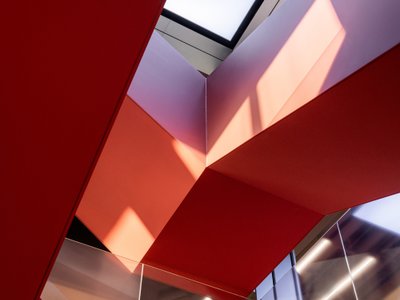
Ippolito Fleitz Group Identity Architects Turn Eight Floors in Shanghai into a Vertical Creative City
Publicis Groupe's new headquarters in Xintiandi reimagines the office as a courtyard-driven urban landscape stacked across eight floors.
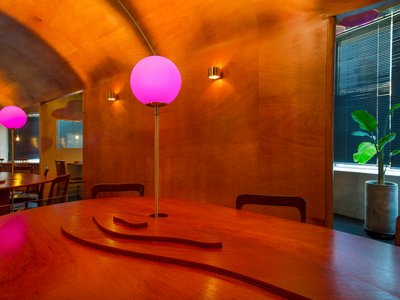
Indiesalon Carves a Plywood Cave into a Seoul Bistro's Second Floor
Munhwa Bistro's second Seongsu branch wraps diners in a laminated timber vault laced with colored light and mirror illusions.
Similar Reads
You might also enjoy these articles

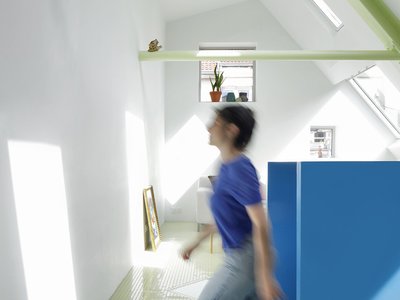
127af Flips a Tiny Bagnolet Rowhouse Upside Down with a Handcrafted Roof Extension
A 55-square-meter terraced house on the edge of Paris gains a luminous upper living floor through lightweight timber and steel.
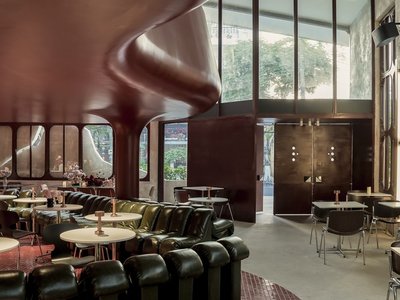
1.61 Design Workshop Wraps a 600-Square-Meter Café in Vietnam in Sculptural Burgundy Drama
Reden Café & Bistro pairs a helical staircase, mosaic floors, and deep red interiors to rethink Vietnamese hospitality space.

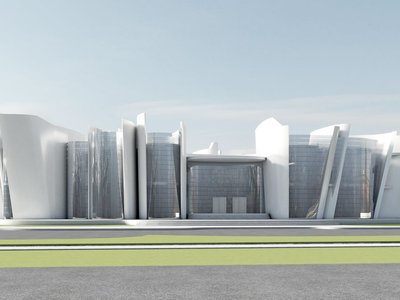
The Unbound Brain: A School Shaped by Cognitive Architecture
Cylindrical learning pods radiate like neurons from a central cortex, turning the floor plan into a spatial model of human thought.
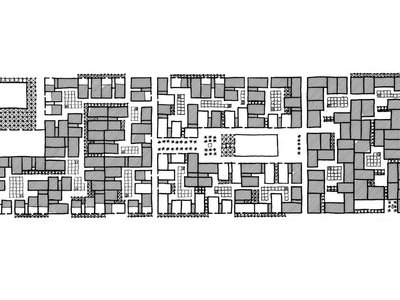
Revival Vernacular Architecture: Rammed Earth Settlements for the Sahara
A modular desert community in Mauritania that fuses passive cooling techniques with earthen construction and local craftsmanship.

Explore Landscape Design Competitions
Discover active competitions in this discipline




The Global Benchmark for Architecture Dissertation Awards

Challenge to design mud housing for contemporary communities
Comments (0)
Please login or sign up to add comments
No comments yet. Be the first to comment!