
Bermúdez Arquitectos Plants a Navy Blue Steel Refuge at 3,500 Meters in the Colombian Andes
A dry-assembled, thermally insulated mountain shelter in Carmen de Carupa responds to daily swings from freezing to 21°C with zero energy consumption.


At 3,500 meters above sea level in Carmen de Carupa, Colombia, temperatures can swing from freezing to 21°C in a single day. The sub-páramo zone, that ecological threshold between high Andean forest and the páramo grasslands, is one of the most thermally volatile environments on the continent. Building here demands more than insulation: it demands a complete rethinking of how a shelter performs, grows, and sits on the land. Bermúdez Arquitectos answered with Carupa House, a 136 m² refuge assembled almost entirely dry, using steel framing and only 15 concrete foundation dies as its sole wet process.
What makes this project genuinely interesting is not just the altitude or the prefabrication, but the discipline of its logic. A 4m x 4m structural module governs everything: bedroom, kitchen, living room, dining area, and porch each occupy one unit. A narrower 2m x 4m strip slots in for the bathroom and an extension of the social area. The system is designed to replicate itself, meaning the house can grow over time using the same module without compromising structural integrity or spatial coherence. The result is a compact, rectangular volume topped by a sawtooth roof, painted navy blue to sit within the Andean color palette without resorting to camouflage.
A Deliberate Stranger in the Landscape
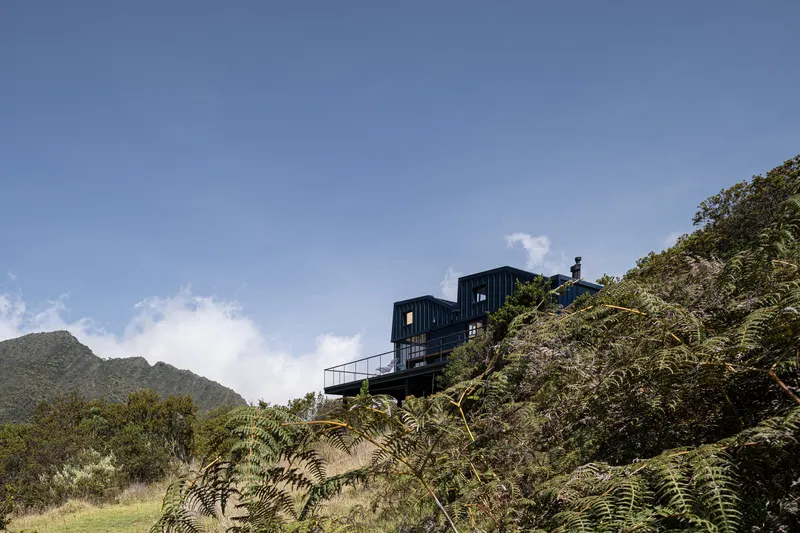
The navy blue metal tile cladding is a calculated choice. Bermúdez Arquitectos describes the intent as differentiation without disruption: the house acknowledges that it is not a natural object, but it refuses to shout about it. The deep blue reads as complementary to the greens and ochres of the surrounding ferns and native vegetation, shifting in perceived darkness with the cloud cover that rolls through these elevations. It is a color that absorbs light rather than reflecting it, which also has thermal implications at this altitude where every captured calorie of solar energy matters.
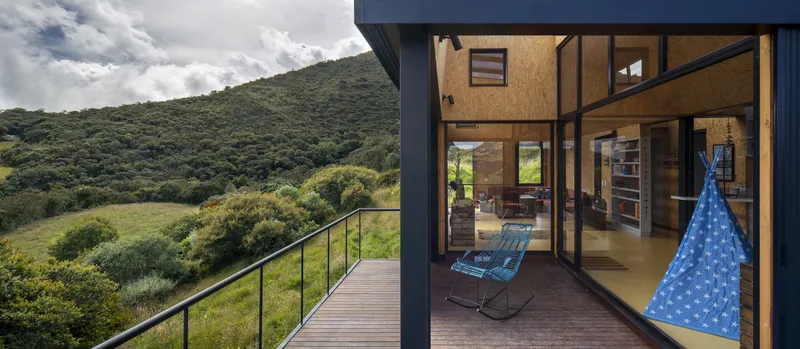
Perched on a hillside and elevated on its minimal foundation dies, the volume touches the ground lightly. The pre-assembled, pre-cut components were brought to the site and erected with minimal excavation, preserving the private nature reserve's existing topography and root systems. The timber deck extends the living space outward toward the valley, establishing a threshold between the controlled thermal interior and the volatile mountain air beyond.
Thermal Performance Without Mechanical Systems
The envelope is where Carupa House earns its credibility. The layered assembly works from outside in: oven-painted metal sheet tiles and a waterproofing membrane form the weather skin; expanded polystyrene and rock wool provide the thermal break; a vapor barrier prevents condensation from migrating into the insulation; and OSB panels close the interior. This sandwich achieves what Bermúdez calls a "hot structure," meaning the entire building mass stays on the warm side of the insulation line. No energy is consumed for heating.
Windows and skylights are oriented toward the morning sun to capture maximum solar radiation during the hours when ambient temperatures are lowest. Crucially, the glazing uses thermal break frames, which allows generously sized openings without hemorrhaging the heat gained during the day. The sawtooth roof profile is not merely formal: it creates high clerestory windows that pull light deep into the plan while directing solar gain precisely where it is needed. In a climate this extreme, every detail of the envelope is load-bearing in a thermal sense.
OSB Warmth Against the Cold Steel Frame
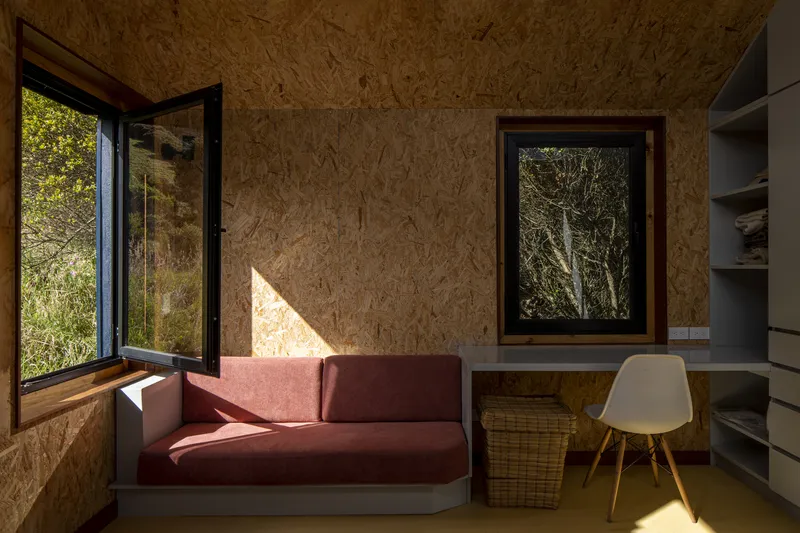
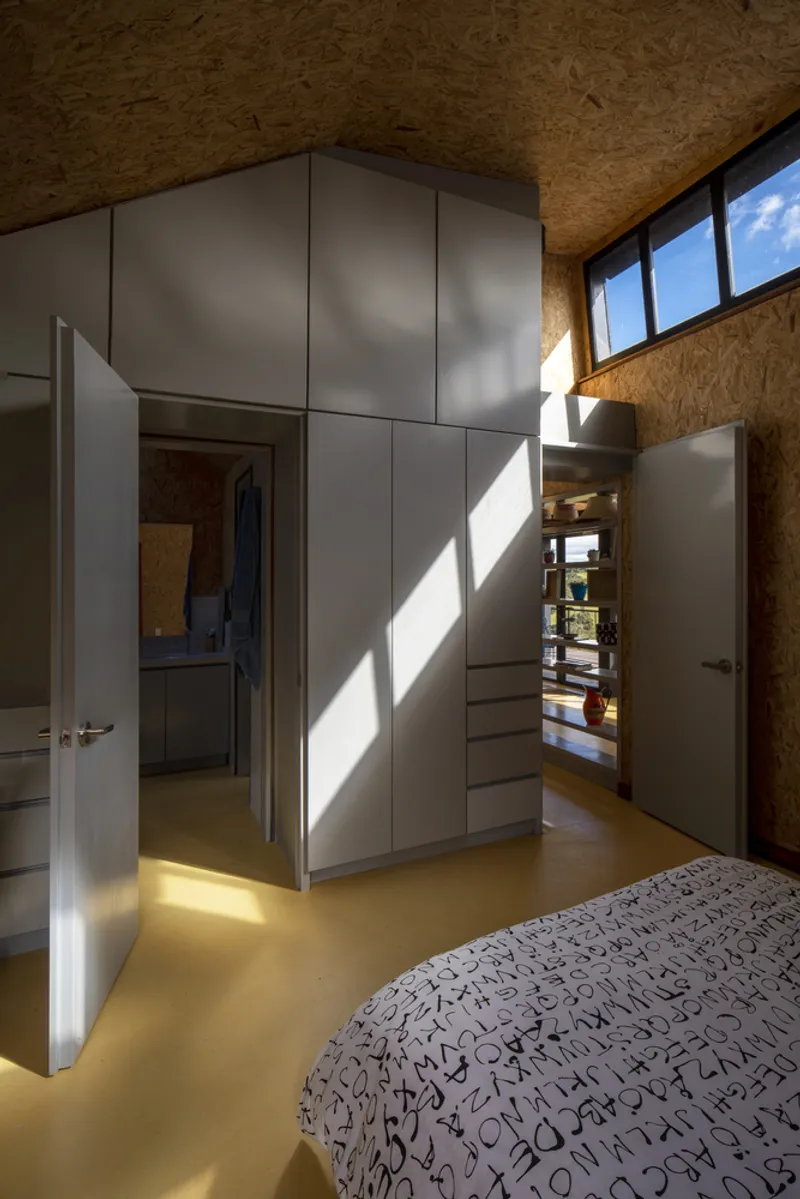
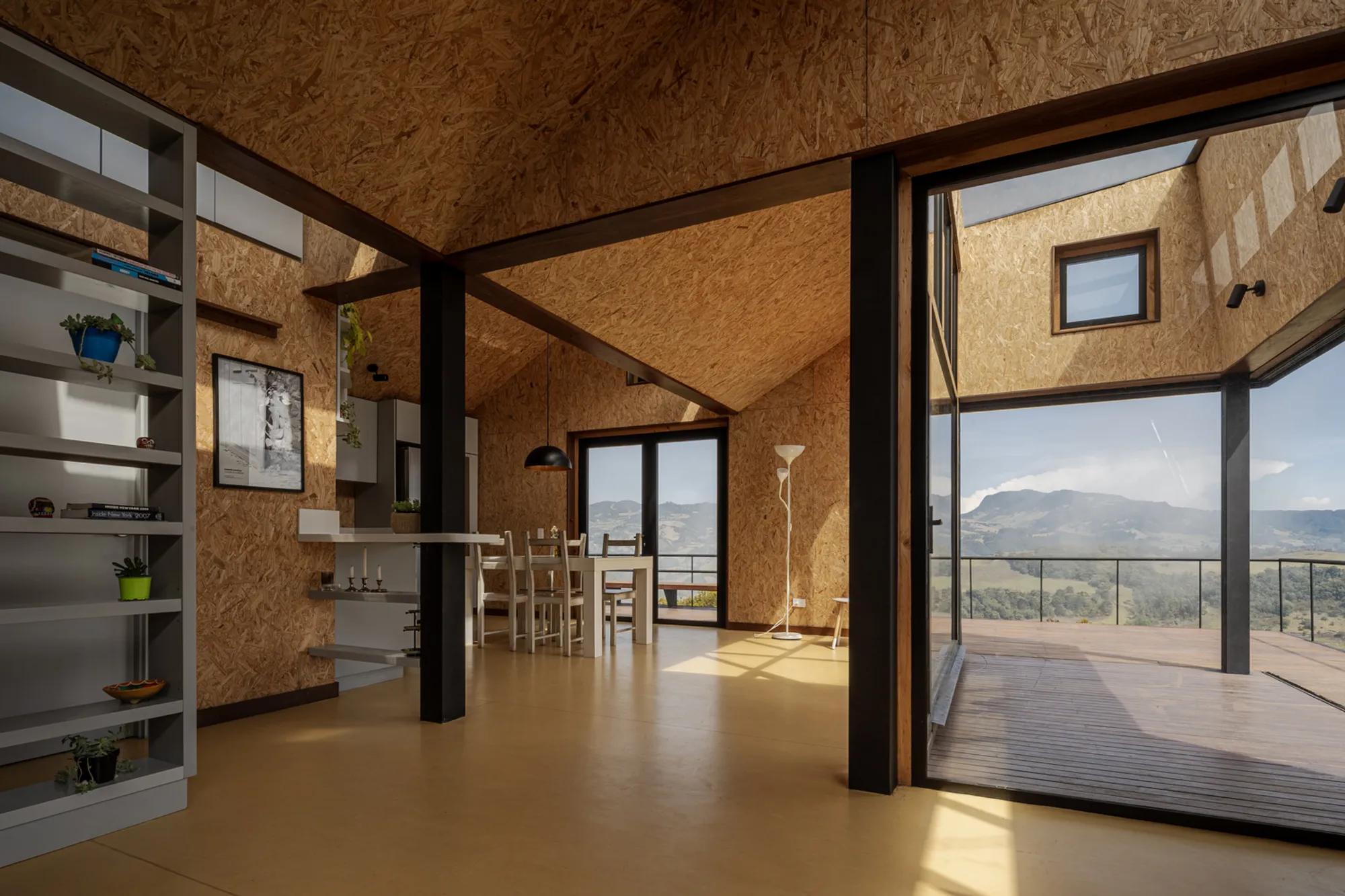
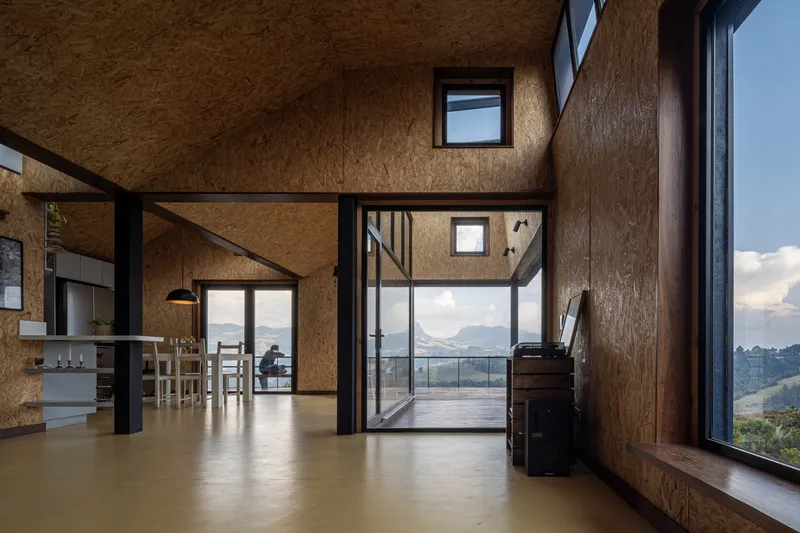
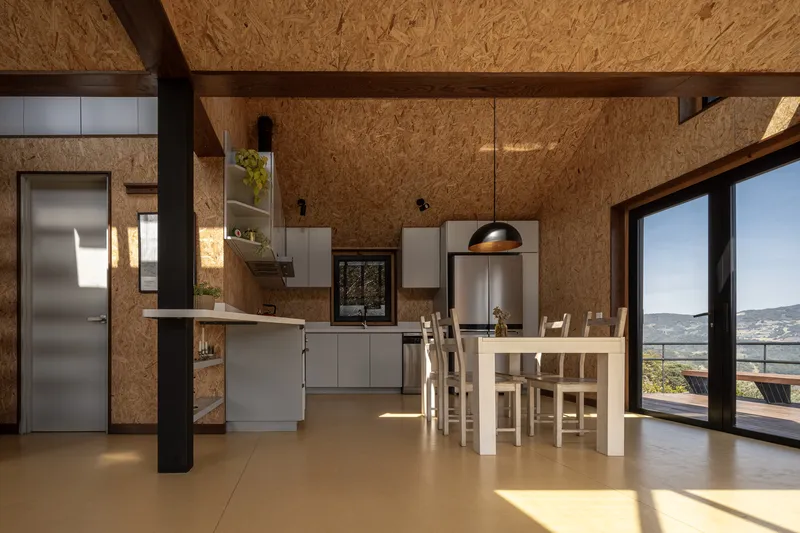
Step inside and the material language inverts completely. Where the exterior is dark, metallic, and deliberately cool, the interior is wrapped in oriented strand board panels on walls and ceilings, with warm-toned vinyl underfoot. The exposed black steel beams and columns read as graphic lines against the honey-colored OSB, giving the space a tectonic legibility that lets you understand exactly how the building is put together. There is no drywall, no plaster, no pretense. The structure is the finish.
The effect is surprisingly domestic for a building made of steel and insulation board. The kitchen and dining area, bathed in afternoon sun from the sawtooth glazing, feels like a mountain cabin rather than a prefab unit. A built-in seating nook with pink cushions, framed by an OSB wall and a window aimed at the hillside, demonstrates that comfort here is not incidental but designed. The bedroom, with its high clerestory windows and pale grey wardrobe unit, confirms the same: every interior element serves the thermal strategy while creating spaces that feel genuinely inhabitable.
The Deck as Mediator
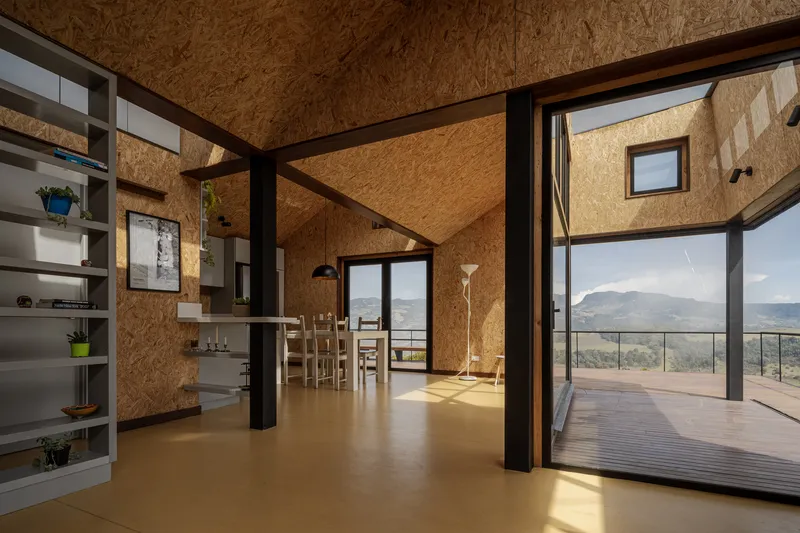
The timber deck is more than an outdoor amenity. At this altitude, the threshold between inside and outside is a genuine boundary condition. Large sliding doors in the living space open fully onto the deck, collapsing the wall between the thermally controlled interior and the panoramic valley views. When closed, the thermal break glazing maintains the envelope's integrity. When open on warmer afternoons, the deck becomes an extension of the living room, framing the forested hills and clouded sky as a kind of inhabited landscape painting.
The steel columns that march along the deck edge maintain the 4m rhythm of the structural grid, reinforcing the modular logic even in the outdoor space. If additional modules are added in the future, the deck can extend with them, preserving the relationship between shelter and view. It is a simple detail, but it reveals how thoroughly the modular thinking permeates the project.
Modularity as Future-Proofing
The standardized steel framing system is designed so that every profile contributes to the stability of the whole. This is not a post-and-beam frame with infill panels: it is a system where redundancy is structural, meaning additional modules can be bolted on without weakening or overloading the existing structure. The 4m x 4m grid is the generative unit, and because all components are pre-cut and pre-assembled, expansion can follow the same rapid dry-assembly process used for the original build.
For a private nature reserve at 3,500 meters, this matters practically. Access is limited, wet trades are difficult in freezing temperatures, and site disruption should be minimized for ecological reasons. By concentrating wet construction into just 15 foundation dies, Bermúdez Arquitectos reduced the project's dependence on water, curing time, and heavy equipment. The rest is bolted, screwed, and stapled. It is construction as assembly, not as casting.
Why This Project Matters
Carupa House is a proof of concept for lightweight, thermally autonomous architecture in extreme climates. It demonstrates that a steel-framed, dry-assembled building can achieve genuine thermal comfort at 3,500 meters without consuming energy for heating, provided the envelope is designed with the same rigor typically reserved for much larger or more expensive buildings. The layered thermal strategy, the solar orientation of every opening, and the thermal break glazing are not innovations in isolation, but their integration into a 136 m² modular refuge at this price point and altitude is genuinely instructive.
More broadly, the project offers a replicable model for building in ecologically sensitive highland environments across Latin America. The modular grid means the system can scale. The dry assembly means it can be deployed quickly with minimal site impact. And the navy blue cladding suggests an approach to contextual design that neither mimics nature nor ignores it, but instead proposes a specific, considered relationship with a landscape that deserves better than the corrugated metal sheds and concrete blocks that typically populate these altitudes.
Carupa House: High Mountain Refuge by Bermúdez Arquitectos. Carmen de Carupa, Cundinamarca, Colombia. 136 m². Photography by Bé estudio.
About the Studio
Share Your Own Work on uni.xyz
If projects like this are the kind of work you want to make, uni.xyz is a place to publish your own, find collaborators, and enter design competitions.



Popular Articles
Popular articles from the community


Conexión: Biophilic Design Reimagines High-Rise Living in Hong Kong
Conexión reimagines high-rise living in Hong Kong through biophilic design, green facades, shared spaces, daylight, water and nature within.

The Earth Pod: 3D Printed Homes for Resilient Refugee Communities
The Earth Pod reimagines refugee housing through 3D printed homes made from clay, combining resilience, self-sufficiency, and rapid shelter.

Co-Life: Senior Housing Design That Reconnects Older Adults With the City
Co-Life reimagines senior housing design through healing gardens, shared streets, workshops, and a sustainable community across generations.

Co-life: Sustainable Architecture for Age-Friendly Community Living
Co-life reimagines sustainable architecture for seniors through courtyards, rammed earth, shared gardens, and spaces designed for belonging.

Similar Reads
You might also enjoy these articles


Hodi-Mandai Geram
Project Function: Preservation and revitalization of the Intangible heritage and socio-spatial identity of the Hodi by Housing, Cultural Memory Center, Sacred Grove, landscape, local tourism economy


Olio Towers: A Mid-Rise for Performers That Fuses Housing, Rehearsal, and Stage
Located blocks from Houston's Theater District, this modular tower stacks living units around a central performance atrium.

Oasis: Modular Green Housing Carved into Dhaka's Urban Fabric
A shortlisted Plugin Housing entry reclaims unauthorized settlements in Dhaka with stepped concrete volumes, green roofs, and ventilation-driven design.

Black Hole: A Floating Megastructure for the Post-Physical Era
Emiliano Mazzarotto envisions a spherical, self-scaling arena where e-sports, digital hotels, and holographic stadiums replace traditional public space.

Explore Housing Competitions
Discover active competitions in this discipline



Challenge to reimagine the Iron Throne


Photograph architecture without architects


Illustrate the lost glory of Angkor Wat - Render Challenge


Design challenge to reuse E-waste
Comments (0)
Please login or sign up to add comments
No comments yet. Be the first to comment!