

ES-arch Converts a Mountain Farmstead into a Seasonal Retreat at 1,700 Meters Above Sea Level
Casa PJA in Madesimo, Italy, makes every seam of its rural-to-residential transformation legible through stone, plaster, and timber.


Mountain agriculture in the upper Valchiavenna has all but vanished. The stone buildings it left behind, clustered in small rural nuclei like Mottaccio above Madesimo, now face a second life or slow collapse. ES-arch chose the first option for Casa PJA, converting a traditional farmstead into a seasonal residence that refuses to disguise the surgery. Every volumetric addition is rendered in lime plaster, set plainly against the original stone walls so the timeline of the building reads on its surface.
What makes the project worth studying is not the conversion itself, which is common enough in the Alps, but the discipline with which ES-arch managed legibility. The east facade facing the public road is nearly blind. The west facade opens entirely to the valley through large timber-framed glazing. A single recessed opening on the stone front produces a deep shadow void rather than a glassy reflection, preserving the closed, airtight character that made these buildings functional in harsh winters. The project is a catalog of deliberate asymmetries: public versus private, stone versus plaster, opacity versus transparency.
Reading the Building in Its Hamlet


Sitting at 1,700 meters in the rural core of Mottaccio, Casa PJA is not an isolated object but a participant in a tight cluster of stone chalets and timber barns. The snow-covered context reveals how closely these structures crowd one another, sharing retaining walls and narrow paths rather than formal setbacks. ES-arch's intervention had to negotiate that proximity. The stone masonry facade, punctured by a single deep-set window, maintains the reticence expected of a building that faces its neighbors and the road. Privacy here is not a curtain trick; it is embedded in the massing.
The forested valley dropping away to the west explains the building's fundamental orientation strategy. Everything closed faces uphill and east toward the path. Everything open faces downhill and west toward the landscape. The slope itself becomes part of the architecture through a small ground movement that follows existing grade and terminates with a 45 cm retaining wall, freeing the west front at ground level without any heroic excavation.
The Upper Living Room as Open Landscape Frame
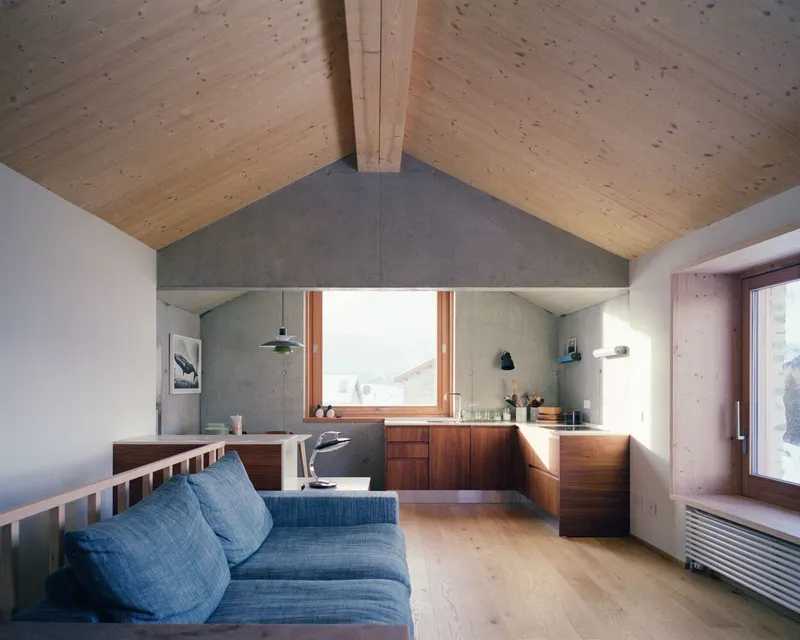
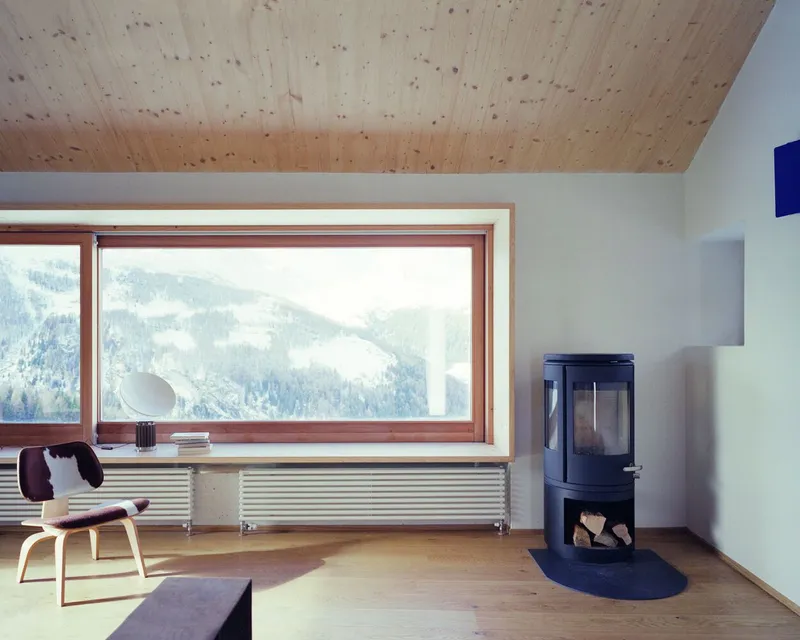
The upper floor is a single open room with a kitchen corner, and the gabled plywood ceiling gives it the proportions of a nave. A wide timber-framed window on the west wall acts less as a window and more as a controlled aperture. The radiator below it and the freestanding wood stove nearby are frank about function: this room has to work in alpine winter. There is no pretense that mountain living is effortless, and the honesty is appealing.
The timber framing of the window deserves attention. It extends the language of the roof structure, with its horizontal corea beam and joists, down into the wall plane. The result is a unified timber register that wraps the ceiling and reading of the aperture into one gesture. Light pours through the west-facing glass and bounces off the plywood soffit, warming the room even when the sky is grey.
Concrete, Plywood, and the Interior Palette
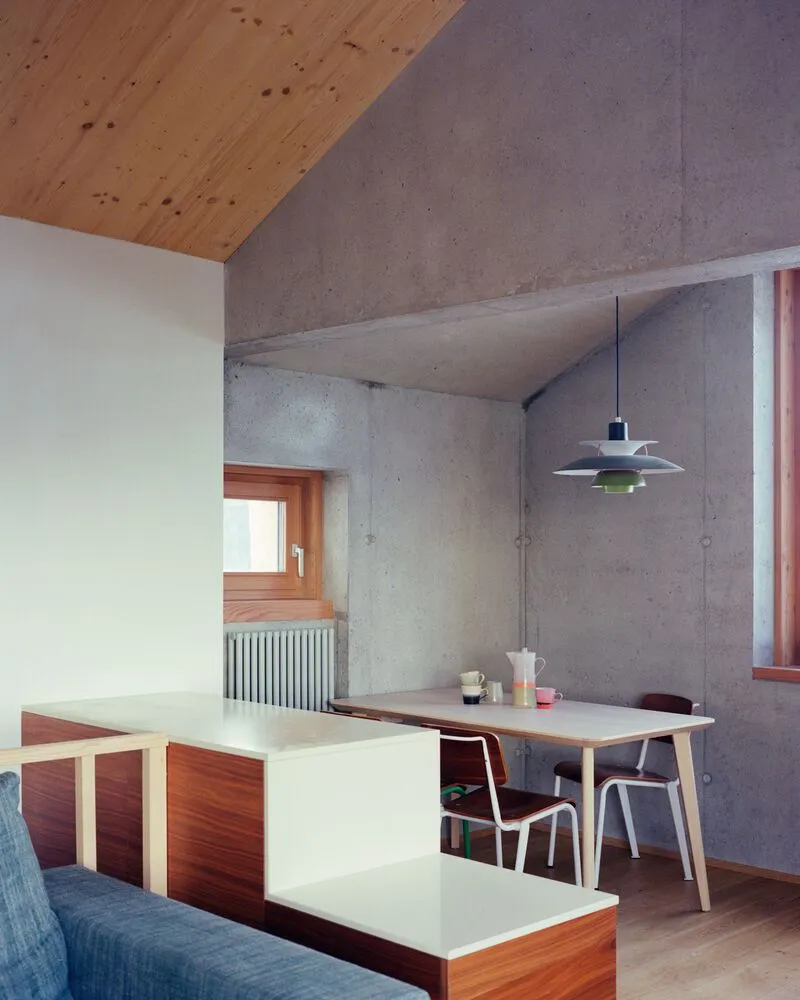

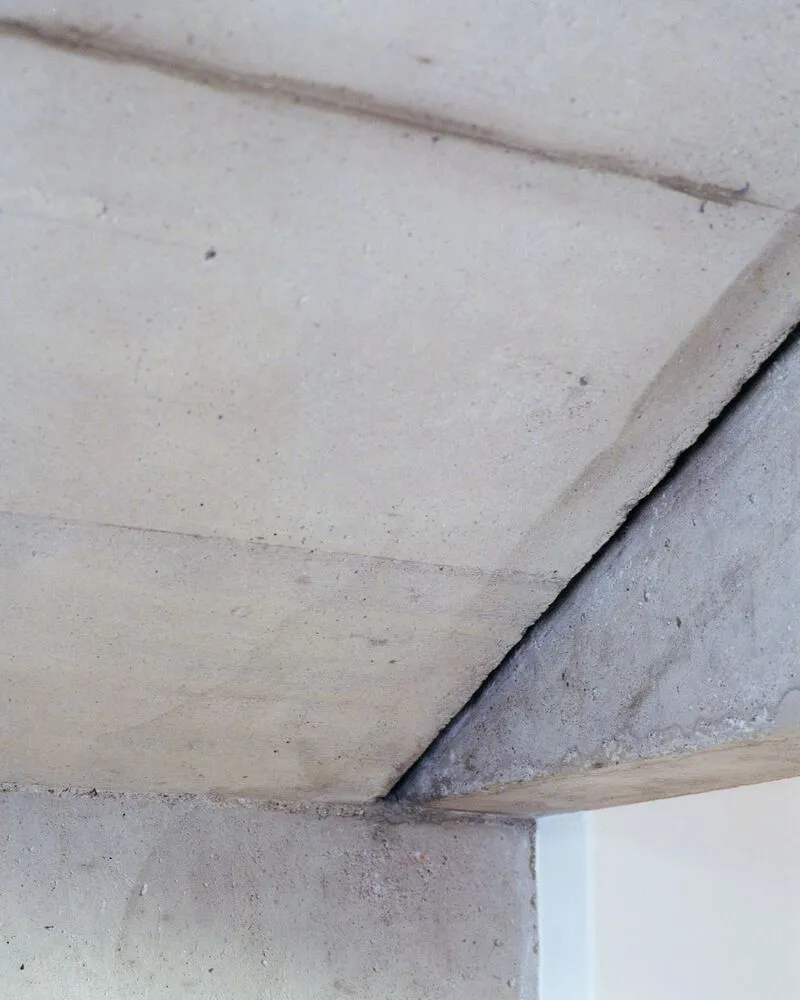
Inside, ES-arch deploys a restrained material palette: board-formed concrete walls, plywood ceiling cladding, and walnut cabinetry. The concrete is left raw, with formwork joints and surface texture fully visible. The detail of the ceiling-to-wall junction shown in close-up reveals how the two materials meet without trim or cover strips. The joint is simply a line, and the honesty of it aligns with the project's larger ethos of making every construction decision legible.
The dining area beneath the vaulted plywood ceiling is the emotional center of the upper floor. A single pendant lamp hangs from the ridge, and the concrete walls absorb sound, creating an intimate acoustic despite the open plan. The walnut millwork in the kitchen corner adds warmth without softening the room's industrial undertone. It is a well-calibrated balance: enough comfort for a holiday home, enough rigor to hold the architecture together.
Circulation and Threshold

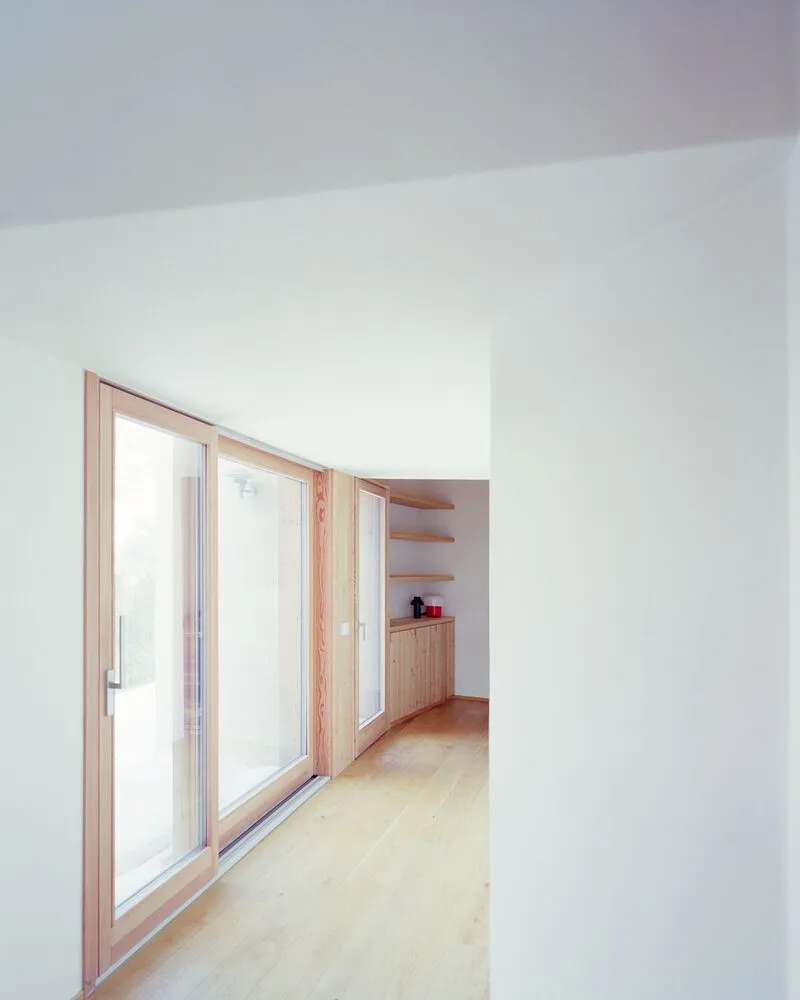

A straight timber staircase with white vertical railings connects the ground-floor sleeping area to the upper living room. The staircase is clad in the same plywood as the ceiling, reinforcing a sense of vertical continuity. From the hallway, a timber doorway frames a view through to the living space above, and the sequence from dark, enclosed corridor to bright, open room is one of the project's most effective spatial experiences.
The small glass corridor that leads to the study performs a critical role. At a connection height of just 210 cm, it links the main body to the first parcel structure at a scale that feels almost bodily. The white walls and timber-framed glazing keep it luminous despite the tight section. Built-in storage at the end absorbs the functional demands that would otherwise clutter the living areas. It is infrastructure disguised as architecture, or perhaps the reverse.
Ground Floor: Bedrooms, Concrete, and Quiet
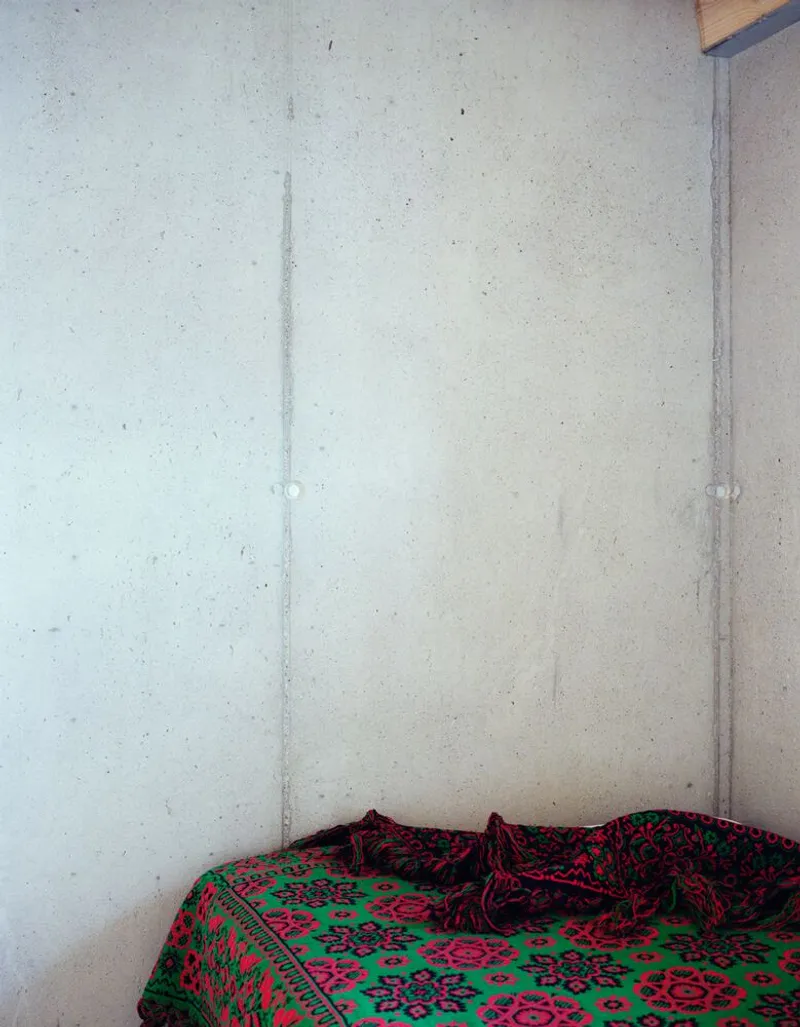

The ground floor belongs to sleep and retreat. The bedroom tucks into a corner defined by raw concrete walls, with a low bed dressed in patterned textile providing the only decorative note. The multifunctional room on the south end opens onto an outdoor space bounded by a small wall and access stair that preserve the existing landscape system. ES-arch did not reinvent the threshold between inside and outside here; they inherited it and cleaned it up.
One exterior detail stands out: the speckled white plaster wall with dried berry branches casting shadows at its base. It is a small moment, but it captures the project's relationship to its site. Two basins at different heights on the east side host raspberry plants, an agricultural remnant turned ornamental. The building remembers what it used to be, not through nostalgia, but through material evidence.
Why This Project Matters
Alpine conversions are a genre with well-worn tropes: the contrast of old stone and new glass, the panoramic window, the minimal interior. Casa PJA participates in that genre but earns its distinction through the precision of its legibility strategy. Every added element is marked in lime plaster. Every subtracted opening is recessed to cast shadow rather than reflect sky. The building communicates its own history without placards or explanatory text, which is a higher standard than most renovation projects set for themselves.
More broadly, the project asks what happens to rural building stock when the economies that produced it disappear. ES-arch's answer is neither preservation nor demolition but a third path: transformation made visible. The farmstead becomes a residence, the stone walls carry new loads, and the plaster additions stand as a frank record of the moment the building changed its purpose. At 1,700 meters, where winters are long and materials must perform, that frankness is not just an aesthetic choice. It is a practical one.
Casa PJA by ES-arch. Madesimo (SO), Italy. Completed 2023. Photographs by Marcello Mariana fotografia.
About the Studio
Share Your Own Work on uni.xyz
If projects like this are the kind of work you want to make, uni.xyz is a place to publish your own, find collaborators, and enter design competitions.


Popular Articles
Popular articles from the community

Garden of Hope: Sustainable Architecture for a Resilient Community in Qandahar
Garden of Hope reimagines sustainable architecture as secure, organic community where women rebuild lives through housing, work, and nature.

The Earth Pod: 3D Printed Homes for Resilient Refugee Communities
The Earth Pod reimagines refugee housing through 3D printed homes made from clay, combining resilience, self-sufficiency, and rapid shelter.

FAMM Arquitectura Organizes Ten Villas Around Courtyards and Jungle in Nosara, Costa Rica
El Molino pairs two elongated volumes with deep overhangs and timber louvers to build a compact coastal community five minutes from the beach.

Riyadh For All: Intergenerational Urban Design for Active Aging in Rabat
Riyadh For All reimagines urban design in Rabat with intergenerational co-living, adaptive courtyards, and Moroccan cultural exchange today.


Similar Reads
You might also enjoy these articles


Hodi-Mandai Geram
Project Function: Preservation and revitalization of the Intangible heritage and socio-spatial identity of the Hodi by Housing, Cultural Memory Center, Sacred Grove, landscape, local tourism economy


Olio Towers: A Mid-Rise for Performers That Fuses Housing, Rehearsal, and Stage
Located blocks from Houston's Theater District, this modular tower stacks living units around a central performance atrium.

Oasis: Modular Green Housing Carved into Dhaka's Urban Fabric
A shortlisted Plugin Housing entry reclaims unauthorized settlements in Dhaka with stepped concrete volumes, green roofs, and ventilation-driven design.

Black Hole: A Floating Megastructure for the Post-Physical Era
Emiliano Mazzarotto envisions a spherical, self-scaling arena where e-sports, digital hotels, and holographic stadiums replace traditional public space.


Explore Architecture Competitions
Discover active competitions in this discipline



The International Standard for Design Portfolios


The Global Benchmark for Architecture Dissertation Awards

The Global Benchmark for Graduation Excellence


Challenge to reimagine the Iron Throne
Comments (0)
Please login or sign up to add comments
No comments yet. Be the first to comment!