

Hyde + Hyde Architects Float a Metal-Clad Volume Over Concrete in the Pembrokeshire Countryside
Castle High is a modern farmhouse that balances raw concrete and copper cladding inside a Welsh national park landscape.


Building a new house inside a national park is already a provocation. Building one that looks nothing like a farmhouse, that floats a dark metal volume over a raw concrete plinth and opens itself almost entirely to the landscape through floor-to-ceiling glass, is something else. Castle High, designed by Cardiff-based Hyde + Hyde Architects, sits in the Pembrokeshire Coast National Park in Wales, and it reads less as a traditional dwelling than as a carefully calibrated argument about what rural architecture can be when it stops deferring to nostalgia.
The most interesting move here is not the cantilever, though the cantilever is dramatic. It is the decision to treat the ground floor as landscape infrastructure and the upper volume as a hovering object, creating a house that is simultaneously embedded in its terrain and visually detached from it. Board-formed concrete anchors the building to the earth while copper-toned metal cladding catches light and changes character through the day. The result is a dwelling that acknowledges the pastoral setting without mimicking it.
A Deliberate Split Between Base and Crown
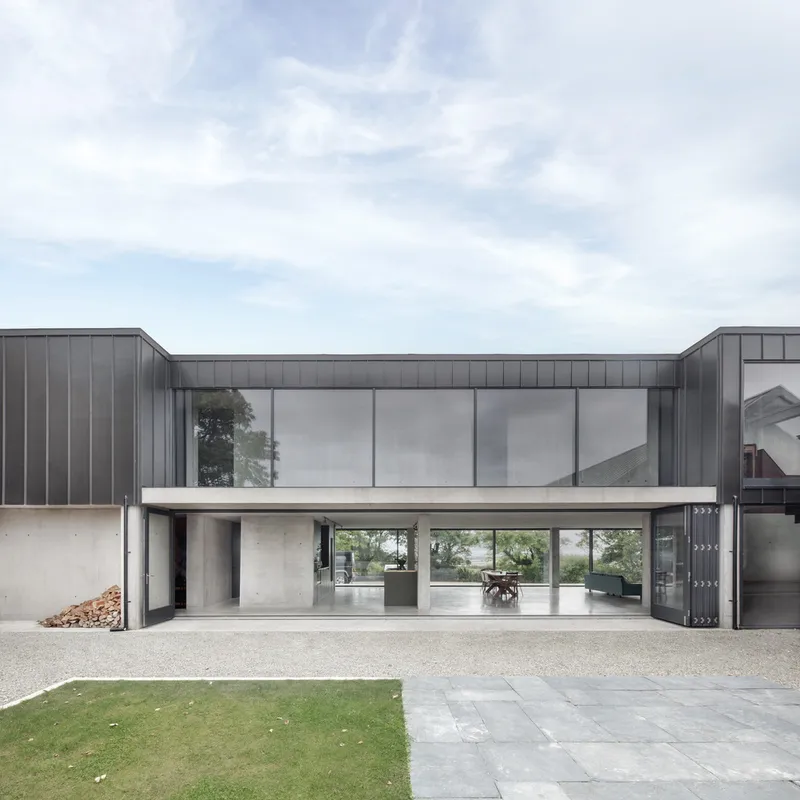
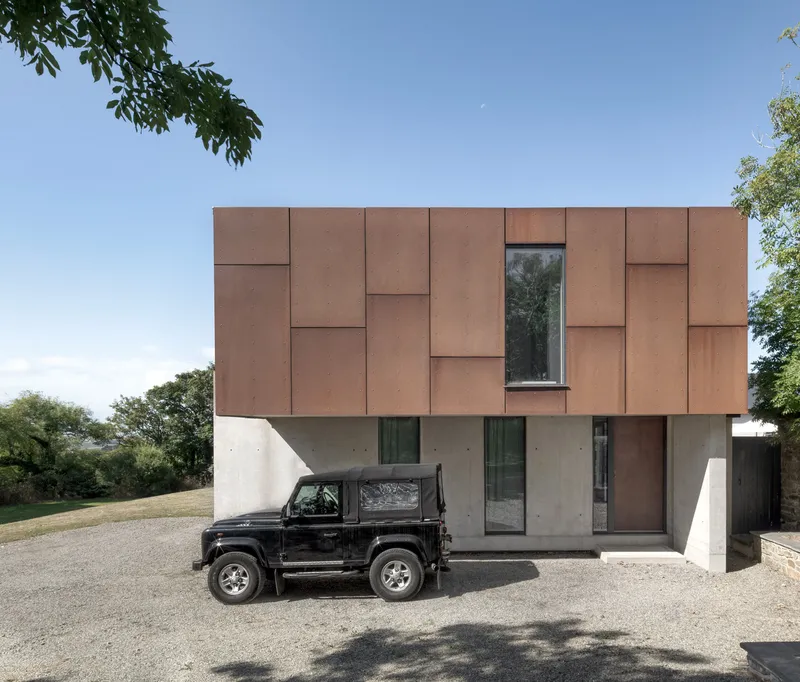
Castle High is composed of two distinct registers. The lower volume is concrete: heavy, recessed, grounded. The upper storey is clad in grey metal panels with copper tones, offset and cantilevered beyond the footprint below. The split creates a shadow line that runs the length of the building, making the upper mass appear to hover. From the street facade, the composition reads almost as two separate buildings stacked with deliberate misalignment.
The offset between the two volumes is not merely formal. It generates covered exterior spaces at ground level, sheltered terraces that extend the inhabitable area of the house without adding enclosed floor area. The gravel driveway and modest landscaping around the approach keep things restrained, letting the architecture do the talking.
Concrete as Both Structure and Surface
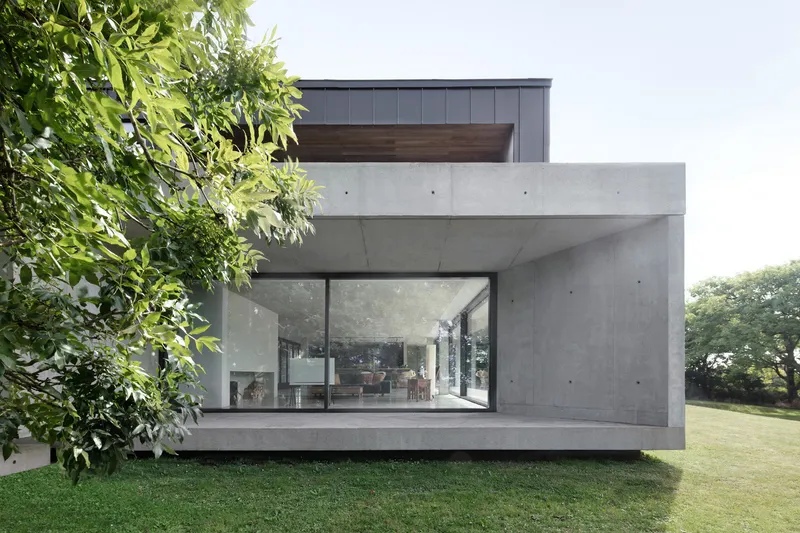


Hyde + Hyde use board-formed concrete throughout the ground floor, and they are not shy about it. The formwork imprints are visible everywhere: on exterior walls, on interior ceilings, on the soffits of the deep overhangs that shelter the terraces. Concrete does triple duty here, working as structure, as thermal mass, and as the dominant finish material. There is no plaster, no paint, no attempt to soften what the material is.
The timber-lined soffit beneath the upper cantilever provides a single moment of warmth against all that grey. It frames the sky when you look up from the terrace and softens the transition between inside and out. Large sliding glass panels dissolve the ground floor walls entirely, so the concrete plinth reads less as an enclosure and more as a platform on which life unfolds.
Living Spaces That Dissolve Into the Garden
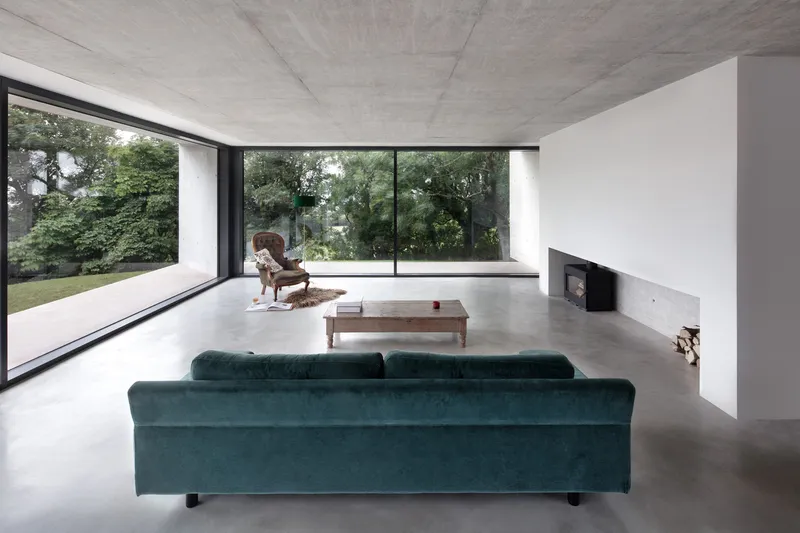
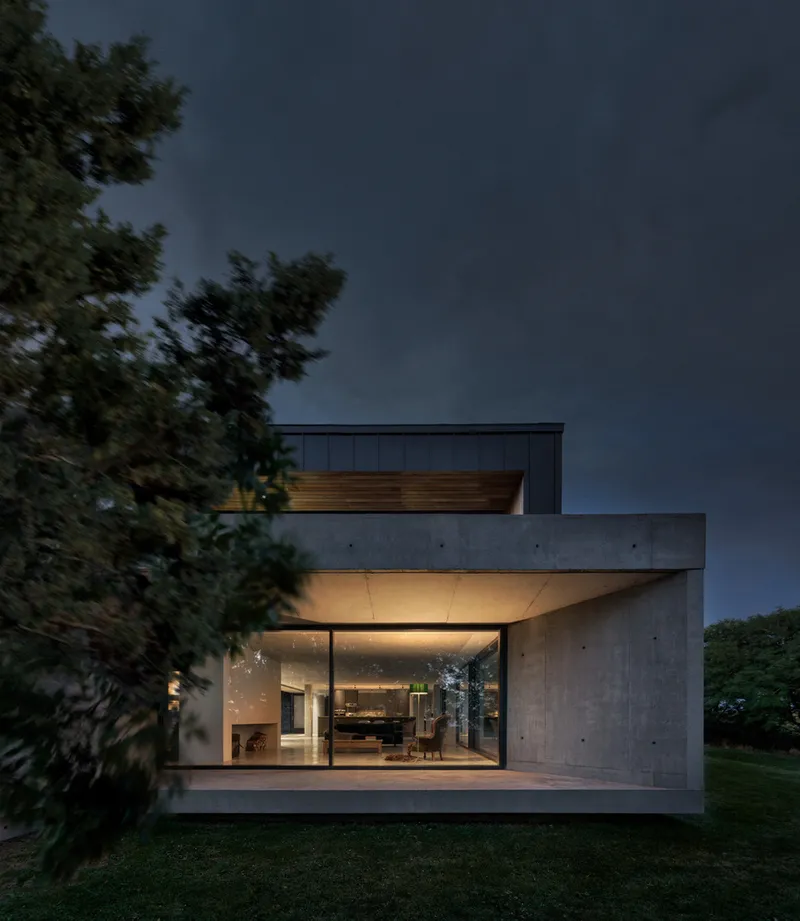
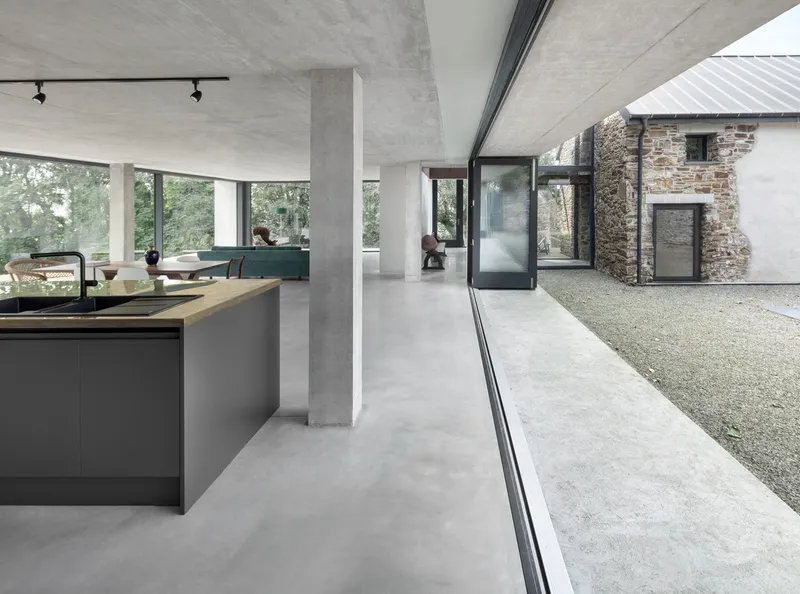
The ground floor living spaces are configured around transparency. Corner glazing in the living room eliminates the structural column at the building's edge, creating an uninterrupted panorama of the garden and surrounding hills. At dusk, when the interior lights are on and the landscape recedes into blue, the effect is striking: the house becomes a glowing inhabitable frame within a dark field.
The open plan kitchen and living area operates as a single spatial continuum, anchored by the exposed concrete ceiling above and connected to a courtyard that brings light deep into the plan. There is nothing tentative about the relationship between interior and exterior here. The glass walls are not punched openings; they are the absence of wall.
Interior Material Discipline
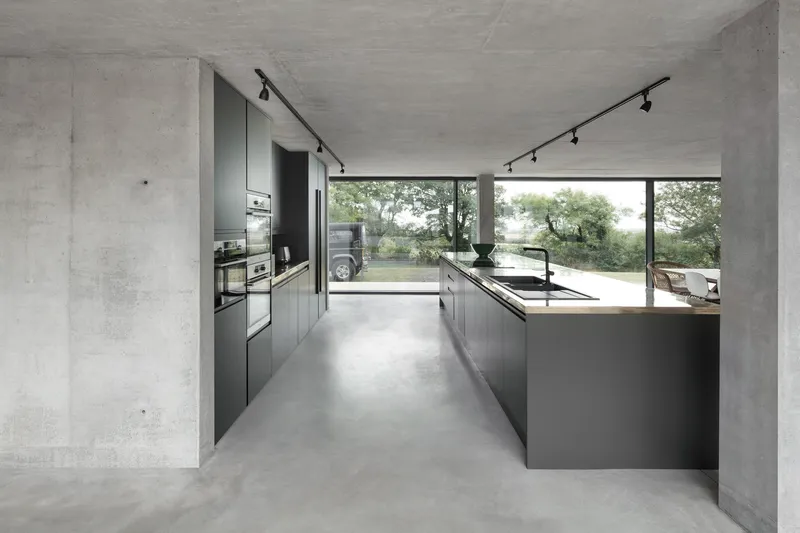
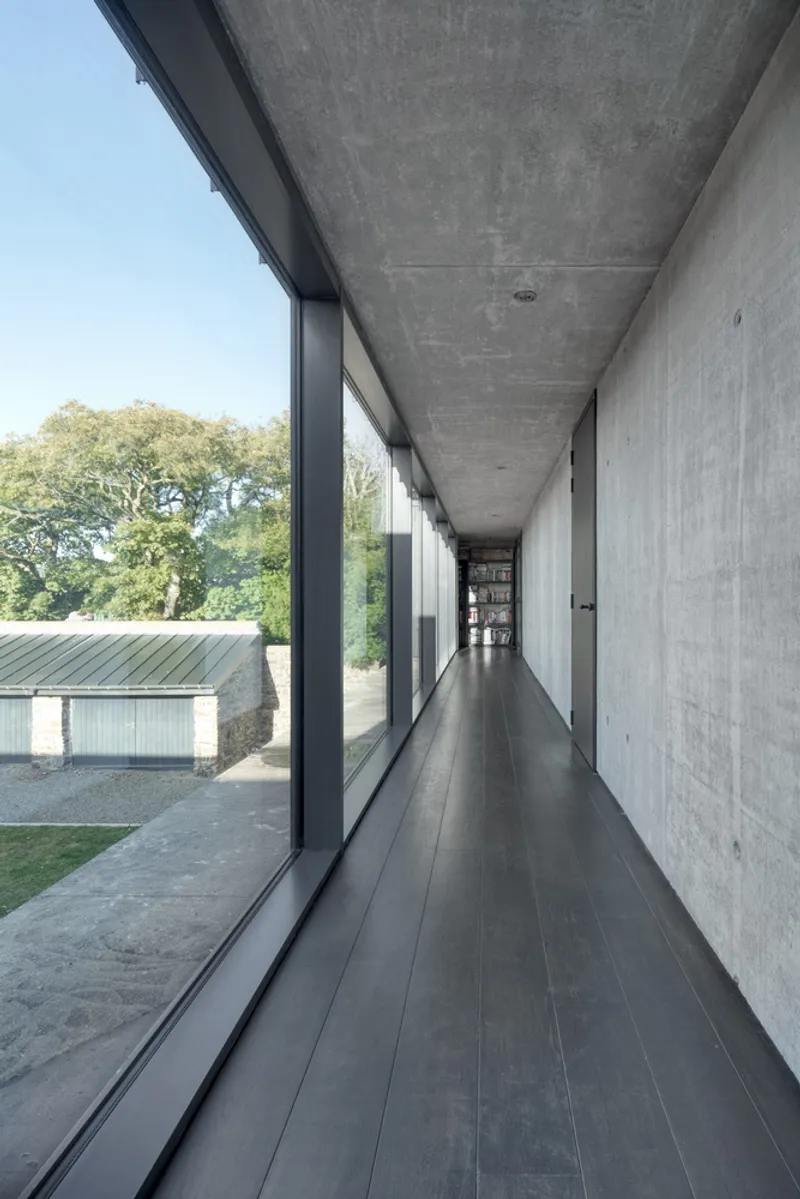
Inside, the material palette is narrow and uncompromising. The kitchen deploys dark grey cabinetry beneath the board-formed concrete ceiling, with track lighting as the only visible servicing. A corridor along one edge of the house pairs floor-to-ceiling glazing on one side with a raw concrete wall on the other, turning circulation into a gallery-like sequence. Light becomes a material in its own right, entering in controlled strips that move across the concrete surfaces through the day.
The restraint is deliberate and consistent. There are no accent walls, no decorative gestures, no visual relief. The interiors trust the quality of the concrete casting and the precision of the joinery to carry the experience. It is a house for people who find texture in austerity.
Vertical Circulation as Spatial Event
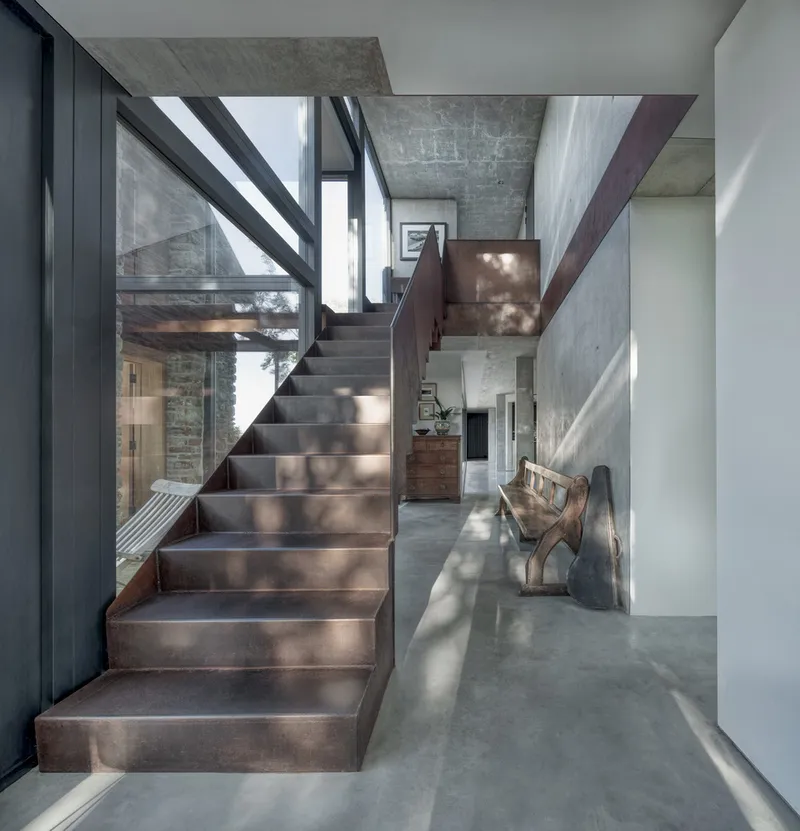
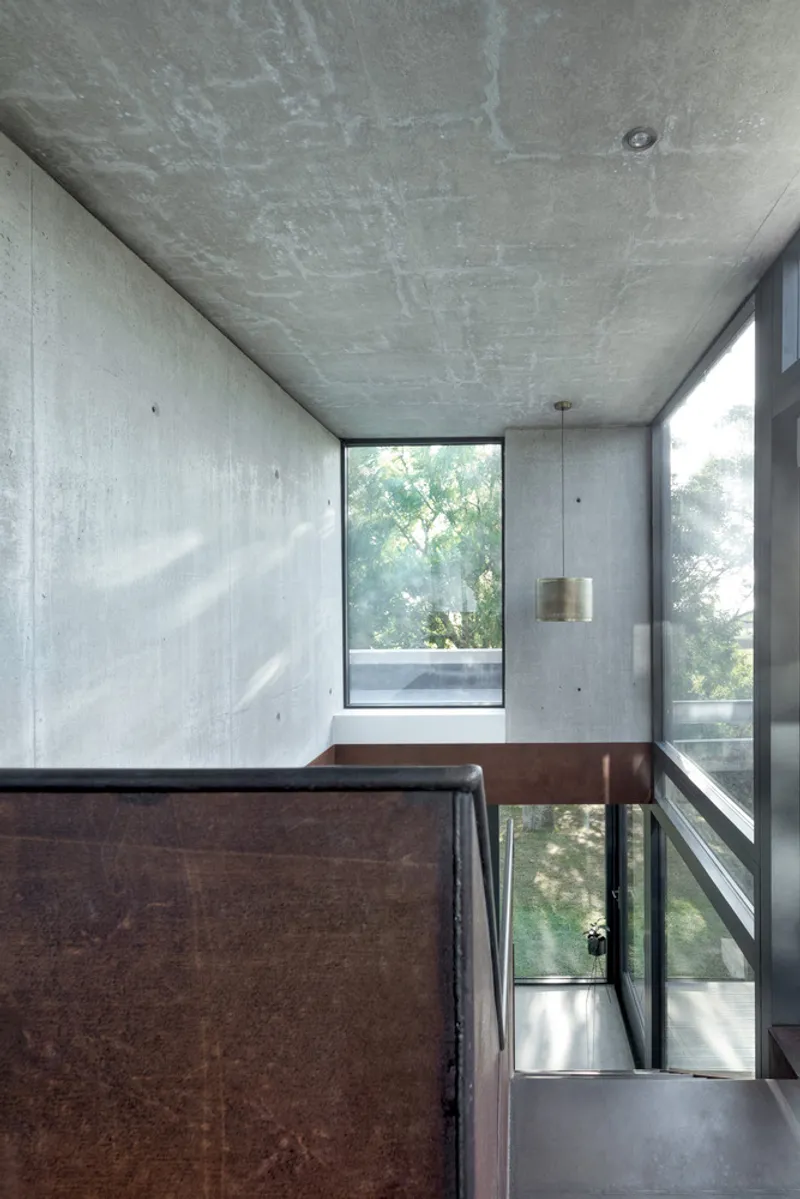
The staircase connecting the two storeys is one of the strongest moments in the house. A steel structure with copper-toned treads ascends through a double-height void, catching natural light from above. The board-formed concrete walls of the stairwell are punctuated by a single vertical window that frames a deliberate slice of sky and landscape.
This is not a staircase tucked away for efficiency. It is designed to slow you down, to make the transition from the grounded public spaces of the lower floor to the private rooms above feel like an ascent in every sense. The steel handrail and the warm metallic treads introduce the copper tones of the exterior cladding into the interior, stitching the two registers of the building together materially.
Why This Project Matters
Castle High matters because it refuses the premise that building in a national park means hiding. Too many rural residential projects in the UK retreat into vernacular camouflage, producing stone-clad boxes with slate roofs that perform deference without offering anything in return. Hyde + Hyde take the opposite position. They make a house that is conspicuously modern, materially assertive, and spatially generous, and they trust the quality of the architecture to justify its presence in a sensitive landscape.
The result is a dwelling that will age well. Concrete weathers. Metal patinas. The garden will grow into the terraces and soften the edges. In ten years, Castle High will look less like a statement and more like something that has always belonged to its hillside. That is the real argument the house makes: that honest materiality and confident form are a more durable kind of contextuality than imitation ever could be.
Castle High by Hyde + Hyde Architects, Pembrokeshire Coast National Park, Wales. Photography by Martin Gardner.
About the Studio
Share Your Own Work on uni.xyz
If projects like this are the kind of work you want to make, uni.xyz is a place to publish your own, find collaborators, and enter design competitions.


Popular Articles
Popular articles from the community


Singing Woman: An Opera House That Performs Before the Curtain Rises
Ovidiu Cristian Pavel's conceptual opera house translates Estonia's choral identity into a sculpted waterfront landmark facing the Baltic Sea.


David Ortega Stacks a Two-Story Mexico City Penthouse Around a Steel Stair and a Pergola-Shaded Roof Terrace
In Colonia Roma, a 300 m² penthouse uses oak joinery, a planted steel stair and a slatted roof pergola to make a new-build apartment feel like a house.

Opera on the Sea: Driftwood Logic Shapes a Timber Opera House on Estonia's Coast
Trevor Orgill's opera house translates the entangled drift of floating timber into a civic building where wood, water, and music converge.

Cube Design Draws an Ecological Corridor Between Two Shenzhen Hills with the Nankai Building
Beside Shenzhen's container docks, the Nankai Building pairs stacked balconies with a climbing green screen to connect two hillsides across its height.

Similar Reads
You might also enjoy these articles


Hodi-Mandai Geram
Project Function: Preservation and revitalization of the Intangible heritage and socio-spatial identity of the Hodi by Housing, Cultural Memory Center, Sacred Grove, landscape, local tourism economy


Olio Towers: A Mid-Rise for Performers That Fuses Housing, Rehearsal, and Stage
Located blocks from Houston's Theater District, this modular tower stacks living units around a central performance atrium.

Oasis: Modular Green Housing Carved into Dhaka's Urban Fabric
A shortlisted Plugin Housing entry reclaims unauthorized settlements in Dhaka with stepped concrete volumes, green roofs, and ventilation-driven design.

Black Hole: A Floating Megastructure for the Post-Physical Era
Emiliano Mazzarotto envisions a spherical, self-scaling arena where e-sports, digital hotels, and holographic stadiums replace traditional public space.

Explore Architecture Competitions
Discover active competitions in this discipline

Challenge to reimagine the Iron Throne

Photograph architecture without architects

Illustrate the lost glory of Angkor Wat - Render Challenge

Design challenge to reuse E-waste
Comments (0)
Please login or sign up to add comments
No comments yet. Be the first to comment!