

Castle of Art: Medieval Urbanism Rebuilt as a Creative Micro-City
A fortified ring structure shelters modular artisan dwellings, translating the spatial logic of medieval towns into a sustainable creative community.


What if the most forward-looking model for creative housing already existed 600 years ago? Castle of Art takes the spatial DNA of the medieval fortified town, its protective perimeter, dense artisan dwellings, and communal marketplace, and rewrites it as a contemporary mixed-use complex designed for artists, makers, and young professionals. The outer ring becomes a multi-storey residential structure that shields a cluster of modular workshop-houses inside, recreating the symbiosis of living and making that defined pre-industrial urban life.
Designed by Софья Поздеева and published on uni.xyz, the project proposes a full urban ecosystem rather than a single building. Its masterplan integrates water management channels, pedestrian-first circulation, climate-responsive orientation, and mixed-use zoning into a coherent whole. The result reads as part neighborhood, part arts campus, and part social experiment: an architectural complex that takes community-building as seriously as it takes environmental performance.
The Fortified Ring as Modern Infrastructure
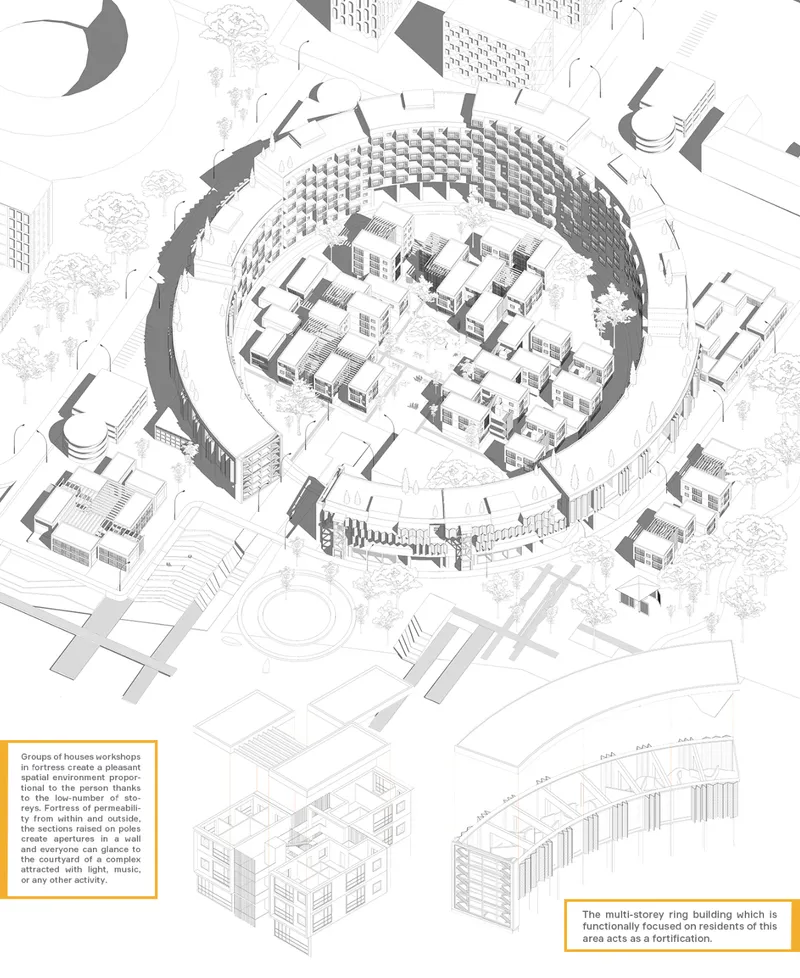

The axonometric and site drawings reveal the project's organizing move clearly: a continuous multi-storey ring wraps around the site perimeter, enclosing a field of lower-rise workshop-houses within its courtyard. The ring is not decorative historicism; it functions as acoustic buffer, wind break, and spatial boundary all at once. Its massing defines the public face of the complex to the surrounding city while creating a protected interior world scaled to pedestrians rather than vehicles.
Inside the ring, clustered housing blocks are arranged with deliberate gaps between them, allowing visual porosity from multiple vantage points. Residents can see through courtyards, across workshops, and into green spaces. The elevation drawing shows how this layered depth, outer ring to inner houses to shared ground plane, generates a gradient of privacy that mirrors the medieval transition from city wall to market square to private dwelling.
Seasonal Light as a Design Driver
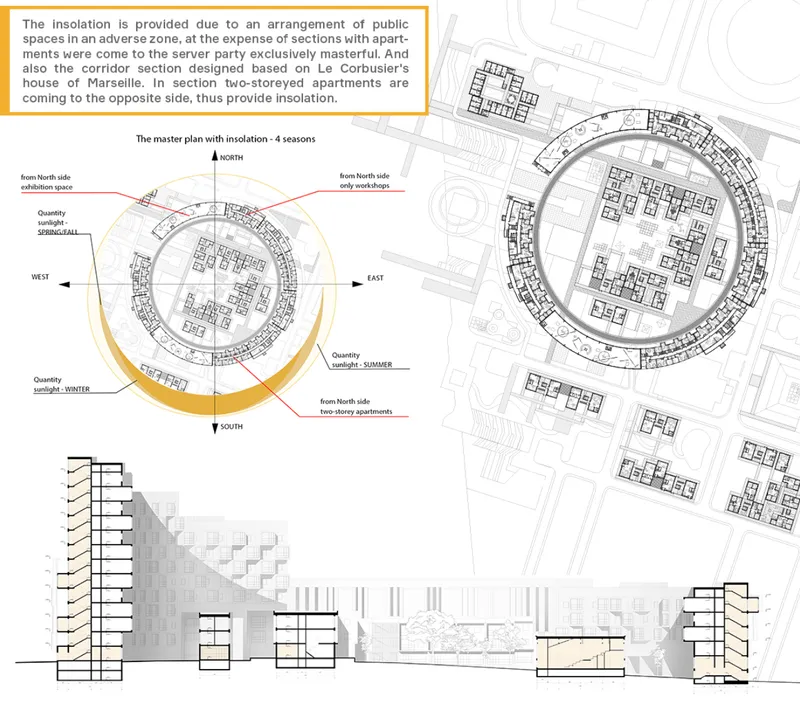
The masterplan sheet pairs the site layout with insolation diagrams and sectional studies that track sunlight penetration through different seasons. Public spaces are positioned to capture maximum solar exposure during winter months, while two-storey apartment sections, inspired by principles from Le Corbusier's Unité d'Habitation, are oriented so that living areas receive optimal natural light year-round. The sections demonstrate how the ring's height and the inner buildings' low profiles work together: the ring does not overshadow the courtyard because its geometry is calibrated to the sun's seasonal arc.
This is climate-responsive design operating at the masterplan scale rather than the facade scale. Building orientation, massing proportions, and open space placement are all consequences of environmental analysis. The water management strategy, with channels that collect, filter, and redistribute rainwater across the site, reinforces the impression that every site decision has been tested against performance criteria, not just compositional preference.
Workshop-Houses: Where Living and Making Share a Floor Plan

The floor plans and axonometric details of individual dwelling units reveal the project's most distinctive spatial proposition. Each artisan unit combines living quarters with a dedicated studio area, allowing residents to shape their professional environment within the same structure where they sleep and cook. Numbered room layouts show a clear organizational logic: working spaces face shared courtyards for visibility and social exchange, while private rooms retreat toward quieter zones.
The section perspective cuts through these units to show how raised platforms, terraces, and elevated galleries create interactive visual connections between public and private zones. These thresholds are not just architectural gestures; they produce the passive surveillance and neighborly proximity that Pozdeyeva identifies as essential to social sustainability. When you can see your neighbor's studio from your terrace, collaboration becomes a spatial default rather than a scheduled event.
Courtyard Life Between Timber and White Facades
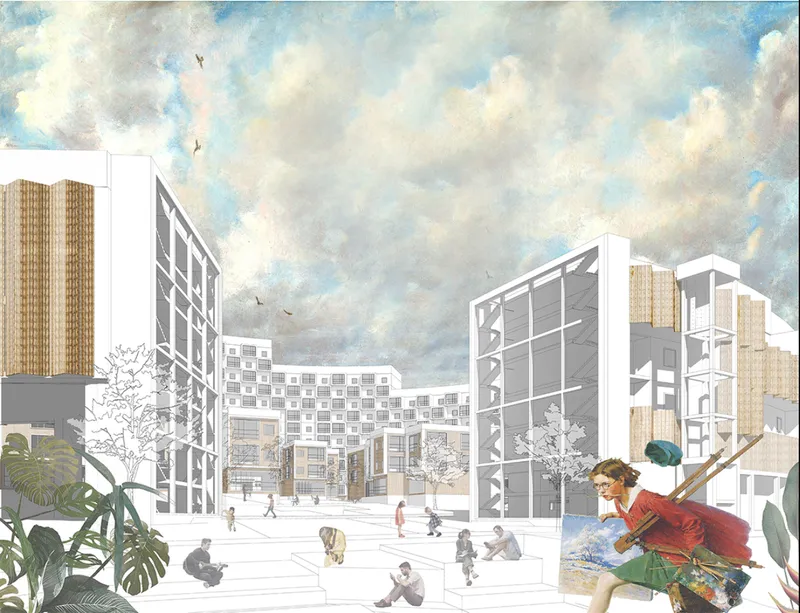

The rendered views bring the material palette and social atmosphere into focus. Timber-clad townhouses sit alongside white apartment blocks, creating a textural contrast that reinforces the typological distinction between the inner workshop-houses and the outer residential ring. The courtyard rendering, framed beneath cloudy skies with residents and dogs occupying the shared ground, communicates the human-scaled spatiality that the project prioritizes: low-rise structures create comfortable proportions while the surrounding ring forms what Pozdeyeva describes as a protective architectural "embrace."
The sunset view extends this atmosphere outward, showing families on lawns between the timber and white volumes. Communal plazas, inspired by the medieval marketplace archetype, are designed as cultural stages for performances, exhibitions, and social gatherings. The architecture here is not performing for a camera; it is performing for the people inside it, providing the spatial diversity that lets a neighborhood feel like a neighborhood rather than a housing block.
Why This Project Matters
Castle of Art matters because it treats historical precedent as operational intelligence rather than aesthetic reference. The medieval town is not quoted for its turrets or stone walls; it is studied for its spatial logic of integration, where work, residence, and community occupy the same footprint without hierarchy. Translating that logic into a contemporary framework of climate-responsive orientation, water management, and social sustainability produces something genuinely useful: a replicable model for creative communities that need more than open-plan coworking spaces and loft apartments.
Pozdeyeva's design also demonstrates that density and comfort are not opposites. By calibrating the ring's height against seasonal sun angles, staggering interior volumes for visual porosity, and embedding workshop spaces directly into dwelling units, the project achieves a compact urban form that still feels generous, open, and socially alive. For anyone interested in how historical typologies can inform sustainable urbanism, this is a compelling case study.
View the Full Project
About the Designers
Designer: Софья Поздеева
Enter a Design Competition on uni.xyz
uni.xyz runs architecture and design competitions year-round that reward proposals with spatial conviction and real site intelligence.
Project credits: Castle of Art by Софья Поздеева.


Popular Articles
Popular articles from the community


David Ortega Stacks a Two-Story Mexico City Penthouse Around a Steel Stair and a Pergola-Shaded Roof Terrace
In Colonia Roma, a 300 m² penthouse uses oak joinery, a planted steel stair and a slatted roof pergola to make a new-build apartment feel like a house.


The Amber Palace Opera: A Geological Fiction Surfaces on Tallinn's Baltic Waterfront
Pierre Brillard reimagines a Baltic legend as a public landscape, opera house, and waterfront promenade rooted in Tallinn's coastal identity.

Manzana Morphosis: Stretching Barcelona's Grid into a Living Landscape for 2050
A radical reworking of the Eixample manzana turns density into a tool for generous public space, vertical ecology, and environmental performance.

FCC Arquitectura Expands a Portuguese Granite House with a Board-Marked Concrete Wing
In Portugal, JV House pairs a cleaned-up whitewashed and granite dwelling with a timber-shuttered concrete extension, courtyards and a garden pool.

Similar Reads
You might also enjoy these articles

Aquadapt: An Underwater Habitat That Rewrites Its Rooms by the Hour
Curved modules ring the seabed while one shell shifts from breakfast room to cinema, farm and football pitch as residents' needs change.

Play: Fragments of Their World: Remembered Architecture Rebuilt as a Modular Playground for Refugee Camps
Tom Gardner abstracts domes, arches and towers from the homelands of displaced families into a kit of child-scaled play parts for camp settlements.
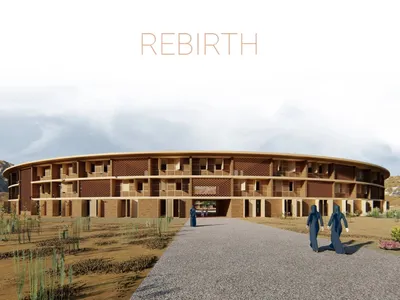
REBIRTH: A Circular Settlement Where Afghan Widows and Their Children Rebuild Life Together
A shortlisted Resile entry turns the circle into a protective ring of timber and brick, gathering homes, classrooms and gardens around a shared landscape.
The Main Dream: A Recycled Plastic Kit That Lets Refugee Children Build Their Own Playground
Thirty-centimetre interlocking cubes that connect on three axes turn play into construction, letting children author the spaces they occupy.


Comments (0)
Please login or sign up to add comments
No comments yet. Be the first to comment!