
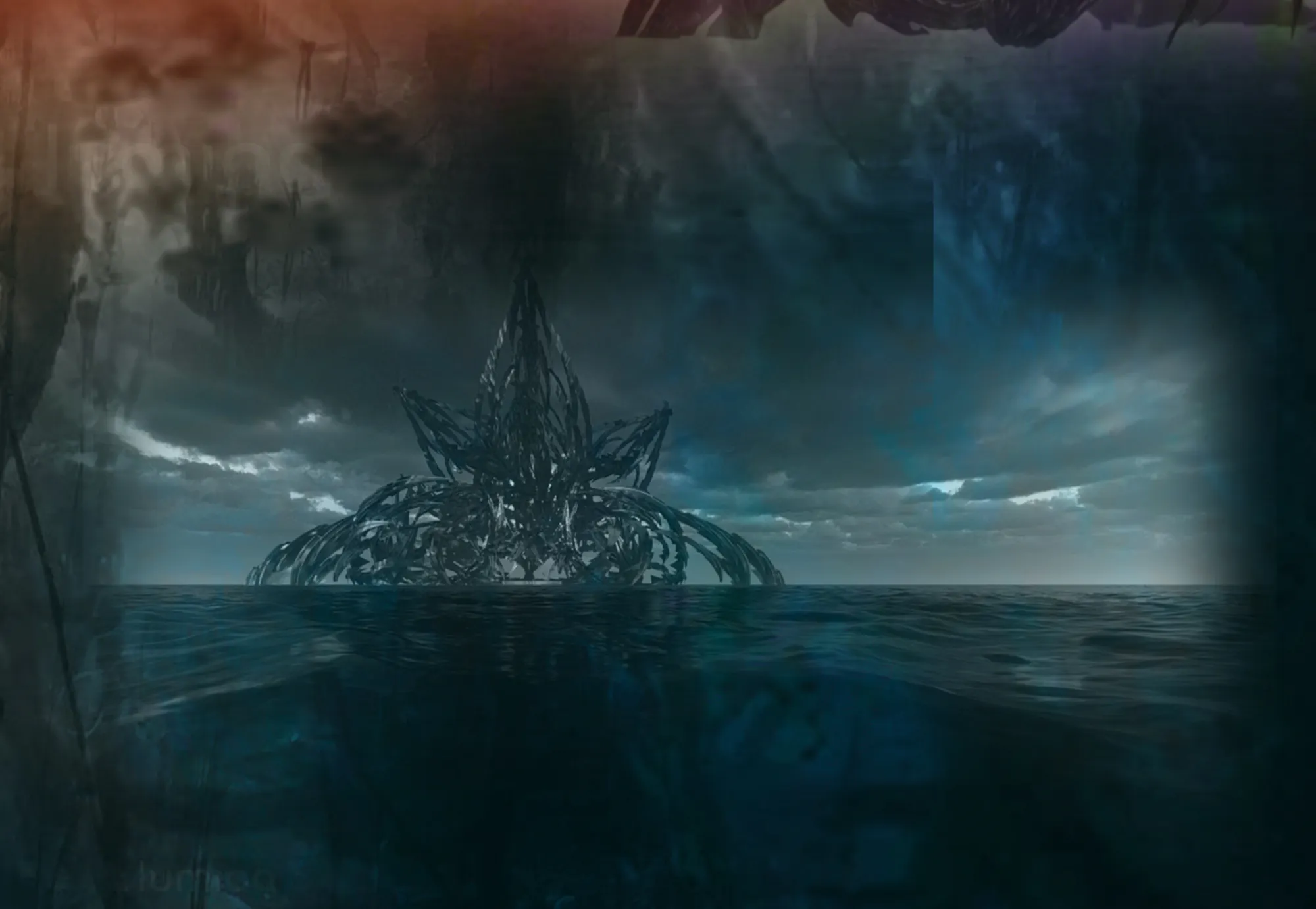
Cathedral of Breath: A Living Structure That Oxygenates the Ocean
A ribbed, skeletal pavilion grows from the sea floor to attract marine life and restore underwater oxygen levels through biomimetic form.


What if architecture could breathe? Not metaphorically, through passive ventilation or responsive facades, but literally: generating oxygen, pulling life toward it, functioning as a lung for a suffocating ocean. The Cathedral of Breath proposes exactly that. It is a skeletal, ribbed pavilion that rises from the waterline like some ancient marine organism, designed not to shelter human inhabitants but to restore the biological systems we have steadily dismantled beneath the surface.
Designed by Haley DeGidio for the Underwater Web competition, the project reimagines underwater architecture as ecological infrastructure. Rather than colonizing the deep with sealed capsules and pressurized rooms, DeGidio's proposal positions structure as catalyst: a branching, latticed form engineered to promote oxygenation and serve as an attractor for marine biodiversity. The site is not merely occupied; it is activated.
A Skeletal Canopy Between Water and Sky

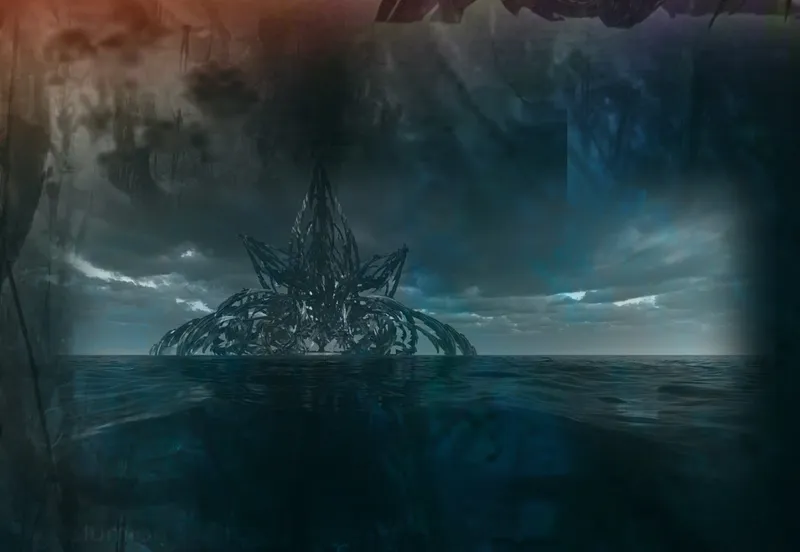
The structure reads as something between a gothic nave and a coral exoskeleton. Arching ribs rise from the water in dark, spiked silhouettes, catching dramatic light against turbulent skies. From a distance, the latticed pavilion appears to emerge organically from the surface, its geometry somewhere between calculated and grown. There is a deliberate tension here: the forms are too precise to be natural, yet too irregular to feel manufactured. DeGidio leans into that ambiguity, producing an object that belongs to neither world entirely.
The exterior views are striking in their atmospheric charge. The structure does not sit on the water so much as it punctures it, its verticality asserting presence without mass. Light filters through the lattice in ways that shift with weather and time, making the pavilion less a fixed object and more a temporal condition, constantly rewritten by its environment.
Inside the Ribcage: Reflections on a Flooded Floor
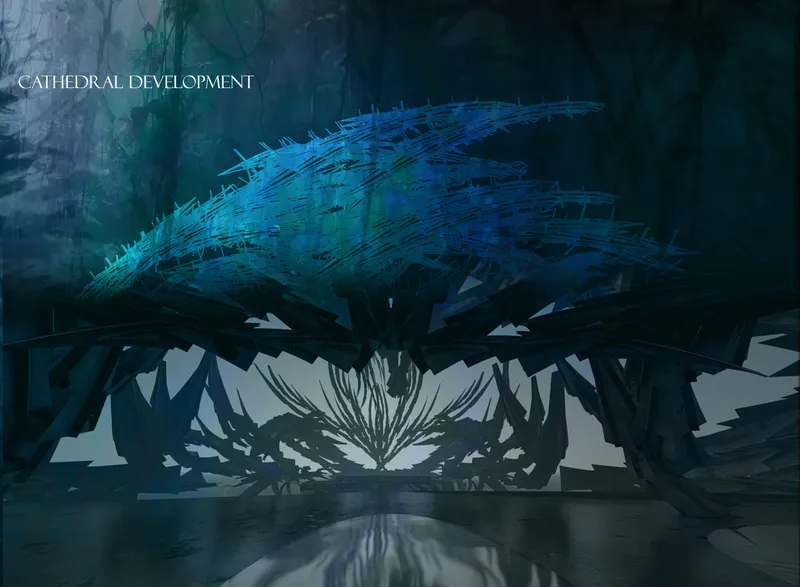
Step beneath the canopy and the scale shifts dramatically. The interior view reveals a curved skeletal framework overhead, its ribs converging like the vaulting of a cathedral, while the floor below is entirely flooded. Water becomes ground plane, and reflections double every structural member, dissolving the boundary between up and down. It is a disorienting, luminous space that positions the human visitor as a guest within a water-dominated environment, not the other way around.
This inversion matters. Most underwater architecture proposals treat water as a hostile medium to be sealed out. DeGidio invites it in, allowing the tide to claim the interior. The result is a space that is genuinely amphibious: architecture that accepts submersion as a design condition rather than a threat.
Growing the Structure: Branching Logic in Three Stages


The conceptual drawings reveal the design's generative logic. Three sequential stages illustrate how the form develops from a simple branching origin into a complex, interlocking canopy. The growth pattern is biomimetic, drawing on the fractal branching of coral, trees, and vascular systems. Each stage adds density and structural redundancy, creating a lattice that is both load-bearing and porous enough to allow water and light to pass through freely.
A panoramic timeline extends this logic into the temporal dimension, showing the structure under shifting light conditions from dawn to sunset. The message is clear: the Cathedral of Breath is not a static monument. It is designed to be read across time, its character transforming with the diurnal cycle and, presumably, with the biological growth that accumulates on its surfaces over years.
Oxygenation Attractors and Spiral Observation Platforms
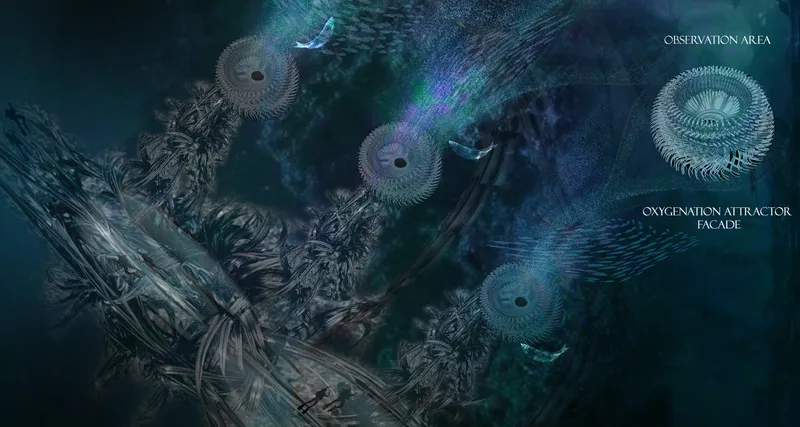
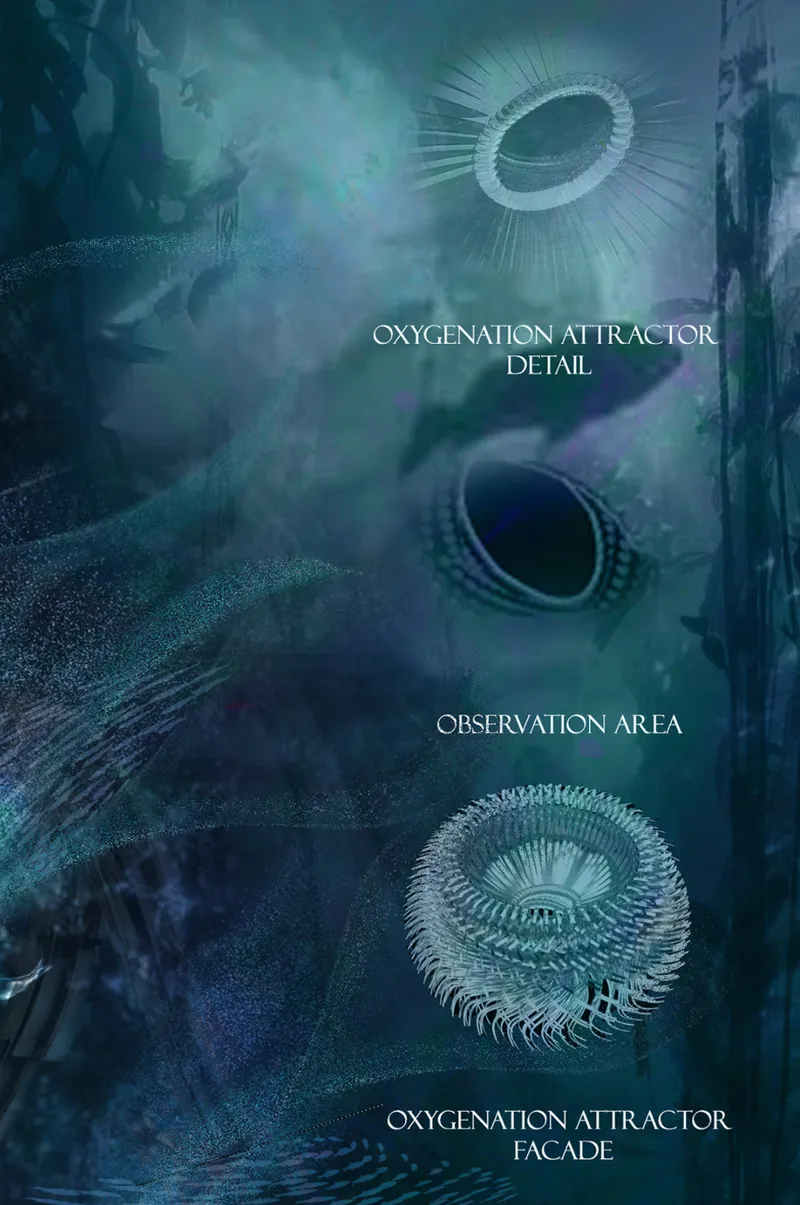
The site plan and conceptual diagrams ground the project's ecological ambitions in spatial specificity. Spiral observation platforms radiate from the central latticed structure, providing human access points without disrupting the underwater systems below. These platforms are not destinations; they are vantage points, oriented toward witnessing the ecological recovery the structure is designed to trigger.
The most technically revealing drawing identifies three circular volumetric elements as "oxygenation attractors," positioned within the underwater environment to promote localized oxygen generation and draw marine organisms into the structure's zone of influence. The architecture, in this reading, is less building than bait: a spatial device calibrated to attract the very life forms it aims to protect. It is a compelling inversion of the typical architect-client relationship, where the primary users are fish, not people.
Why This Project Matters
The Cathedral of Breath succeeds because it refuses the dominant paradigm of underwater architecture as human habitat. There are no airlocks, no viewing lounges, no luxury suites with porthole windows. Instead, the proposal asks what architecture would look like if its primary obligation were to non-human life, and if human experience were a secondary, almost incidental benefit. That reframing is radical in a field still largely preoccupied with spectacle and habitation.
DeGidio's formal language is muscular and specific. The ribbed, branching geometry is not arbitrary biomimicry applied as decoration; it is structurally and ecologically motivated, generating the porosity needed for water flow and the surface area required for biological colonization. As an entry in the Underwater Web competition, the Cathedral of Breath makes a persuasive case that the most meaningful architecture we can build beneath the waves might be architecture that was never really meant for us.
View the Full Project
About the Designers
Designer: Haley DeGidio
Enter a Design Competition on uni.xyz
uni.xyz runs architecture and design competitions year-round that reward proposals with spatial conviction and real site intelligence.
Project credits: The Cathedral of Breath by Haley DeGidio Underwater Web (uni.xyz).




Popular Articles
Popular articles from the community


Conexión: Biophilic Design Reimagines High-Rise Living in Hong Kong
Conexión reimagines high-rise living in Hong Kong through biophilic design, green facades, shared spaces, daylight, water and nature within.

The Ocean Hive: Sustainable Architecture for a Self-Sufficient Civilization at Sea
The Ocean Hive imagines sustainable architecture at sea, where modular habitats, algae, wave power and ocean waste sustain a growing colony.

Lunar Spiral: Space Architecture Shaped by the Mathematics of the Universe
Lunar Spiral reimagines space architecture through Fibonacci geometry, lunar regolith, levitating habitats, and self-sustaining Moon living.

The Musturak Paradise: Senior Living Architecture for a Connected Future in Temara, Morocco
The Musturak Paradise reimagines senior living architecture in Temara via private homes, social spaces, culture, community, and shared care.


Similar Reads
You might also enjoy these articles

Day and Night Park: A Time-Based Urban Newsstand in Beijing
A temporary urban newsstand in Beijing blending travel, light, and reading through poetic colors, compact form, and community-focused design.

Modernist Patio Renovation in El Masnou, Barcelona by Oliver Segura Arquitectura + Cebrià Arquitectura
Modernist patio renovation blending tradition and innovation with a movable pool, leveled floors, and Catalan materials in El Masnou.
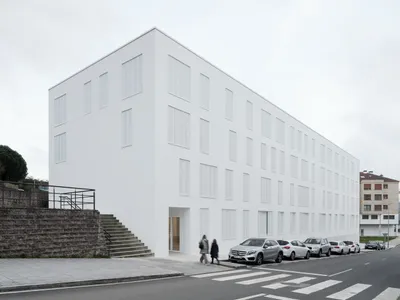
Alto Residencial Coop: Cooperative Housing Development in Santiago de Compostela by Carbajo Barrios Arquitectos
A linear cooperative housing complex blending white volumes and perforated metal façades, enhancing community living, natural light, privacy, and urban integration.
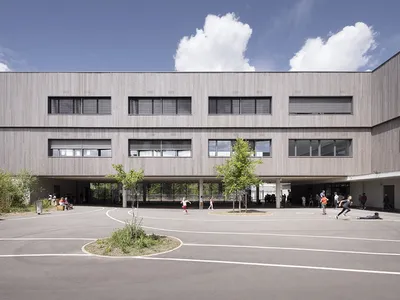
Vil Genis School by BPA ARCHITECTURE – Massy, France
Vil Genis School in Massy, France, features sustainable design, south-facing classrooms, community integration, accessible spaces, and modern educational architecture.


Explore Ocean Architecture Competitions
Discover active competitions in this discipline



Challenge to reimagine the Iron Throne


Photograph architecture without architects


Illustrate the lost glory of Angkor Wat - Render Challenge


Design challenge to reuse E-waste
Comments (0)
Please login or sign up to add comments
No comments yet. Be the first to comment!