
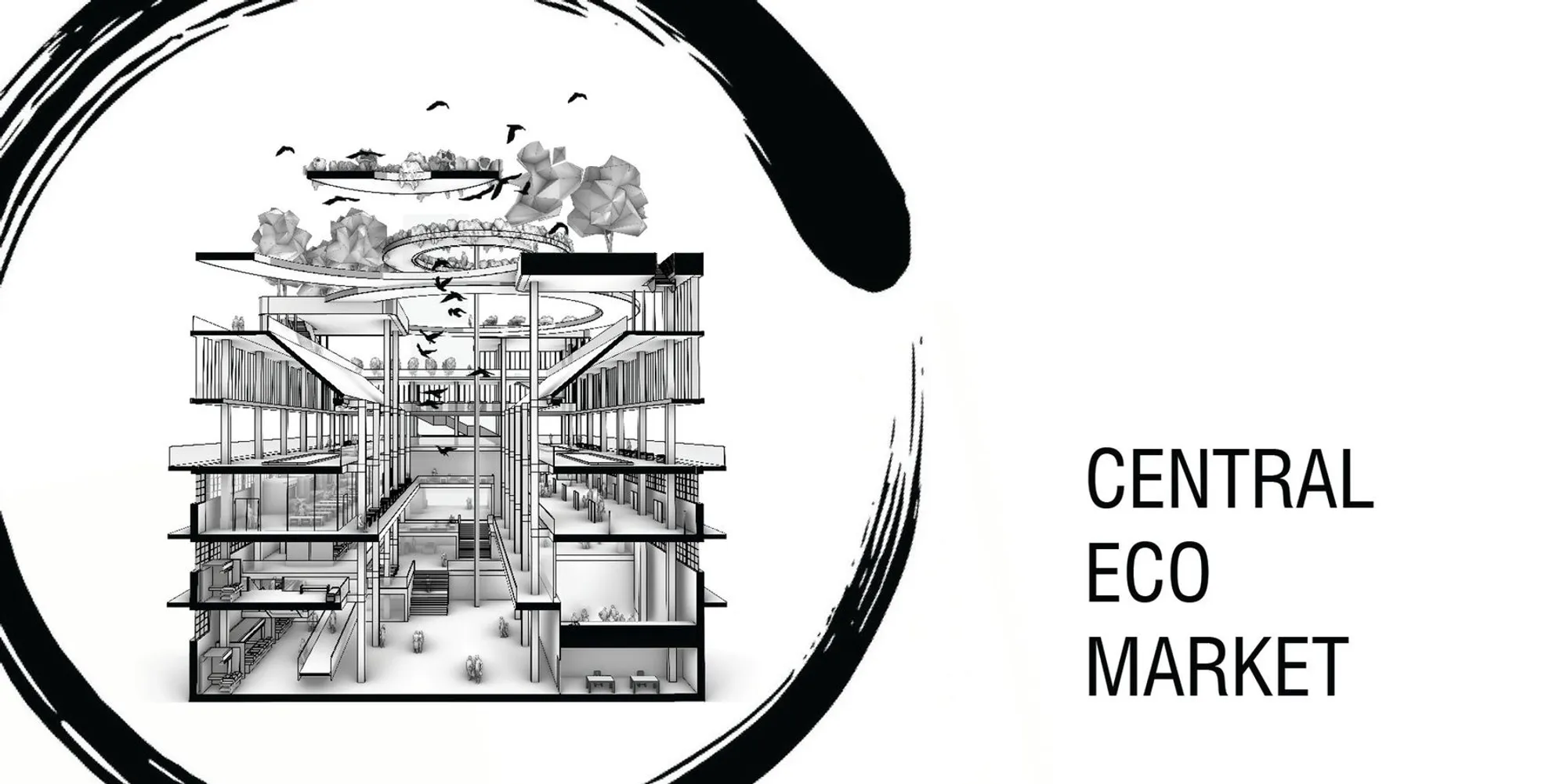
Central Eco Market: A Seed Bank That Spreads Rather Than Stores
Xavier Lee reimagines the urban market as a living ecosystem in Hong Kong, where architecture mirrors the seed-to-tree life cycle.


What if a building could behave like a seed: germinating, growing, and dispersing its value outward into the city? In the Central Eco Market, set in the dense urban core of Hong Kong, architecture borrows its organizational logic from an ecological cycle. A seed becomes a tree, a tree feeds birds, and the birds carry seeds to new ground. That loop of regeneration is not just metaphor here; it is the conceptual spine of a building that layers food markets, urban farms, exhibition spaces, and community terraces into a single structure designed to teach, nourish, and propagate.
Designed by Xavier Lee, the Central Eco Market is a shortlisted entry in the Seed Bank competition on uni.xyz. The project positions itself as a counter-narrative to Hong Kong's high-rise congestion and the alienation that often accompanies dense urban development. Rather than storing seeds in a vault, Lee proposes a seed bank that actively distributes knowledge, biodiversity, and community engagement through its programmatic design and spatial strategy.
From Cage to Open Ring: A Building That Unfolds
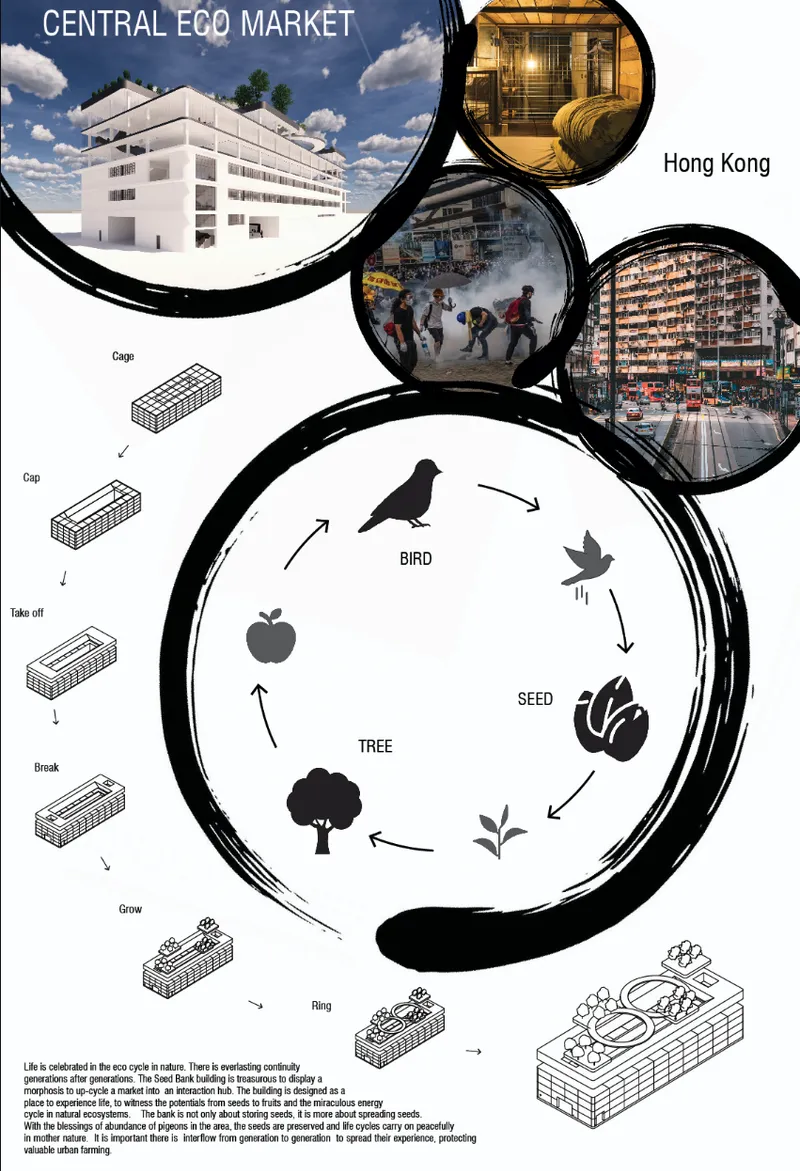
The ecological diagram at the heart of Lee's concept lays out the life cycle that governs the building's logic. Bird, tree, and seed symbols circle one another in a closed loop, surrounded by modular unit illustrations that translate each phase into architectural form. The building transitions from what Lee calls a symbolic "cage" into an "open ring," a spatial metaphor for how enclosed, congested urban blocks can be reimagined as breathable, nurturing public environments. Pigeons occupy a surprisingly central role in the narrative: symbols of peace, they carry seeds from place to place, making seed propagation both literal and poetic within the architecture.
A Multi-Story Atrium Built for Community Exchange
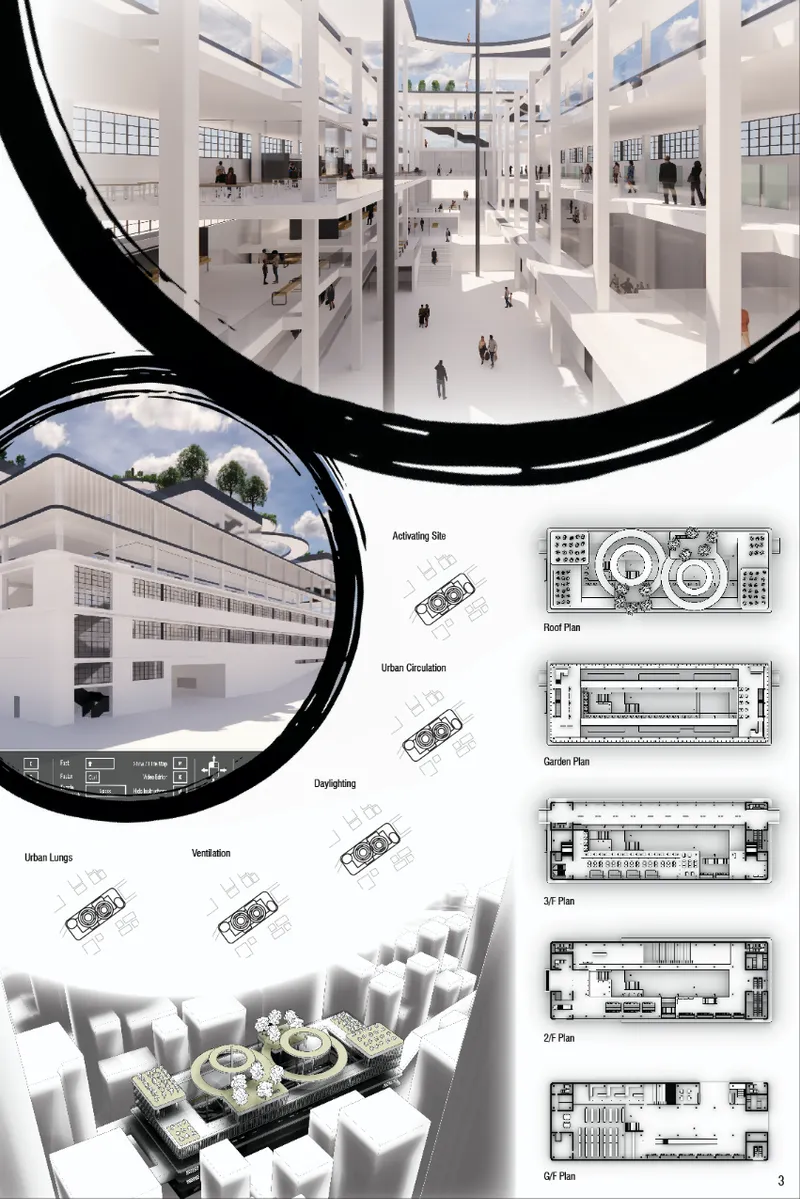
The interior rendering reveals a generous multi-story atrium where white balconies stack upward and visitors populate the ground floor. The spatial quality is open and permeable, with circulation corridors and sightlines connecting levels visually and socially. This is not a sealed commercial interior; it reads more like a covered public square, with daylight penetrating deep into the plan. The programmatic mix across these levels, including a Seed Shop, Green Market, Food Market, Interaction Zone, and Exhibition Space, is calibrated to activate community engagement at every floor, turning casual shoppers into participants in a larger ecological conversation.
Urban Lungs: Ventilation Shafts and Rooftop Cultivation
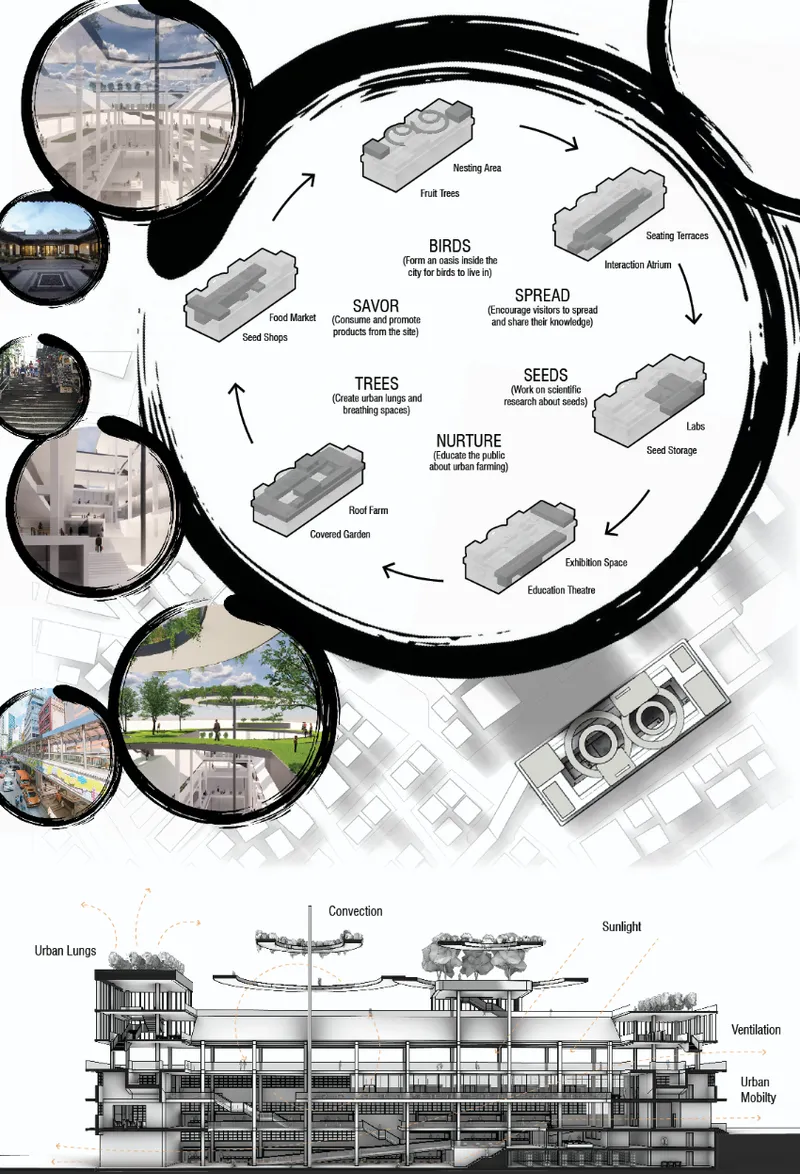
The section drawing exposes the building's passive sustainability strategy with clarity. Ventilation shafts run the full height of the structure, drawing air through open circulation corridors and expelling it at the top, while rooftop cultivation zones cap the building with productive green space. Lee dubs these upper terraces "Urban Lungs," a term that captures their dual function: contributing to local food security through urban farming and improving air quality for the surrounding neighborhood. Strategic daylighting works in concert with these ventilation channels, reducing the building's reliance on mechanical systems and reinforcing the project's commitment to circular resource thinking.
Stacked Programs: From Seed Shop to Glass Pavilion
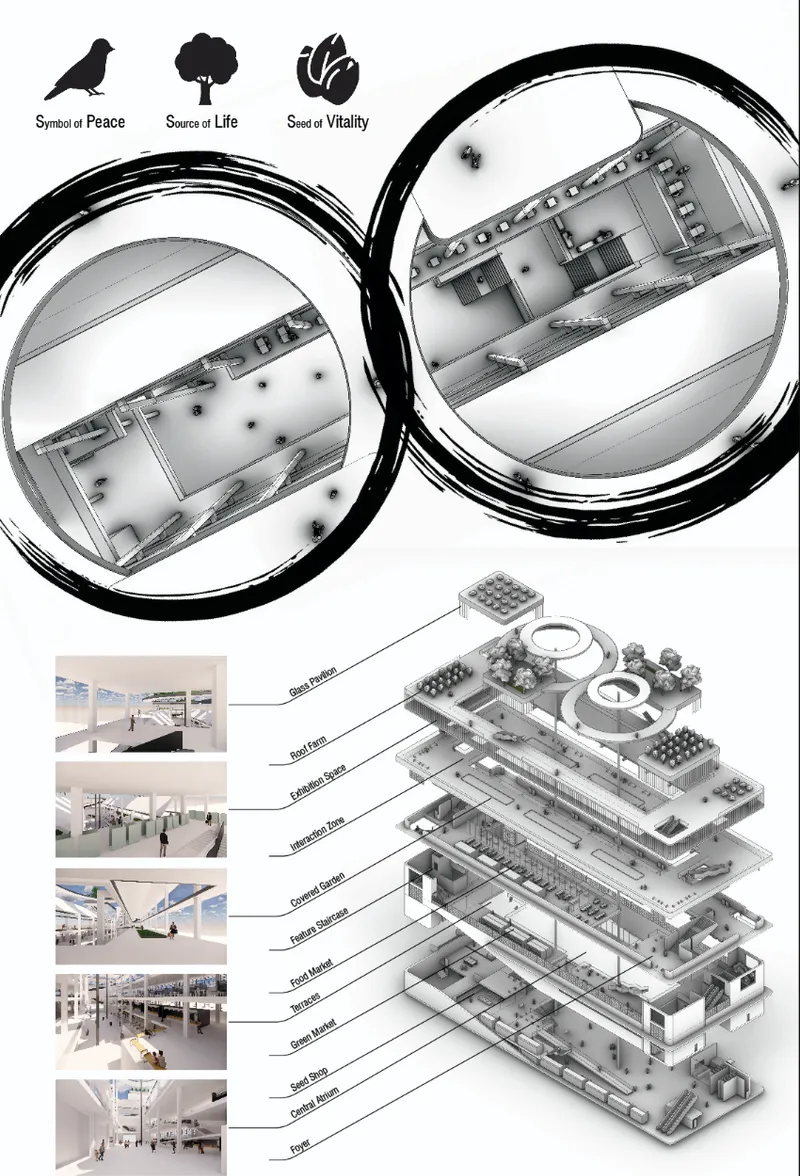
The exploded axonometric drawing pulls the building apart floor by floor, labeling each programmatic layer as it stacks upward. From the ground-level markets through mid-level terraces and a Covered Garden, up to the Roof Farm and a Glass Pavilion at the crown, every level has a distinct character and function. What makes the drawing effective is how it reveals the relationships between these zones: the Interaction Zone sits at a hinge point between commercial and educational programs, while the Exhibition Space bridges food production below and cultivation above. The vertical organization mirrors the seed-to-tree growth trajectory, with the most open, light-filled spaces reserved for the canopy.
Why This Project Matters
The Central Eco Market takes a familiar building type, the urban market, and recasts it as a didactic environment for sustainable living. In a city like Hong Kong, where vertical density often squeezes out public green space, Lee's proposal is quietly radical. It insists that a commercial building can also be a site of ecological education, intergenerational exchange, and biodiversity. The architecture does not simply house these functions; it performs them through its section, its material logic, and its relationship to natural cycles.
What distinguishes the project within the Seed Bank competition brief is its refusal to treat the seed bank as a static repository. Seeds here are meant to move. Knowledge is meant to spread. The building grows, gives back, and, if Lee's conceptual framework holds, propagates its values outward into the surrounding urban fabric. That ambition, to design a building that disperses rather than accumulates, is a provocation worth taking seriously.
View the Full Project
About the Designers
Designer: Xavier Lee
Enter a Design Competition on uni.xyz
uni.xyz runs architecture and design competitions year-round that reward proposals with spatial conviction and real site intelligence.
Project credits: Central Eco Market by Xavier Lee Seed Bank (uni.xyz).



Popular Articles
Popular articles from the community


The Ocean Hive: Sustainable Architecture for a Self-Sufficient Civilization at Sea
The Ocean Hive imagines sustainable architecture at sea, where modular habitats, algae, wave power and ocean waste sustain a growing colony.

Hill & Cross Opera: Sculptural Opera House Architecture Shaped by Tallinn’s Landscape and Identity
Hill & Cross Opera reimagines opera house architecture in Tallinn through its sculptural hill, civic plaza, glass wave and a luminous cross.

EW PARK: Sustainable Architecture Reimagines the Future of Urban Parking
EW PARK reimagines city parking as a modular wooden tower combining automation, solar energy, electric mobility, and adaptable urban design.

The Musturak Paradise: Senior Living Architecture for a Connected Future in Temara, Morocco
The Musturak Paradise reimagines senior living architecture in Temara via private homes, social spaces, culture, community, and shared care.

Similar Reads
You might also enjoy these articles

Day and Night Park: A Time-Based Urban Newsstand in Beijing
A temporary urban newsstand in Beijing blending travel, light, and reading through poetic colors, compact form, and community-focused design.

Modernist Patio Renovation in El Masnou, Barcelona by Oliver Segura Arquitectura + Cebrià Arquitectura
Modernist patio renovation blending tradition and innovation with a movable pool, leveled floors, and Catalan materials in El Masnou.

Alto Residencial Coop: Cooperative Housing Development in Santiago de Compostela by Carbajo Barrios Arquitectos
A linear cooperative housing complex blending white volumes and perforated metal façades, enhancing community living, natural light, privacy, and urban integration.
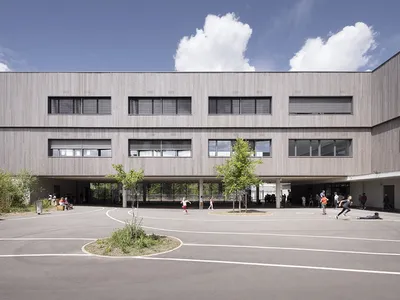
Vil Genis School by BPA ARCHITECTURE – Massy, France
Vil Genis School in Massy, France, features sustainable design, south-facing classrooms, community integration, accessible spaces, and modern educational architecture.
Explore Eco-Conscious Competitions
Discover active competitions in this discipline


Challenge to design locus for the upliftment of human rights


Design challenge to reuse E-waste
Comments (0)
Please login or sign up to add comments
No comments yet. Be the first to comment!