

Cereus House By Circle Studio Architects: Contemporary Heritage Extension in Seddon, Australia
Cereus House blends Edwardian heritage with contemporary curved extensions, creating light-filled, flexible, and thermally comfortable living spaces in Melbourne.


Located in the heritage-rich inner-west of Melbourne, Cereus House by Circle Studio Architects (lead architect: Yvonne Meng) is a stunning 197 m² residence that combines modern architecture with Edwardian heritage. The project transforms a 1915 weatherboard cottage with a contemporary curved extension that seamlessly integrates light, flow, and spatial connectivity while respecting the historical context.

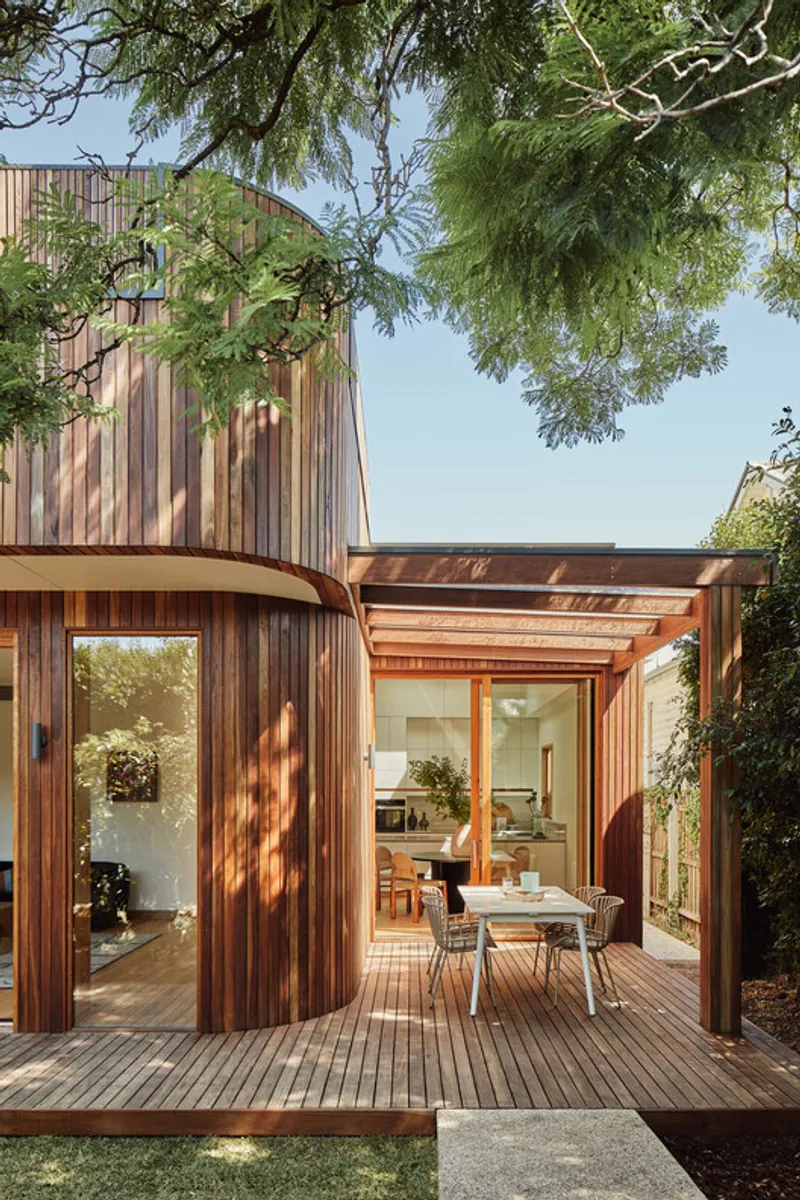
The design responds to a client brief seeking a thermally comfortable, light-filled home with spaces for working from home, relaxation, and family gatherings. A key requirement was to retain an oversized cereus cactus in the north-facing backyard, which inspired the design of outdoor and indoor sightlines.
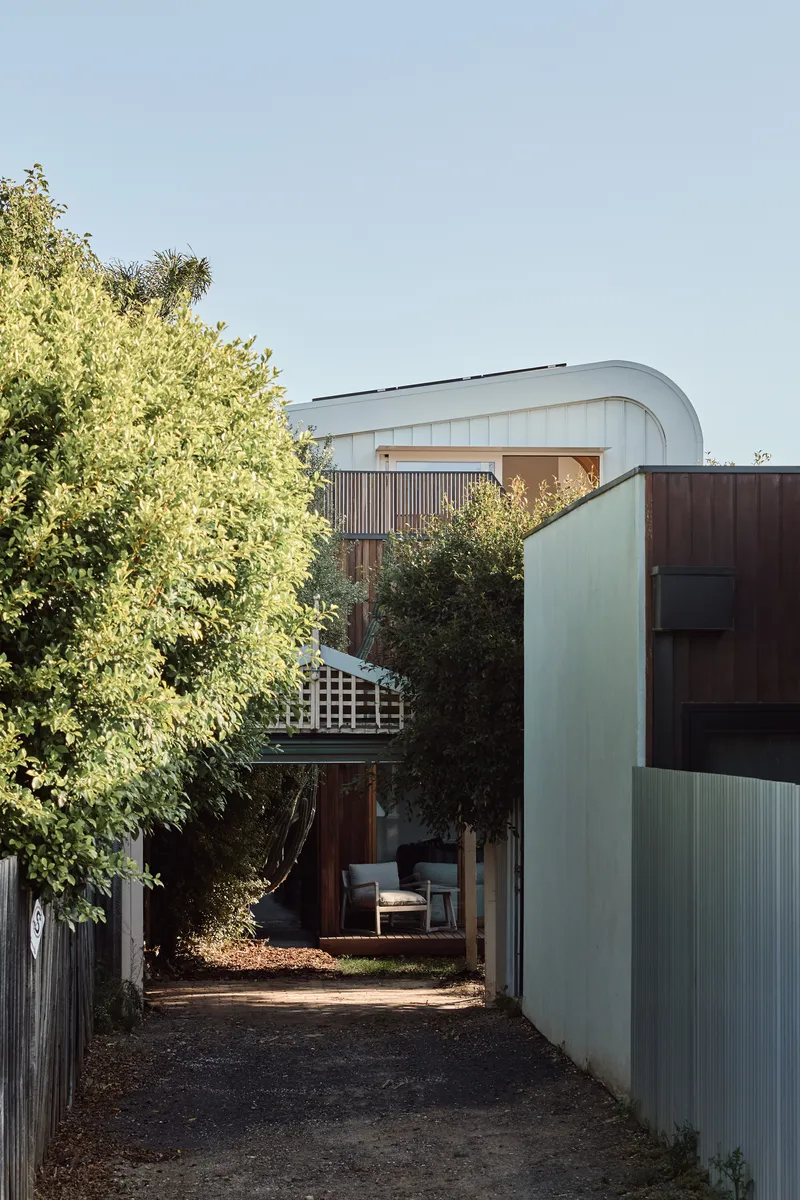

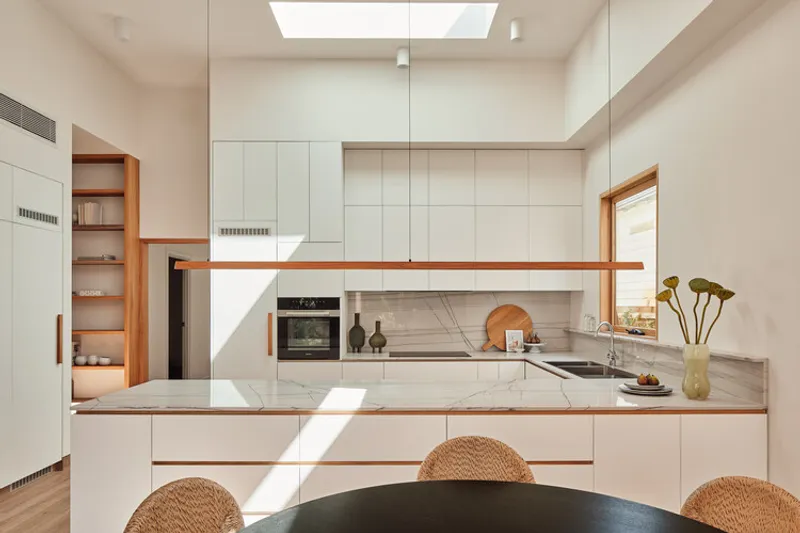
Architectural Concept and Design: Cereus House introduces two curved volumes that contrast yet harmonize with the original Edwardian structure. On the ground floor, curves in plan create soft transitions between the kitchen, living, and deck, while the upper floor curves in section to reduce visual bulk and create a fluid connection with the treeline. Curved rafters, inspired by traditional bullnose verandahs, are exposed in the ceiling, enhancing a sense of rhythm and lightness in the interiors.


The interior layout prioritizes versatile work modes and family living. A secluded office is positioned at the front, while an upstairs studio opens onto a large deck with selective openings for privacy. Timber shelves integrate seamlessly into leftover spaces, reflecting the clients’ love for books. The original cottage was stripped, insulated, and double-glazed to optimize thermal comfort, demonstrating a commitment to sustainability.

Materiality and Heritage Sensitivity: The upper extension is set back from the Edwardian roofline, preserving the historic street view. Timber cladding faces the backyard, providing warmth and natural texture, while metal cladding on the upper shell ensures durability and low maintenance. By respecting the heritage overlay, the design maintains the appearance of the original roof while introducing a subtle low walkway to access attic spaces.

Structural Innovation: Supporting the new extension required replacing the original floor with a new concrete slab. The house was internally gutted, and walls propped while footings were poured with a “hit-and-miss” method, ensuring structural stability, thermal mass, and minimized future maintenance.

Cereus House successfully balances contemporary design with heritage preservation, offering a liveable, light-filled, and adaptable family home. Its sculptural curves, natural materials, and sensitive interventions create a sanctuary that is both functional and aesthetically striking.
All the photographs are works of
Jade Cantwell


Popular Articles
Popular articles from the community


LT2A and OPEN Architectes Thread a Brick and Glass High School Through a Wooded Belgian Campus
In Braine-l'Alleud, a 3,000 m² wing for Collège Cardinal Mercier pairs pale brick with a glazed colonnade, deferring to a small chapel and a dense wood.

David Macias Steps a Doorless Stone and Plaster House Down a Tropical Colombian Hillside
In the humid hills of Colombia, Threshold House replaces the front door with an open void and terraces its 850 m² down the slope instead of fighting it.

U.GA Architects Wraps an Oval Rooftop Pool in Curved Board-Formed Concrete on Busan's Jeollidan-gil
In Busan's Jeonpo-dong, a 454 m² mixed-use block stacks a neighborhood facility, guest rooms and an oval rooftop pool inside spiraling concrete walls.

Jaramillo Van Sluys Arquitectura and Urbanismo Turn a Demolished Registry Lot in Quito into an Orchard Plaza
In Quito's Centro Histórico, a 2,800 m² plaza exposes the San Agustín convent wall and redraws its lost Augustinian orchard in volcanic stone.

Similar Reads
You might also enjoy these articles

Gil Mello Arquitetura Tilts a Single Roof Toward the Waterfalls on a Plateau Above Aiuruoca, Brazil
In Aiuruoca, Minas Gerais, a 200 m² house of local labor and reclaimed poles pairs a low valley veranda with a tall mountain one.
U.GA Architects Wraps an Oval Rooftop Pool in Curved Board-Formed Concrete on Busan's Jeollidan-gil
In Busan's Jeonpo-dong, a 454 m² mixed-use block stacks a neighborhood facility, guest rooms and an oval rooftop pool inside spiraling concrete walls.

Felipe Hess Arquitetos Turns a Blind Stone Wall to the Street and Opens a Brazilian House onto a Courtyard and Canal
A canal-front house in Brazil hides behind painted stone and planting, then opens to an olive-tree courtyard, a reed-ceilinged porch and a curving pool.
David Macias Steps a Doorless Stone and Plaster House Down a Tropical Colombian Hillside
In the humid hills of Colombia, Threshold House replaces the front door with an open void and terraces its 850 m² down the slope instead of fighting it.

Explore Blocs Competitions
Discover active competitions in this discipline

Challenge to reimagine the Iron Throne

Photograph architecture without architects

Illustrate the lost glory of Angkor Wat - Render Challenge

Design challenge to reuse E-waste
Comments (0)
Please login or sign up to add comments
No comments yet. Be the first to comment!