

C.F. Møller Builds a Hybrid Timber Office in Munich's Former Industrial Quarter
A 20,000 square meter beech and concrete workplace anchors the Werksviertel district with recycled aluminum and a daylit atrium.


Munich's Werksviertel district has spent the last two decades shedding its industrial skin. What was once the Pfanni potato factory, and later the legendary Kunstpark Ost nightlife complex, is now a dense urban quarter of housing, culture, and business opposite the Ostbahnhof. Into this charged territory, C.F. Møller has placed i8, a six-story office building that reads as both a gateway marker and a serious proposition about how timber construction can scale to commercial architecture.
What makes this project worth attention is the structural ambition behind its gentle facade. The building uses beech laminated veneer lumber paired with concrete composite decks, a hybrid system that substantially cuts embodied carbon while delivering the clear spans and three-meter ceiling heights that speculative office tenants demand. The recycled aluminum cladding, tinted a muted green, gives the exterior an industrial cast that nods to the site's heritage without resorting to pastiche. And the interior, organized around a generous skylit atrium, treats timber not as decorative cladding but as the visible skeleton of a workspace designed around daylight and social connection.
A Facade That Works Twice


The building's street presence relies on a distinctive diagonal bracing pattern visible through the glass curtain wall. These are not decorative appliqués; they are part of the hybrid timber and concrete structural system, expressed honestly on the exterior. The recycled aluminum framing, finished in a soft green that shifts tone under Munich's overcast skies, adds depth without heaviness. Vertical fins modulate the facade rhythm and reference the industrial vernacular of the surrounding Werksviertel blocks.
From a distance, the layered assembly of glass, structure, and metal screening gives the building a kind of visual density that most curtain-wall offices lack. You see through it, but not all at once. The diagonal members catch light differently at each floor, creating a subtle animation across the elevation that rewards a second look.
Timber Structure as Interior Architecture


Inside, the beech laminated veneer lumber is left exposed wherever possible, and its warm honey tone does more for the workplace atmosphere than any amount of biophilic wallpaper could. The ceiling beams in the open office floors run parallel to integrated linear lighting, creating a regular rhythm that is both structurally legible and acoustically functional. Looking up through the atrium, gridded translucent panels flood the space with diffused light while the timber framework recedes into a lattice of overlapping grain lines.
C.F. Møller's decision to use beech rather than the more common spruce or pine is worth noting. Beech has a tighter grain and higher structural capacity, which allows for slimmer members at commercial spans. It also has a distinctly different color and texture from softwood glulam, lending the interiors a material specificity that avoids the generic 'wood box' aesthetic now ubiquitous in Scandinavian and Central European office design.
The Atrium as Social Infrastructure
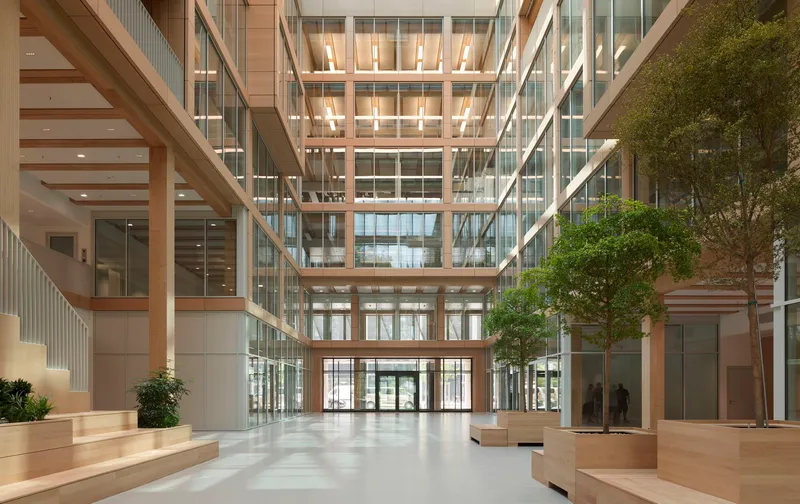

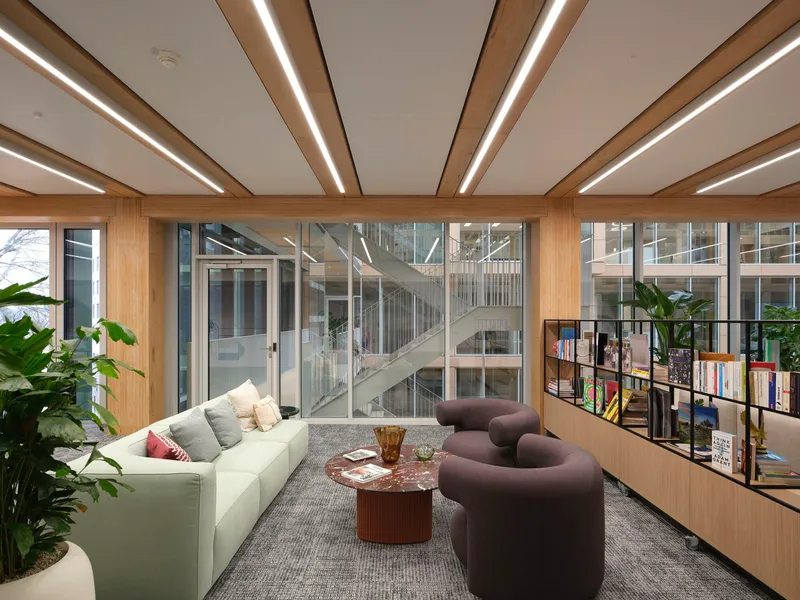
The central atrium is the project's organizational and experiential core. All six levels open onto it through timber-lined balconies and loggias, making visual contact between floors effortless. A planted tree anchors the polished concrete ground floor, and the large wooden staircase that stitches the levels together is designed as a destination rather than a fire escape. People linger on it, which is the whole point.
The strategy here is deliberate: by making the staircase more inviting than the elevator, C.F. Møller encourages incidental encounters between tenants on different floors. Circular seating overlooks the void, meeting rooms open toward it, and the ground-level lobby functions as an active threshold between the building and the Werksviertel street life outside. It is co-working infrastructure without the branding.
Ground Floor and Urban Activation
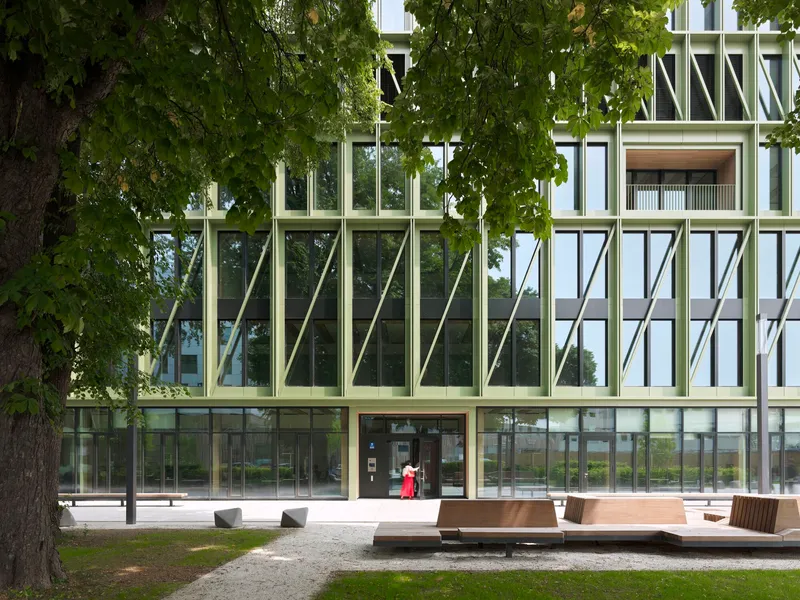

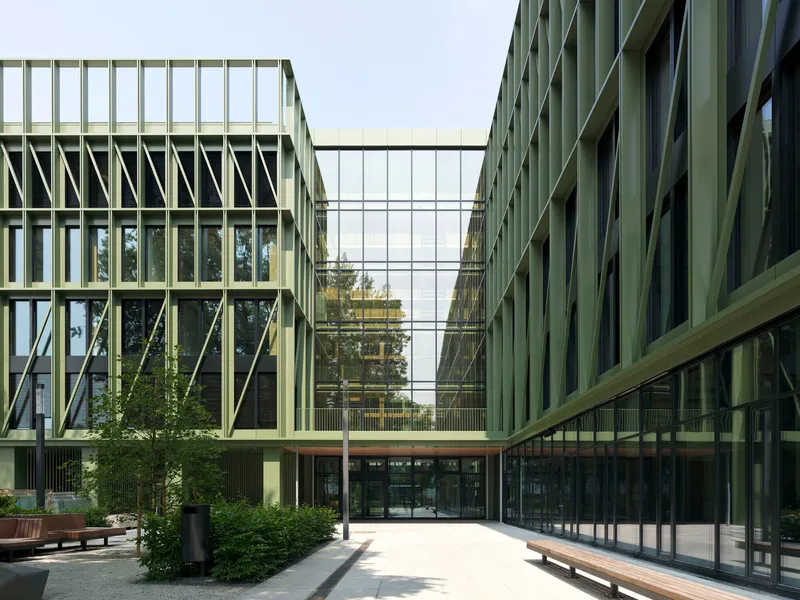
The building's L-shaped plan creates a courtyard open to August-Everding-Straße, framing a small public plaza with timber benches and mature trees. This ground-level porosity is essential to the Werksviertel's urban strategy, which depends on activated edges rather than blank podiums. A glass skybridge connects the two wings at upper levels, leaving the courtyard entry generous and permeable at grade.
The restaurant space at ground level, with its curved pink bar stools and floor-to-ceiling windows, brings evening life to a building type that typically goes dark after six o'clock. It is a small move but a meaningful one in a district still building its identity as a place people choose to be, not just commute to.
Flexible Floors and Daylight Strategy


Office floors are designed with optimized depths and three-meter clear ceiling heights to pull daylight as deep into the plan as possible. The floor plates can be subdivided into individual offices, open-plan layouts, or hybrid combinations, a flexibility that reflects the commercial reality of multi-tenant buildings where lease terms shift and team sizes change. Corner meeting rooms frame views through full-height glazing while the timber beams above maintain material continuity.
The kitchenette spaces, finished with patterned tile and open shelving, suggest that C.F. Møller paid real attention to the spaces where people actually spend time between meetings. These are not afterthought pantries. They are proportioned and detailed with the same care as the conference rooms, which says something about how the architects understand contemporary work.
Rooftop and Exterior Thresholds


The rooftop terrace is planted with grasses and perennials in raised beds, offering tenants outdoor space with long views across the Werksviertel. Balconies at intermediate levels provide smaller moments of outdoor access, overlooking the tree-lined courtyard below. These thresholds between inside and out reinforce the building's ambition to be more than a sealed office container: they offer choices about where and how to work throughout the day.
Facade Detail and Material Craft
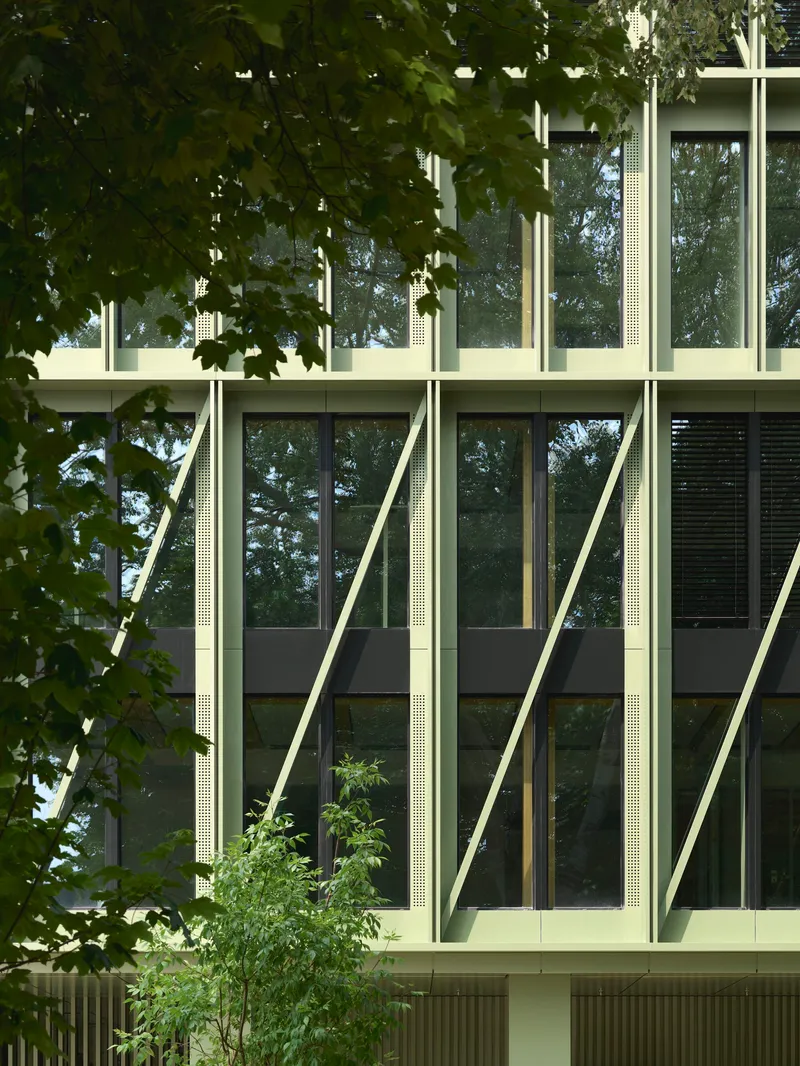
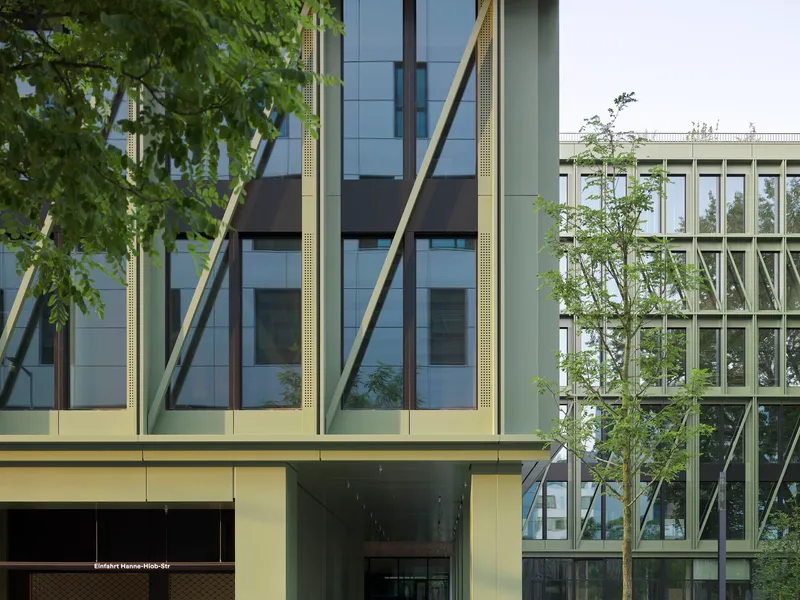

Up close, the recycled aluminum panels reveal perforated patterns and a surface texture that catches raking light. The diagonal bracing, painted in a slightly warmer tone, reads as a separate layer from the horizontal floor slabs, giving the facade its distinctive depth. Timber planters in the interior courtyard corridors soften the structural expression and introduce greenery at every level, blurring the line between the building's public and working zones.
Plans and Drawings


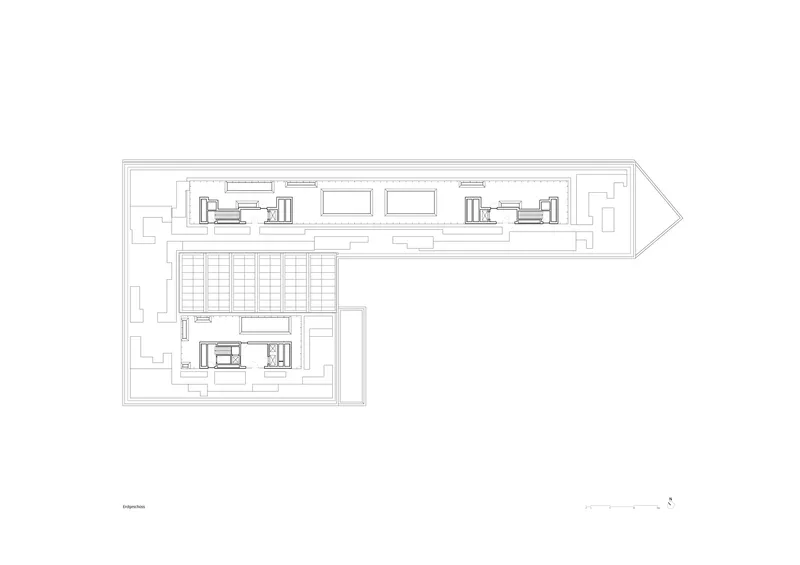


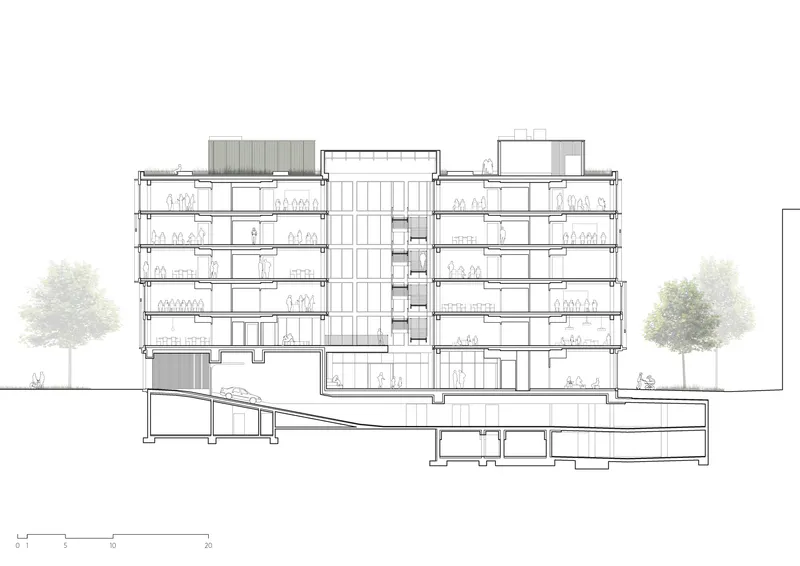


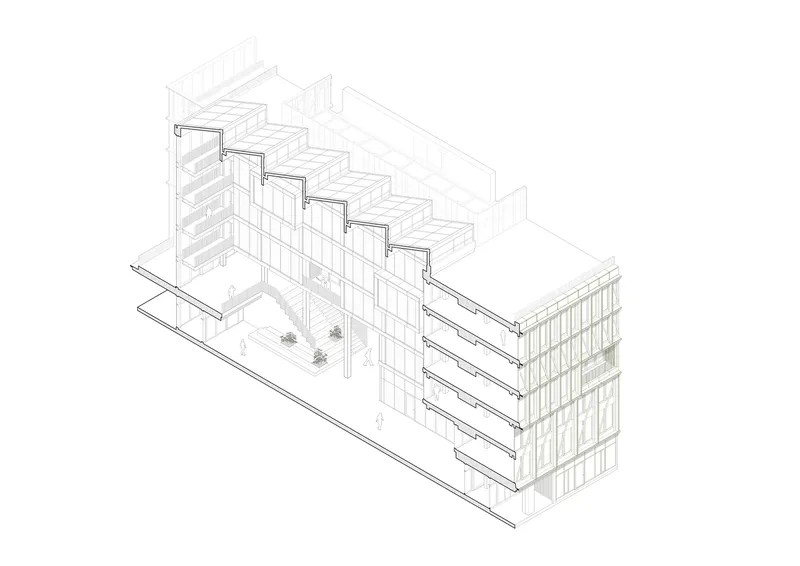
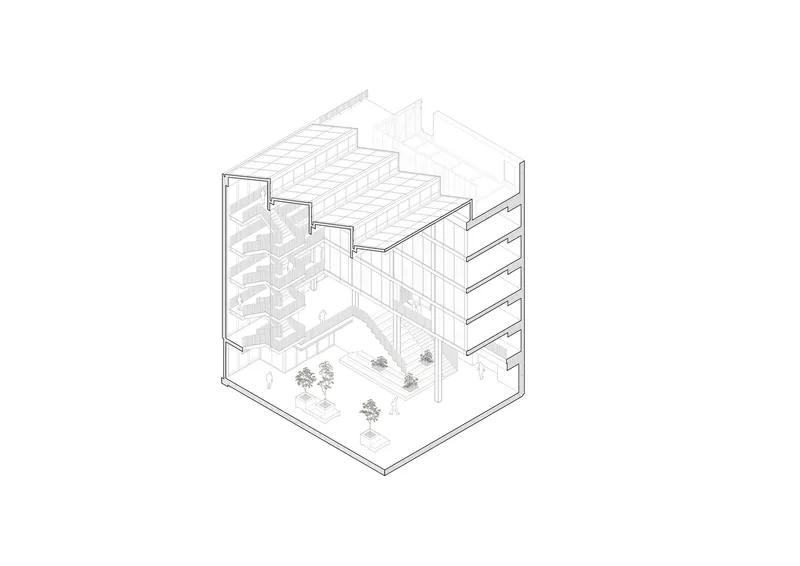
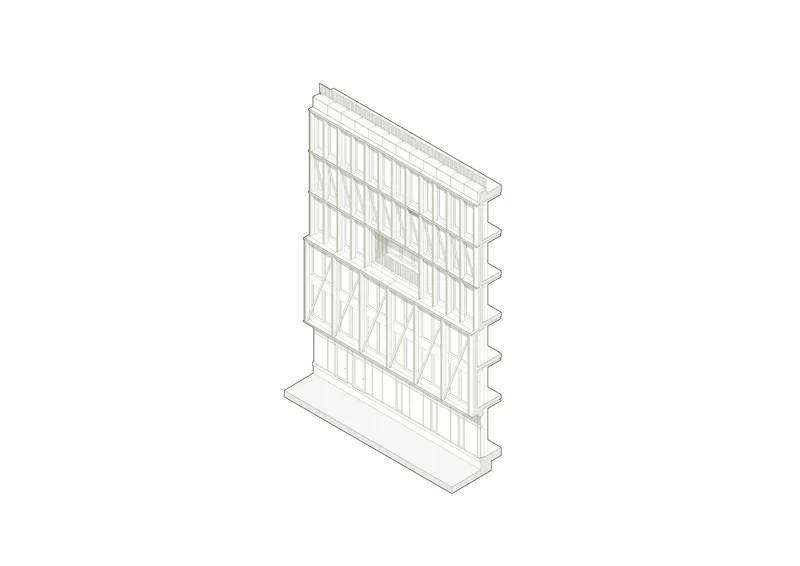

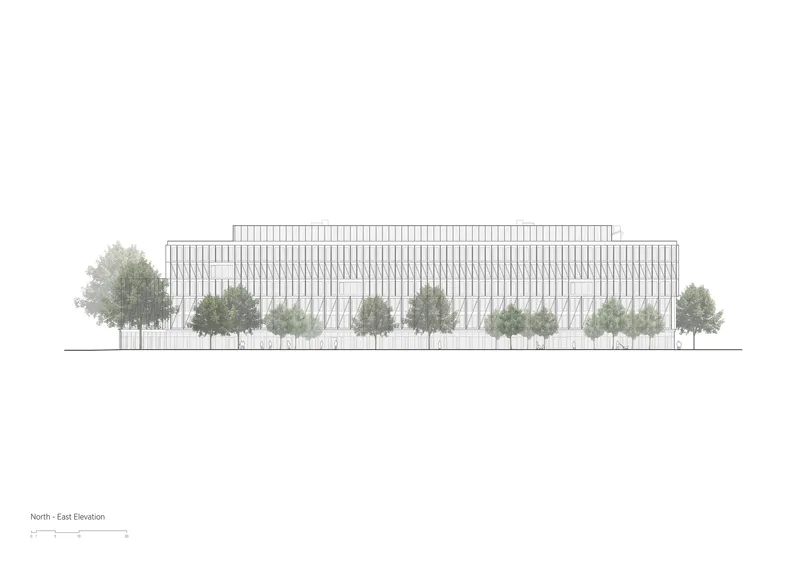

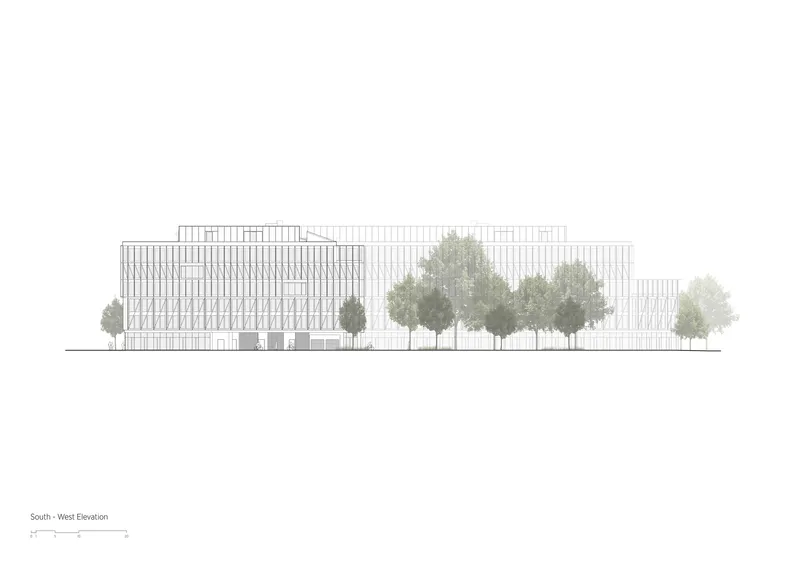
The drawings reveal the building's angular footprint and the way the L-shaped plan wraps around its courtyard to define a clear public threshold on the southeast corner of the iCampus. Sections through the atrium show how the skylight system and stepped balconies direct daylight deep into the plan while the below-grade parking levels descend in sloped plates beneath the courtyard. The axonometric massing studies trace a logical progression from a simple volume to the final articulated form, with cantilevered floor plates and a sawtooth roof profile that breaks down the building's scale to match its Werksviertel neighbors.
The facade detail drawing is particularly instructive: it isolates the gridded panel system with its diagonal bracing and horizontal floor slabs as a single repeatable unit, demonstrating how the building's visual identity emerges from structural logic rather than applied ornament. The elevations confirm the consistency of the green-toned cladding and vertical fin system across all orientations, with deciduous street trees calibrated to screen the lower floors in summer while allowing solar gain in winter.
Why This Project Matters
Hybrid timber construction in commercial office buildings is no longer experimental, but it remains uncommon at 20,000 square meters. i8 demonstrates that beech laminated veneer lumber paired with concrete composite decks can deliver the structural performance, fire safety, and spatial flexibility that institutional tenants expect, while significantly reducing the embodied carbon of a conventional steel and concrete frame. The building's pursuit of LEED Platinum and DGNB certification gives that claim measurable teeth.
More broadly, i8 offers a model for how a speculative office building can contribute to district-making. Its active ground floor, courtyard plaza, and materially rich facade engage the Werksviertel as a participant rather than a backdrop. In a city where commercial development often defaults to sealed glass volumes, C.F. Møller has produced a building that is structurally honest, environmentally accountable, and genuinely pleasant to be inside. That combination remains rarer than it should be.
i8, iCampus in Werksviertel by C.F. Møller. Munich, Germany. 20,000 m². Completed 2025. Photography by Yohan Zerdoun.
About the Studio
Share Your Own Work on uni.xyz
If projects like this are the kind of work you want to make, uni.xyz is a place to publish your own, find collaborators, and enter design competitions.


Popular Articles
Popular articles from the community


The Amber Palace Opera: A Geological Fiction Surfaces on Tallinn's Baltic Waterfront
Pierre Brillard reimagines a Baltic legend as a public landscape, opera house, and waterfront promenade rooted in Tallinn's coastal identity.

Temporary Home for Dogs: A Reversed Zoo Rethinks Animal Shelter Architecture
In Bucharest, a sinuous corridor and freed landscape flip the logic of containment, designing a shelter that works to make itself unnecessary.

Opera by the Sea Estonia: Three Shells Dissolving Architecture into Tallinn's Coastline
A winning opera house proposal replaces monumental form with interconnected shells that blur the boundary between building, park and Baltic Sea.

Singing Woman: An Opera House That Performs Before the Curtain Rises
Ovidiu Cristian Pavel's conceptual opera house translates Estonia's choral identity into a sculpted waterfront landmark facing the Baltic Sea.

Similar Reads
You might also enjoy these articles

Pixel Gardens: One Repeated Module Stacked Into a Terraced Social Housing Tower for Famagusta
Salem Bader's shortlisted housing tower builds a vertical neighbourhood from one repeated module, offsetting units to carve terraces, light and air.

Bao Huynh Watercolor Atelier: A Serene Art Retreat in Hội An
Bao Huynh Watercolor Atelier in Hội An blends multifunctional art spaces, sustainable design, local materials, and family-friendly living in a serene environment.

Atelier Macri Concept Store Interior Design by CASE-REAL
Atelier Macri store features a "ko" counter, walnut wood details, cork displays, blending retail, gallery, and seamless customer experiences.

Manuel Vargas Izquierdo Stadium and High-Performance Sports Center: Architectural Excellence in Jalpa de Méndez
The Manuel Vargas Izquierdo Stadium blends sustainable design, inclusive sports facilities, and cultural-inspired architecture, revitalizing Jalpa de Méndez’s public spaces.

Explore Campus Competitions
Discover active competitions in this discipline

Challenge to reimagine the Iron Throne

Photograph architecture without architects

Illustrate the lost glory of Angkor Wat - Render Challenge

Design challenge to reuse E-waste
Comments (0)
Please login or sign up to add comments
No comments yet. Be the first to comment!