

Birdseye Rebuilds a 1960s Vermont Ski Chalet as a Fossil-Fuel-Free Mountain Home
Perched slope-side at Stratton Mountain, two cantilevered gables clad in repurposed Douglas fir revive mid-century ski culture with geothermal conviction.


A dilapidated 1960s ski house on Stratton Mountain could have been scraped and forgotten. Instead, Birdseye Architecture stripped the building down to its foundation and first-floor framing, then rebuilt outward and upward into something that honors the mid-century chalets dotting these slopes while performing at a level those originals never could. The result is a 5,000-square-foot home that runs on geothermal energy, collects its own rainwater, and wraps itself in repurposed Douglas fir arranged in a chevron pattern that nods directly to the siding lay-up of the house it replaced.
What makes the project genuinely interesting is the tension between nostalgia and rigor. The gabled forms, the natural wood, the sunken living room: all of these read as familiar alpine vocabulary. But the R40 walls, R60 roof, triple-pane glazing, and zero-fossil-fuel mechanical system belong to a completely different conversation. Birdseye refuses to treat those two ambitions as contradictory, and the discipline required to hold them together is what gives the Chalet its character.
Two Gables and a Black Bar
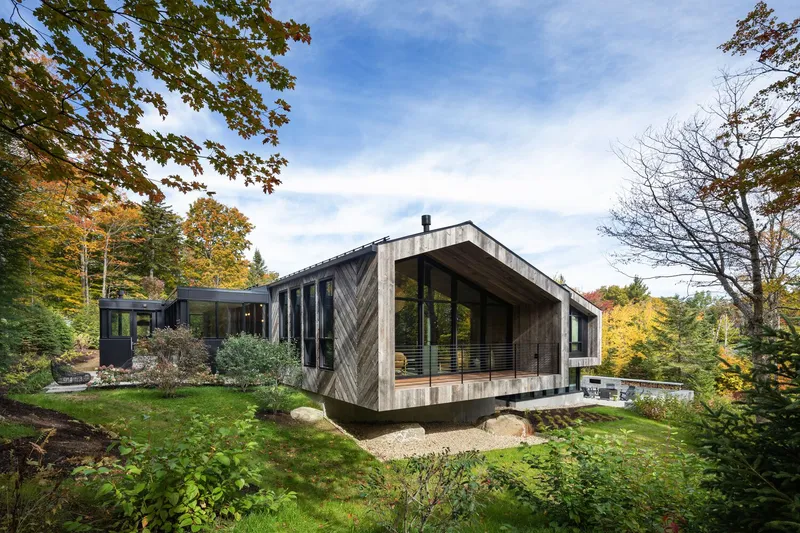
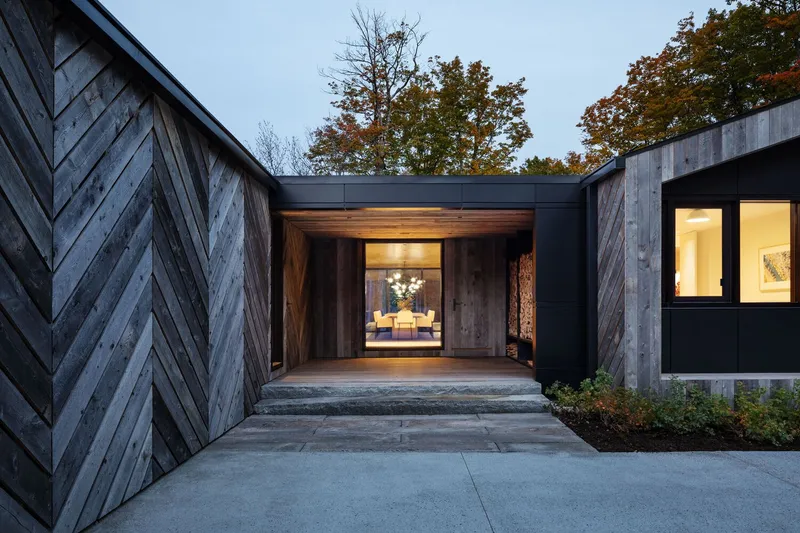

The massing strategy reads clearly from any angle: two cantilevered gable volumes, clad in the chevron-patterned Douglas fir rainscreen, linked by a perpendicular black bar that recedes visually and lets each gable assert itself against the mountain. The chevron motif is more than decoration. It references the herringbone and diagonal wood patterns common to mid-century ski architecture in the region, giving the building a textural kinship with its neighbors even as its crisp detailing and deep overhangs signal contemporary intentions.
The entry auto court and expanded footprint were carefully threaded through the parcel's wetland buffers, a constraint that likely shaped the elongated, bar-connected plan more than any purely aesthetic impulse. From the air, the house reads as a deliberate insertion into a dense canopy of deciduous trees, its timber tones blending with fall foliage rather than competing with it.
Living with the Slope
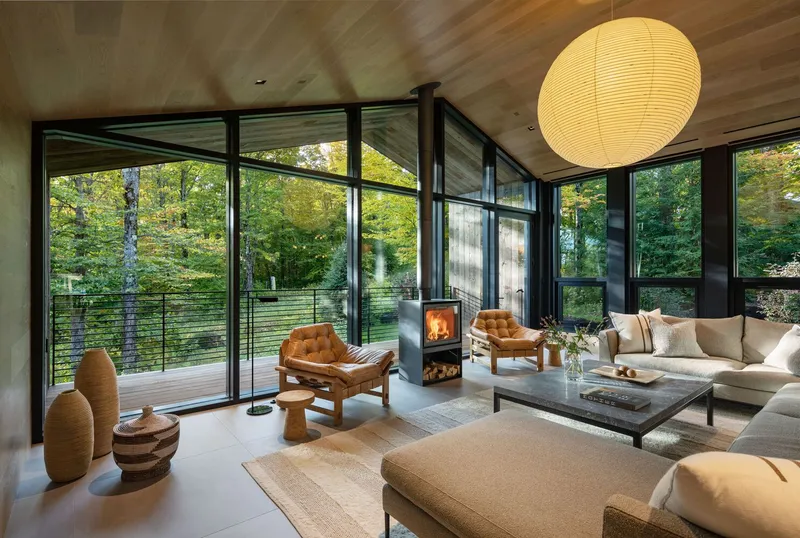
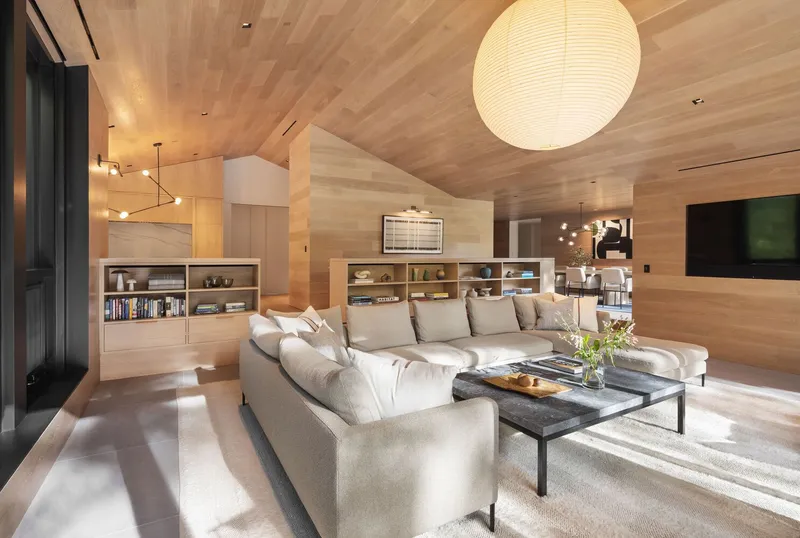
The first floor holds the social heart of the house: a sunken living room anchored by a wood-burning stove and wrapped in floor-to-ceiling glass that opens to a deck cantilevered over the slope. The sunken conversation pit is a distinctly mid-century gesture, lowering the eye line and drawing attention to the forest beyond. Built-in shelving and continuous white oak ceilings keep the space warm without clutter, and the storefront window system frames the landscape as a single, unbroken composition.
Below, the walk-out level takes advantage of the mountain's grade to provide direct ski-slope access from a dedicated ski room. A game room, TV lounge, bunk room, and additional bedroom suite fill out the lower floor, giving the house the capacity to host large groups without sacrificing the intimacy of the main living spaces above.
Kitchen and Dining as a Continuous Field
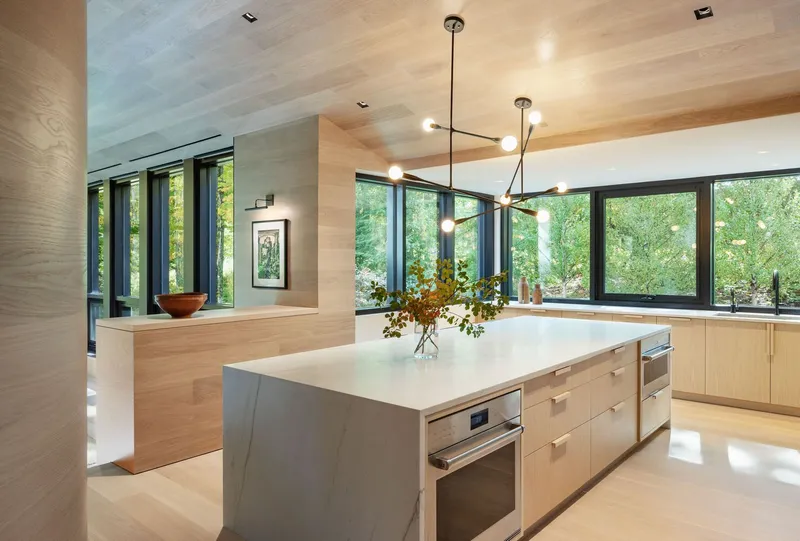
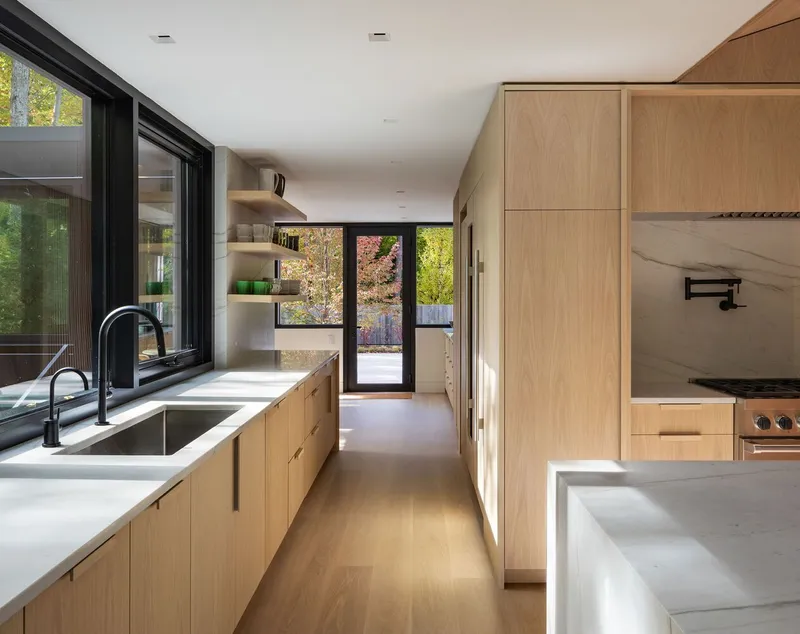
The kitchen occupies a galley arrangement with white stone countertops and oak cabinetry that matches the wall and ceiling planes, so the room reads as carved from a single block of wood rather than assembled from parts. A glazed door at the end frames autumn trees like a painting you walk through. The island, topped in the same pale stone and lit by a branching fixture, serves as the hinge between cooking and gathering.
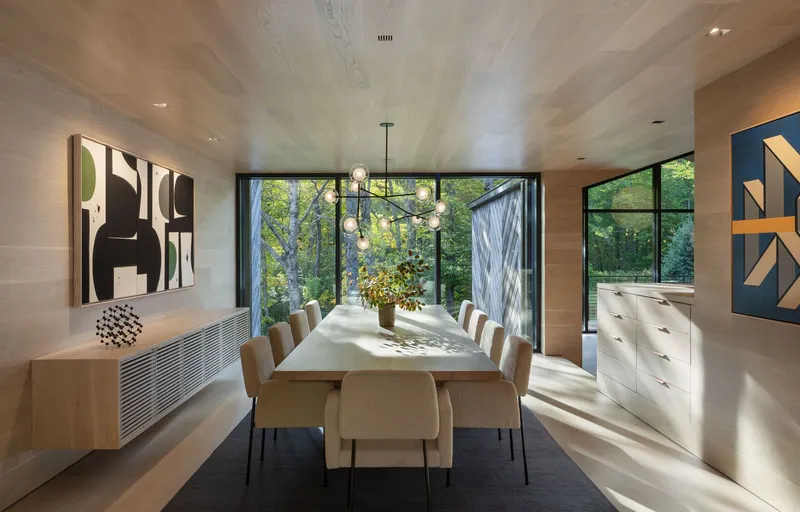
The dining room extends this material logic under the same continuous wood ceiling, with full-height glazing that makes the surrounding foliage feel like wallpaper. There is no moment where the interior finishes abruptly change mood. White oak, pale stone, and glass maintain a single register from kitchen to dining to living room, and the consistency is what gives the open plan its calm.
Bedrooms Built by Hand
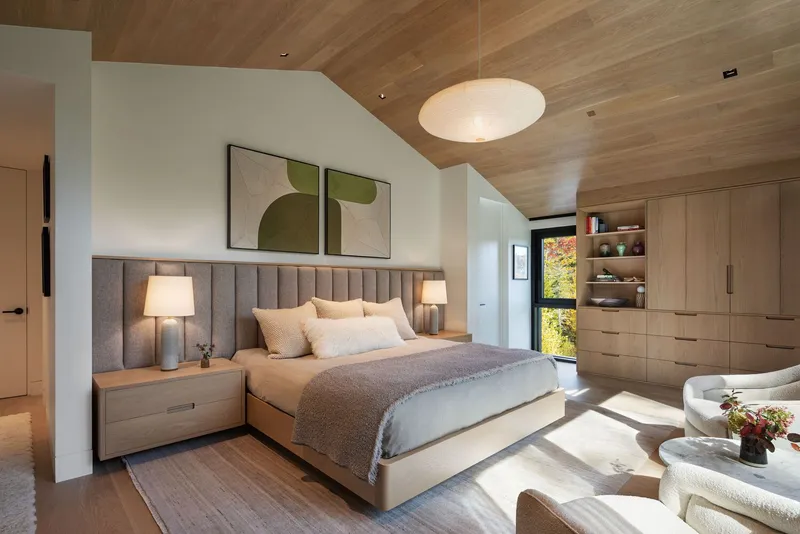
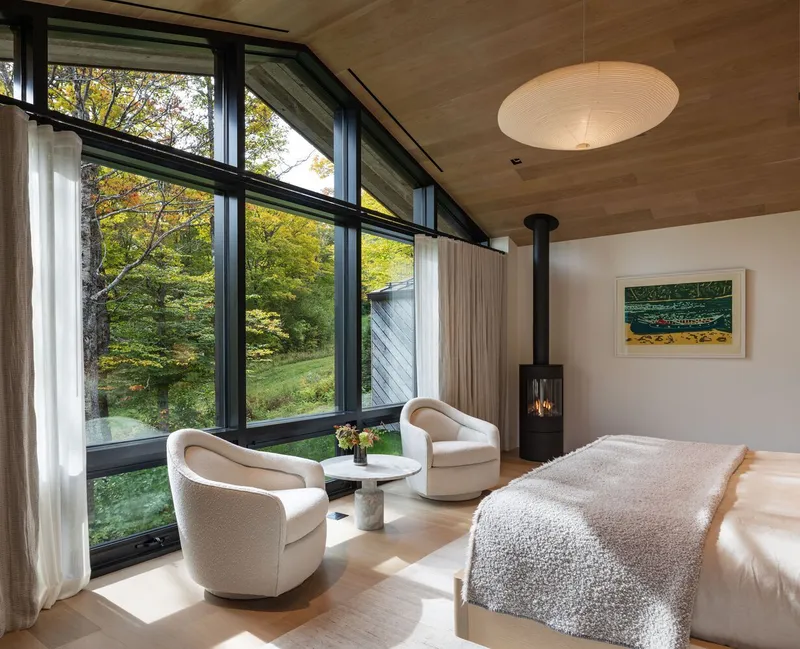
The bedrooms reveal the depth of craft that Birdseye and its network of local artisans brought to the project. Custom-built bunk units, window seats, and storage cabinets are integral to the architecture rather than afterthoughts. In one suite, a freestanding wood stove sits beneath a pendant light and black-framed clerestory windows, giving the room the quiet intensity of a mountain cabin within a larger house. In another, an upholstered headboard meets built-in cabinetry that wraps the bed in oak, making the furniture and the walls indistinguishable.
All interior wood was locally sourced from New Hampshire, and the custom furniture was built by regional craftspeople. These are not luxury flourishes. They are the project's argument that high-performance building and hands-on craft are not separate disciplines but the same one, practiced at different scales.
Bathrooms as Material Studies

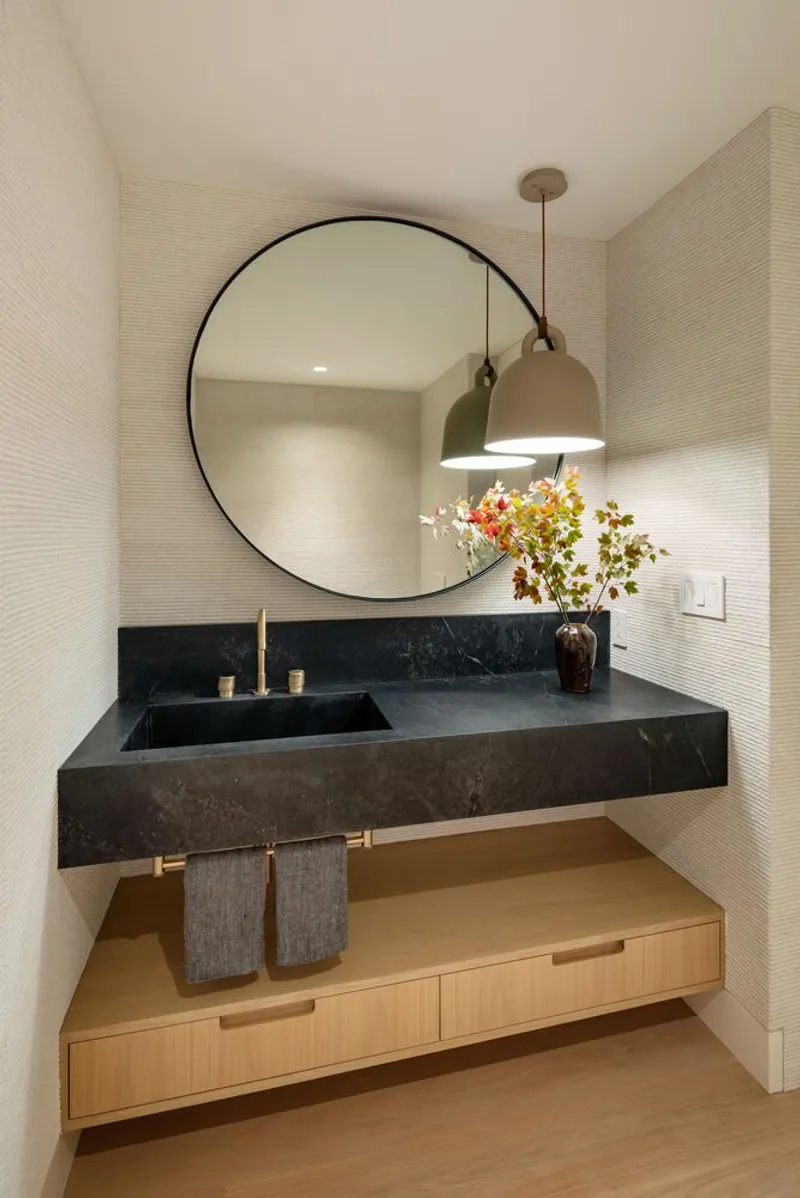
The bathrooms carry the house's material rigor into tighter quarters. A floating oak vanity paired with black fixtures and vertical tile creates a room that feels edited rather than decorated. Elsewhere, a floating black stone vanity with an integrated sink sits beneath a large circular mirror and brass pendant, a deliberate counterpoint to the pervasive warmth of oak. These rooms are small enough to read as complete compositions, and the restraint in palette lets each material choice register clearly.
Performance Without Proclamation

The sustainability strategy here is notable for its invisibility. A geothermal HVAC system eliminates fossil fuel dependence entirely. Rainwater is collected from the roof through an insulated pipe system and directed for erosion control. Fresh air exchangers, low-VOC finishes, LED lighting, and sun shades manage indoor air quality and energy load. The building envelope, with R40 walls and an R60 roof, is among the most aggressive insulation packages you will find in a residential ski project. Yet none of these systems announce themselves. The house looks and feels like a warm, wood-lined retreat, not a demonstration project.
Native plantings that require no supplemental watering complete the ecological picture on the exterior. Demolition waste from the original structure was separated and recycled. The cumulative effect is a home that operates with the conscientiousness of a net-zero laboratory while presenting itself simply as a good place to come in from the cold.
Why This Project Matters
Ski resort architecture has a reputation problem. It tends toward either nostalgic pastiche or aggressive modernism that treats the mountain as a backdrop for showing off. Birdseye's Chalet avoids both traps by grounding every formal decision in something specific: the chevron cladding references the house that stood here before, the gable forms match the pitch and scale of neighboring mid-century homes, and the geothermal system responds to the practical reality of heating a house at altitude in Vermont. There is no single heroic gesture. There is a sequence of disciplined choices that accumulate into coherence.
The larger lesson is about what it means to renovate. Retaining the foundation and first-floor framing of the original structure was not a sentimental act. It was a material and logistical strategy that reduced waste, respected wetland setbacks, and gave the new house a literal footing in the site's history. The best renovation projects do not just save old buildings. They use the constraints of what already exists to generate architecture that could not have been designed from scratch. That is exactly what happened here.
Chalet by Birdseye Architecture, Stratton Mountain, Vermont, USA. 5,000 sq ft. Completed 2022. Photography by Michael Moran Photography.
About the Studio
Share Your Own Work on uni.xyz
If projects like this are the kind of work you want to make, uni.xyz is a place to publish your own, find collaborators, and enter design competitions.


Popular Articles
Popular articles from the community


U.GA Architects Wraps an Oval Rooftop Pool in Curved Board-Formed Concrete on Busan's Jeollidan-gil
In Busan's Jeonpo-dong, a 454 m² mixed-use block stacks a neighborhood facility, guest rooms and an oval rooftop pool inside spiraling concrete walls.

David Macias Steps a Doorless Stone and Plaster House Down a Tropical Colombian Hillside
In the humid hills of Colombia, Threshold House replaces the front door with an open void and terraces its 850 m² down the slope instead of fighting it.

LT2A and OPEN Architectes Thread a Brick and Glass High School Through a Wooded Belgian Campus
In Braine-l'Alleud, a 3,000 m² wing for Collège Cardinal Mercier pairs pale brick with a glazed colonnade, deferring to a small chapel and a dense wood.

Jaramillo Van Sluys Arquitectura and Urbanismo Turn a Demolished Registry Lot in Quito into an Orchard Plaza
In Quito's Centro Histórico, a 2,800 m² plaza exposes the San Agustín convent wall and redraws its lost Augustinian orchard in volcanic stone.

Similar Reads
You might also enjoy these articles


Hodi-Mandai Geram
Project Function: Preservation and revitalization of the Intangible heritage and socio-spatial identity of the Hodi by Housing, Cultural Memory Center, Sacred Grove, landscape, local tourism economy


Olio Towers: A Mid-Rise for Performers That Fuses Housing, Rehearsal, and Stage
Located blocks from Houston's Theater District, this modular tower stacks living units around a central performance atrium.

Oasis: Modular Green Housing Carved into Dhaka's Urban Fabric
A shortlisted Plugin Housing entry reclaims unauthorized settlements in Dhaka with stepped concrete volumes, green roofs, and ventilation-driven design.

Black Hole: A Floating Megastructure for the Post-Physical Era
Emiliano Mazzarotto envisions a spherical, self-scaling arena where e-sports, digital hotels, and holographic stadiums replace traditional public space.

Explore Architecture Competitions
Discover active competitions in this discipline

Challenge to reimagine the Iron Throne

Photograph architecture without architects

Illustrate the lost glory of Angkor Wat - Render Challenge

Design challenge to reuse E-waste
Comments (0)
Please login or sign up to add comments
No comments yet. Be the first to comment!