

Nikken Housing System Makes a Tokyo Nursing Home Feel Like Part of the Neighborhood
A 4,397-square-meter care facility in Shinagawa dissolves the boundary between senior living and city life


Most nursing homes in dense cities retreat from their surroundings, buffering residents behind setbacks and gated entries. Nikken Housing System did the opposite in Shinagawa. The Charm Premier Grand Gotenyama Nursing Home, completed in 2022 on a steeply sloped residential street, opens dining rooms and lounges directly to the sidewalk. Passersby can glance in. Residents can glance out. The 4,397-square-meter building treats urban integration not as a compromise but as the core premise of dignified elder care.
Japan's aging population has made isolation a policy concern as much as a design problem. This project proposes that the antidote is not more amenities inside the building but more porosity between inside and outside. The architects organized 22 varieties of private rooms, ranging from 20 to 80 square meters, along a gradient that moves from street-facing communal spaces to quieter, more private zones deeper in the plan. Residents control how much they engage with the neighborhood simply by choosing where to spend their time.
Staging the Street as Part of the Program
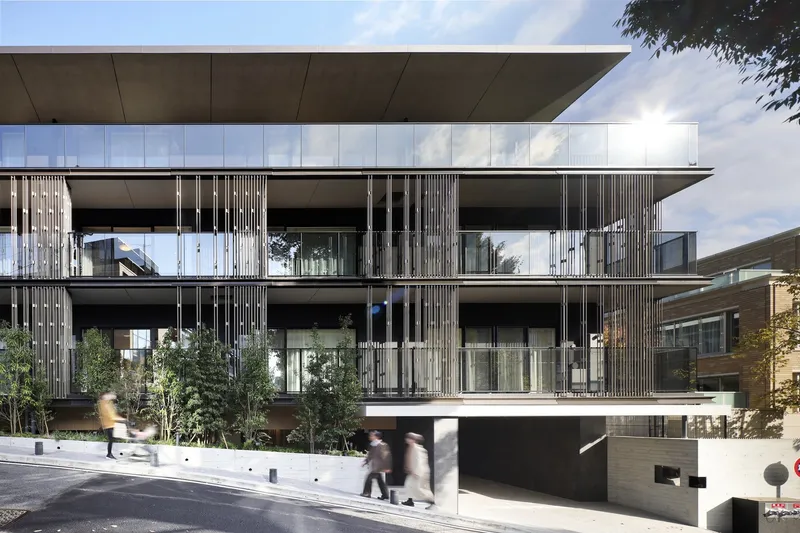
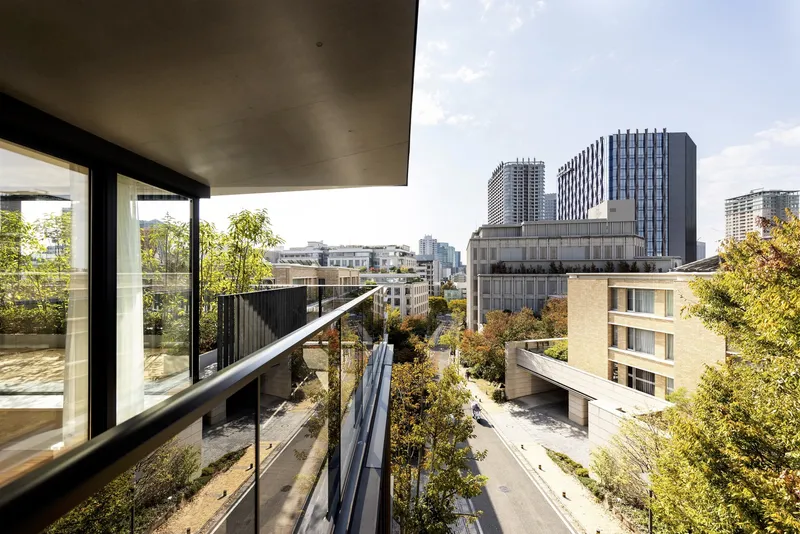
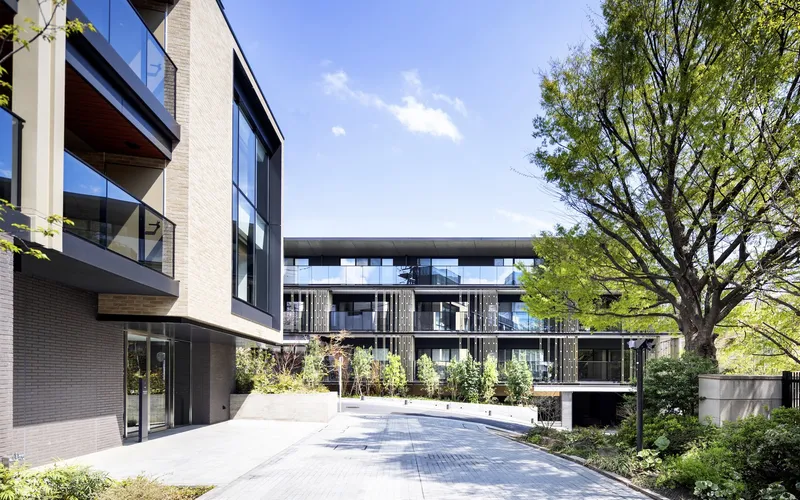
The facade is layered with vertical timber screens and planted terraces that read less like institutional cladding and more like the balconies of a nearby apartment block. The screens modulate privacy without closing off views, and the planting softens the building's presence on a residential street. A shared courtyard between two volumes extends the semi-public realm onto the site itself, reinforcing the idea that the facility is woven into the neighborhood rather than dropped onto it.
On the north side, the communal dining room opens to a terrace accessible from the street. This is not a token gesture. It is a programmed overlap where residents and neighbors can share the same space during events or casual encounters. The building does not ask the city to accommodate it. It accommodates the city.
Turning a Sloped Site into a Vertical Sequence
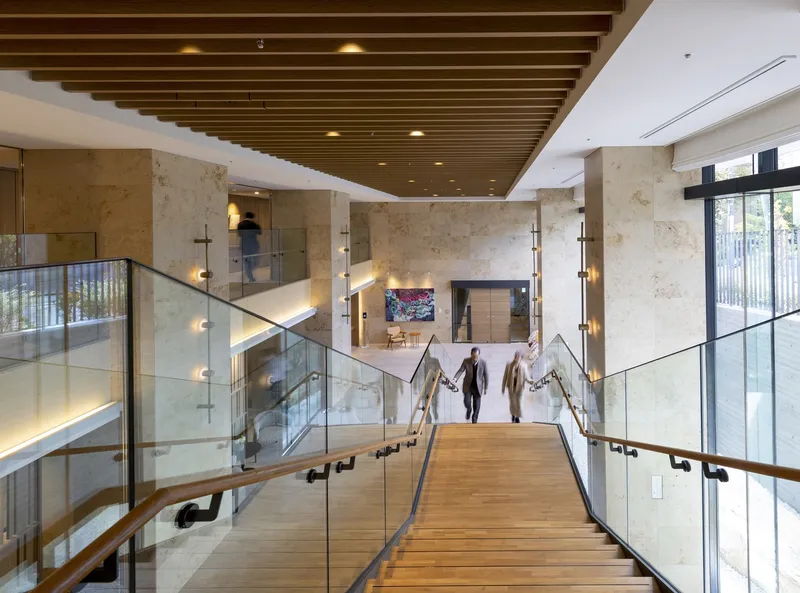
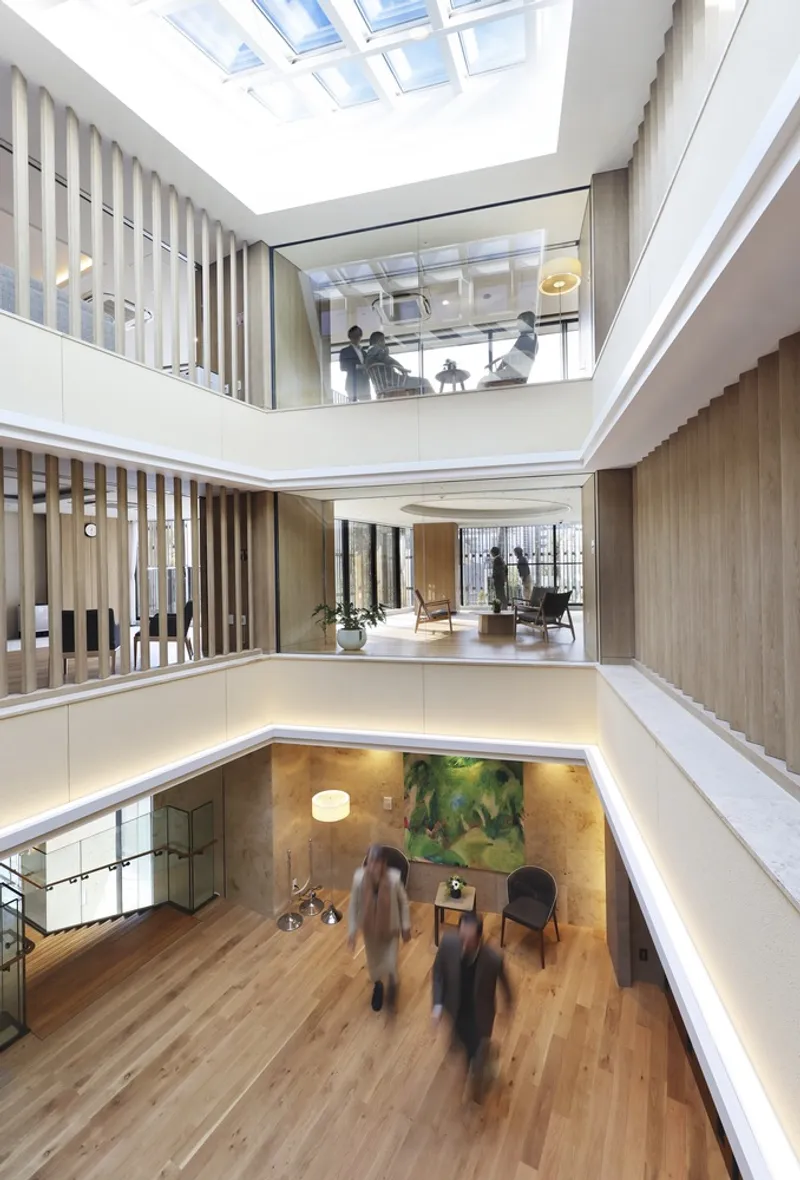
The site drops steeply, which the architects used to separate vehicular and pedestrian entries and to carve out a three-story atrium below grade. A double-height glass-walled entrance hall at the slope's base opens into this atrium, which is top-lit by a skylight and wrapped by timber-screened balconies. What could have been a buried service core becomes the building's luminous center, pulling daylight deep into the section and creating a vertical lobby that connects all floors.
The timber and glass staircase descending through the atrium reinforces the building's strategy of making circulation visible and legible. Residents moving between floors become part of the spatial composition, and the atrium itself becomes a social space rather than residual leftover. The skylight and screened balconies modulate light and air without mechanical assistance, using gravity ventilation to pull breezes through corridors and lounges.
Custom Louvers as Climate Control and Camouflage
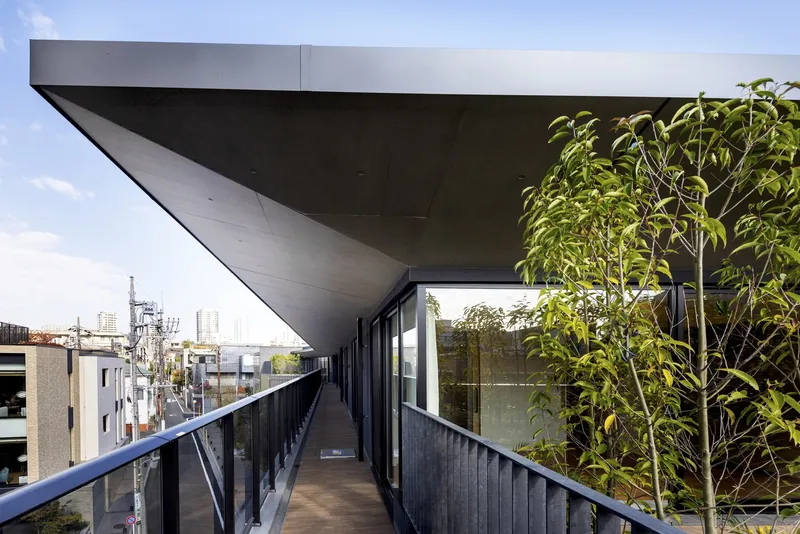
The exterior aluminum louvers do triple duty: they reduce solar heat gain, provide visual privacy, and conceal outdoor air-conditioning units. This is a practical move that also cleans up the facade. Too many care facilities let mechanical equipment clutter the envelope. Here, the louvers turn a functional necessity into a coherent surface treatment.
The covered walkways along the perimeter extend this logic, using cantilevered concrete soffits and timber screens to create shaded circulation that stays cool in summer and dry in rain. These spaces blur the line between interior corridor and exterior terrace, reinforcing the building's commitment to al fresco living even in a dense urban block.
Plans and Drawings
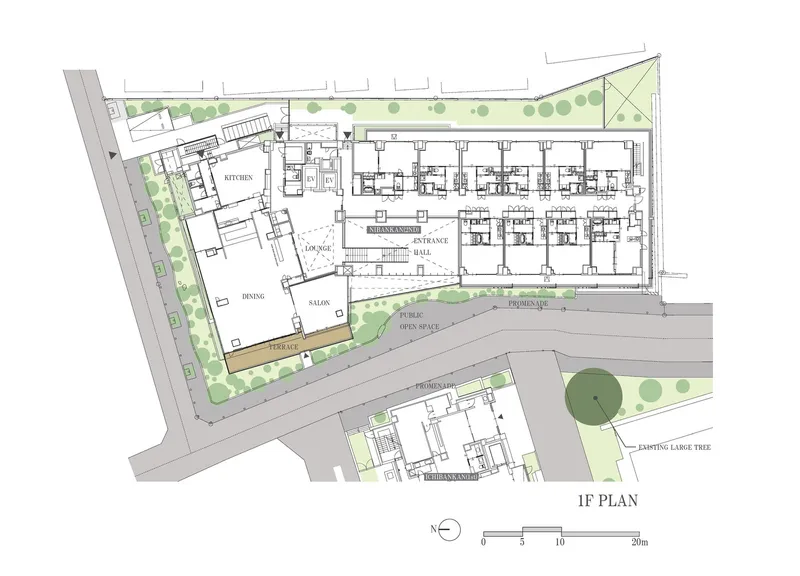
The first floor plan shows how the building drapes along the slope, with public spaces clustered at the street edge and private rooms stepping back into quieter zones. The courtyard between the two residential volumes creates a sheltered outdoor room that residents can access without leaving the site. This spatial organization gives residents agency over how much city they want at any given moment.
Why This Project Matters
Elder care architecture often defaults to a medicalized model that prioritizes efficiency over dignity and isolates residents from the rhythms of urban life. Nikken Housing System demonstrates that it is possible to design a care facility that treats engagement with the city as a therapeutic resource rather than a logistical problem. The gradient of privacy and the direct connection to the street let residents calibrate their own level of participation in the neighborhood.
The building also shows how to turn a difficult site into an organizational advantage. The slope and the atrium work together to create a vertical lobby that connects all floors while pulling daylight and ventilation deep into the plan. This is not expensive technology. It is careful sectional thinking that uses natural forces to do what mechanical systems would otherwise handle. The result is a building that feels open and breathable without sacrificing the intimacy that makes a nursing home livable.
Charm Premier Grand Gotenyama Nursing Home, Nikken Housing System Ltd, Shinagawa, Tokyo, 4,397 square meters, 2022.
About the Studio
Share Your Own Work on uni.xyz
If projects like this are the kind of work you want to make, uni.xyz is a place to publish your own, find collaborators, and enter design competitions.


Popular Articles
Popular articles from the community


LT2A and OPEN Architectes Thread a Brick and Glass High School Through a Wooded Belgian Campus
In Braine-l'Alleud, a 3,000 m² wing for Collège Cardinal Mercier pairs pale brick with a glazed colonnade, deferring to a small chapel and a dense wood.

GROUP A Strips a 1969 Rotterdam Harbor Headquarters to Its Frame and Wraps It in Timber Louvers
In Rotterdam's M4H harbor district, Ferro Offices reuses a 1969 frame, adds one timber storey and reaches BREEAM-NL Outstanding.

U.GA Architects Wraps an Oval Rooftop Pool in Curved Board-Formed Concrete on Busan's Jeollidan-gil
In Busan's Jeonpo-dong, a 454 m² mixed-use block stacks a neighborhood facility, guest rooms and an oval rooftop pool inside spiraling concrete walls.

David Macias Steps a Doorless Stone and Plaster House Down a Tropical Colombian Hillside
In the humid hills of Colombia, Threshold House replaces the front door with an open void and terraces its 850 m² down the slope instead of fighting it.

Similar Reads
You might also enjoy these articles


Hodi-Mandai Geram
Project Function: Preservation and revitalization of the Intangible heritage and socio-spatial identity of the Hodi by Housing, Cultural Memory Center, Sacred Grove, landscape, local tourism economy


Olio Towers: A Mid-Rise for Performers That Fuses Housing, Rehearsal, and Stage
Located blocks from Houston's Theater District, this modular tower stacks living units around a central performance atrium.

Oasis: Modular Green Housing Carved into Dhaka's Urban Fabric
A shortlisted Plugin Housing entry reclaims unauthorized settlements in Dhaka with stepped concrete volumes, green roofs, and ventilation-driven design.

Black Hole: A Floating Megastructure for the Post-Physical Era
Emiliano Mazzarotto envisions a spherical, self-scaling arena where e-sports, digital hotels, and holographic stadiums replace traditional public space.

Explore Senior Living Competitions
Discover active competitions in this discipline

Challenge to reimagine the Iron Throne

Photograph architecture without architects

Illustrate the lost glory of Angkor Wat - Render Challenge

Design challenge to reuse E-waste
Comments (0)
Please login or sign up to add comments
No comments yet. Be the first to comment!