

RAD+ar Disguises a Working Chicken Coop as a Grassy Hill in Jakarta's Urban Forest
A temporary bamboo pavilion in Urban Forest Jakarta turns restaurant food waste into compost, eggs, and a case for micro circular economies.


From a distance it reads as just another mound in the rolling topography of Urban Forest Jakarta. Walk closer and you notice the dome skylights puncturing the grass, the faint clucking from inside, and the tunnel entrance framed in woven bamboo. The Chicken Hero Pavilion by RAD+ar is a 900 square meter temporary structure that operated for four weeks in 2024, housing a working poultry farm that processed food waste from six on-site restaurants and returned roughly 40 eggs a day to those same kitchens. It is architecture performing as infrastructure, education tool, and provocation all at once.
What makes the project genuinely interesting is its refusal to treat sustainability as an abstract metric. Lead architects Antonius Richard Rusli and Daniel Susanto designed a closed loop you can walk through: food scraps go in, compost and eggs come out, and visitors witness every step of the cycle. Indonesia loses an estimated 1.6 million tonnes of food annually, roughly 300 kilograms per person. The pavilion does not lecture about that statistic; it demonstrates an alternative in real time, built almost entirely from reclaimed bamboo and wire mesh, materials that can be disassembled and reused once the installation wraps.
A Hill That Breathes
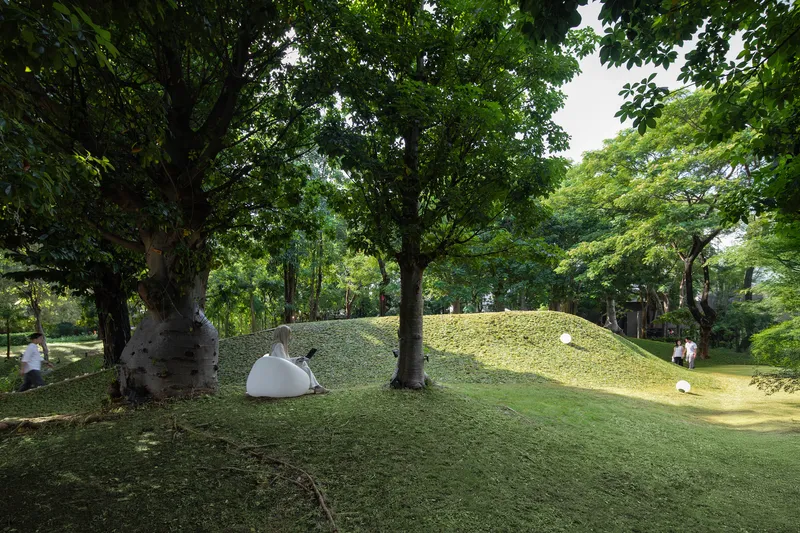
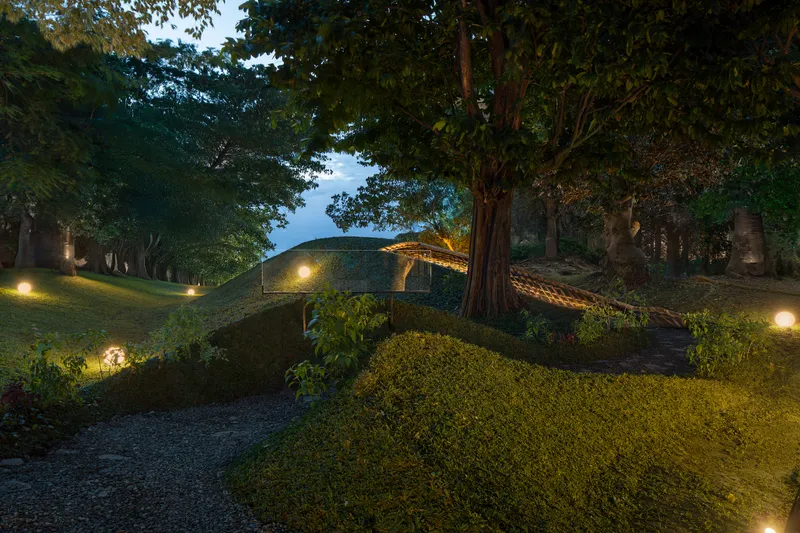
The defining move here is camouflage. RAD+ar covered the entire structure in a grass roof that reads as a continuation of the park's hilly garden, with only white dome skylights betraying its artificial origins. At dusk, pathway lighting traces the contour of the mound, revealing its precise geometry against the mature trees around it. The grass layer is not merely cosmetic: it serves as a rainwater catchment system and provides thermal insulation, keeping the interior cool enough for both poultry and visitors without any mechanical systems.
Burying the program underground, or at least inside an earthen shell, is a strategy with a long pedigree, but applying it to a temporary chicken coop in a public park is a deliberate act of defamiliarization. The pavilion asks visitors to reconsider what urban farming infrastructure could look like if it were designed with the same care as a gallery or community center.
Bamboo Vaults and Dappled Light
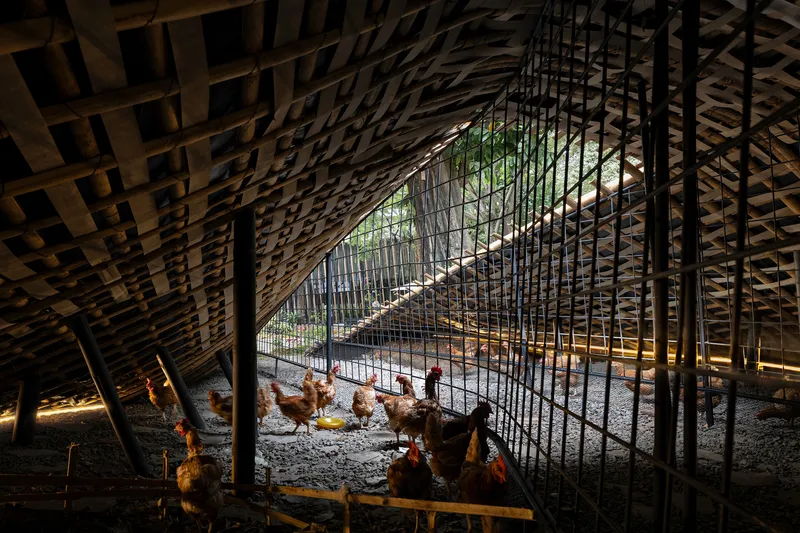
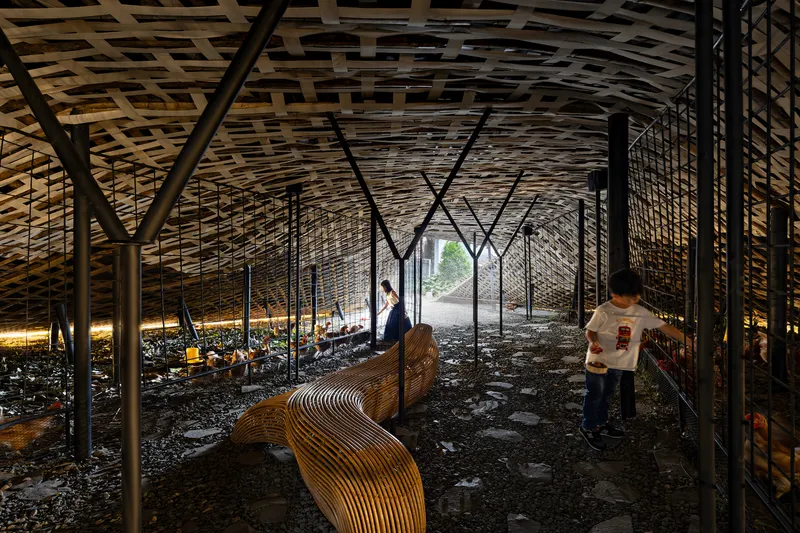
Step inside and the atmosphere shifts from park to cave. Reclaimed bamboo poles are arranged in a horizontal and diagonal lattice that forms the roof structure, woven into panels tight enough to filter sunlight into a soft, dappled pattern across the gravel floor. Steel bracing provides the necessary rigidity for spans this wide, but it recedes visually behind the warmth of the bamboo. Wire mesh enclosures partition the chickens' territory from the visitor walkway without blocking sightlines or airflow.
Cross ventilation is the primary climate strategy. The tunnel form channels air through the length of the pavilion, while the openings in the woven roof allow warm air to escape upward. Indirect daylight enters through those same apertures, eliminating the need for artificial lighting during the day. Dried leaves and organic tree waste line the chicken enclosures as bedding, absorbing humidity and later composted every three days. The construction technique is deliberately simple, reinforcing the project's argument that backyard poultry farming does not require specialized skills or imported materials.
Circular Economy at the Scale of a Coop
The operational logic of the pavilion is where the project transcends its modest program. Six restaurants in Urban Forest Jakarta funneled their food waste into the coop. Chickens processed it. Their bedding, a mix of dried leaves and organic scraps, was harvested as compost every three days. The eggs, around 40 per day, circled back to those same restaurants or were given to visitors as souvenirs. RAD+ar calls this a micro circular economy, and the term fits: the loop is small enough to understand in a single visit, yet scalable enough to replicate in any neighborhood with a backyard and some bamboo.
The firm frames the project within what they call "Glocalization," a portmanteau of globalization and localization that reflects Indonesia's challenge of applying universal sustainability principles across a vast and culturally diverse archipelago. Rather than proposing a centralized waste processing facility, the Chicken Hero Pavilion argues for distributed, household-level interventions. The temporary nature of the structure is part of the message: this is a prototype, not a monument.
Why This Project Matters
Temporary pavilions often get dismissed as exercises in spectacle, interesting for a week and forgotten by the next design cycle. The Chicken Hero Pavilion earns its relevance by actually doing something during its lifespan. It processed real waste, fed real people, and educated real visitors, all within a structure built from materials that existed before the project and will continue to exist after it. That commitment to a genuine closed loop, rather than a symbolic one, separates it from the growing catalogue of sustainability-themed installations that prioritize aesthetics over operations.
For architects working in Southeast Asia and beyond, the project poses a useful question: what if the discipline invested as much design intelligence in food infrastructure as it does in housing or commercial space? RAD+ar does not answer that question with a manifesto. They answer it with a grassy hill full of chickens, and the argument is more convincing for it.
Chicken Hero Pavilion by RAD+ar (Research Artistic Design + Architecture), lead architects Antonius Richard Rusli and Daniel Susanto. Located at Urban Forest Jakarta, Jakarta, Indonesia. 900 square meters. Completed 2024. Photography by Mario Wibowo.
About the Studio
Share Your Own Work on uni.xyz
If projects like this are the kind of work you want to make, uni.xyz is a place to publish your own, find collaborators, and enter design competitions.




Popular Articles
Popular articles from the community


Conexión: Biophilic Design Reimagines High-Rise Living in Hong Kong
Conexión reimagines high-rise living in Hong Kong through biophilic design, green facades, shared spaces, daylight, water and nature within.

The Earth Pod: 3D Printed Homes for Resilient Refugee Communities
The Earth Pod reimagines refugee housing through 3D printed homes made from clay, combining resilience, self-sufficiency, and rapid shelter.

AL-JANNAH: Sustainable Architecture and Permaculture for Afghan Widows
AL-JANNAH uses sustainable architecture and permaculture to create resilient oasis of housing, learning, work and renewal for Afghan widows.

Co-Life: Senior Housing Design That Reconnects Older Adults With the City
Co-Life reimagines senior housing design through healing gardens, shared streets, workshops, and a sustainable community across generations.

Similar Reads
You might also enjoy these articles


Hodi-Mandai Geram
Project Function: Preservation and revitalization of the Intangible heritage and socio-spatial identity of the Hodi by Housing, Cultural Memory Center, Sacred Grove, landscape, local tourism economy


Olio Towers: A Mid-Rise for Performers That Fuses Housing, Rehearsal, and Stage
Located blocks from Houston's Theater District, this modular tower stacks living units around a central performance atrium.

Oasis: Modular Green Housing Carved into Dhaka's Urban Fabric
A shortlisted Plugin Housing entry reclaims unauthorized settlements in Dhaka with stepped concrete volumes, green roofs, and ventilation-driven design.

Black Hole: A Floating Megastructure for the Post-Physical Era
Emiliano Mazzarotto envisions a spherical, self-scaling arena where e-sports, digital hotels, and holographic stadiums replace traditional public space.

Explore Landscape Design Competitions
Discover active competitions in this discipline



Challenge to reimagine the Iron Throne


Photograph architecture without architects


Illustrate the lost glory of Angkor Wat - Render Challenge


Design challenge to reuse E-waste
Comments (0)
Please login or sign up to add comments
No comments yet. Be the first to comment!