
Children's City: Sustainable School Architecture Redefining Learning Through Open and Adaptive Spaces
Children’s City reimagines sustainable school architecture through flexible classrooms, open learning landscapes, and nature-driven design.


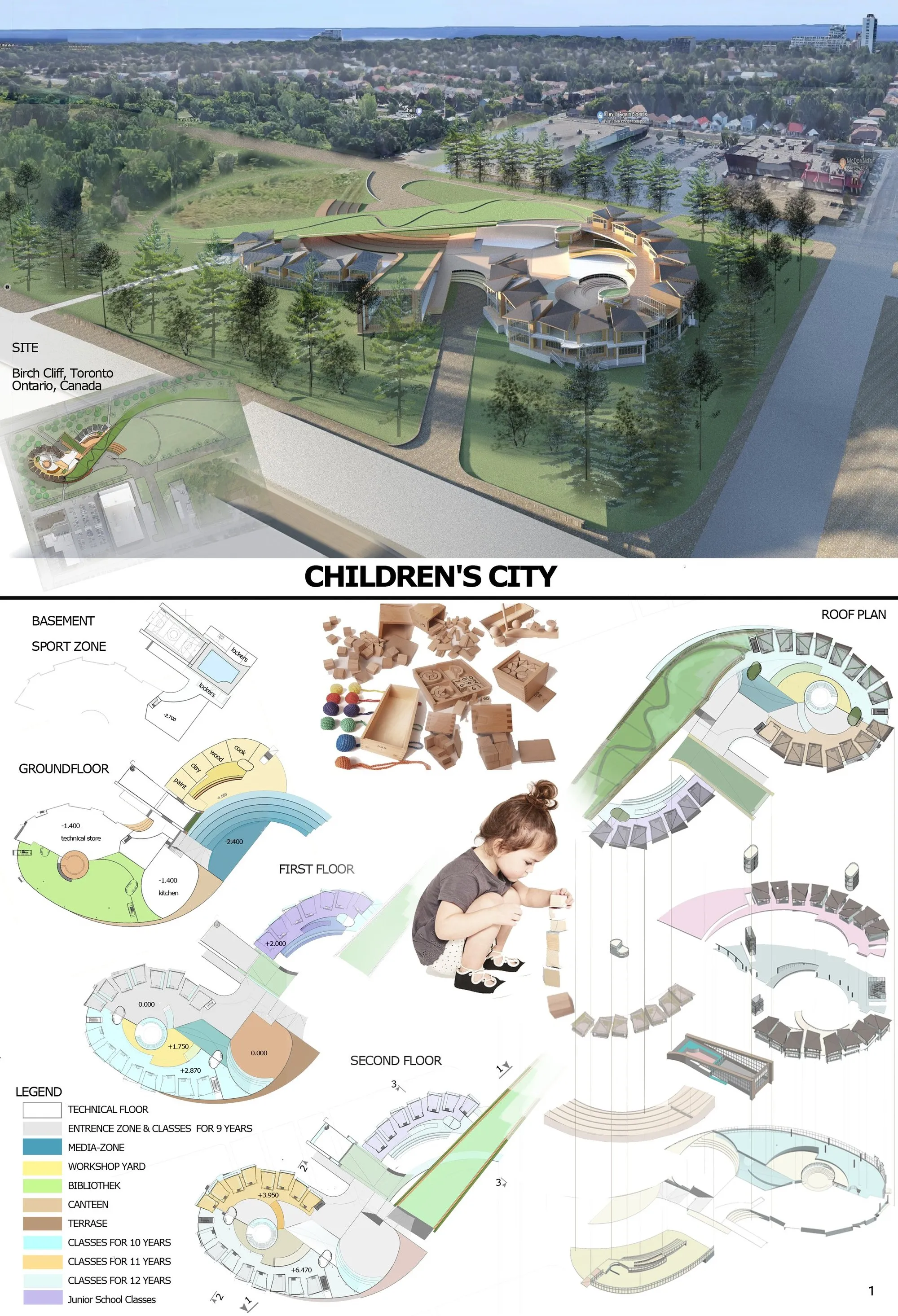
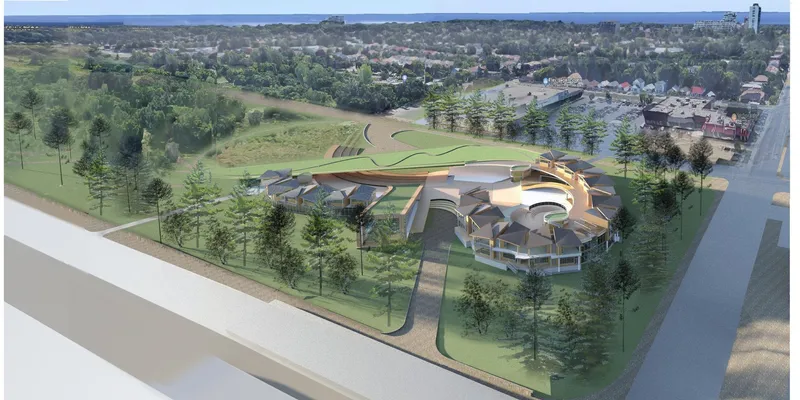
Children’s City is a visionary example of sustainable school architecture that transforms the educational environment into an interactive landscape for learning, exploration, and collaboration. Designed by Anna Bormotova, the project proposes a progressive educational campus where architecture itself becomes a teaching tool. Rather than functioning as a rigid institutional structure, the school evolves into a dynamic “children’s city” composed of interconnected learning houses, open courtyards, amphitheaters, and adaptive communal spaces.
The project challenges conventional ideas of school planning by introducing a spatial system rooted in recognition, diversity, and movement. The design creates an educational ecosystem where students engage not only with classrooms, but also with the broader environment surrounding them. Through fluid circulation, flexible educational modules, and strong integration with landscape, Children’s City presents a future-forward approach to educational architecture.
This project by Anna Bormotova was a shortlisted entry of School Of Thought 2020.
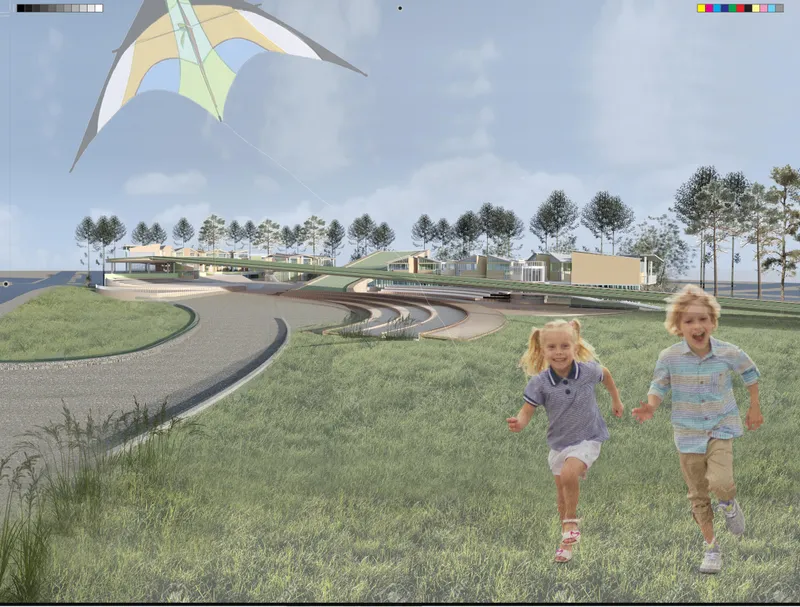
At the heart of the proposal lies the idea of familiarity and recognition. Instead of monumental institutional blocks, the classrooms are designed as cottage-like structures that resemble residential forms commonly found in neighborhood developments. This creates a psychological sense of comfort and belonging for children, making the school environment feel approachable and human-scaled. The architecture deliberately avoids imposing forms, replacing them with fragmented educational clusters arranged around shared public spaces.
The second defining principle of the project is diversity. Open spaces dominate the campus experience and become the connective tissue between all educational activities. Amphitheaters, galleries, ramps, terraces, and courtyards are integrated into the learning journey, encouraging interaction between students, teachers, and the wider school community. Rather than separating circulation from educational spaces, the design merges movement and learning into a single continuous experience.
The campus is organized as a hybrid between a traditional educational institution and a miniature urban environment. Individual classroom “houses” surround central courtyards and atrium spaces, creating a balance between privacy and collective engagement. This hybrid arrangement supports both focused learning and collaborative experiences while maintaining strong visual and physical connections throughout the campus.
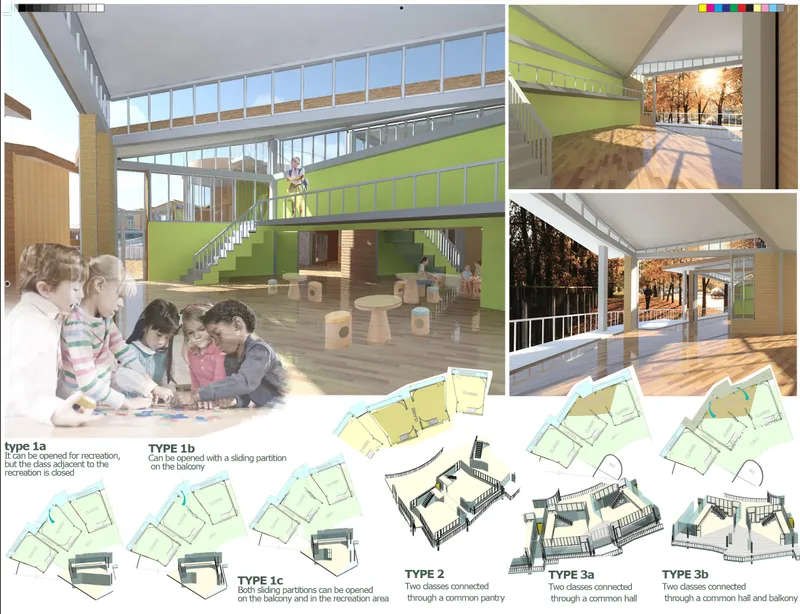
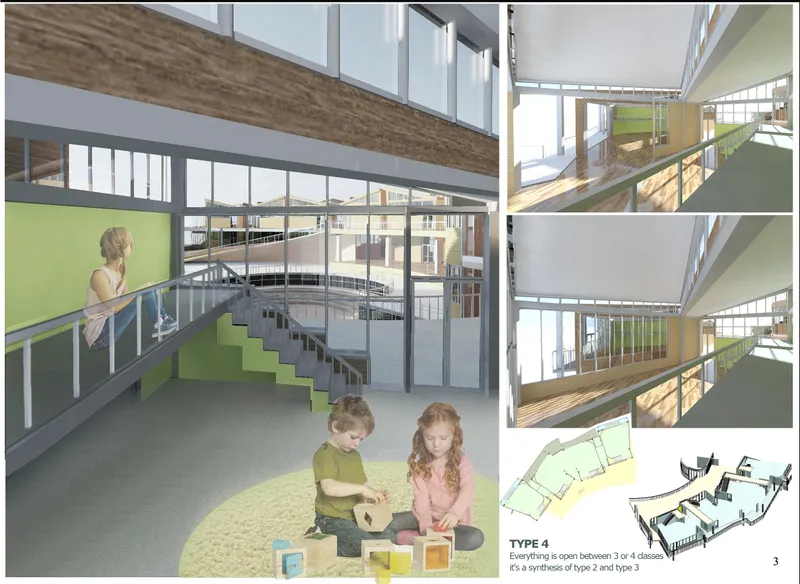
One of the most innovative aspects of Children’s City is its flexible classroom system. The project proposes transformable learning environments where classrooms can expand, merge, or open into neighboring spaces. Sliding partitions and adaptable layouts allow different teaching modes to emerge depending on educational needs. Individual classrooms can operate independently or combine into larger collective learning environments that encourage interdisciplinary interaction and experimentation.
The architectural design directly supports contemporary pedagogical models that prioritize participation, adaptability, and experiential learning. Students are not limited to static classroom arrangements. Instead, they actively engage with evolving spaces that can be modified according to activity, collaboration, or social interaction. The flexibility of the physical environment mirrors the adaptability required in modern education systems.
The circulation strategy further reinforces this philosophy. Conventional corridors are eliminated and replaced with smooth ramps, open galleries, and curved pathways. This removes rigid linear movement and introduces a more natural spatial flow throughout the campus. The absence of sharp directional transitions creates a softer, more exploratory educational environment where students continuously encounter new perspectives and communal interactions.

The central amphitheaters become major social and educational anchors within the school. These multifunctional spaces serve as gathering zones, performance venues, collaborative classrooms, and public interaction areas. Their integration into the core of the campus encourages collective learning experiences and creates opportunities for informal education outside traditional classroom settings.
Nature plays a critical role in shaping the identity of the project. The school is carefully integrated into a renewable forest park landscape, creating a direct connection between architecture and ecology. Trees, green roofs, natural light, and open-air pathways establish a calming and immersive learning atmosphere. The surrounding environment becomes an extension of the educational experience itself.
The project also draws inspiration from Friedrich Fröbel’s educational theories and the famous “Fröbel Gifts,” which influenced the architectural thinking of Frank Lloyd Wright. Through geometry, modularity, and spatial transformation, Children’s City introduces architecture as a medium for understanding relationships, patterns, and systems. The built environment becomes a physical representation of change, balance, and creativity.
Visually, the architecture adopts soft curves, layered terraces, and interconnected forms that dissolve the boundaries between indoor and outdoor space. Large glazed surfaces maximize daylight penetration and establish continuous visual relationships with the landscape. Elevated walkways and flowing rooflines create a playful spatial language that reflects the curiosity and energy of childhood.
The project’s environmental strategy further strengthens its relevance within contemporary sustainable school architecture discourse. Green roofs improve thermal performance while simultaneously creating accessible recreational surfaces. Natural ventilation, daylight optimization, and integration with the surrounding ecological context contribute to a healthier educational environment for students and educators alike.
Children’s City ultimately demonstrates how architecture can shape not only physical space but also human behavior, social interaction, and educational outcomes. By merging flexibility, landscape integration, and child-centered design principles, the project offers a compelling alternative to standardized educational infrastructure.
More than a school, the proposal functions as a living educational landscape where learning extends beyond walls and classrooms into every pathway, courtyard, and communal gathering space. Through its innovative approach to sustainable school architecture, Children’s City presents a powerful vision for the future of educational design.





Popular Articles
Popular articles from the community


Hill & Cross Opera: Sculptural Opera House Architecture Shaped by Tallinn’s Landscape and Identity
Hill & Cross Opera reimagines opera house architecture in Tallinn through its sculptural hill, civic plaza, glass wave and a luminous cross.

Conexión: Biophilic Design Reimagines High-Rise Living in Hong Kong
Conexión reimagines high-rise living in Hong Kong through biophilic design, green facades, shared spaces, daylight, water and nature within.

The Earth Pod: 3D Printed Homes for Resilient Refugee Communities
The Earth Pod reimagines refugee housing through 3D printed homes made from clay, combining resilience, self-sufficiency, and rapid shelter.
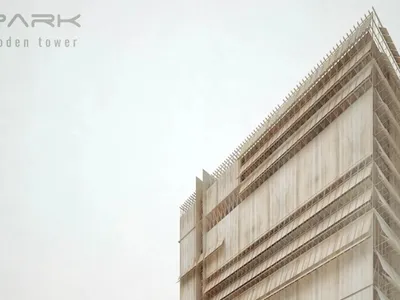
EW PARK: Sustainable Architecture Reimagines the Future of Urban Parking
EW PARK reimagines city parking as a modular wooden tower combining automation, solar energy, electric mobility, and adaptable urban design.

Similar Reads
You might also enjoy these articles

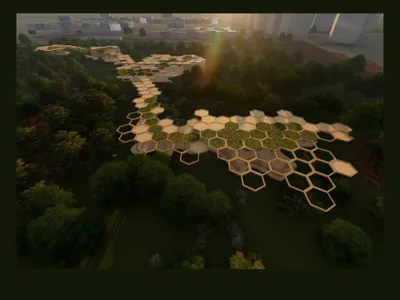
Eco Chapel: A Green Architecture Pavilion Designed in Symbiosis with the Forest
Eco Chapel uses green architecture to weave prayer, learning and reuse into a forest pavilion shaped by modular hexagonal canopies for life.
Kaffeebühnen: Coffee Shop Architecture Designed as a Civic Stage Between Vienna’s City and Park
Kaffeebühnen turns coffee shop architecture into a civic stage, linking Vienna’s park edge, urban life, warm timber yards, and coffee craft.
Healing Façade: Sustainable Architecture for Reforestation, Community, and Sacred Ecology in Ethiopia
Healing Façade reimagines sustainable architecture as a living wall that restores soil, catches water and renews Ethiopia's forest churches.


Urban Forest: A Vertical Ecosystem for 5,000 Workers in Singapore's Changi Business Park
Radially stacked pods and layered green decks turn a 7-acre plot into 47 acres of ecological workspace projected for 2040.


Comments (0)
Please login or sign up to add comments
No comments yet. Be the first to comment!