
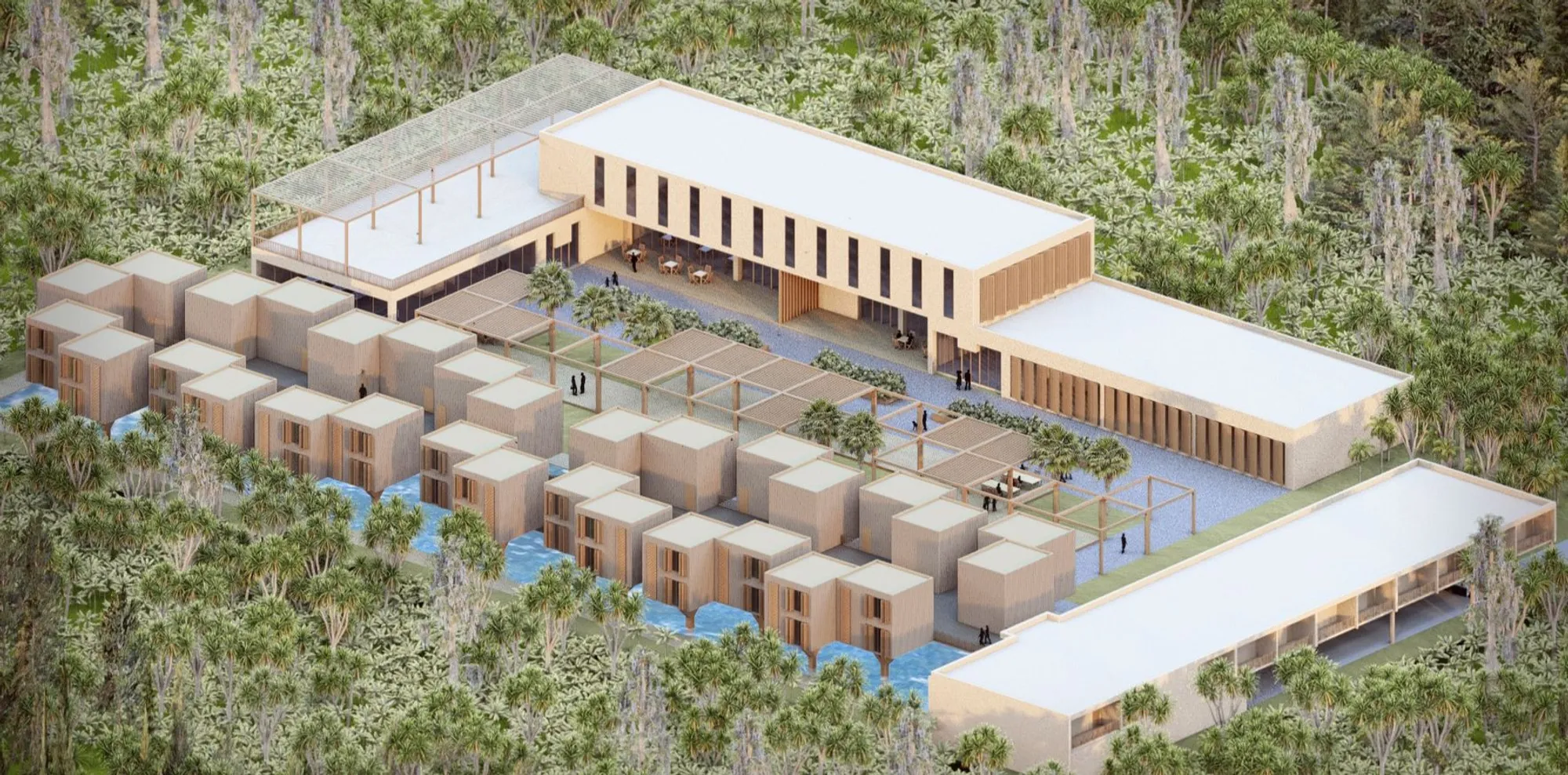
ChocoTerra: A Resort That Grows from Cacao Country
In Tabasco, Mexico, a hospitality complex weaves cacao culture, passive climate strategies, and timber construction into tropical architecture.


Tabasco, Mexico, is where chocolate was born. The region's cacao plantations have shaped local economies, rituals, and identities for millennia, yet few architectural projects have tried to give that heritage a spatial form. ChocoTerra proposes exactly that: a museum, production hub, and hospitality retreat set within the plantation landscape itself, organized around the idea that the journey from bean to bar can structure an entire architectural experience.
Designed by Begumay Kurtoglu, ChocoTerra was shortlisted in the Xocolatl competition. The programme is ambitious: a chocolate museum, exhibition areas, a café, chocolate production zones, event venues, 30 villas, and 20 hotel rooms, all stitched together by shaded walkways, open courtyards, and a grid-based spatial logic inspired by the rhythmic planting patterns of cacao trees. The result is a complex that reads as both orderly and deeply organic, a quality that runs through every design decision.
Courtyards as Connective Tissue
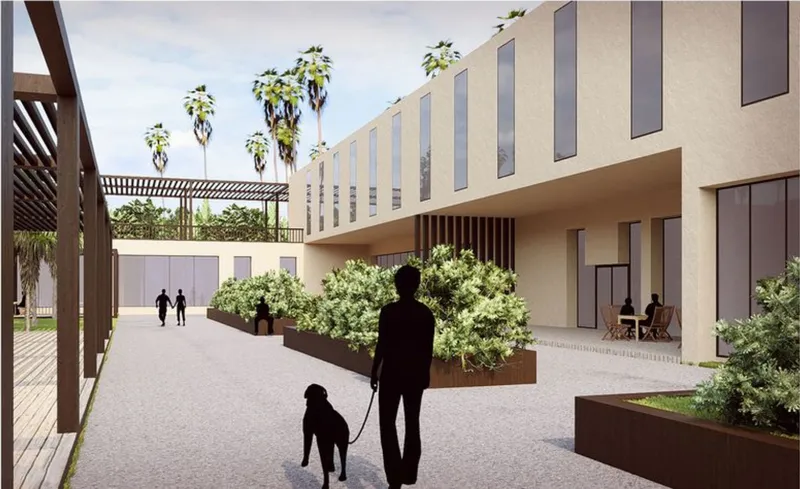
The first images reveal ChocoTerra's fundamental spatial strategy: courtyards framed by slatted timber facades and raised planted beds define the transition between indoor and outdoor life. Rather than a single monolithic volume, the complex fragments into interconnected pavilions. The courtyard view shows how vertical timber slats filter daylight while allowing cross-ventilation, a critical move in Tabasco's humid tropical climate. Raised planting beds bring cacao and tropical species into the architecture itself, blurring the line between cultivated landscape and built form.
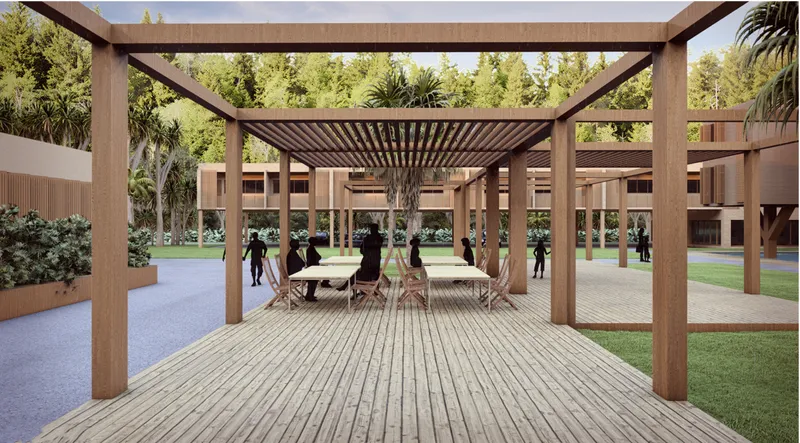
Beneath a timber pergola, a dining table sits on wooden decking, sheltered by a slatted canopy that throws rhythmic shadow patterns across the surface. This is the kind of space that turns a meal into a sensory event: filtered light, the scent of cacao, the warmth of natural materials underfoot. The pergola's construction is deliberately spare, letting the surrounding palms and vegetation become the primary enclosure.
Lifting the Villas off the Ground
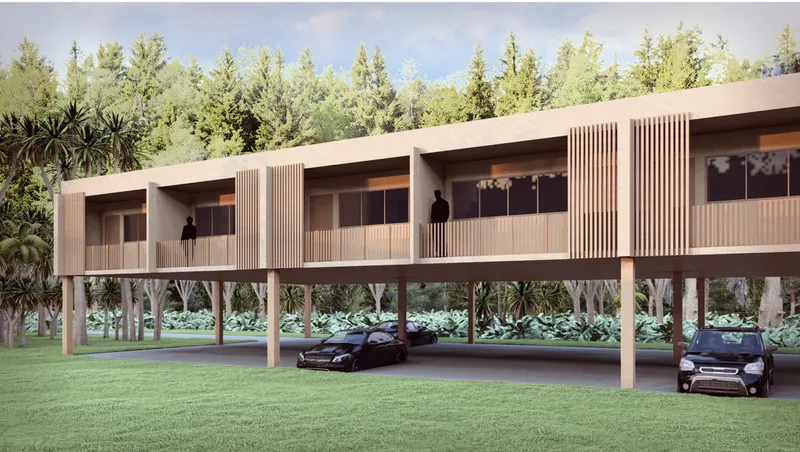

One of the project's strongest moves is the decision to elevate private villas on pilotis, supported by a wooden structural system that minimizes contact with the ground plane. The elevated volume with vertical timber screens floats above a carport, preserving the root systems and drainage patterns of the existing cacao plantation. This is not merely aesthetic lightness; it is ecological strategy. By lifting the built volume, Kurtoglu ensures ecological continuity beneath the structures while promoting airflow underneath the living spaces.
The gallery space, meanwhile, demonstrates a different register entirely. Freestanding display walls stand within a volume defined by floor-to-ceiling glazing that opens onto dense vegetation. Here the architecture operates as a frame: the exhibits narrate cacao's story from pre-Columbian rituals to contemporary chocolate craftsmanship, while the glass walls insist that the landscape remains visible, always present as both context and subject.
Light, Water, and Passive Comfort

At dusk, the interior corridor becomes almost meditative. A full-height glass wall reflects the surrounding landscape, doubling the canopy and sky in its surface. The corridor functions as a circulation spine, but it also acts as a thermal buffer: deep overhangs and the orientation of the glazing minimize heat gain while maximizing views. The project's passive design principles, including natural ventilation, evaporative cooling, and bioclimatic orientation to capture prevailing winds, are most legible in these in-between spaces where building meets climate head-on.
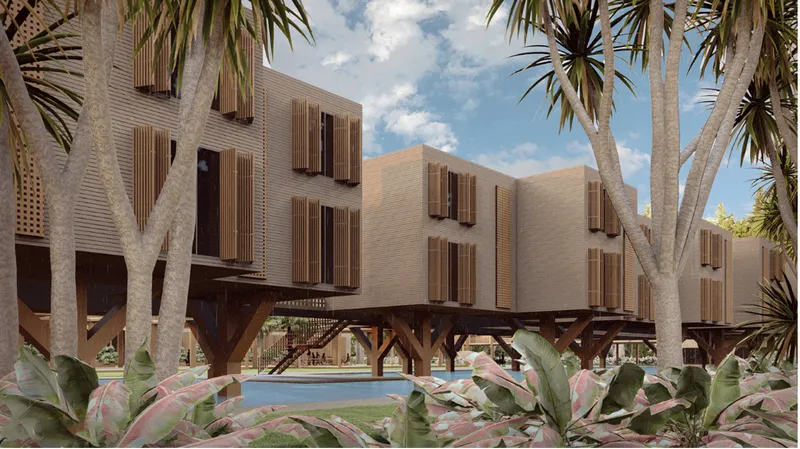
The reflecting pool beneath a piloti structure introduces water as both a cooling element and a compositional device. Framed by palms and tropical planting, the pool extends the ground plane visually while contributing to the site's evaporative cooling strategy. Rainwater harvesting systems feed back into these landscape elements, closing the loop between climate response and material expression. The palette throughout is restrained: earth tones, textured surfaces, and timber lattices that weather with the climate rather than resist it.
Material Language Rooted in Place

The final courtyard view reinforces what the entire complex is built on: a material language drawn from the site. Vertical timber slats, locally sourced materials, and raised planting beds create a vocabulary that feels specific to Tabasco rather than imported from a global resort template. The modular geometry, derived from the cacao tree grid, gives the complex visual coherence without monotony. Each courtyard, walkway, and pavilion varies in proportion and enclosure, but the material palette holds everything together.
Why This Project Matters
ChocoTerra takes the increasingly familiar brief of the sustainable resort and anchors it to something genuinely local. The programme could have easily devolved into eco-resort pastiche, but Kurtoglu's decision to derive the spatial logic from cacao cultivation itself, from the planting grid to the sensory journey from bean to bar, gives the architecture a narrative backbone that most hospitality projects lack. The passive climate strategies are not afterthoughts bolted onto a luxury programme; they are the programme, shaping every elevation, section, and plan.
For a shortlisted competition entry, the level of integration between landscape, culture, and built form is notable. ChocoTerra suggests that the most convincing sustainable architecture does not announce itself through gadgetry or green certifications but through a deep reading of place: its climate, its crops, its stories. In Tabasco's cacao country, that reading produces architecture that is simultaneously shelter, museum, and agricultural landscape, all held together by timber, shade, and the slow process of turning a bean into chocolate.
View the Full Project
About the Designers
Designer: Begumay Kurtoglu
Enter a Design Competition on uni.xyz
uni.xyz runs architecture and design competitions year-round that reward proposals with spatial conviction and real site intelligence.
Project credits: ChocoTerra by Begumay Kurtoglu Xocolatl (uni.xyz).


Popular Articles
Popular articles from the community


The Earth Pod: 3D Printed Homes for Resilient Refugee Communities
The Earth Pod reimagines refugee housing through 3D printed homes made from clay, combining resilience, self-sufficiency, and rapid shelter.
EW PARK: Sustainable Architecture Reimagines the Future of Urban Parking
EW PARK reimagines city parking as a modular wooden tower combining automation, solar energy, electric mobility, and adaptable urban design.

AL-JANNAH: Sustainable Architecture and Permaculture for Afghan Widows
AL-JANNAH uses sustainable architecture and permaculture to create resilient oasis of housing, learning, work and renewal for Afghan widows.

The Ocean Hive: Sustainable Architecture for a Self-Sufficient Civilization at Sea
The Ocean Hive imagines sustainable architecture at sea, where modular habitats, algae, wave power and ocean waste sustain a growing colony.

Similar Reads
You might also enjoy these articles

The Musturak Paradise: Senior Living Architecture for a Connected Future in Temara, Morocco
The Musturak Paradise reimagines senior living architecture in Temara via private homes, social spaces, culture, community, and shared care.

The Leaf Center: Cultural Center Architecture for Social Integration in Amsterdam
Cultural center architecture becomes a bridge at The Leaf Center, connecting international students with Amsterdam through art and exchange.

Conexión: Biophilic Design Reimagines High-Rise Living in Hong Kong
Conexión reimagines high-rise living in Hong Kong through biophilic design, green facades, shared spaces, daylight, water and nature within.

Wander to Wonder: Modular Playground Design for Children in Kutupalong Refugee Camp
Wander to Wonder uses modular playground design to create flexible, imaginative play spaces for children in Kutupalong refugee camp.


Comments (0)
Please login or sign up to add comments
No comments yet. Be the first to comment!