
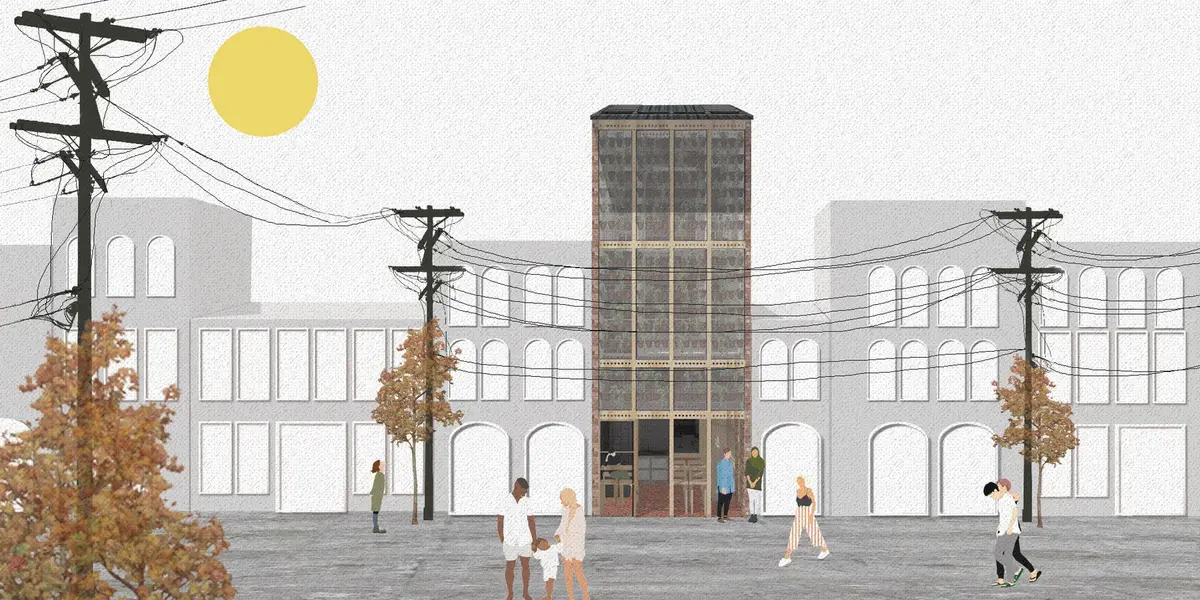
Chopstick Home: Vertical Micro-Dwelling Breathes Through Yangon's Density
A narrow brick and teak tower for a family of six uses a breathable shell, fold-out furniture, and a ground-floor restaurant to compress life into layers.


In a city where 94,000 people pack into a single square kilometer, the idea of fitting a multi-generational family of six into a sliver of urban plot while also running a public restaurant on the ground floor sounds like a logistical impossibility. Chopstick Home turns that impossibility into a coherent vertical sequence: brick shell, timber frame, planted facade, staggered floors, and a roof that collectively form a breathable tower calibrated to Yangon's monsoon heat and social rhythms.
Designed by Naja Spohner and shortlisted in the Nano Nest 2020 competition, the project sits in downtown Yangon, Myanmar's most populous city. Rather than treating tiny house design as a lifestyle novelty, Spohner grounds the work in genuine constraints: extreme density, climatic stress, limited budgets, and a family whose daily life oscillates between commerce, childcare, and communal rest. The result is less a miniature home than a micro-infrastructure, engineered layer by layer to do more with less.
A Narrow Brick Tower That Reads as Streetscape
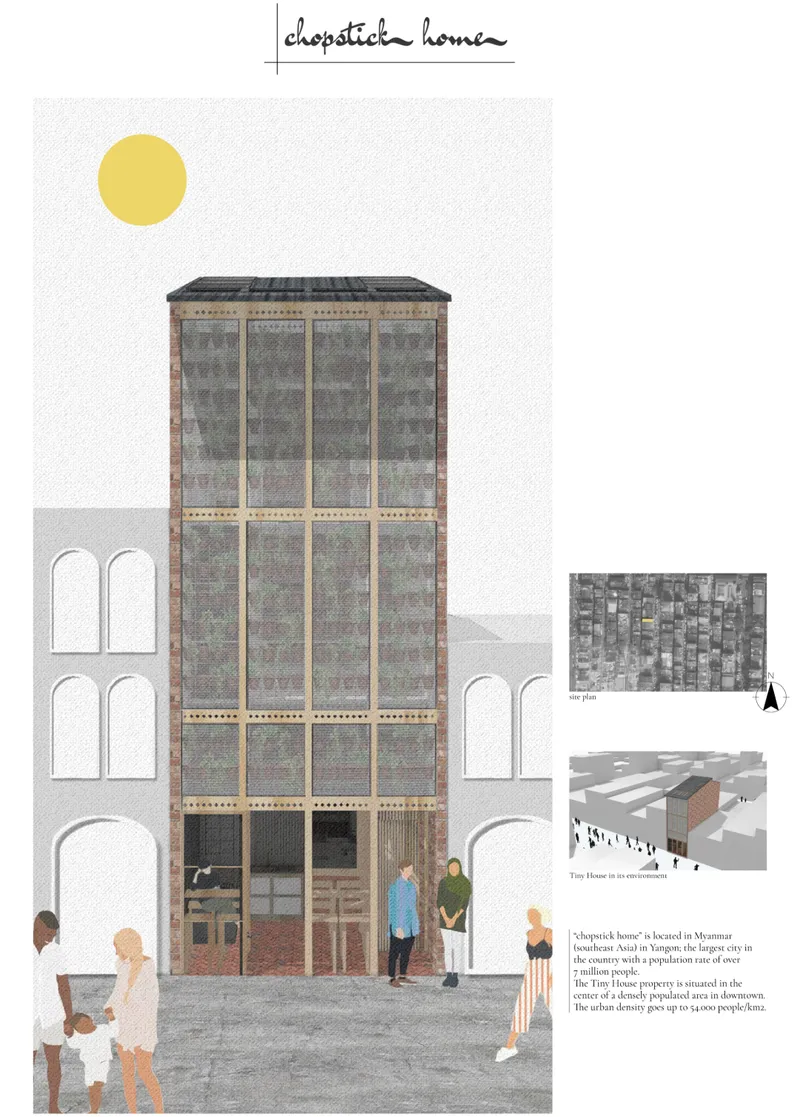
The elevation drawing reveals a facade barely wider than two doorways, yet it commands presence through material honesty. Brick and timber framing compose the street-facing surface, with diamond-pattern grids and plant pockets woven into the structure. Pedestrians at the base give scale to what is essentially a slender vertical extrusion, its proportions reminiscent of Yangon's existing shophouse typology. The slatted facade does triple duty: controlling solar gain, providing privacy from close neighbors, and housing greenery that cools the envelope through evapotranspiration.
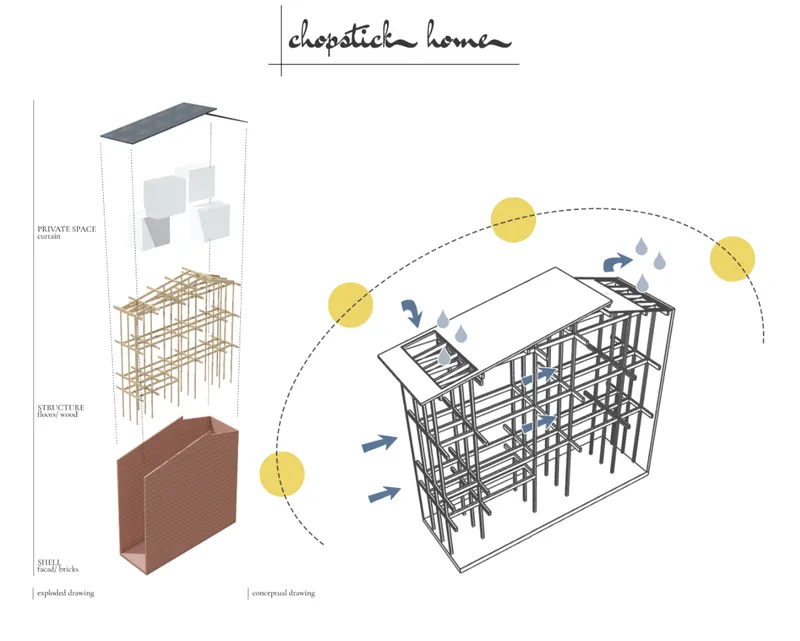
The exploded axonometric breaks the tower into legible layers. At the core sits a timber frame, wrapped by the outer brick shell that acts as a breathable boundary. Between these two skins, air moves freely, driven by cross-ventilation openings on front and rear facades. The roof caps the assembly, channeling monsoon rain so it can drip through the shell and cool the interior. Spohner's choice of regional materials, brick and teak, is strategic rather than nostalgic: both are locally available, weather-resistant, and embedded in Myanmar's building tradition.
Staggered Floors Stack Six Lives into a Single Plot
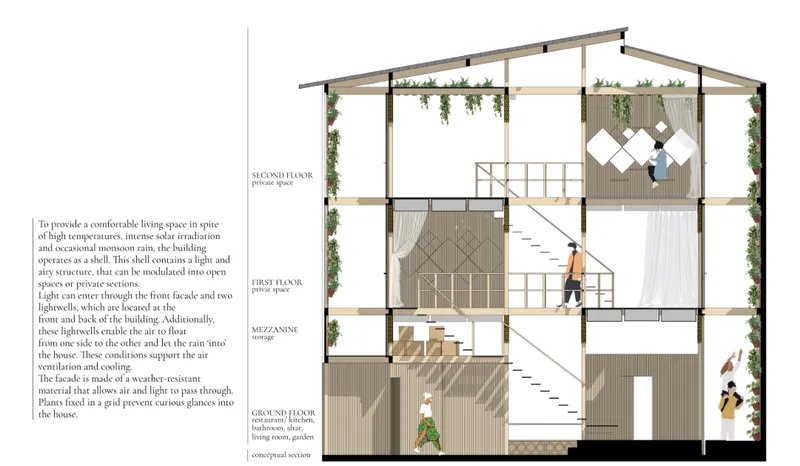
The section drawing is where the project's spatial ingenuity becomes fully apparent. Floors are staggered rather than uniformly stacked, creating half-level shifts connected by compact stairs. The ground floor is public: a small restaurant operated by the grandmother and mother opens directly to the street, with a kitchen tucked behind. Above, private living quarters rise through mezzanine storage levels and sleeping areas, each zone separated less by walls than by elevation change and movable curtains. Hanging plants cascade through the section, reinforcing the sense that the interior is a continuation of the planted facade.
This staggered logic is not merely formal. By splitting levels, Spohner generates more usable surface area within the same vertical envelope and creates distinct spatial territories for different activities: cooking below, resting above, studying in between. Fold-out furniture and hidden storage compartments ensure that every square meter serves multiple purposes throughout the day, accommodating a rhythm where family members cycle between work, school, and communal life.
A Planted Grid That Cools, Filters, and Connects
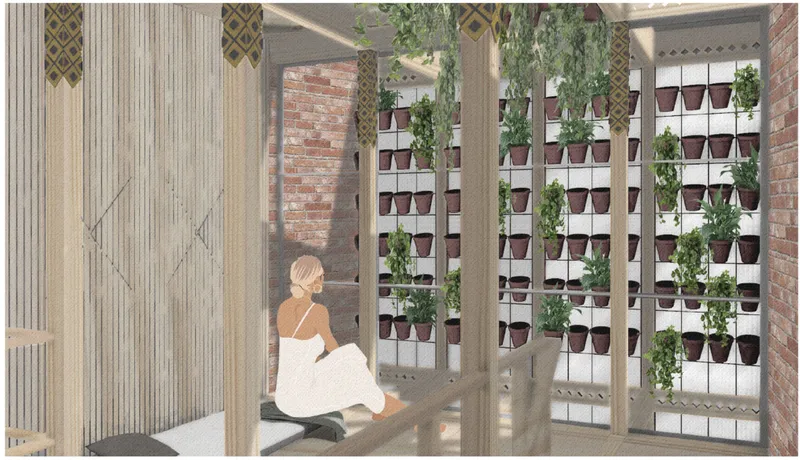
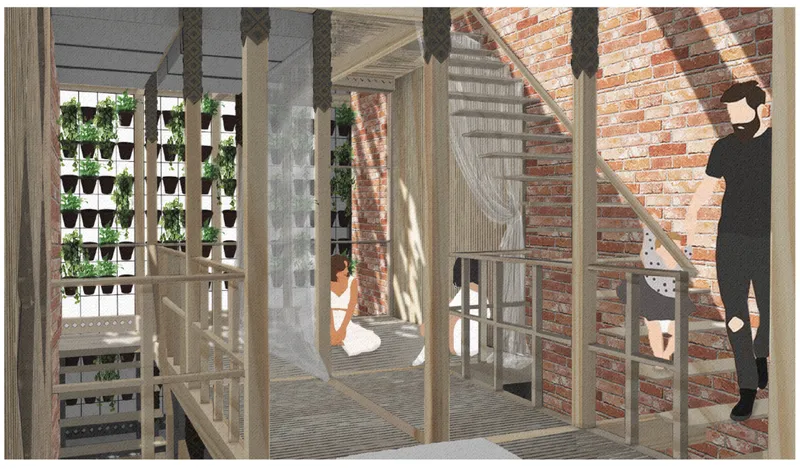
The interior views reveal how the grid facade operates from the inside. Potted plants sit in gridded pockets beside timber screens, forming a vertical green wall that blurs the line between interior climate and exterior ecology. In a neighborhood where open green space is essentially nonexistent, this biophilic layer offers measurable benefits: improved air quality, reduced interior temperatures, and a psychological counterpoint to the visual density outside. The plants are not decorative afterthoughts; they are embedded into the structural grid, making them as integral to the building as the bricks.
Dappled sunlight filtering through timber slats creates shifting patterns on brick walls and staircase surfaces, evidence that the facade is doing its job of mediating Yangon's intense solar exposure. Light wells on both facades pull natural illumination deep into the plan without opening the interior to excessive heat gain. The effect is quiet and textured, a far cry from the sealed, air-conditioned boxes that often pass for modern housing in Southeast Asian cities.
Timber Screens Negotiate Privacy Without Walls
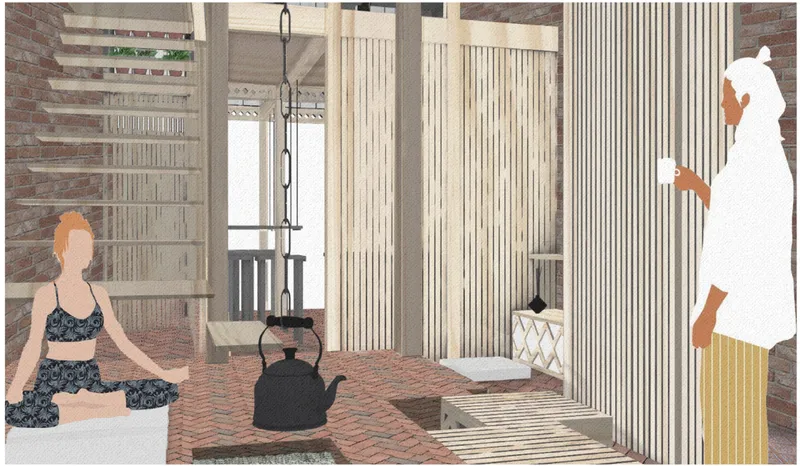
The final interior image captures the project's approach to partition: vertical timber screens separate zones without sealing them off. Two figures occupy the space in soft natural light, and the gaps between timber members allow air and sound to pass through, maintaining the cross-ventilation strategy at the room scale. Movable curtains supplement these screens when full privacy is needed, but the default condition is openness, a design choice that supports both passive cooling and the communal family culture the house is built around.
Minimal furnishings keep the floor area flexible. What walls exist are load-bearing brick, doubling as thermal mass that absorbs heat during the day and releases it slowly at night. The design discipline here is rigorous: nothing is purely structural, purely decorative, or purely environmental. Every element performs at least two roles, which is the only way a home this small can function for six people without feeling compressed.
Why This Project Matters
Chopstick Home matters because it refuses to treat tiny house design as a first-world curiosity. Spohner's project is grounded in a real urban condition where density is not a lifestyle choice but a given, where monsoon rains and extreme heat are seasonal certainties, and where a family's livelihood depends on the same structure that shelters them at night. The decision to place a public restaurant at the base is not a programmatic gimmick; it reflects how households in Yangon actually operate, and it turns the ground floor into an economic engine that justifies the building's existence.
What makes the project scalable is its reliance on locally sourced brick and teak, recycled components, and passive environmental strategies that require no mechanical systems. In cities across Southeast Asia facing identical pressures of density, climate, and affordability, the breathable shell concept and staggered floor logic could be adapted without importing expensive technologies or foreign material supply chains. Chopstick Home suggests that the most innovative housing solutions for the global south may not look spectacular from the outside. They just need to breathe.
View the Full Project
About the Designers
Designer: Naja Spohner
Enter a Design Competition on uni.xyz
uni.xyz runs architecture and design competitions year-round that reward proposals with spatial conviction and real site intelligence.
Project credits: Chopstick Home by Naja Spohner Nano Nest 2020 (uni.xyz).


Popular Articles
Popular articles from the community


Juan García Correa, John González and Claudia Rueda Sink a Circular Amphitheater into a Manizales Engineering Building
On the La Nubia campus in Manizales, Colombia, the S1 Building folds labs and offices into a hillside of ramped lawns that double as a campus route.

Cube Design Draws an Ecological Corridor Between Two Shenzhen Hills with the Nankai Building
Beside Shenzhen's container docks, the Nankai Building pairs stacked balconies with a climbing green screen to connect two hillsides across its height.

David Macias Steps a Doorless Stone and Plaster House Down a Tropical Colombian Hillside
In the humid hills of Colombia, Threshold House replaces the front door with an open void and terraces its 850 m² down the slope instead of fighting it.

GROUP A Strips a 1969 Rotterdam Harbor Headquarters to Its Frame and Wraps It in Timber Louvers
In Rotterdam's M4H harbor district, Ferro Offices reuses a 1969 frame, adds one timber storey and reaches BREEAM-NL Outstanding.

Similar Reads
You might also enjoy these articles


Vereda Arquitetos Renovates a 40-Square-Meter Apartment Inside Niemeyer's Copan Building
A compact unit in São Paulo's most iconic residential tower gets a material overhaul that pairs exposed concrete with bold blue Formica.

Shakur's House: Exposed Brick as an Interior Organiser in a 168 m² Mashhad Residence
Brick moves indoors in this Mashhad residence, where masonry walls, glass partitions and teal planes sequence a compact home without closing it off.

Day and Night Park: A Time-Based Urban Newsstand in Beijing
A temporary urban newsstand in Beijing blending travel, light, and reading through poetic colors, compact form, and community-focused design.

Modernist Patio Renovation in El Masnou, Barcelona by Oliver Segura Arquitectura + Cebrià Arquitectura
Modernist patio renovation blending tradition and innovation with a movable pool, leveled floors, and Catalan materials in El Masnou.


Comments (0)
Please login or sign up to add comments
No comments yet. Be the first to comment!