

Choreography of a Cloud, Dancing Shadows: An Ephemeral Pavilion at the Louvre Abu Dhabi
A kinetic pavilion beneath Louvre Abu Dhabi, where lightweight mesh, wind, and light create ever-changing shadows in constant architectural motion.


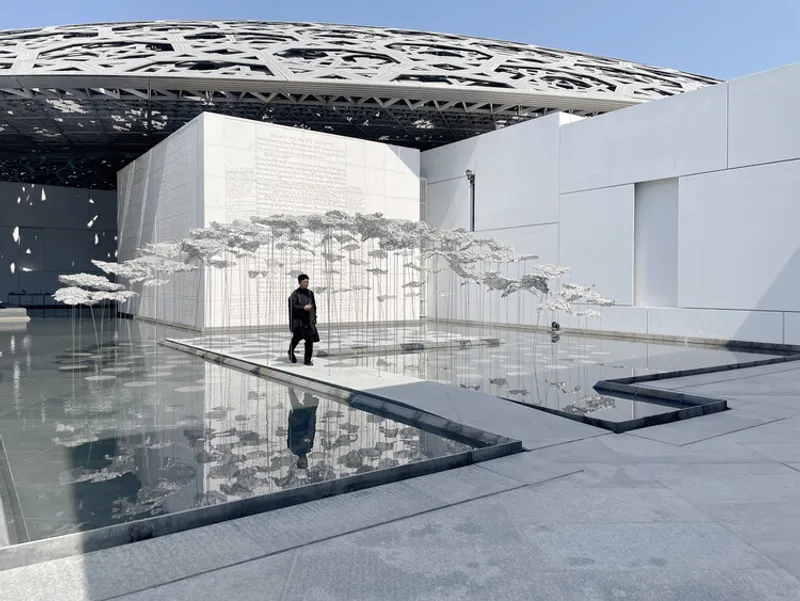
Set beneath the iconic dome of the Louvre Abu Dhabi, Choreography of a Cloud, Dancing Shadows is a poetic architectural pavilion by YOKOMAE et BOUAYAD that transforms light, wind, and shadow into a living spatial experience. Selected as one of five installations for Art Here 2025 and the Richard Mille Art Prize, the pavilion explores the theme of “shadows” through a delicate dialogue between Arab and Japanese cultural sensibilities.
Curated by Sophie Mayuko Arni, the Art Here exhibition invited architects and artists to reflect on shadows as more than absence: interpreting them as carriers of memory, identity, transformation, and time. In response, YOKOMAE et BOUAYAD conceived an architecture that exists precisely between nature and the built environment, evoking the fleeting beauty of clouds drifting across the sky or leaves swaying beneath a tree.
Architecture in Motion: Between Nature and Structure
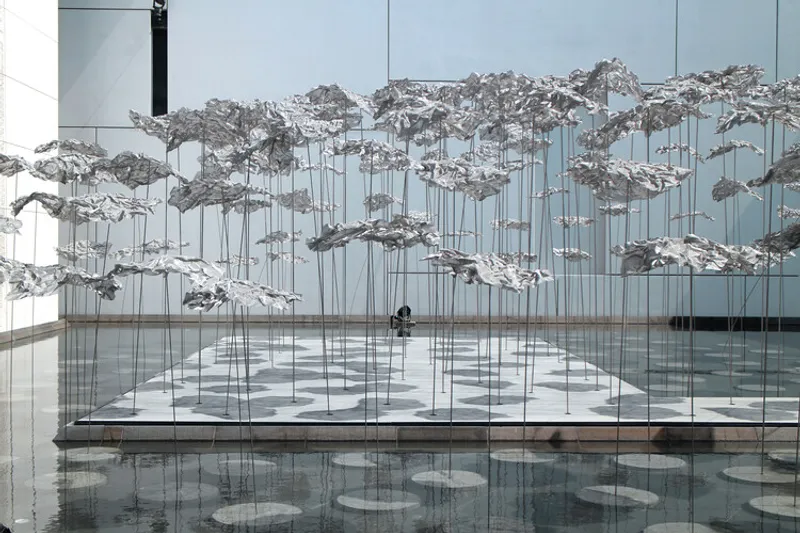
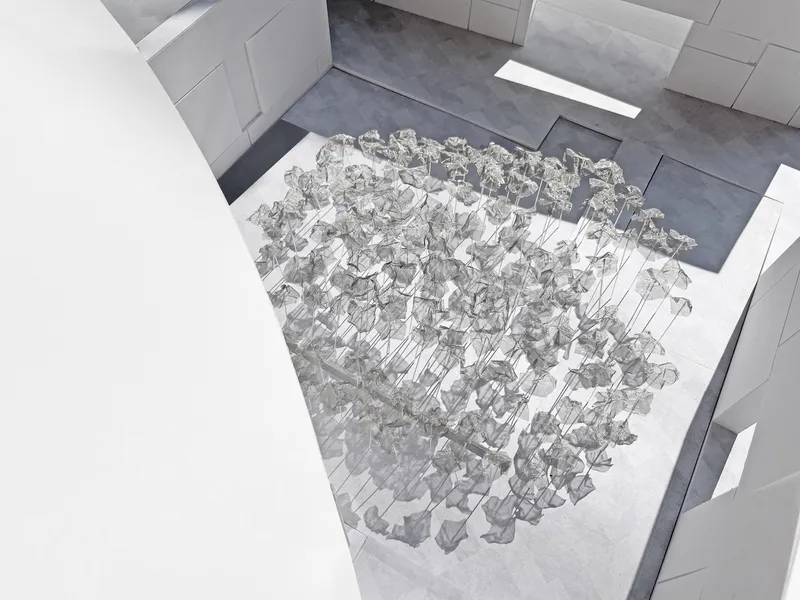
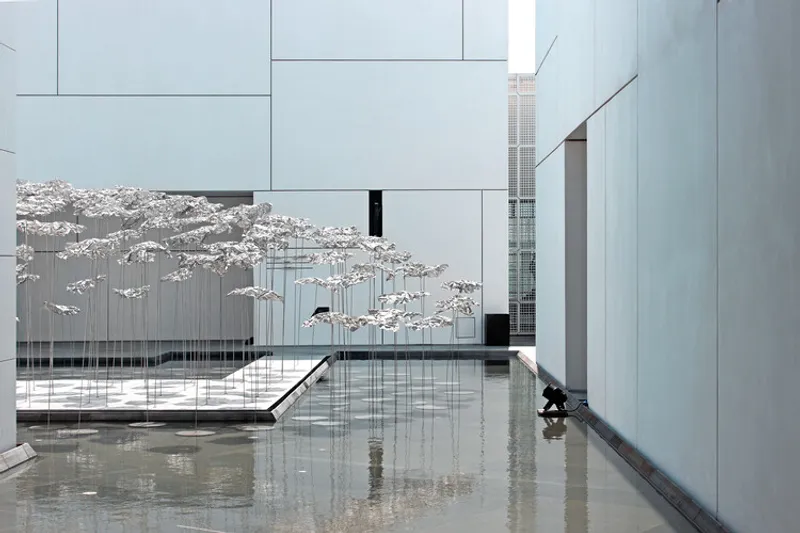
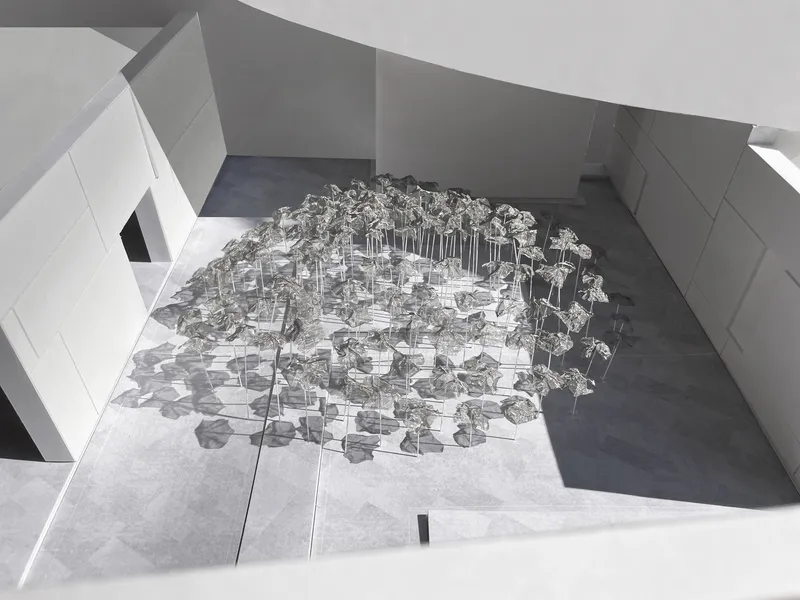
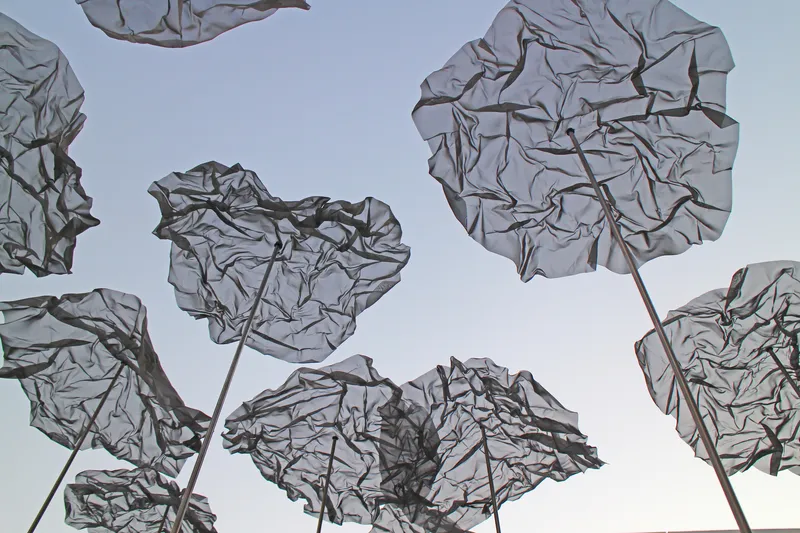
Unlike the Louvre Abu Dhabi’s monumental, static dome, defined by its intricate geometric patterns and controlled light, the pavilion introduces movement and impermanence. Its free-form roof, composed of ultra-lightweight woven stainless steel mesh, responds continuously to Abu Dhabi’s gentle breeze. As wind passes through the structure, shadows shift, dissolve, and reassemble on the ground, creating an ever-changing choreography of light and darkness.
Supported by 152 ultra-thin steel columns, ranging from just 6 to 12 millimeters in diameter, the pavilion achieves an almost immaterial presence. The structure appears to float, its boundaries constantly redefined by perspective, light conditions, and motion. From different viewpoints, the pavilion’s silhouette changes, reinforcing its cloud-like character.
The Poetics of Shadows and Balance
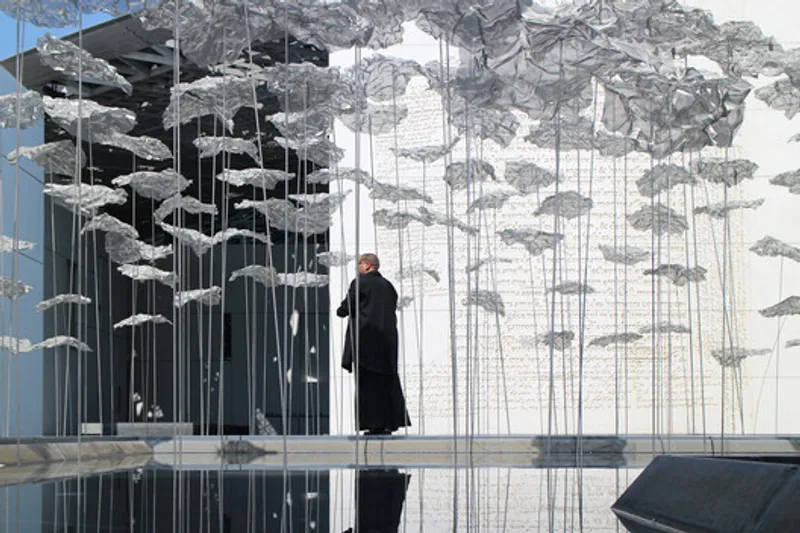
A key conceptual and structural innovation lies in the pavilion’s foundation system. Drawing inspiration from the Japanese Okiagari Koboshi, a traditional self-balancing toy, each column is anchored to a subtly spherical concrete base. This allows the structure to move gently at its base, introducing a slow, natural sway that echoes organic behavior rather than rigid architectural form.
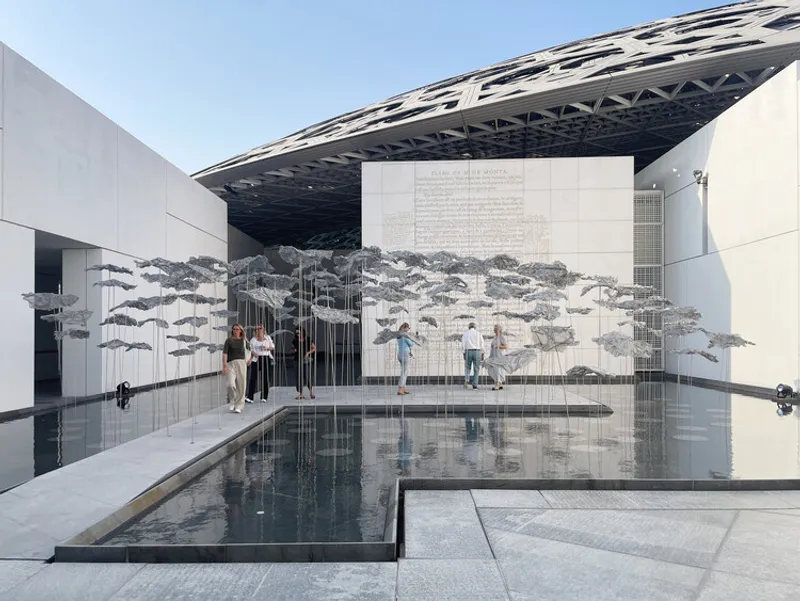
This movement blurs the distinction between architecture and environment. Shadows no longer remain static projections but become active participants, dancing collectively across the site. The pavilion does not impose itself on its context; instead, it listens, responds, and adapts, mirroring the rhythms of nature while contrasting with the museum’s monumental permanence.
A Pavilion That Exists Only Here
Designed specifically for the Louvre Abu Dhabi, Choreography of a Cloud, Dancing Shadows could not exist elsewhere. Its material lightness, responsiveness to wind, and reliance on filtered sunlight are inseparable from the museum’s dome and climatic conditions. Together, the two structures form a compelling dialogue: stillness versus motion, mass versus lightness, permanence versus ephemerality.
Running from October 10 to December 28, 2025, the pavilion invites visitors to slow down, observe, and experience architecture not as a fixed object, but as a constantly evolving phenomenon. In doing so, it redefines how temporary architecture can engage emotion, perception, and the senses, demonstrating that sometimes the most powerful spaces are those that never stay the same.
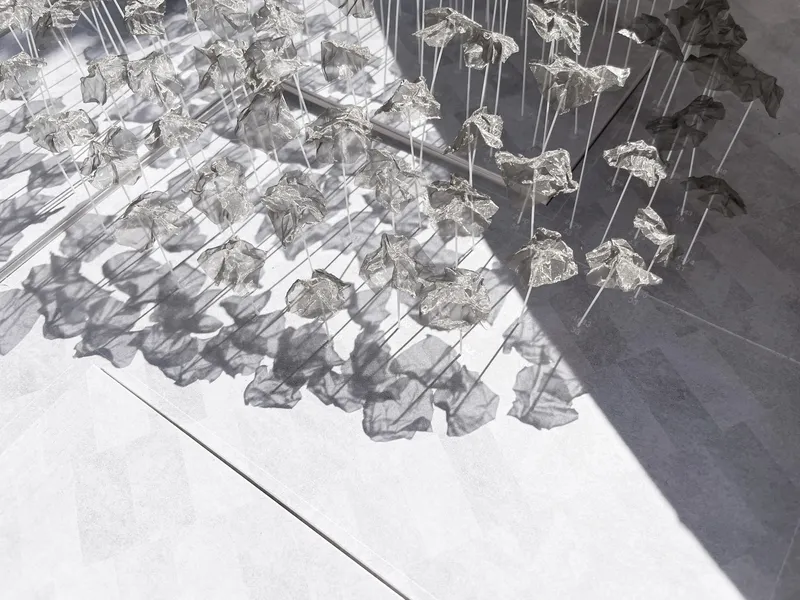
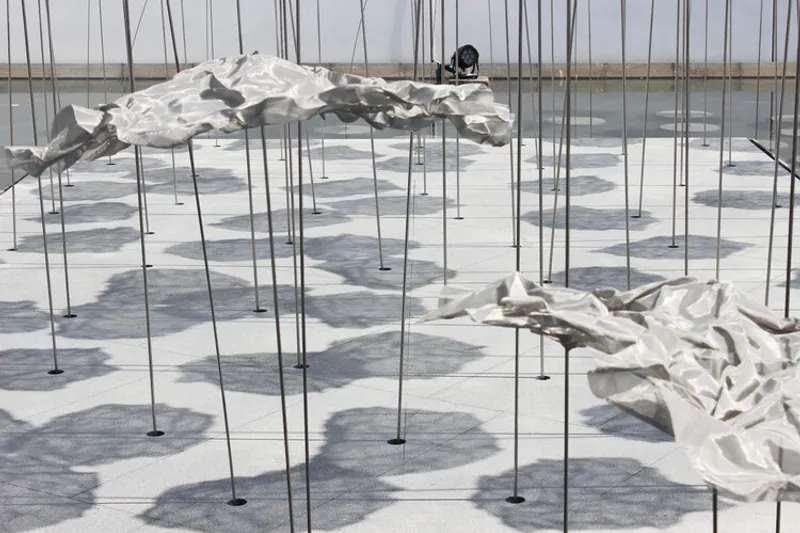
All the photographs are works of YOKOMAE et BOUAYAD


Popular Articles
Popular articles from the community


David Macias Steps a Doorless Stone and Plaster House Down a Tropical Colombian Hillside
In the humid hills of Colombia, Threshold House replaces the front door with an open void and terraces its 850 m² down the slope instead of fighting it.

LT2A and OPEN Architectes Thread a Brick and Glass High School Through a Wooded Belgian Campus
In Braine-l'Alleud, a 3,000 m² wing for Collège Cardinal Mercier pairs pale brick with a glazed colonnade, deferring to a small chapel and a dense wood.

Juan García Correa, John González and Claudia Rueda Sink a Circular Amphitheater into a Manizales Engineering Building
On the La Nubia campus in Manizales, Colombia, the S1 Building folds labs and offices into a hillside of ramped lawns that double as a campus route.

longwave studio Reorganizes a 112 m² Tainan Apartment Around the Daily Routines of a Family and Two Cats
In Tainan, Taiwan, birch plywood, rust-red furniture and a freestanding plaster wall link arrival, storage, work and family life in one apartment.

Similar Reads
You might also enjoy these articles


Hodi-Mandai Geram
Project Function: Preservation and revitalization of the Intangible heritage and socio-spatial identity of the Hodi by Housing, Cultural Memory Center, Sacred Grove, landscape, local tourism economy


Olio Towers: A Mid-Rise for Performers That Fuses Housing, Rehearsal, and Stage
Located blocks from Houston's Theater District, this modular tower stacks living units around a central performance atrium.

Oasis: Modular Green Housing Carved into Dhaka's Urban Fabric
A shortlisted Plugin Housing entry reclaims unauthorized settlements in Dhaka with stepped concrete volumes, green roofs, and ventilation-driven design.

Black Hole: A Floating Megastructure for the Post-Physical Era
Emiliano Mazzarotto envisions a spherical, self-scaling arena where e-sports, digital hotels, and holographic stadiums replace traditional public space.

Explore Architecture Competitions
Discover active competitions in this discipline

Challenge to design a portable theatre

Challenge to design a portable music platform

Challenge to design an open learning module for the elderly

Challenge to reimagine the Iron Throne
Comments (0)
Please login or sign up to add comments
No comments yet. Be the first to comment!