
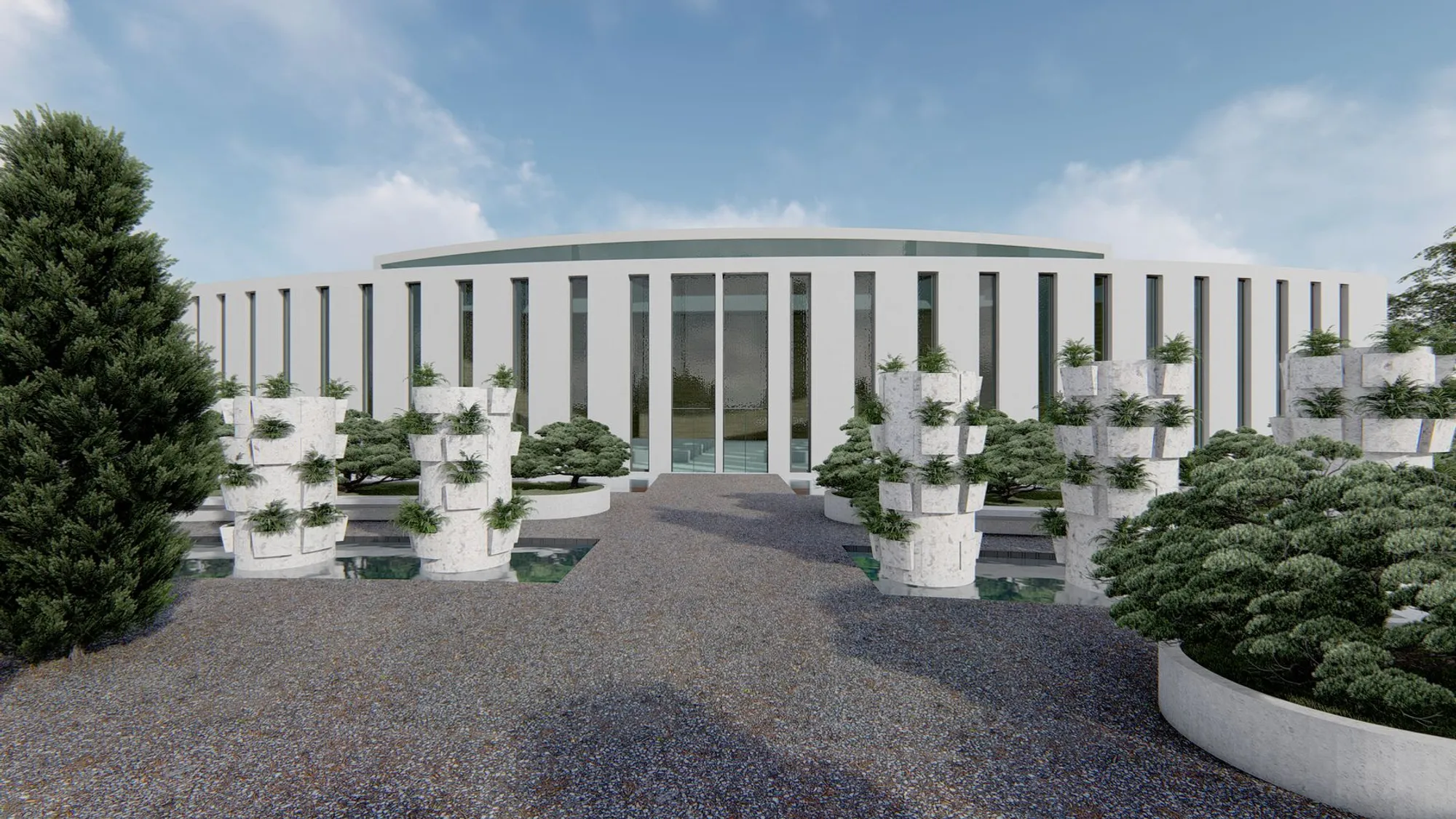
Circle of Life: A Cemetery That Grows with 7,616 Plant-Integrated Urns
A memorial park in Shanghai replaces traditional burial with 272 cremation columns that double as living botanical memorials for the city.


What if a cemetery could feel less like an ending and more like a garden you'd want to walk through on your lunch break? In Hongkou, Shanghai, the Circle of Life project folds 7,616 burial sites into a public park where joggers, readers, and mourners share the same ground. Each urn sits inside a planted column, so memory literally grows: the dead nourish vegetation, and the living move freely among it. The result is a memorial typology that refuses to isolate grief from daily urban life.
Designed by Яся Семенец, the project sits within the dense urban fabric of Hongkou and proposes a cremation-based system as an alternative to land-intensive traditional burial. The masterplan is organized around a main building whose curved footprint mimics a drop of water, a symbolic nod to the beginning of life and the continuity that follows. Underground parking, concealed beneath green alleys, preserves the surface for pedestrians and ecology rather than cars.
Cremation Columns as Botanical Archive
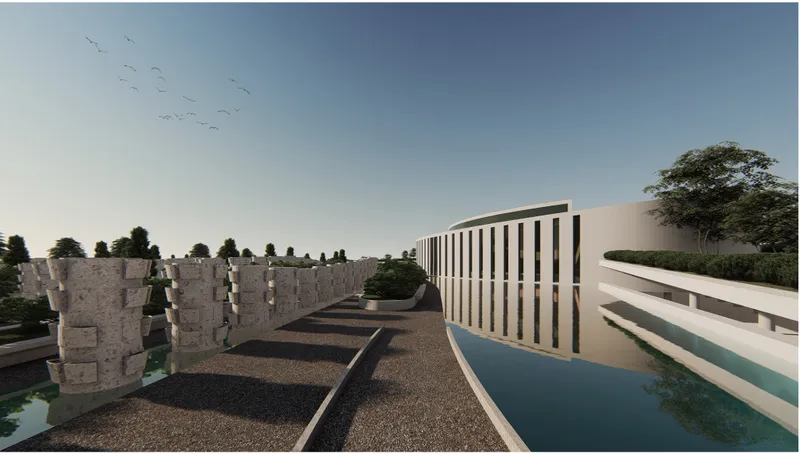
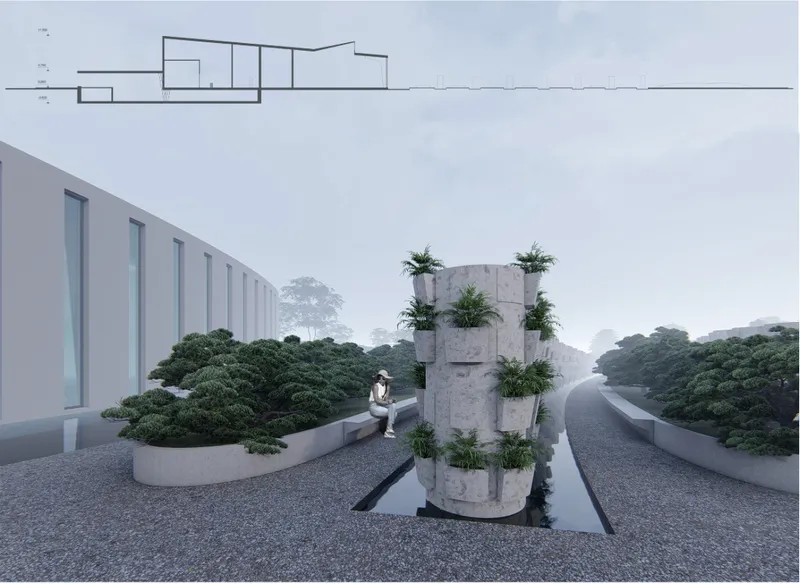
The project's most striking innovation is its cremation column system. 272 vertical concrete structures, each holding 28 urns, are integrated with planters that transform them into living memorials. From the rooftop terrace, they read as a dense botanical field: gravel paths thread between planted columns flanking a reflecting pool, while the building's vertical slatted facade recedes into the background. The sectional drawing reveals how each column is stacked with planter trays and vegetation, so the structure is simultaneously storage, landscape, and monument. It is an extraordinarily efficient model, yielding 7,616 burial sites without consuming the sprawling acreage of a conventional cemetery.
The choice to pair cremation with horticulture is not merely aesthetic. It reframes the act of memorialization as ongoing stewardship. Families return not just to visit a plaque but to see what has grown. The columns become a botanical archive of memory, each one distinct as its plants mature, offering a sensory richness that static headstones cannot.
Light, Timber, and the Interior Ritual Space
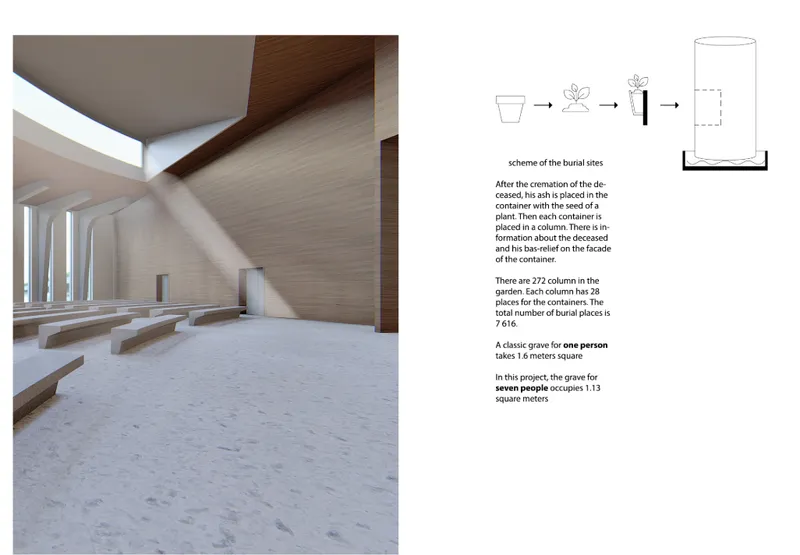
Inside, the memorial hall balances gravity with warmth. Vertical slatted walls filter daylight in thin, rhythmic bands while angular skylights carve precise shafts of light onto the stone floor. The timber ceiling introduces a softer register overhead, ensuring the space feels contemplative without becoming oppressive. It is a room designed for ceremony but equally suited to quiet personal reflection.
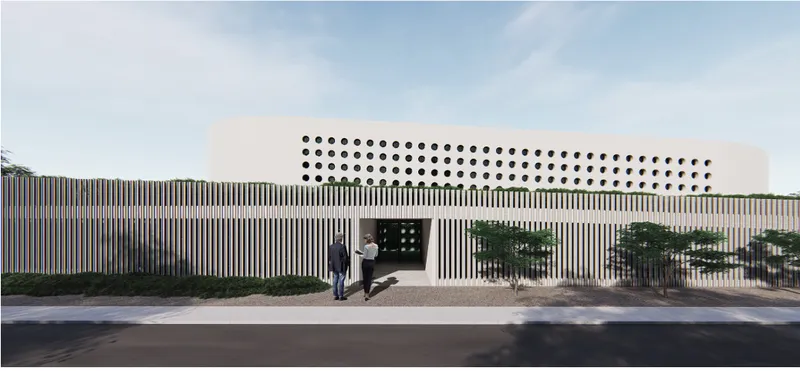
The street facade shares the same material language: vertical timber slats and a perforated upper volume give the building a legible civic presence without broadcasting its programme aggressively. Two figures approaching the entrance in the rendering could be heading to a memorial service or simply entering a park pavilion. That ambiguity is precisely the point. The architecture normalizes proximity to death by making the threshold between city and sanctuary almost imperceptible. South-facing windows and gardens ensure that natural light penetrates deeply throughout the day, reinforcing the building's hospitality.
Landscape as Ecological and Emotional Buffer
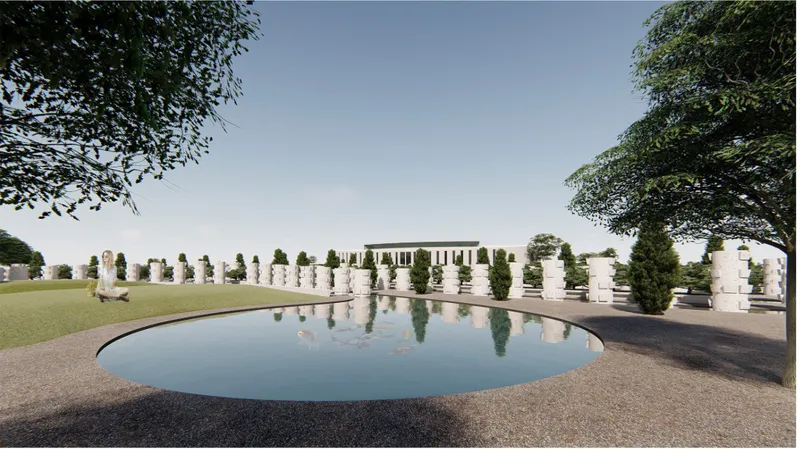
A circular reflecting pool anchors the outer landscape, sitting on a gravel lawn surrounded by planted cremation columns with the slatted building volume visible in the distance. Water features, green roofs, and tree-lined pathways create an ecological buffer that mediates between the memorial precinct and the surrounding urban density. The site is strategically connected to the city through two major access points, public transit stops, and dedicated pedestrian axes, ensuring the park remains woven into Hongkou's daily circulation rather than sitting apart from it.
The landscape strategy serves a dual purpose. Ecologically, it introduces permeable surfaces, biodiversity corridors, and stormwater management to a dense district. Emotionally, the layering of water, planting, and open sky creates graduated zones of intimacy: from the busy street edge, through a canopy walk, past the reflecting pool, and finally into the quieter column groves. Visitors choose their own depth of engagement.
Why This Project Matters
Urban land scarcity is forcing cities worldwide to confront an uncomfortable question: where do the dead go when there is barely room for the living? Circle of Life offers a concrete answer. By stacking 7,616 urns into 272 planted columns and embedding them within a functioning public park, the project demonstrates that memorial architecture can be radically space-efficient without sacrificing dignity or beauty. The cremation column typology is replicable and scalable, making it relevant far beyond Shanghai.
More importantly, the project challenges the cultural segregation of death from everyday life. A cemetery that also functions as a jogging route, a reading garden, and a civic gathering place quietly insists that mortality is not something to be walled off. Яся Семенец has proposed a space where remembrance and routine coexist, and in doing so has sketched a more honest and humane relationship between cities and the cycles they contain.
View the Full Project
About the Designers
Designer: Яся Семенец
Enter a Design Competition on uni.xyz
uni.xyz runs architecture and design competitions year-round that reward proposals with spatial conviction and real site intelligence.
Project credits: Circle of Life by Яся Семенец.




Popular Articles
Popular articles from the community


Co-life: Sustainable Architecture for Age-Friendly Community Living
Co-life reimagines sustainable architecture for seniors through courtyards, rammed earth, shared gardens, and spaces designed for belonging.

Co-Life: Senior Housing Design That Reconnects Older Adults With the City
Co-Life reimagines senior housing design through healing gardens, shared streets, workshops, and a sustainable community across generations.

Conexión: Biophilic Design Reimagines High-Rise Living in Hong Kong
Conexión reimagines high-rise living in Hong Kong through biophilic design, green facades, shared spaces, daylight, water and nature within.

Lunar Spiral: Space Architecture Shaped by the Mathematics of the Universe
Lunar Spiral reimagines space architecture through Fibonacci geometry, lunar regolith, levitating habitats, and self-sustaining Moon living.

Similar Reads
You might also enjoy these articles

Bao Huynh Watercolor Atelier: A Serene Art Retreat in Hội An
Bao Huynh Watercolor Atelier in Hội An blends multifunctional art spaces, sustainable design, local materials, and family-friendly living in a serene environment.

Atelier Macri Concept Store Interior Design by CASE-REAL
Atelier Macri store features a "ko" counter, walnut wood details, cork displays, blending retail, gallery, and seamless customer experiences.

Manuel Vargas Izquierdo Stadium and High-Performance Sports Center: Architectural Excellence in Jalpa de Méndez
The Manuel Vargas Izquierdo Stadium blends sustainable design, inclusive sports facilities, and cultural-inspired architecture, revitalizing Jalpa de Méndez’s public spaces.

KAKR Buluh Awar Hall: Revitalizing Community and Ecology Through Bamboo Architecture
Community built bamboo hall revitalizes Buluh Awar village, empowering youth, restoring ecology, celebrating vernacular craftsmanship through sustainable architecture and culture.

Explore Memorial Design Competitions
Discover active competitions in this discipline



Challenge to design locus for the upliftment of human rights


Design challenge to reuse E-waste
Comments (0)
Please login or sign up to add comments
No comments yet. Be the first to comment!