
CityScraper
Eco Favelas
Statistics on São Paulo, South America's largest city, are a treasure trove for the adept of radical urbanism. Any guidebook will tell you that São Paulo is a megalopolis of 19 million people, and that its population has grown by 8000% since the beginning of the twentieth century. Do such statistics help us understand the city? Do they reveal its important features? To a certain extent, yes, but on the other hand it only confirms what we already know. Speed has always been the raison d'être of São Paulo. In The Sad Tropics, Claude Lévi-Strauss, who lived here in 1935, wrote: "The city is developing so fast that it is impossible even to get a map of it. In the mid-20th century, when the city became the locomotive of the "Brazilian miracle," the popular slogan "São Paulo must not stop. It was the "perpetual motion machine."
Today, despite impressive statistics, São Paulo is slowing down. Its population is growing more slowly than ever before, and it is growing only in one area: the periphery. São Paulo's sprawling suburbs show that the city is still forming. The sacrifices people make to get to São Paulo are embedded in the landscape, in the very walls of their homes. Cities that grow so rapidly develop disorderly, and so São Paulo's periphery is associated not only with poverty, but also with enormous potential.
The common perception of São Paulo is based, on the one hand, on images of the forest of skyscrapers and stories about the life of the urban elite, who allow themselves the luxury of traveling through the metropolis in helicopters, and, on the other hand, on the ever-expanding fringe of favelas surrounding this luxury. But it would be simplistic to view the city's structure as "a rich core in a ring of poverty".
To address the aforementioned social problems faced by the inhabitants of such a large metropolis, we decided to change the face of the favela. Through our project, we want to show that it is possible to create a building that performs the functions of a small city by disenchanting the not-so-glorious image of the suburbs. A building with all the amenities available to the tenants themselves or to the surrounding community. Because we must remember that a building is always an integral part of a city and cannot exist in isolation from it. For this reason, the body of our building consists of 4 essential parts.
The base of our skyscraper is a 200x70 metre, where we concentrate all off the most important services, available for the tenants themselves and the surrounding residents. It therefore houses a shopping centre, medical, veterinary, dental surgeries, banks, spaces for rent, to which small service points from the neighbourhood could be relocated. On the ground floor there are additionally a soccer field, a playground that will integrate people. The different levels of the ground floor block are offset from each other to form terraces with arcades.
We have started our design process with setting up a primary unit. We decided to create 4 Residential modules with various living area, as a proposal for potential clients, depending on their needs and social status. In our portfolio, we have flats for singles or families with one child (the 40m2 module) as well as those that will meet the greater needs of families with many children (the 60m2 and 80m2 modules). We have also thought about the elderly and disabled people by creating a 60m2 module with appropriate amenities such as wider doors, corridors, a bathroom with sufficient space to allow a wheelchair to turn around, and accessories in the bathroom to make it easier to use. Richer people will also find something for themselves. We would like to create a good space for people from different social groups to coexist, so that those who are financially disadvantaged can improve it.
One of our inspirations was the DNA-helix shape. And just as DNA defines our features so dwellings are the basic formative of our skyscraper. From level 6 onwards, the residential towers on opposite corners of the building grow out of the base of the building. However, the drawing of the façade
already starts from ground level so that we maintain the homogeneity of the whole. From level 13, the residential floors are grouped by 3 and rotate by 3 degrees.
In the middle of the two towers there are offices and service areas, whose rotation is determined by the rotation of the residential towers. In order to keep the massing integral as a whole, we decided to use connecting links to connect the residential and office/commercial sections. These sorts of bridges have a recreational role and connect to the park in the office and service part. By doing so, we create communal spaces that foster a sense of community among both the residents and those working in the high-rise.
The building we designed is equipped with solutions to make it energy independent. These include: kinetic floor, rainwater, quantum glass, aquaphonica. All this makes our building an element that will enrich the surroundings, not only in terms of aesthetics, but above all in social terms. It will be a kind of heart of the neighborhood, which will polarize people of different social status and different needs.

Popular Articles
Popular articles from the community


Tsunami Convergenics: Turning Catastrophic Ocean Forces into Underwater Housing Infrastructure
A speculative underwater settlement off the coast of Onagawa, Japan, treats tsunamis and typhoons as energy sources rather than threats.

Singing Woman: An Opera House That Performs Before the Curtain Rises
Ovidiu Cristian Pavel's conceptual opera house translates Estonia's choral identity into a sculpted waterfront landmark facing the Baltic Sea.

Faces of the Soviet Avant-Garde: Turning Moscow's Street Names into an Open-Air Museum
A network of sculptural installations across a Moscow residential district transforms forgotten architect names into spatial encounters with cultural memor

Opera by the Sea Estonia: Three Shells Dissolving Architecture into Tallinn's Coastline
A winning opera house proposal replaces monumental form with interconnected shells that blur the boundary between building, park and Baltic Sea.

Similar Reads
You might also enjoy these articles
The Rhythm of Seasons
A Farmers' Market Connecting Nature and the City
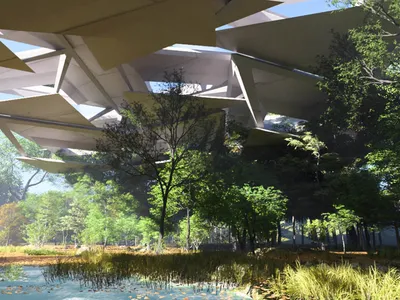

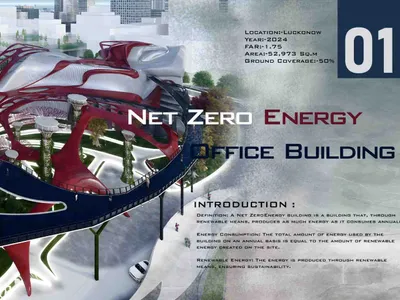
More Than a Building-Designing a Living System
More Than a Building-Designing a Living System
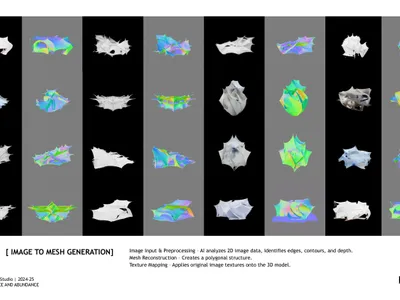
Base Beyond
DESERT COMPOUND ARID: TOURISM OF ABSENCE AND ABUNDANCE

Explore Slumscraper Competitions
Discover active competitions in this discipline


Challenge to reimagine the Iron Throne

Photograph architecture without architects

Illustrate the lost glory of Angkor Wat - Render Challenge

Design challenge to reuse E-waste
Comments (0)
Please login or sign up to add comments
No comments yet. Be the first to comment!