

CL3 Studio Wraps Two Apartment Buildings in Larch Shingles in the Czech Highlands
A pair of gabled volumes in Bělá pod Pradědem reinterpret Jeseníky barn architecture with colored glass mosaic and local timber.


The Jeseníky highlands of northern Czechia are not a place that invites architectural bravado. The landscape is quiet, forested, and punctuated by simple agricultural structures whose proportions have barely shifted in centuries. When CL3 studio set out to design a pair of apartment buildings on a sloping meadow in the village of Filipovice, the question was not how to stand out but how to belong. The answer was a disciplined act of translation: take the steep gables, the rough-hewn timber cladding, and the compact massing of local barns, then rework them with contemporary precision and a few deliberate jolts of color.
What makes these buildings genuinely interesting is their commitment to near self-sufficiency in a rural setting without resorting to the techno-aesthetic that so often accompanies green ambition. A ground-water heat pump, air recuperation in common areas, an on-site well, and a domestic sewage treatment plant mean electricity is the only utility drawn from the grid. The larch shingles, harvested from a local forest and left unplaned, will darken over the years until the two volumes read almost as geological features on the hillside. The project, completed in 2020 after a design phase running from 2016 to 2018, encompasses roughly 2,240 square meters of gross floor area across a 2,375 square meter site.
Two Volumes, One Conversation
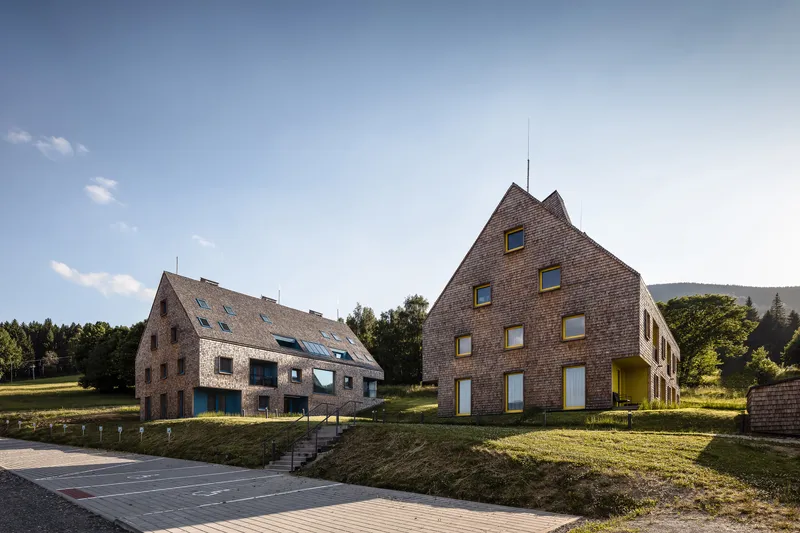
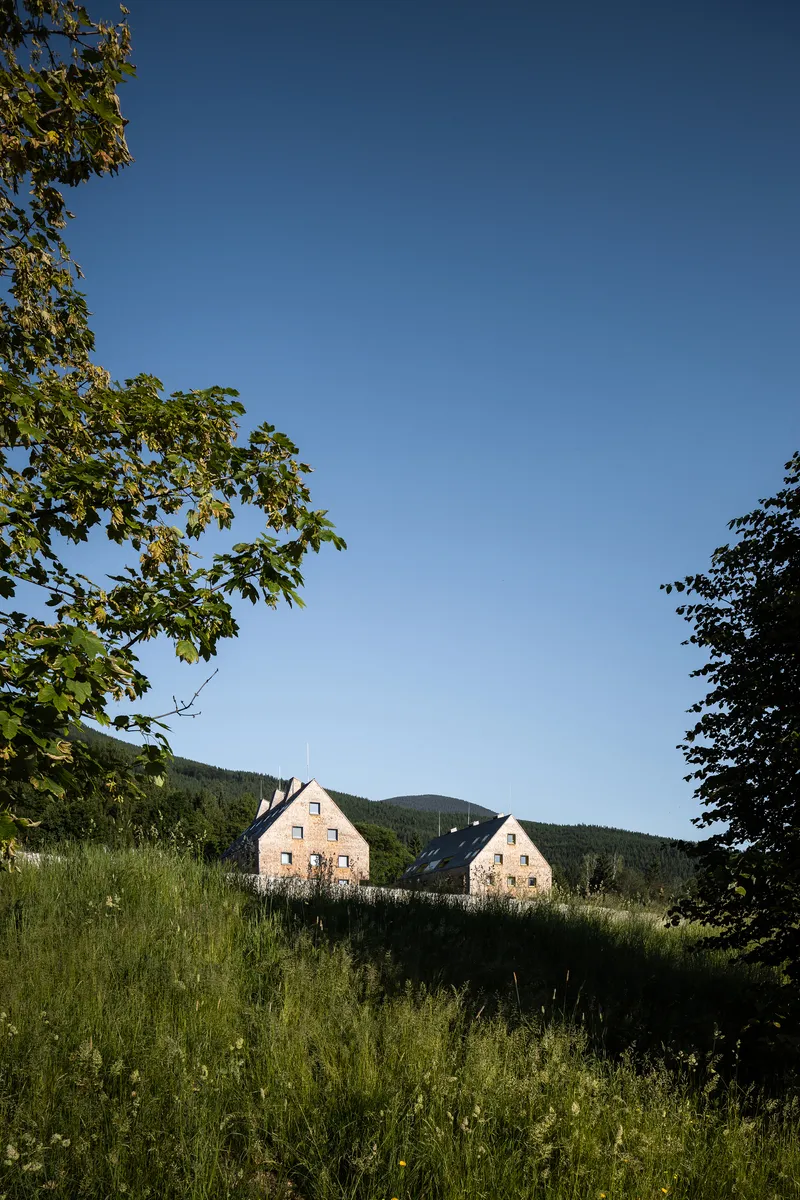
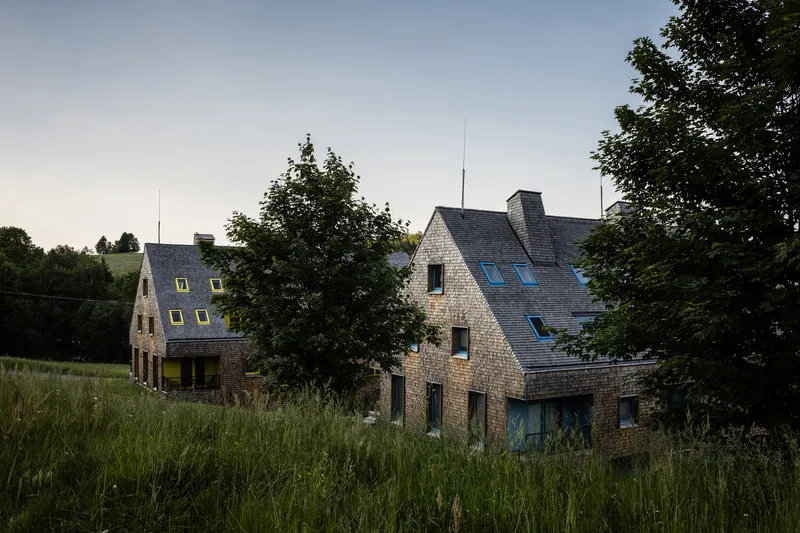
The complex consists of two freestanding rectangular buildings, each sitting on strip foundations and topped with steeply pitched gable roofs. Seen from a distance, their proportions echo the barns scattered through the valley: tall, narrow profiles with generous roof planes that dominate the elevation. By placing the buildings in parallel on a gentle slope, CL3 creates a courtyard condition between them, a shared outdoor room that mediates between the domestic scale of the apartments and the vastness of the surrounding meadow and forest.
The pairing is not identical. One building uses blue window frames and loggia accents, the other yellow, giving each volume a distinct identity while maintaining a clear family resemblance. At dusk, when the colored frames glow against the dark shingle skin, the differentiation becomes theatrical, almost festive, without breaking the overall restraint of the composition.
Shingle Skin and Colored Mosaic
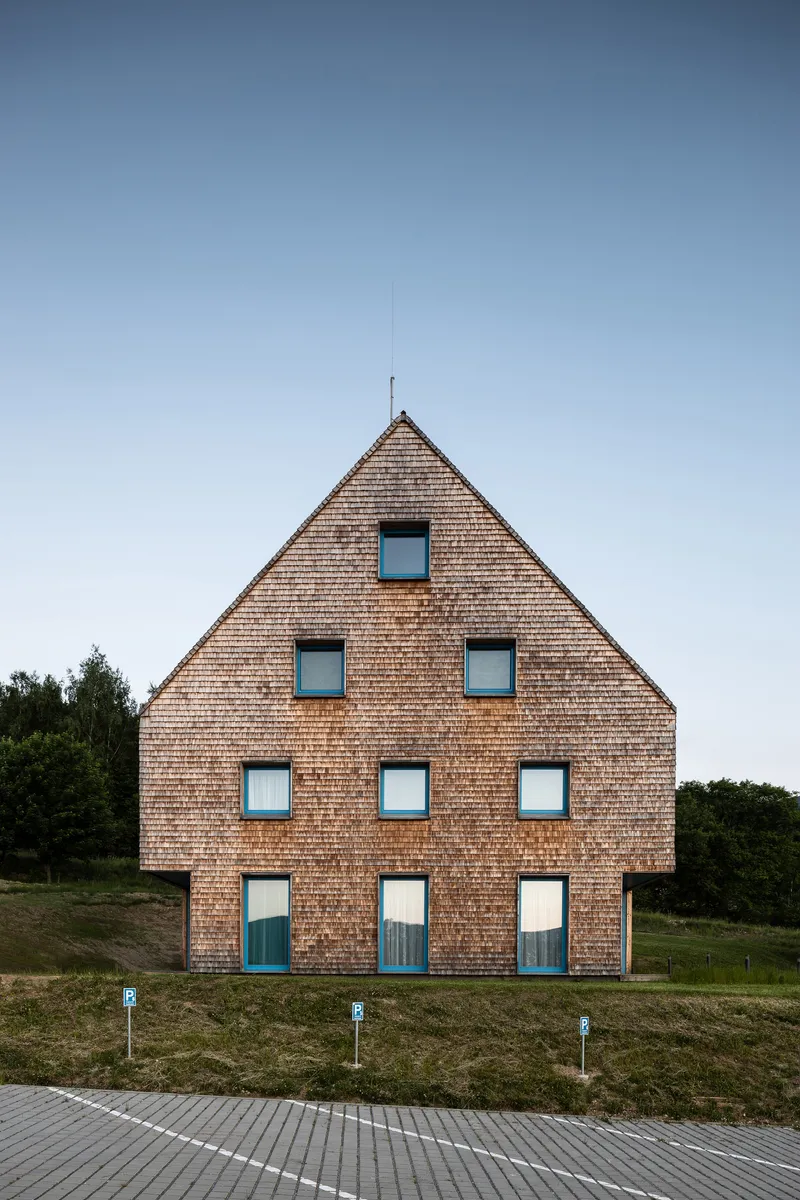

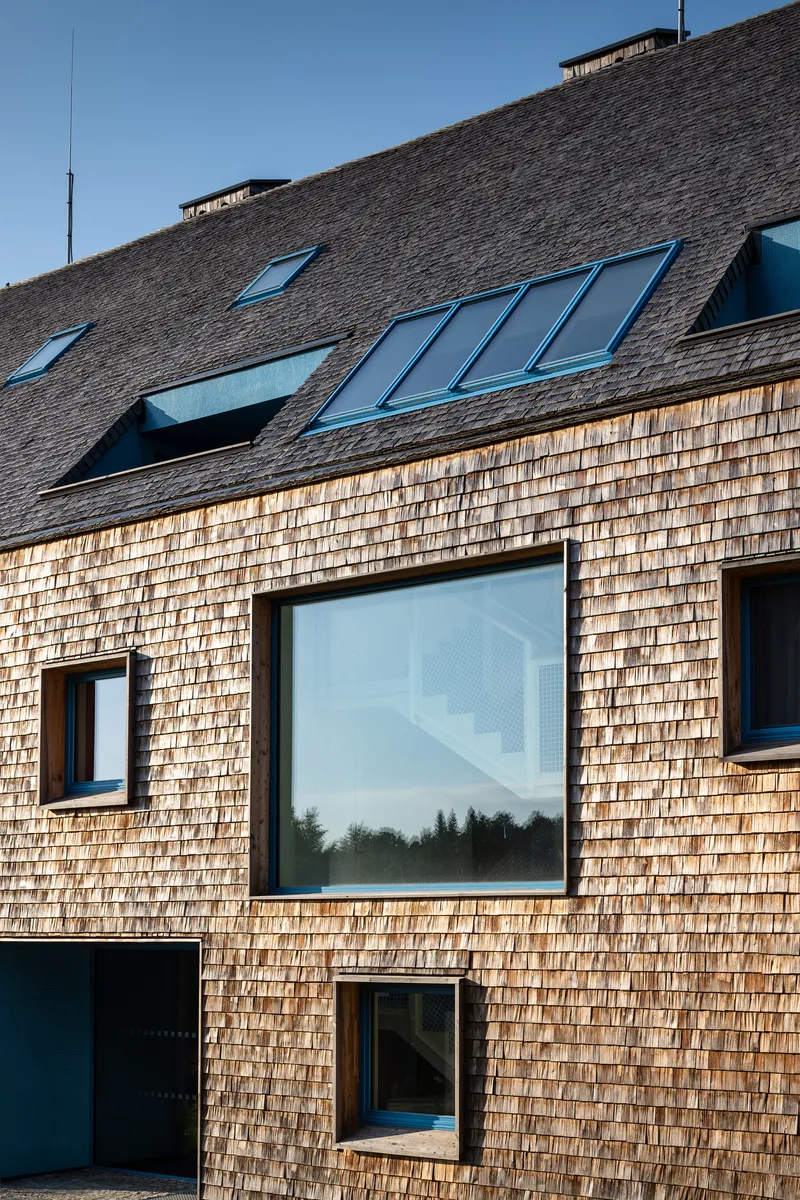
The facades deserve close reading. Unplaned larch shingles cover both walls and roof in a continuous envelope, blurring the boundary between cladding and roofing. The shingles are arranged with the deliberate irregularity of traditional craft: no two rows are perfectly identical, and the raw texture gives the surface a depth that shifts with light and weather. Behind this timber skin, the actual structure is a hybrid of sand-lime brick walls and reinforced concrete ceilings, a robust and conventional system hidden by the vernacular wrapper.
The windows are strictly square, punched into the shingle field with almost graphic precision. Their reveals are lined with colored glass mosaic, blue on one building, yellow on the other. It is a small detail that does significant work: the mosaic catches and reflects light in a way that flat paint cannot, giving the window openings a jewel-like quality that contrasts sharply with the rough timber surrounding them. The effect references the colored plaster details found on older Jeseníky houses, updated into a more durable and luminous material.
The Courtyard and the Slope
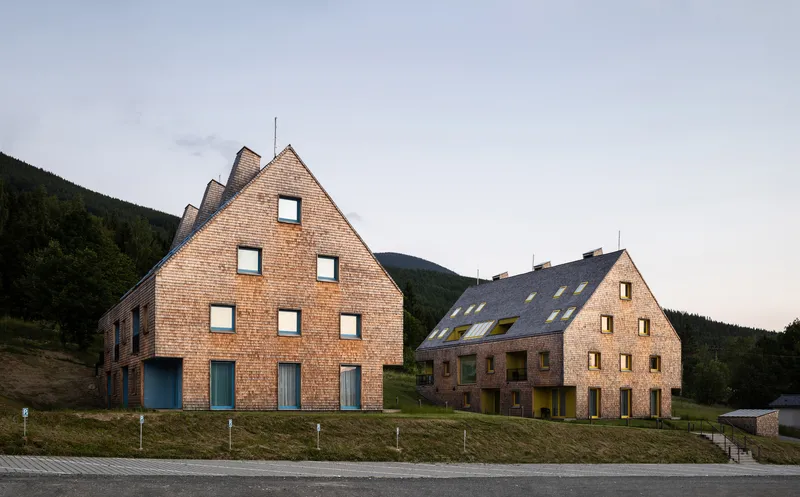
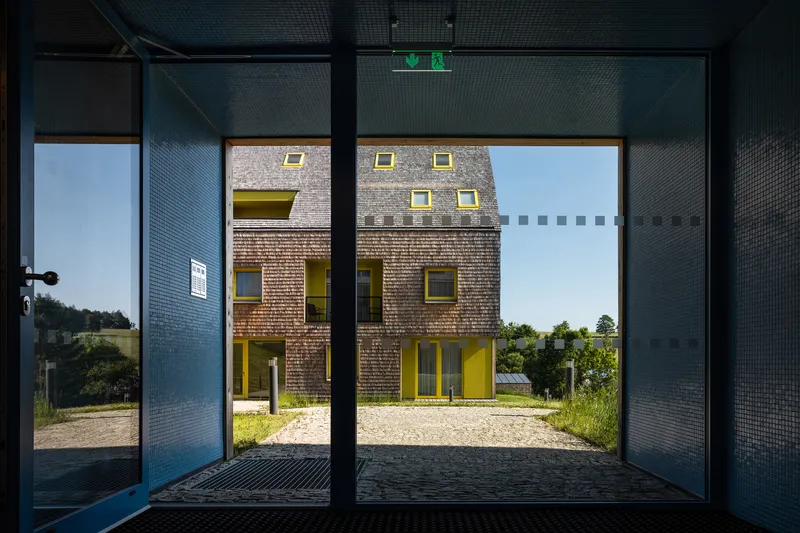
Approaching from the road at dusk, the two volumes frame a generous entrance courtyard defined in part by dark mesh screens that filter the view before revealing the shingle facades and colored window reveals beyond. The mesh acts as a semi-permeable threshold, signaling arrival without creating a hard boundary. It is a subtle move that gives the complex a sense of enclosure appropriate to a residential address without mimicking suburban gatedness.
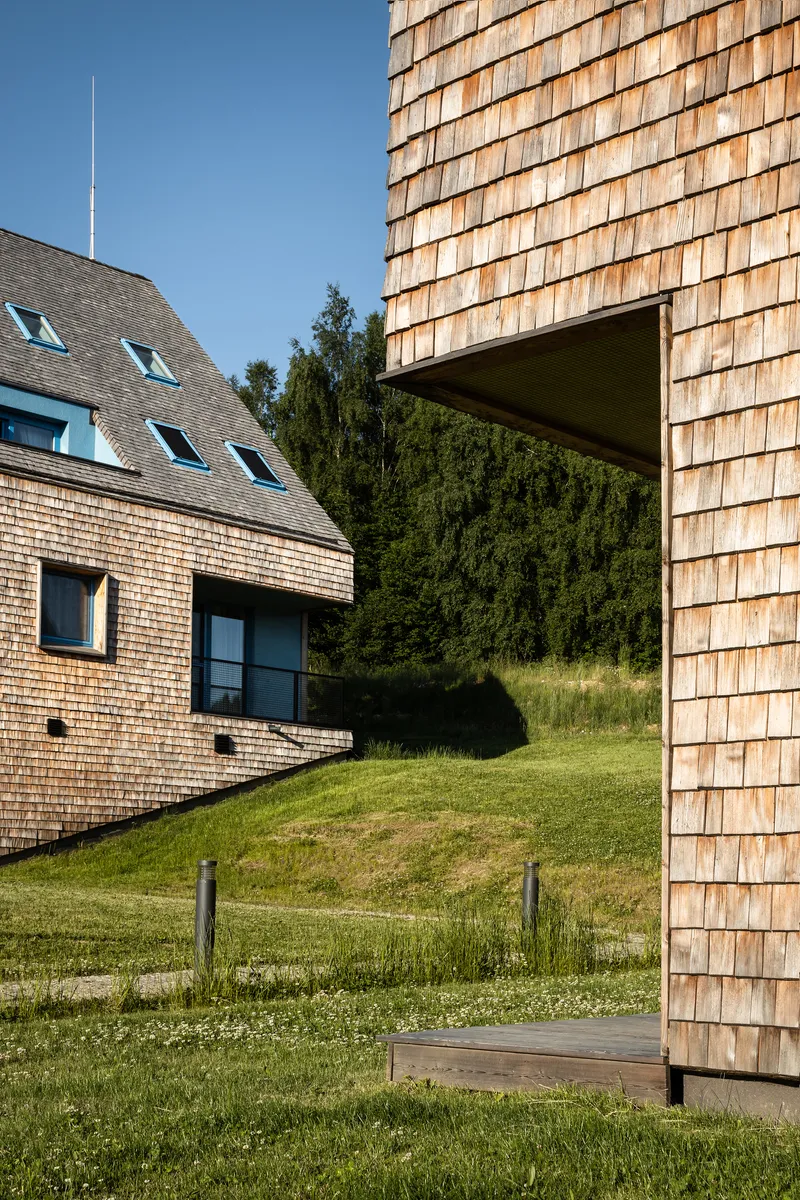
The site slopes gently toward the forest, and the buildings are oriented to take advantage of mountain views while respecting the natural drainage patterns. Wildflower meadow is left to grow right up to the building edges, minimizing the zone of manicured landscape and letting the architecture sit directly in its terrain. A cantilevered corner on one volume extends over the mown lawn, a modest overhang that creates a covered threshold and gives the otherwise simple massing a moment of structural assertiveness.
Color as Spatial Signal
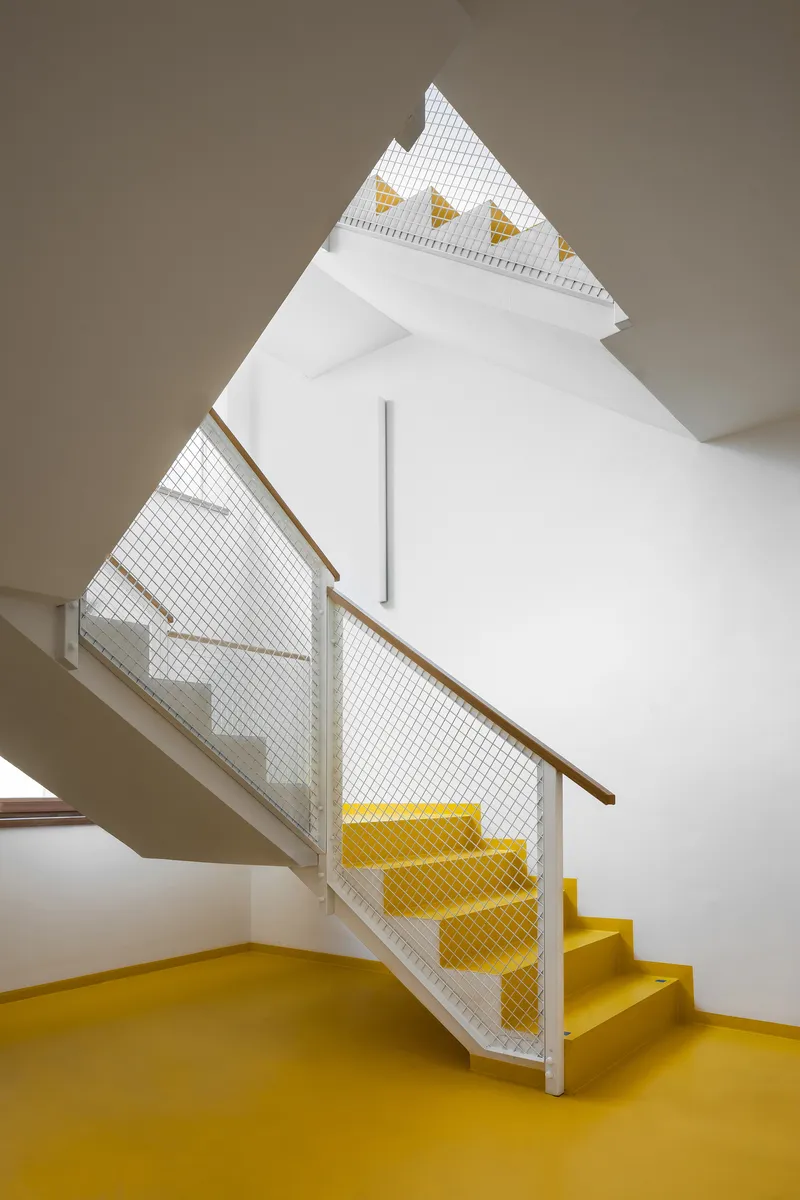
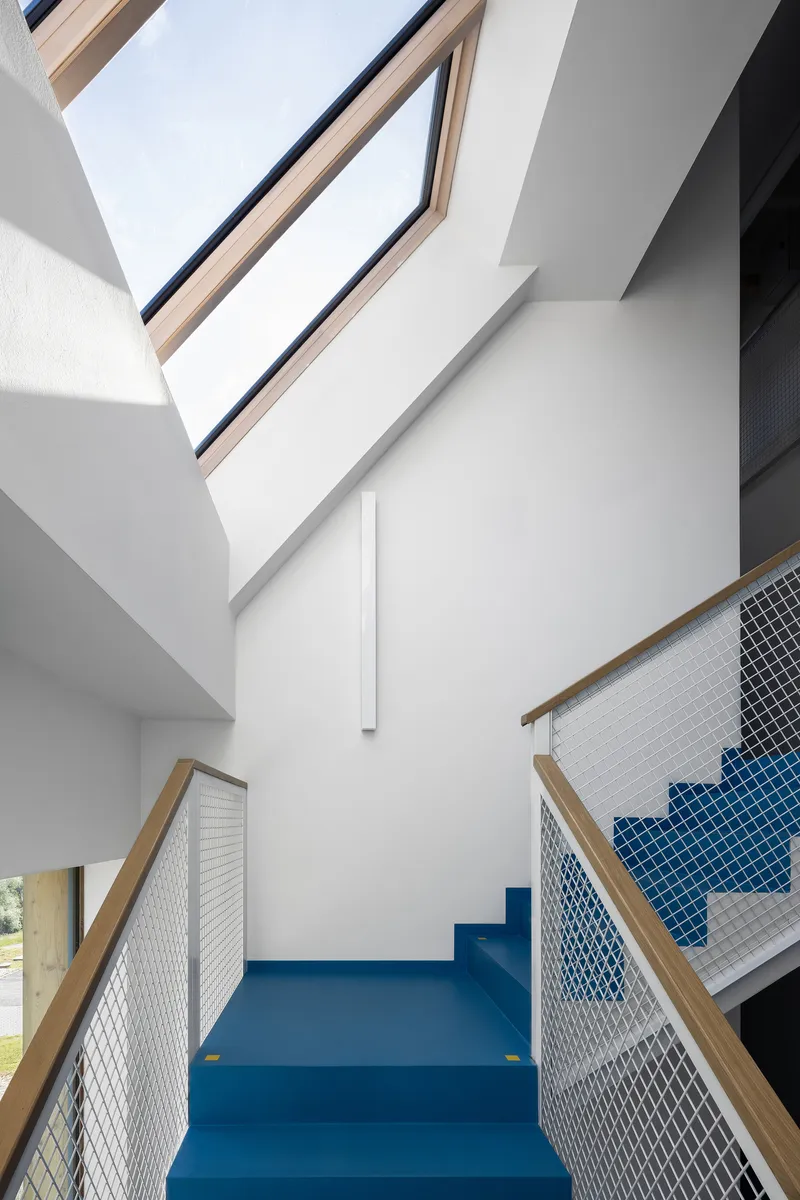
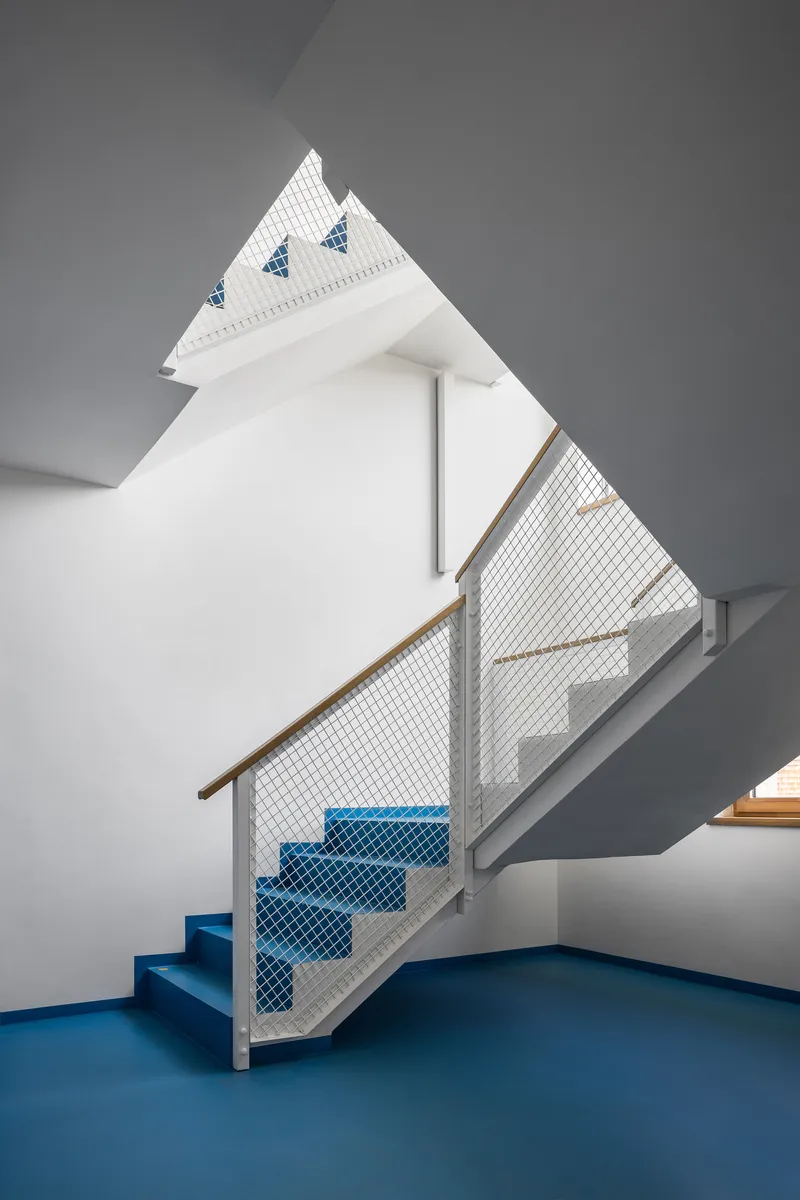
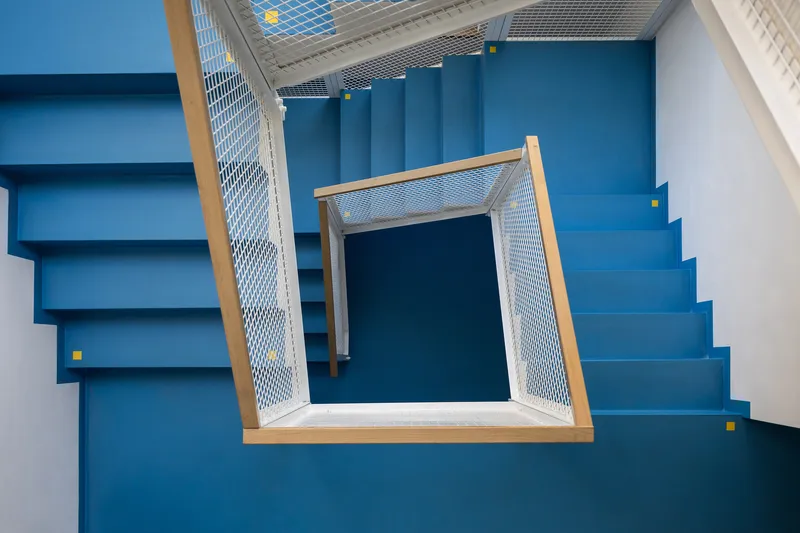
Inside, the color coding intensifies. The staircases in the blue building are finished in blue rubber or resin flooring, their treads saturated against white plaster walls and timber-framed mesh balustrades. In the yellow building, the same logic applies with yellow flooring. The effect is unexpectedly exhilarating: you enter a restrained, timber-clad exterior and find yourself climbing through a vertical shaft of color, punctuated by angled skylights that pour daylight down from the ridge.
The mesh balustrades with timber handrails are a pragmatic choice that doubles as a design move. They keep the stairwells visually open, allowing light from the peaked skylights to penetrate multiple floors. From above, looking down through the stair void, the geometry of the blue treads spiraling beneath the timber frame reads as a precise, almost graphic composition. These are common circulation spaces, but CL3 treats them as the most expressive rooms in the building.
Living with the Landscape
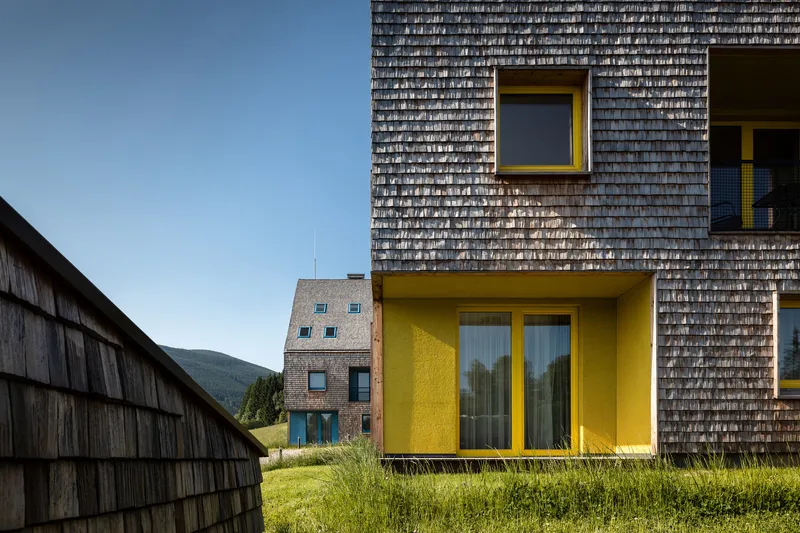
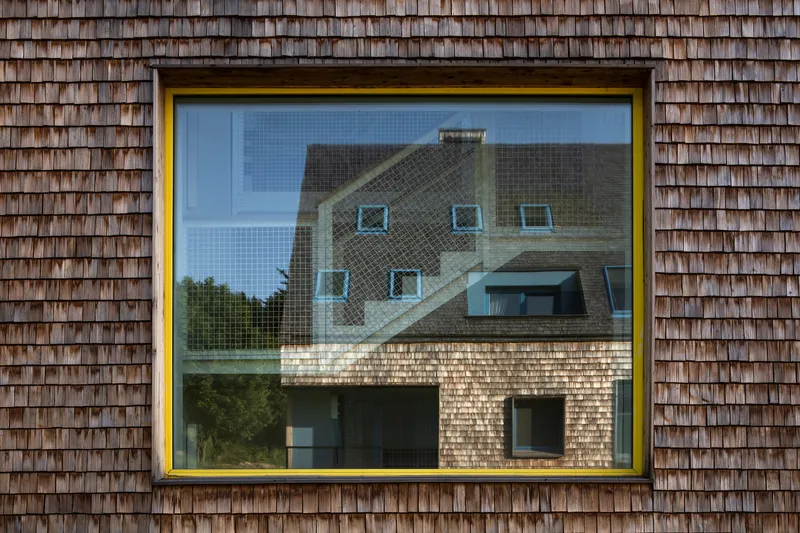
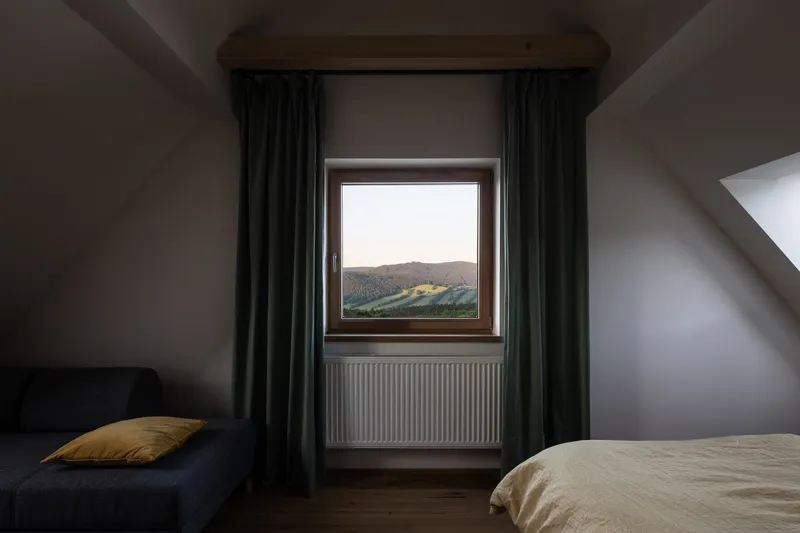
The apartments themselves open to the landscape through a combination of recessed balconies and flush windows. The yellow balcony projection on one facade, framed in timber shingles, creates a sheltered outdoor room that cantilevers just enough to clear the wall plane, offering a panoramic seat within the building's envelope. From inside, deep window reveals frame the forested hills like landscape paintings, and the decision to use wooden window profiles rather than aluminum or PVC keeps the material palette coherent from outside in.
A bedroom window at dusk, dark curtains pulled aside, offers the kind of view that justifies the entire project: nothing but rolling forest and sky, with the neighboring shingle-clad volume visible as a companion rather than an obstruction. The adjacency of the two buildings is carefully calibrated so that they provide visual company without compromising privacy, a balance that many denser housing schemes struggle to achieve.
Dusk and the Disappearing Facade
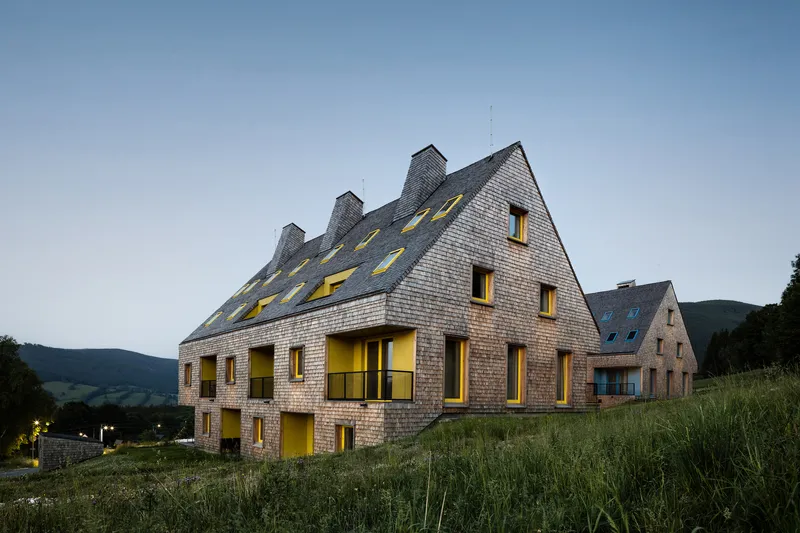
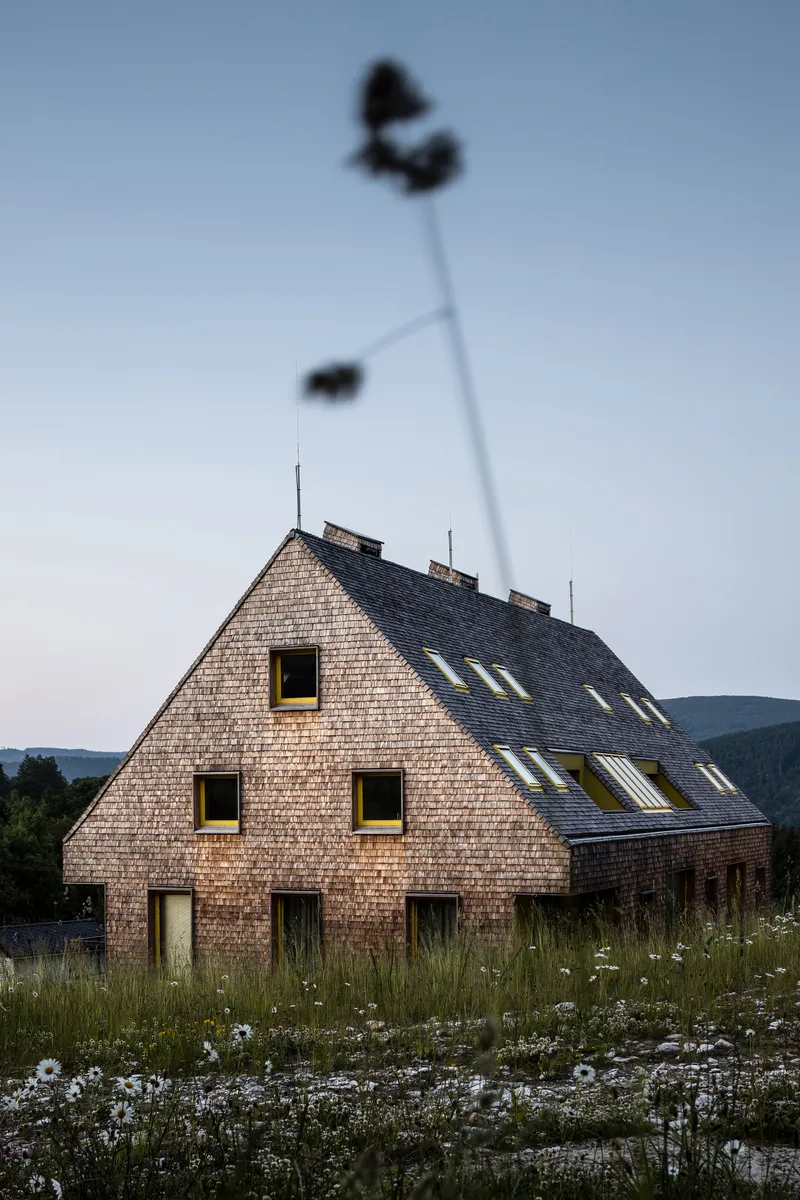
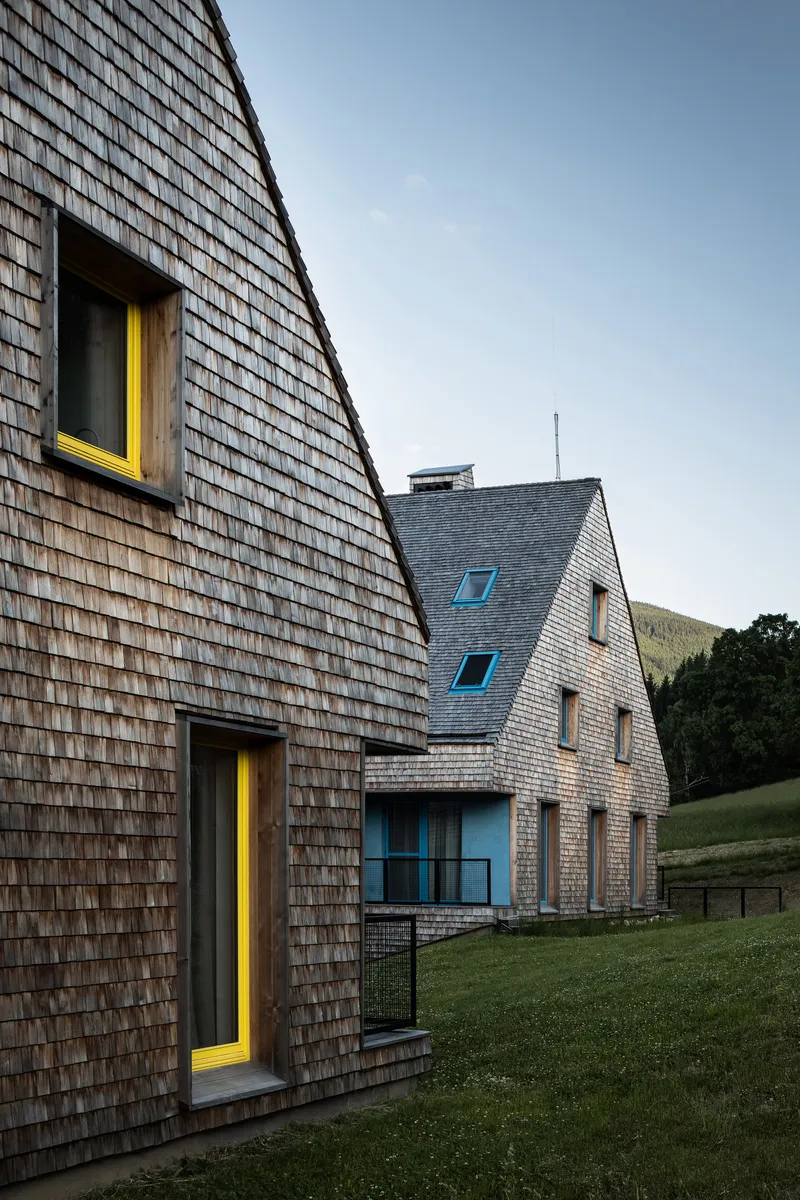
The buildings are at their most compelling at twilight. As natural light fades, the dark shingle surfaces absorb into the surrounding landscape while the colored window frames and loggias begin to glow from interior lighting. The architecture oscillates between solidity and transparency, between the heavy rustic mass of the shingled gable and the delicate lantern effect of the illuminated openings. A tall floodlight tower beside one building, practical for a site adjacent to ski slopes, punctuates the composition like an exclamation mark.
Over time, as the larch darkens from golden to silver-grey to near-black, this twilight transformation will only deepen. The design anticipates its own aging, treating material weathering not as decay but as convergence with the palette of the highland landscape. It is a long-term strategy that very few contemporary housing projects bother to consider.
Roof and Section
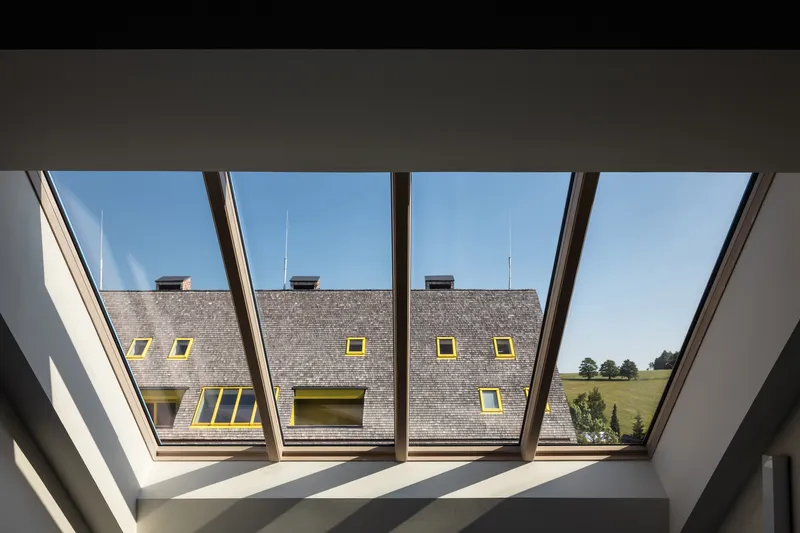
Looking through the angled roof windows, you catch the grey shingle roof and yellow-trimmed dormers of the neighboring volume, a composed view that underscores the architects' attention to the relationship between the two buildings at every level, including from inside the roof apartments. The dormers and skylights are not afterthoughts; they are the primary devices for bringing daylight into the upper floors, and their placement on the roof surface creates a rhythm that enlivens what could otherwise be an inert expanse of shingle.
Plans and Drawings
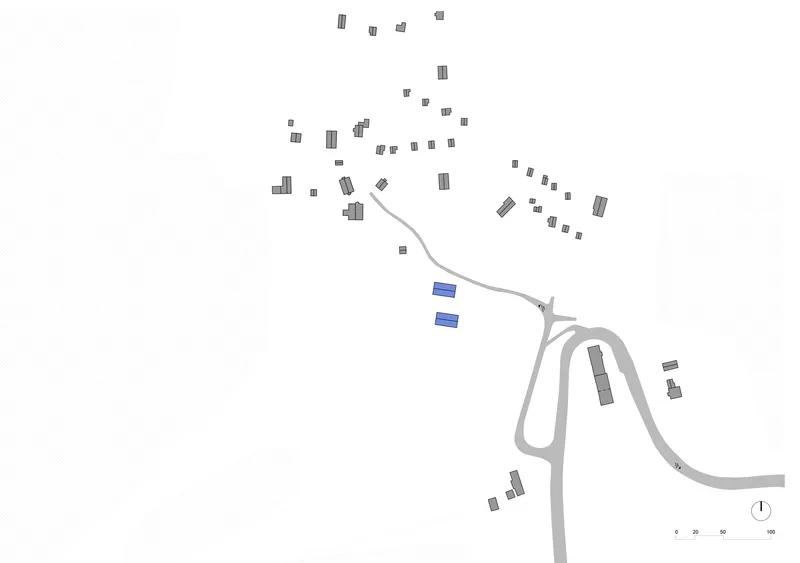

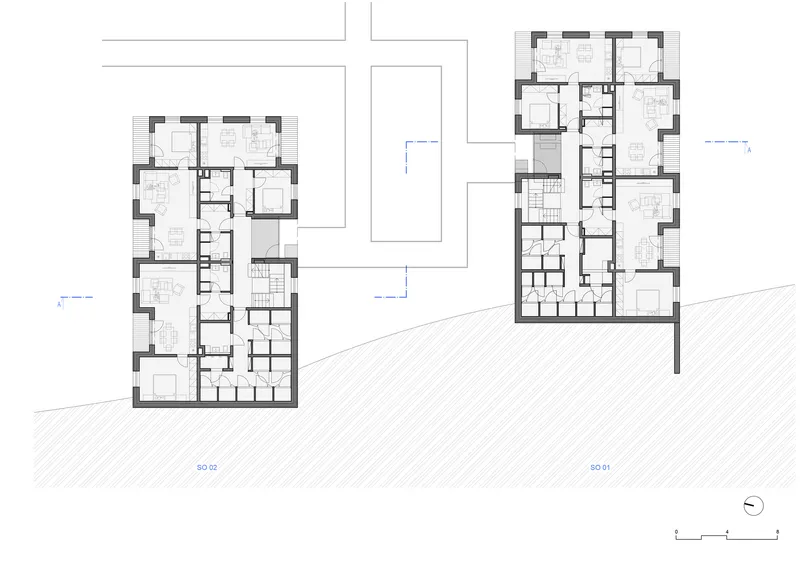
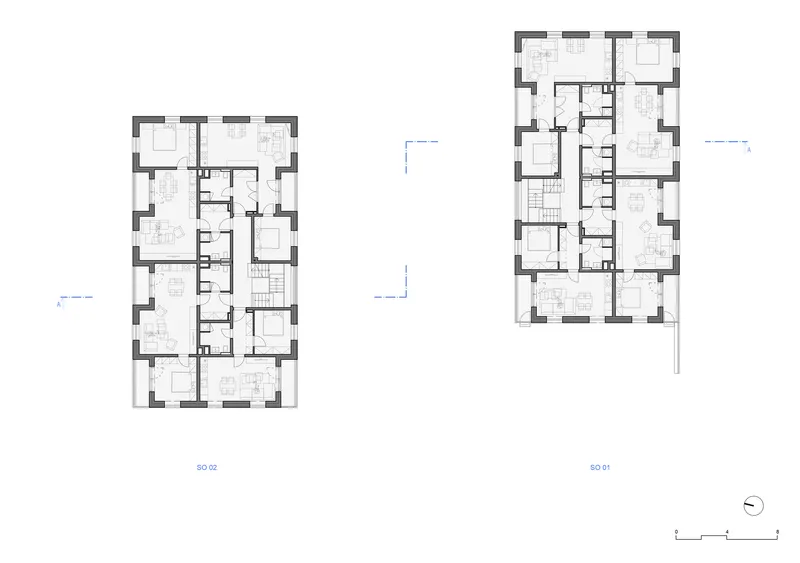
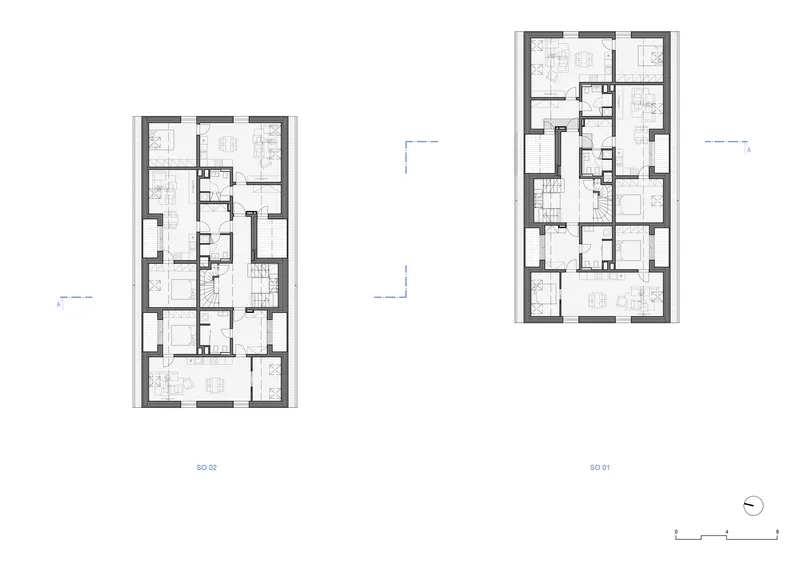
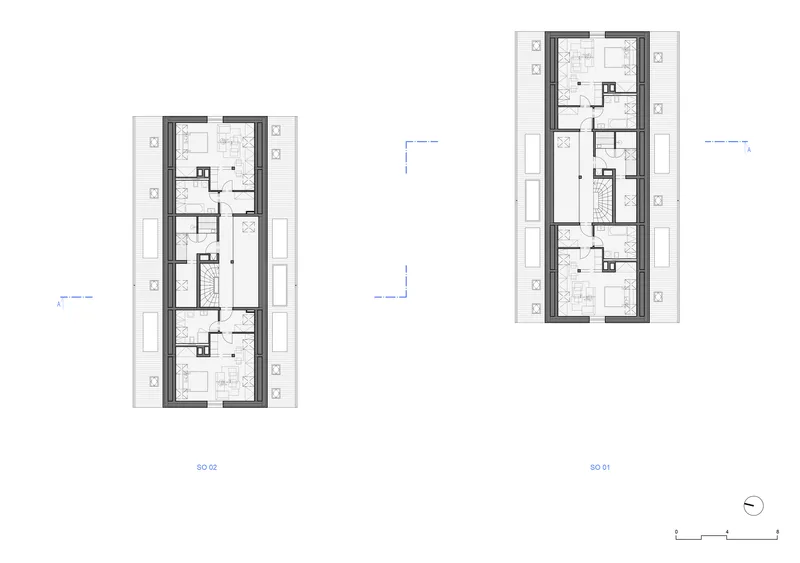
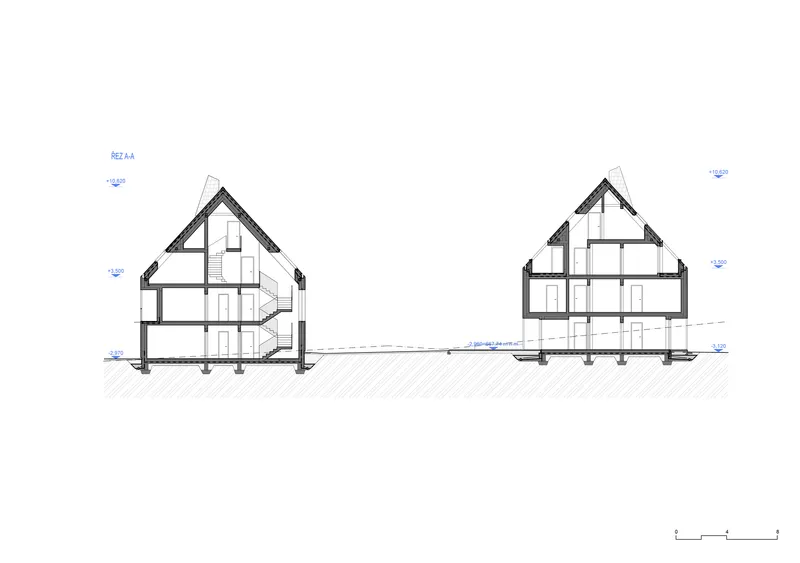
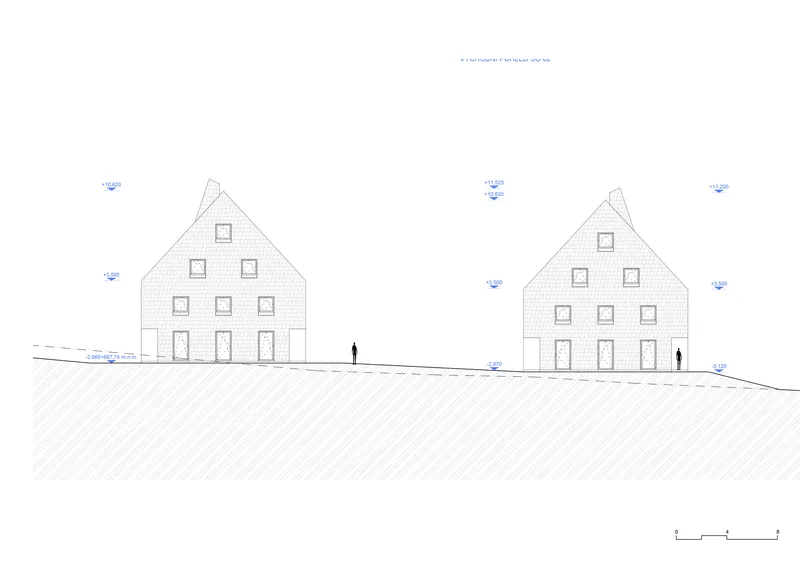

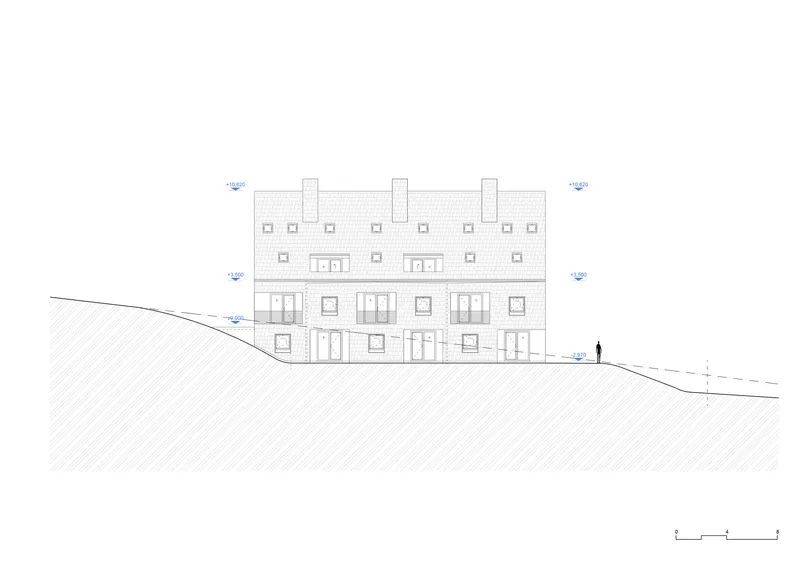
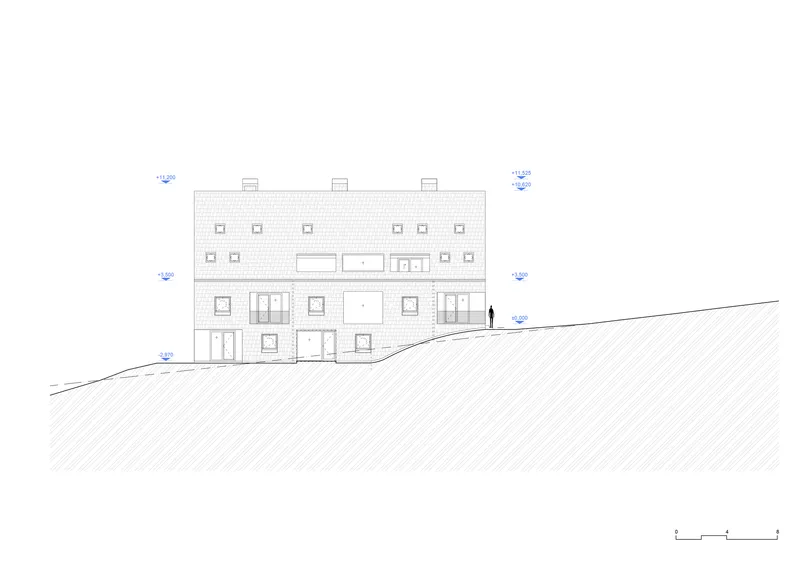
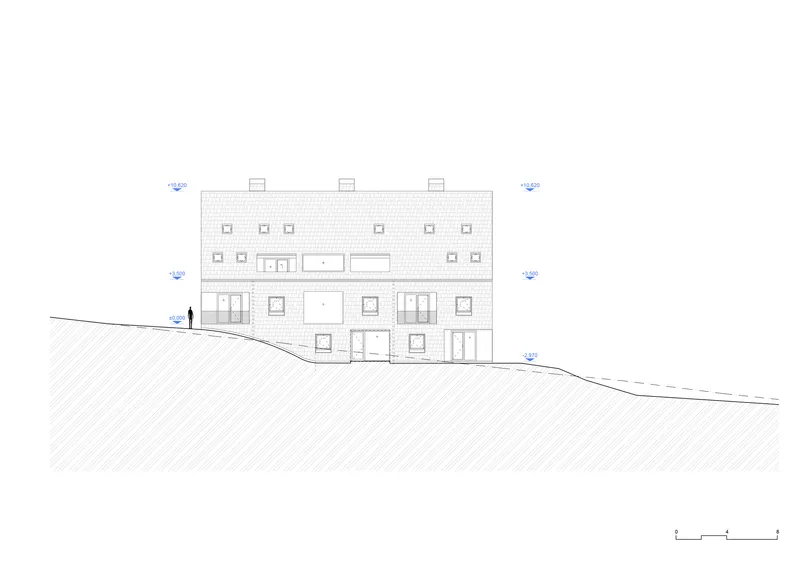
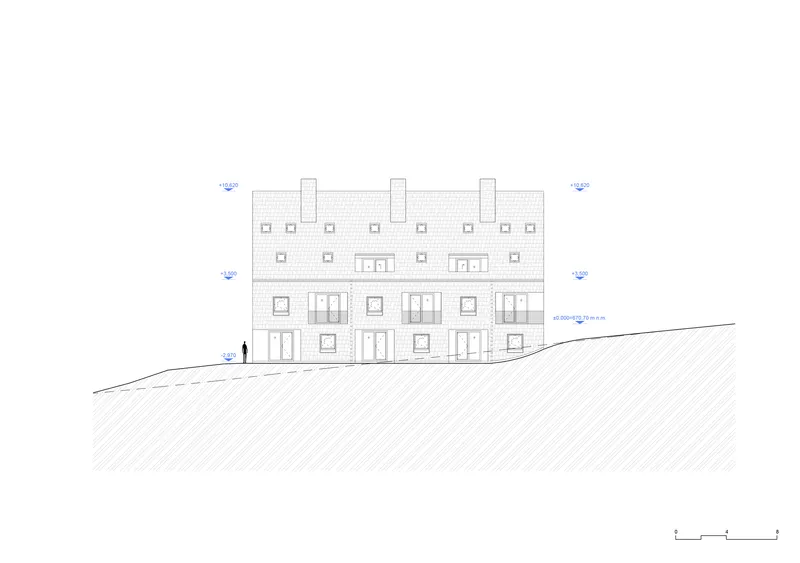
The site plan reveals the project's relationship to the scattered village fabric of Filipovice: the two buildings sit at a slight angle to the curved road, following the contour of the slope rather than the geometry of the street grid. The floor plans show efficient multi-unit layouts organized around central stairwells, with thick perimeter walls (the sand-lime brick and concrete hybrid) and recessed balconies along the exterior facades. Each floor accommodates several apartments, their rooms arranged to maximize frontage and views.
The sections are perhaps the most revealing drawings. They show the full height of the gable exploited for living space, with the stairwell rising through the center of each building to meet the peaked skylight at the ridge. The structural logic is clear: wooden rafters form the gable roof, sitting on the concrete and masonry box below. The elevations confirm the disciplined window grid, the dormer rhythm, and the continuous shingle envelope wrapping from wall to roof. Standing figures at grade provide scale and remind you that these are, at heart, modest buildings doing ambitious work quietly.
Why This Project Matters
Apartments Filipovice is a case study in how to build housing in a sensitive landscape without either capitulating to pastiche or imposing metropolitan aesthetics on a rural site. CL3 studio's strategy of translating rather than copying the regional vernacular produces buildings that feel genuinely rooted while being unmistakably contemporary. The colored glass mosaic, the mesh stairwells, the cantilevered balconies: these are not nostalgic gestures. They are modern interventions calibrated to coexist with larch shingles and steep gables.
The project's near-autonomous infrastructure, relying on groundwater, on-site sewage treatment, and heat pumps, demonstrates that sustainable servicing in rural contexts need not result in buildings that look like science experiments. Here, the green technology is invisible, tucked behind a facade that speaks the language of place. As highland communities across Central Europe face pressure from tourism development and second-home construction, Filipovice offers a persuasive model: density delivered with care, modernity worn lightly, and a material strategy that will only improve with age.
Apartments Filipovice by CL3 studio, Bělá pod Pradědem, Czechia. Gross floor area approximately 2,240 m² across two buildings on a 2,375 m² site. Completed 2020. Photography by Tomáš Slavík.
About the Studio
Share Your Own Work on uni.xyz
If projects like this are the kind of work you want to make, uni.xyz is a place to publish your own, find collaborators, and enter design competitions.


Popular Articles
Popular articles from the community


Co-life: Sustainable Architecture for Age-Friendly Community Living
Co-life reimagines sustainable architecture for seniors through courtyards, rammed earth, shared gardens, and spaces designed for belonging.

The Musturak Paradise: Senior Living Architecture for a Connected Future in Temara, Morocco
The Musturak Paradise reimagines senior living architecture in Temara via private homes, social spaces, culture, community, and shared care.

Lunar Spiral: Space Architecture Shaped by the Mathematics of the Universe
Lunar Spiral reimagines space architecture through Fibonacci geometry, lunar regolith, levitating habitats, and self-sustaining Moon living.

Hill & Cross Opera: Sculptural Opera House Architecture Shaped by Tallinn’s Landscape and Identity
Hill & Cross Opera reimagines opera house architecture in Tallinn through its sculptural hill, civic plaza, glass wave and a luminous cross.

Similar Reads
You might also enjoy these articles

Bao Huynh Watercolor Atelier: A Serene Art Retreat in Hội An
Bao Huynh Watercolor Atelier in Hội An blends multifunctional art spaces, sustainable design, local materials, and family-friendly living in a serene environment.

Atelier Macri Concept Store Interior Design by CASE-REAL
Atelier Macri store features a "ko" counter, walnut wood details, cork displays, blending retail, gallery, and seamless customer experiences.

Manuel Vargas Izquierdo Stadium and High-Performance Sports Center: Architectural Excellence in Jalpa de Méndez
The Manuel Vargas Izquierdo Stadium blends sustainable design, inclusive sports facilities, and cultural-inspired architecture, revitalizing Jalpa de Méndez’s public spaces.

KAKR Buluh Awar Hall: Revitalizing Community and Ecology Through Bamboo Architecture
Community built bamboo hall revitalizes Buluh Awar village, empowering youth, restoring ecology, celebrating vernacular craftsmanship through sustainable architecture and culture.

Explore Apartments Competitions
Discover active competitions in this discipline

Challenge to reimagine the Iron Throne

Photograph architecture without architects

Illustrate the lost glory of Angkor Wat - Render Challenge

Design challenge to reuse E-waste
Comments (0)
Please login or sign up to add comments
No comments yet. Be the first to comment!