
CLOUD ARCHITECTS Splits a Kobe Hillside into Terraced Volumes for Living and Working
A 115-square-meter hybrid of residence and studio navigates a 5.5-meter slope between an arterial road and a quiet neighborhood street.


Most architect-designed live-work buildings treat the two programs as stacked layers or mirrored halves. Cloud Terrace, designed by CLOUD ARCHITECTS lead architect Masato Kawakami for his own practice and home in Kobe, takes a different route. The site sits between two radically different street conditions: a 26-meter-wide arterial road lined with commercial buildings to the south, and a 6-meter-wide residential lane to the north. Between those two edges, the ground drops roughly 5.5 meters over a slope of about 30 degrees. Rather than leveling the terrain and building one box, Kawakami broke the program into separate corrugated metal volumes and let the hillside do the organizing.
What results is a sectional building that reads more like a terraced garden than a conventional mixed-use structure. Workspace, living areas, sleeping lofts, and rooftop terraces step up and down the slope, connected by generous plywood stairs that double as storage furniture and reading nooks. At 115 square meters, the project is modest in footprint but spatially ambitious, using every vertical meter the topography provides. It is a convincing argument that the most productive constraint an architect can accept is an awkward site.
Two Streets, Two Faces
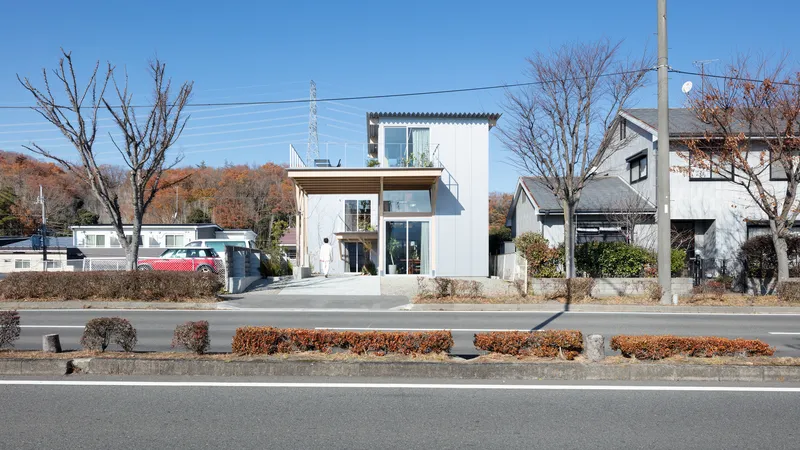
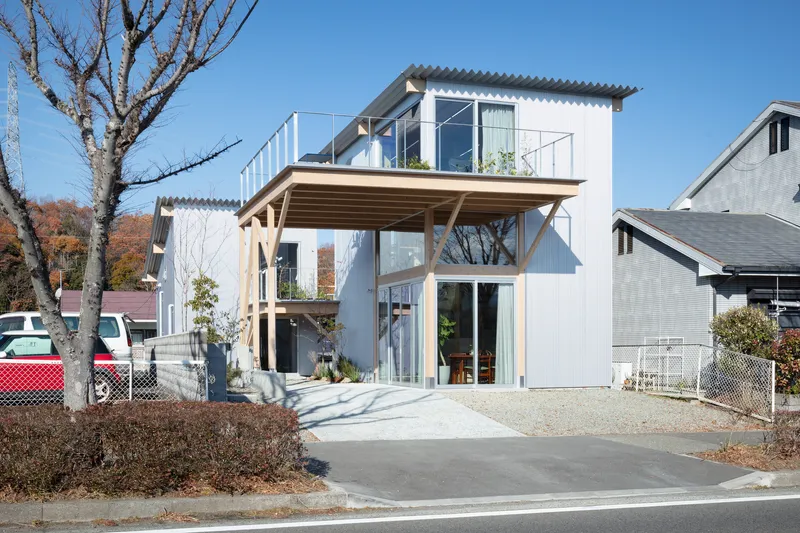
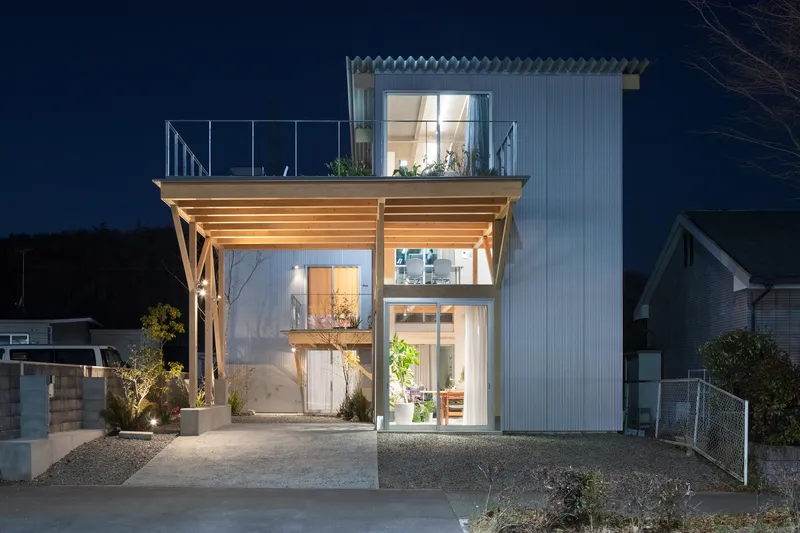
From the south, Cloud Terrace presents a quiet white corrugated metal wall to the wide arterial road. There is no showmanship on this side, just the calm anonymity of a building that knows it is not competing with the scale of the commercial strip. Walk around to the north, and the personality shifts completely. The timber structural frame is fully exposed, supporting an upper terrace and roof overhang that project outward toward the residential street. At night, the floor-to-ceiling glazing turns the facade into a lantern, revealing the skeletal logic of the timber trusses.
The contrast is deliberate. Kawakami uses corrugated metal as a privacy shield on the commercial side and exposed timber as a social gesture on the neighborhood side. It is a simple move, but it gives a 115-square-meter building two distinct identities without resorting to formal gymnastics.
Negotiating the Slope
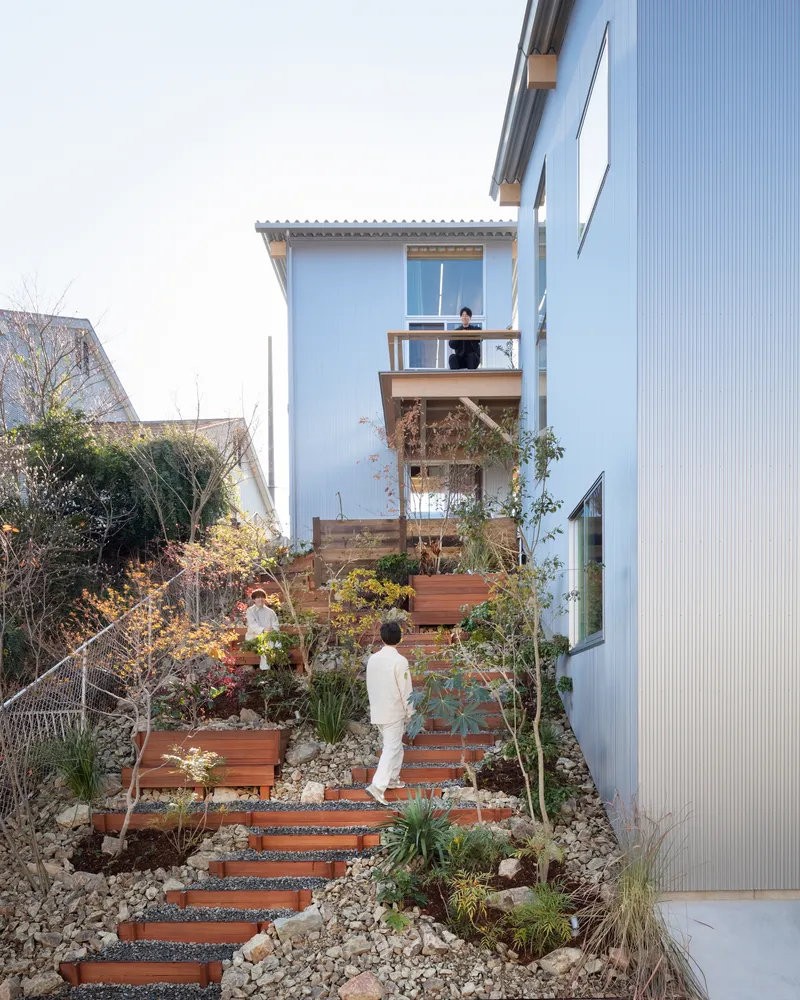
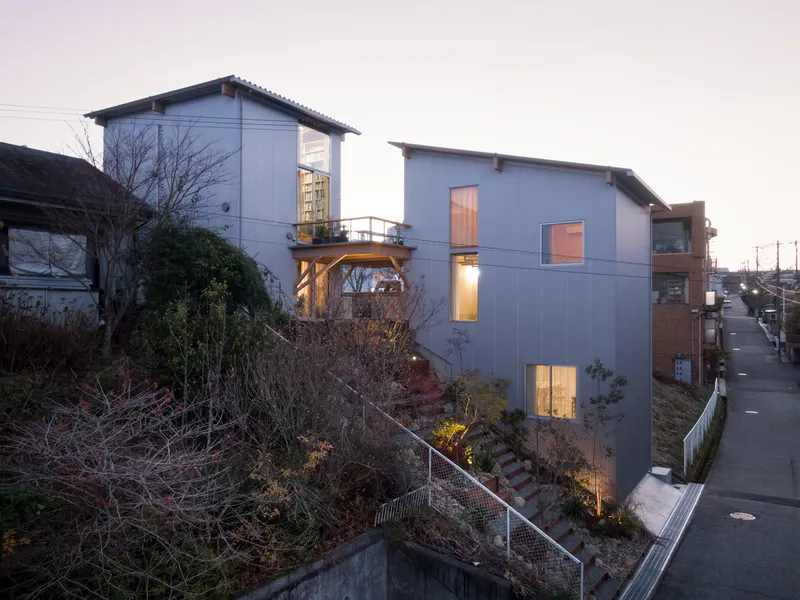
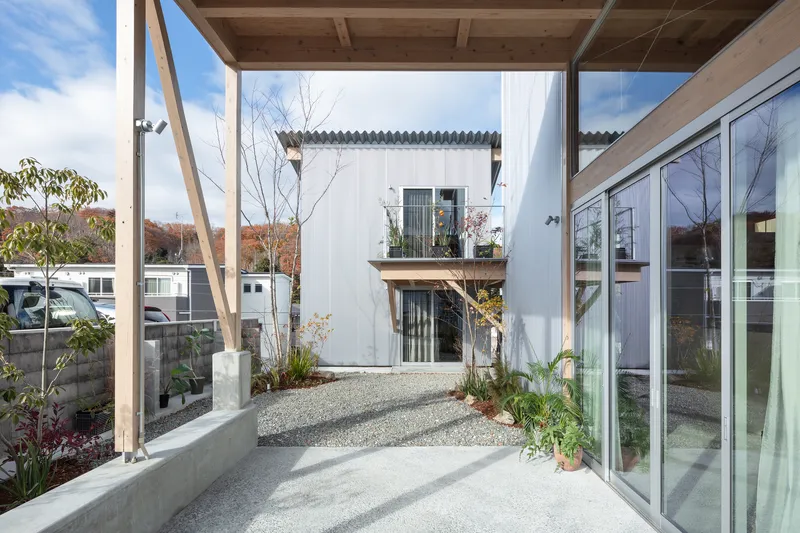
The hillside is not just tolerated here; it is the project's primary material. The southern half of the site is flat, and the northern half rises steeply. Rather than a single retaining wall and a flat pad, the building breaks into volumes that follow the grade, connected by outdoor stairs threaded through gravel beds and young plantings. Walking between the two parts of the building means walking through the landscape, ascending the planted hillside on timber-tread paths.
At dusk, the corrugated facades glow from within, and the stepped massing reads almost like a cluster of small sheds scattered across a slope. The strategy avoids the monolithic bulk that would be out of place on a residential lane, and it gives the occupants a constant awareness of the ground beneath them, which changes character from pavement to gravel to soil as you move uphill.
The Gravel Courtyard as a Hinge
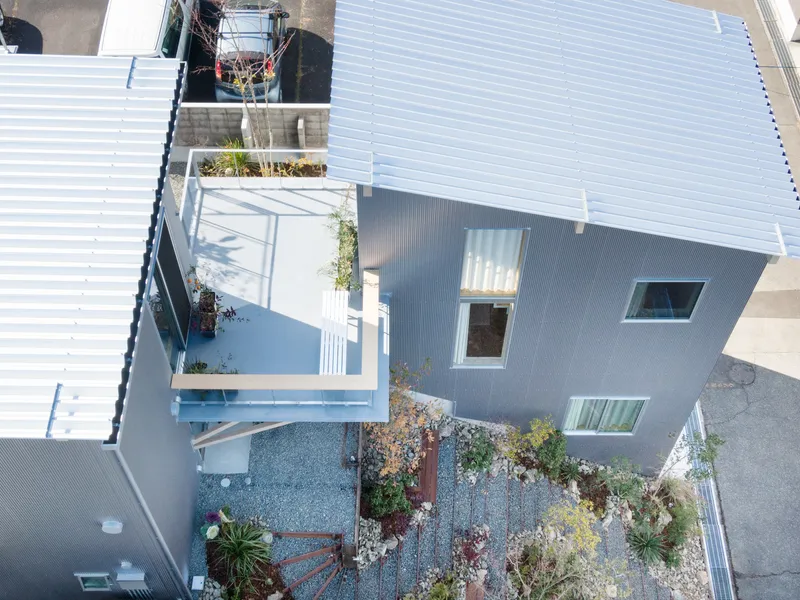
Between the corrugated volumes, a flat gravel courtyard with a concrete planter bed acts as the project's hinge. It is neither fully indoors nor fully landscaped. Scattered vegetation and loose stone give it the feel of a dry garden, a decompression space between work and domestic life. The courtyard also introduces daylight and air deep into the plan, preventing the kind of dark interior corridors that small split-level buildings tend to produce.
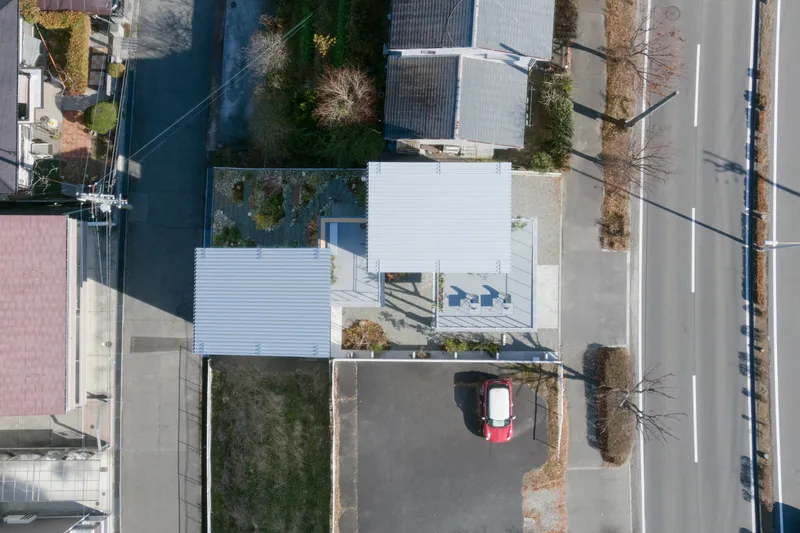
Seen from above, the courtyard clarifies the building's organization: two metal-clad roofs flanking an open ground, with a small roof terrace popping up at the high point. It is a diagram that reads cleanly from the air but dissolves into a sequence of intimate moments at ground level.
Stairs as Furniture
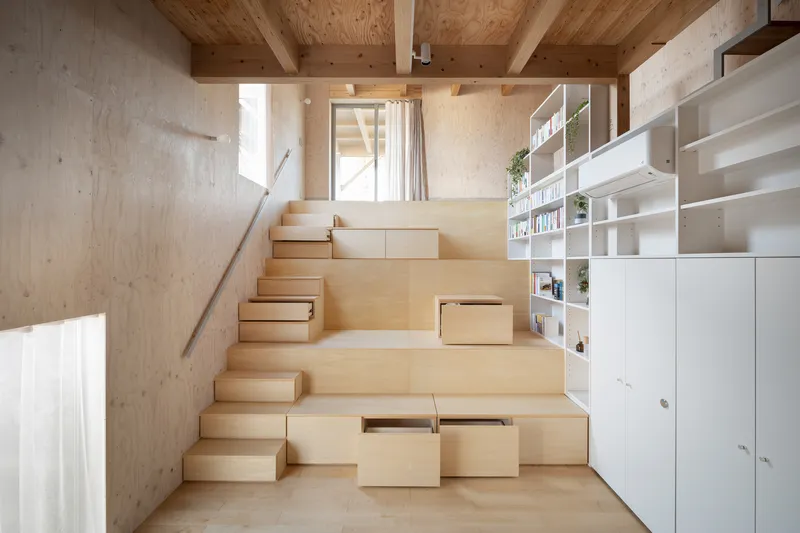
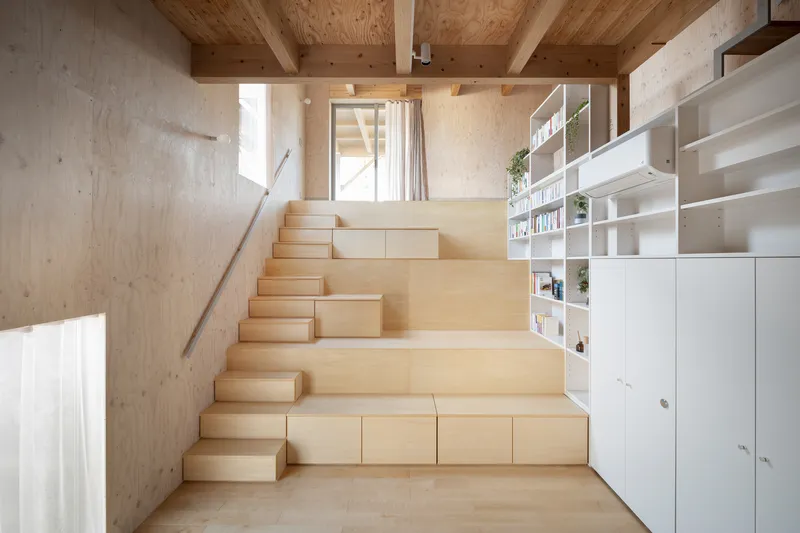
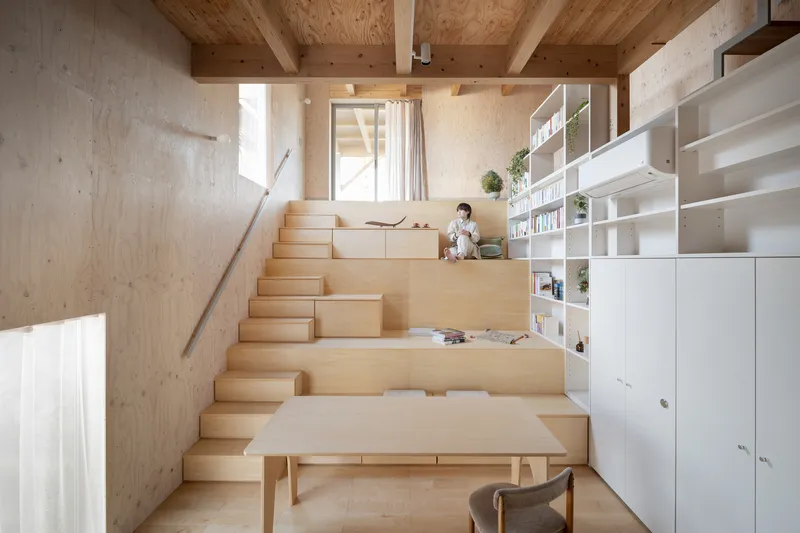
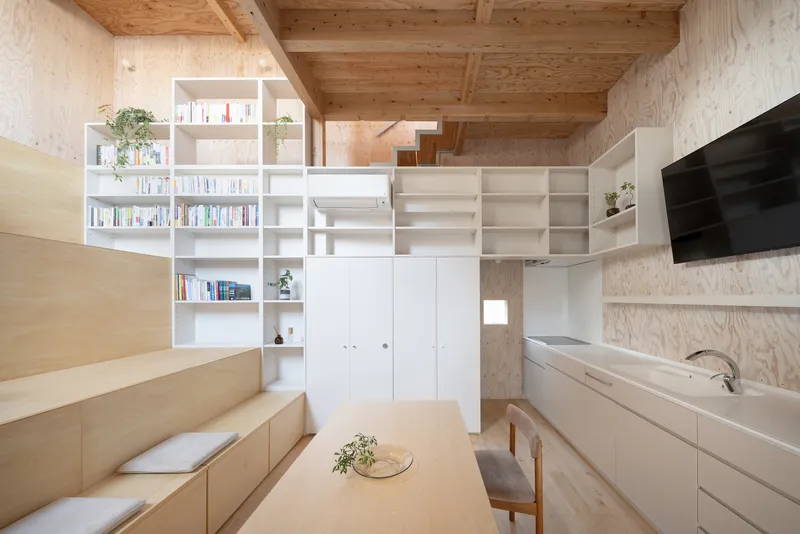
With a 5.5-meter height difference to traverse in a compact building, stairs are not just circulation; they are the dominant interior element. Kawakami treats them accordingly. Wide plywood treads integrate pull-out storage drawers beneath each step, turning the staircase into a cabinet. White shelving walls line one side, creating a library condition along the ascent. The treads are deep enough to sit on, and the captions tell us someone does: a figure reads comfortably on the stepped seating near potted plants.
The decision to make stairs thick and inhabitable rather than thin and efficient is what saves the project from feeling cramped. In a 115-square-meter building that spans multiple levels, a conventional stair would eat floor area without giving anything back. Here, the stair is simultaneously storage, seating, bookshelf, and living room. It collapses program layers into a single piece of architecture.
Vertical Living Under Timber Frames
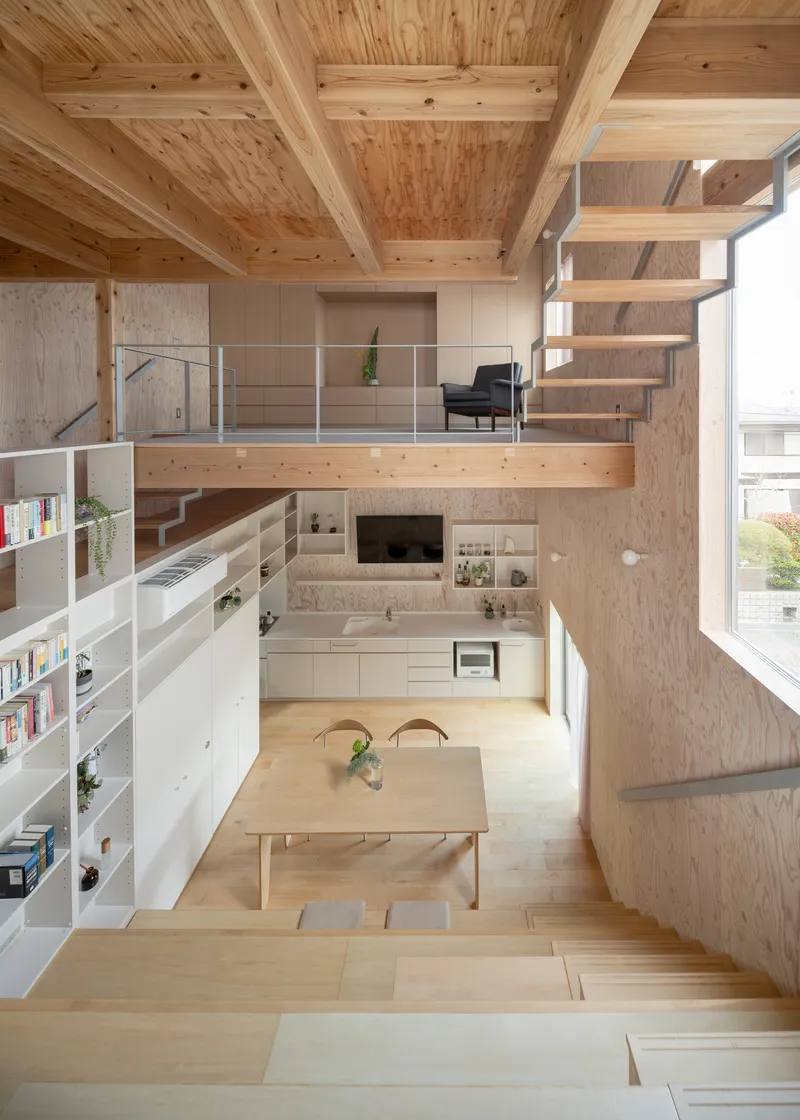
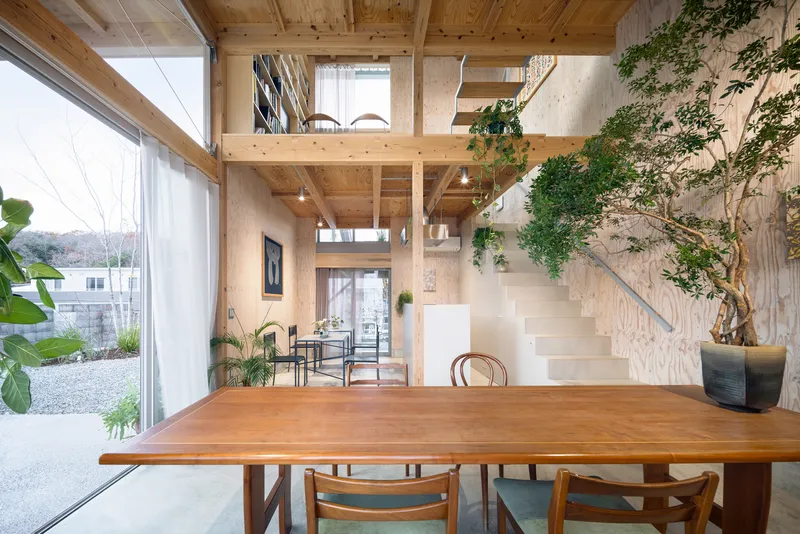
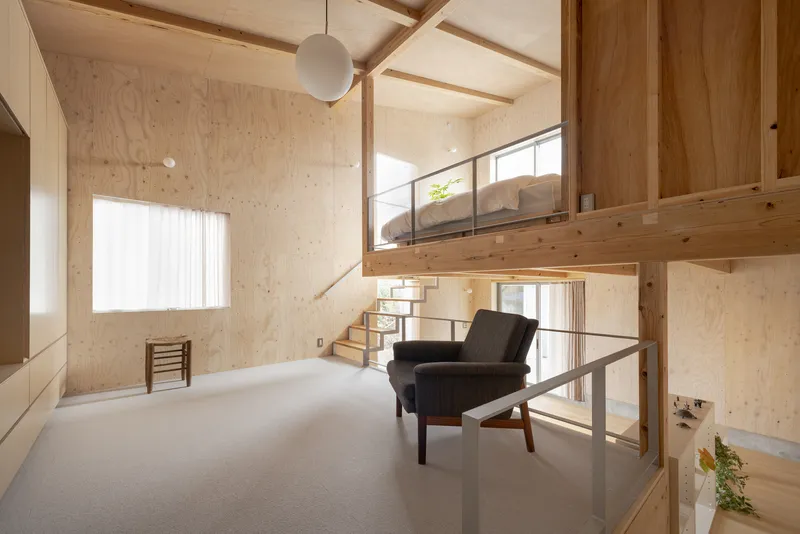
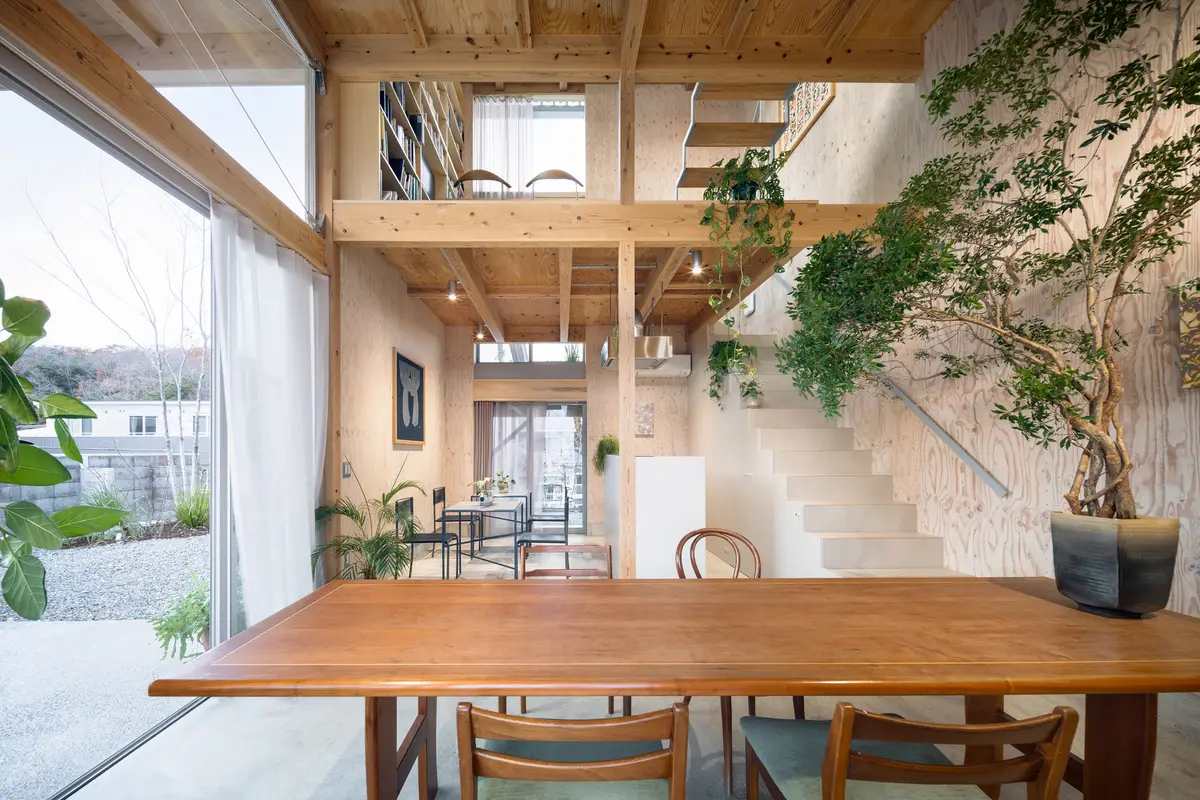
The interior sections reveal a double-height and even triple-height condition that belies the building's small footprint. Exposed timber beams run overhead, and the plywood-lined walls give the spaces a warm, workshop quality. A mezzanine accessed by open treads hovers within the larger volume, adding usable area without closing off the vertical dimension. The sleeping loft, with its platform bed and timber slat screen, perches above an open landing, borrowing light and air from the full-height space below.
There is a material discipline at work. Plywood, timber, corrugated metal, and glass: the palette is short. By keeping the finishes raw and the structure visible, Kawakami makes a small building feel legible. You can trace every beam and understand where loads travel. For an architect's own studio, that transparency is fitting. The building is its own pedagogical tool.
Workspace, Kitchen, and the In-Between
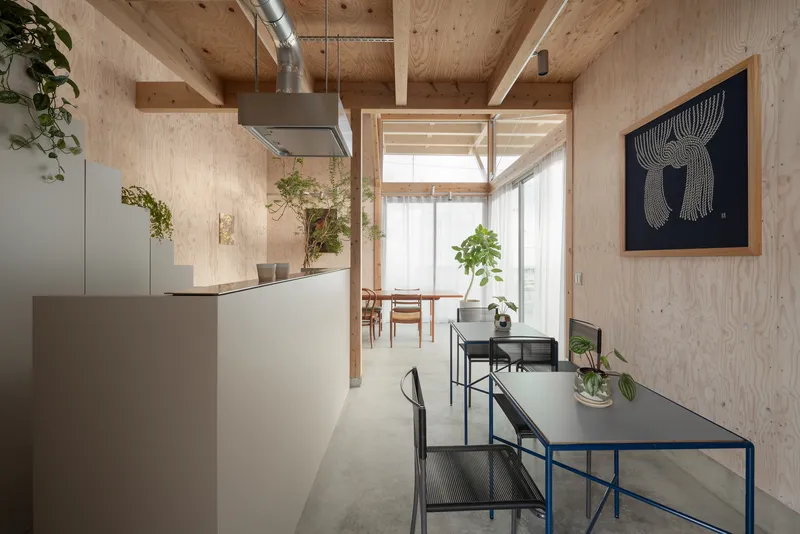
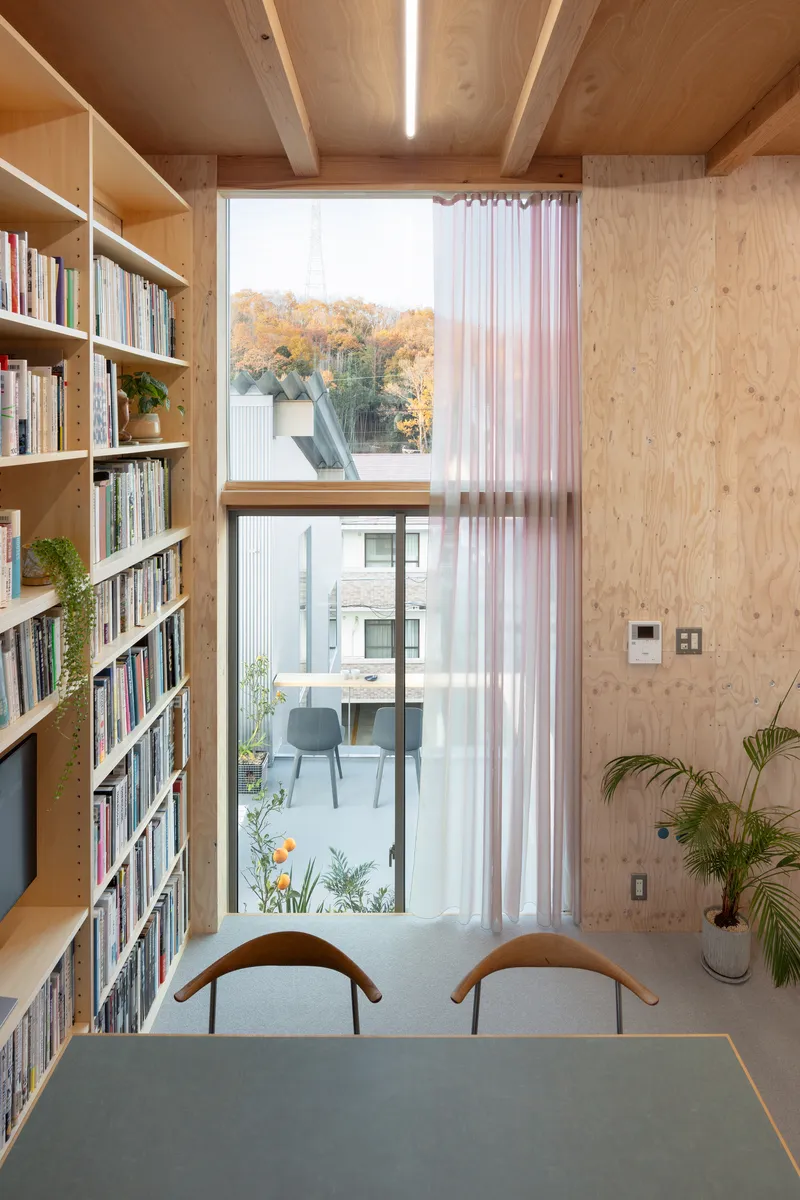
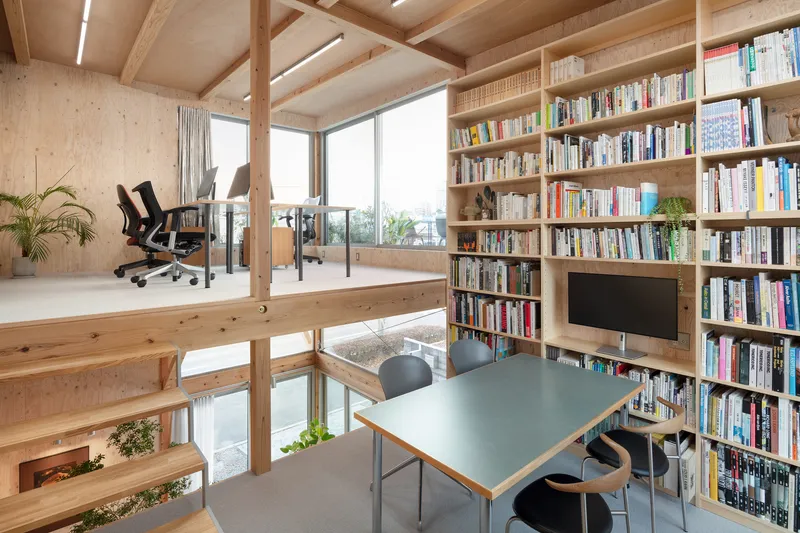
The open-plan kitchen and dining area sit beneath the timber ceiling beams, with a stainless steel range hood marking the cooking zone. Potted plants soften the edges. Nearby, a study nook lined with floor-to-ceiling bookshelves faces a full-height window overlooking autumn foliage, creating the kind of focused workspace that architects dream about and rarely build for themselves. At the mezzanine level, a second workspace backs up against a full bookshelf wall, with views through the timber frame down to the lower level.
The boundaries between office and home are permeable but legible. You know when you are in the work zone and when you are in the kitchen, not because of walls or doors, but because of level changes, ceiling heights, and orientation. It is a spatial negotiation rather than a partition strategy, and it works because the section is so richly varied.
Rooftop and Elevated Terraces
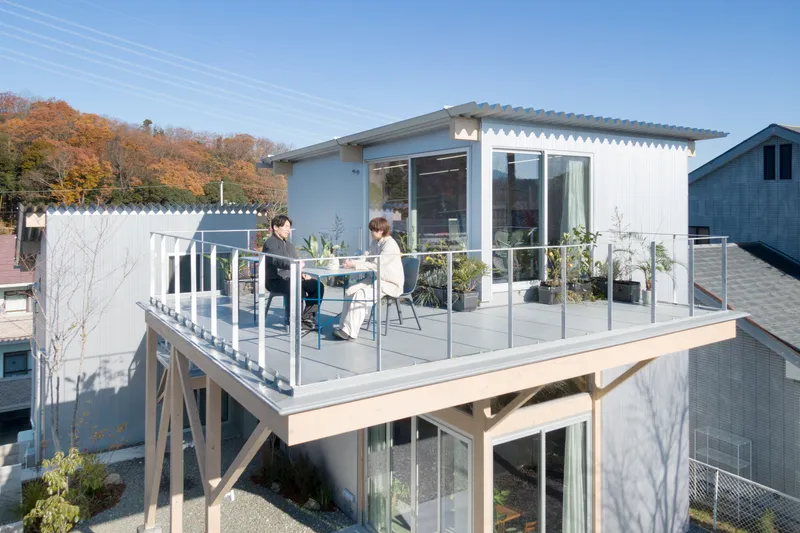
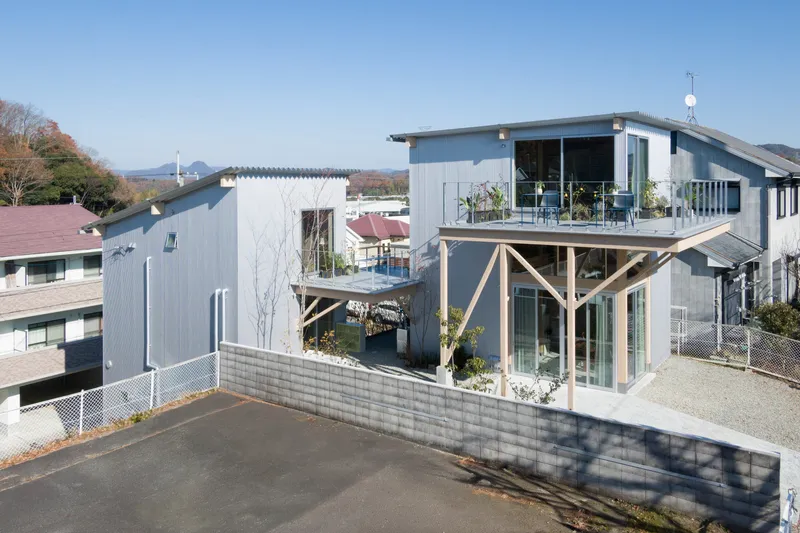
At the top of the slope, a rooftop terrace with glass railings and corrugated metal siding captures sunlight and views over the neighborhood. Two figures sit in deck chairs, surveying the roofscape. Below, a second elevated terrace takes advantage of the hillside exposure. These outdoor spaces are not afterthoughts or leftover roof area. They are deliberate extensions of the living and working zones, calibrated to take advantage of the slope's gift: unobstructed southern exposure at the high point, sheltered enclosure at the base.
The aerial images confirm that the terraces, gravel courtyard, and roof garden form a continuous outdoor system that is proportionally generous for a building this size. Nearly half of the site is given over to open-air occupation. In a dense suburban context, that is a significant commitment, and it prevents Cloud Terrace from becoming just another compact volume maxing out its lot coverage.
Structural Expression at Night
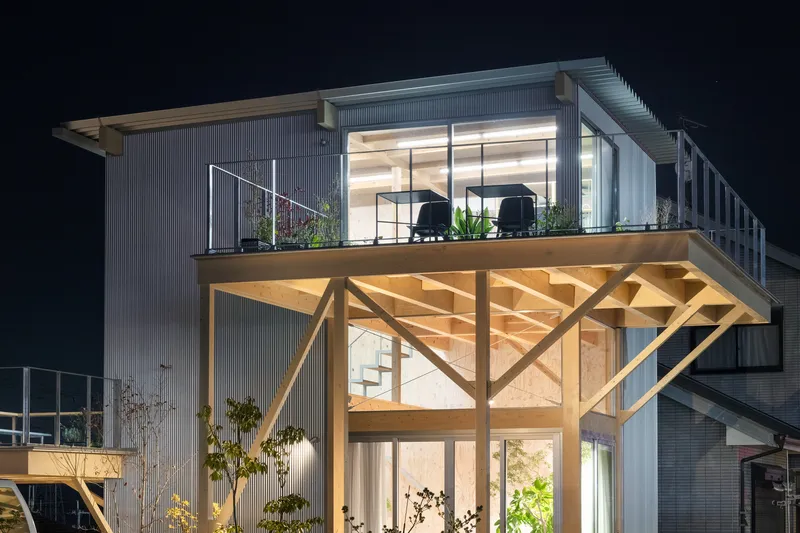
After dark, the building's wood-and-steel hybrid structure comes into sharp relief. The close-up of the exposed timber truss supporting the upper deck shows the craft clearly: thick members joined with steel hardware, spanning generously to create the deep overhangs that protect the terraces. The night view is the most architecturally revealing image of the project. It strips away the corrugated cladding's visual dominance and foregrounds the skeleton, the real protagonist.
Plans and Drawings
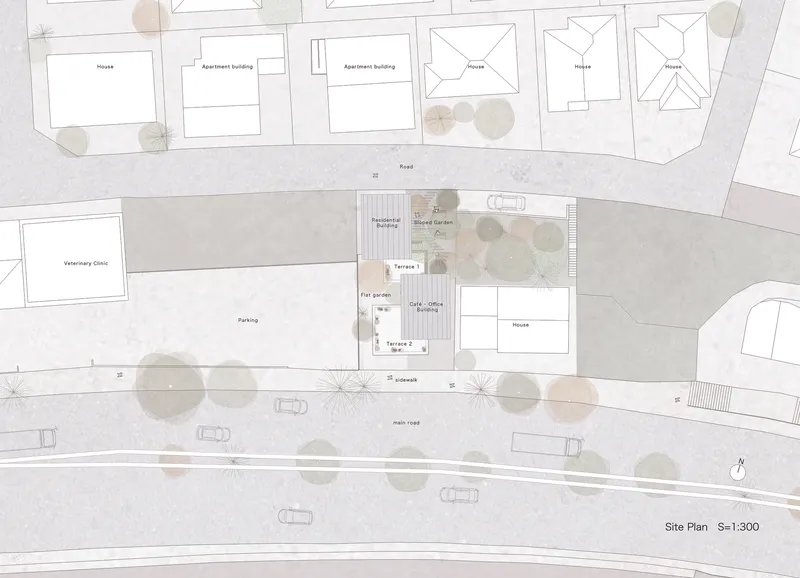
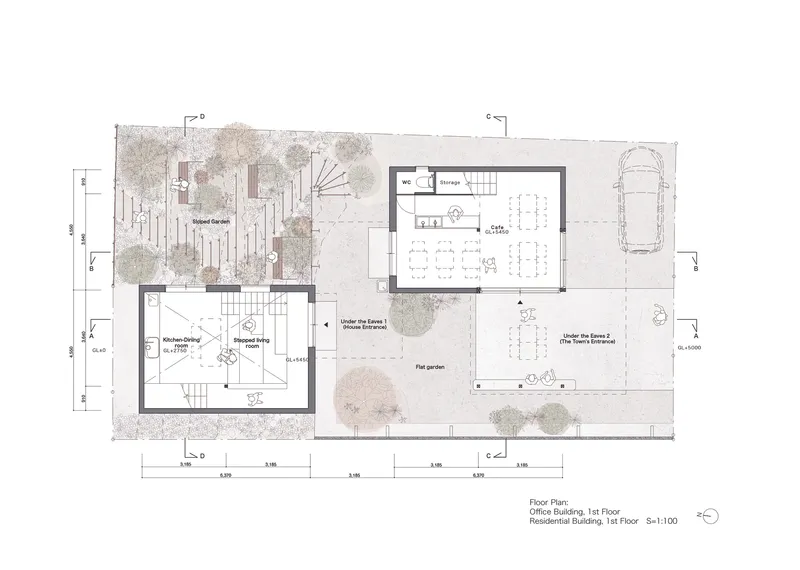

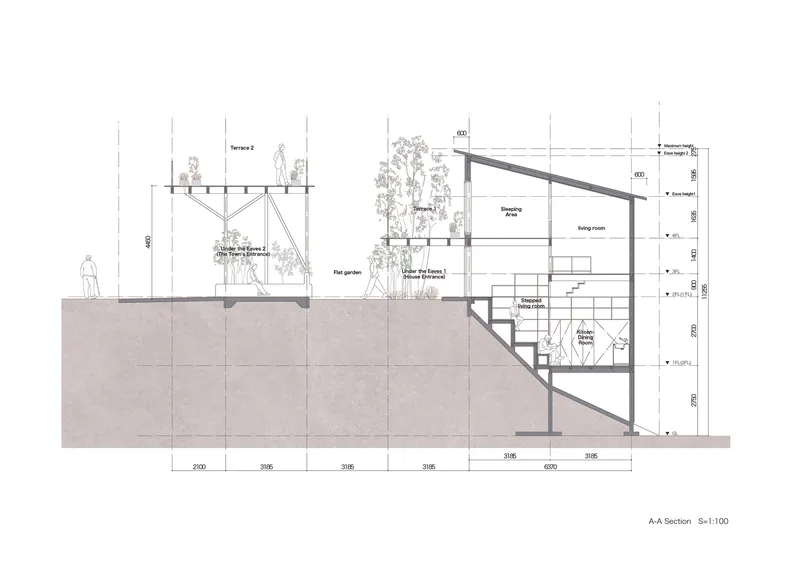
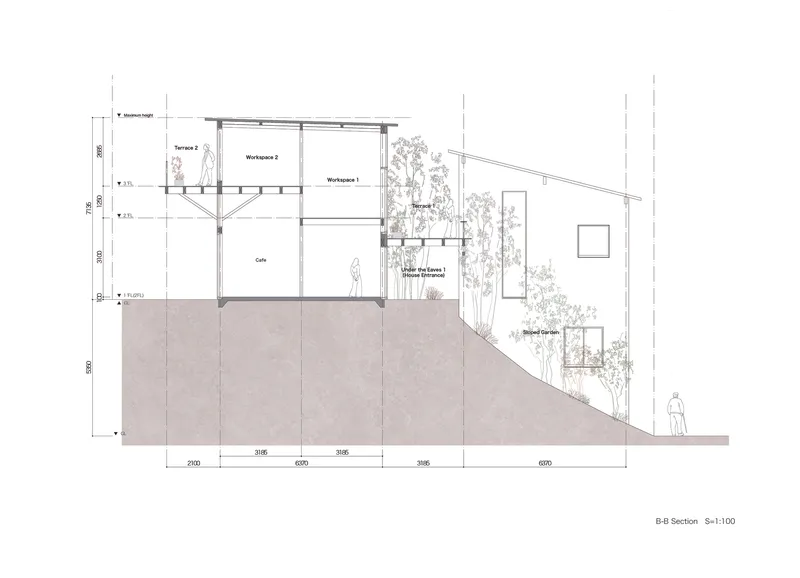
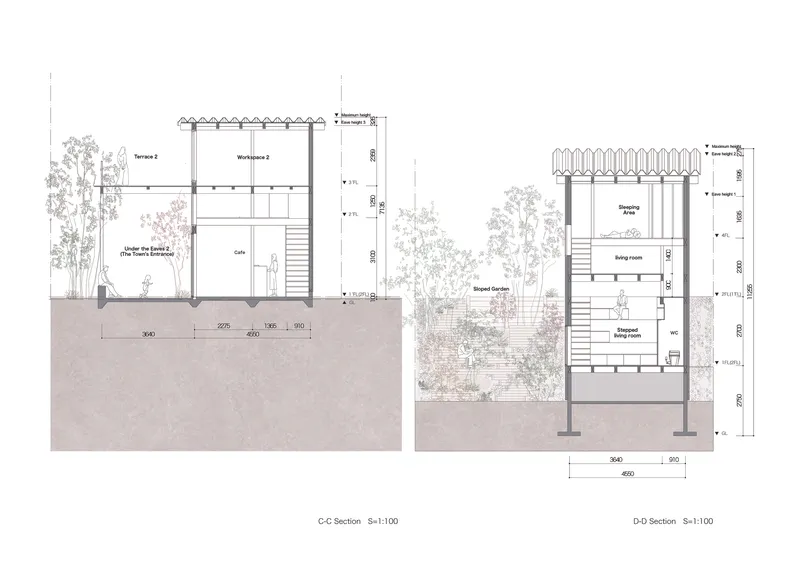
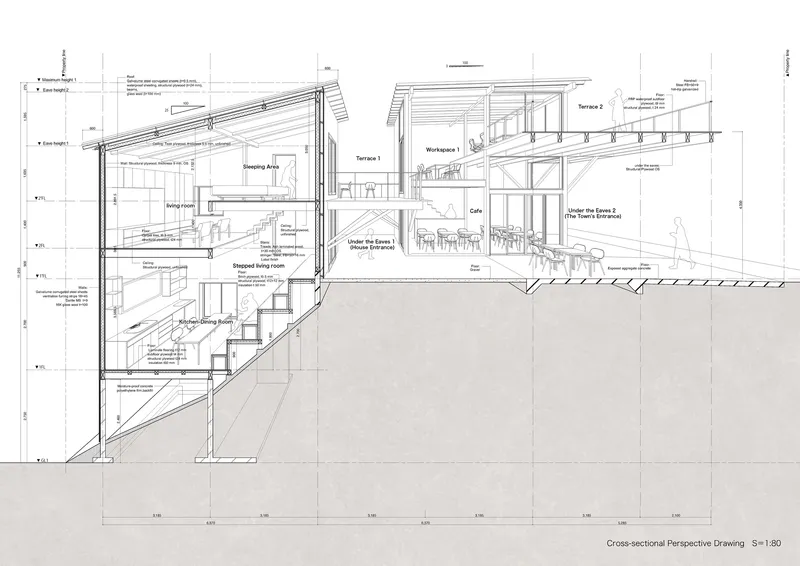
The site plan makes the dual-street condition explicit: apartment buildings and houses line the curving main road to the south, while the northern lane serves a quieter residential cluster. Cloud Terrace sits at the seam, mediating between scales. The floor plans show the two volumes flanking a central flat garden populated with trees, confirming that the courtyard is not residual space but the organizing element. On the second level, workspace volumes and terraces surround the garden from above, creating a section that wraps around the open core.
The section drawings are the most informative. They illustrate how the sloped roofs follow the terrain's gradient, how the terraces step down to meet planted gardens, and how the interiors achieve their generous ceiling heights. The cross-sectional perspective, in particular, reveals the interior workspaces with their exposed structure nestled into the hillside, grounding the architectural ambition in the physical reality of the slope.
Why This Project Matters
Cloud Terrace is a reminder that topography is not a problem to be solved but a resource to be exploited. By splitting the program across the slope and linking volumes with stairs, terraces, and a courtyard, Kawakami avoids the two traps of small hillside buildings: either you flatten everything and lose the landscape, or you perch one box on stilts and pretend the ground isn't there. Neither happens here. The building is genuinely woven into the grade, and the occupants move through it vertically as much as horizontally.
As a live-work model, the project is equally instructive. The separation between residence and studio is achieved through section and orientation rather than partition walls, which keeps the spaces connected without collapsing the distinction. For an architect designing his own office and home at 115 square meters, restraint is the hardest brief. Kawakami delivers a building that feels generous without wasting a single square meter, and that is worth studying regardless of scale.
Cloud Terrace by CLOUD ARCHITECTS, lead architect Masato Kawakami. Kobe, Japan. 115 m², completed 2025. Photography by Takumi Ota.
About the Studio
Share Your Own Work on uni.xyz
If projects like this are the kind of work you want to make, uni.xyz is a place to publish your own, find collaborators, and enter design competitions.


Popular Articles
Popular articles from the community


Opera on the Sea: Driftwood Logic Shapes a Timber Opera House on Estonia's Coast
Trevor Orgill's opera house translates the entangled drift of floating timber into a civic building where wood, water, and music converge.

The Amber Palace Opera: A Geological Fiction Surfaces on Tallinn's Baltic Waterfront
Pierre Brillard reimagines a Baltic legend as a public landscape, opera house, and waterfront promenade rooted in Tallinn's coastal identity.

Aquadapt: An Underwater Habitat That Rewrites Its Rooms by the Hour
Curved modules ring the seabed while one shell shifts from breakfast room to cinema, farm and football pitch as residents' needs change.


FCC Arquitectura Expands a Portuguese Granite House with a Board-Marked Concrete Wing
In Portugal, JV House pairs a cleaned-up whitewashed and granite dwelling with a timber-shuttered concrete extension, courtyards and a garden pool.

Similar Reads
You might also enjoy these articles

LAVA Architecten Gives Vocational Education a Sawtooth-Roofed Face on a Mechelen School Campus
In Mechelen, Belgium, a 2,053 m² STEM school on a 6×6 m grid turns workshops and classrooms into rooms that can be rearranged as teaching changes.

KEMA Studio Turns a Derelict Marvila Attic into a 60 m² Lighthouse Apartment Above Lisbon
In Lisbon's Marvila district, a rebuilt roof, four skylights and two plywood volumes turn an unlivable attic into a bright home facing the Tagus.

Pixel Gardens: One Repeated Module Stacked Into a Terraced Social Housing Tower for Famagusta
Salem Bader's shortlisted housing tower builds a vertical neighbourhood from one repeated module, offsetting units to carve terraces, light and air.

Bao Huynh Watercolor Atelier: A Serene Art Retreat in Hội An
Bao Huynh Watercolor Atelier in Hội An blends multifunctional art spaces, sustainable design, local materials, and family-friendly living in a serene environment.

Explore Tetsuo Kobori Architects Competitions
Discover active competitions in this discipline

Comments (0)
Please login or sign up to add comments
No comments yet. Be the first to comment!