
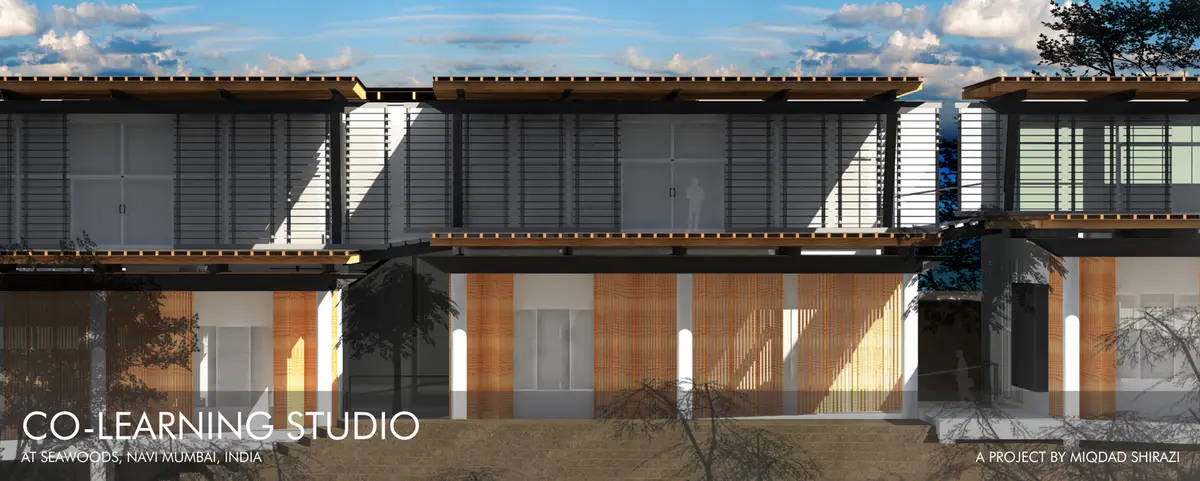
Co-Learning Studio: Architecture That Grows From Debris and Terrain in Navi Mumbai
A fragmented learning complex at Seawoods Lake turns construction waste into artificial contours, merging workshops and maker spaces with landscape.


What happens when you take 36,000 square meters of neglected land littered with construction debris and treat the rubble not as waste but as raw material for a new topography? At Seawoods, Navi Mumbai, the Co-Learning Studio answers that question by reshaping the ground itself, using on-site debris to create artificial contours that generate terraces, courtyards, and graduated floor levels. The architecture doesn't sit on the landscape; it emerges from it, fragmenting into interconnected volumes that follow the site's remade terrain rather than imposing a single monolithic form.
Designed by Miqdad Shirazi, the project was a shortlisted entry in UnIATA '18. Sited adjacent to Seawoods Lake at Sector 26, the proposal occupies a zone caught between an emerging public plaza and underutilized open land. Shirazi develops only about 15,000 of the available 36,000 square meters, leaving the majority of the plot as a breathable public realm shaped by the lake edge, existing vegetation, and the surrounding residential fabric. The result is a collaborative co-working and learning environment conceived as contextual architecture: a place where students and professionals from different disciplines share workshops, maker spaces, and studios without retreating into institutional isolation.
Studying the Fragments: From Timber Models to Spatial Logic

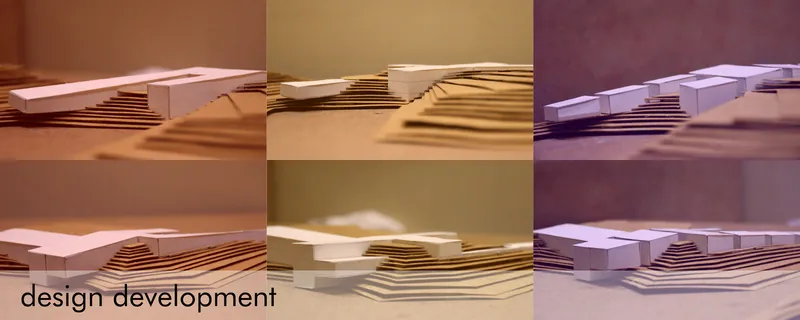
The design process reveals itself through a series of physical study models that test the project's core strategy of fragmentation. Layered timber volumes sit on the work surface alongside embedded sketch drawings, showing how Shirazi developed the relationship between built mass and terrain before committing to a final configuration. Sequential model variations photographed under shifting light conditions demonstrate how the terraced volumes would read at different times of day, each iteration refining the balance between solid enclosure and open terrace. The iterative rigor visible here is notable: rather than arriving at form through a single gesture, the design accumulates through careful adjustment of height, setback, and overlap.
Courtyard Sections: Where Terrain Meets Program
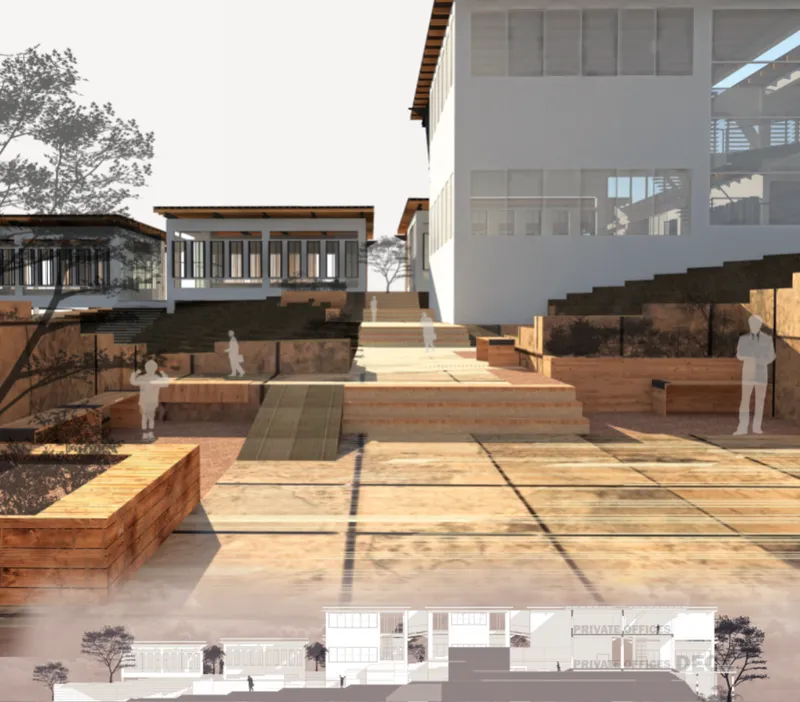
A rendered courtyard view paired with a section drawing reveals how the building volumes negotiate the remade terrain. Timber decking and raised planters define the ground plane, while the section exposes the programmatic layering beneath: ground-level workshops and maker spaces open directly onto landscaped courts, and upper-level studios step back to allow cross-ventilation at the lower floors. The artificial contours created from construction debris are legible here as the foundation of the spatial hierarchy, generating the varying levels that accommodate everything from formal workspaces to informal gathering areas. By building only on a fraction of the site, Shirazi ensures that the architecture breathes outward into the surrounding landscape rather than walling itself off.
Timber Screens and Climatic Thresholds
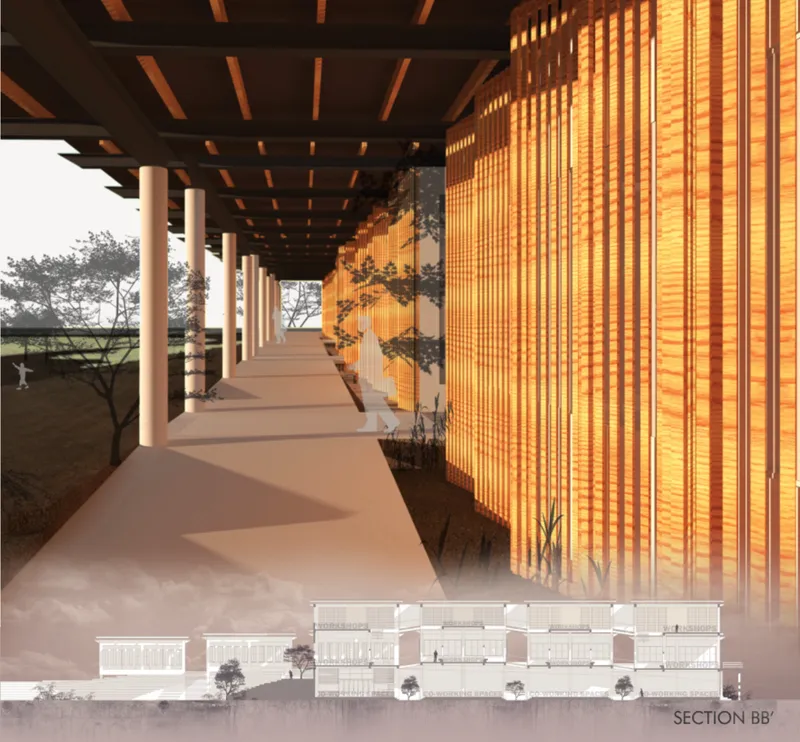
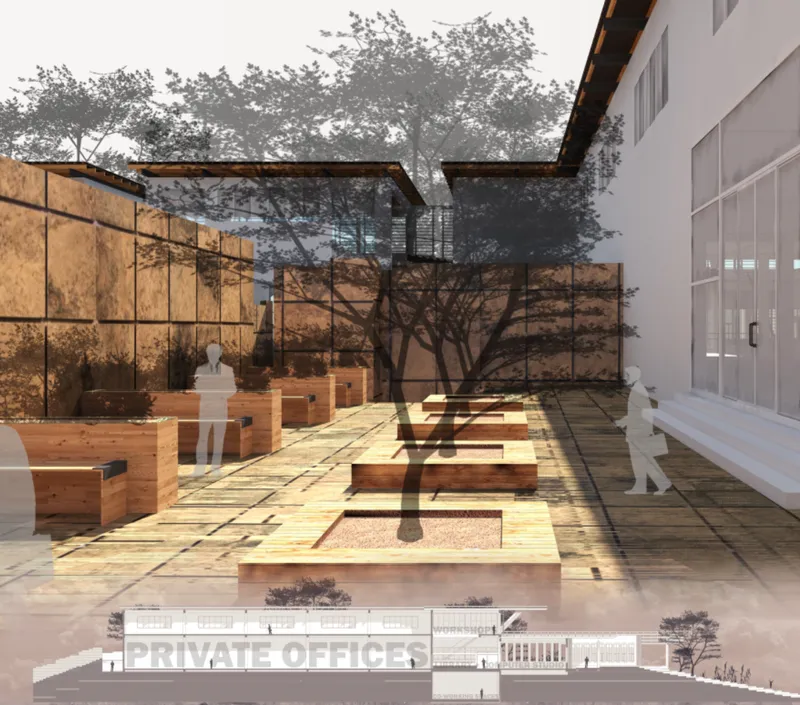
The material palette resolves into timber columns, slatted ceilings, and vertical wood screens that filter light and manage thermal comfort across the complex. A covered walkway captured at dusk shows how the slatted ceiling creates a gradient of illumination, softening the transition between fully enclosed workshops and open-air courts. The vertical timber screen acts as both a privacy buffer and a shading device, controlling glare from the harsh evening sun without severing the visual connection to the landscape. In the adjacent courtyard, a glass facade faces outward, allowing uninterrupted views toward Seawoods Lake while tree shadows cast across the paved surface reinforce the project's commitment to layering indoor and outdoor conditions.
These semi-open terraces serve a double function. Climatically, they act as buffers that enhance airflow through the ground-floor workshops. Socially, they blur the boundary between work, rest, and interaction, providing informal meeting spaces that the program deliberately leaves unscripted. The porosity is structural, not decorative: volumes on the upper levels are trimmed specifically to improve ventilation below, a strategy that shapes the building's silhouette as much as its interior comfort.
Terraced Seating and the Pavilion Edge
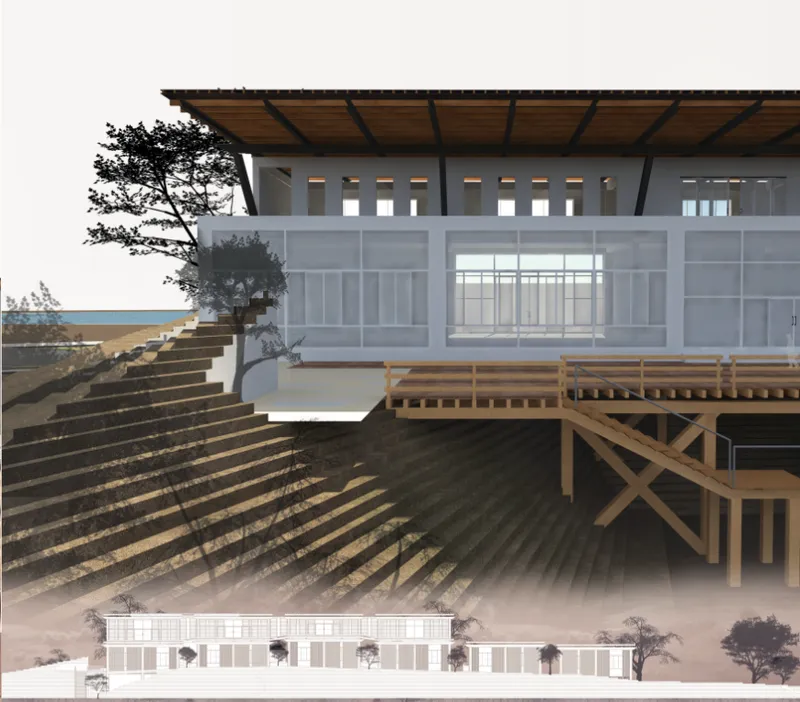
At the complex's edge, terraced timber seating steps down toward a white pavilion punctuated by horizontal window bands and sheltered by an overhanging roof. This is the programmatic gradient at its most legible: from enclosed studio to semi-covered terrace to open-air amphitheater. The pavilion reads as a moment of architectural clarity within the fragmented campus, its clean horizontal lines contrasting with the organic contours of the reshaped terrain. For students working late in the maker spaces or flexible studios above, where mezzanine levels accommodate informal sleeping arrangements, this outdoor threshold offers a decompression zone that connects concentrated work to the broader public landscape.
Why This Project Matters
The Co-Learning Studio makes a convincing case that contextual architecture is not simply about matching local materials or referencing vernacular forms. It is about reading a site's existing conditions, including its problems, and converting them into design drivers. Construction debris becomes topography. A neglected lake edge becomes the primary orientation for glazed facades. A sprawling plot becomes an argument for restraint, with more than half the land left unbuilt. Each decision feeds back into the spatial experience of the complex, producing an environment where learning feels inseparable from the place it happens.
What distinguishes Shirazi's approach is the refusal to treat collaboration as a buzzword that can be solved with open floor plans and bean bag chairs. The programmatic layering, from shared workshops at ground level to flexible studios and temporary stay facilities above, creates genuine spatial variety that supports different modes of engagement. Students working alone can find quiet; groups convening for a workshop can spill into a courtyard; a visiting professional can occupy a mezzanine for a multi-day residency. The architecture does not prescribe interaction. It organizes the conditions under which interaction becomes likely, and then steps aside.
View the Full Project
About the Designers
Designer: Miqdad Shirazi
Enter a Design Competition on uni.xyz
uni.xyz runs architecture and design competitions year-round that reward proposals with spatial conviction and real site intelligence.
Project credits: Co-Learning Studio by Miqdad Shirazi UnIATA ’18 (uni.xyz).


Popular Articles
Popular articles from the community


David Ortega Stacks a Two-Story Mexico City Penthouse Around a Steel Stair and a Pergola-Shaded Roof Terrace
In Colonia Roma, a 300 m² penthouse uses oak joinery, a planted steel stair and a slatted roof pergola to make a new-build apartment feel like a house.

Cube Design Draws an Ecological Corridor Between Two Shenzhen Hills with the Nankai Building
Beside Shenzhen's container docks, the Nankai Building pairs stacked balconies with a climbing green screen to connect two hillsides across its height.

longwave studio Reorganizes a 112 m² Tainan Apartment Around the Daily Routines of a Family and Two Cats
In Tainan, Taiwan, birch plywood, rust-red furniture and a freestanding plaster wall link arrival, storage, work and family life in one apartment.

Architekt Andreas Gruber Scatters 23 Dark Timber Chalets Across a South Tyrolean Forest Edge
In Molini di Tures, Amonti Chalets breaks a resort into a hamlet of gabled timber houses, with parking, storage and services pushed into the slope.

Similar Reads
You might also enjoy these articles


Aquadapt: An Underwater Habitat That Rewrites Its Rooms by the Hour
Curved modules ring the seabed while one shell shifts from breakfast room to cinema, farm and football pitch as residents' needs change.

Play: Fragments of Their World: Remembered Architecture Rebuilt as a Modular Playground for Refugee Camps
Tom Gardner abstracts domes, arches and towers from the homelands of displaced families into a kit of child-scaled play parts for camp settlements.
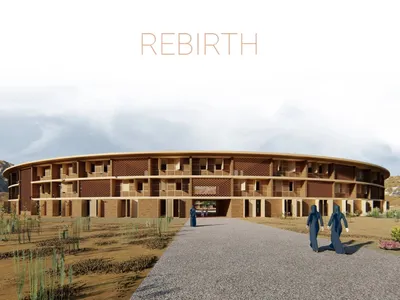
REBIRTH: A Circular Settlement Where Afghan Widows and Their Children Rebuild Life Together
A shortlisted Resile entry turns the circle into a protective ring of timber and brick, gathering homes, classrooms and gardens around a shared landscape.
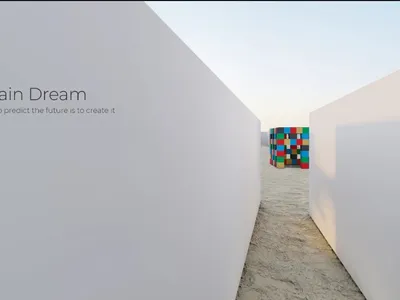
The Main Dream: A Recycled Plastic Kit That Lets Refugee Children Build Their Own Playground
Thirty-centimetre interlocking cubes that connect on three axes turn play into construction, letting children author the spaces they occupy.

Explore Collaborative Space Competitions
Discover active competitions in this discipline

Challenge to design public laboratory

Challenge to reimagine the Iron Throne

Photograph architecture without architects

Illustrate the lost glory of Angkor Wat - Render Challenge
Comments (0)
Please login or sign up to add comments
No comments yet. Be the first to comment!