
Coachella 2022 Unveils Six Mesmerizing Installations Combining Material, Color, Sound, and Light!
Experience the Intersection of Art and Technology with These Stunning Multi-Sensory Exhibits at Coachella 2022


Coachella Valley Music and Arts Festival 2022 has unveiled a series of specially commissioned, large-scale installations created by 11 international designers, architecture and design studios and experimental artists from Europe, Latin America, the UK, and the United States. The site-responsive installations explore a range of pressing topics and global themes surrounding environmental sustainability, from use to reuse, and up-cycling to re-cycling, multi-cultural dialogue, immigration, community and exchange, social behaviour and architecture, performance, and pop culture.
 Mutts by Oana Stănescu, photo by Lance Gerber, courtesy Coachella Valley Music and Arts Festival.
The installations, which were presented over two weekends in April 2022, are complex, dynamic, and ambitious in scale and design. They span imaginary transformations and reinventions of everyday objects and experiences as fantastical, playful forms and spaces; progressive approaches to structure and material; subtle interplays of light, colour and sound, and responses to the geography and topography of the desert landscape, its flora and fauna, temporal shifts from day to night and spectacular sunrises and sunsets. The installations serve as vital navigational markers on the field as gathering points, havens for shelter and respite, and spaces for reflection and contemplation on the Empire Polo Field.
 Mutts by Oana Stănescu, photo by Lance Gerber, courtesy Coachella Valley Music and Arts Festival.
The art program manager for the Coachella Valley Music and Arts Festival, Paul Clemente, said, “Building on our art program with designers, architects and visual artists from around the world and from the Coachella Valley allows festival-goers to explore shared global interests and perspectives through the experience of ambitious and one-of-a-kind, large-scale installations.” The experience of these new spaces invites connectedness and adds an iconic sense of place in the spirit of the Festival. After two years of planning, finally seeing the works come to fruition and make their way onto the field is very exciting. My hope is that they will surprise, inspire and inform, creating personal memories and serving as lasting beacons for the Festival.”
 Buoyed by Kiki Van Eijk, photo by Julian Bajsel, courtesy Coachella Valley Music and Arts Festival.
One of the most notable installations is Mutts by Oana Stănescu, a Romanian architect based in New York. The pack of massive canine sculptures was built with steel frames and filled with a variety of plants, including lantana, cassia, fountain grass, yellow bell, and jasmine. The striking silhouettes reduce the dogs to their minimal forms, allowing their expressions to speak through their contours and gestures. Stănescu is known for creating architectural wonderlands incorporating elements of nature, has collaborated with the late Virgil Abloh, Ye, and the New Museum in New York, and teaches at the Harvard Graduate School of Design and MIT.
 Buoyed by Kiki Van Eijk, photo by Lance Gerber, courtesy Coachella Valley Music and Arts Festival.
Buoyed by Kiki van Eijk is another installation that stood out. Three massive buoys, each about four stories tall, were angled as if they were floating in a sea of grass, creating a surreal and happy space where everybody belongs regardless of their differences. The Eindhoven-based designer created Buoyed with great optimism for the future, and each buoy includes cultural references emphasizing the goodness of diversity and inclusiveness. “It’s about the journey we’re making together in life and at Coachella,” she explains. “When you’re at a festival for a few days, you’re in a bubble, making a journey. Everybody becomes one.”
 Cocoon (BKF + H300) Martín Huberman, photo Lance Gerber, courtesy Coachella Valley Music and Arts Festival
Overall, the Coachella Valley Music and Arts Festival 2022's installations are not only impressive but also thought-provoking. They invite festival-goers to explore global issues and perspectives through the experience of ambitious and one-of-a-kind, large-scale installations. They are not only aesthetically pleasing but also meaningful in the messages they convey.

In the realm of design and architecture, it is often the unexpected that captures the most attention. Take, for instance, the trio of whimsical buoys designed by Dutch artist Kiki van Eijk. The slender-necked, off-white buoy boasts a 15-foot diameter base with butterfly wings that illuminate at night. The blue buoy merges an igloo form with a patchwork dome and a walk-through passage on its 18-foot diameter base. And the green buoy, the largest of the three, features a 24-foot diameter base with a soft stucco rim for comfortable seating, topped by a dramatic union dome and a plume of palm leaves.

Together, these fanciful structures provide a fantastical space for people to meet, interact, and bond. LED lights activate their silhouettes at night, while daytime offers a softer, more calming experience. Van Eijk, one of the most respected names in Dutch design, has an impressive portfolio that includes ceramics, textiles, metal, wood, glass, furniture, and lighting. Her approach is both whimsical and rigorous, resulting in designs that are not only imaginative but also functional. Another designer whose work is both imaginative and functional is Martín Huberman of Estudio Normal.
Huberman’s nine-story sculpture, Cocoon (BKF+H300), is constructed with 300 reproductions of the iconic BKF chair, also known as the butterfly chair. Originally designed by three architects in Buenos Aires in 1940, the chair gained popularity and was added to MoMA's permanent collection a year later. However, it was the proliferation of copycats and knock-off versions that made the butterfly chair a ubiquitous presence in mid-century modern design. Huberman has reclaimed the narrative, using the reproductions to complete a structural irony of the mythological origin of a chair that was born out of a cocoon. Cocoon (BKF+H300) is an impressive architectural feat, with a “skin” made of window shade-type material that provides shade during the day and illumination at night.

The sculpture is a tribute to the original butterfly chair and the design legacy of Argentina, which was overshadowed by the popularity of the knock-off version. Huberman’s work is not limited to the BKF chair. He is known for his experimental approach to design, transforming everyday objects such as clothespins into site-specific public art. He also serves as director of Galería Monoambiente, the first space in Buenos Aires dedicated to experimental architecture and design. In the world of design and architecture, it is important to recognize and celebrate innovation and imagination. Whether it is Kiki van Eijk’s fanciful buoys or Martín Huberman’s reimagining of the butterfly chair, these designers remind us that creativity knows no bounds. They challenge our perceptions of what is possible, inviting us to explore new ideas and possibilities. These structures and sculptures offer not only visual appeal but also a space for community and connection, a reminder that art and design can bring people together.
 La Guardiana by LosDos, photo Lance Gerber, courtesy Coachella Valley Music and Arts Festival.
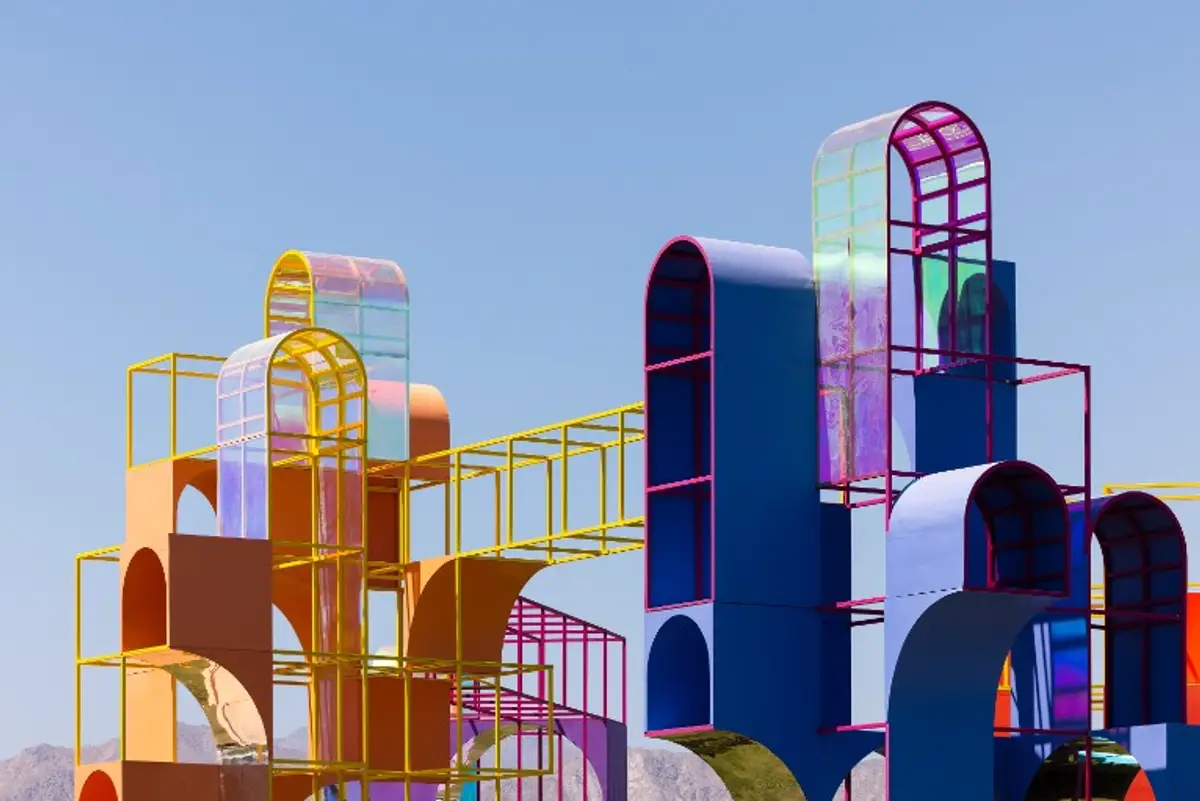
Architensions, the architectural design and research studio of Alessandro Orsini and Nick Roseboro, presented a colourful vertical response to the single-story suburban sprawl in the Coachella Valley, bringing urbanity to the desert. Their installation, The Playground, encompasses four towers ranging from 42 to 56 feet in height, linked by sky bridges. Each tower features a variety of geometric forms, some with dichroic film in cyan, magenta, and yellow that bathes the surrounding area in colours as the sun shines through them, and others mirrored to encourage people to interact with them. The design also contains cultural references to classical leisure architecture types, such as the arcade and the theatre. The centrepiece of the installation is the piazza, a 174-by-104-foot public square at the intersection of the towers, where people can rest on benches that flank its elevated platform. The fifth dimension of architecture, the experience, is the place for people to assert their own narrative.

La Guardiana by LosDos, photo Lance Gerber, courtesy Coachella Valley Music and Arts Festival.
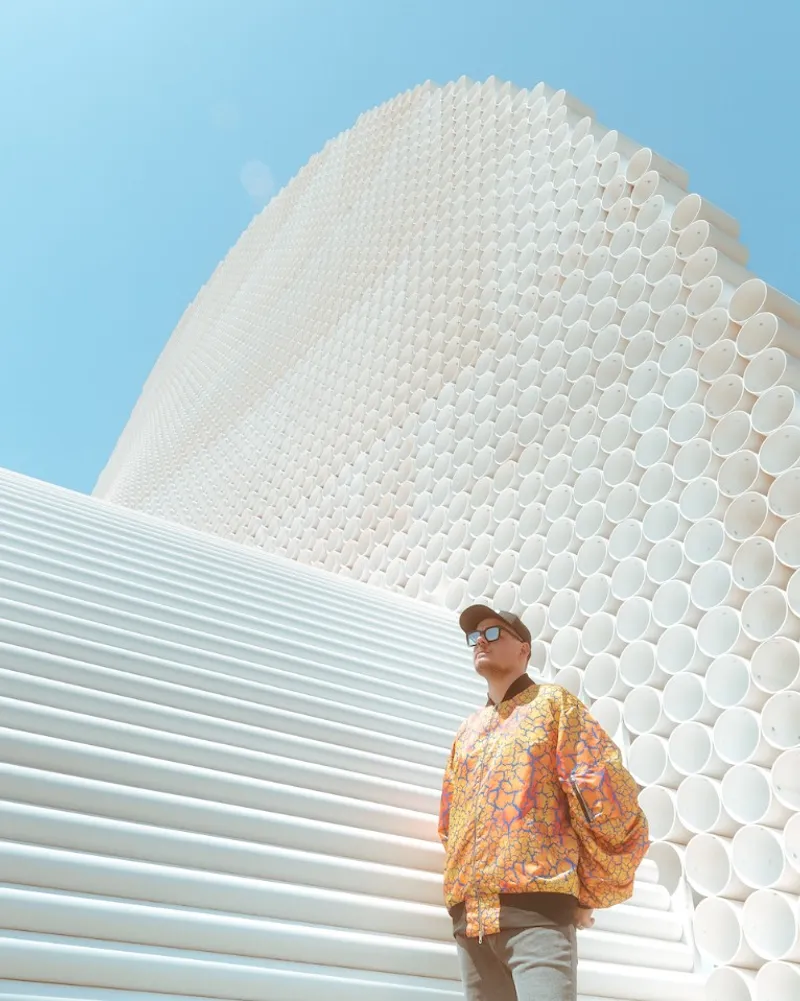
Circular Dimensions x Microscape by Cristopher Cichocki is a five-story-tall bandshell-shaped pavilion constructed with over 25,000 feet of PVC tubes. It presents a visual spectacle peering into the artist’s ongoing exploration of water and the history of the desert. The pavilion contains a laboratory where scientists and artists generate experimental “video paintings” by manipulating water, salt, barnacles, and algae from the Salton Sea under microscopes and projecting the activity in real-time inside the pavilion’s “nucleus.” Meanwhile, a soundscape of field recordings and industrial rhythms resonates.
Courtesy Coachella Valley Music and Arts Festival

Popular Articles
Popular articles from the community


Singing Woman: Contemporary Architecture Inspired by Estonia’s Voice and the Sea
Singing Woman turns Estonia’s song culture into flowing opera house architecture, blending public life, landscape, sea, and national memory.
Opera by the Sea Estonia: Three Shells Dissolving Architecture into Tallinn's Coastline
A winning opera house proposal replaces monumental form with interconnected shells that blur the boundary between building, park and Baltic Sea.
Faces of the Soviet Avant-Garde: Turning Moscow's Street Names into an Open-Air Museum
A network of sculptural installations across a Moscow residential district transforms forgotten architect names into spatial encounters with cultural memor
Temporary Home for Dogs: A Reversed Zoo Rethinks Animal Shelter Architecture
In Bucharest, a sinuous corridor and freed landscape flip the logic of containment, designing a shelter that works to make itself unnecessary.

Similar Reads
You might also enjoy these articles
116 Rokeby Building, Collingwood
Sustainable Collingwood office building featuring double-skin façade, natural ventilation, rooftop amenities, and carbon-neutral design focused on wellbeing and longevity.
Contemporary Apartment Renovation in Spain: RV House by BIAN Opens Up to the Sea
A minimalist 1930s apartment in Santander is transformed into a flexible, sea-facing home through contemporary Spanish renovation.
3 Marías House: A Contemporary Mediterranean Courtyard Retreat by Bajet Giramé + Burckhardt
Mediterranean courtyard home blending traditional architecture with modern design, terracotta flooring, flexible interiors, sustainable climate strategies, and garden integration.
NZ10 Apartment by auba studio: Adaptive Reuse in Palma de Mallorca
Adaptive reuse apartment transforms bakery into light-filled home with patios, privacy layers, and wood interiors enhancing urban living experience.

Explore Installations Competitions
Discover active competitions in this discipline


Challenge to design a portable theatre

Challenge to design a portable music platform

Challenge to design an open learning module for the elderly

Challenge to reimagine the Iron Throne
Comments (0)
Please login or sign up to add comments
No comments yet. Be the first to comment!