
COFFEE CULTURA
BREWED – BALI DESIGN COMPETITION BY UNI

Introduction
What comes to your mind when you hear the word "Bali"? Maybe some of you will imagine about its inherent and sacred customs and some of you will imagine the amazing tourist attraction with its magical effects that can invite all tourists from abroad to visit and enjoy its beauty. However, have you ever thought about coffee in Bali? Without you knowing it, Bali is one of the highest coffee producing areas in Indonesia. Bali ranks fourth after Sumatra, Java and South Sulawesi. Although not as big as other islands, Bali is no less in terms of diversity of vegetation. One type of coffee that has become the island's own icon is Kintamani Coffee. For coffee lovers, its two distinctive flavors, namely orange or lemony and floral, make it a favorite coffee. This coffee has medium thickness and acidity.
Coffee and Bali cannot be separated. Of the eight districts in Bali, there are six regencies with arabica coffee plantations. The robusta coffee plantations are scattered throughout the regency. Almost all coffee plantations in Bali are plantations of the Balinese people. Not only about tourism, but also about coffee, a prayer-filled drink and the smell of incense, which flows in the breath and blood of nak Bali.
Therefore, we present a Coffee House design idea with the theme "Coffee & Culture". This Coffee House will have a concept that combines elements of coffee and customs in Bali and implements it in every architectural value and aspect as a whole.
Architecture (body)
Design Objectives
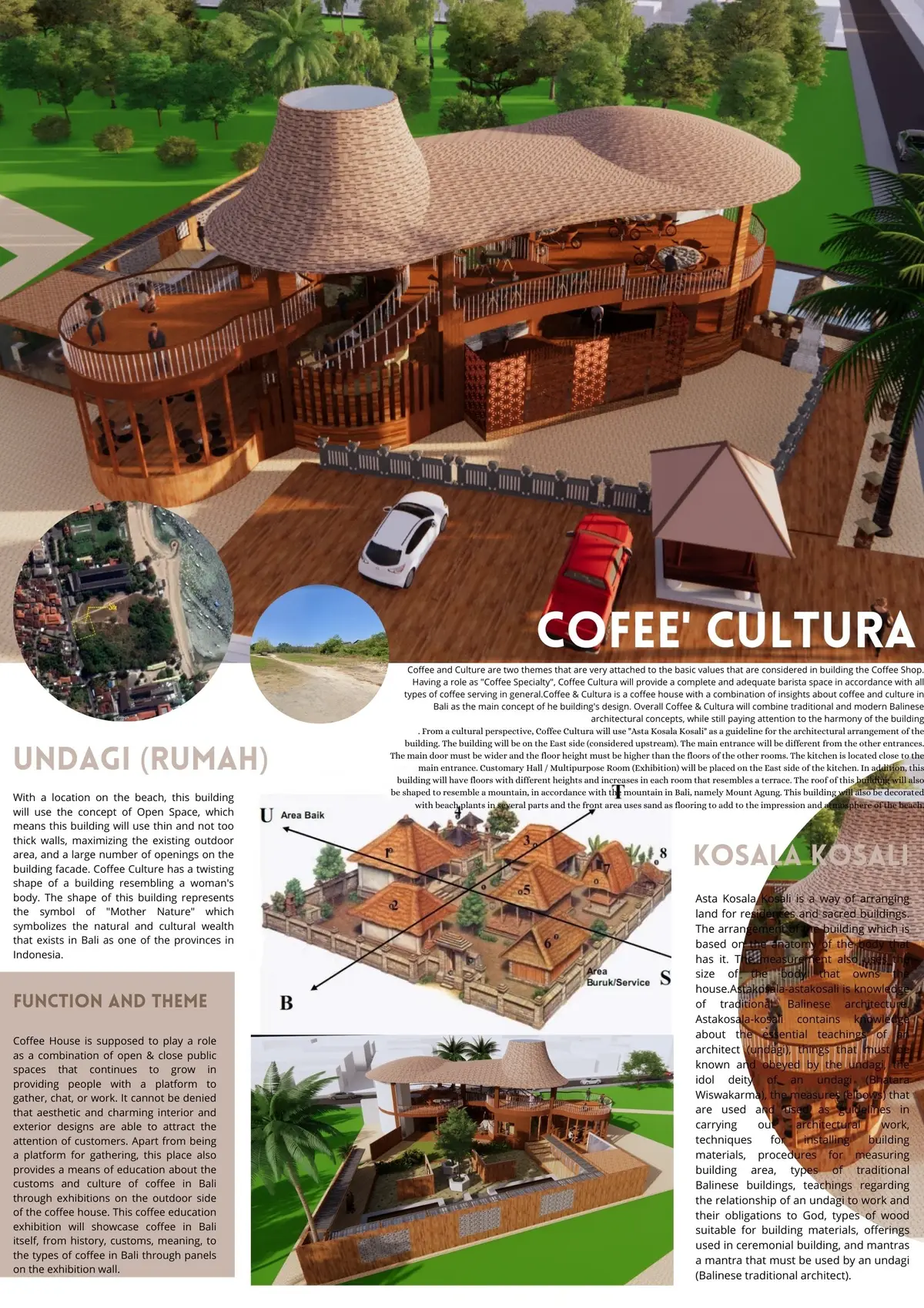
"Coffee & Cultura". ¬ Coffee and Culture are two themes that are very attached to the basic values that are considered in building the Coffee Shop. Having a role as "Coffee Specialty", Coffee Cultura will provide a complete and adequate barista space in accordance with all types of coffee serving in general. In addition, all the coffee beans provided come from the roastery belonging to Coffee Cultura itself which is roasted in the special roastery room in the building. Each room in this building will be given the impression and atmosphere of the texture of the coffee body, such as Base, Light, Medium, and Bold.
From a cultural perspective, Coffee Cultura will use "Asta Kosala Kosali" as a guideline for the architectural arrangement of the building. The building will be on the East side (considered upstream). The main entrance will be different from the other entrances. The main door must be wider and the floor height must be higher than the floors of the other rooms. The kitchen is located close to the main entrance. Customary Hall / Multipurpose Room (Exhibition) will be placed on the East side of the kitchen. In addition, this building will have floors with different heights and increases in each room that resembles a terrace. The roof of this building will also be shaped to resemble a mountain, in accordance with the mountain in Bali, namely Mount Agung. This building will also be decorated with beach plants in several parts and the front area uses sand as flooring to add to the impression and atmosphere of the beach. With a location on the beach, this building will use the concept of Open Space, which means this building will use thin and not too thick walls, maximizing the existing outdoor area, and a large number of openings on the building facade. Coffee Culture has a twisting shape of a building resembling a woman's body. The shape of this building represents the symbol of "Mother Nature" which symbolizes the natural and cultural wealth that exists in Bali as one of the provinces in Indonesia.
FUnction & Others
Coffee House is supposed to play a role as a combination of open & close public spaces that continues to grow in providing people with a platform to gather, chat, or work. It cannot be denied that aesthetic and charming interior and exterior designs are able to attract the attention of customers. Apart from being a platform for gathering, this place also provides a means of education about the customs and culture of coffee in Bali through exhibitions on the outdoor side of the coffee house. This coffee education exhibition will showcase coffee in Bali itself, from history, customs, meaning, to the types of coffee in Bali through panels on the exhibition wall.
Materials
This building will use materials that are in accordance with the context environment and the concepts discussed above. Given that Bali is very rich in culture and very thick customs, this building will use materials that carry the concept of open space, such as natural stone, bamboo, and wood. The main part which is the highest symbol in the form of a roof and is made of materials such as reeds and fibers. The middle part which consists of the walls, windows and doors using wood materials which are equipped with Balinese carvings.
However, there are a number of characters that are usually adopted in modern Balinese architecture, such as the roof design which is now made simpler by eliminating carvings, the use of natural stone materials with types that are easier to find, to the pillars that are now made using walls to make them stronger. Whether traditional or modern concepts, the principles of Balinese architecture remain the same, namely balance and harmony with the natural surroundings. Thus, the material chosen is a combination of materials that reflect traditional and modern Balinese architecture while still paying attention to harmony and balance with the existing context.
DESIGN Conclusion
In conclusion, Coffee & Cultura is a coffee house with a combination of insights about coffee and culture in Bali as the main concept of the building's design. Also traditional values will continue to be maintained in the building with changing times. Overall Coffee & Cultura will combine traditional and modern Balinese architectural concepts, while still paying attention to the harmony of the building.

Popular Articles
Popular articles from the community


graciastudio Turns a Viewless Tijuana Lot Inward Around a Courtyard of Concrete, Timber and Trees
In Tijuana, Jorge Gracia's GA2 House stacks a timber-clad private floor over exposed concrete and replaces a missing view with a planted interior patio.

LT2A and OPEN Architectes Thread a Brick and Glass High School Through a Wooded Belgian Campus
In Braine-l'Alleud, a 3,000 m² wing for Collège Cardinal Mercier pairs pale brick with a glazed colonnade, deferring to a small chapel and a dense wood.

FCC Arquitectura Expands a Portuguese Granite House with a Board-Marked Concrete Wing
In Portugal, JV House pairs a cleaned-up whitewashed and granite dwelling with a timber-shuttered concrete extension, courtyards and a garden pool.

David Ortega Stacks a Two-Story Mexico City Penthouse Around a Steel Stair and a Pergola-Shaded Roof Terrace
In Colonia Roma, a 300 m² penthouse uses oak joinery, a planted steel stair and a slatted roof pergola to make a new-build apartment feel like a house.

Similar Reads
You might also enjoy these articles

The Rhythm of Seasons
A Farmers' Market Connecting Nature and the City

More Than a Building-Designing a Living System
More Than a Building-Designing a Living System
Base Beyond
DESERT COMPOUND ARID: TOURISM OF ABSENCE AND ABUNDANCE


Comments (0)
Please login or sign up to add comments
No comments yet. Be the first to comment!