

Collaboration In Urban Voids: Adaptive Reuse Architecture
Adaptive reuse architecture transforms Paris’ abandoned railway into a modular, community-driven public space for collaboration and urban renewal.


In the evolving discourse of adaptive reuse architecture, few contexts present as much latent potential as abandoned infrastructural corridors. The project Collaboration in Urban Voids, designed by Xilin Wang, emerges as a compelling response to this condition. Recognized as an Honorable Mention in the Salut Paris competition, the proposal reinterprets the neglected Petite Ceinture railway in Paris as a dynamic, collaborative urban ecosystem.
Rather than treating the site as a residual void, the project positions it as an active framework for social production, community engagement, and sustainable urban transformation.
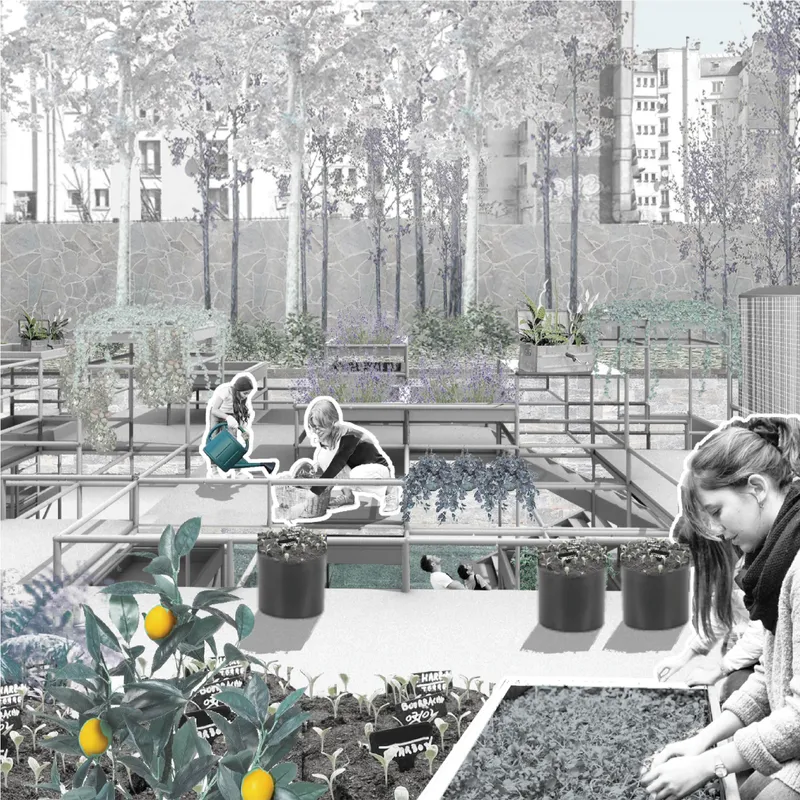
Reclaiming the Petite Ceinture: From Obsolete Infrastructure to Social Catalyst
The Petite Ceinture, once a vital railway loop encircling Paris, now exists as a fragmented and largely abandoned linear space. Its current state reflects a broader urban dilemma: how to reintegrate obsolete infrastructure into contemporary city life.
Through the lens of adaptive reuse architecture, this project identifies the railway as a half-open, sunken urban corridor with immense but underutilized spatial capacity. Instead of imposing a singular program, the design introduces a flexible, modular system that allows the site to evolve through community participation.
This approach aligns with contemporary urban strategies that prioritize incremental development, user-driven activation, and low-impact intervention.
A Modular Framework for Urban Collaboration
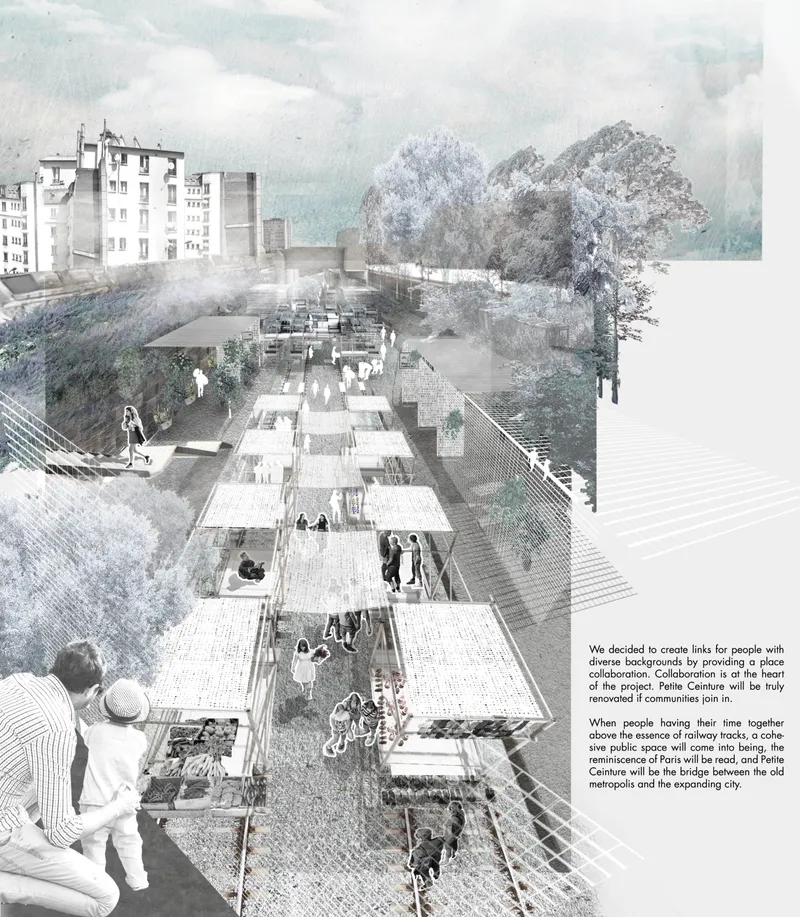
At the core of the proposal lies a scaffold-based architectural system, designed for adaptability, scalability, and cost efficiency. These modular units form a lightweight infrastructure that can be assembled, modified, and replicated across different segments of the railway.
The design operates through three primary spatial typologies:
- Pavilion (Central Spine): A collaborative platform where gardening, crafting, and communal production occur.
- Side Rooms: Functional spaces including workshops, marketplaces, and urban farming zones.
- Scattered Rooms: Flexible installations for exhibitions, performances, and informal social interaction.
This distributed system transforms the linear constraint of the railway into an opportunity for layered spatial programming, enabling multiple activities to coexist without conflict.
Three Phases of Activation: Collaboration, Connection, Sharing
The project is structured around a phased strategy that reflects both temporal growth and social integration:
Phase 1: Collaboration
Local communities initiate the transformation through shared activities such as gardening, crafting, and small-scale production. This phase establishes a sense of ownership and collective identity.
Phase 2: Connection
The system expands to include marketplaces, workshops, and community centers. These functions create economic opportunities while linking diverse user groups including residents, visitors, and local businesses.
Phase 3: Sharing
The space evolves into a vibrant public realm where cultural exchange, performances, and informal gatherings take place. The railway becomes a platform for expression and interaction, bridging social and spatial divides.
Programmatic Diversity and Social Inclusivity
A defining strength of this adaptive reuse architecture project is its multi-layered programmatic strategy. The proposal accommodates a wide range of users:
- Local residents and families
- Students and artists
- Small-scale vendors and entrepreneurs
- Urban farmers and social workers
- Tourists and transient populations
By integrating activities such as urban agriculture, workshops, flea markets, and exhibitions, the project fosters a hybrid public space that supports both economic and cultural exchange.
Importantly, the design encourages co-creation, allowing users to shape the environment according to their needs.
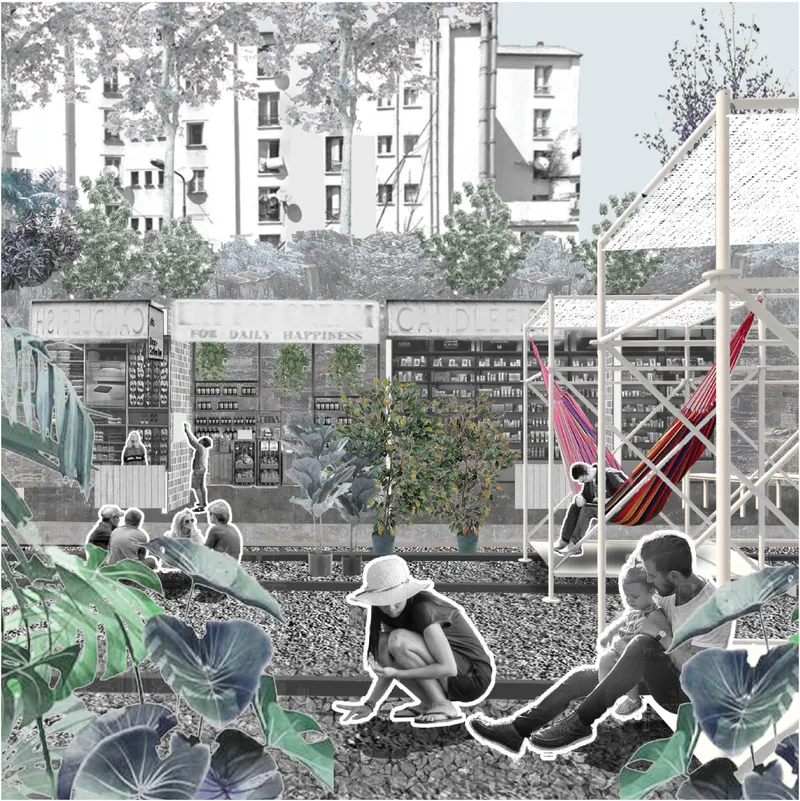
Sustainable Design Through Simplicity and Reusability
Sustainability in this project is not treated as a technological add-on but as an inherent property of the system. The design achieves this through:
- Scaffolding as primary structure: Lightweight, reusable, and easy to assemble
- Low-cost construction: Minimal materials and rapid deployment
- Urban agriculture integration: Enhancing biodiversity and local food production
- Adaptability: Spaces can be reconfigured based on changing needs
This approach reflects a resource-conscious architectural methodology, where flexibility and longevity replace permanence and rigidity.
Linear Space, Reimagined
One of the critical challenges addressed in the proposal is the linearity of the railway corridor. Instead of resisting this constraint, the design leverages it to create a continuous spatial narrative.
A central circulation axis ensures accessibility, while modular insertions activate both sides of the track. This results in a layered spatial experience, where movement, interaction, and activity unfold simultaneously.
The project transforms the railway into a living urban section, rather than a static infrastructural relic.
Architecture as a Platform for Participation
At its essence, Collaboration in Urban Voids redefines architecture not as a finished object, but as a participatory framework. The success of the project relies on continuous engagement, where users are not passive occupants but active contributors.
The design enables:
- Collaborative production and local economies
- Cultural exchange and artistic expression
- Social integration across diverse demographics
- Incremental growth driven by community needs
This positions the project within a broader movement toward open-ended, process-driven architecture.
A New Model for Urban Regeneration
By reactivating the Petite Ceinture through adaptive reuse architecture, the project proposes a replicable model for cities worldwide facing similar challenges of abandoned infrastructure.
It demonstrates that urban voids are not liabilities, but latent assets, capable of supporting vibrant, inclusive, and sustainable public life.
Through modularity, participation, and strategic minimalism, Collaboration in Urban Voids transforms a forgotten railway into a catalyst for urban renewal, bridging the gap between Paris’ historic fabric and its evolving metropolitan future.




Popular Articles
Popular articles from the community


The Musturak Paradise: Senior Living Architecture for a Connected Future in Temara, Morocco
The Musturak Paradise reimagines senior living architecture in Temara via private homes, social spaces, culture, community, and shared care.

Co-life: Sustainable Architecture for Age-Friendly Community Living
Co-life reimagines sustainable architecture for seniors through courtyards, rammed earth, shared gardens, and spaces designed for belonging.

The Earth Pod: 3D Printed Homes for Resilient Refugee Communities
The Earth Pod reimagines refugee housing through 3D printed homes made from clay, combining resilience, self-sufficiency, and rapid shelter.

Hill & Cross Opera: Sculptural Opera House Architecture Shaped by Tallinn’s Landscape and Identity
Hill & Cross Opera reimagines opera house architecture in Tallinn through its sculptural hill, civic plaza, glass wave and a luminous cross.


Similar Reads
You might also enjoy these articles

Eco Chapel: A Green Architecture Pavilion Designed in Symbiosis with the Forest
Eco Chapel uses green architecture to weave prayer, learning and reuse into a forest pavilion shaped by modular hexagonal canopies for life.
Kaffeebühnen: Coffee Shop Architecture Designed as a Civic Stage Between Vienna’s City and Park
Kaffeebühnen turns coffee shop architecture into a civic stage, linking Vienna’s park edge, urban life, warm timber yards, and coffee craft.
Healing Façade: Sustainable Architecture for Reforestation, Community, and Sacred Ecology in Ethiopia
Healing Façade reimagines sustainable architecture as a living wall that restores soil, catches water and renews Ethiopia's forest churches.


Urban Forest: A Vertical Ecosystem for 5,000 Workers in Singapore's Changi Business Park
Radially stacked pods and layered green decks turn a 7-acre plot into 47 acres of ecological workspace projected for 2040.


Comments (0)
Please login or sign up to add comments
No comments yet. Be the first to comment!