
COLLECTING MOTION
BETTER BUS STOP _ MAKING PUBLIC TRANSPORT FUN AGAIN
A bus stop is usually a place that is used temporarily, with users staying there just for a few minutes. They are usually not interested in the space because of the rush and smartphones. But with our design, we would like them to be a part of the bus stop space even in the rush.
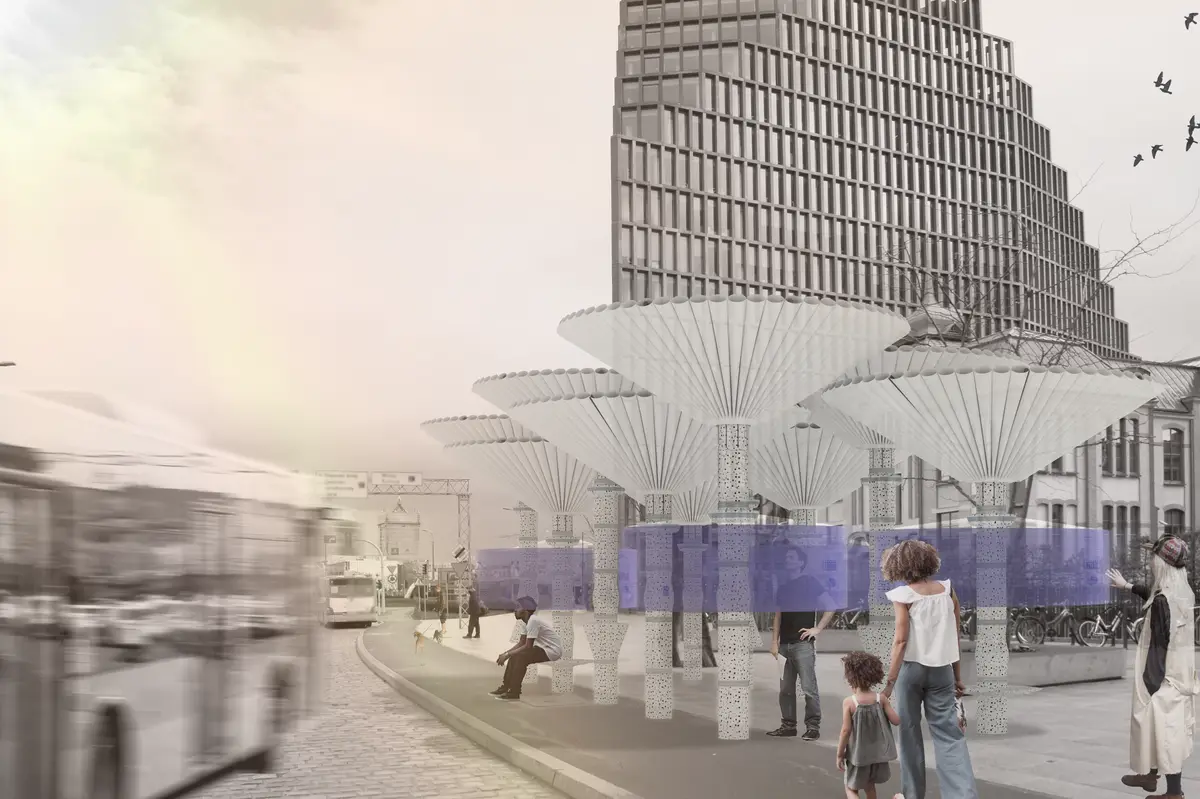
Nowadays is Poland, public transport works on a schedule, but what will be the future? By “Collecting Motion” we wanted to make a bus stop a never ending science research spot and a place for collecting information. Our research space would be a hologram, based in one of the modules will project an information board. In this module will also be placed a small motion camera, which will provide the experience of touching common surfaces by users. Words “collecting” and “motion” also refer to water, since we thought of three solutions to gather water or return it to the ecosystem.
Our hologram would be a platform for exchanging information between citizens and local government with a questionnaire. It can work like a posting pillar, but could also take on some more serious topics like social consultation on urban development of districts. Secondly, cameras will monitor the usage of bus stops at each hour, which would provide a better timetable coordination and eventually could be used in the newest form of transport – public transport on demand for users.
Our design can also be accommodated to local needs, as thanks to our site plan, we can create larger or smaller compositions of pillars. To show how this project can work in a city we located it at Kaponiera Roundabout in Poznan. We have chosen this town, due to the metropolitan nature of the city center and the connection with the main communication routes.
The form of “Collecting Motion” is based on modularity, we have designed two different height pillars ending with a trapeze structure. This finishing allowed us to change the direction of the roof. The kinetic motion is achieved by the motion of eight weights sliding in rails. Each pillar is made of five or six tambours depending on height. Our team designed seven variations of them : two different seats, a hinging one, a semi standing one, a holographic one, a roof top system and a standard extension. Tambours are joined by a metal ring.
Each pillar is placed in our network and is based on circles with 150 diameter – the same diameter in the flat position of the roof. Between seats is a 100 cm space for easy passing. Each pillar has a diameter of 25 cm, and seats have 35 cm depth.
For pillar material we chose recycled plastic, it is made of plastic waste and turned into colored panels. It’s mostly made from soft plastic which yogurt containers and other food packaging are often made of, known under the name of HIPS, that is High Impact Polysterene. Today, it is modified by adding gum to make it less brittle and more resistant to impact. The material allows for forming objects in the injection molding process. Thanks to this solution we can crush each element and reuse it in the future.
For roofing material we chose OPV foil. It is a stretchable solar energy panel, which can be easily stretched 50000 times without damage or loss to photovoltaic properties. We wanted to make this the only source of electrical energy for our bus stop. We chose this material because of its stretchiness, which is needed in our three-position roof.
Each position was designed to suit specific needs. The close position was made particularly for nights. When our roof will become an extension of the pillar and be light up, it will make users safer. The 30 degree position was designed for the best position of solar panels, as it is known that solar system panel have the best efficiency at that angle. The maximum opened position was designed to protect users from rain and snow, and to offer the largest surface to protect users and to collect water.
Each tambour will be drilled inside out. It will help to enhance the water. We designed the system to let water return to the ground slowly. It will consist of a big screw with a drainage system. This screw will also be an element which holds our pillar construction in the ground and allows us to place our bus stop around the city. We also had designed a solution for a temporary bus stop, where the sitting tambour will have a water container which can be connected to the sewer.
To sum up, our design was made with a view to the future. We believe that the future world is based on information and data-flow. Its common thinking is concealed in a smart city idea. We wanted to make our project adaptable to a city that is always developing, to make it more approachable and more attractive for users.

Popular Articles
Popular articles from the community


Manzana Morphosis: Stretching Barcelona's Grid into a Living Landscape for 2050
A radical reworking of the Eixample manzana turns density into a tool for generous public space, vertical ecology, and environmental performance.

Opera on the Sea: Driftwood Logic Shapes a Timber Opera House on Estonia's Coast
Trevor Orgill's opera house translates the entangled drift of floating timber into a civic building where wood, water, and music converge.

Singing Woman: An Opera House That Performs Before the Curtain Rises
Ovidiu Cristian Pavel's conceptual opera house translates Estonia's choral identity into a sculpted waterfront landmark facing the Baltic Sea.
Faces of the Soviet Avant-Garde: Turning Moscow's Street Names into an Open-Air Museum
A network of sculptural installations across a Moscow residential district transforms forgotten architect names into spatial encounters with cultural memor

Similar Reads
You might also enjoy these articles

Shakur's House: Exposed Brick as an Interior Organiser in a 168 m² Mashhad Residence
Brick moves indoors in this Mashhad residence, where masonry walls, glass partitions and teal planes sequence a compact home without closing it off.

Day and Night Park: A Time-Based Urban Newsstand in Beijing
A temporary urban newsstand in Beijing blending travel, light, and reading through poetic colors, compact form, and community-focused design.

Modernist Patio Renovation in El Masnou, Barcelona by Oliver Segura Arquitectura + Cebrià Arquitectura
Modernist patio renovation blending tradition and innovation with a movable pool, leveled floors, and Catalan materials in El Masnou.

Alto Residencial Coop: Cooperative Housing Development in Santiago de Compostela by Carbajo Barrios Arquitectos
A linear cooperative housing complex blending white volumes and perforated metal façades, enhancing community living, natural light, privacy, and urban integration.


Comments (0)
Please login or sign up to add comments
No comments yet. Be the first to comment!