

Commercial Entertainment Mall: Revitalizing Waterfront Architecture in El-Quseir Through Culture and Commerce
A waterfront commercial architecture project reviving El-Quseir’s heritage through markets, culture, entertainment, and public space.


Commercial Entertainment Mall by Alexandria University and Norhan Moussa
The Commercial Entertainment Mall is a contemporary waterfront architecture proposal envisioned as a new urban destination for El-Quseir, Egypt. Developed by Alexandria University and Norhan Moussa, the project was recognized as a Shortlisted entry in Commercial '20 for its thoughtful integration of traditional architectural identity with modern commercial and entertainment functions.
Located along the Red Sea coastline, the project seeks to reconnect the city with its cultural roots while responding to the growing need for commercial activity, tourism infrastructure, and public gathering spaces. Rather than introducing an isolated shopping complex, the proposal creates an immersive urban environment where architecture becomes a tool for cultural preservation, economic activation, and social interaction.
The project addresses a major urban challenge in El-Quseir. Although the city possesses a strong architectural character and a rich maritime history, it lacks contemporary commercial and entertainment destinations capable of supporting tourism and local community engagement simultaneously. The Commercial Entertainment Mall attempts to bridge this gap through a design language deeply inspired by the urban fabric, streets, materials, and spatial traditions of El-Quseir.
Waterfront Architecture Rooted in Local Identity
One of the strongest aspects of the project is its commitment to contextual architecture. Instead of relying on generic commercial typologies, the design carefully studies the morphology of El-Quseir and transforms local architectural elements into contemporary spatial experiences.
The project draws inspiration from several characteristics found within the city:
- Traditional mashrabiya patterns
- Narrow shaded streets
- Repetitive urban grids
- Courtyard typologies
- Arches and wooden structural systems
- Passive cooling strategies
- Coastal urban relationships
These references are not applied superficially. They become organizational and environmental devices that shape circulation, public interaction, shading systems, and spatial hierarchy throughout the project.
The resulting architecture creates a balance between heritage preservation and modern commercial functionality. Visitors experience spaces that feel culturally authentic while still accommodating retail, entertainment, restaurants, exhibitions, performances, and tourism-oriented activities.
Site Strategy and Urban Connectivity
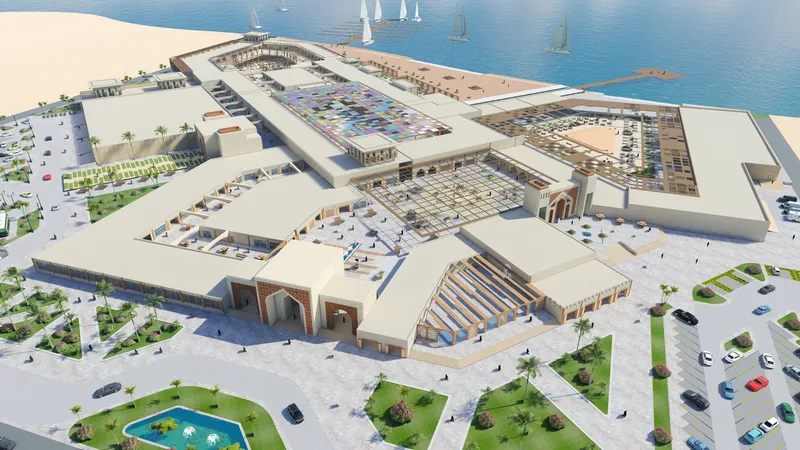
The selected site occupies a strategic waterfront location in El-Quseir, positioned between major circulation routes connecting Safaga and Marsa Alam. The urban analysis demonstrates how the site acts as both a local destination and a regional gateway.
The design carefully responds to movement patterns, transportation access, land use, and environmental conditions. Multiple entry points organize circulation into primary and secondary pathways, ensuring accessibility while maintaining spatial clarity.
The site planning strategy introduces a strong central axis that connects the inland urban fabric directly toward the Red Sea waterfront. This gesture reinforces visual connectivity and creates a sequence of public spaces that gradually transition from urban density to open coastal experience.
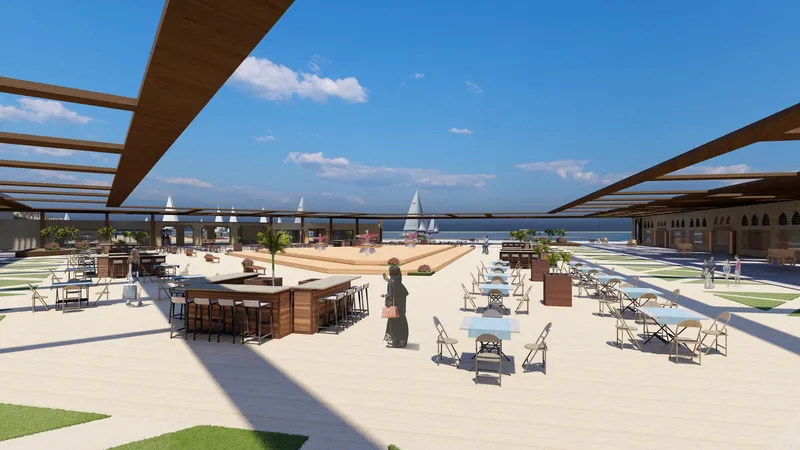
By extending activity toward the sea, the project transforms the waterfront into an active civic interface rather than a disconnected edge. Public plazas, outdoor seating, promenades, and viewing areas encourage continuous engagement with the surrounding landscape.
Climate Responsive Commercial Architecture
Environmental responsiveness plays a central role in the project’s architectural language. Given El-Quseir’s hot desert climate and coastal conditions, the proposal incorporates several passive design strategies inspired by vernacular architecture.
Wind studies and environmental analysis informed the orientation of masses and open spaces. Courtyards and ventilation towers are strategically placed to improve airflow and thermal comfort. Semi-shaded walkways and wooden canopy systems reduce direct solar exposure while preserving openness and visual continuity.
Traditional passive cooling systems such as Malqaf Hawa ventilation elements are reinterpreted within a modern architectural framework. The project also integrates shading screens inspired by local mashrabiya patterns, creating filtered light conditions while enhancing façade identity.
These strategies reduce dependence on mechanical cooling systems while reinforcing the sensory qualities of the architecture. Shadows, airflow, texture, and light become active spatial components throughout the project.
Spatial Organization and Public Experience
The Commercial Entertainment Mall is organized around interconnected public courtyards and circulation loops that encourage exploration and interaction. The design avoids the closed and inward-focused nature of conventional shopping malls. Instead, it creates an open civic environment where commercial spaces merge with cultural and recreational experiences.
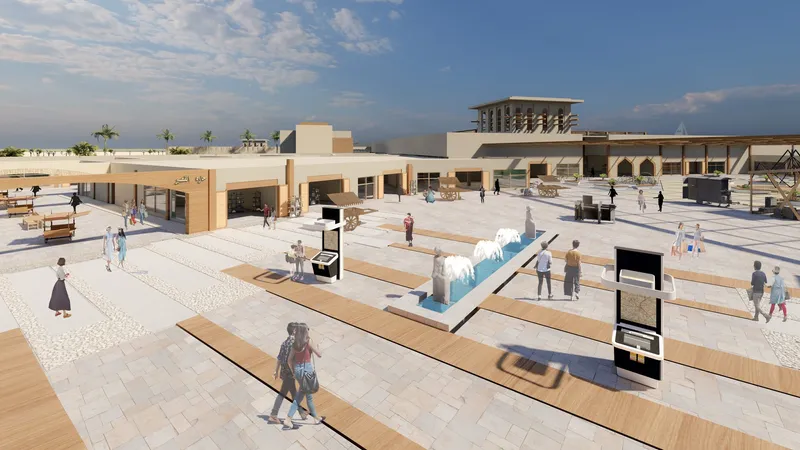
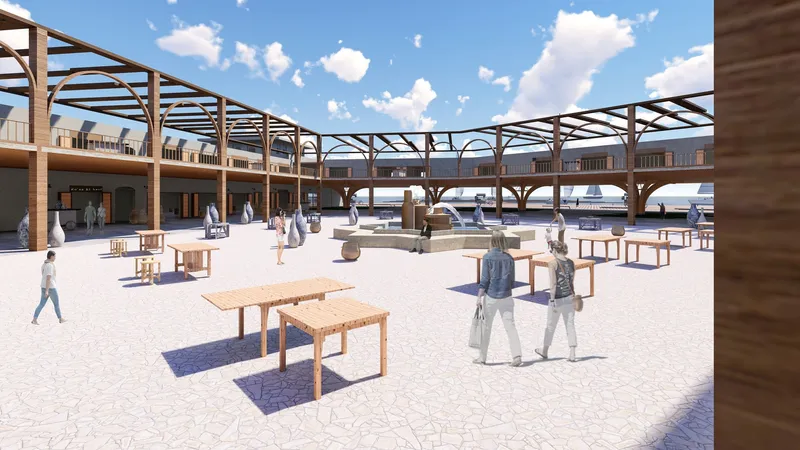
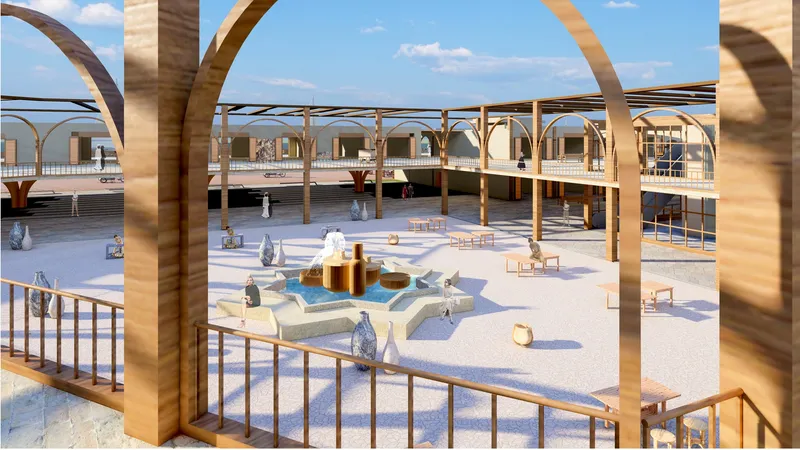
The ground floor accommodates retail units, food courts, exhibition spaces, administration areas, and public plazas. The central courtyard acts as a communal gathering zone featuring water elements and seating areas that activate the public realm.
The first floor expands commercial activity while introducing elevated circulation routes and shaded walkways overlooking the main public spaces below. The layered circulation system enhances visual interaction between levels and encourages movement throughout the complex.
Entertainment functions are integrated strategically within the masterplan. Outdoor performance zones, cultural event spaces, and exhibition areas allow the project to host community gatherings, local markets, and festivals.
This mixture of uses transforms the development into more than a retail center. It becomes a social and cultural platform capable of strengthening urban life within El-Quseir.
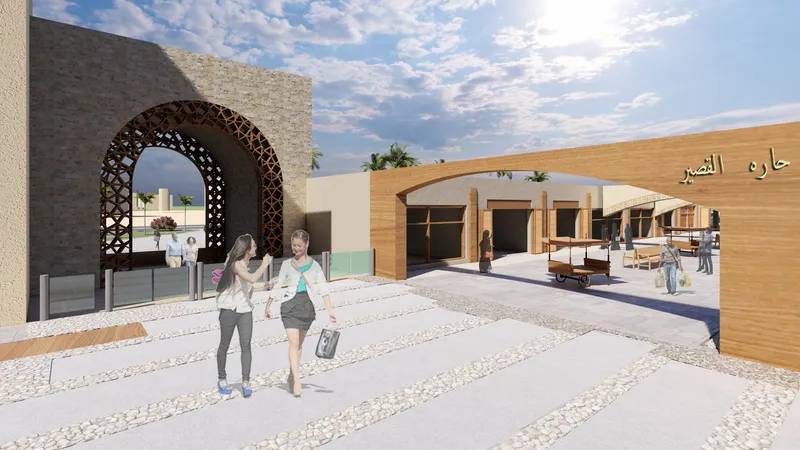
Traditional Architecture Reimagined Through Contemporary Design
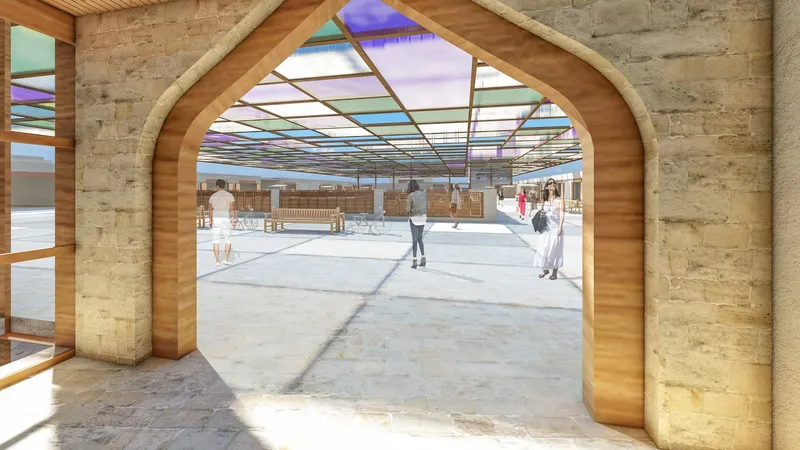
The architectural language of the project is heavily influenced by traditional Red Sea settlements and local construction patterns. The use of arches, repetitive wooden structures, narrow corridors, and internal courtyards reflects the spatial qualities found within historic urban districts.
The proposal modernizes these elements without losing their original cultural significance. Wooden structural systems are reinterpreted as large-span canopy structures capable of providing shade and spatial rhythm across commercial corridors and gathering areas.
The project’s façade treatments and shading devices reinterpret traditional patterns into contemporary architectural screens. These interventions improve environmental performance while creating a visually recognizable identity linked to local heritage.
The marketplace typology also plays a significant role in the design. Inspired by traditional souqs, the circulation paths mimic the layered experience of historic market streets. Visitors move through shaded passages, open courtyards, and interconnected plazas that recreate the atmosphere of local urban life.
This architectural strategy allows the project to feel integrated with the city rather than imposed upon it.
Structural and Technical Systems
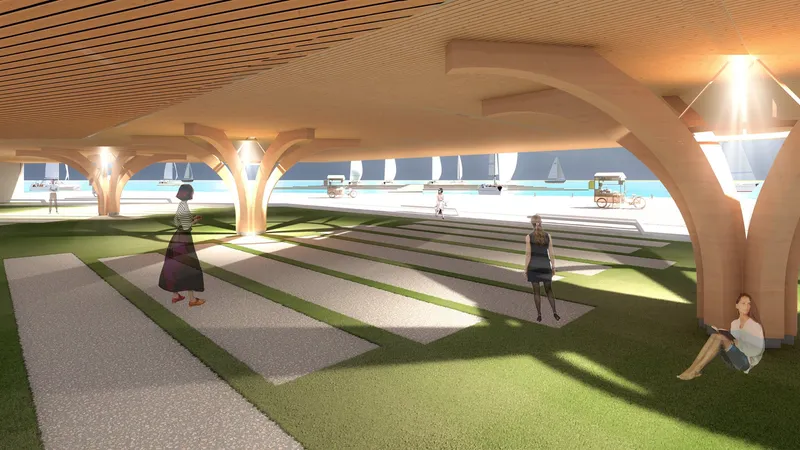
The project combines reinforced concrete systems with expressive wooden structural components. Large wooden canopies supported by branching column systems create shaded transitional spaces throughout the complex.
These structural interventions contribute both environmentally and aesthetically. The tree-like wooden supports reduce visual heaviness while reinforcing the project’s organic and human-scaled spatial character.
Glass walkways and lightweight bridging elements further enhance circulation and visual connectivity across the waterfront site. The integration of water features beneath elevated pathways creates cooling effects while reinforcing the relationship between architecture and landscape.
The technical systems are carefully integrated into the architectural language rather than concealed. Ventilation towers, shading systems, circulation bridges, and structural components become visible design elements contributing to the project’s identity.
Public Realm and Community Engagement
Beyond commercial functionality, the proposal prioritizes public life and community engagement. The open plazas, waterfront walkways, performance areas, and exhibition zones create opportunities for social interaction across different age groups and user types.
The project acknowledges that successful commercial architecture in historic urban contexts must support both economic activity and collective identity. By integrating entertainment, public events, cultural programming, and local commercial opportunities, the design strengthens the relationship between residents, tourists, and the city itself.
The use of open-air circulation and flexible gathering spaces also allows the project to adapt to seasonal activities and varying event scales.
Importantly, the project avoids privatizing the waterfront. Instead, it reinforces public accessibility and transforms the coastal edge into an active social landscape.
Reinterpreting the Future of Commercial Architecture in Egypt
The Commercial Entertainment Mall demonstrates how commercial architecture can move beyond consumption-oriented environments and become a catalyst for cultural continuity and urban revitalization.
The proposal positions architecture as a mediator between heritage and modernity. Through climate-responsive design, contextual materiality, and culturally rooted spatial organization, the project establishes a contemporary commercial destination deeply connected to the identity of El-Quseir.
Its integration of public space, entertainment, tourism, and local commerce presents a holistic approach toward waterfront development in historic coastal cities.
By drawing from traditional urban patterns while introducing modern architectural systems, the project creates a model for sustainable and culturally responsive commercial architecture in Egypt.
A Contemporary Landmark Inspired by El-Quseir
Rather than replicating international retail typologies, the Commercial Entertainment Mall celebrates the uniqueness of El-Quseir through architecture that emerges from place, climate, and culture.
The project transforms local architectural heritage into a contemporary civic experience capable of attracting tourism, supporting economic growth, and strengthening public life along the Red Sea coast.
Through its layered courtyards, shaded public spaces, waterfront connections, and reinterpretation of traditional forms, the proposal demonstrates how architecture can preserve identity while embracing future urban needs.
Developed by Alexandria University and Norhan Moussa, this shortlisted Commercial '20 entry presents a compelling vision for culturally rooted waterfront architecture that prioritizes both community and experience.



Popular Articles
Popular articles from the community


Co-life: Sustainable Architecture for Age-Friendly Community Living
Co-life reimagines sustainable architecture for seniors through courtyards, rammed earth, shared gardens, and spaces designed for belonging.

AL-JANNAH: Sustainable Architecture and Permaculture for Afghan Widows
AL-JANNAH uses sustainable architecture and permaculture to create resilient oasis of housing, learning, work and renewal for Afghan widows.
EW PARK: Sustainable Architecture Reimagines the Future of Urban Parking
EW PARK reimagines city parking as a modular wooden tower combining automation, solar energy, electric mobility, and adaptable urban design.

The Ocean Hive: Sustainable Architecture for a Self-Sufficient Civilization at Sea
The Ocean Hive imagines sustainable architecture at sea, where modular habitats, algae, wave power and ocean waste sustain a growing colony.

Similar Reads
You might also enjoy these articles

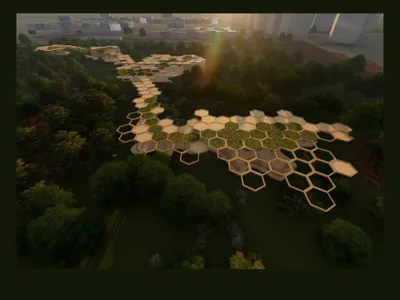
Eco Chapel: A Green Architecture Pavilion Designed in Symbiosis with the Forest
Eco Chapel uses green architecture to weave prayer, learning and reuse into a forest pavilion shaped by modular hexagonal canopies for life.
Kaffeebühnen: Coffee Shop Architecture Designed as a Civic Stage Between Vienna’s City and Park
Kaffeebühnen turns coffee shop architecture into a civic stage, linking Vienna’s park edge, urban life, warm timber yards, and coffee craft.
Healing Façade: Sustainable Architecture for Reforestation, Community, and Sacred Ecology in Ethiopia
Healing Façade reimagines sustainable architecture as a living wall that restores soil, catches water and renews Ethiopia's forest churches.


Urban Forest: A Vertical Ecosystem for 5,000 Workers in Singapore's Changi Business Park
Radially stacked pods and layered green decks turn a 7-acre plot into 47 acres of ecological workspace projected for 2040.
Comments (0)
Please login or sign up to add comments
No comments yet. Be the first to comment!