
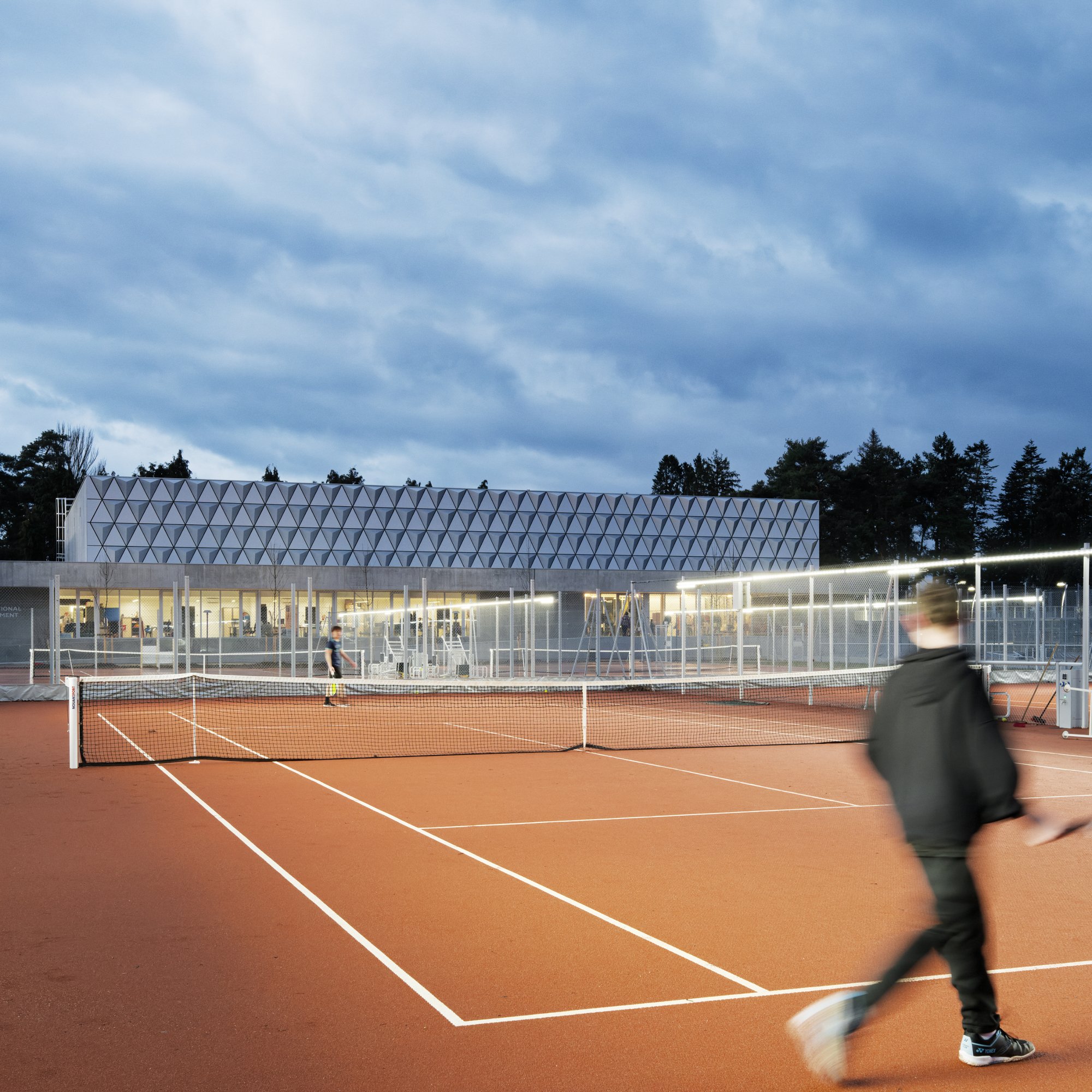
Comte and Vollenweider Rebuild a Century-Old Tennis Club on the Shores of Lake Allier
Sporting Vichy replaces a dated indoor hall with timber-braced pavilions facing a UNESCO-listed riverbank in central France.

The original Sporting Vichy courts were inaugurated in 1923, set on a 3.5-hectare site between the towns of Vichy and Bellerive-sur-Allier. A century later, the complex was tired: an old hall housing three tennis courts no longer matched the ambitions of a site that now faces a UNESCO World Heritage-listed riverbank. Comte and Vollenweider, led by Stéphane Vollenweider, demolished that hall and replaced it with two new volumes, expanding the program to include 12 padel courts and 13 tennis courts across indoor and outdoor configurations. At nearly 5,000 square meters, the project is the latest chapter in a broader campaign to reclaim the Allier waterfront, following renovations of the right bank in 2014 and the left bank in 2019.
What makes this project worth studying is not its program, which is standard enough for a racquet sports facility, but the way the architects treat structure as ornament without pretending otherwise. The diagonal timber bracing that holds up the halls is left fully visible through floor-to-ceiling glazing, creating a graphic layer that reads from the exterior as pattern and from the interior as warmth. The buildings sit low and horizontal against a landscape of mature conifers and clay courts, deferring to the parks across the water rather than competing with them.
A Waterfront Posture
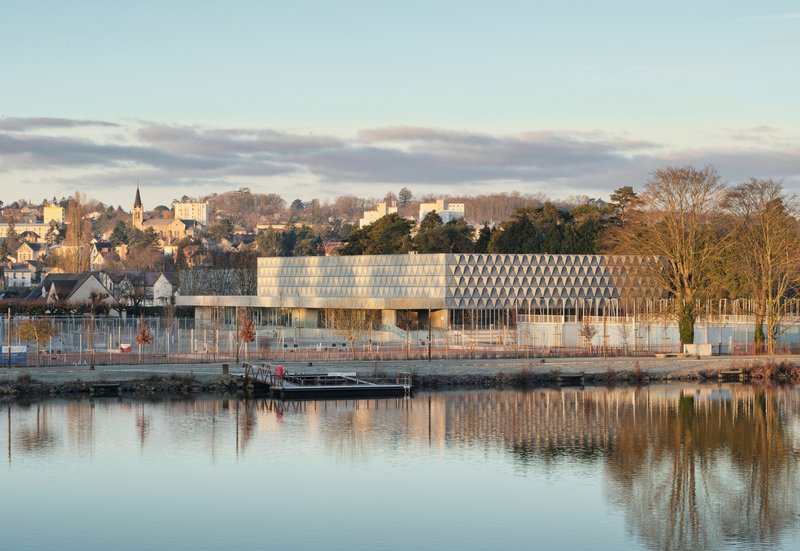
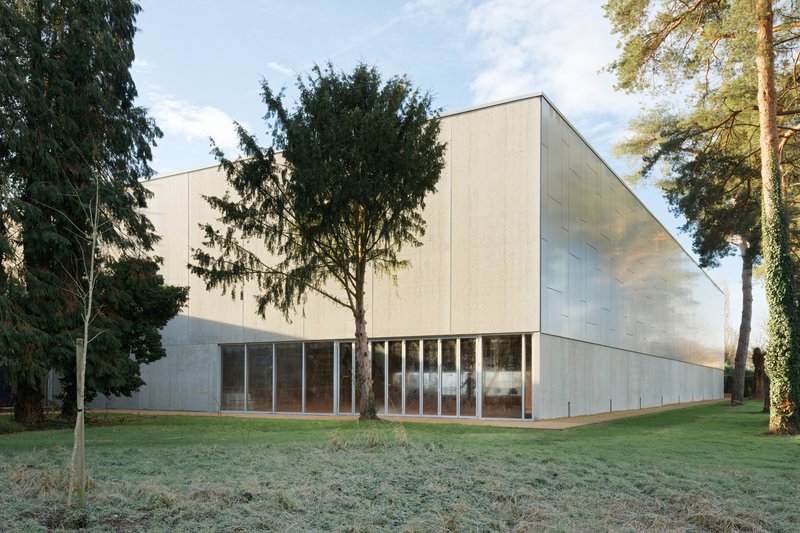
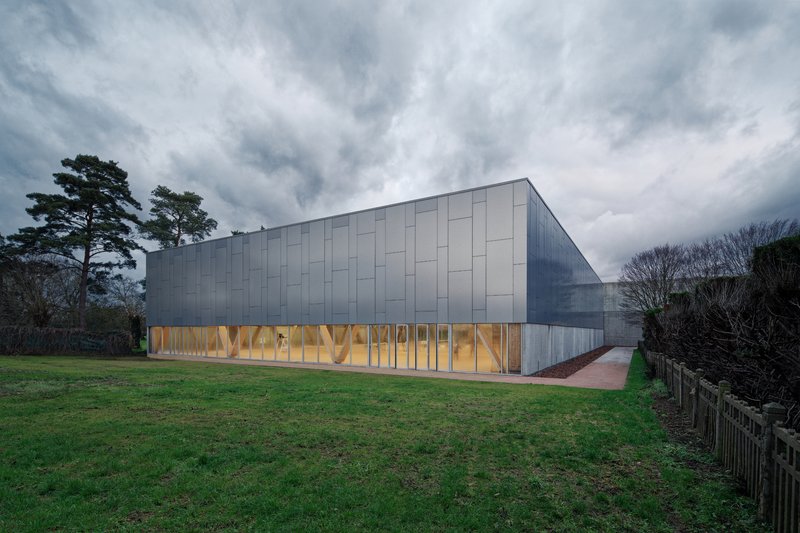
The building's primary gesture is horizontal restraint. Seen from across Lake Allier at dusk, the long facade barely rises above the tree line, its pale cladding reflecting in the still water like a second ground plane. The architects took the site's existing "classic" composition as their baseline, then introduced subtle shifts and offsets to keep the new work from feeling like a replica. Rather than a single monolithic block, the program is split into two halls that face each other across tree-lined walkways, allowing the landscape to penetrate the complex instead of being pushed to its edges.
At dawn, with frost on the grass and mist over the river, the metal-clad volumes read almost as agricultural structures. That is a compliment. The proportions are right for this terrain: long, low, and quiet beside the conifers that anchor the site.
Timber Bracing as Identity
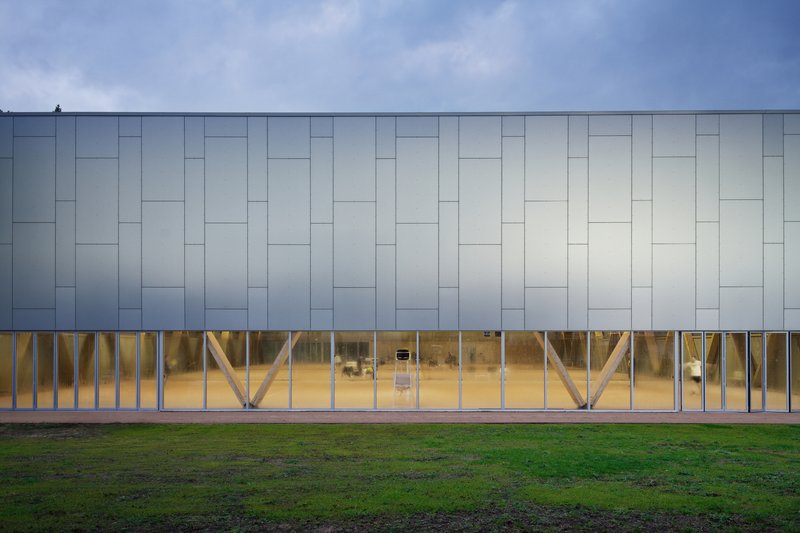
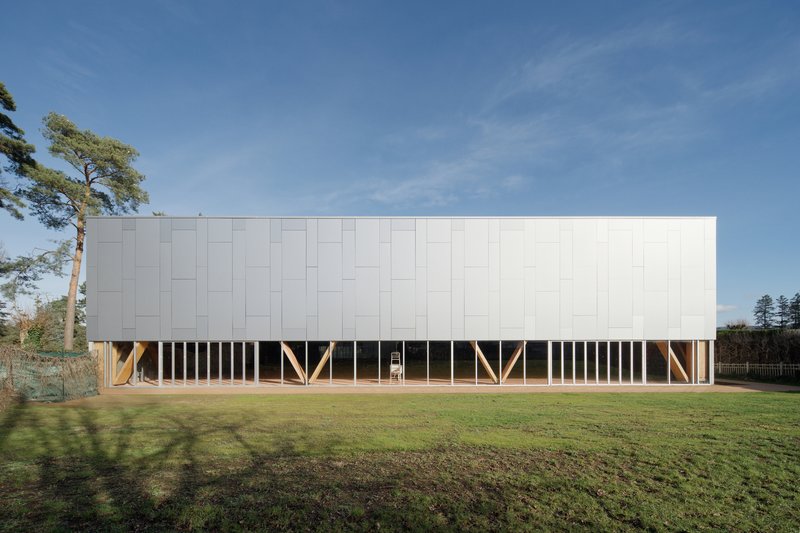
The defining detail of Sporting Vichy is the diagonal timber bracing that supports the elevated hall volumes and remains visible through full-height glazing. During the day it reads as a rhythmic lattice of angled members against pale panel cladding. At twilight, when interior lighting takes over, the structure becomes a lantern, projecting the geometry of its own bones outward. One volume sits raised on timber diagonal supports above a manicured lawn, creating a covered ground-level zone that extends usable space without adding built mass.
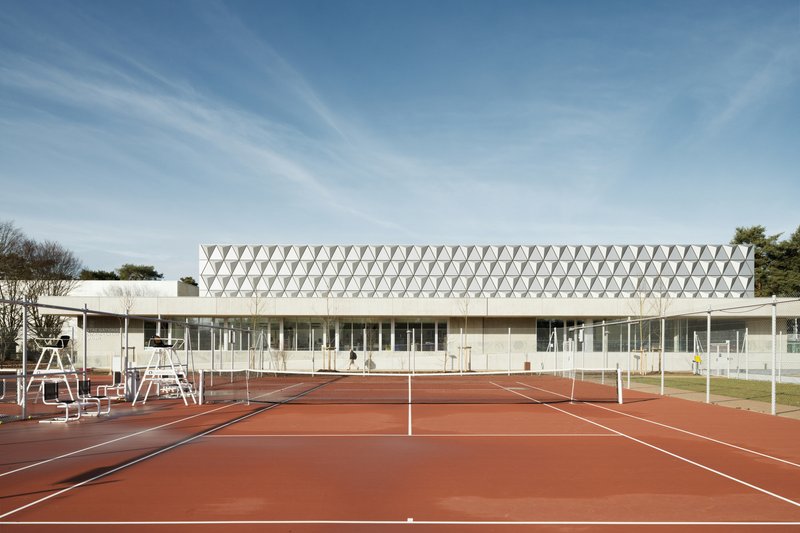
The triangulated roof screen above the main tennis pavilion adds a second register of structural expression. It operates as a sun filter and ventilation zone while giving the building a distinctive silhouette against the sky. The architects did not need to expose any of this. They chose to, and the decision pays off because the timber has enough warmth to keep the industrial vocabulary from feeling cold.
Indoor Courts and Corridors
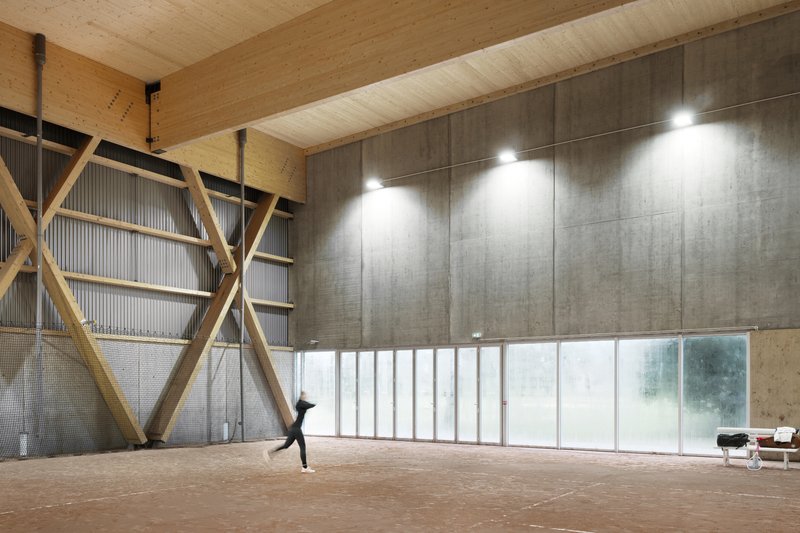
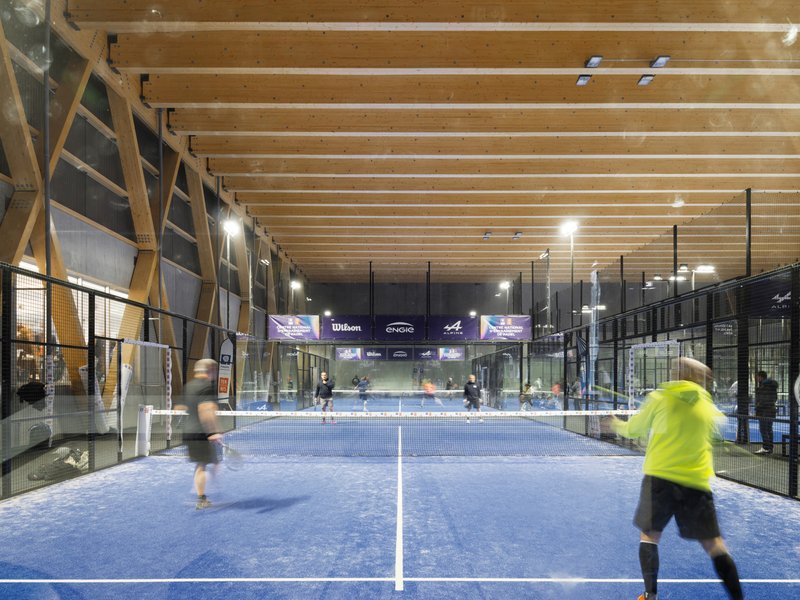
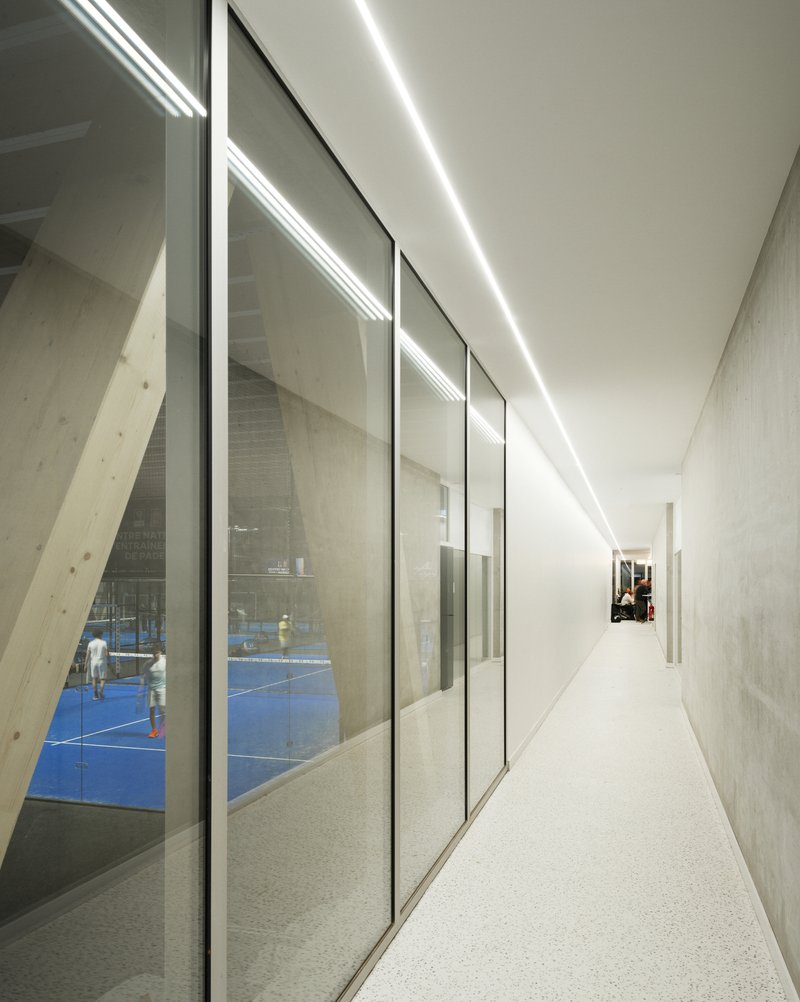
Inside, the wood and concrete palette holds together cleanly. The padel hall, which spans over 2,000 square meters to house six indoor courts, features a timber beam ceiling that keeps the proportions grounded despite the volume's considerable width. Plywood panels line the ceiling of the tennis hall, catching warm light from fixtures embedded in the structure above. A figure walking across the red clay floor in one of these spaces gives the necessary scale: these are tall rooms, but the material grain keeps them from feeling cavernous.
Circulation corridors are treated with equal care. Angled glazing overlooks the courts from a raised walkway, with recessed ceiling light strips providing orientation without glare. The detailing here is precise without being precious: the exposed structure continues through every threshold, so you are never in doubt about what holds the building up.
Landscape and Courtside
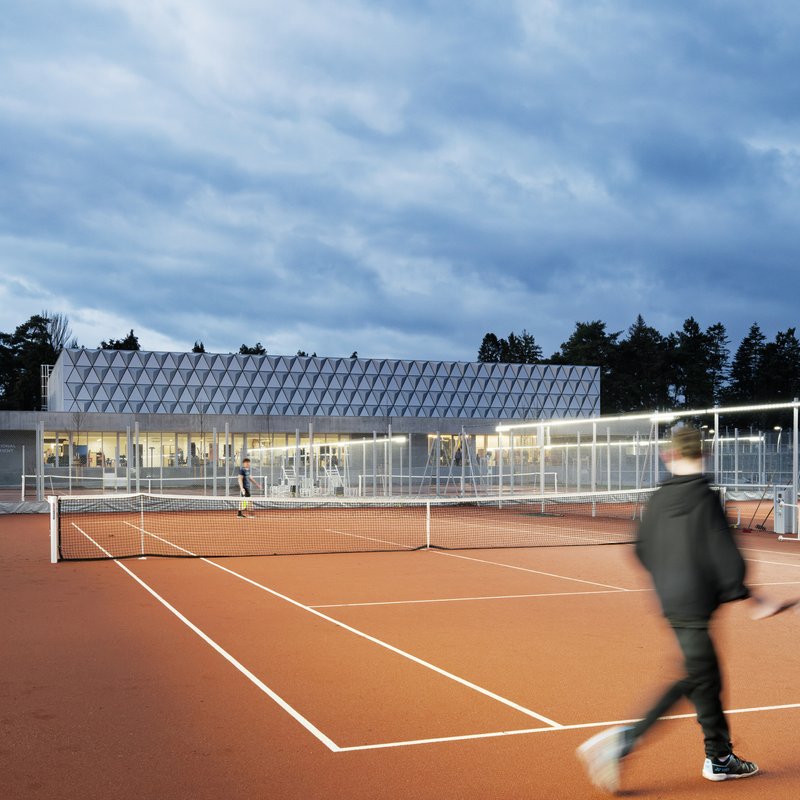
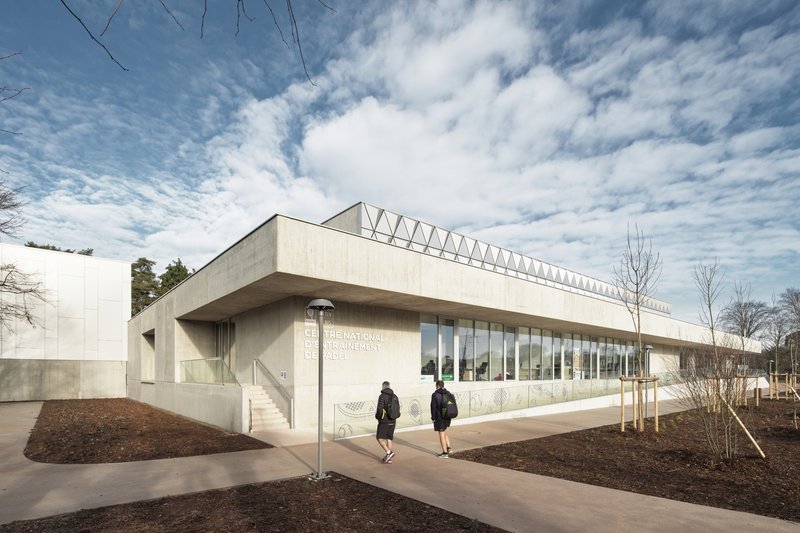
The outdoor courts, including two that meet international standards, occupy the ground between the two halls. From the entry facade, a cantilevered roof overhang marks the threshold with a clean horizontal line, framing the approach without ceremony. The paved path leading to the entrance is deliberately understated. Mature trees, retained throughout the site, do most of the atmospheric work.
The diamond-patterned roof visible above the tennis pavilion at dusk is the project's most photogenic moment, and the architects know it. Players on the clay courts below are silhouetted against warm artificial light while the geometric screen above catches the last blue of the evening sky. It is theatrical, but the theater is earned through the structural logic that generates the pattern.
Plans and Drawings
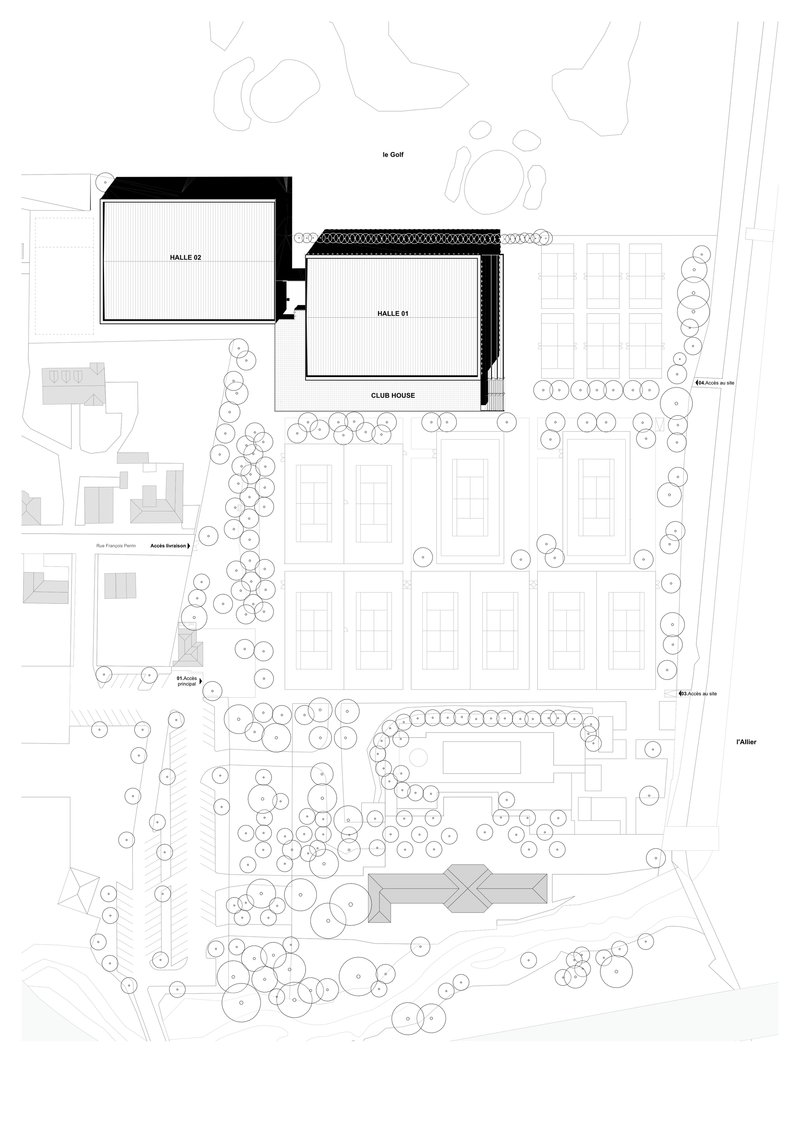
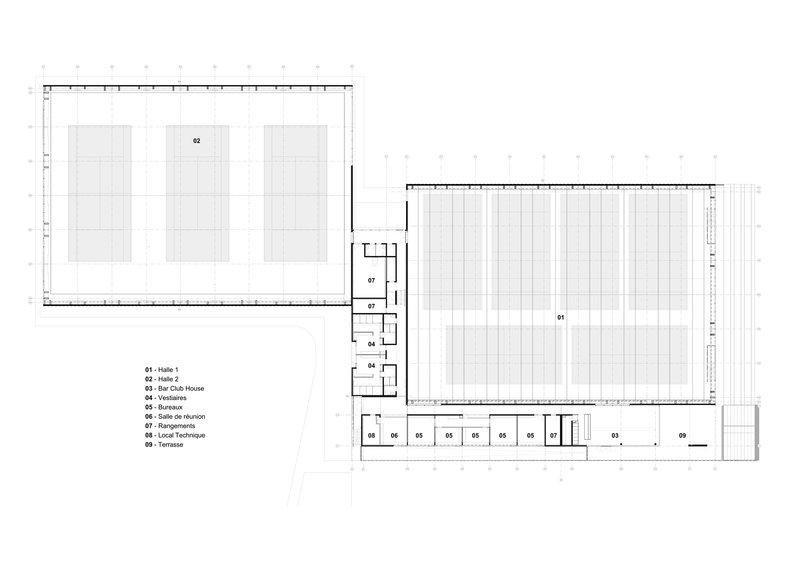
The site plan confirms the split-volume strategy: two rectangular halls sit parallel to each other, flanked by outdoor tennis courts and clusters of existing trees. The floor plan reveals a compact service core that links the two wings, housing the 90-to-100 square meter clubhouse with bar and fast food service. Three rectangular hall volumes are arranged in sequence, with circulation threaded along the long edges to maximize uninterrupted court space.
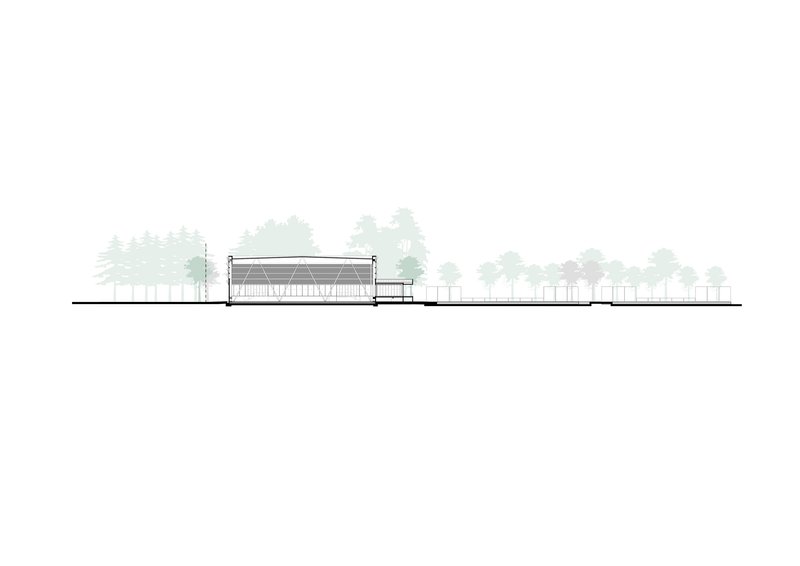
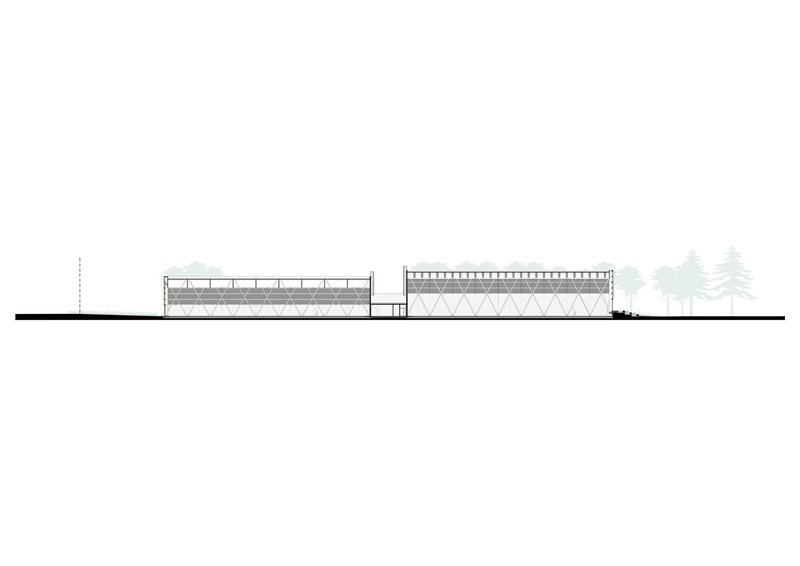
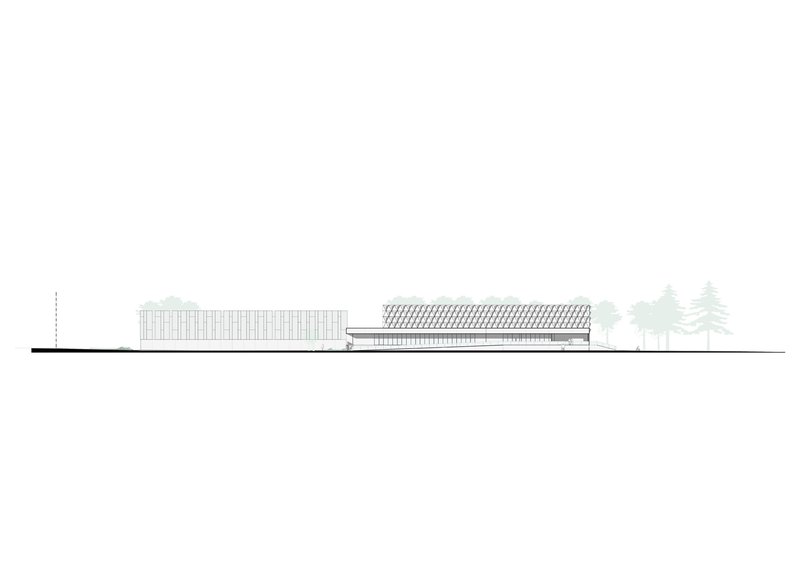
The section and elevation drawings are especially revealing. The section shows just how low the structure sits among rows of trees, its exposed truss roof barely clearing the canopy. The elevations lay out the two volumes side by side, making legible the interplay between vertical and diagonal structural systems and the distinct roofing approaches applied to each hall. One volume deploys a triangulated truss, the other a more regular vertical pattern. The difference creates variety within a unified material and proportional language.
Why This Project Matters
Sports facilities rarely get this level of architectural attention, and when they do, the results tend toward spectacle: oversized cantilevers, branded skins, aggressive geometry. Sporting Vichy goes the other direction. The ambition here is to make a building that belongs to its site as naturally as the century-old clay courts it replaces. By using timber structure as the primary expressive element and keeping the volumes low and bifurcated, Comte and Vollenweider produced a complex that enhances the UNESCO-listed landscape rather than competing with it.
The project also demonstrates that heritage sensitivity does not require mimicry. The original 1923 courts established a classical composition. The new buildings acknowledge that composition through alignment and proportion, then depart from it with contemporary structure and materials. The result is 16 months of construction that settles a 100-year-old site into its next chapter. For anyone working on sports architecture in sensitive contexts, this is a reference worth filing.
Sporting Vichy, designed by Comte and Vollenweider, lead architect Stéphane Vollenweider. Bellerive-sur-Allier, France. 4,974 m². Completed 2026. Photography by Takuji Shimmura.
About the Studio
Share Your Own Work on uni.xyz
If projects like this are the kind of work you want to make, uni.xyz is a place to publish your own, find collaborators, and enter design competitions.




Popular Articles
Popular articles from the community

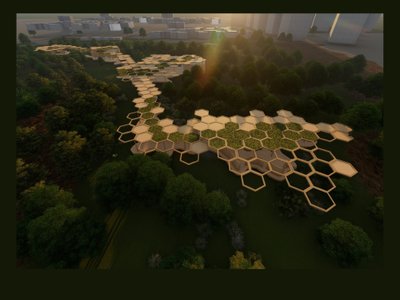
Eco Chapel: A Green Architecture Pavilion Designed in Symbiosis with the Forest
Eco Chapel uses green architecture to weave prayer, learning and reuse into a forest pavilion shaped by modular hexagonal canopies for life.
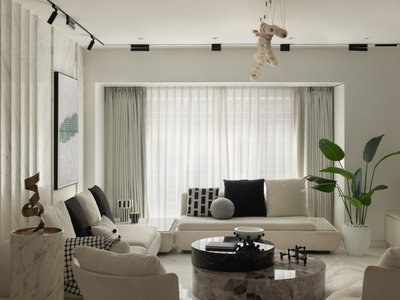
Inside a Timeless Mumbai Residence by Aether Studio
Aether Studio's 2,250 sq ft apartment in Malad, Mumbai uses marble, brass, boucle, and disciplined restraint to build a quiet retreat from the city.

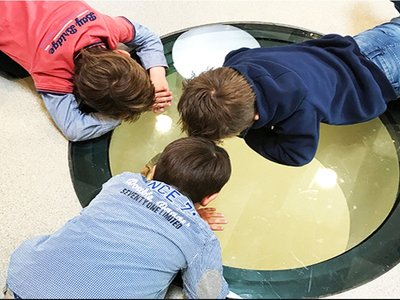
IKC de Geluksvogel: Sustainable School Architecture Designed for Free Movement and Digital Learning
IKC de Geluksvogel turns sustainable school architecture into a flexible Maastricht campus for digital learning, nature, and free movement.
Kerry Kounnapis Packs 800 Daily Coffees into a 43-Square-Metre Melbourne Laneway Bar
Palace Coffee channels Pellegrini's and European standing bars through oxide-red steel and spotted gum timber in a Ridgway Place sliver.


Similar Reads
You might also enjoy these articles
Freebird Residence by Alexis Dornier: A Tropical Modernist Sanctuary in Bali
Floating living pavilion above pool anchors H-shaped tropical villa, blending Japanese minimalism, sustainable strategies, lush landscape, and sculptural interiors.
127af Flips a Tiny Bagnolet Rowhouse Upside Down with a Handcrafted Roof Extension
A 55-square-meter terraced house on the edge of Paris gains a luminous upper living floor through lightweight timber and steel.
1.61 Design Workshop Wraps a 600-Square-Meter Café in Vietnam in Sculptural Burgundy Drama
Reden Café & Bistro pairs a helical staircase, mosaic floors, and deep red interiors to rethink Vietnamese hospitality space.

The Unbound Brain: A School Shaped by Cognitive Architecture
Cylindrical learning pods radiate like neurons from a central cortex, turning the floor plan into a spatial model of human thought.




Comments (0)
Please login or sign up to add comments
No comments yet. Be the first to comment!