

CONQUEST: An Asteroid Mining Habitat That Treats the Production Line as the Heart of a Town
A Leap winner that wraps a factory-style extraction core in work and life zones, growing module by module from the very asteroids it mines.


Most space mining concepts are machines with a few bunks attached. CONQUEST inverts that hierarchy. It accepts the industrial logic of asteroid extraction, borrowing its organisation from factory production lines and terrestrial mining, then argues that the people running that line deserve a place to live rather than a place to endure. The result is a rotating orbital settlement where the extraction core sits at the centre and everything human gathers around it.
Designed by Nicole Li, Kolbie Fung and Hyo Yeon Lee, the project was named a winner of the Leap competition. The brief it sets itself is specific: in 2032, trained professionals travel into deep space to mine asteroids and ship essential minerals back to replenish Earth's diminishing resources. Mining, research, agriculture, living quarters and communal amenities are folded into a single architectural framework, and the team's position is clear: resource extraction is the purpose, but long-term habitability is the measure of success.
A Disc That Hunts Asteroids
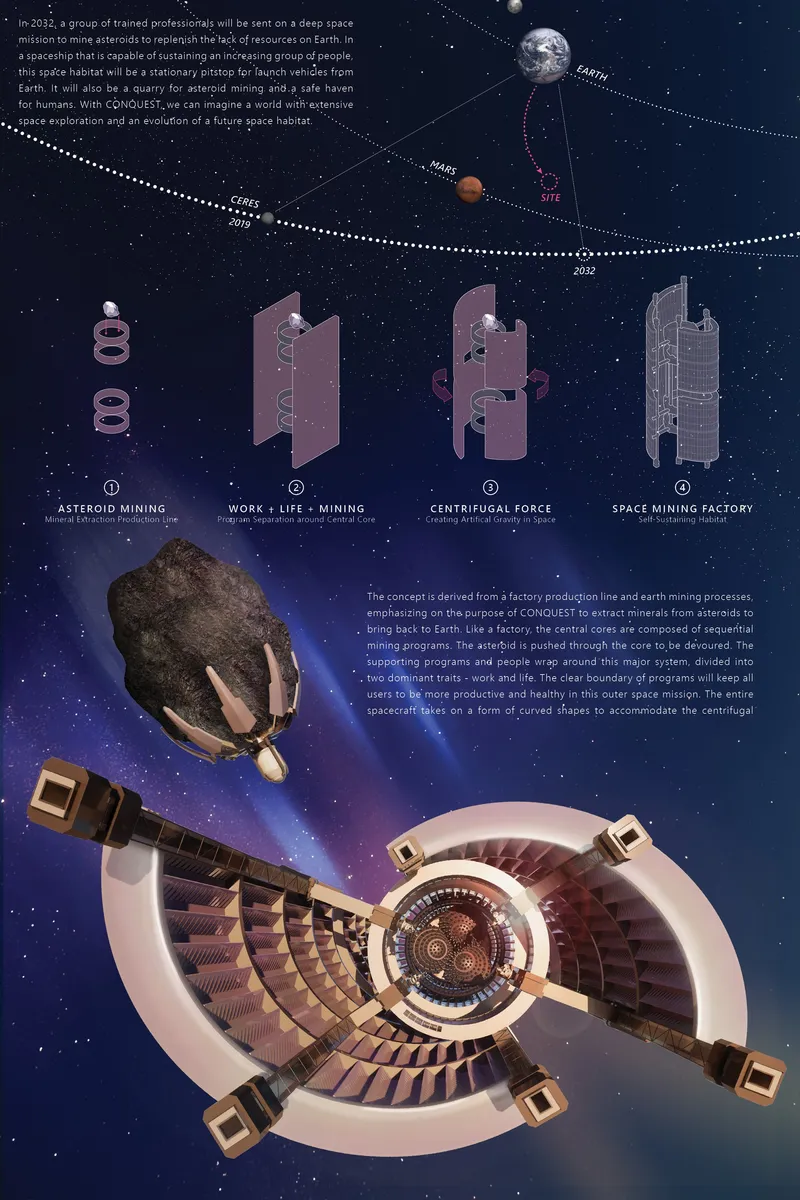
The opening board sets out the premise in four steps and a single dramatic image: a disc-shaped craft closing in on an asteroid against a field of stars. It reads less like a station than a vessel with intent, which suits the mission. The habitat is not parked in orbit waiting for work; its entire form is organised around receiving rock, breaking it down and sending value home.
What the diagram also makes clear is the split that governs the whole scheme. Around the industrial core, programme divides into two zones, work and life. That separation is the project's quiet strength. In an isolated environment where the commute is a corridor, the team uses distance and threshold to protect mental and physical wellbeing from the noise of the production floor.
Building the Habitat Out of Its Own Harvest
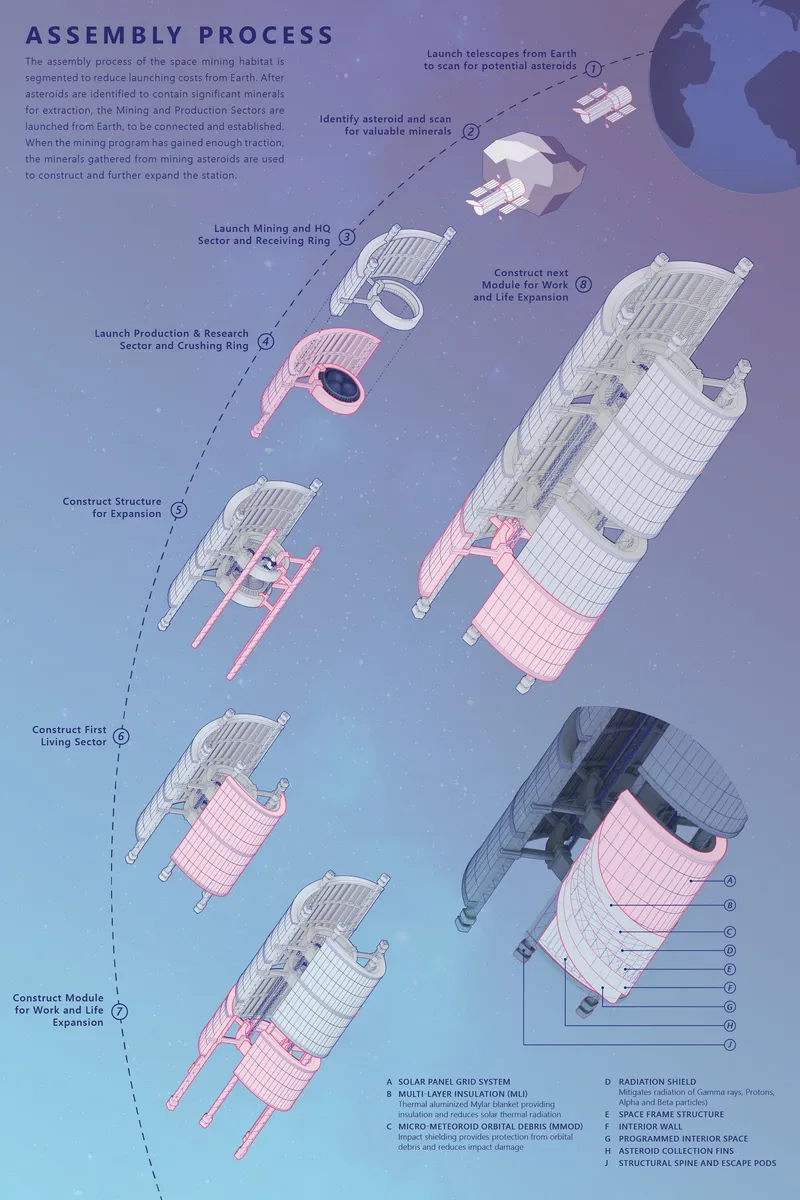
The axonometric sequence is where CONQUEST earns its credibility. Assembly is phased: satellites and telescopes on Earth first identify mineral-rich asteroids, then initial mining and research modules are launched and assembled in orbit. As extraction ramps up, new modules are fabricated from the mined material itself through in situ resource utilisation and 3D printing. The cylinder grows section by section, and the labelled cutaway of the hull at lower right signals that the team considered the envelope as a layered assembly rather than a smooth skin.
The strategy matters because it attacks the real cost of building in space: launches. Each module printed in orbit is one less payload hauled out of Earth's gravity well. It also reframes the station as an open-ended system. Living sectors, research facilities, production areas and communal spaces can keep being added as population and output grow, which positions CONQUEST as a prototype for settlement rather than a fixed outpost.
An Extraction Core Run Like an Assembly Line
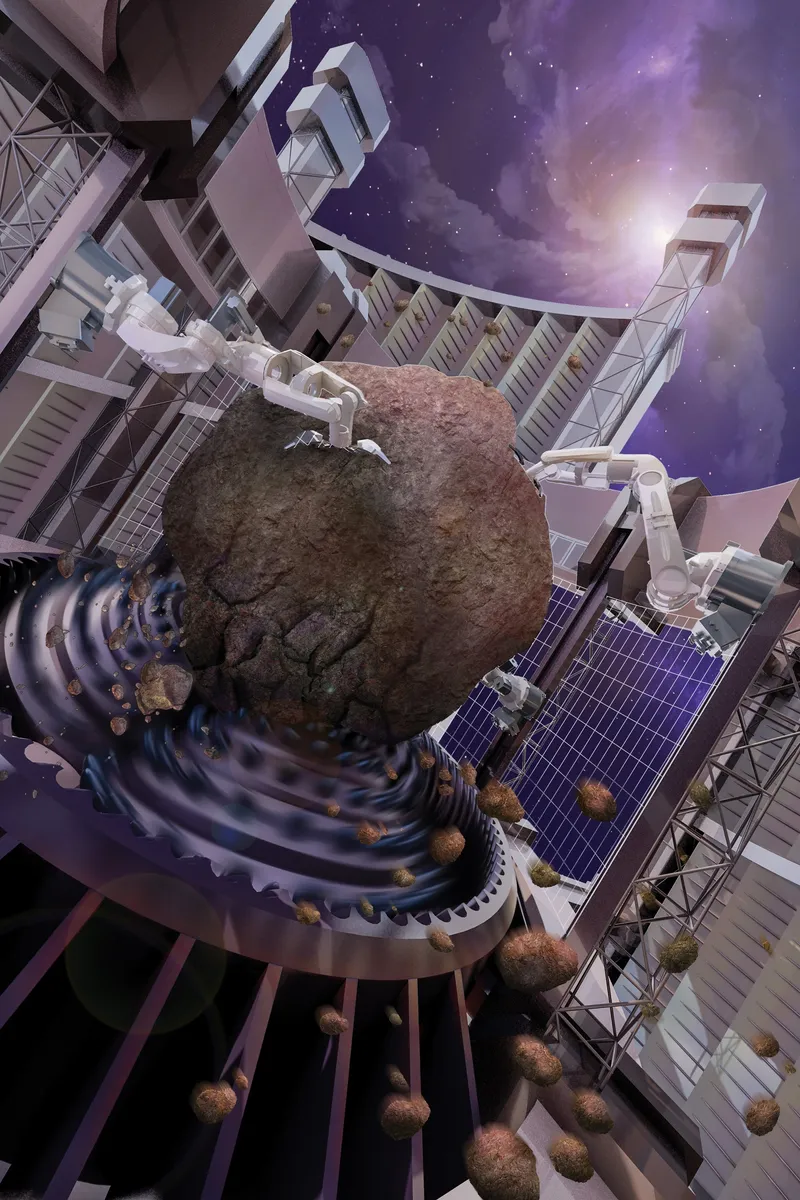
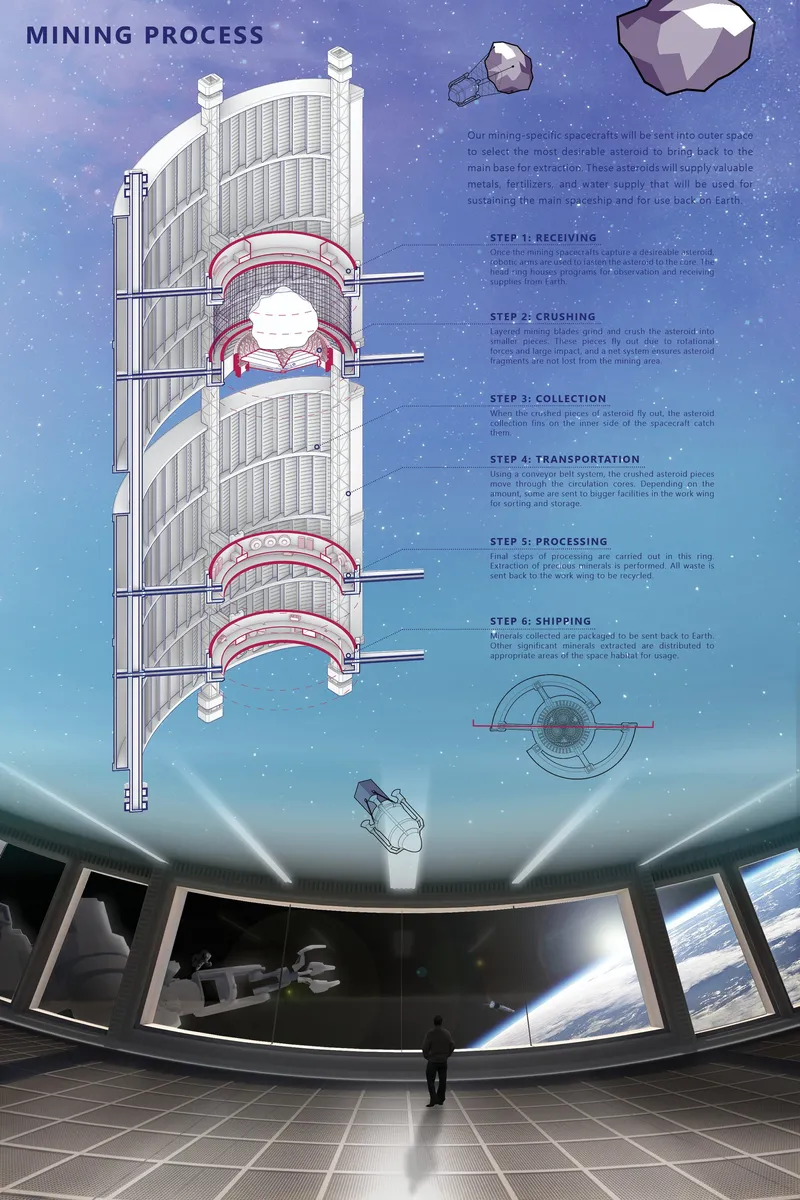
The first rendering is the project at its most muscular: robotic arms grip an asteroid above a spinning crusher ring, with solar arrays framing the scene. The exploded axonometric beside it translates that spectacle into process, breaking the mining sections into six sequential steps through which rock is extracted, refined and distributed. The factory analogy is not decorative here; it dictates the plan, with material moving in one direction through dedicated zones.
Beneath the diagram, a single figure stands on an observation deck facing the Earth. It is a small gesture, but a telling one. The same board that explains how minerals move also reminds the viewer why they are moving: back to a planet that the workers can still see from where they stand.
Curved Corridors Over the Factory Floor
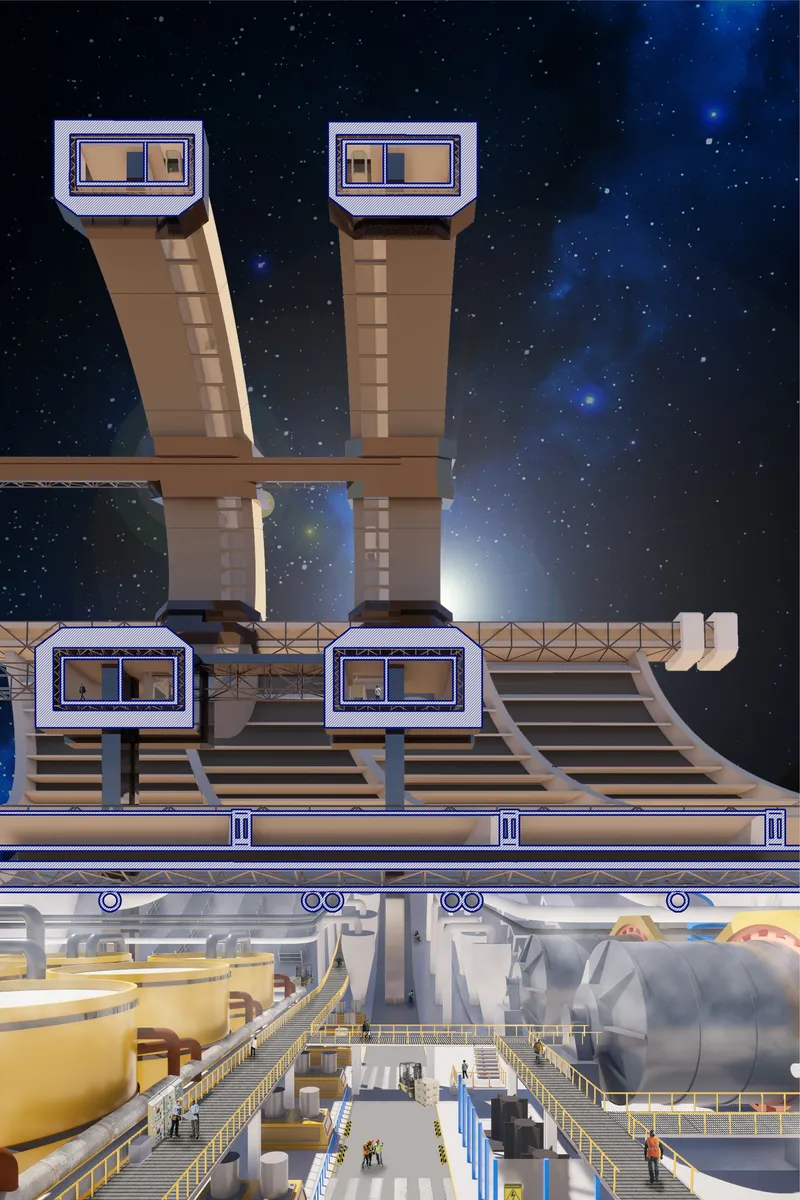
The cross-section shows how the work zone stacks. Curved tubular corridors punctuated by capsule windows run above a factory floor of yellow tanks, catwalks and workers, all set against open space. The curvature is functional. CONQUEST generates artificial gravity through centrifugal force, drawing on spirals and circular systems that rotate, so floors bend with the hull and the outer rim becomes ground.
This is where the designers' attention to the absence of gravity becomes spatial rather than technical. The section gives workers an up and a down, a sense of looking over the plant from circulation above it, and windows that keep the void in view. It is a legible, almost familiar industrial interior, which is precisely the point in an environment that is otherwise anything but familiar.
A Lawn Under Glass at the Edge of the Asteroid Belt
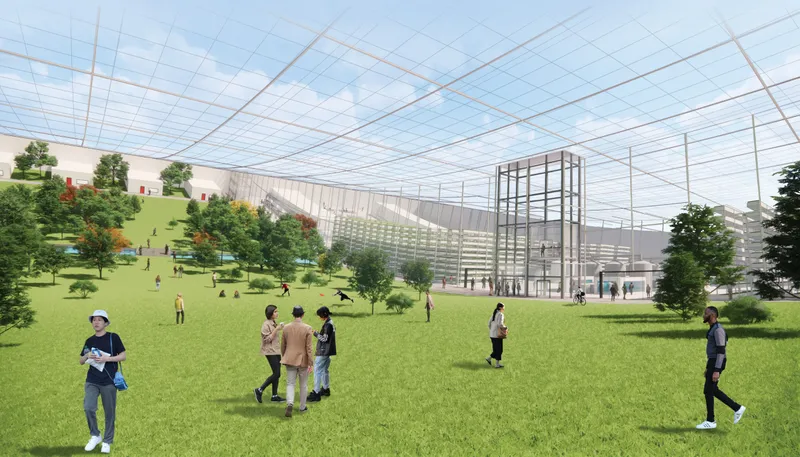
The final rendering is the life zone, and it is deliberately the calmest image in the set. A vast glazed enclosure holds a lawn, scattered trees and a lift tower, with people strolling in daylight. After the crusher rings and catwalks, the contrast is almost startling, and that contrast is the argument of the whole project made visible.
The space also ties back to the programme the team lists: agriculture and communal amenities sitting alongside living quarters. Green, open and social, it is the counterweight to the extraction core, a place designed for rest rather than output. The lift tower is a reminder that this calm is still part of a vertical, rotating machine, connected back to the work that sustains it.
Why This Project Matters
CONQUEST takes the least romantic version of space architecture, an industrial mining operation, and treats it as a serious architectural problem about how people live alongside heavy production. Its clear separation of work and life, its centrifugal geometry and its phased growth from harvested material form a coherent system rather than a collection of futuristic images. Each strategy answers a real constraint: isolation, weightlessness and the expense of launching from Earth.
For a student team, the discipline is notable. The project resists the temptation to make the habitat purely heroic and instead asks what a worker needs at the end of a shift: a window, a sense of ground, a lawn, a view of home. If extraterrestrial settlement does begin with resource extraction, as many expect it will, CONQUEST makes a persuasive case that the first space cities could grow out of factories, provided architects insist on the town around them.
View the Full Project
About the Designers
Designers: Nicole Li, Kolbie Fung, Hyo Yeon Lee
Enter a Design Competition on uni.xyz
uni.xyz runs architecture and design competitions year-round that reward proposals with spatial conviction and real site intelligence.
Project credits: CONQUEST by Nicole Li, Kolbie Fung, Hyo Yeon Lee Leap (uni.xyz).


Popular Articles
Popular articles from the community


GROUP A Strips a 1969 Rotterdam Harbor Headquarters to Its Frame and Wraps It in Timber Louvers
In Rotterdam's M4H harbor district, Ferro Offices reuses a 1969 frame, adds one timber storey and reaches BREEAM-NL Outstanding.

David Ortega Stacks a Two-Story Mexico City Penthouse Around a Steel Stair and a Pergola-Shaded Roof Terrace
In Colonia Roma, a 300 m² penthouse uses oak joinery, a planted steel stair and a slatted roof pergola to make a new-build apartment feel like a house.

David Macias Steps a Doorless Stone and Plaster House Down a Tropical Colombian Hillside
In the humid hills of Colombia, Threshold House replaces the front door with an open void and terraces its 850 m² down the slope instead of fighting it.

Architekt Andreas Gruber Scatters 23 Dark Timber Chalets Across a South Tyrolean Forest Edge
In Molini di Tures, Amonti Chalets breaks a resort into a hamlet of gabled timber houses, with parking, storage and services pushed into the slope.

Similar Reads
You might also enjoy these articles
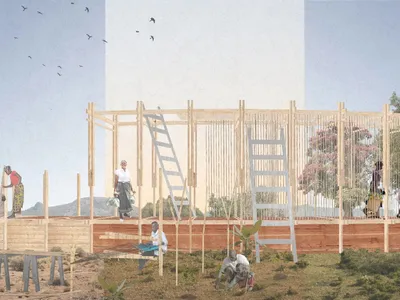
Healing Façade: A Modular Chapel System That Restores Ethiopia's Sacred Forests
Winner of the Eco-Chapel competition, this circular timber façade collects water from air to rebuild soil and reforest degraded Ethiopian landscapes.
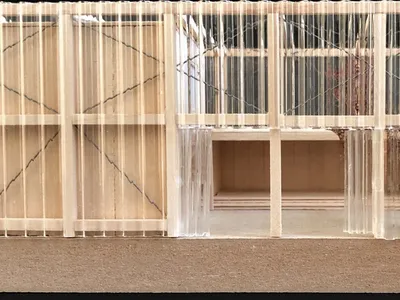
Kaffeebühnen: Where Coffee Shop Architecture Becomes a Civic Stage in Vienna
A linear sequence of timber boxes, transparent shells, and open yards turns the Viennese café tradition into a public performance space.
Eco Chapel: A Modular Forest Pavilion That Grows Like the Landscape It Protects
Hexagonal timber modules weave through existing trees, turning a chapel into a living system for prayer, education, and reforestation.


Urban Forest: A Vertical Ecosystem for 5,000 Workers in Singapore's Changi Business Park
Radially stacked pods and layered green decks turn a 7-acre plot into 47 acres of ecological workspace projected for 2040.


Comments (0)
Please login or sign up to add comments
No comments yet. Be the first to comment!