
CONTAINER CITY
Cyberpunk Container City

What was the concept behind the project?
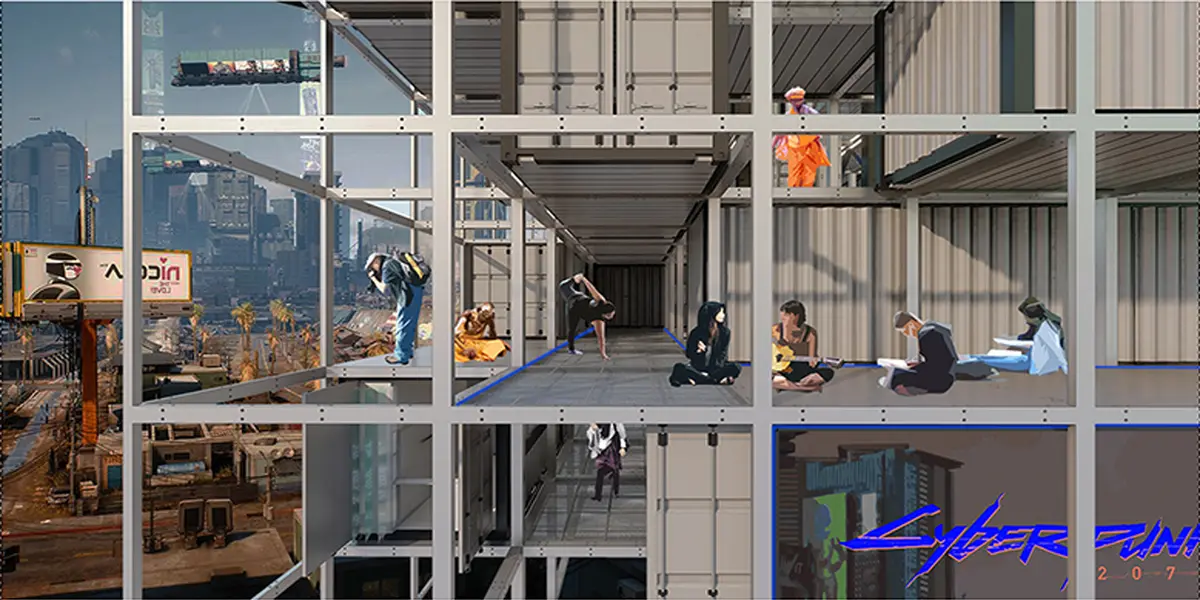
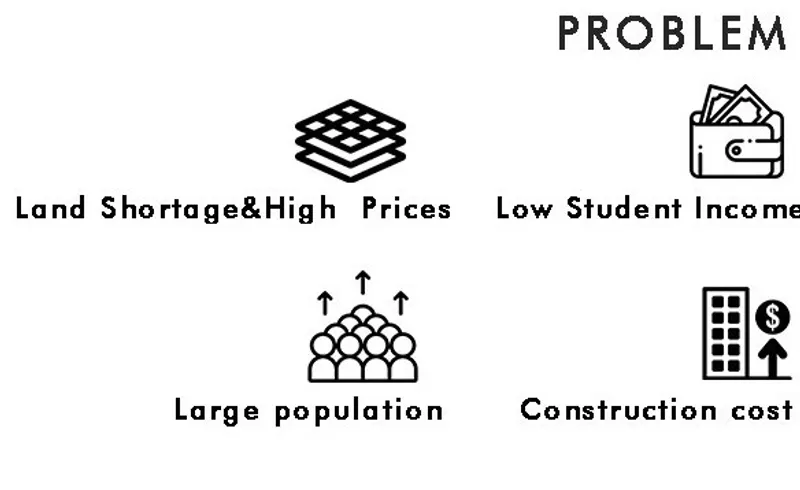
As a result of the scarcity of land and the increase in construction costs in today's cities, people sought alternative solutions. One of these solutions is containers that offer ease of use with their modular structure.Containers have emerged as a solution to the growth and development needs of cities. And it played an important role in the formation of cities. The relationship between city and container is linear. The more it grows, the more containers are needed. The recycling and reuse of the remaining containers that completed the shipping task were included in the design process. The container city project has proposed the reuse of cranes in the reuse process of containers. With the use of the crane, the project is planned to be in a addible & removable structure that can be added to the increasing need in the coming years. With the crane being under the control of the structure, an open-ended, unplaned process was left for the coming years, and it was aimed to include the users in the construction process.
What was the intent behind the organization of elements across various levels?
This project allows 24 students to live. The residential units at various levels are provided with vertical circulation with a glass elevator. 15 containers are placed in different positions in a steel structure. In vertical layout, the container at the lower level has formed the surface for the upper level container. In this way, an extra surface was not included in the project. The horizontal circulation is provided by adding the minimum surface. Openings in the construction provide experience between elevations.

What/How were the materials chosen?
The steel structure where the containers will be placed was used. This steel structure is compatible with the cyberpunk concept. Door and window openings opened from the containers were produced from cut container parts. A transparent transition between floors in vertical circulation was achieved by choosing a glass elevator. It was turned into a digital advertising board with the LED panels placed on some of the exterior facades of the containers. Laminate flooring was used in residential containers. Containers are supported with insulating material. The specially designed furniture unit in the interior is made of wood.
How many iterations were tried to arrive at the final outcome?
A number of conceptual models were developed during the design process. As a result, one house typology of 40 'x 8' x 8'6 "and 20 'x 8' x 8'6" was produced. In total, 11 of 40 'x 8' x 8'6 '' sized containers and 4 of 20 'x 8' x 8'6 '' sized containers were used. It has a footprint of 154.97 square meters.
Which methods of design investigation?
During the design process, future city constructions were focused. In this process, the films Blade Runner 2049 and Metropolis, the video game of Cyberpunk 2077 were inspired. We improved our design through the cyberpunk city concept.
How was a specific objective attempted to be met?
The aim is to offer the user an economical life where containers are used wherever the crane can go. In this context, in order to provide the students with the maximum quality of life, only LED panels were added to the outside of the container and insulation was made inside and a unit was designed to meet the basic needs.
What is the expansion plan of the project?
Our project is designed to achieve a vertical growth, taking into account the problem of future high-rise construction. These cranes, which are involved in the construction of high-rise buildings, have taken place in the usage process of our project. Our project, which can be applied anywhere in the world, can expand vertically in the future wherever there is a crane. In this context, it has eliminated the site problem, which is one of the future scenarios.
How will the project transform with the passing time? etc.
In the future, due to the increasing population in metropolises, the horizontal architecture can no longer be observed due to the inadequacy of residential areas and they turn into vertical cities. And as a result of the increase in house rental fees, the lower segment society will have difficulties in providing even the most vital need for housing. Therefore, students will find it difficult to find a living space. Since our project can grow vertically, it can grow by adding the required amount of containers to the steel construction in the future with the crane. You can see this growth on the presentation board.


Popular Articles
Popular articles from the community


Manzana Morphosis: Stretching Barcelona's Grid into a Living Landscape for 2050
A radical reworking of the Eixample manzana turns density into a tool for generous public space, vertical ecology, and environmental performance.

Cloaked Colonization: A Mobile Underwater Habitat That Moves Like a Fish
Micah Abaya's shortlisted EHC Pacific entry reimagines ocean settlement as a dispersed network of self-sustaining architectural organisms.

The Amber Palace Opera: A Geological Fiction Surfaces on Tallinn's Baltic Waterfront
Pierre Brillard reimagines a Baltic legend as a public landscape, opera house, and waterfront promenade rooted in Tallinn's coastal identity.

Opera by the Sea Estonia: Three Shells Dissolving Architecture into Tallinn's Coastline
A winning opera house proposal replaces monumental form with interconnected shells that blur the boundary between building, park and Baltic Sea.

Similar Reads
You might also enjoy these articles

Day and Night Park: A Time-Based Urban Newsstand in Beijing
A temporary urban newsstand in Beijing blending travel, light, and reading through poetic colors, compact form, and community-focused design.

Modernist Patio Renovation in El Masnou, Barcelona by Oliver Segura Arquitectura + Cebrià Arquitectura
Modernist patio renovation blending tradition and innovation with a movable pool, leveled floors, and Catalan materials in El Masnou.

Alto Residencial Coop: Cooperative Housing Development in Santiago de Compostela by Carbajo Barrios Arquitectos
A linear cooperative housing complex blending white volumes and perforated metal façades, enhancing community living, natural light, privacy, and urban integration.

Vil Genis School by BPA ARCHITECTURE – Massy, France
Vil Genis School in Massy, France, features sustainable design, south-facing classrooms, community integration, accessible spaces, and modern educational architecture.
Explore Container City Competitions
Discover active competitions in this discipline


Challenge to design mud housing for contemporary communities

Challenge to reimagine the Iron Throne

Photograph architecture without architects

Illustrate the lost glory of Angkor Wat - Render Challenge
Comments (0)
Please login or sign up to add comments
No comments yet. Be the first to comment!