

CONTINUUM: A Waterfront Cultural Ecosystem Woven into Brazil's Coastline
Terraced volumes, circular plazas, and ribbon-like forms merge land and water into a continuous civic and creative framework for Brazil.


What if a coastline could become a sentence that never ends? CONTINUUM takes that question literally, stretching a series of interconnected circular and ribbon-like volumes across a Brazilian waterfront so that architecture, landscape, and water read as one continuous spatial narrative. The proposal refuses the convention of discrete buildings dropped onto a site; instead, it weaves program, topography, and public life into a single flowing armature where a performing arts school bleeds into a civic amphitheater, which in turn extends toward production studios and a working port. The result is a masterplan that treats culture not as a program to be housed but as a current to be sustained.
Designed by Raphael Hiponia, Maxine Panlilio, Ariel Raquitico, and Miguel Ordoño III, CONTINUUM responds to Brazil's designation as the World Capital for Architecture by proposing a climate-adaptive cultural ecosystem on the coast. The project spans five interconnected zones, from a public park and open spaces at the western entry to a port area and visitor center at the eastern edge, each one calibrated to a specific dimension of Brazil's creative identity. Passive ventilation, natural shading, green promenades, and strategic orientation drive the environmental strategy, while the fluid architectural language draws on continuity, rhythm, and the interconnectedness of human activity.
A Ribbon of Volumes Over Turquoise Water
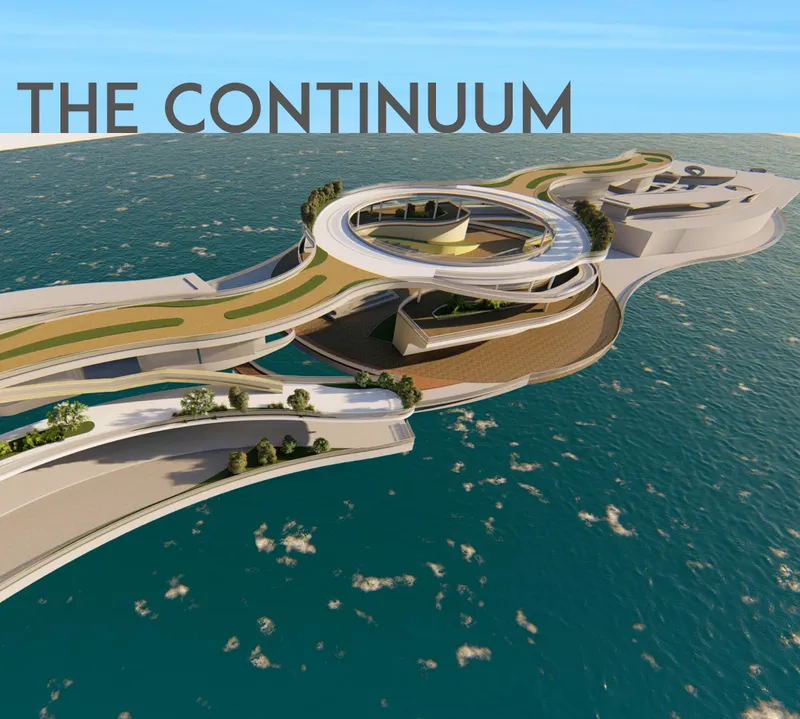
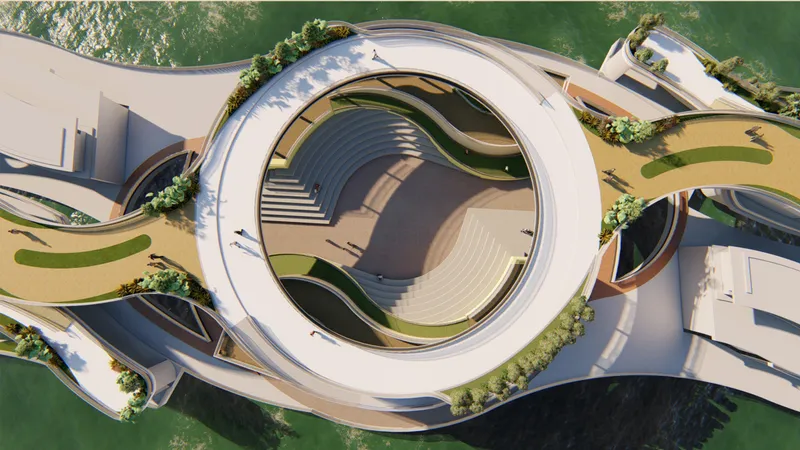
From above, the masterplan reads as a chain of overlapping loops and curving spines that reach out over turquoise water. The aerial view reveals how the designers organized five distinct programmatic zones into a single connective tissue: a generous public park (Area A) at the western entry, a performing arts school (Area B) with integrated indoor-outdoor classrooms, a circular civic center (Area C) at the heart, production stages and creative studios (Area D), and a port area with visitor center (Area E) at the eastern terminus. Elevated walkways stitch these pieces together so that a visitor can move from a shaded promenade through a theater rehearsal space and into a film production studio without ever stepping off the continuous path.
The circular courtyard at the civic center functions as the social and geometric anchor of the entire composition. Conceived as an amphitheater-like open plaza, it hosts festivals, exhibitions, performances, and community gatherings. Planted terraces cascade down its perimeter, softening the built edge and providing tiered seating that faces inward. An elevated promenade rings the space from above, offering panoramic views of both the ocean and the interior plaza, forming what the designers call a "ring of culture" that reinforces community interconnectedness. It is the project's gravitational center, the point where all the ribbons converge.
From Sketch to Spatial Logic
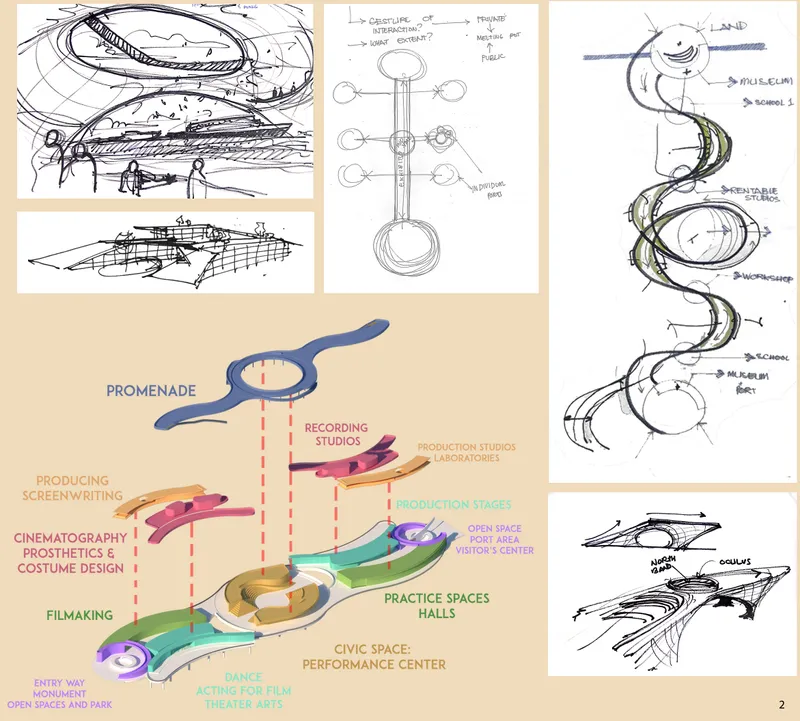
The concept sketches and programmatic diagrams expose the generative logic behind CONTINUUM's fluid geometry. Rather than starting with a fixed footprint, the designers developed the form through a narrative of interwoven master planning: each volume responds to its neighbor, overlapping and rotating to create pockets of public space, sheltered courtyards, and open-air passages. The diagrams trace how the performing arts school's expressive massing transitions into the civic center's circular plan, and how the production stages extend laterally toward the port. It is a useful reminder that the project's organic appearance is not decorative; it is the direct spatial consequence of linking program to movement to coastline.
Cantilevered Roofs and Planted Terraces at the Water's Edge
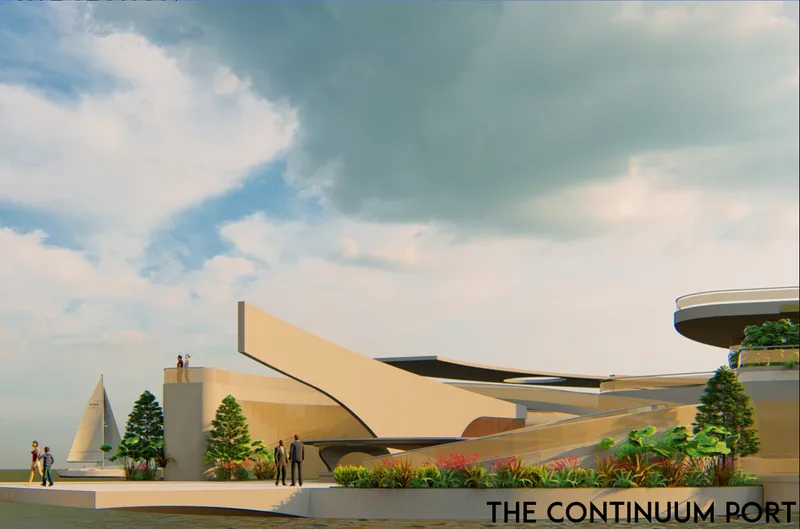
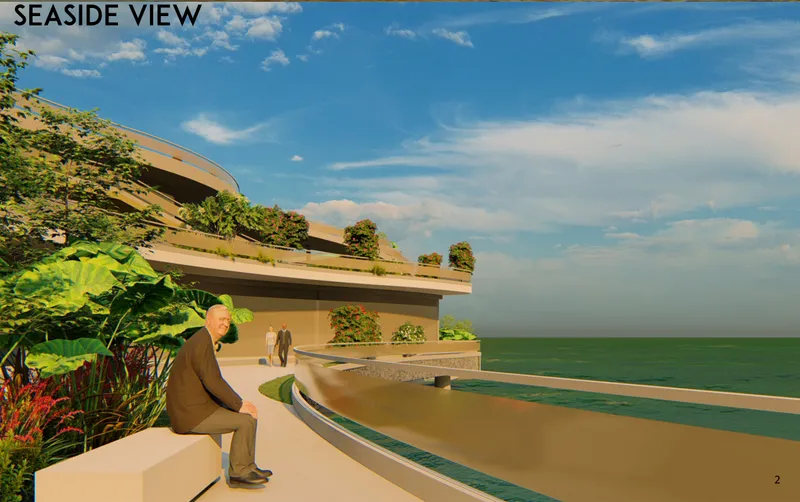
At eye level, the architecture reveals its climate-adaptive strategies with quiet confidence. The waterfront elevation shows a curving cantilevered roof that extends over planted terraces, providing deep natural shading while framing views of the ocean. A sailboat passing in the foreground underscores the scale: these are substantial overhangs, calibrated to block direct sun while allowing breezes to pass through the open structure. The terraced forms step down toward the water, dissolving the boundary between built environment and coastline so that landscape dictates architectural flow rather than the other way around.
The exterior terrace captures the everyday life the project anticipates. Planted beds line the edge, a seated figure looks out toward open ocean, and the horizon is uninterrupted. These are not leftover rooftop spaces; they are deliberate extensions of the green promenades that begin at ground level in the public park and climb through the performing arts school and civic center. The continuity of planted surfaces across multiple elevations supports passive cooling and stormwater management while giving users the sensation of inhabiting a landscape rather than a building.
A Circular Oculus as Interior Sky
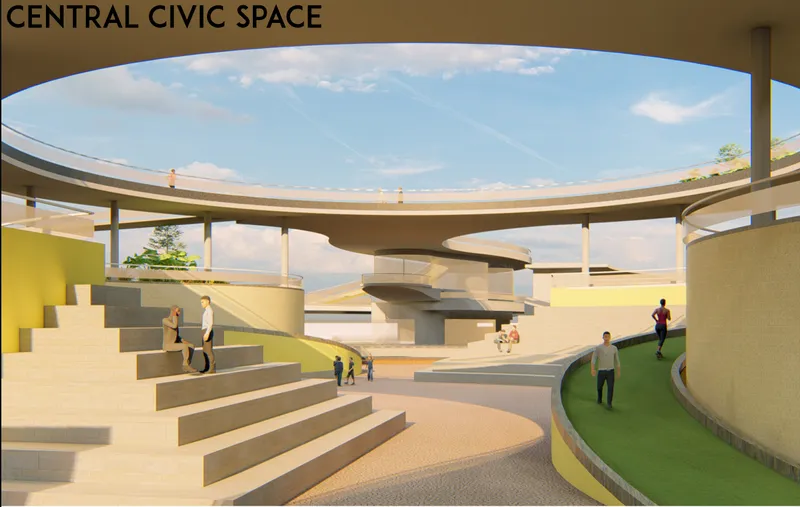
The interior courtyard is perhaps the most spatially charged moment in the project. A spiral staircase winds upward through stepped seating tiers, and at the top a circular oculus opens the roof to the sky, flooding the space with natural light. The geometry is clearly derived from the civic center's amphitheater plan, but here it turns vertical, creating a compressed, almost sacred gathering space within the larger horizontal framework. The oculus simultaneously ventilates and illuminates, reinforcing the passive environmental strategies that run through the entire proposal.
What makes this space convincing is its dual register. It works as an intimate performance venue, with stepped seating and focused sightlines, and it works as an atrium that draws daylight deep into the building section. The spiral staircase adds a kinetic quality, encouraging vertical movement through what could otherwise be a static room. It is the project's thesis compressed into a single interior: continuity, culture, and climate operating as one system.
Why This Project Matters
CONTINUUM demonstrates that large-scale cultural infrastructure does not have to fragment a coastline into isolated objects. By organizing five distinct programs along a single continuous armature, the designers show how a performing arts school, a civic amphitheater, creative studios, a public park, and a working port can reinforce one another spatially and socially. The commitment to passive ventilation, natural shading, terraced planting, and strategic orientation grounds the formal ambition in climate-responsive thinking, avoiding the trap of fluid geometry for its own sake.
For a team of young designers responding to Brazil's role as the World Capital for Architecture, the ambition here is proportionate to the brief. Hiponia, Panlilio, Raquitico, and Ordoño III have proposed not just a building but an evolving cultural ecosystem, one where the architecture operates as connective tissue between community, creativity, and coast. The circular oculus, the cantilevered roofscape, the ring of culture at the civic center: these are moments that prove the concept of continuity can be more than a metaphor. It can be a plan.
View the Full Project
About the Designers
Designers: Raphael Hiponia, Maxine Panlilio, Ariel Raquitico, Miguel Ordoño III
Enter a Design Competition on uni.xyz
uni.xyz runs architecture and design competitions year-round that reward proposals with spatial conviction and real site intelligence.
Project credits: CONTINUUM by Raphael Hiponia, Maxine Panlilio, Ariel Raquitico, Miguel Ordoño III.


Popular Articles
Popular articles from the community

Manzana Morphosis: Stretching Barcelona's Grid into a Living Landscape for 2050
A radical reworking of the Eixample manzana turns density into a tool for generous public space, vertical ecology, and environmental performance.

Singing Woman: An Opera House That Performs Before the Curtain Rises
Ovidiu Cristian Pavel's conceptual opera house translates Estonia's choral identity into a sculpted waterfront landmark facing the Baltic Sea.


FCC Arquitectura Expands a Portuguese Granite House with a Board-Marked Concrete Wing
In Portugal, JV House pairs a cleaned-up whitewashed and granite dwelling with a timber-shuttered concrete extension, courtyards and a garden pool.

Cube Design Draws an Ecological Corridor Between Two Shenzhen Hills with the Nankai Building
Beside Shenzhen's container docks, the Nankai Building pairs stacked balconies with a climbing green screen to connect two hillsides across its height.

Similar Reads
You might also enjoy these articles

Aquadapt: An Underwater Habitat That Rewrites Its Rooms by the Hour
Curved modules ring the seabed while one shell shifts from breakfast room to cinema, farm and football pitch as residents' needs change.

Play: Fragments of Their World: Remembered Architecture Rebuilt as a Modular Playground for Refugee Camps
Tom Gardner abstracts domes, arches and towers from the homelands of displaced families into a kit of child-scaled play parts for camp settlements.
REBIRTH: A Circular Settlement Where Afghan Widows and Their Children Rebuild Life Together
A shortlisted Resile entry turns the circle into a protective ring of timber and brick, gathering homes, classrooms and gardens around a shared landscape.
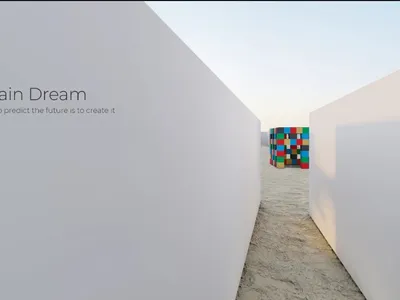
The Main Dream: A Recycled Plastic Kit That Lets Refugee Children Build Their Own Playground
Thirty-centimetre interlocking cubes that connect on three axes turn play into construction, letting children author the spaces they occupy.

Explore Arquitetura E Urbanismo Competitions
Discover active competitions in this discipline

Challenge to design public laboratory

Challenge to reimagine the Iron Throne

Photograph architecture without architects

Illustrate the lost glory of Angkor Wat - Render Challenge
Comments (0)
Please login or sign up to add comments
No comments yet. Be the first to comment!