

Vereda Arquitetos Renovates a 40-Square-Meter Apartment Inside Niemeyer's Copan Building
A compact unit in São Paulo's most iconic residential tower gets a material overhaul that pairs exposed concrete with bold blue Formica.


Oscar Niemeyer's Copan Building is not just a São Paulo landmark; it is a small city stacked 32 floors high, housing roughly 5,000 residents behind a serpentine concrete facade that has defined the downtown skyline since 1966. Working inside a structure this loaded with cultural weight puts any renovation team in a bind: strip too much away and you erase the DNA of the place, change too little and you are decorating a museum. Vereda Arquitetos, led by João Paulo Meirelles de Faria and Juliana Braga, found a third path with this 40-square-meter unit in Block B, completed in 2018. They kept the apartment's original spatial logic almost entirely intact and redirected all their energy into material surfaces and color.
The result is a renovation that reads like a dialogue between two eras of Brazilian concrete culture. Niemeyer's raw reinforced structure is left exposed on key walls, while a single, decisive intervention transforms the built-in closet partition into a floor-to-ceiling plane of saturated blue-green Formica. That color, carried into custom plywood furniture and echoed by terrazzo finishes in the wet rooms, does the heavy lifting. It turns a modestly sized one-bedroom into a space with genuine character, all without moving a single wall.
Concrete and Color as a Single Strategy
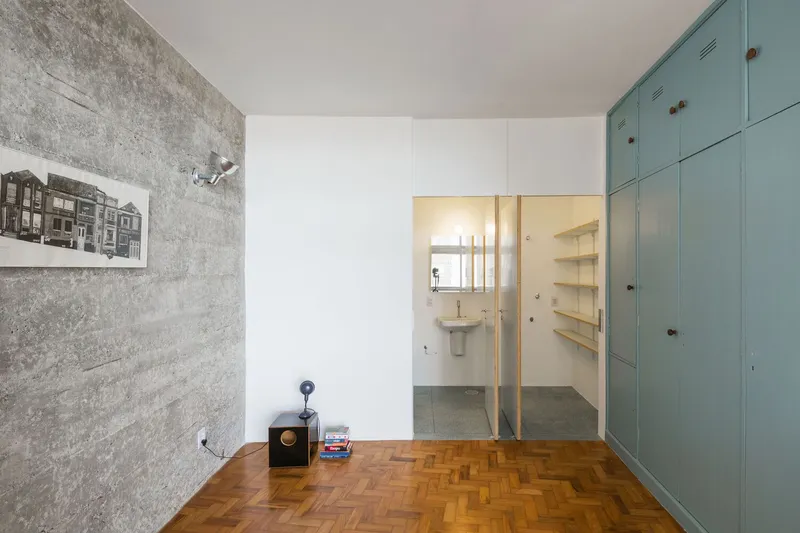
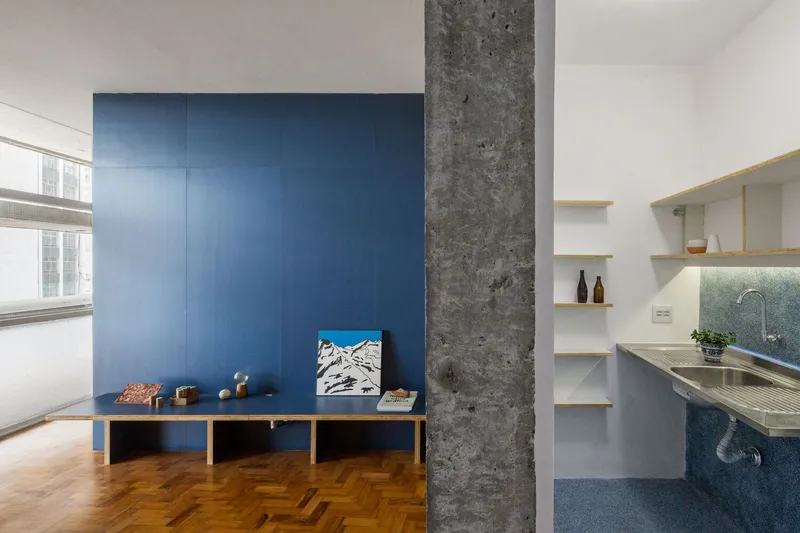
The most striking decision here is what was not touched. The concrete walls and the original herringbone parquet floor were both retained, cleaned, and left to show their age. Against these warm, weathered textures, the blue-green Formica panels hit with real force. The closet that separates the bedroom from the living area was refurbished rather than demolished, its doors reconfigured to present a seamless flat surface on the living room side. A custom plywood rack and bench in a matching hue extend the color field, creating the illusion that the blue wall is a much larger element than it actually is.
What makes this work is restraint. Only two primary materials compete for attention: concrete and Formica. The parquet floor mediates between them, warm enough to soften the industrial aggregate but worn enough to belong to the same timeline as the exposed structure. There is no accent wall chaos, no gratuitous material sampling. The apartment commits to a limited palette and follows it everywhere.
The Built-In Closet as Room Divider

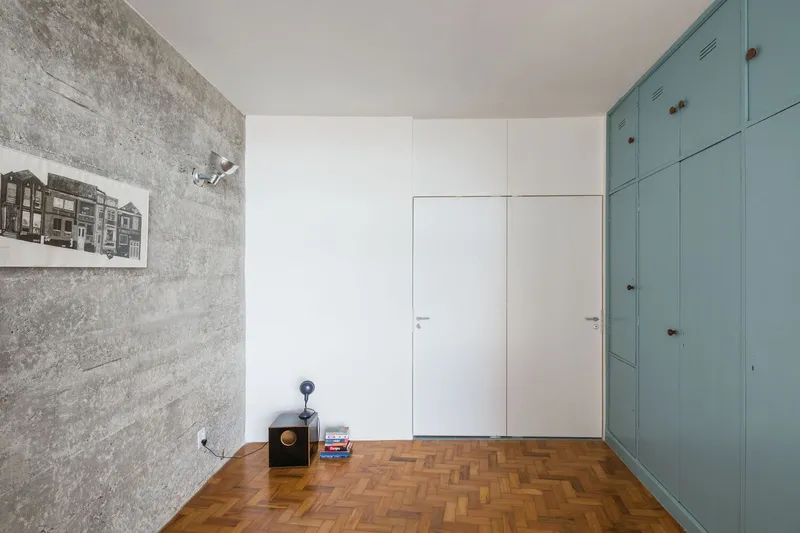
In a 40-square-meter apartment, the closet is not just storage. It is the wall. Vereda Arquitetos recognized this and treated the built-in partition as the project's central architectural element. From the bedroom side, it functions as expected: doors open to reveal wardrobes. From the living area, those same doors fold flush into a monolithic blue panel that conceals the domestic clutter behind it. The effect is a room that can shift register depending on which side of the partition you stand on.
Keeping this original element was also a statement about Copan itself. The closet partition was part of the unit's design from the outset, a remnant of Niemeyer-era planning for dense residential living. Replacing it with drywall and modern sliding doors might have opened up a few more centimeters of floor area, but it would have severed the apartment's connection to its own history. The renovation gains its coherence precisely because that connection is preserved.
Threshold Details and the Bathroom Frame

Small apartments live or die by their thresholds. Vereda Arquitetos handled the doorways with noticeable care. The bathroom entrance is framed by the blue-green cabinetry, turning what could have been a utilitarian opening into a composed vignette. The white door, when open, reveals the tiled interior without breaking the color logic established in the main rooms. When closed, it sits flush with the adjacent wall, disappearing into the surface plane.
According to the existing documentation, the kitchen and bathroom both feature a bluish terrazzo finish on floors and walls. That choice ties the wet rooms back to the dominant color story without resorting to the same Formica treatment. Terrazzo is also a practical pick for a compact apartment where moisture and daily wear would punish softer finishes. It is the kind of material decision that looks good in a photograph but is actually motivated by durability.
Plans and Drawings
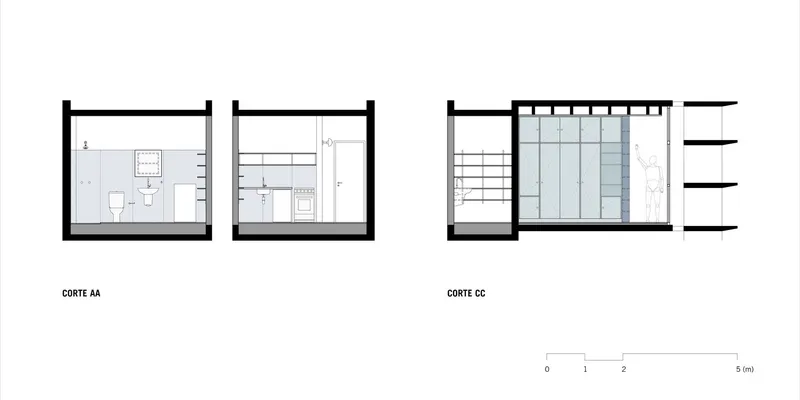
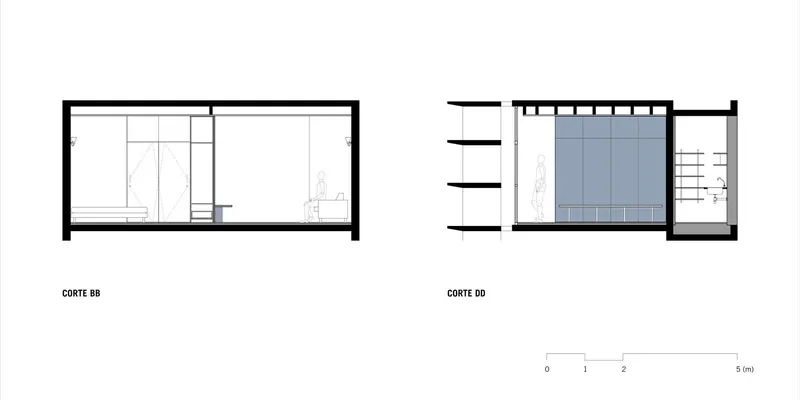
The section drawings reveal just how compact the unit really is. The central partition, rendered in blue, reads clearly as the spatial hinge of the entire plan. On one side: bedroom and bathroom; on the other: living area and kitchen alcove. What the sections also show is the vertical ambition of the storage wall. It runs from floor to ceiling, maximizing capacity in a plan that offers almost no free wall surface for standalone furniture.
The bathroom and kitchen elevations confirm the terrazzo application and show the integration of fixtures into tight wall pockets. These are not generous rooms. They are rooms where every millimeter of countertop and shelf has been accounted for. The drawings make it clear that the renovation's apparent simplicity is the product of very careful dimensional control, not casual minimalism.
Why This Project Matters
Renovating inside a heritage building is always a negotiation, but renovating inside the Copan Building carries additional pressure. Every intervention is measured against the ghost of Niemeyer. Vereda Arquitetos navigated that pressure by refusing to compete. They did not insert dramatic new geometries or ostentatious material contrasts. Instead, they took what was already there, the concrete walls, the herringbone parquet, the original closet partition, and gave each element a sharper version of its existing identity. The blue Formica is the only genuinely new voice in the room, and it speaks loudly enough to redefine the space without drowning out the original conversation.
For anyone working on compact urban apartments in historically significant buildings, this project offers a useful lesson: you do not need to reinvent the plan when you can transform the surface. Forty square meters cannot absorb spatial experiments the way a loft can. What it can absorb is color, texture, and a rigorous material logic. Vereda Arquitetos delivered exactly that, proving that respect for a building's past and a strong contemporary identity are not opposing goals.
Copan Apartment Renovation by Vereda Arquitetos, led by João Paulo Meirelles de Faria and Juliana Braga. São Paulo, Brazil. 40 m². Completed 2018. Photography by André Scarpa.
About the Studio
Share Your Own Work on uni.xyz
If projects like this are the kind of work you want to make, uni.xyz is a place to publish your own, find collaborators, and enter design competitions.




Popular Articles
Popular articles from the community


Conexión: Biophilic Design Reimagines High-Rise Living in Hong Kong
Conexión reimagines high-rise living in Hong Kong through biophilic design, green facades, shared spaces, daylight, water and nature within.

The Musturak Paradise: Senior Living Architecture for a Connected Future in Temara, Morocco
The Musturak Paradise reimagines senior living architecture in Temara via private homes, social spaces, culture, community, and shared care.

Co-Life: Senior Housing Design That Reconnects Older Adults With the City
Co-Life reimagines senior housing design through healing gardens, shared streets, workshops, and a sustainable community across generations.

Riyadh For All: Intergenerational Urban Design for Active Aging in Rabat
Riyadh For All reimagines urban design in Rabat with intergenerational co-living, adaptive courtyards, and Moroccan cultural exchange today.


Similar Reads
You might also enjoy these articles


Hodi-Mandai Geram
Project Function: Preservation and revitalization of the Intangible heritage and socio-spatial identity of the Hodi by Housing, Cultural Memory Center, Sacred Grove, landscape, local tourism economy


Olio Towers: A Mid-Rise for Performers That Fuses Housing, Rehearsal, and Stage
Located blocks from Houston's Theater District, this modular tower stacks living units around a central performance atrium.

Oasis: Modular Green Housing Carved into Dhaka's Urban Fabric
A shortlisted Plugin Housing entry reclaims unauthorized settlements in Dhaka with stepped concrete volumes, green roofs, and ventilation-driven design.

Black Hole: A Floating Megastructure for the Post-Physical Era
Emiliano Mazzarotto envisions a spherical, self-scaling arena where e-sports, digital hotels, and holographic stadiums replace traditional public space.


Explore Residential Building Competitions
Discover active competitions in this discipline


Challenge to design mud housing for contemporary communities


Challenge to reimagine the Iron Throne


Photograph architecture without architects


Illustrate the lost glory of Angkor Wat - Render Challenge
Comments (0)
Please login or sign up to add comments
No comments yet. Be the first to comment!