
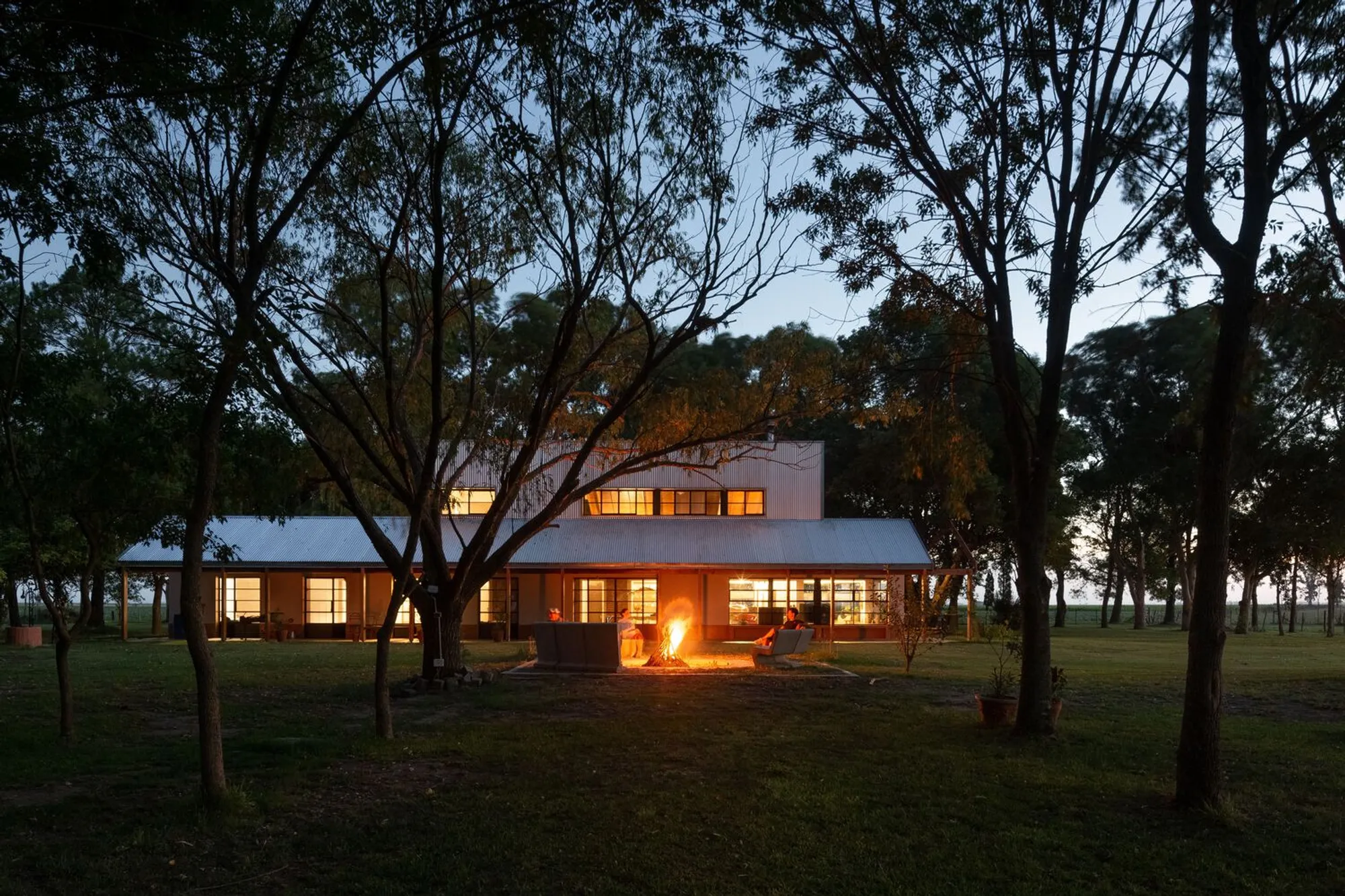
DRM Arquitectura Grows a Pampas Farmhouse Upward into a Star Observatory
A 160 square meter renovation on the Argentine plains reconnects a family estate through red ceramic touchpoints and vertical ambition.


Two hundred kilometers south of Buenos Aires, on a working cattle estate called El Basson, a small inherited house sat quietly among windmills and lagoons on the Pampas plain. The family who owned it had outgrown the structure but not their attachment to it. DRM Arquitectura was brought in not to replace the house but to stretch it in every direction, including straight up, turning the roof into a lookout for watching stars in one of Argentina's least light-polluted skies.
What makes this 160 square meter renovation genuinely compelling is its refusal to treat the house as an isolated object. The architects deployed a material strategy they call "red points," scattering red ceramic surfaces across the entire property: the well, the pool, the Australian water tank, the windmill base, and the house itself. The result is a landscape-scale composition where architecture dissolves into territory, and the familiar color of fired clay becomes a navigational thread stitching together every corner of the estate.
A Pavilion Rooted Under Old Trees
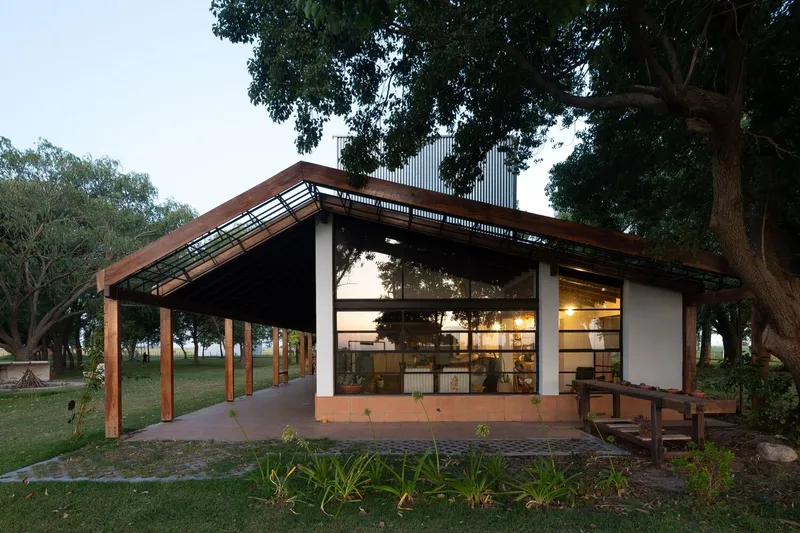
The ground-level extension reads as a long timber-framed pavilion that slides beneath the canopy of mature trees already on site. A corrugated metal roof floats on slender columns, its eaves deliberately generous to shade the north-facing gallery, the traditional Pampas device for outdoor sleeping during hot afternoons. Steel-framed glazing bays fill the gaps between structural timber posts, making the wall plane almost entirely transparent. The effect at dusk is of a warm lantern set into the landscape, its glow filtered through branches.
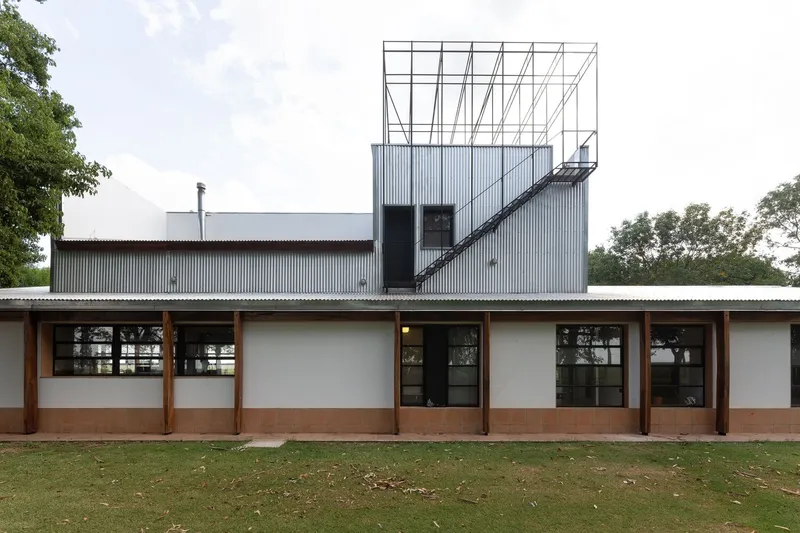
Around back, the elevation reveals a more industrial vocabulary. An open steel framework tower rises above the roofline, its skeletal profile recalling the windmills and water towers that define the Argentine countryside. This is no decorative gesture; it is the structural spine of the star observatory above and the staircase within.
Vertical Ambition on a Horizontal Plain
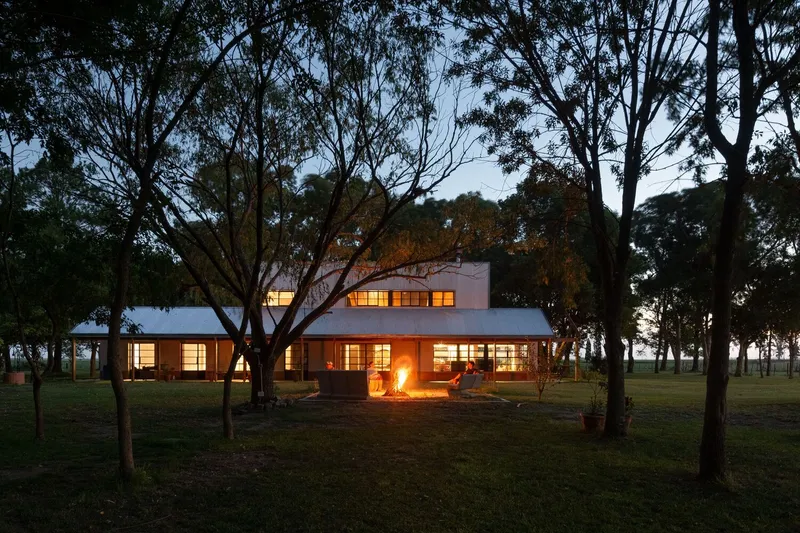
On the Pampas, the horizon is everything. Buildings cling to the ground, and the sky occupies the vast majority of any view. DRM Arquitectura's decision to grow the house vertically is therefore a deliberate provocation, a way of claiming the sky as usable domestic space. The two-story volume, seen glowing against the night with a bonfire crackling in the foreground, announces itself as the social heart of the estate.
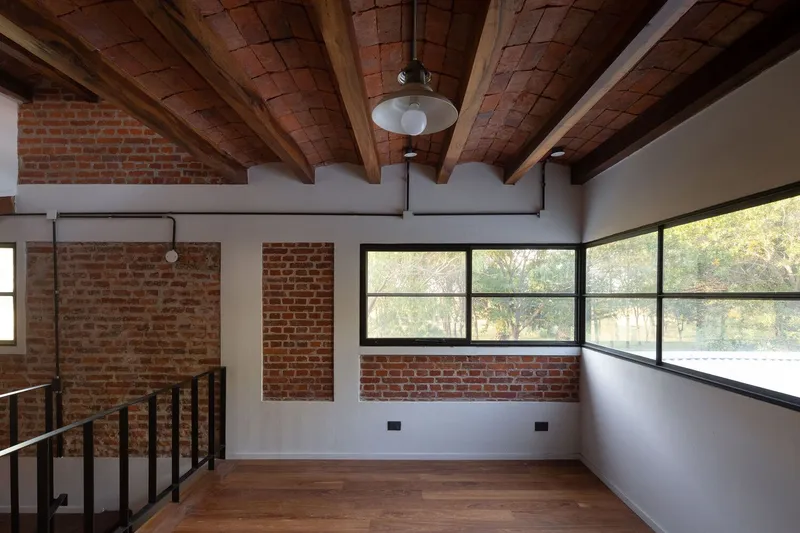
At the top, a compact room with a brick vaulted ceiling and a generous corner window gives the family an unbroken panorama of the surrounding fields and the Salado River corridor. By day it works as a bedroom; by night it becomes the observatory the architects envisioned. The brick vault overhead is not merely atmospheric. It continues the material logic of the original house, whose load-bearing walls and masonry arches were preserved and exposed throughout the renovation.
Exposed Structure as Interior Language
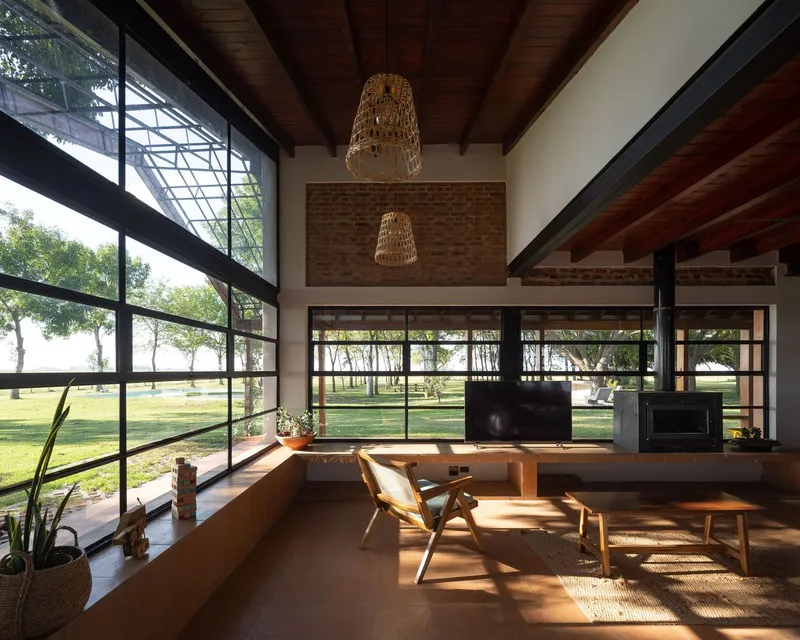
The double-height living space is the clearest expression of the architects' commitment to honesty of construction. Timber ceiling beams, original to the house, span the full width of the room and remain completely exposed. Sunlight enters through tall steel-framed windows, casting geometric patterns across the brick walls and polished floor. There is no plasterboard, no suspended ceiling, no attempt to hide the bones of the building. The palette is limited to brick, timber, and steel, the same three materials that built the estate a generation ago.
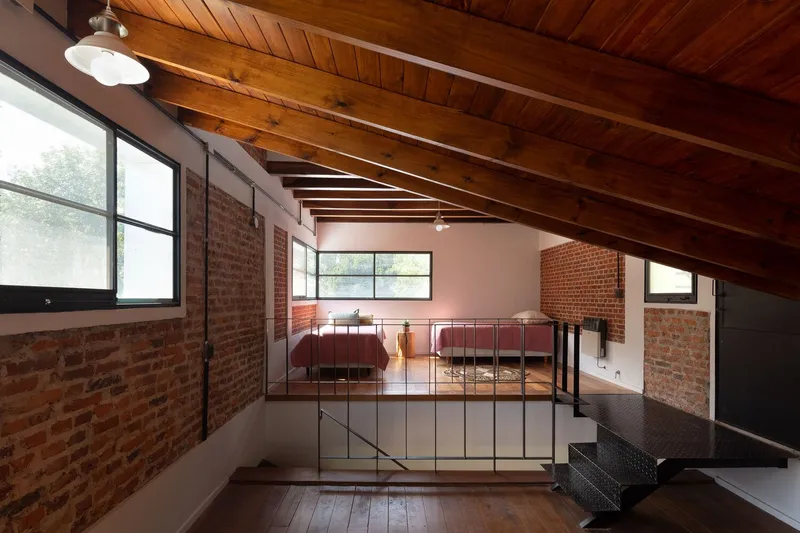
Up at the mezzanine level, a bedroom is carved into the sloped timber roof structure. A steel railing serves as both safety barrier and spatial divider, maintaining visual continuity with the living volume below. The exposed brick walls here are rougher, less finished, a quiet reminder that this is a working farm, not a lifestyle showroom. The restraint is convincing because it never tips into calculated rusticity. The materials simply are what they are.
Utility Without Apology
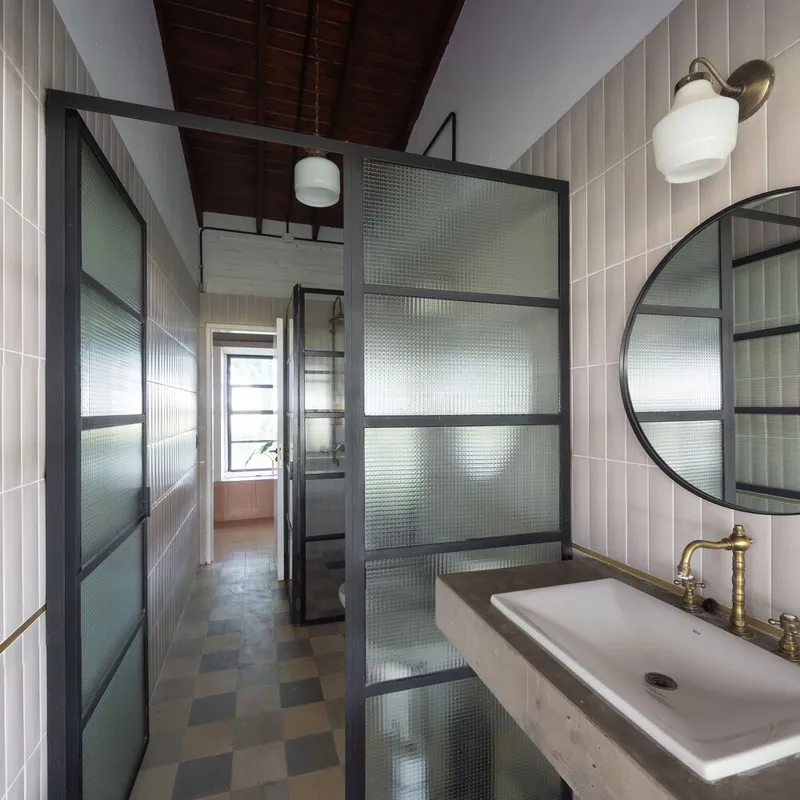
Even the bathroom refuses to break character. Vertical white tiles line the wet zone, and a textured glass partition in a steel frame separates the shower. The detailing is clean but industrial, consistent with the steel-and-brick vocabulary that governs the rest of the house. There are no luxury finishes, no imported stone, no spa-like pretensions. The room works, it drains, and it fits the world outside its window.
This utilitarian honesty is the project's quiet strength. DRM Arquitectura understood that El Basson is a place where fences need mending and cattle need feeding, and the architecture had to hold up under that kind of daily use. The choice of red ceramic as a unifying material across the property reinforces this pragmatism: it is cheap, locally available, weather-resistant, and carries decades of associative memory for the family.
Plans and Drawings
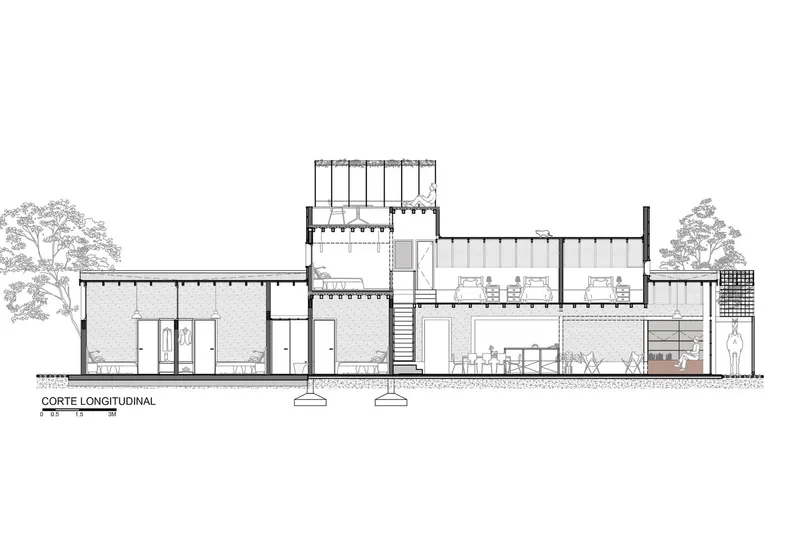
The longitudinal section reveals the full spatial logic of the renovation. The original single-story volume sits at the center, flanked by the horizontal extensions for living and sleeping. The vertical tower punctuates the composition, its steel staircase spiraling up to the observatory. What the drawing makes legible is the deliberate asymmetry of the roofline: the lower extensions defer to the existing trees while the tower pushes past them. Natural light enters from multiple orientations, confirming the architects' claim that the vertical element was designed partly to bring daylight deep into the circulation core.
Why This Project Matters
Rural renovation in Argentina rarely receives serious architectural attention. The default approach is either wholesale demolition or cosmetic maintenance, and the result is a countryside littered with generic weekend houses that could be anywhere. DRM Arquitectura's work at El Basson offers a counter-model: treat the entire estate as the project, not just the house. By extending a consistent material language from the dwelling to the well, the tank, the pool, and the windmill, the architects built a landscape strategy, not merely a building.
The star observatory is the move that elevates the project from competent to memorable. On the Pampas, where the sky is the defining feature of the place, claiming vertical space for stargazing is both poetic and functionally precise. It solves the practical problem of adding a bedroom and a stair while giving the family a room that literally reframes their relationship to the land. That kind of double duty, where structural necessity and spatial ambition collapse into a single gesture, is what separates good renovation from routine expansion.
Country House in Pila by DRM Arquitectura. Located in Pila, Argentina. 160 m². Completed in 2022. Photography by Javier Agustín Rojas.
About the Studio
Share Your Own Work on uni.xyz
If projects like this are the kind of work you want to make, uni.xyz is a place to publish your own, find collaborators, and enter design competitions.




Popular Articles
Popular articles from the community


Lunar Spiral: Space Architecture Shaped by the Mathematics of the Universe
Lunar Spiral reimagines space architecture through Fibonacci geometry, lunar regolith, levitating habitats, and self-sustaining Moon living.

Conexión: Biophilic Design Reimagines High-Rise Living in Hong Kong
Conexión reimagines high-rise living in Hong Kong through biophilic design, green facades, shared spaces, daylight, water and nature within.

Hill & Cross Opera: Sculptural Opera House Architecture Shaped by Tallinn’s Landscape and Identity
Hill & Cross Opera reimagines opera house architecture in Tallinn through its sculptural hill, civic plaza, glass wave and a luminous cross.

Riyadh For All: Intergenerational Urban Design for Active Aging in Rabat
Riyadh For All reimagines urban design in Rabat with intergenerational co-living, adaptive courtyards, and Moroccan cultural exchange today.

Similar Reads
You might also enjoy these articles


Hodi-Mandai Geram
Project Function: Preservation and revitalization of the Intangible heritage and socio-spatial identity of the Hodi by Housing, Cultural Memory Center, Sacred Grove, landscape, local tourism economy


Olio Towers: A Mid-Rise for Performers That Fuses Housing, Rehearsal, and Stage
Located blocks from Houston's Theater District, this modular tower stacks living units around a central performance atrium.

Oasis: Modular Green Housing Carved into Dhaka's Urban Fabric
A shortlisted Plugin Housing entry reclaims unauthorized settlements in Dhaka with stepped concrete volumes, green roofs, and ventilation-driven design.

Black Hole: A Floating Megastructure for the Post-Physical Era
Emiliano Mazzarotto envisions a spherical, self-scaling arena where e-sports, digital hotels, and holographic stadiums replace traditional public space.
Explore Architecture Competitions
Discover active competitions in this discipline



Challenge to reimagine the Iron Throne


Photograph architecture without architects


Illustrate the lost glory of Angkor Wat - Render Challenge


Design challenge to reuse E-waste
Comments (0)
Please login or sign up to add comments
No comments yet. Be the first to comment!