

Cuauhtémoc Park Ramp by Carreño Sartori Arquitectos: Elevating Accessibility Through Landscape-Inspired Design
Elevated ramp in Vitacura park enhancing accessibility, blending landscape design, prefabricated structure, and urban continuity by Carreño Sartori Arquitectos.


Reimagining Accessibility in Public Space
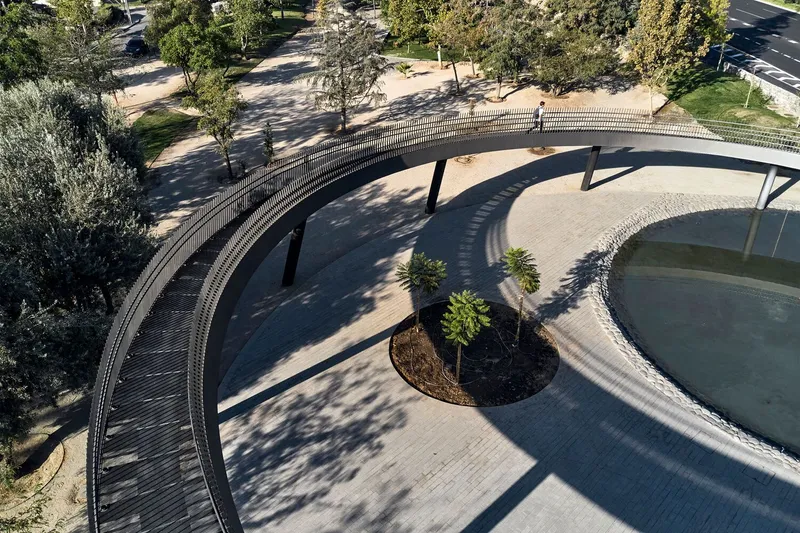
Cuauhtémoc Park Ramp by Carreño Sartori Arquitectos is a visionary urban infrastructure project that bridges architecture, landscape, and inclusive design. Located in Vitacura, Chile, this elevated pathway was the result of an open competition aiming to create a universally accessible route that extends an existing network of public parks.
The intervention responds to the site’s complex topography and historical context. The location features a 1970s-era circular pool designed by renowned Chilean landscape architect Carlos Martner, and a vehicular overpass that severs pedestrian flow. As urban growth pushed the avenue closer to the park, pedestrian access became increasingly restricted and hazardous due to proximity to traffic and noise pollution.
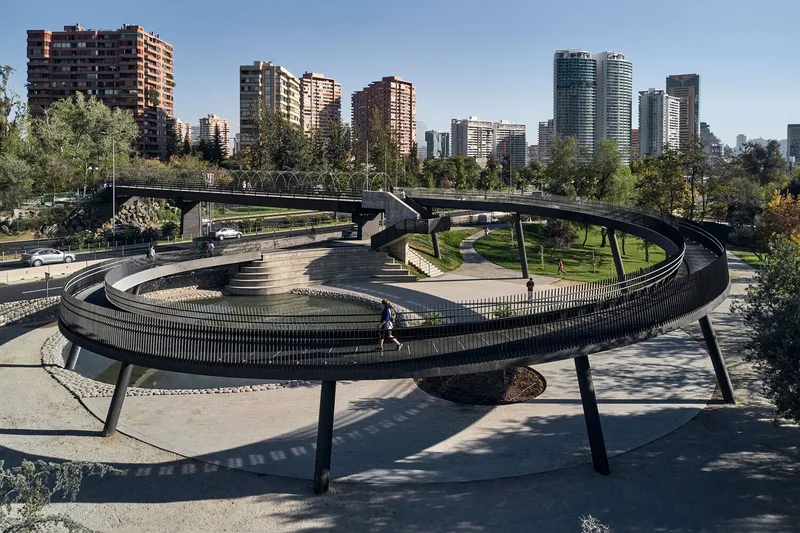
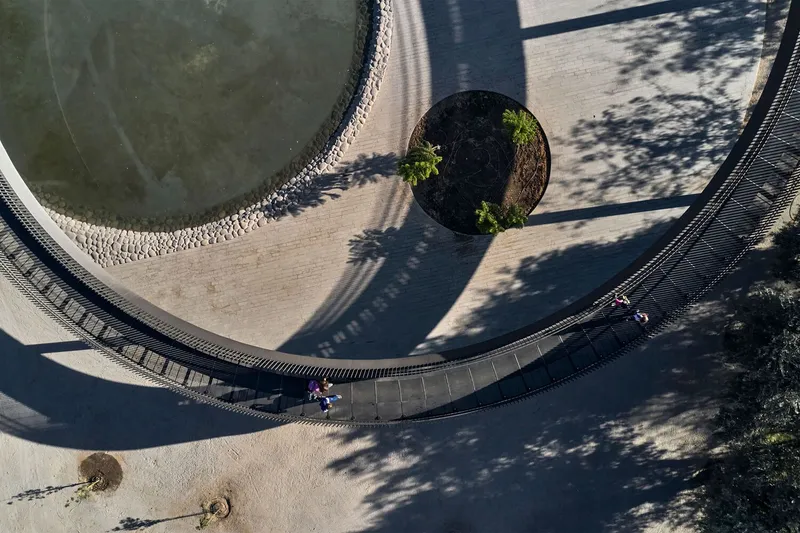
A Dual-Section Ramp as Urban Connector
To navigate a 6-meter elevation difference while maintaining a gentle 5% gradient, the architects designed a 120-meter-long ramp that unfolds in two distinct sections:
- The First Section: A 60-meter elevated walkway that gracefully curves around the pool’s perimeter, offering panoramic views of the Andes Mountains. This sculptural spiral honors the memory of the site's original landscape design and reintroduces calm into the noisy urban setting.
- The Second Section: A tree-lined embankment that buffers the park from the adjacent road. This slope continues the descent and integrates a natural sound barrier, improving both environmental comfort and pedestrian safety.
Between both ramp segments, a shortcut staircase and a small amphitheater create places for pause, social interaction, and alternative movement, enhancing the project's civic value.
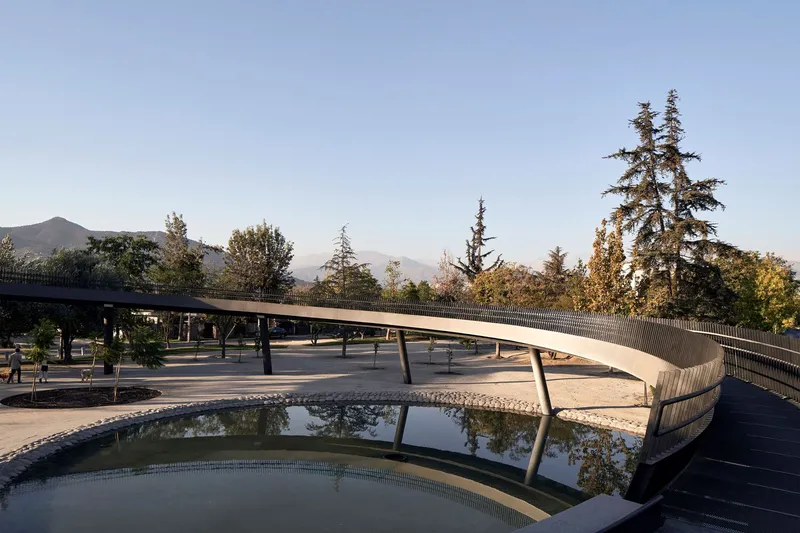
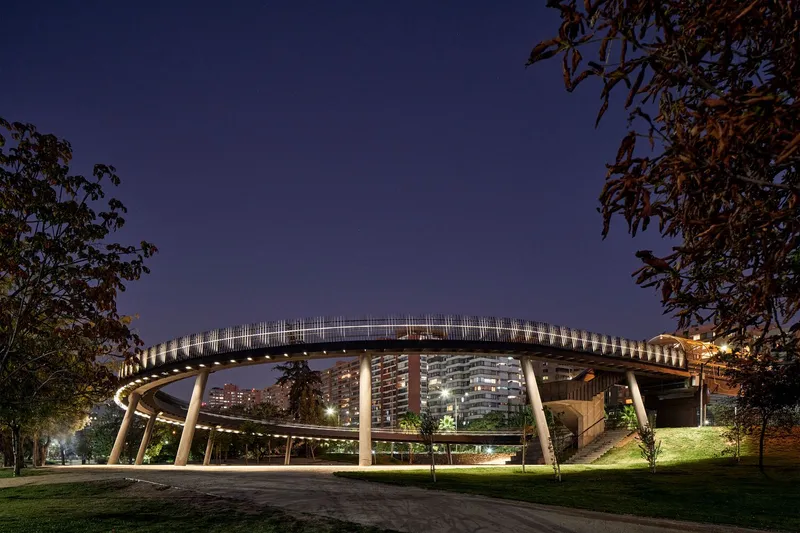
Precision, Modularity, and Prefabrication
The ramp’s design was digitally modeled to optimize structural efficiency and construction workflow. The torsion of the circular spiral was solved through a concentric system of radial ribs and a central beam, forming an integrated unit. Using CNC technology, the structure was fabricated as nine modular units plus three custom-fit terminal modules. These were pre-assembled off-site, reducing environmental impact and allowing precise installation onto in-situ pillars.
The team employed full-scale physical models to test slope conditions, tolerances, and detailing, ensuring a seamless integration with the site’s natural and built elements.
Architectural Legacy and Inclusive Urbanism
More than just a ramp, Cuauhtémoc Park Ramp functions as an inclusive public infrastructure, a landscape intervention, and an architectural homage to a modernist legacy. It resolves accessibility with elegance, creating a fluid pedestrian experience while respecting the memory of Carlos Martner’s original design.
This project illustrates how thoughtful urban design can restore pedestrian continuity, enhance sensory experience, and prioritize accessibility without compromising on aesthetic and environmental quality.



Popular Articles
Popular articles from the community


The Musturak Paradise: Senior Living Architecture for a Connected Future in Temara, Morocco
The Musturak Paradise reimagines senior living architecture in Temara via private homes, social spaces, culture, community, and shared care.

The Ocean Hive: Sustainable Architecture for a Self-Sufficient Civilization at Sea
The Ocean Hive imagines sustainable architecture at sea, where modular habitats, algae, wave power and ocean waste sustain a growing colony.
AL-JANNAH: Sustainable Architecture and Permaculture for Afghan Widows
AL-JANNAH uses sustainable architecture and permaculture to create resilient oasis of housing, learning, work and renewal for Afghan widows.

The Earth Pod: 3D Printed Homes for Resilient Refugee Communities
The Earth Pod reimagines refugee housing through 3D printed homes made from clay, combining resilience, self-sufficiency, and rapid shelter.
Similar Reads
You might also enjoy these articles


Hodi-Mandai Geram
Project Function: Preservation and revitalization of the Intangible heritage and socio-spatial identity of the Hodi by Housing, Cultural Memory Center, Sacred Grove, landscape, local tourism economy


Olio Towers: A Mid-Rise for Performers That Fuses Housing, Rehearsal, and Stage
Located blocks from Houston's Theater District, this modular tower stacks living units around a central performance atrium.

Oasis: Modular Green Housing Carved into Dhaka's Urban Fabric
A shortlisted Plugin Housing entry reclaims unauthorized settlements in Dhaka with stepped concrete volumes, green roofs, and ventilation-driven design.

Black Hole: A Floating Megastructure for the Post-Physical Era
Emiliano Mazzarotto envisions a spherical, self-scaling arena where e-sports, digital hotels, and holographic stadiums replace traditional public space.

Explore Landscape Design Competitions
Discover active competitions in this discipline



Challenge to reimagine the Iron Throne


Photograph architecture without architects


Illustrate the lost glory of Angkor Wat - Render Challenge


Design challenge to reuse E-waste
Comments (0)
Please login or sign up to add comments
No comments yet. Be the first to comment!