
D-Day Museum in Arromanches-les-Bains by Projectiles: Preserving History Through Architecture
The D-Day Museum in Arromanches-les-Bains by Projectiles blends historical preservation, landscape integration, and innovative architecture, honoring WWII memory and Mulberry B remnants.


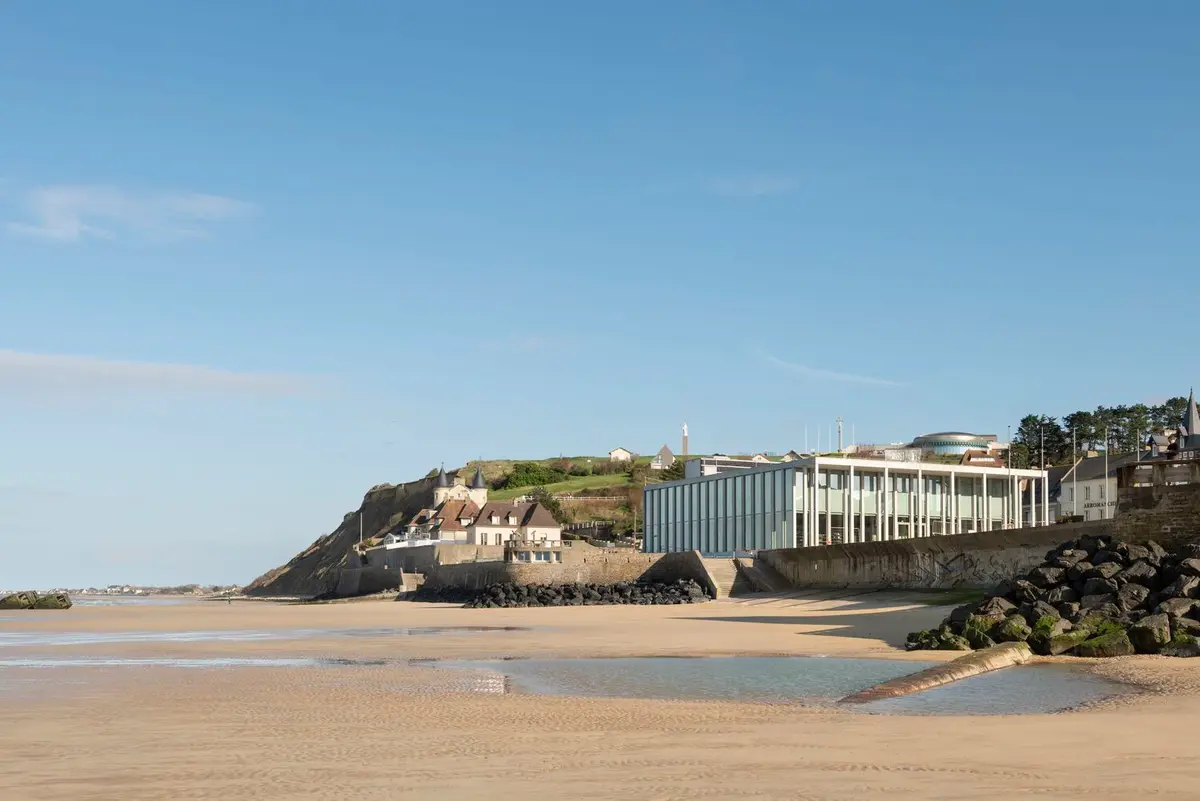
The D-Day Museum, located in Arromanches-les-Bains, France, stands as a powerful tribute to one of the most pivotal events of the Second World War. Originally established as the first museum dedicated to the D-Day landings, the museum entered a new chapter in 2024 with the unveiling of a thoughtfully designed building by Projectiles. This contemporary architectural intervention underscores the museum's enduring mission: preserving memory, sharing historical knowledge, and honoring the duty of remembrance even as the physical remnants of the Mulberry B artificial port gradually fade.

A Landscape Museum Integrated with Its Context
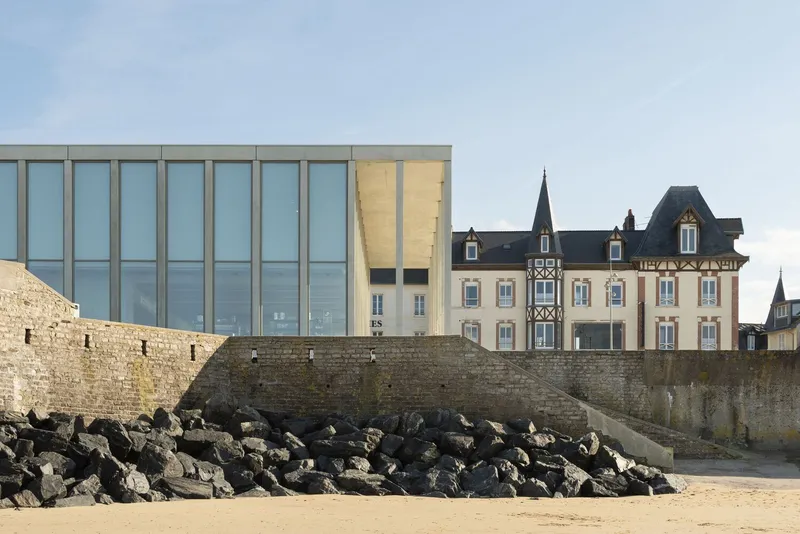
The museum’s design emphasizes a profound relationship with the surrounding landscape, positioning it as an observatory that frames the historical coastline in compelling ways. Conceptualized as part of a broader museum system stretching from cliff to cliff and encompassing the village horizon, the building’s five façades offer multiple viewpoints that engage visitors with the environment. The forecourt invites contemplation of the tidal spectacle, revealing vestiges of the wartime structures, while a newly designed eastern wooded public space connects harmoniously with the Place du 6 juin 1944, creating continuity between the museum and its historic surroundings.
Architectural Expression: Volumetry, Vistas, and Constructive Rigor
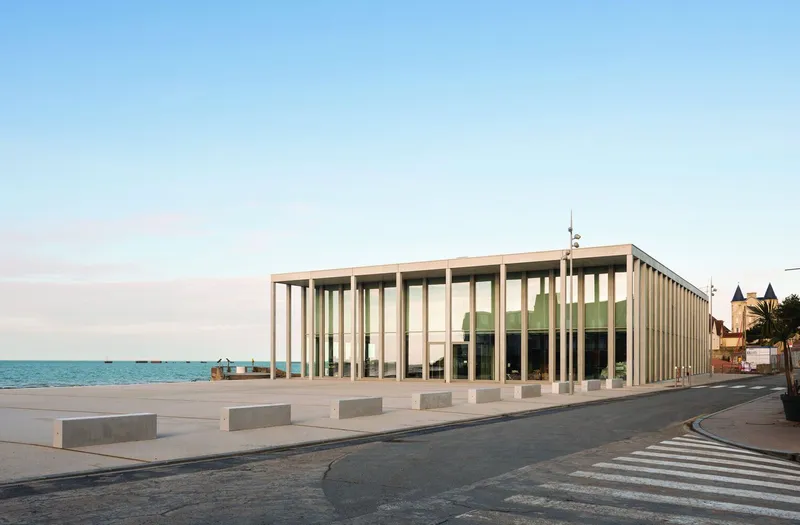
The museum's architectural language is defined by simple, rigorous volumetry and a focus on visual continuity between interior and exterior spaces. The building functions as a “horizon museum,” where views of the landscape are crucial from every level.
- On the ground floor, the public square and street seamlessly extend into the museum, creating an integrated experience.
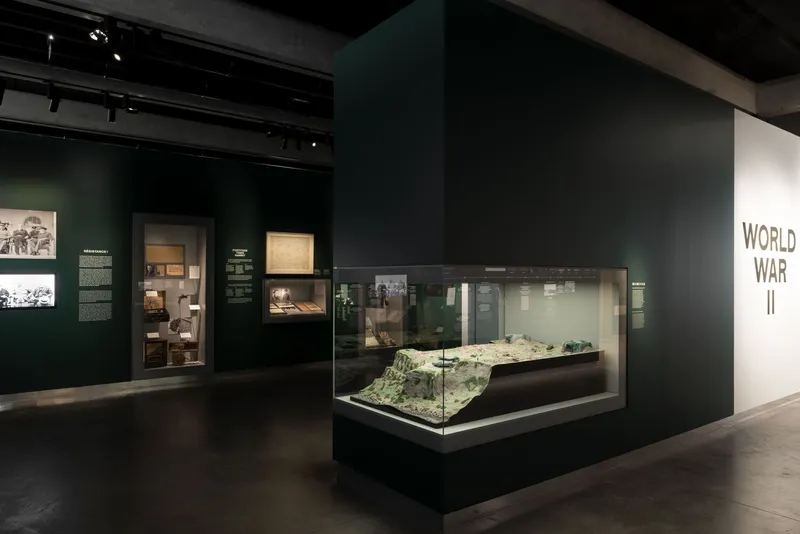
- The first floor showcases collections, maps, and artifacts while maintaining a strong visual dialogue with the maritime horizon.
- On the roof, architectural elements such as façades, gallery walls, and projections dissolve, enhancing the immersive encounter with the site.
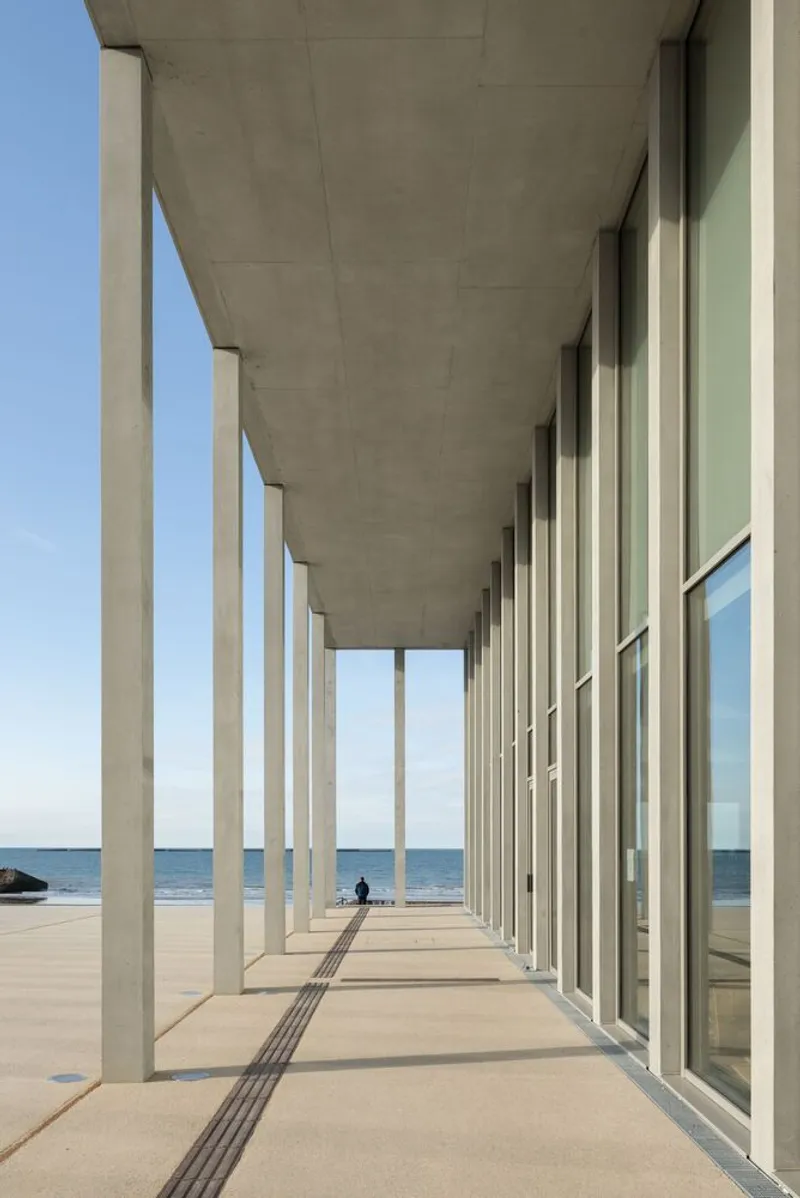
A striking awning, measuring 4 meters deep and 8 meters high, spans the building’s length. The periphery is defined by prefabricated, light-colored concrete columns, echoing the engineering ingenuity of Mulberry B's modular caissons. Large glazed frames fill the concrete exoskeleton, allowing abundant natural light while maintaining a robust structural presence.


Exhibition Design: From History to Horizon
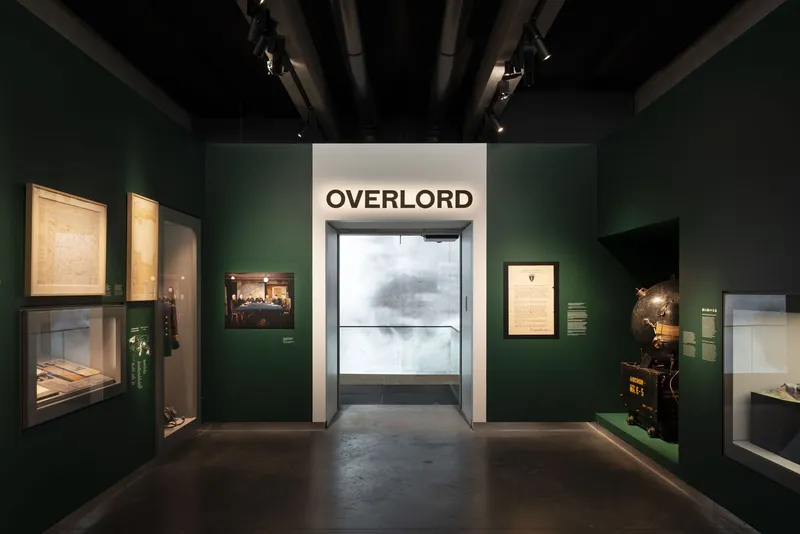
Visitors experience the museum through a carefully choreographed path that begins at the Place du 6 juin 1944 and the shoreline promenade, straddling land and sea. A longitudinal fracture, 16 meters long and 4 meters wide, structures each level’s plan and mirrors the proportions of the Phoenix caissons. Inside, a floating footbridge introduces the visitor to the narrative, connecting the prefabricated concrete structure with the museum’s spatial journey.
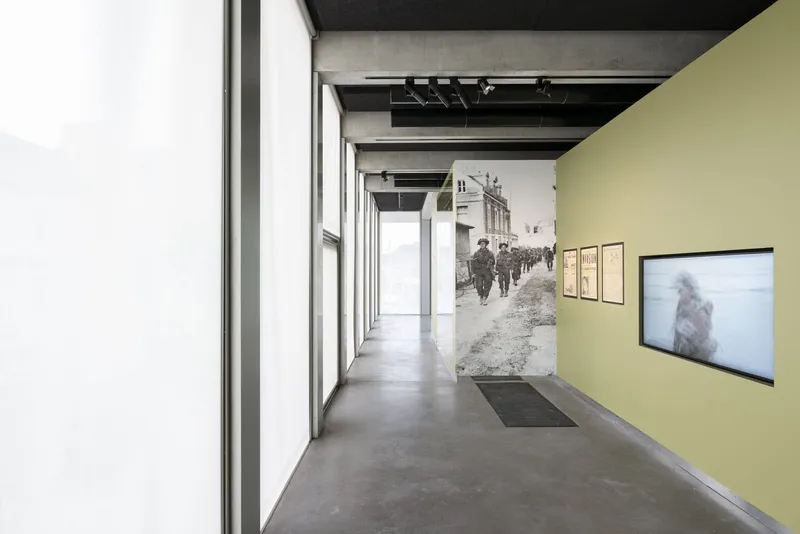
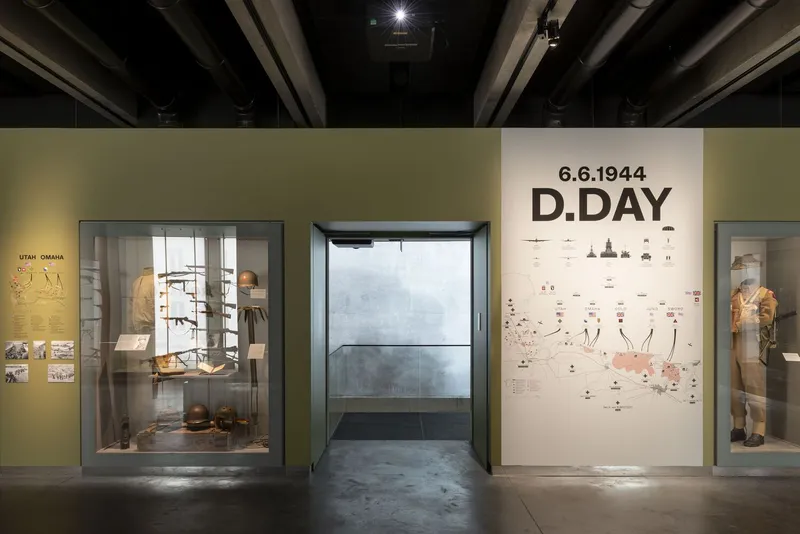
The exhibition unfolds in chronological and thematic sequences, tracing the outbreak of World War II through to the liberation. The ground floor immerses visitors in a multi-level room with a subdued atmosphere, screening an introductory film that contextualizes the museum’s purpose. The first floor strengthens the connection to the historical site, offering panoramic views of the Mulberry B remnants and the surrounding sea, forging a dialogue between memory, architecture, and landscape.


Conclusion: Architecture as Memory Keeper
The D-Day Museum by Projectiles is more than a repository of artifacts; it is a landmark that harmonizes architectural innovation with historical preservation. Its design honors the past while offering a contemporary framework for reflection, education, and remembrance. By blending precise volumetry, landscape integration, and constructive elegance, the museum embodies a lasting tribute to history and memory along the Normandy coast.


All photographs are works of
Antoine Cardi


Popular Articles
Popular articles from the community


U.GA Architects Wraps an Oval Rooftop Pool in Curved Board-Formed Concrete on Busan's Jeollidan-gil
In Busan's Jeonpo-dong, a 454 m² mixed-use block stacks a neighborhood facility, guest rooms and an oval rooftop pool inside spiraling concrete walls.

LT2A and OPEN Architectes Thread a Brick and Glass High School Through a Wooded Belgian Campus
In Braine-l'Alleud, a 3,000 m² wing for Collège Cardinal Mercier pairs pale brick with a glazed colonnade, deferring to a small chapel and a dense wood.

Architekt Andreas Gruber Scatters 23 Dark Timber Chalets Across a South Tyrolean Forest Edge
In Molini di Tures, Amonti Chalets breaks a resort into a hamlet of gabled timber houses, with parking, storage and services pushed into the slope.

longwave studio Reorganizes a 112 m² Tainan Apartment Around the Daily Routines of a Family and Two Cats
In Tainan, Taiwan, birch plywood, rust-red furniture and a freestanding plaster wall link arrival, storage, work and family life in one apartment.

Similar Reads
You might also enjoy these articles

Gil Mello Arquitetura Tilts a Single Roof Toward the Waterfalls on a Plateau Above Aiuruoca, Brazil
In Aiuruoca, Minas Gerais, a 200 m² house of local labor and reclaimed poles pairs a low valley veranda with a tall mountain one.
U.GA Architects Wraps an Oval Rooftop Pool in Curved Board-Formed Concrete on Busan's Jeollidan-gil
In Busan's Jeonpo-dong, a 454 m² mixed-use block stacks a neighborhood facility, guest rooms and an oval rooftop pool inside spiraling concrete walls.

Felipe Hess Arquitetos Turns a Blind Stone Wall to the Street and Opens a Brazilian House onto a Courtyard and Canal
A canal-front house in Brazil hides behind painted stone and planting, then opens to an olive-tree courtyard, a reed-ceilinged porch and a curving pool.

David Macias Steps a Doorless Stone and Plaster House Down a Tropical Colombian Hillside
In the humid hills of Colombia, Threshold House replaces the front door with an open void and terraces its 850 m² down the slope instead of fighting it.

Explore Architecture Competitions
Discover active competitions in this discipline

Challenge to reimagine the Iron Throne

Photograph architecture without architects

Illustrate the lost glory of Angkor Wat - Render Challenge

Bring back Drive In's
Comments (0)
Please login or sign up to add comments
No comments yet. Be the first to comment!