

DADA Partners Wraps a New Delhi Residence Around a Ficus Tree in a Prairie-Inspired Plan
An E-shaped house on a one-acre plot in New Delhi reinterprets the Prairie typology through deep overhangs, twin courtyards, and tropical materiality.


The Prairie house, as Frank Lloyd Wright codified it, was a creature of the American Midwest: low slung, earth hugging, pitched against vast horizontal landscapes. Transplanting that logic to a one-acre plot in New Delhi, where monsoon rains, searing summers, and dense vegetation replace open grassland, is not a simple copy-paste exercise. DADA Partners, led by principal architect Mukul Arora, takes the essential Prairie moves (long overhangs, continuous datum lines, indoor-outdoor porosity) and reworks them through a tropical lens. The result is Patio House, a 15,000-square-foot residence completed in 2022 that feels genuinely calibrated to its climate rather than imported from another one.
What makes the project worth studying is its refusal to treat the patio as a decorative afterthought. The client asked for a generous outdoor living zone, and the architects responded by making the entire plan a consequence of that request. An E-shaped footprint generates two courtyards, one organized around an existing mature Ficus tree, the other densely planted as a visual buffer. These outdoor rooms are not leftover spaces between wings; they are the primary organizational device, dictating sightlines, ventilation paths, and the social gradient from public lounge to private suite.
The E-Plan and Its Twin Courtyards
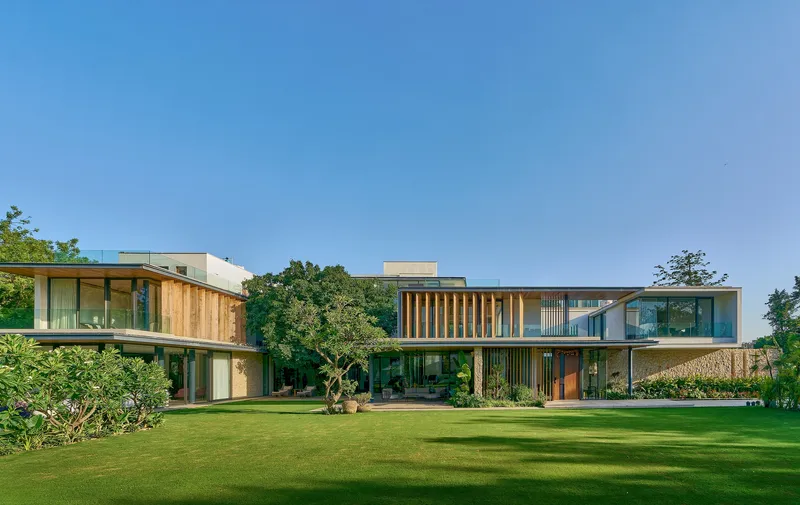
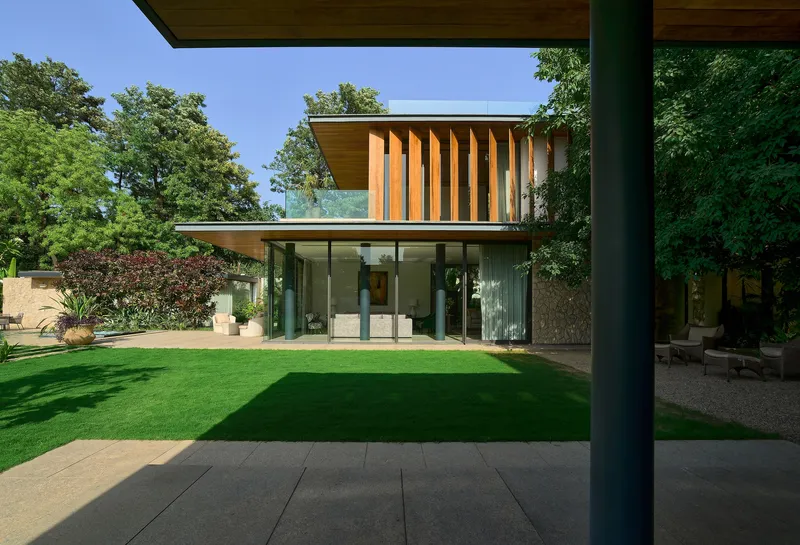
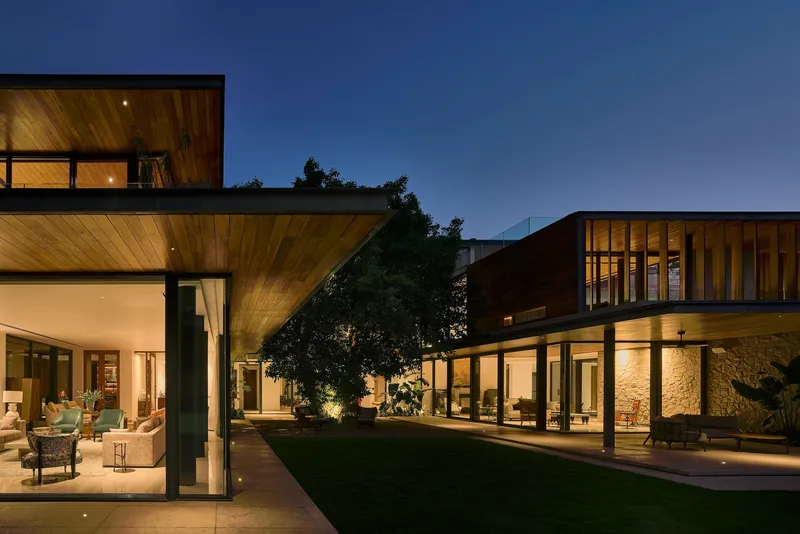
The E-shaped plan is the skeleton key to this house. Three parallel volumes, connected by a spine, create two distinct courtyards that face north toward the lawn and pool. The larger courtyard wraps around the existing Ficus tree, placing the formal lounge on one side and the informal living area on the other. It is a bold move: the tree becomes the centerpiece of family life, not something to be admired from a distance through a picture window but an active participant in the room's atmosphere, casting dappled light across timber decks and stone pavers.
The second courtyard operates differently. Dense plantations turn it into a green screen, managing the transition from the informal lounge toward the master suite and study. Privacy increases as you move laterally across the plan, but the visual connection to planting never drops out. Both courtyards merge seamlessly with the larger lawns to the north, dissolving the boundary between architecture and landscape in a way that feels effortless on paper but demands real precision in section.
Overhangs That Work for a Living
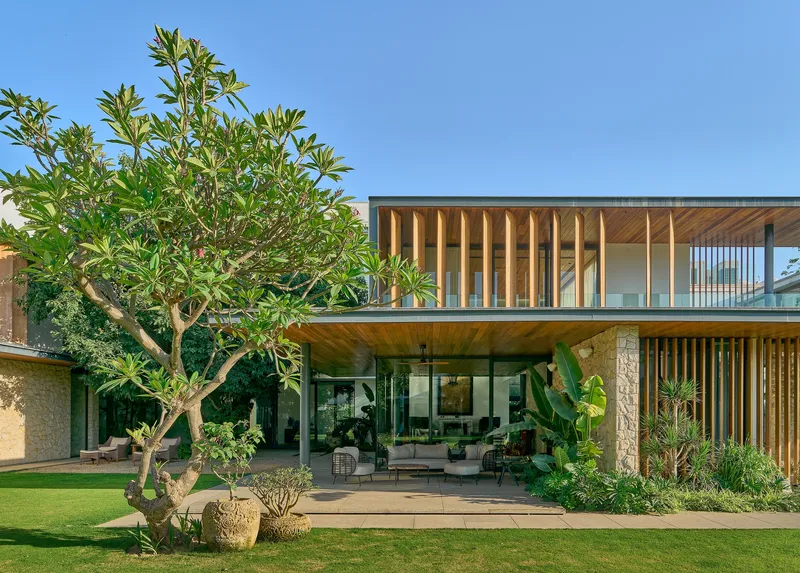
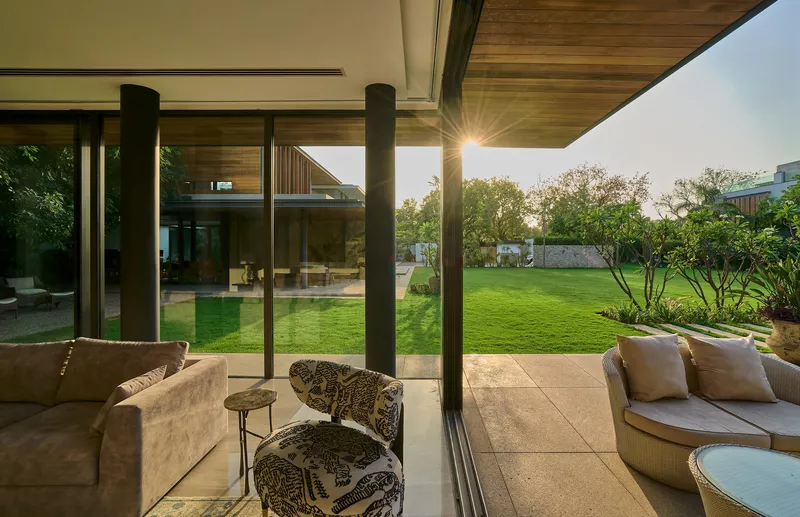
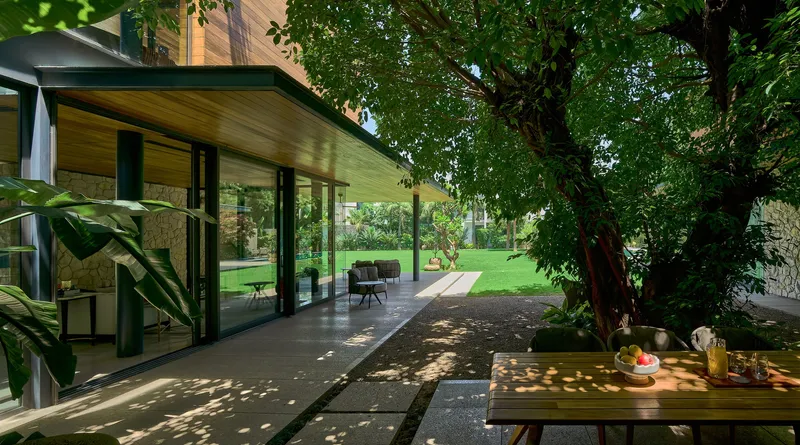
Delhi summers are punishing. Peak temperatures regularly clear 45°C, and direct sun on a glass facade will turn any room into a greenhouse in minutes. DADA Partners addresses this with deep canopies on both levels, their edges capped by custom aerofoil-shaped timber fins, each two feet wide. These fins are not decorative: they control solar ingress while allowing diffused light to reach interior spaces. The ashwood cladding on the roof undersides gives the overhangs a warm, inhabited quality, making the covered terraces feel like rooms without walls rather than mere shelters.
The 14-foot-deep patio extending along the full length of the family lounge is the most generous example. It is deep enough to function as a true outdoor room, shaded for most of the day, and open to cross-ventilation from the courtyards. At dusk, when the timber ceilings glow with ambient light, the line between interior and exterior becomes nearly impossible to draw.
A Material Palette Tuned to Tropical Light
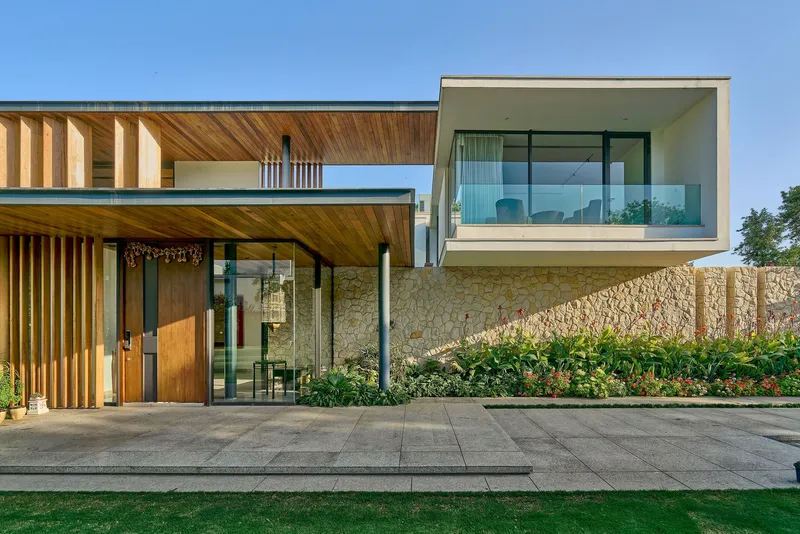
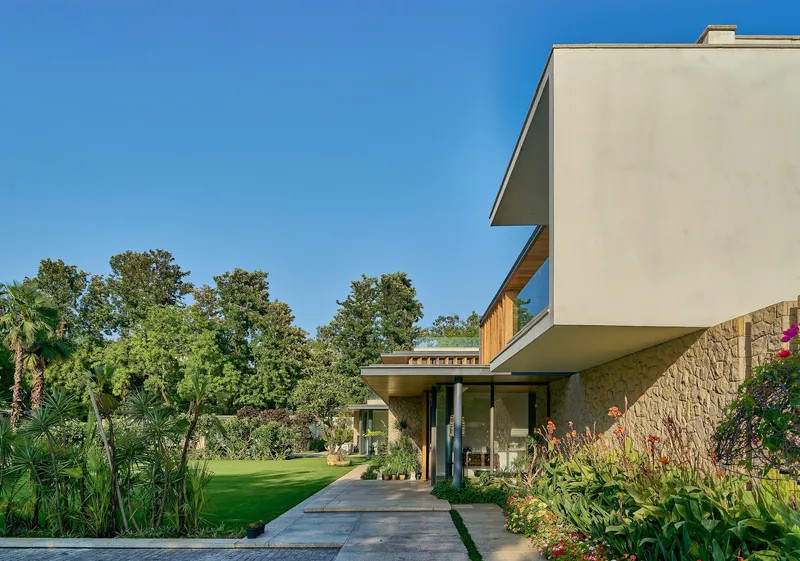
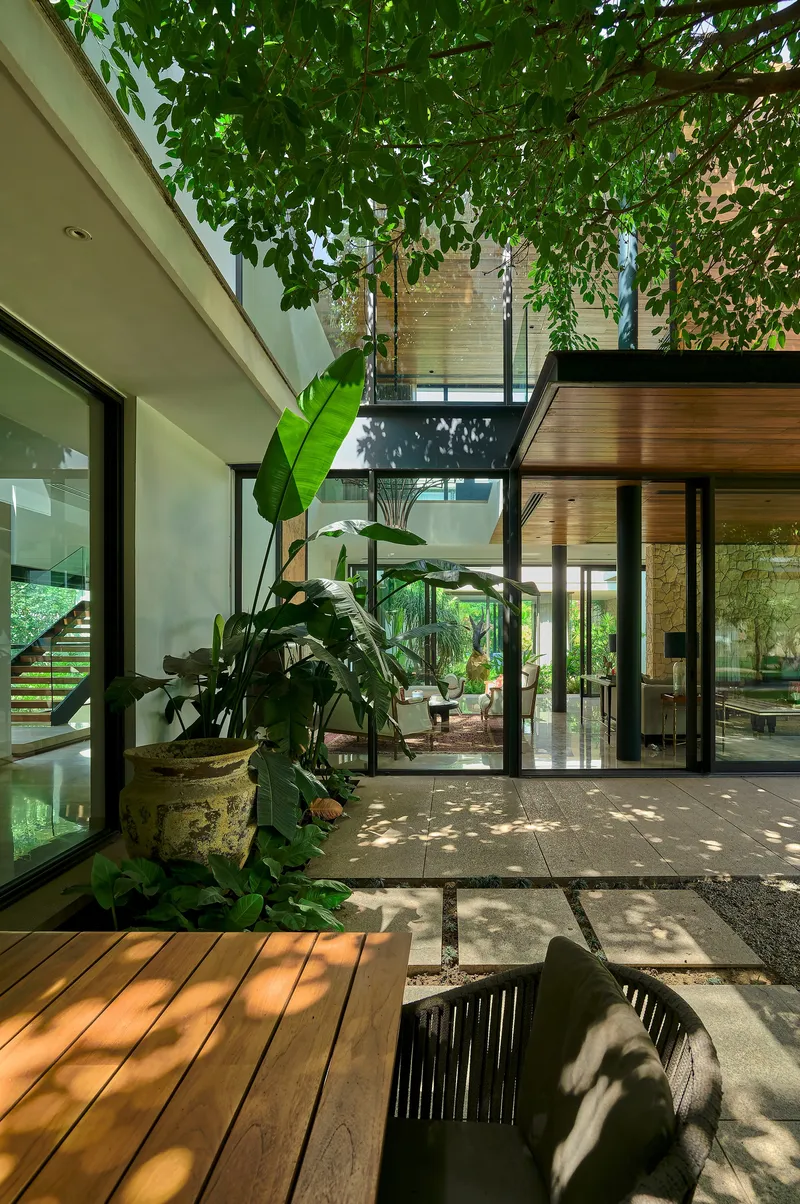
The material strategy is deliberate in its restraint. Warm mint sandstone, laid in a mosaic pattern, forms the primary wall surface at the ground level. It reads as monolithic from a distance but reveals a handcrafted texture up close. Above, hardwood timber cladding and vertical louvers introduce a finer grain. Sandblasted beige granite slabs serve as deck flooring, their matte finish absorbing tropical light rather than bouncing it back into the eye. Everything sits within a tightly controlled beige palette that glows rather than bleaches under Delhi's bright sun.
The interplay between stone and timber is managed with care. Stone appears where mass and permanence are needed: base walls, columns, floors. Timber appears where lightness and warmth matter: ceilings, louvers, the aerofoil fins. The cantilevered upper volumes, wrapped in timber and vertical screens, appear to hover over the heavier stone base, reinforcing the Prairie-derived horizontality without resorting to literal mimicry.
Glass as Threshold, Not Barrier
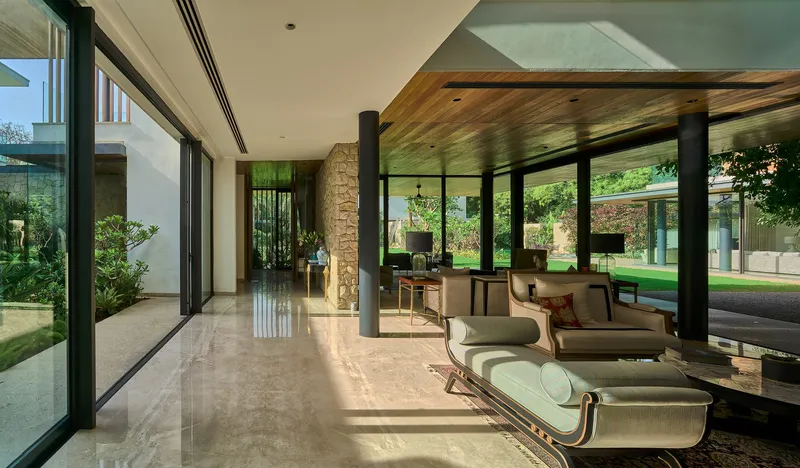
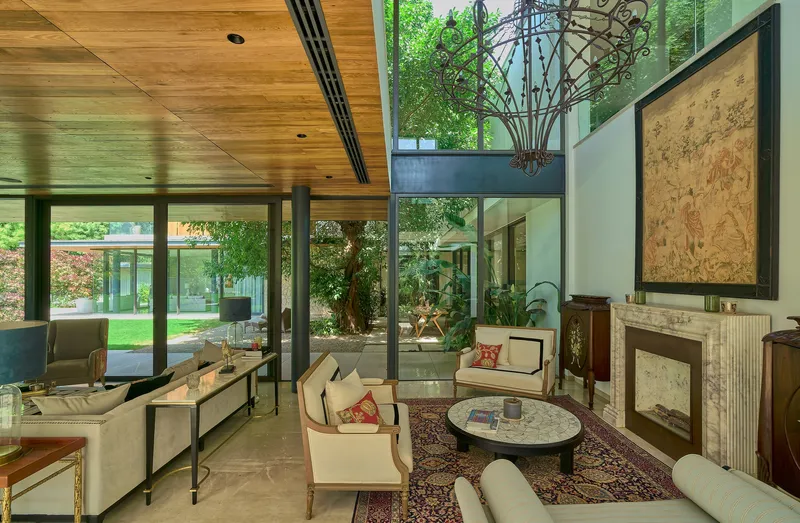
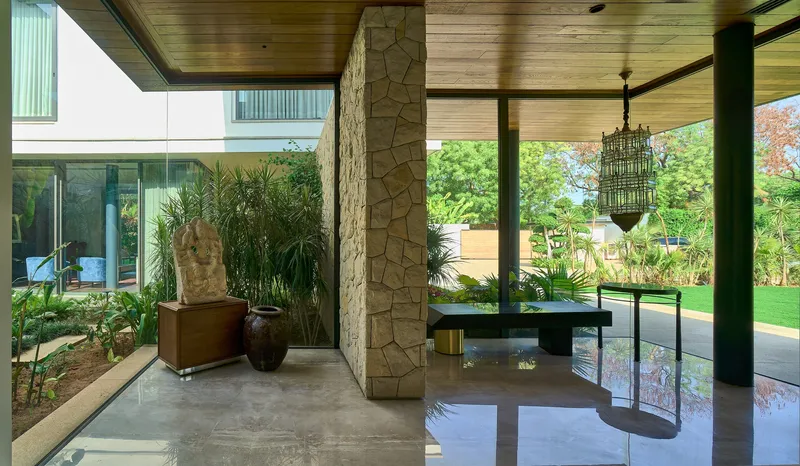
Floor-to-ceiling glazing appears throughout the house, but it almost never operates as a sealed envelope. Instead, the glass walls function as thresholds, operable panels that slide away to merge rooms with courtyards. In the double-height living room, glazing on two sides frames the mature Ficus tree and the pool lawn simultaneously, creating a panoramic connection that makes the 15,000-square-foot house feel considerably larger than its footprint suggests.
Corridors benefit from the same logic. A polished stone floor runs uninterrupted from interior to courtyard, and the timber ceiling follows suit overhead, erasing the moment of transition. You understand you have moved outdoors only when the quality of air shifts. It is a simple trick, but executing it cleanly requires aligned floor levels, continuous material runs, and concealed drainage, all of which the project handles without fuss.
Interior Atmosphere and Vertical Space
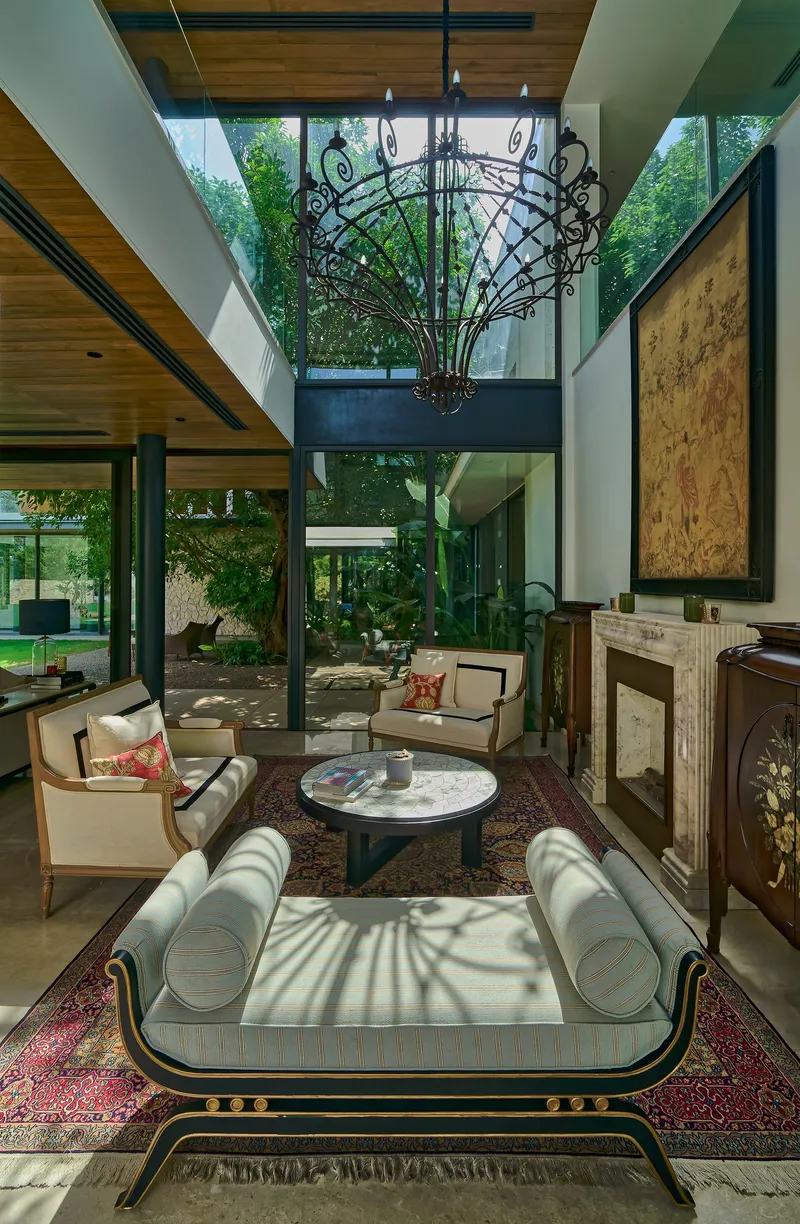
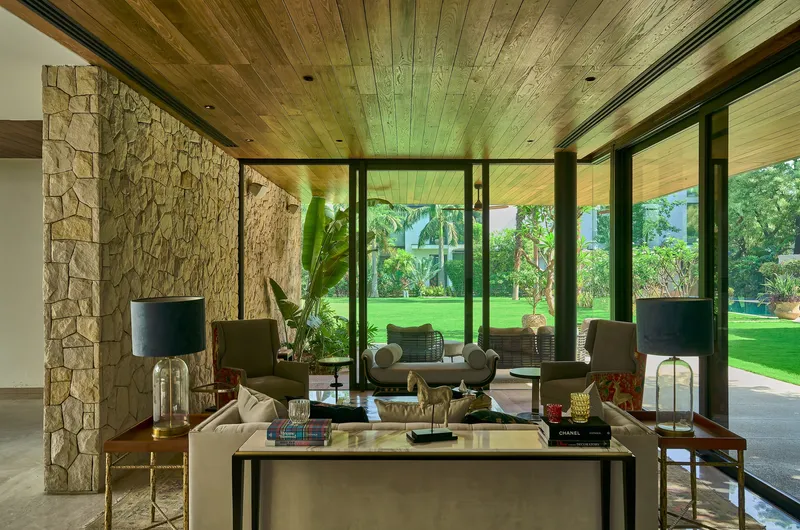
Inside, the double-height living spaces create a vertical counterpoint to the dominant horizontality. An ornamental wrought-iron chandelier drops through the full height, anchoring the room and giving it a sense of occasion without competing with the garden views. The timber plank ceilings, running continuously across interior and covered terrace, establish a warm datum overhead that pulls the eye outward.
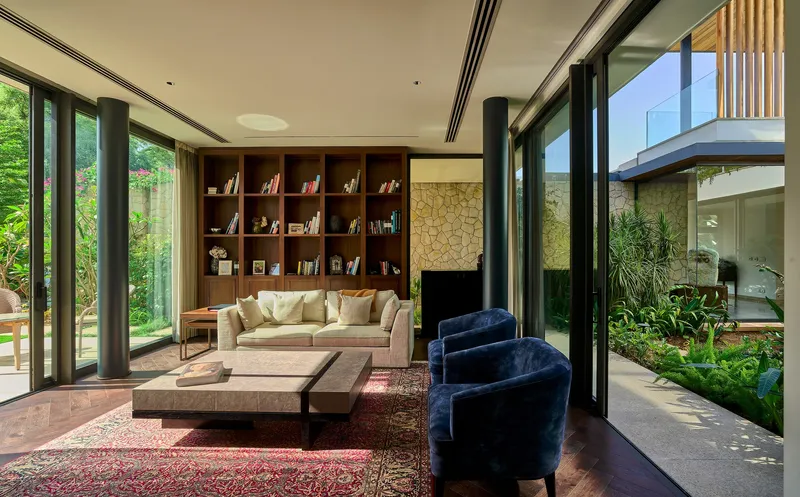
The more intimate zones, like the timber-bookshelf living area that opens through sliding glass to the planted courtyard, show the house at a quieter register. Stone veneer columns, polished floors, and carefully framed green views create a composed stillness. These rooms benefit from the second courtyard's dense planting, which filters light and sound, giving the private wing a noticeably different atmospheric quality from the more open social spaces.
Dusk Reveals the Section
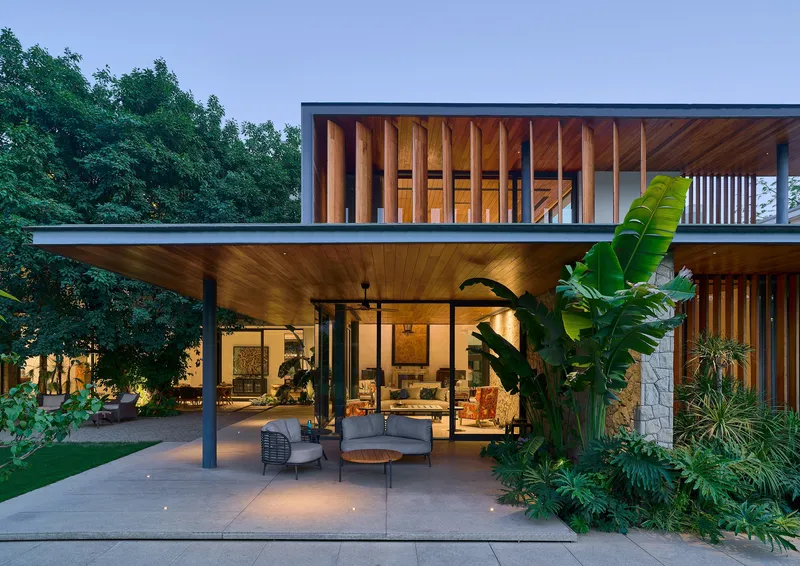
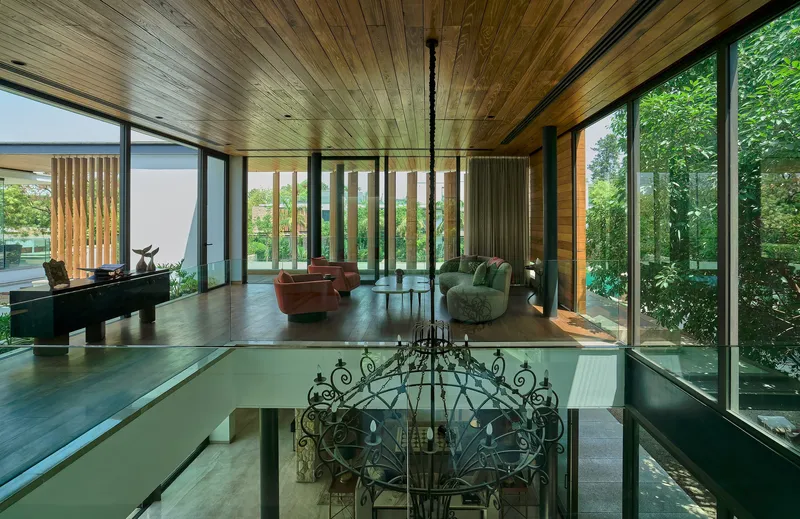
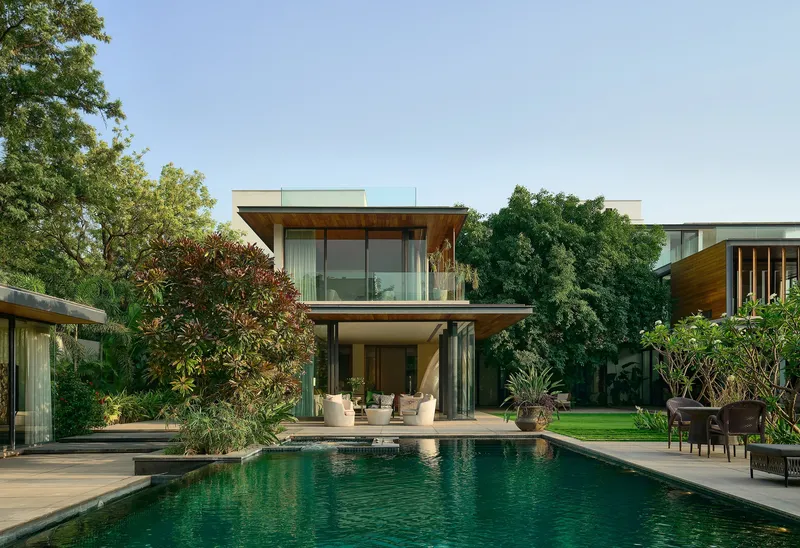
As with many houses that rely on deep overhangs and layered transparency, Patio House comes alive at twilight. The cantilever overhang becomes a luminous plane, its ashwood soffit catching interior light. The vertical louvers on the upper floor glow from within, revealing the timber skeleton that is invisible during the day. The pool terrace, framed by mature trees, settles into a cinematic calm that photographs well but, more importantly, delivers the kind of outdoor living that Delhi's winter evenings make possible.
The dusk views also expose the sectional logic most clearly. You can read the two-storey composition as a dialogue between a heavy, stone-grounded base and a lighter, timber-wrapped upper volume. The cantilevered overhang sheltering the terrace below extends the upper floor's presence outward, creating a deep shadow line that defines the house's profile against the sky.
Plans and Drawings
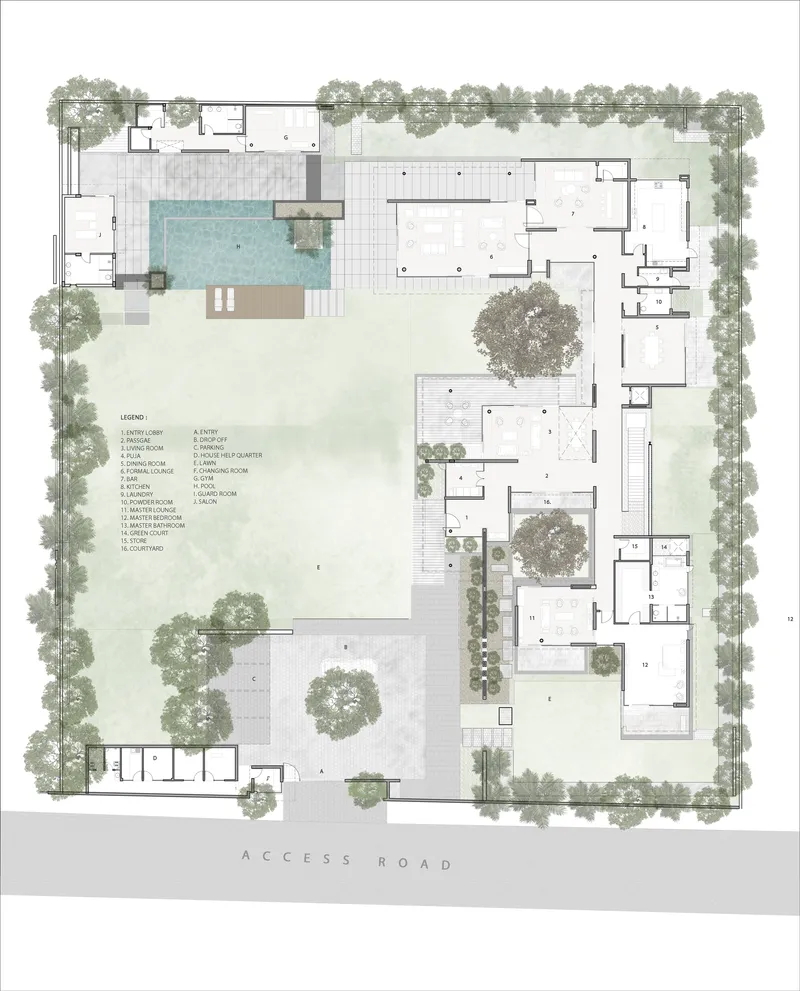
The site plan confirms what the photographs suggest: the architecture is inseparable from its landscape strategy. The interconnected pavilions are arranged to preserve existing trees, channel views toward the pool, and create sheltered outdoor rooms at multiple scales. Softscape by MASH Designs, hardscape by LOCI Landscape, and pool work by Premier Landscape and Pools collectively ensure that the ground plane is as resolved as the built volumes above it. The drawing makes the E-plan legible, showing how the three wings and two courtyards lock together into a single, continuous domestic landscape.
Why This Project Matters
Patio House is a reminder that typological borrowing works best when it is rigorous rather than nostalgic. DADA Partners did not replicate a Prairie house; they extracted its core principles (horizontal emphasis, deep shelter, blurred thresholds) and rebuilt them using materials and geometries that respond to Delhi's climate. The E-plan, the aerofoil fins, the 14-foot patio depth: these are not gestures toward an aesthetic. They are instruments of environmental performance, tested against monsoon rain and 45-degree heat.
For architects working in tropical and subtropical contexts, the project offers a useful case study in how generous outdoor space can drive a plan rather than fill its leftovers. The decision to organize the entire house around a single existing tree may sound sentimental, but in practice it produced a courtyard of real spatial power, one that anchors the social life of the house and provides passive cooling, privacy screening, and a constantly shifting light show. That is landscape working as architecture, not decoration.
Patio House by DADA Partners (Principal Architect: Mukul Arora). New Delhi, India. 15,000 sq.ft. Completed 2022. Photography by Ranjan Sharma / Lightzone India.
About the Studio
Share Your Own Work on uni.xyz
If projects like this are the kind of work you want to make, uni.xyz is a place to publish your own, find collaborators, and enter design competitions.


Popular Articles
Popular articles from the community


Singing Woman: Contemporary Architecture Inspired by Estonia’s Voice and the Sea
Singing Woman turns Estonia’s song culture into flowing opera house architecture, blending public life, landscape, sea, and national memory.

Extended Shell: Retrofitting Kolkata's Balconies as Living Urban Thresholds
A modular retrofit system recovers the social and environmental intelligence of Kolkata's historic verandas for contemporary Park Street residents.

The Amber Palace Opera: A Geological Fiction Surfaces on Tallinn's Baltic Waterfront
Pierre Brillard reimagines a Baltic legend as a public landscape, opera house, and waterfront promenade rooted in Tallinn's coastal identity.

Tsunami Convergenics: Turning Catastrophic Ocean Forces into Underwater Housing Infrastructure
A speculative underwater settlement off the coast of Onagawa, Japan, treats tsunamis and typhoons as energy sources rather than threats.

Similar Reads
You might also enjoy these articles

Bao Huynh Watercolor Atelier: A Serene Art Retreat in Hội An
Bao Huynh Watercolor Atelier in Hội An blends multifunctional art spaces, sustainable design, local materials, and family-friendly living in a serene environment.

Atelier Macri Concept Store Interior Design by CASE-REAL
Atelier Macri store features a "ko" counter, walnut wood details, cork displays, blending retail, gallery, and seamless customer experiences.

Manuel Vargas Izquierdo Stadium and High-Performance Sports Center: Architectural Excellence in Jalpa de Méndez
The Manuel Vargas Izquierdo Stadium blends sustainable design, inclusive sports facilities, and cultural-inspired architecture, revitalizing Jalpa de Méndez’s public spaces.

KAKR Buluh Awar Hall: Revitalizing Community and Ecology Through Bamboo Architecture
Community built bamboo hall revitalizes Buluh Awar village, empowering youth, restoring ecology, celebrating vernacular craftsmanship through sustainable architecture and culture.


Comments (0)
Please login or sign up to add comments
No comments yet. Be the first to comment!