

Damith S Munasinghe Folds Studio and Home into a Single 2400-Square-Foot Continuum in Sri Lanka
On a compact site in rapidly urbanizing Malabe, courtyards, portals, and planted rooftops blur the line between dwelling and design practice.


Architects designing their own homes tend to treat the exercise as a manifesto, and the results often say more about professional ambition than about actually living. Damith S Munasinghe Associates' Living Continuum Studio and House in Malabe, Sri Lanka, sidesteps that trap by posing a genuinely practical question: what does it look like when the place you work and the place you rest share not just a roof but a single spatial logic? The answer, spread across 2400 square feet on a roughly 7.5-perch site, is a building where courtyards, planted beds, and ochre walls stitch together rooms that shift from studio to dining room to bedroom without ever announcing a hard boundary.
What makes the project worth studying is its refusal to treat density as a constraint to be overcome. Malabe is urbanizing fast; plots are tight and neighbors are close. Instead of retreating behind blank walls or stacking program vertically to free up ground, Munasinghe carves the footprint into a sequence of interlocking courts and corridors that pull light, air, and greenery deep into the plan. The result is a house that feels substantially larger than its numbers suggest, not through illusion but through a relentless porosity that turns every threshold into a moment of release.
Arriving: The Street and the Threshold


From the street, the house presents a restrained face: timber cladding, rooftop planters spilling vines down the facade, and a low entry that registers as an opening in a garden wall rather than a front door. The cascading greenery is doing real work here, softening a building edge that would otherwise read as another hard boundary in a neighborhood full of them. A gravel courtyard beyond the timber doors extends the sidewalk's informality inward, signaling that arrival is not a single moment but a gradual transition from public to private.
A covered terrace with a green paneled door and a bicycle propped against the wall gives the entrance zone an almost domestic ordinariness. There is nothing ceremonial about coming in. That casualness is deliberate: in a building that houses both clients and family, the threshold needs to be legible to both without making either group feel they've entered the wrong space.
The Courtyard as Organizational Engine

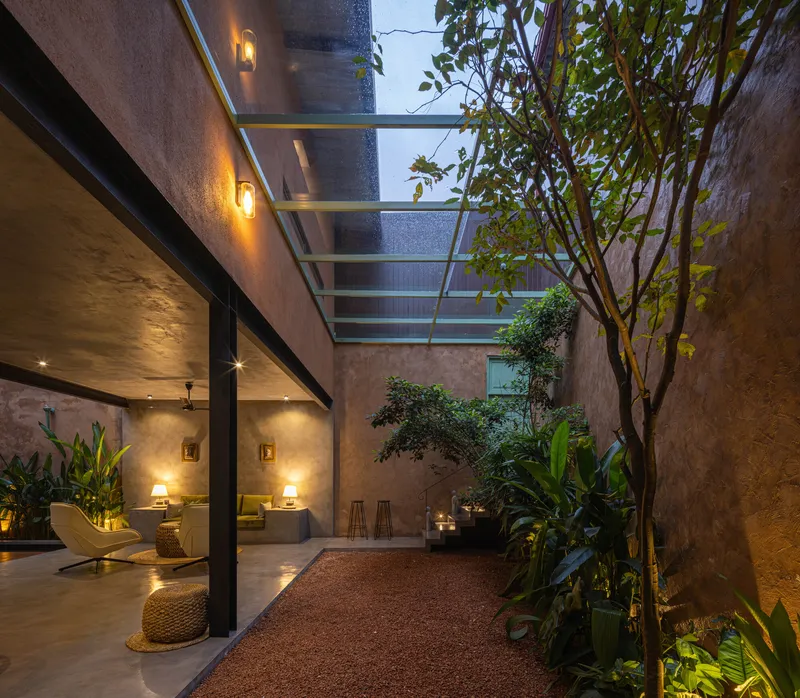

Multiple courtyards punctuate the plan, and they are not decorative insertions. They are the organizational spine of the project. Each one operates at a different scale and mood: a tight, gravel-floored well with a single tree and a glass skylight overhead; a broader, sunlit room framed by ochre walls and planted beds; a working court with a slatted screen, a bicycle, and the kind of gentle disorder that signals everyday use. Together, they create a rhythm of compression and expansion that keeps a compact plan from ever feeling cramped.
The ochre tone unifying the walls is important. It gives these outdoor rooms a warmth that concrete alone would not achieve, and it ages sympathetically in Sri Lanka's humid climate. As afternoon light shifts across the surfaces, the courts become something close to sundials, marking time in a building where the line between indoor and outdoor barely exists.
Circular Portals and Borrowed Views
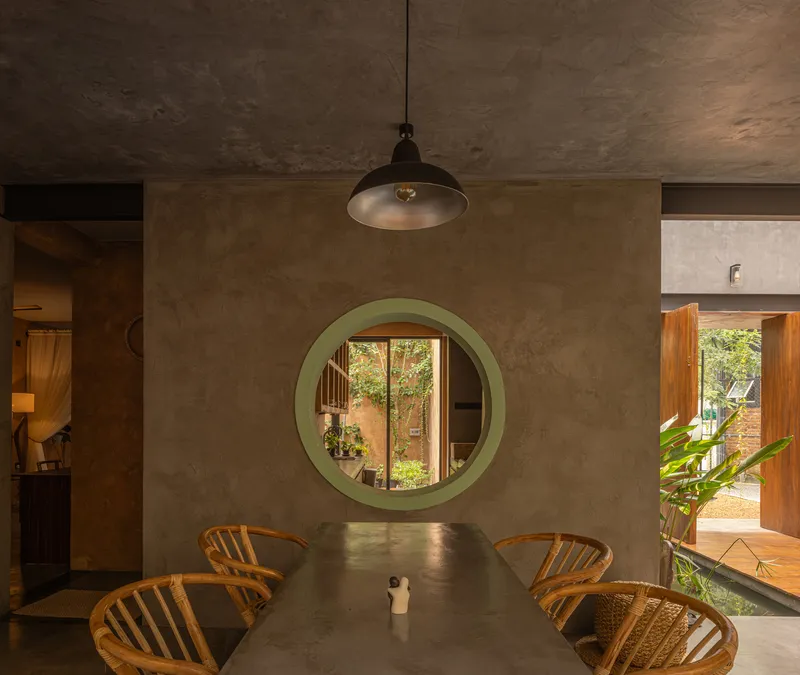

The circular green portal between the dining area and the planted courtyard is the building's most photographed moment, and it earns the attention. It functions like a picture frame that collapses the depth between interior and garden into a single composed view. Seen from the courtyard looking back in, it reverses the effect, turning the dining table and its occupants into a vignette. The device is simple, but it works because it is deployed sparingly: one portal, one axis, one color accent against the neutral palette.
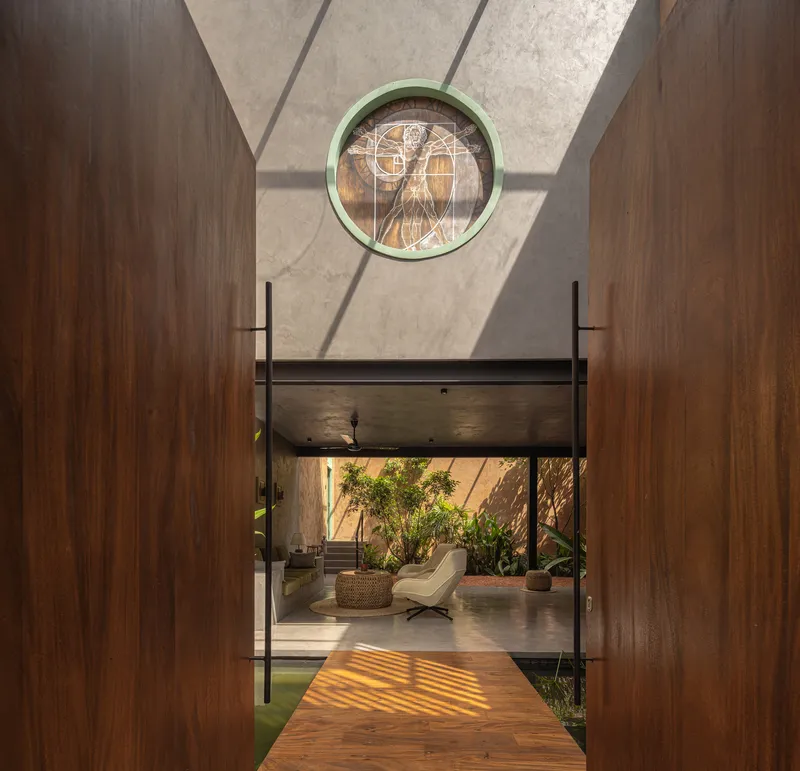
A timber-clad corridor leading to a courtyard with a circular stained glass window above repeats the theme at a different register. Here the circle frames sky rather than garden, and the light it admits is filtered rather than direct. Munasinghe understands that borrowed views are most powerful when they are specific: a tree, a patch of sky, a table seen through a wall. Generalized transparency rarely achieves the same focus.
Living Spaces: Concrete, Timber, and Filtered Light

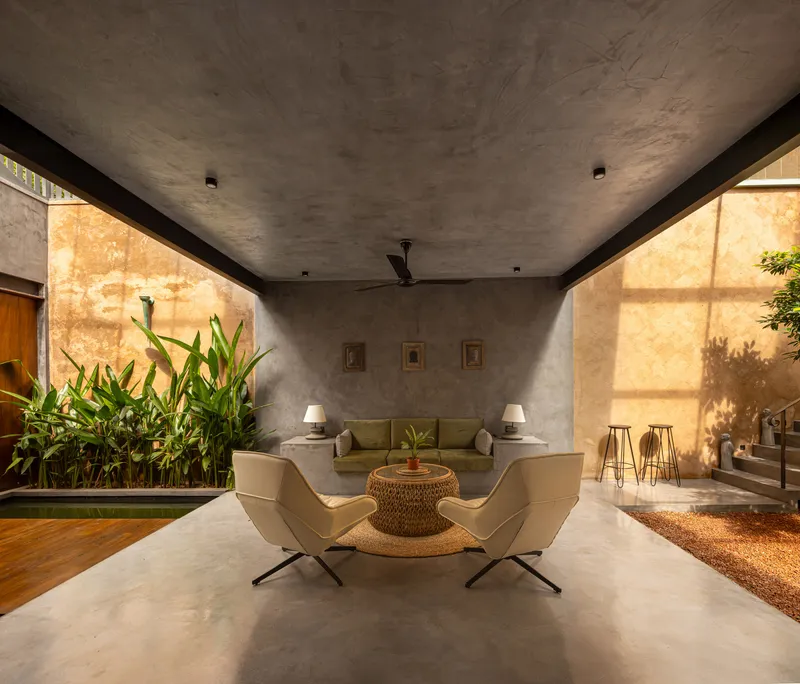
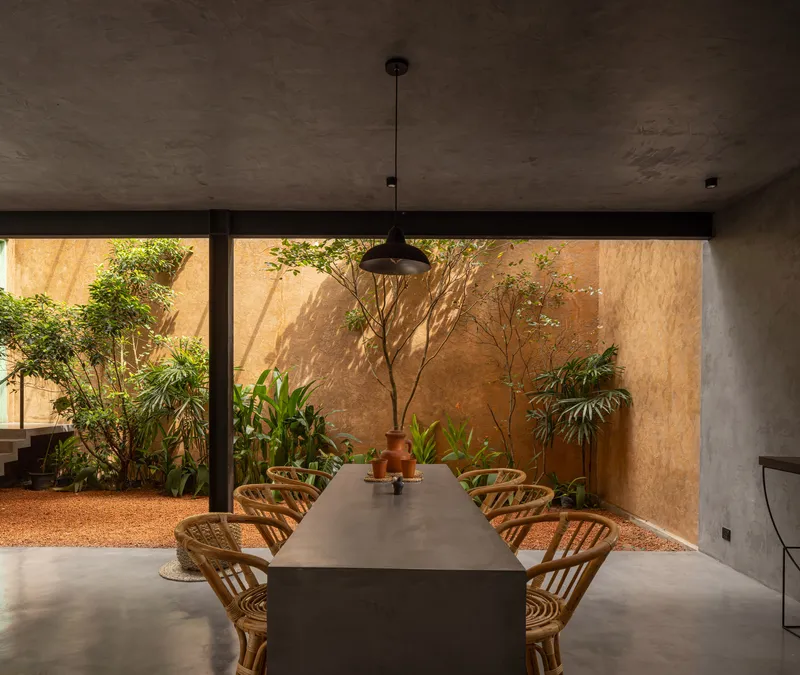
The main living area sets polished concrete floors against exposed concrete ceilings, with timber furnishings providing warmth. Overhanging foliage from the upper level drops into the frame, a reminder that the planted rooftop is not merely cosmetic but actively participates in the spatial experience of rooms below. Afternoon sun filtering through adjacent planting casts complex shadow patterns across walls and ceiling, an effect that changes hour by hour and season by season.
The dining space opens through frameless glass to one of the courtyards, creating an ambiguity about where the room ends. When the glass is slid open, the planted bed and ochre wall become part of the dining room's furniture. When closed, the courtyard becomes a terrarium. Either condition works, which is the mark of a threshold designed with care rather than merely specified.
Private Rooms and the Kitchen Garden
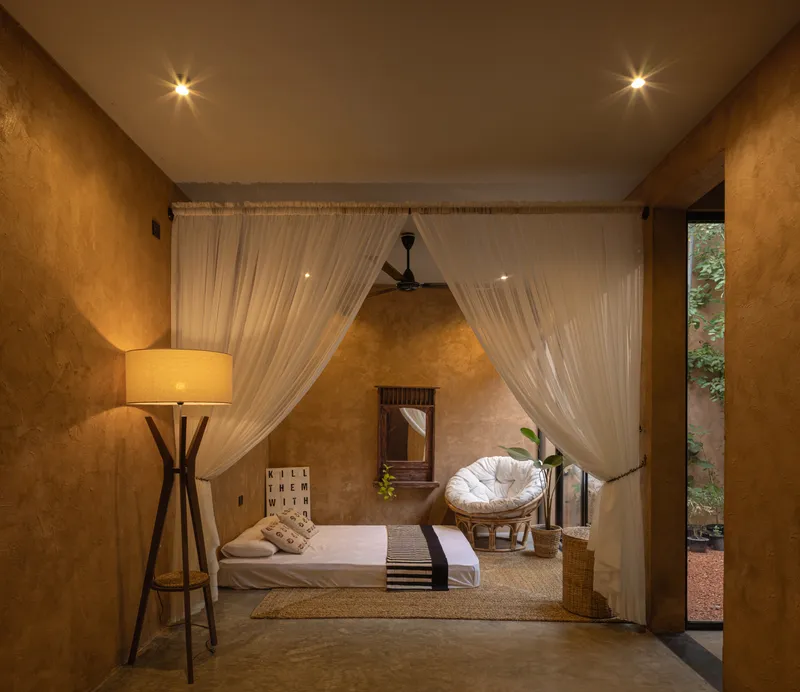
The bedroom, framed by sheer white curtains with a view to the courtyard at dusk, is the quietest room in the sequence. Its restraint is welcome after the spatial complexity of the public areas. The curtains do what curtains have always done: they modulate light, suggest privacy without enforcing it, and introduce a softness that concrete and timber cannot provide alone.
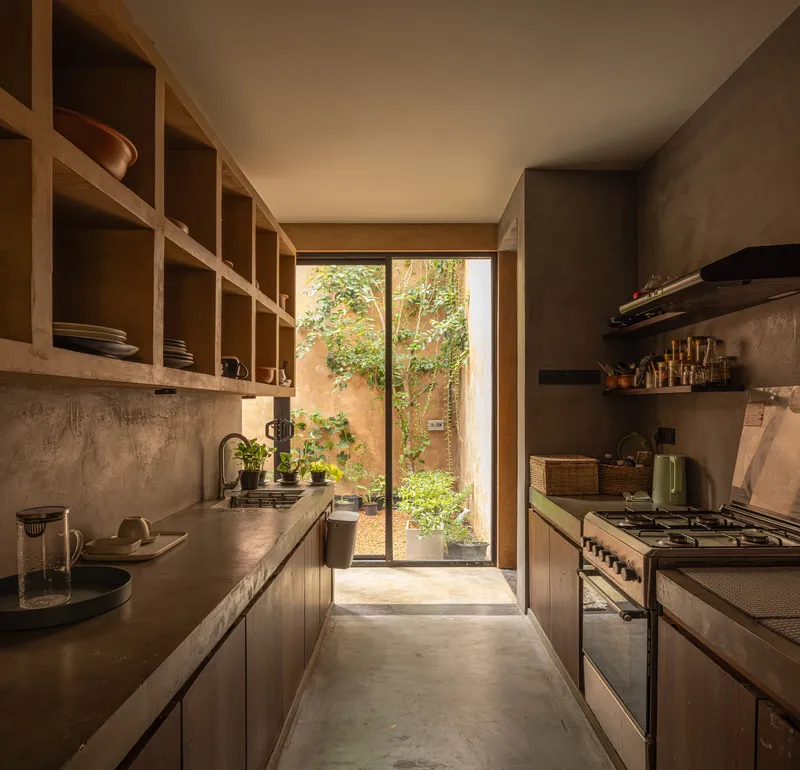
The galley kitchen opens to its own small garden courtyard through a glazed door, a practical move that brings ventilation and daylight to a room that in many tropical houses gets shoved to the back of the plan. Timber shelving keeps the palette consistent. The kitchen garden is modest, but its presence means that even the most functional space in the house has a relationship with the sky.
The Rooftop and the Double-Height Section
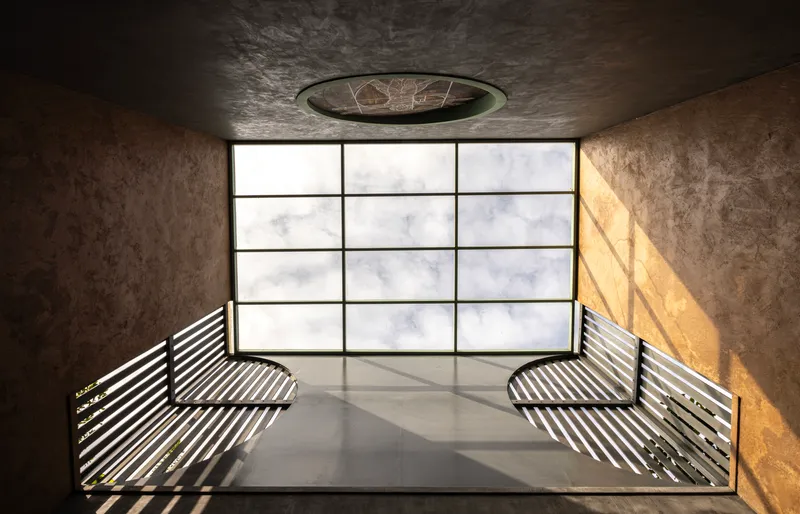

The rooftop terrace, with slatted metal benches facing a gridded glass wall and a circular skylight, reads as a living room without a ceiling. It is the most exposed space in the building and the one that most directly engages the neighborhood: you are above the walls here, visible and open to the weather. The gridded glass wall and skylight below it connect this terrace to the courtyard underneath, establishing a vertical section where light passes through two levels before reaching the ground floor.
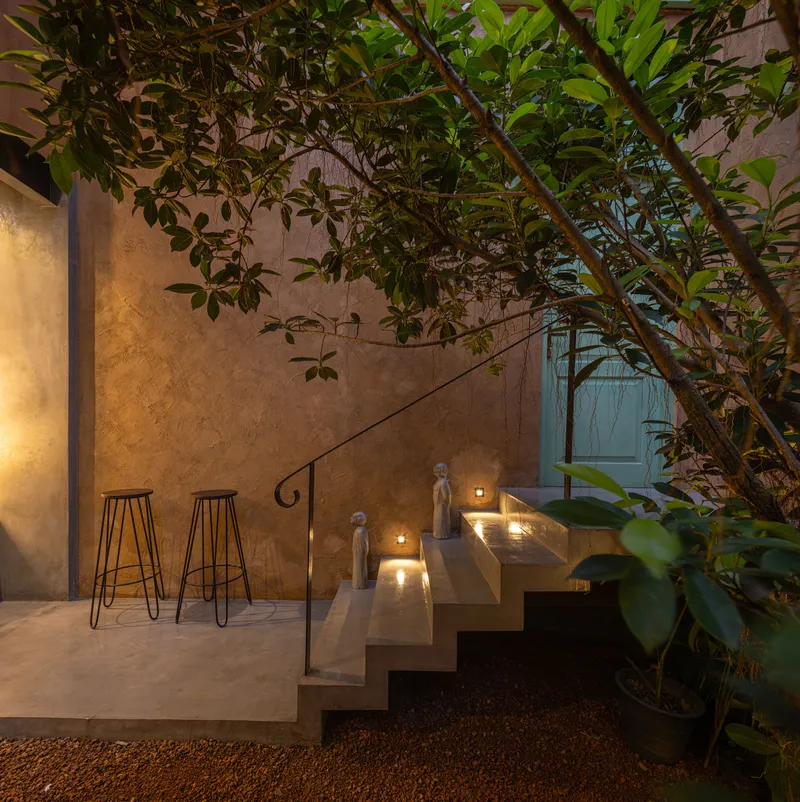
An exterior staircase with steel railing ascending to a mint green door beside a young courtyard tree reinforces the theme of movement through planted spaces. The vertical timber screen draped in climbing vines below the planted terrace demonstrates how the green strategy works in section: plants occupy the roof, cascade down the facade, and root in beds at ground level, creating a continuous vegetative surface that cools, shades, and softens the building's mass.
The Entry Sequence in Section
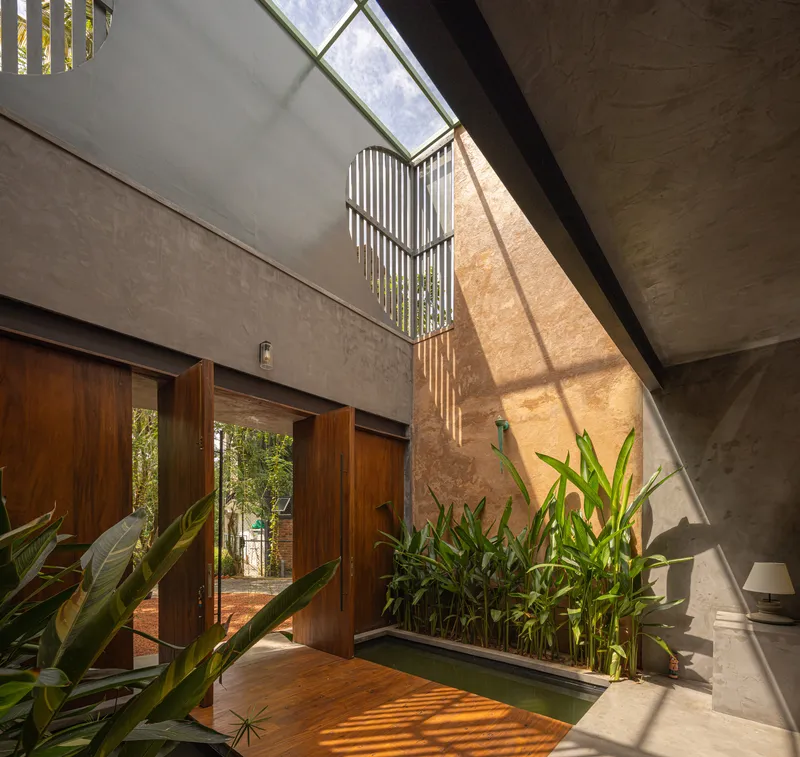


The double-height entryway, where a glazed clerestory throws dappled light across an ochre wall, is the project's most effective spatial move. It announces the building's sectional ambition immediately upon entry: you are not in a flat plan but in a volume that breathes upward. A timber bridge crossing a narrow water feature in the courtyard lounge extends this drama horizontally, turning circulation into event.
These moments are calibrated rather than excessive. A water feature in a 2400-square-foot building could easily tip into pretension; here, its narrowness makes it feel like an irrigation channel rather than a decorative pool. The wire-frame stools beside the stone staircase and the young tree at twilight suggest a house still settling into itself, which is honest. Buildings designed by their own architects often look suspiciously finished. This one has the good sense to leave room for time.
Plans and Drawings


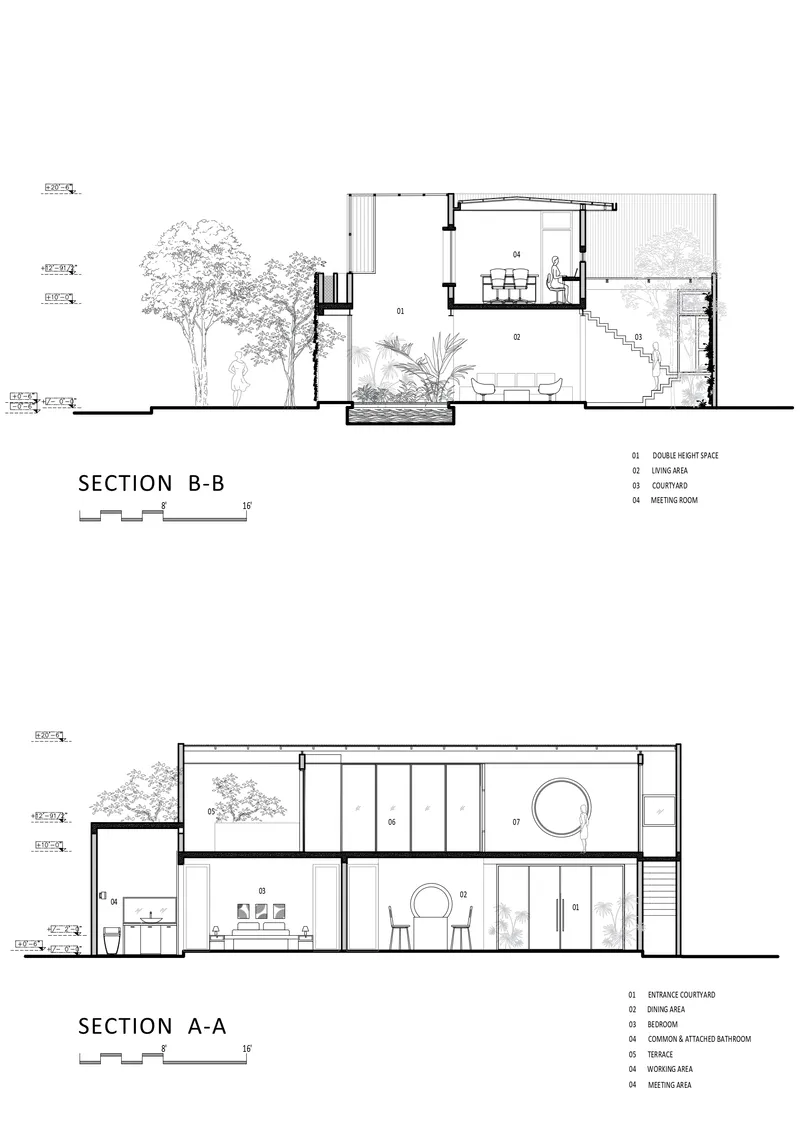
The floor plans reveal the angular, non-orthogonal logic driving the layout. The ground floor wraps living, dining, kitchen, and studio spaces around multiple courtyards, with a double-height void connecting to the level above. The first floor consolidates the more formal studio functions, meeting rooms and gathering areas, around their own planted courts. The section drawings make explicit what the photographs only suggest: that trees are as much a part of the building's structure as walls and columns, occupying voids that extend from ground level through the roof.
What the drawings confirm is that the irregularity of the plan is not arbitrary. Each angle responds to the site's boundaries or to an internal courtyard's orientation toward light. The surrounding landscape buffer, visible in the ground floor plan, provides a green edge that insulates the building from its dense neighborhood while allowing selective views and ventilation through planted gaps.
Why This Project Matters
Living Continuum matters because it offers a credible model for combining work and home on a tight urban site without resorting to the open-plan loft or the vertically stacked box. By fragmenting the program around courtyards, Munasinghe creates genuine separation between activities while maintaining the spatial continuity the project's name promises. It is a strategy with deep roots in South Asian and tropical architecture, but its application here feels specific to Malabe's conditions rather than nostalgic.
The building also demonstrates that density does not have to mean deprivation of nature. At 2400 square feet on 7.5 perches, this is not a generous site by any measure. Yet every room has a relationship with a planted space, every threshold opens to sky, and the rooftop contributes to a vegetative strategy that extends from ground to parapet. For architects confronting the relentless urbanization of South Asian cities, the lesson is clear: the courtyard is not a luxury. It is infrastructure.
Living Continuum Studio and House by Damith S Munasinghe Associates. Malabe, Sri Lanka. 2400 sq ft. Completed 2025.
About the Studio
Share Your Own Work on uni.xyz
If projects like this are the kind of work you want to make, uni.xyz is a place to publish your own, find collaborators, and enter design competitions.


Popular Articles
Popular articles from the community

Opera on the Sea: Driftwood Logic Shapes a Timber Opera House on Estonia's Coast
Trevor Orgill's opera house translates the entangled drift of floating timber into a civic building where wood, water, and music converge.

The Amber Palace Opera: A Geological Fiction Surfaces on Tallinn's Baltic Waterfront
Pierre Brillard reimagines a Baltic legend as a public landscape, opera house, and waterfront promenade rooted in Tallinn's coastal identity.

Singing Woman: An Opera House That Performs Before the Curtain Rises
Ovidiu Cristian Pavel's conceptual opera house translates Estonia's choral identity into a sculpted waterfront landmark facing the Baltic Sea.

Manzana Morphosis: Stretching Barcelona's Grid into a Living Landscape for 2050
A radical reworking of the Eixample manzana turns density into a tool for generous public space, vertical ecology, and environmental performance.

Similar Reads
You might also enjoy these articles

LAVA Architecten Gives Vocational Education a Sawtooth-Roofed Face on a Mechelen School Campus
In Mechelen, Belgium, a 2,053 m² STEM school on a 6×6 m grid turns workshops and classrooms into rooms that can be rearranged as teaching changes.

KEMA Studio Turns a Derelict Marvila Attic into a 60 m² Lighthouse Apartment Above Lisbon
In Lisbon's Marvila district, a rebuilt roof, four skylights and two plywood volumes turn an unlivable attic into a bright home facing the Tagus.

Pixel Gardens: One Repeated Module Stacked Into a Terraced Social Housing Tower for Famagusta
Salem Bader's shortlisted housing tower builds a vertical neighbourhood from one repeated module, offsetting units to carve terraces, light and air.

Bao Huynh Watercolor Atelier: A Serene Art Retreat in Hội An
Bao Huynh Watercolor Atelier in Hội An blends multifunctional art spaces, sustainable design, local materials, and family-friendly living in a serene environment.

Explore Living Building Competitions
Discover active competitions in this discipline

Comments (0)
Please login or sign up to add comments
No comments yet. Be the first to comment!