
DaoHo Studio Threads Light and Air Through a 4.5-Meter-Wide Tube House in Ha Long
A slender residential tower on Vietnam's coast uses timber screens, voids, and split levels to defeat the constraints of the tube house typology.

Vietnam's tube houses are a form born of pragmatism: narrow lots, shared party walls, and a single facade open to the street. The result, at its worst, is a dark corridor with rooms stacked like drawers. In Ha Long, the coastal city synonymous with its limestone-studded bay, DaoHo Studio confronted this typology head-on with the LHL House, a 4.5 by 15 meter dwelling that rises through five levels. Lead architect Ho Van Cuong chose not to fight the proportions but to work with them, carving vertical voids, layering timber screens, and staggering floors to create a home that feels far more generous than its 400 square meters on paper.
What makes LHL House worth studying is its disciplined material palette and its commitment to a single environmental strategy: pulling daylight deep into the section. Almost every major design decision, from the louvered facade to the glass floor panels to the planted ledges on upper landings, serves that goal. The house is a quiet argument that the tube house need not be a compromise.
A Timber Face on a Concrete Street
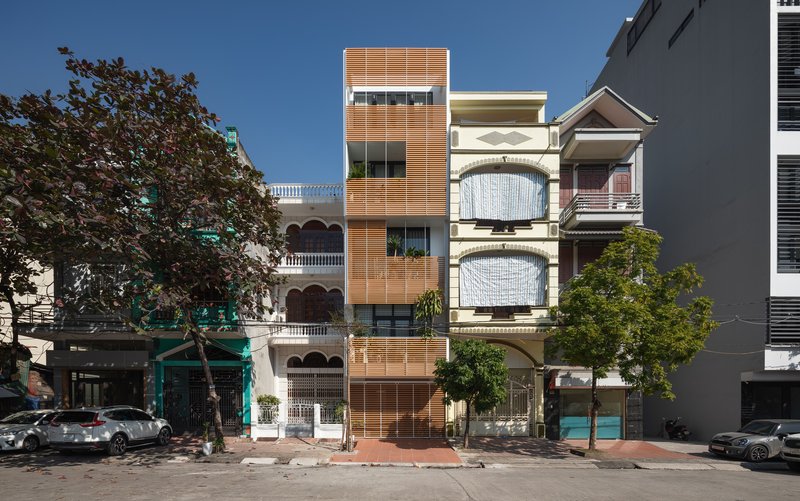
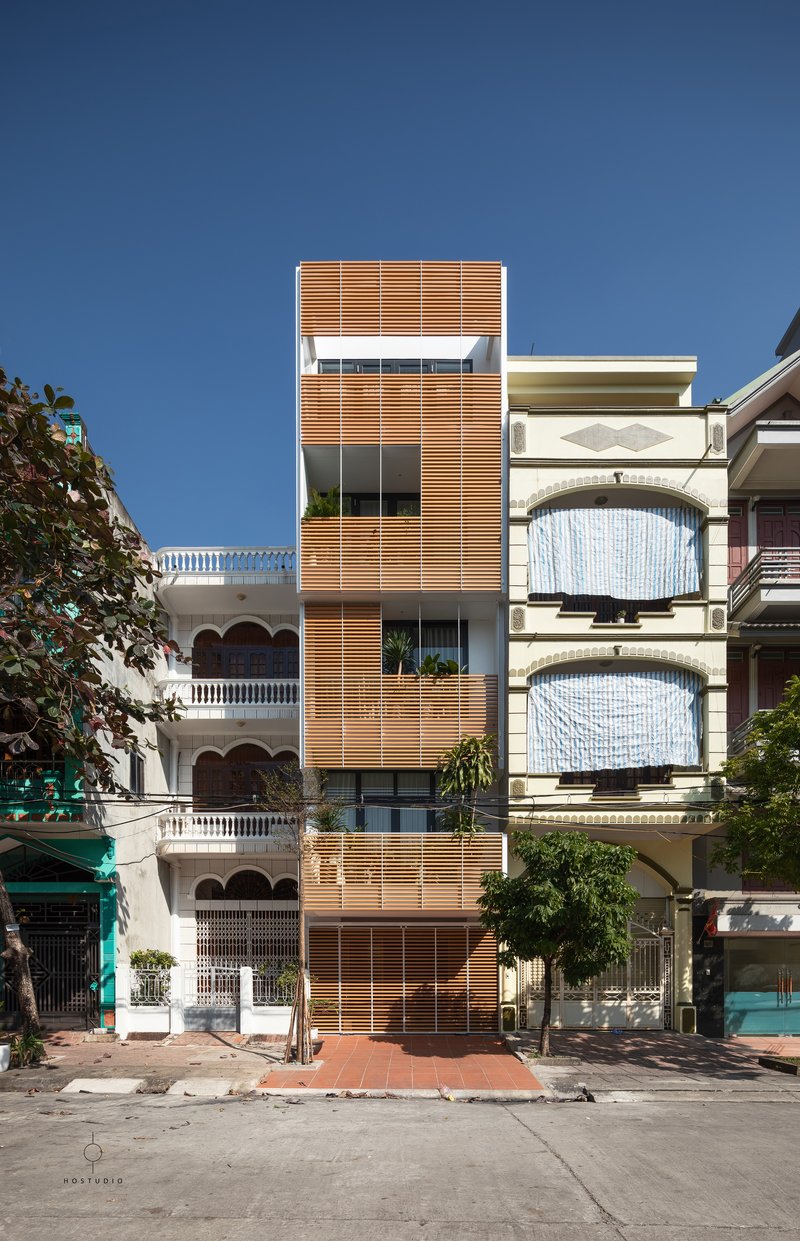
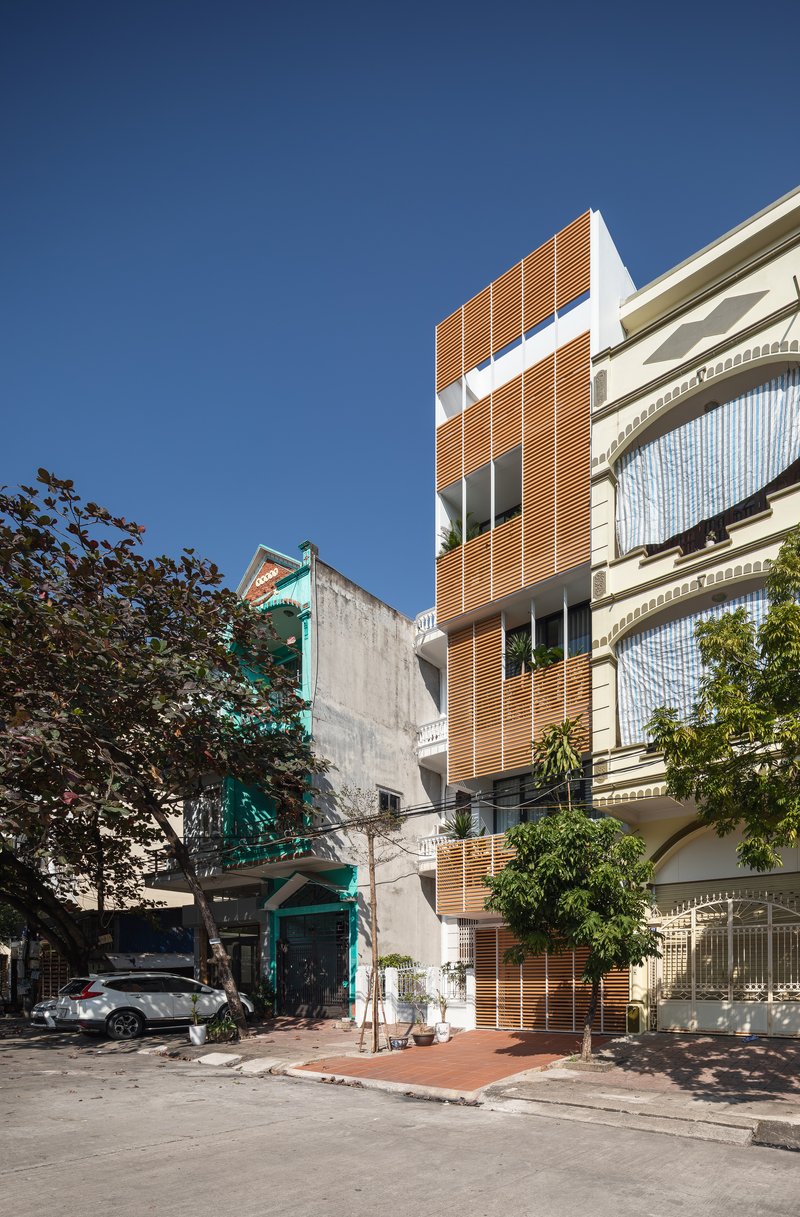
Seen from the street, the LHL House reads as an interloper: a warm, finely grained timber screen slotted between the typical painted concrete neighbors. The horizontal louvers run the full width of the facade and up the full height of the building, creating a consistent rhythm that makes the narrow elevation feel composed rather than pinched. White framing sets the timber back slightly, adding depth and shadow to what could otherwise be a flat surface.
The facade is functional, not decorative. Those louvers filter direct sunlight while allowing cross-ventilation from the only exposed face. Recessed planters punctuate the grid at irregular intervals, softening the geometry and signaling the domestic life behind the screen. It is a controlled gesture, and it works precisely because the surrounding streetscape is so uncontrolled.
The Facade Up Close
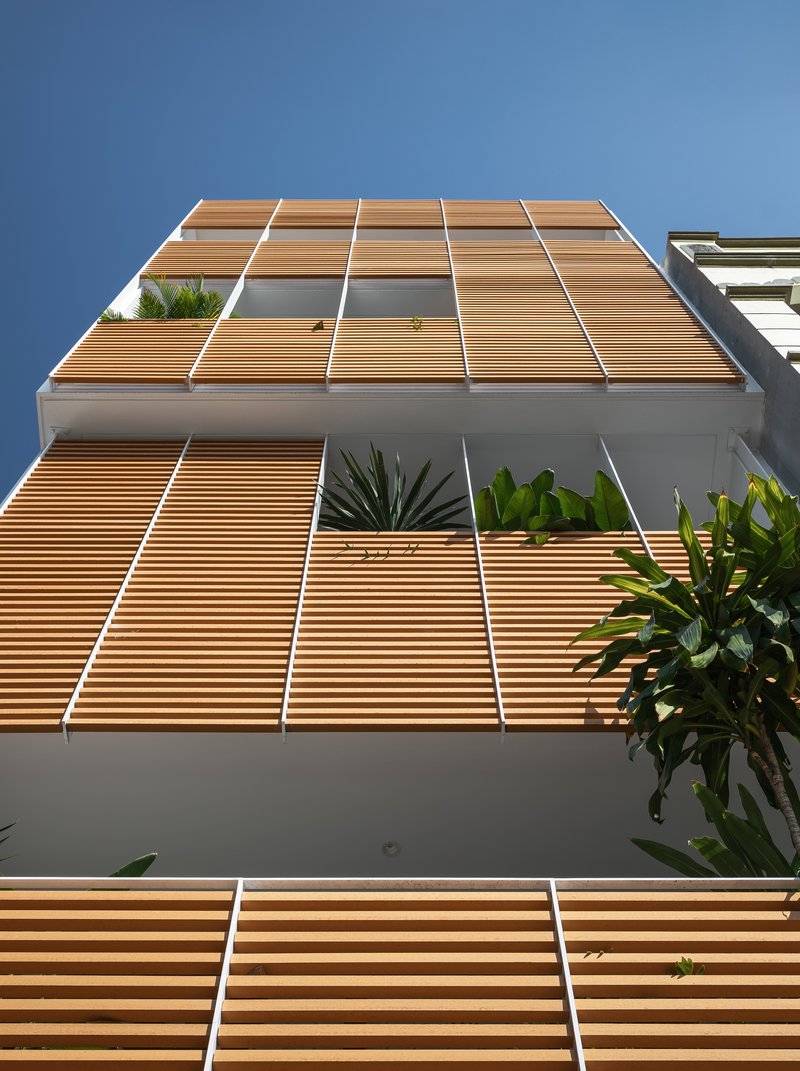
Looking upward through the louvered grid, the layering of the facade becomes more legible. White concrete frames define structural bays while the timber slats sit within them as operable or fixed infill panels. Small planted pockets break the repetition, and the whole assembly casts complex shadow patterns that shift throughout the day. The upper landing behind the louvers reveals how close the living spaces sit to this screen: residents occupy the threshold between interior comfort and the street, mediated only by the timber filter.
Kitchen and Ground Floor Living
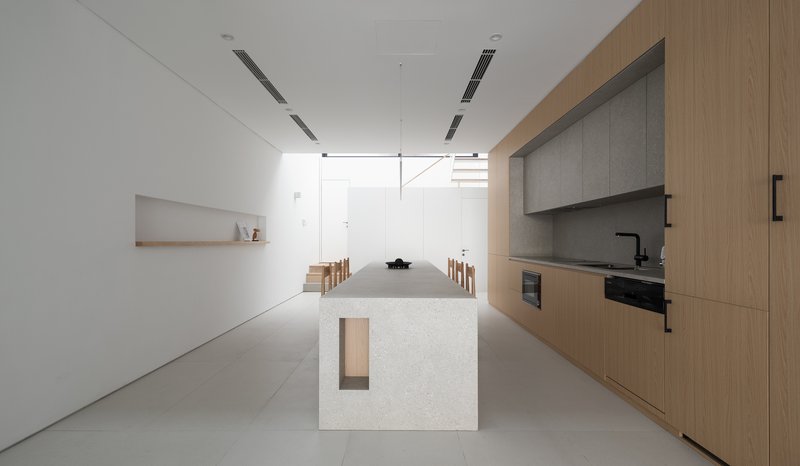
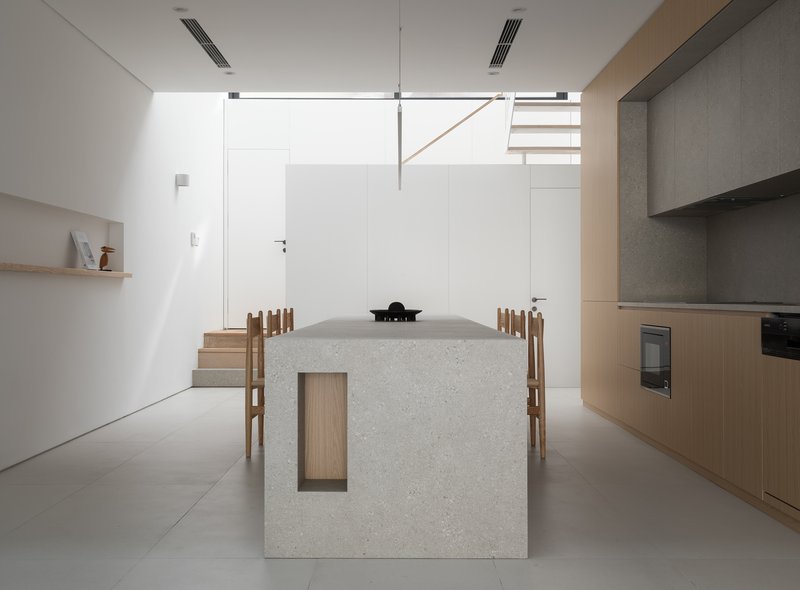
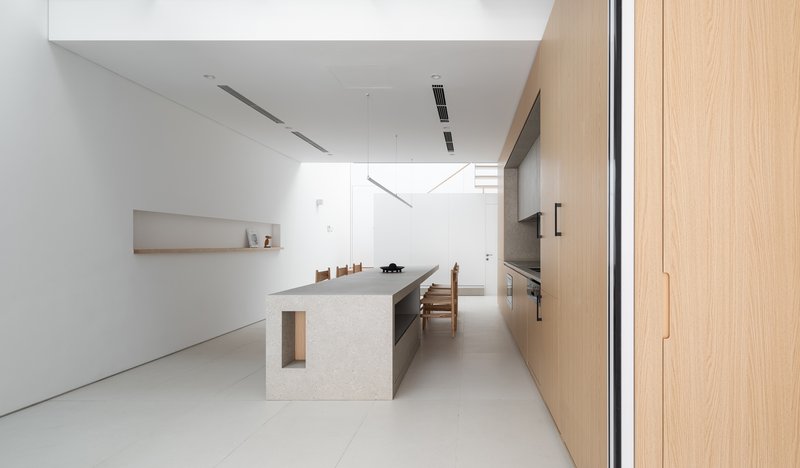
The ground floor is given over to an open kitchen and dining area organized around a terrazzo island that doubles as the spatial anchor. Light timber cabinetry lines one wall, keeping the palette consistent with the exterior screens. The ceiling is deliberately low here, compressed under the staircase above, which makes the double-height volume that follows feel all the more dramatic.
A long view down the island reveals just how deep the plan runs. At 15 meters, the risk is that the rear of the ground floor becomes a cave. DaoHo Studio counters this with pale tile flooring, white walls, and carefully positioned linear light fixtures that draw the eye toward the back. The floating stair overhead reads as a sculptural object rather than a barrier, keeping sightlines open across the section.
The Central Void
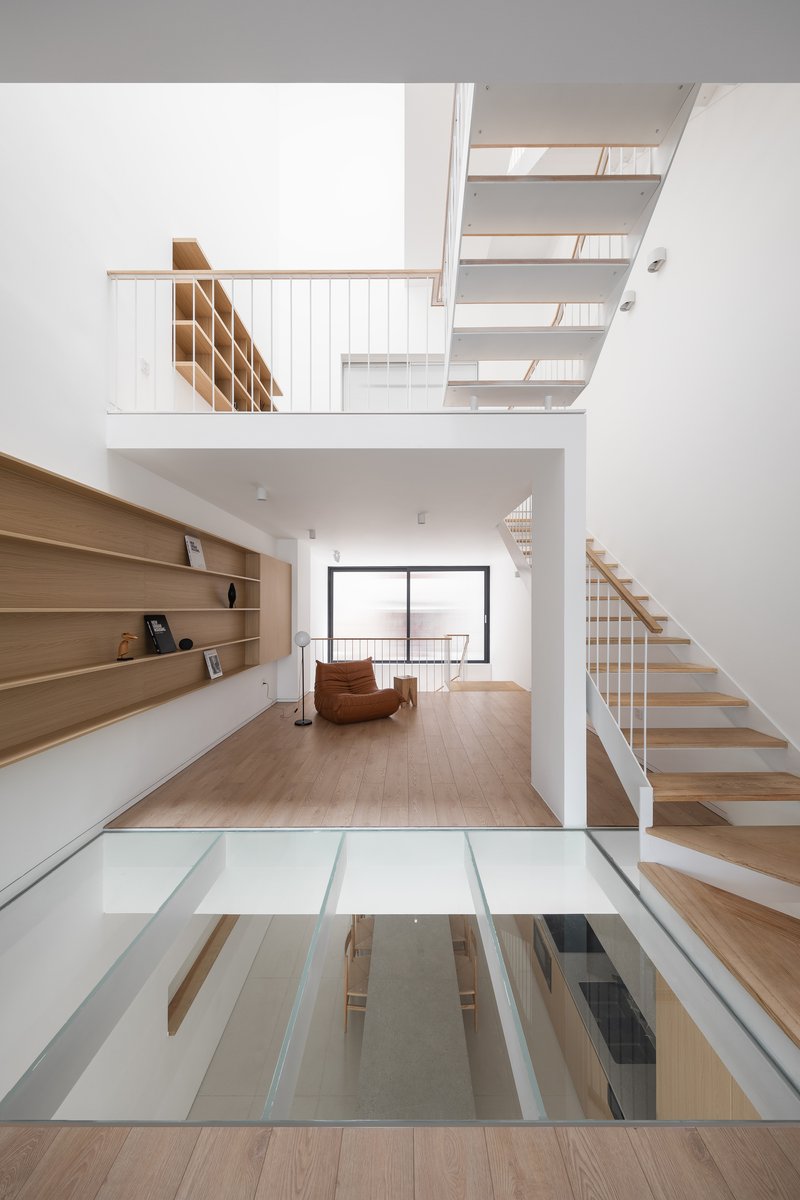
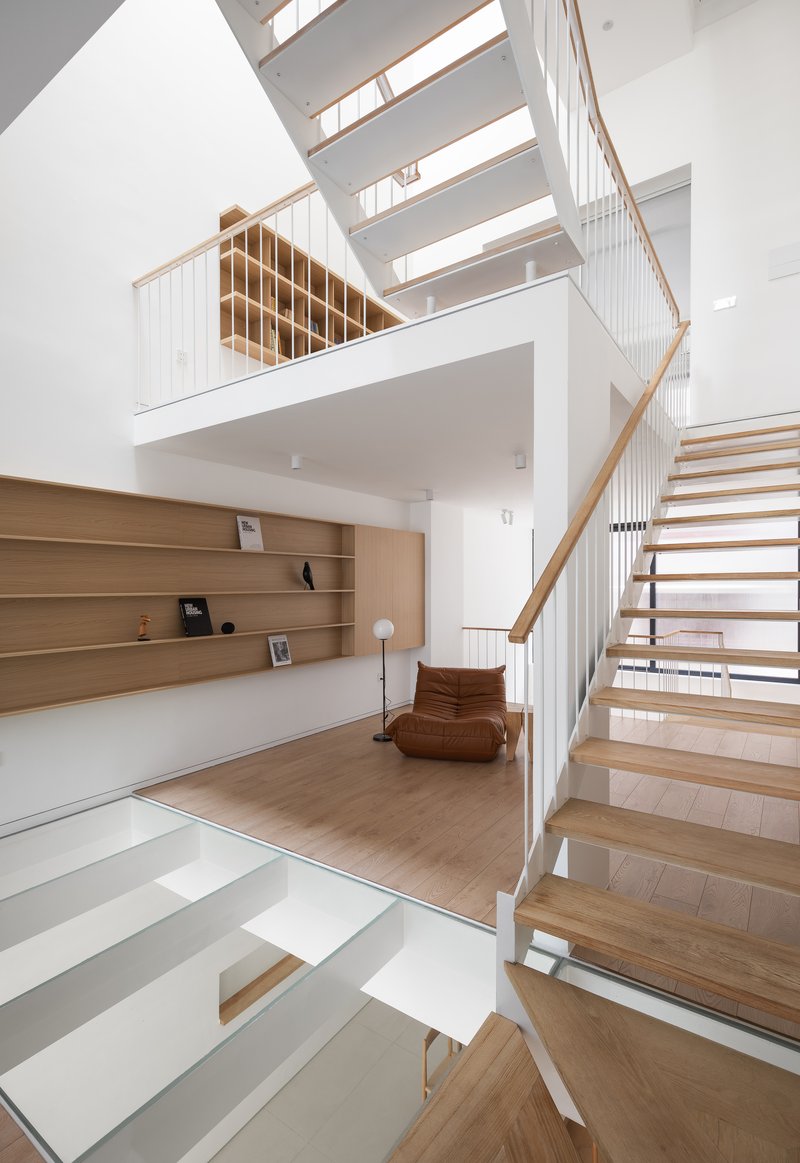
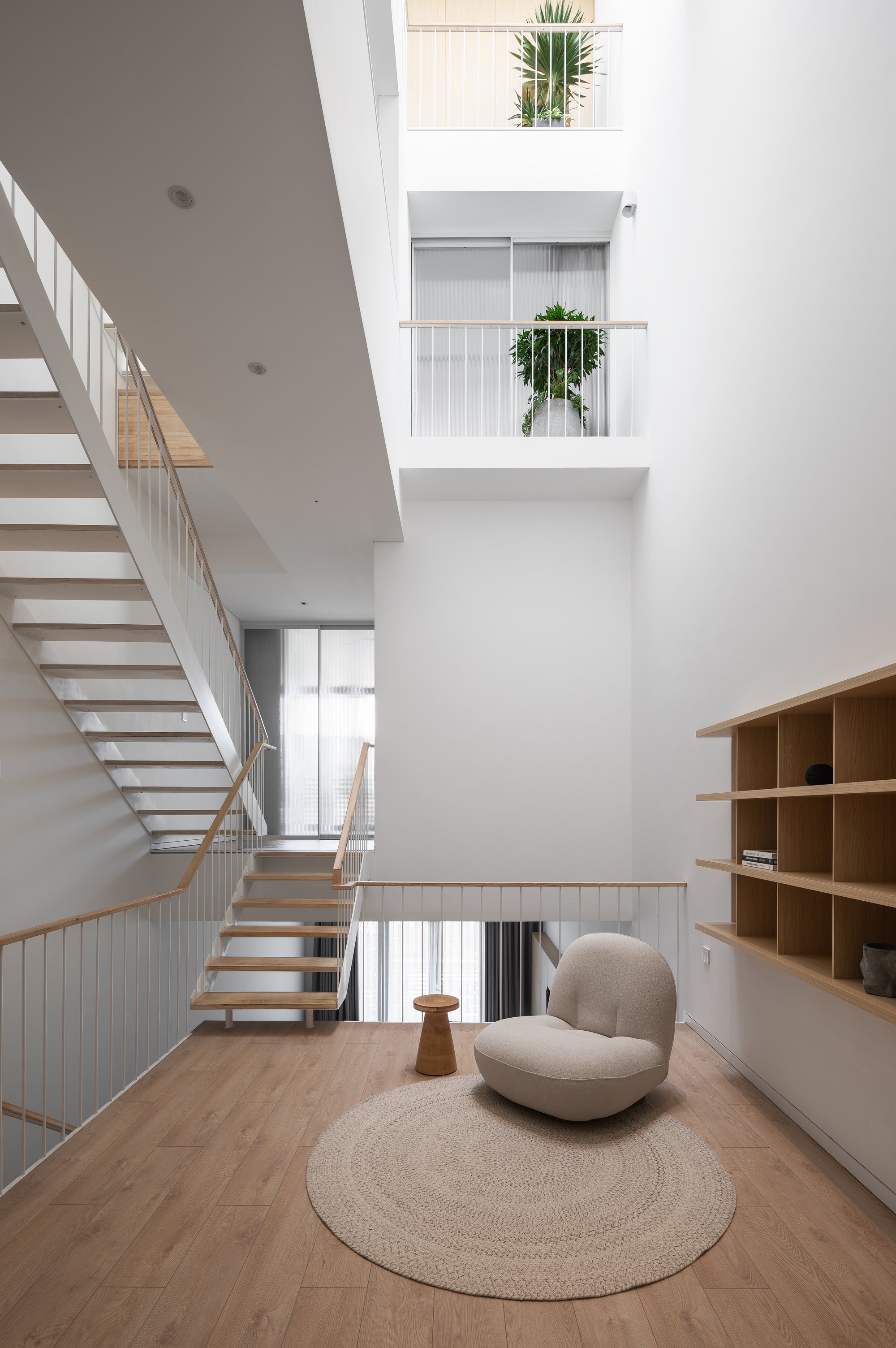
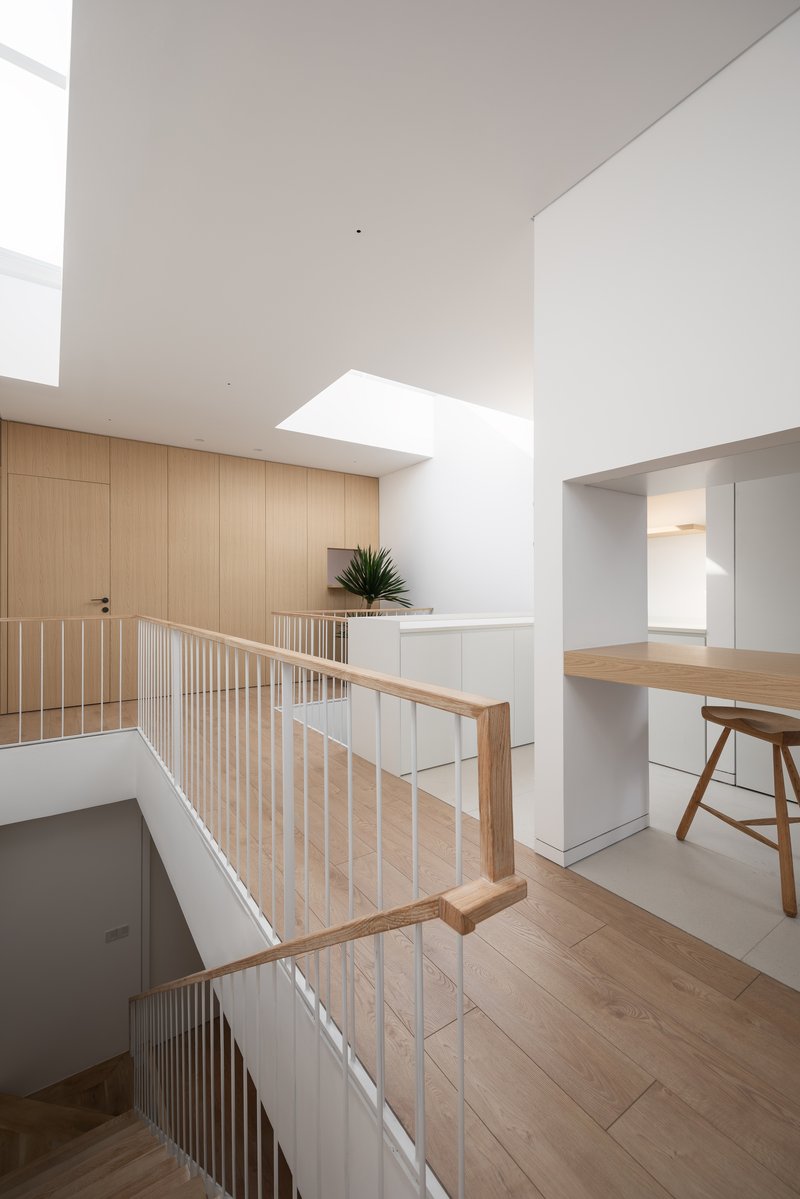
The core move of the house is a double-height void that connects the living level to the floors above. Timber stairs climb one wall, glass floor panels admit light from a skylight at the top of the section, and built-in shelving lines the opposite face, turning the void into a vertical library. Midday sunlight rakes across the wood floor in hard-edged bands, confirming that the skylight is doing real work, not just providing ambient glow.
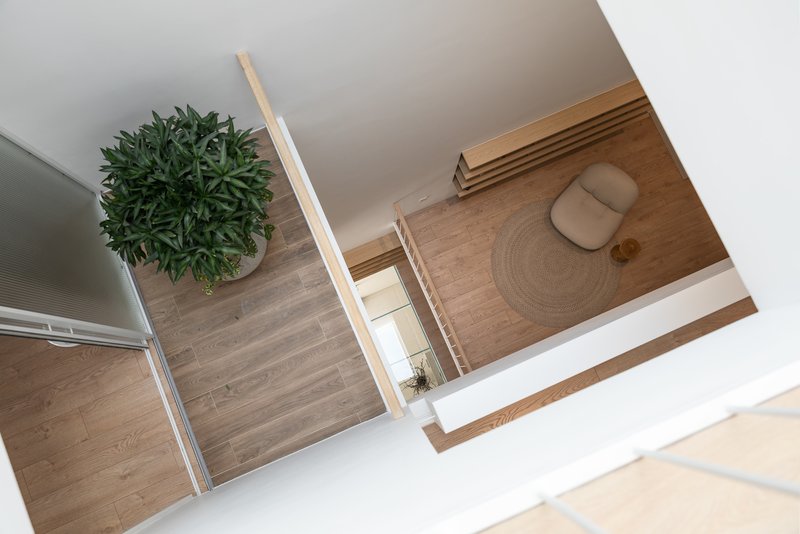
An overhead view from the upper levels shows how the void organizes the entire plan. Timber platforms at different heights are connected by the stair and linked visually across the open space. A potted plant on one landing introduces a single note of green. The restraint is notable: DaoHo Studio resists the temptation to fill the void with bridges or mezzanines, letting it breathe as the house's primary spatial event.
Vertical Circulation as Architecture
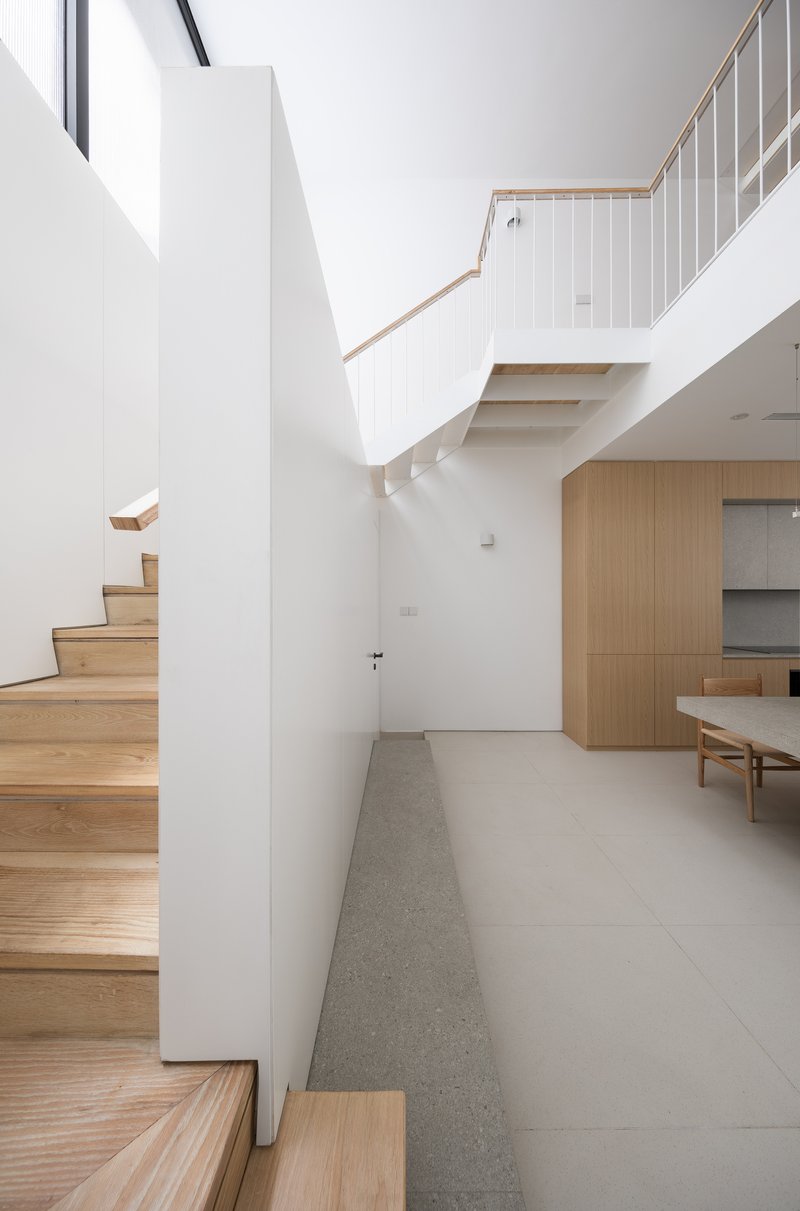
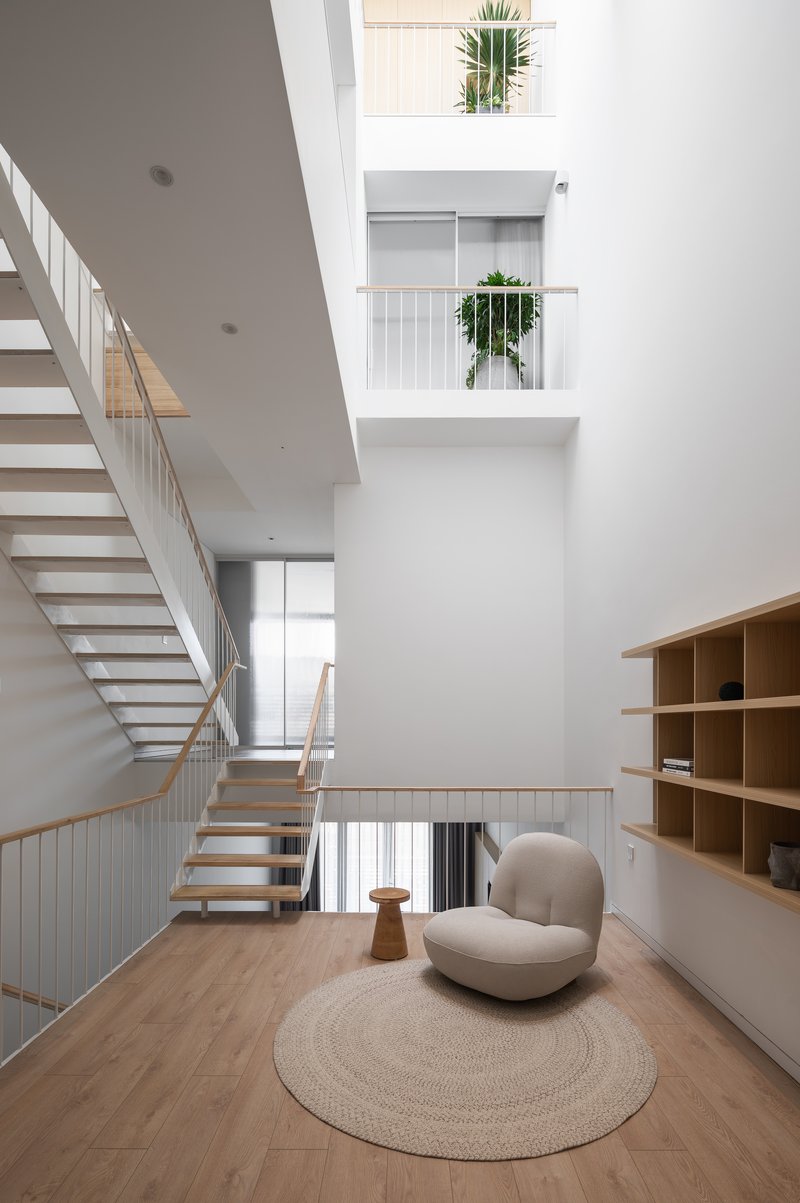
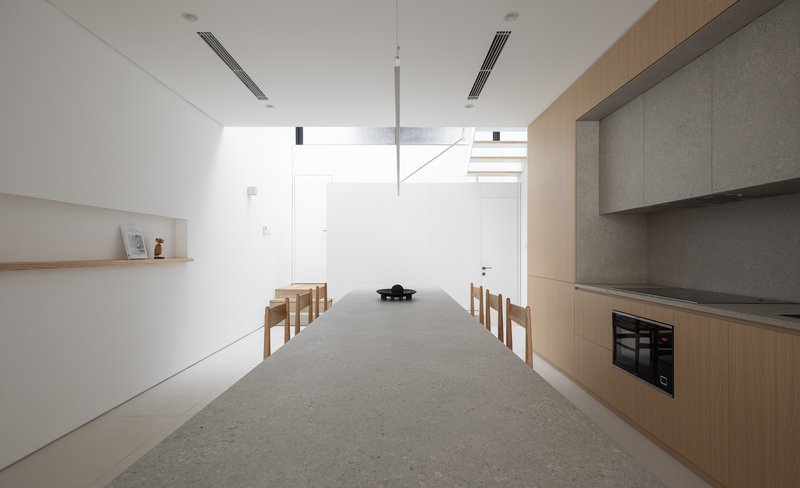
In a tube house, the staircase is everything. It consumes a disproportionate share of the plan, it dictates how each floor connects to the next, and it determines whether the section reads as a stack of rooms or as a continuous space. Here, the open timber stair does triple duty: it moves people vertically, it allows light to pass through its treads, and its metal railings frame views across the planted balconies that protrude into the void above.
Looking up through the stairwell, you see how each landing introduces a planted ledge or a clerestory that keeps the vertical journey interesting. The dining table below catches a wash of light from above, reinforcing the idea that every level of the house is in conversation with every other level. The section, not the plan, is the real drawing here.
Private Rooms and Filtered Light
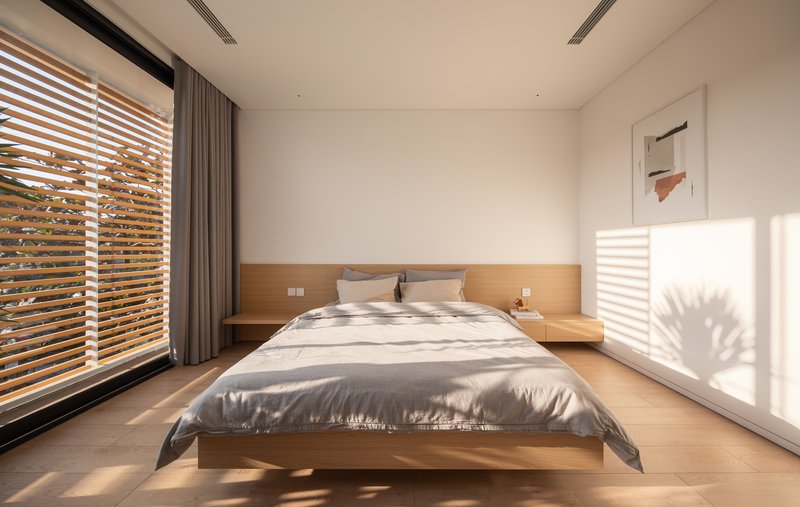
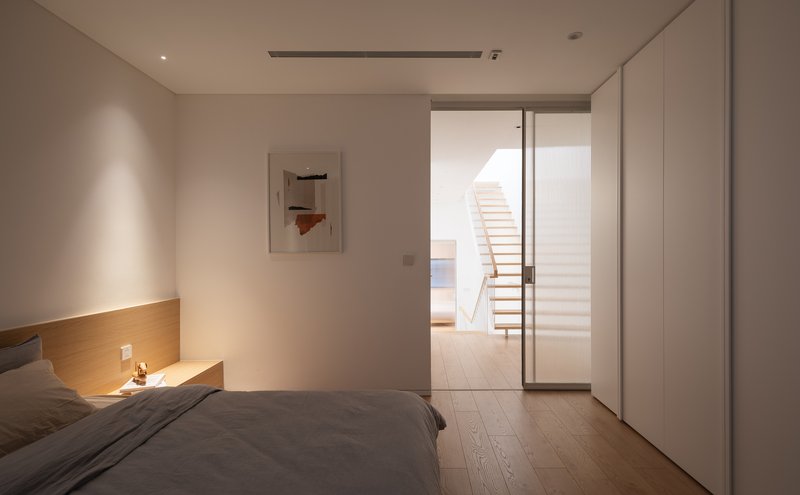
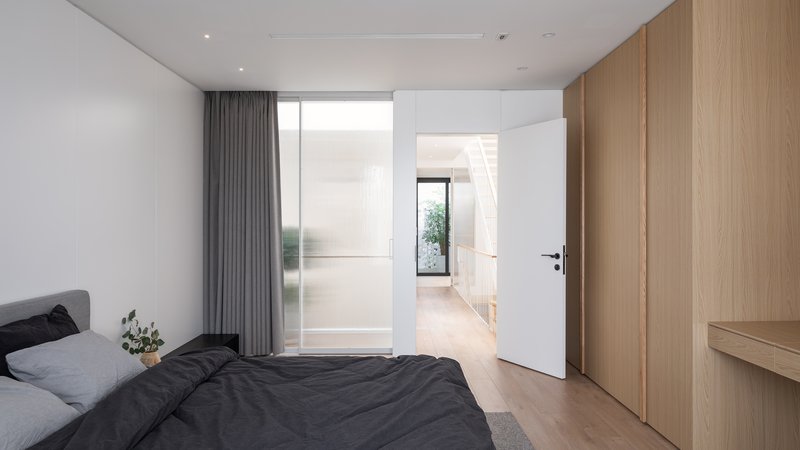
The bedrooms occupy the upper floors, where the timber louvers on the facade do their most important work. Morning sunlight enters through horizontal slats, throwing parallel lines across platform beds and timber wall panels. The effect is warm without being oppressive, and the louvers can presumably be adjusted to modulate the light as the day progresses.
Sliding glass doors and translucent partitions separate bedrooms from the circulation zone without severing the visual connection. One bedroom opens directly to the floating staircase, framing a dusk view through layered glass. Another looks through a doorway toward a planted courtyard at the rear of the plan. These moments of transparency are critical: they prevent the private rooms from feeling like sealed boxes in a narrow column of space.
Material Details
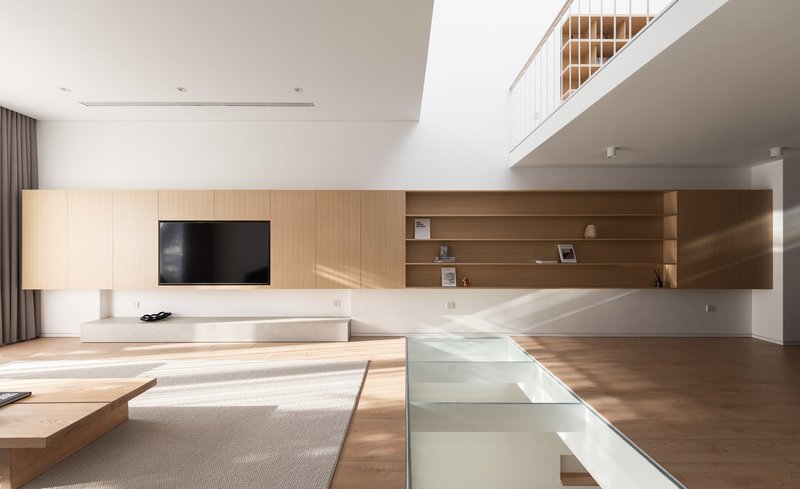
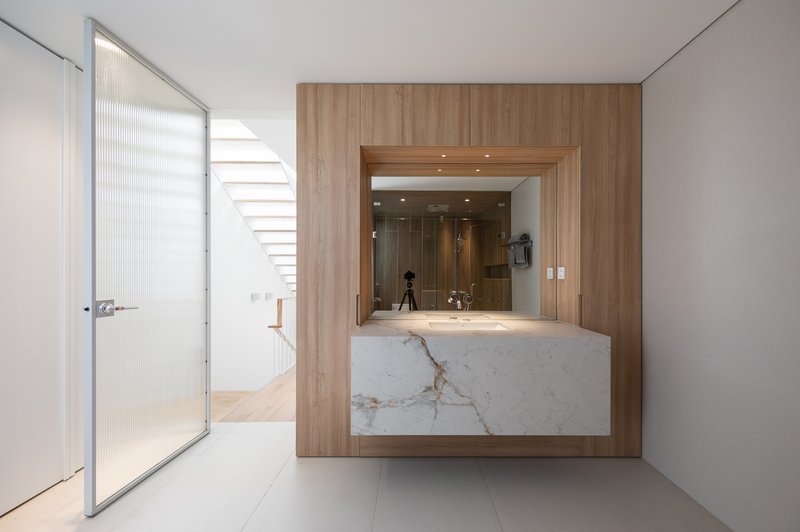
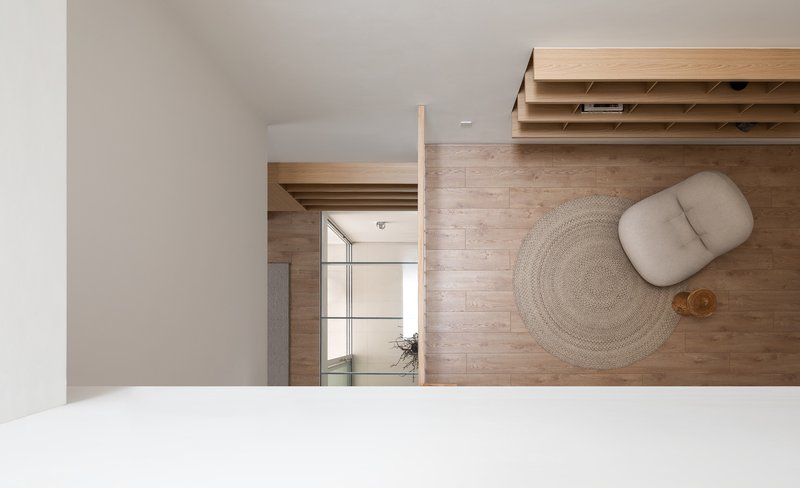
DaoHo Studio works with a deliberately limited palette: timber, white plaster, terrazzo, marble, and pale tile. The living room wall unit shows the timber at its most refined, a flat-panel system with flush handles that reads as a warm surface rather than a piece of furniture. Sunlight raking across the wood floor highlights the grain and gives the room its only decoration.
The bathroom tucks under a staircase, using what would otherwise be dead space. A marble countertop and timber surround keep the material language consistent, and a slot of daylight from the stair above means the room never needs artificial light during the day. Elsewhere, a woven rug and floor cushion suggest a quieter, almost meditative use of the upper levels. The materials age well in Vietnam's humid coastal climate, which matters more than it usually gets credit for.
Plans and Drawings
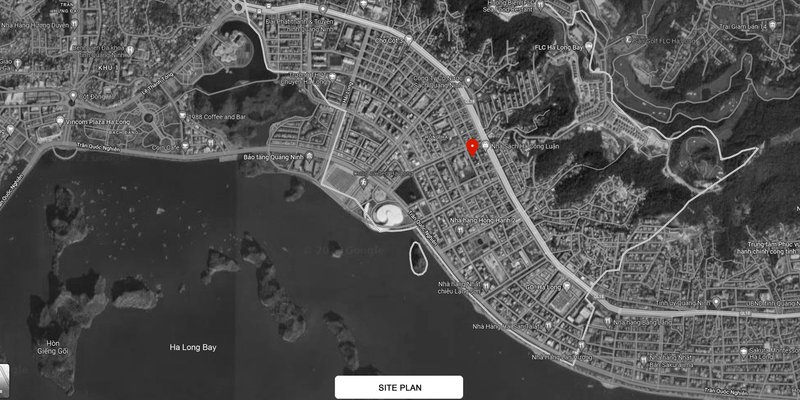
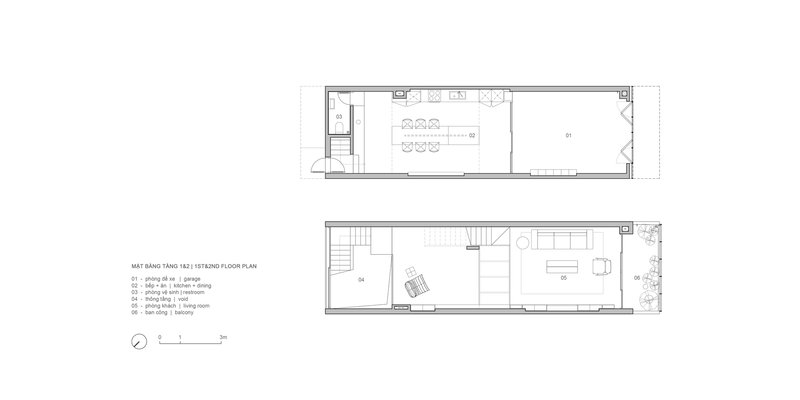
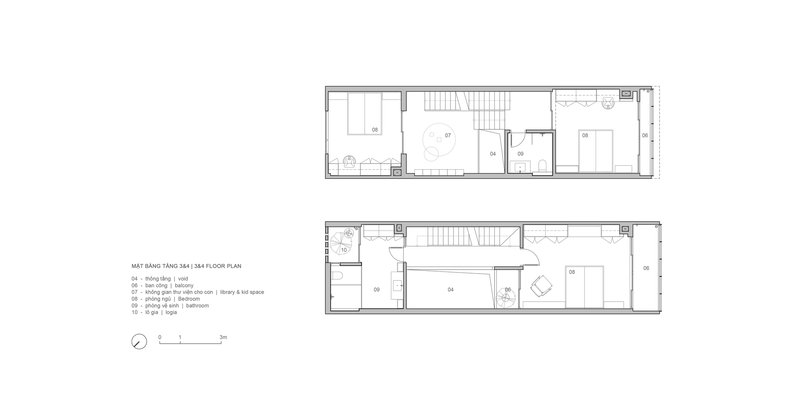
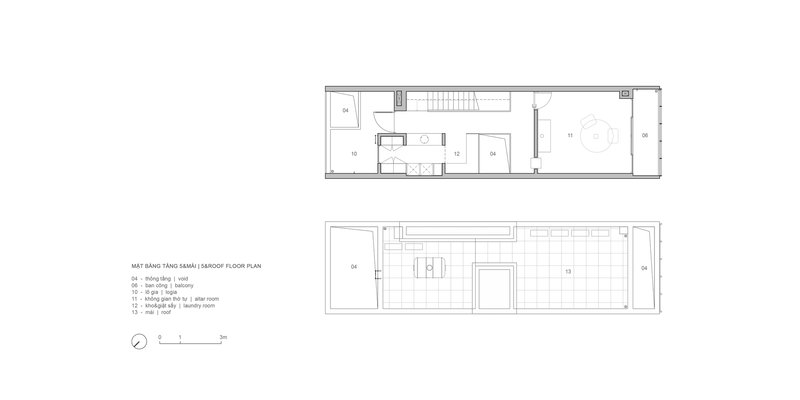
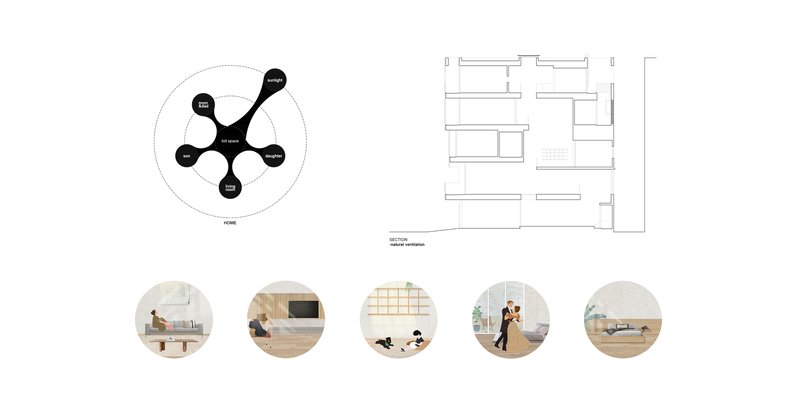
The site plan confirms the challenge: the LHL House is one slot in a dense coastal urban grid, marked in red, with neighboring buildings pressed tight against its party walls. The floor plans across five levels show how the central staircase acts as a spine, with rooms arranged on either side along the 15-meter depth. Ground and first levels are open and communal; second and third floors introduce bedrooms and private zones around the stair; the fourth and roof levels provide utility space and an outdoor terrace.
The conceptual diagram is revealing. A central five-lobed plan, surrounded by circular vignettes of domestic activities, suggests that DaoHo Studio conceived the house as a series of overlapping zones rather than discrete floors. The accompanying section drawing makes the vertical strategy legible: voids, split levels, and the louvered facade all work in concert to create a section that is far richer than the plan could ever be on its own.
Why This Project Matters
The tube house is one of Southeast Asia's most stubborn building types. It persists because land division patterns persist, and because the economics of urban infill rarely reward spatial generosity. Most tube houses solve the problem by ignoring it: stack rooms, install air conditioning, paint the facade a bright color, move on. LHL House takes the type seriously. It treats the narrow lot not as a constraint to be endured but as a sectional opportunity, using voids, screens, and glass to make daylight and air do the heavy lifting.
DaoHo Studio's contribution here is in the rigor of the material strategy and the clarity of the environmental idea. There is no signature gesture, no Instagram moment, just a well-considered sequence of spaces that perform better than they have any right to given the lot dimensions. In a city like Ha Long, where tourism drives most of the architectural attention toward the waterfront and the bay, LHL House is a reminder that the most valuable design work often happens on the most ordinary sites.
LHL House by DaoHo Studio, led by architect Ho Van Cuong. Located in Ha Long, Vietnam. 400 m², completed in 2022. Photography by Nguyen Thai Thach.
About the Studio
DaoHo Studio
Share Your Own Work on uni.xyz
If projects like this are the kind of work you want to make, uni.xyz is a place to publish your own, find collaborators, and enter design competitions.




Popular Articles
Popular articles from the community

GGR Architectes Anchors a New Neighborhood in Frouzins with a Brick and Timber School Complex
A cruciform plan of terracotta brick and exposed wood frames four courtyards for 140 students outside Toulouse, France.

Non Architecture's Horrible Houses Competition Asks AI to Design the Ugliest Home Possible
A free global competition invited participants to use AI image generators to produce the most hideous house they could imagine.
Inside a Timeless Mumbai Residence by Aether Studio
Aether Studio's 2,250 sq ft apartment in Malad, Mumbai uses marble, brass, boucle, and disciplined restraint to build a quiet retreat from the city.
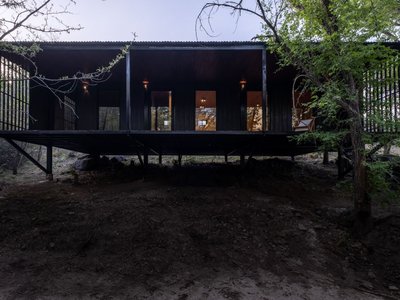
Pablo Senmartin Suspends a Steel-and-Timber Refuge Above a River Forest in Córdoba
An 80-square-meter dwelling on pilotis camouflages itself among the trees of Mayu Sumaj, designed to be dismantled without waste.


Similar Reads
You might also enjoy these articles

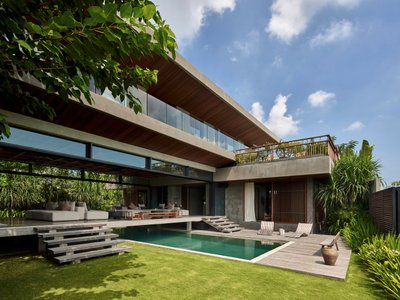
Freebird Residence by Alexis Dornier: A Tropical Modernist Sanctuary in Bali
Floating living pavilion above pool anchors H-shaped tropical villa, blending Japanese minimalism, sustainable strategies, lush landscape, and sculptural interiors.
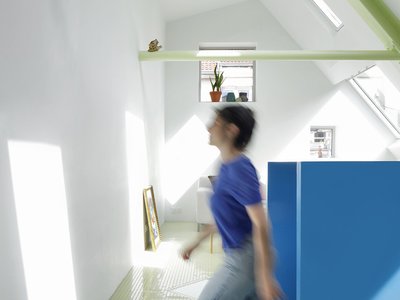
127af Flips a Tiny Bagnolet Rowhouse Upside Down with a Handcrafted Roof Extension
A 55-square-meter terraced house on the edge of Paris gains a luminous upper living floor through lightweight timber and steel.
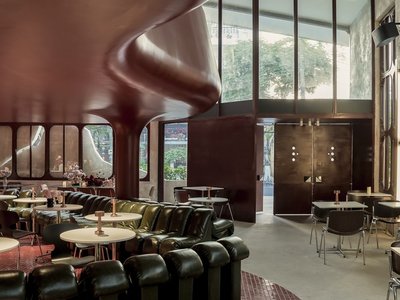
1.61 Design Workshop Wraps a 600-Square-Meter Café in Vietnam in Sculptural Burgundy Drama
Reden Café & Bistro pairs a helical staircase, mosaic floors, and deep red interiors to rethink Vietnamese hospitality space.

The Unbound Brain: A School Shaped by Cognitive Architecture
Cylindrical learning pods radiate like neurons from a central cortex, turning the floor plan into a spatial model of human thought.


Explore Architecture Competitions
Discover active competitions in this discipline




The International Standard for Design Portfolios


The Global Benchmark for Architecture Dissertation Awards


The Global Benchmark for Graduation Excellence


Challenge to design mud housing for contemporary communities
Comments (0)
Please login or sign up to add comments
No comments yet. Be the first to comment!