

DARP Rehabilitates a Medellín Hillside House Around a Central Staircase and Garden Dialogue
Casa P. Colina in Medellín embraces regenerative architecture, weaving split levels, timber, and tropical planting into 250 square meters of considered liv


Rehabilitation projects in Latin America rarely receive the same editorial attention as new builds, which is a shame, because they often demand more ingenuity. Casa P. Colina, completed in 2025 by DARP (De Arquitectura y Paisaje) in Medellín, Colombia, is a 250 square meter residential reworking led by architects Jaime Cabal and Jorge Buitrago. It takes an existing hillside house and reframes it through what the studio calls a regenerative view of architecture: not demolition and replacement, but careful transformation that amplifies what was already there.
What makes the project genuinely interesting is the way it negotiates its steep topography. Rather than fighting the slope, DARP organizes the house around a central staircase that becomes the spatial engine of the entire plan, stitching split levels together while pulling daylight and garden views through each floor. The result is a house that feels far larger than its footprint, where every half-level turn reveals a new relationship between interior volume and the lush tropical landscape outside.
The Staircase as Spatial Engine

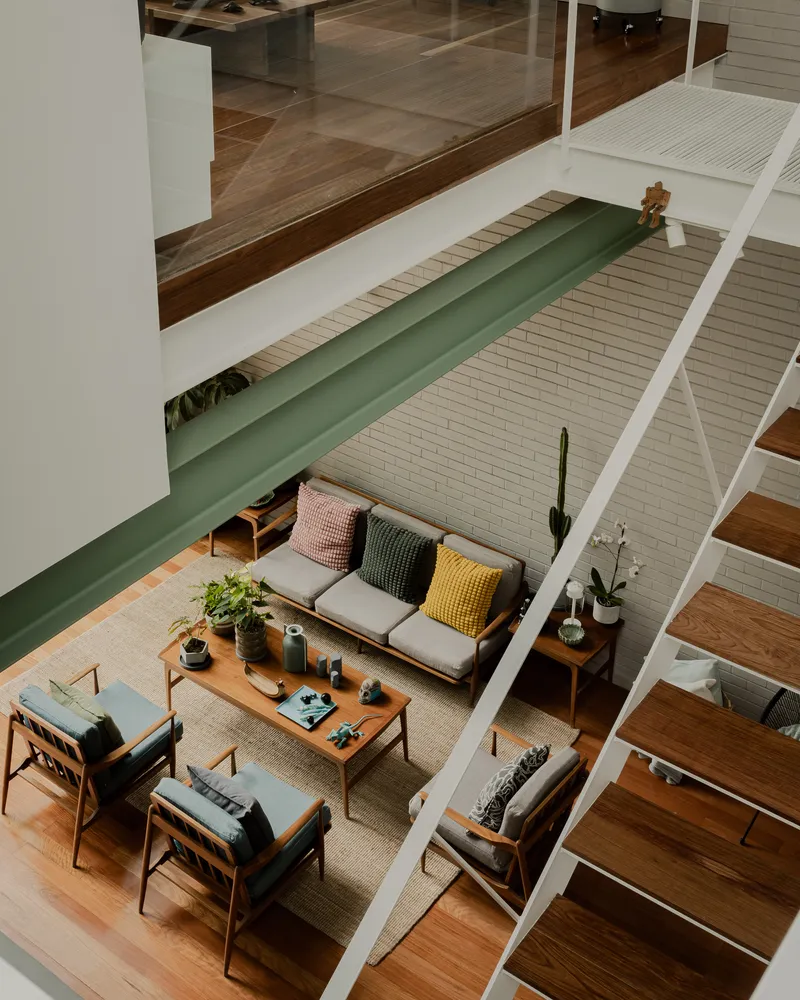
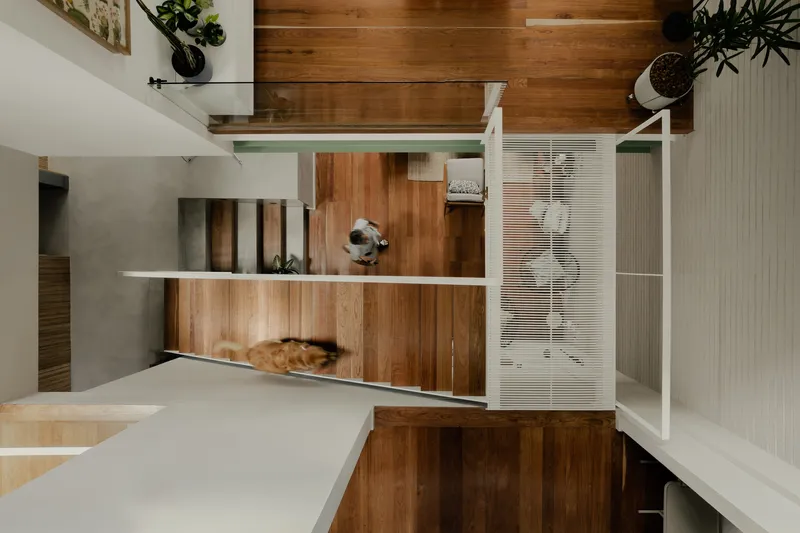
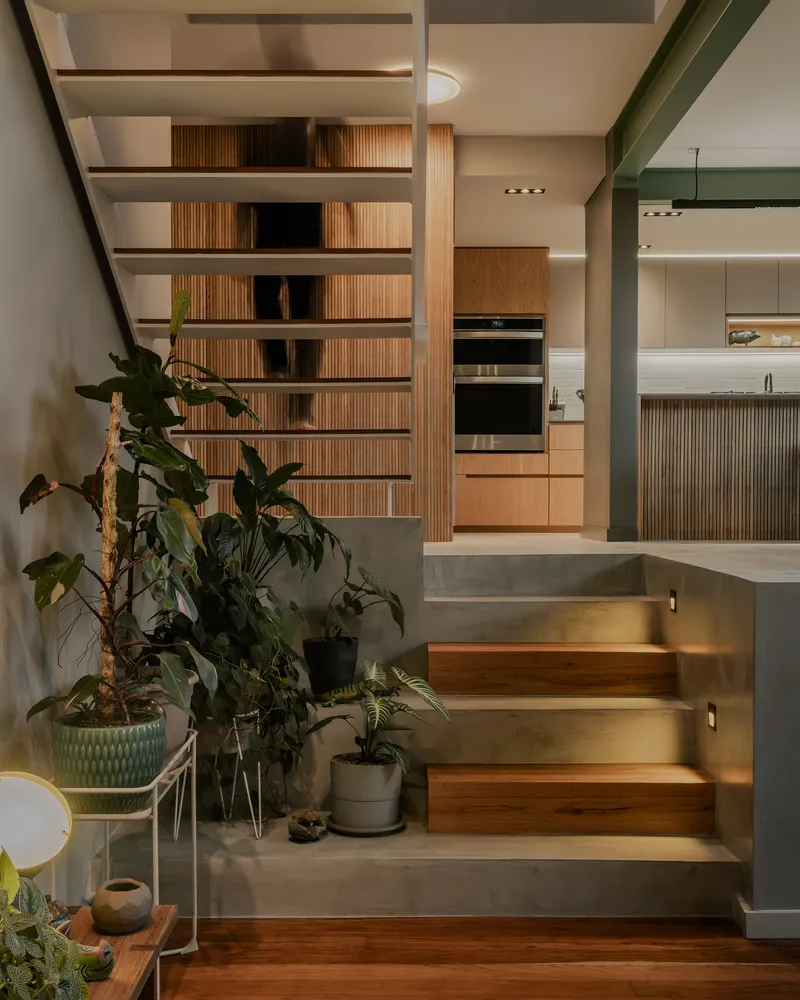
The central staircase is not a corridor or a shaft. It is the organizing principle of the entire house. Open timber treads, green-painted steel beams, and a mezzanine bridge create a vertical sequence that connects the ground floor living areas to the upper workspace and bedrooms. The double-height volume it carves out is the largest single space in the house, and DARP uses it to draw natural light deep into the plan.
From above, the green steel bridge reads as a deliberate interruption, a horizontal line that slices across the vertical openness and gives the house its most legible interior moment. The walkways connecting timber-clad volumes at different levels turn circulation into a spatial event rather than a leftover. You move through this house by ascending, pausing, and looking back down.
Garden and Interior as a Single Room
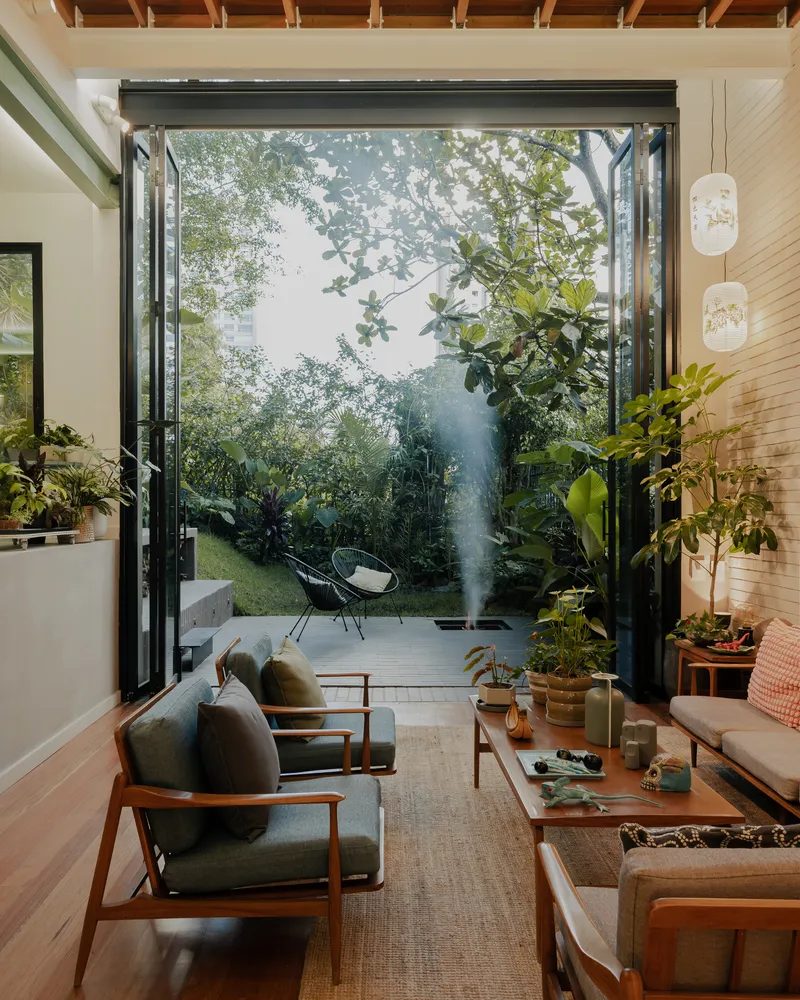

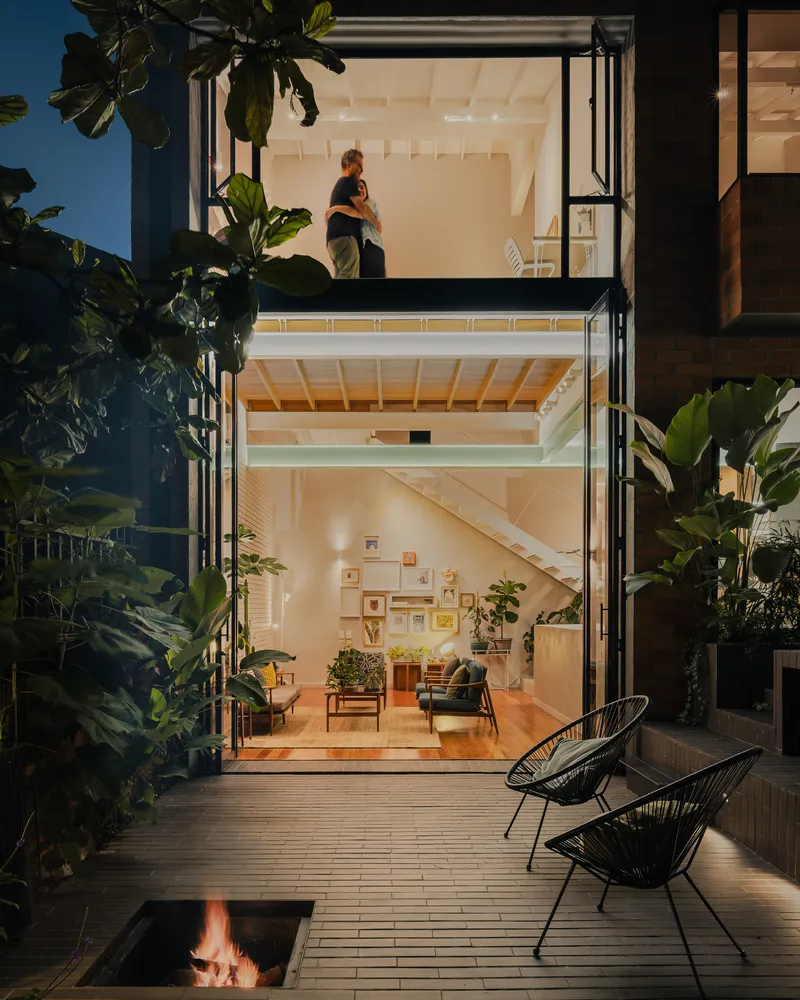
Medellín's mild climate gives architects license to collapse the boundary between inside and out, and DARP takes full advantage. Fully folding glass doors on the ground floor open the living room directly to a courtyard garden, so that on a misty morning the threshold effectively disappears. At dusk, the stacked volumes glow behind tropical planting, framing the house as a lantern set into its hillside.
The courtyard planting is not ornamental. It mediates between the private interior and the steep terrain beyond, providing shade, humidity regulation, and a visual anchor that every split level references. From the kitchen to the upper study, the garden is always in the peripheral field of vision, a constant negotiation between built volume and living green.
Timber, Brick, and a Selective Palette

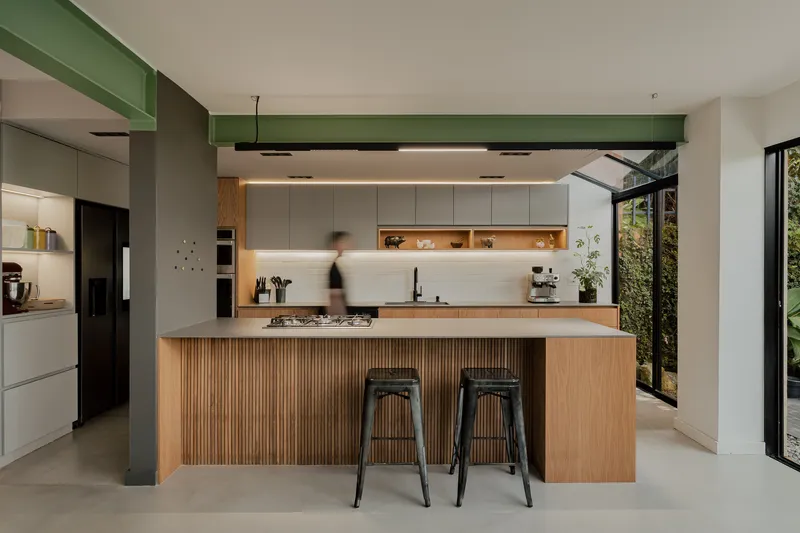

DARP restricts the material palette to three primary elements: red brick on the exterior upper volume, timber cladding and structure throughout the interior, and green-painted steel at key structural moments. The discipline pays off. Each material has a clear role. Brick handles the street-facing mass and thermal performance. Timber creates warmth and acoustic softness across ceilings, walls, and stair treads. Green steel marks the moments where the structure performs visibly, at beams, bridges, and mezzanine edges.
The kitchen is a good summary of this logic. Vertical timber slats clad the island, a green beam spans overhead, and pendant lighting provides an intimate scale. Nothing is competing for attention, and the restraint makes the few bold gestures, like that beam color, land with real force.
Split Levels and the Study
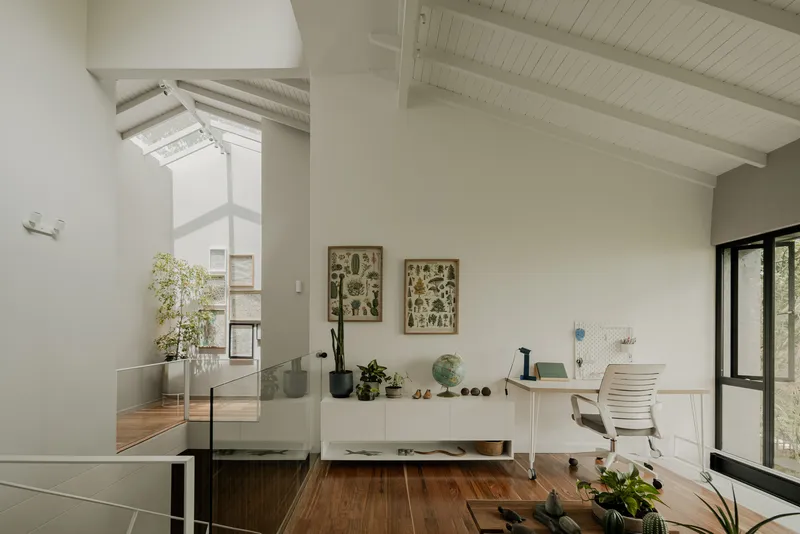


The upper levels house a workspace and study that benefit enormously from the split-level section. The mezzanine workspace sits under exposed white timber rafters with a glass balustrade that keeps the visual connection to the double-height void below. It is a room that borrows volume from its neighbor, feeling generous without consuming extra floor area.
The study, wrapped in horizontal timber cladding and terminating in a fully glazed wall facing the garden, is one of the quieter moments in the house but also one of the most successful. A corner skylight washes the adjacent gallery wall with natural light, illuminating framed maps and timber niches. These are spaces designed for concentration, where the section does the heavy lifting and the materials step back.
Outdoor Rooms and Threshold Details
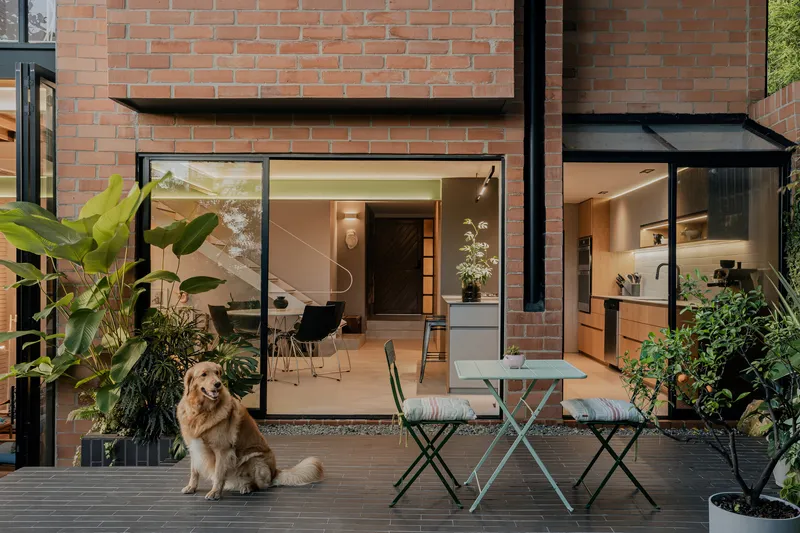
The timber deck functions as an outdoor room rather than a balcony. Furniture, a dog, and a direct visual line through the glazed doors into the brick interior establish it as an extension of the living space. DARP treats the transition with care: black-framed sliding doors, a consistent floor level, and a planting buffer that softens the edge without blocking it.
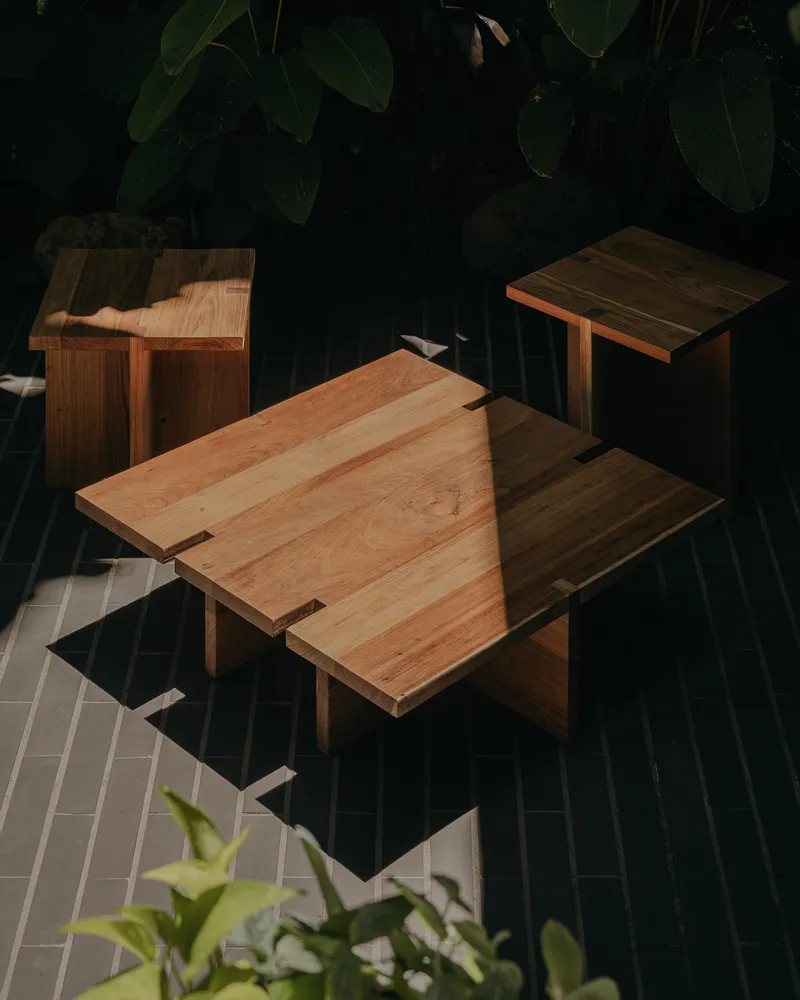
Inside, the staircase treads are flanked by open slat shelving and potted plants, reinforcing the idea that the garden does not stop at the glass. Even the detail of the angled timber table legs, casting sharp shadows on cream brick paving, suggests a design team thinking about how light and material interact at every scale.
Material Closeups

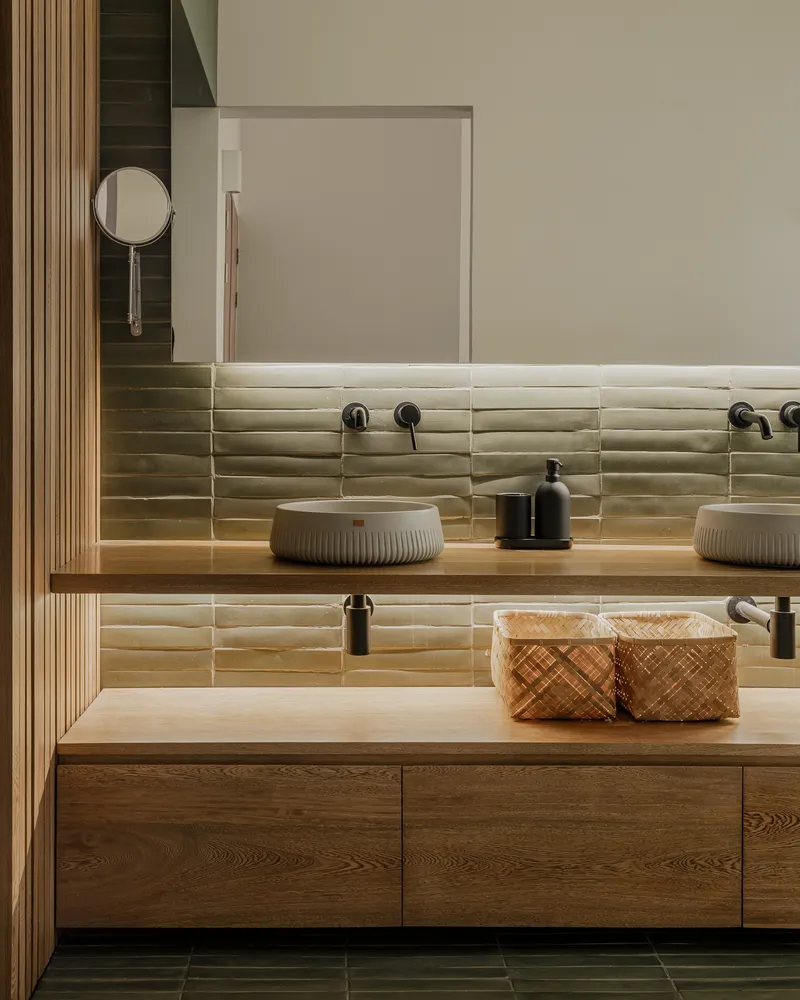
At the detail scale, the house holds together. A timber countertop in the bathroom sits against cream ribbed tile under soft, even lighting. Custom furniture legs meet the paved surface with precision. These are not expensive finishes; they are ordinary materials placed with enough care that they read as intentional. Rehabilitation projects live or die at this resolution, where new interventions meet existing fabric, and DARP manages the seams convincingly.
Plans and Drawings
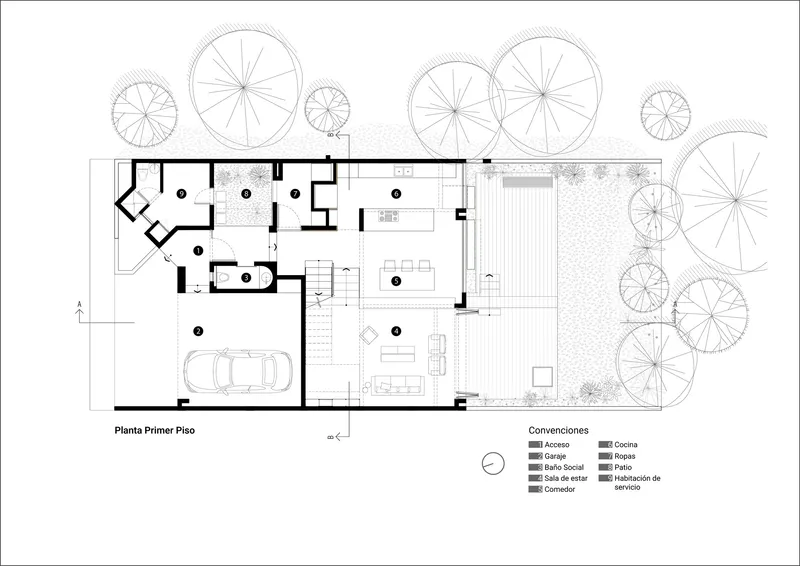
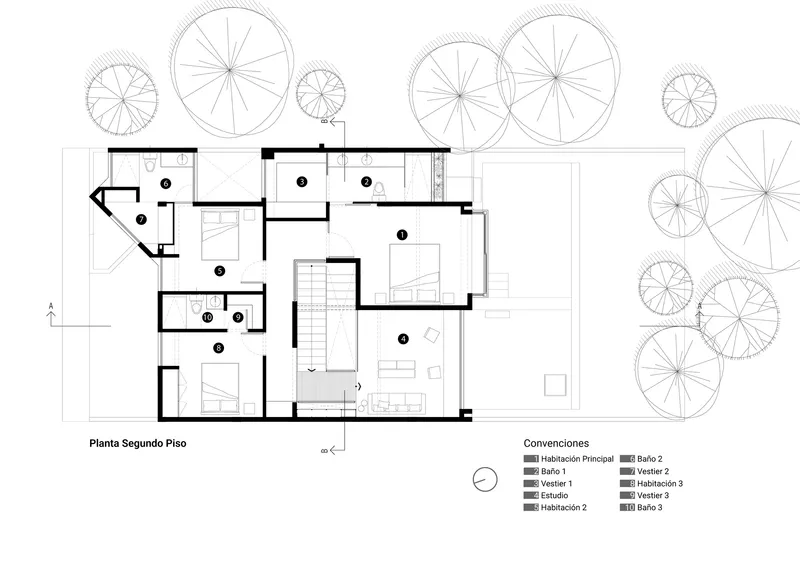

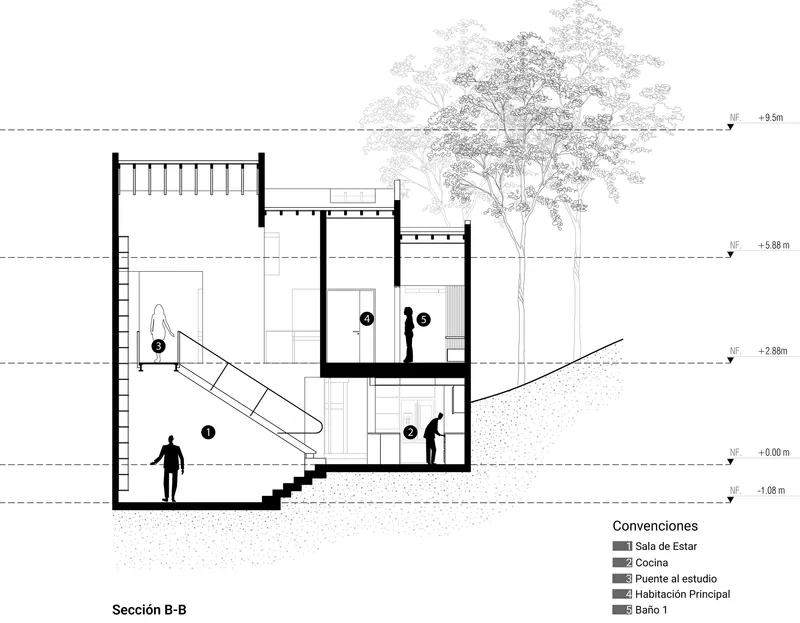
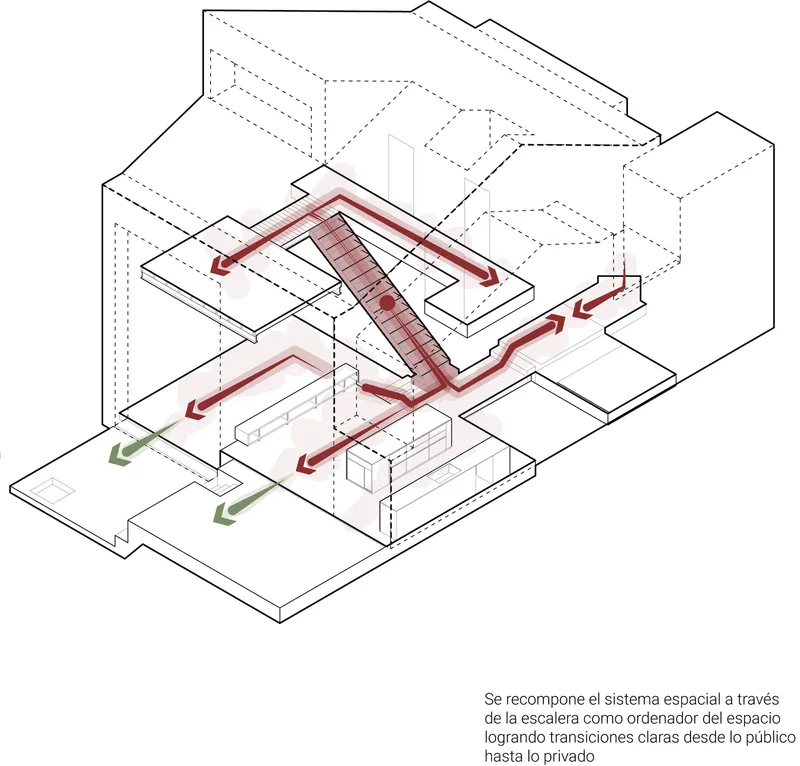
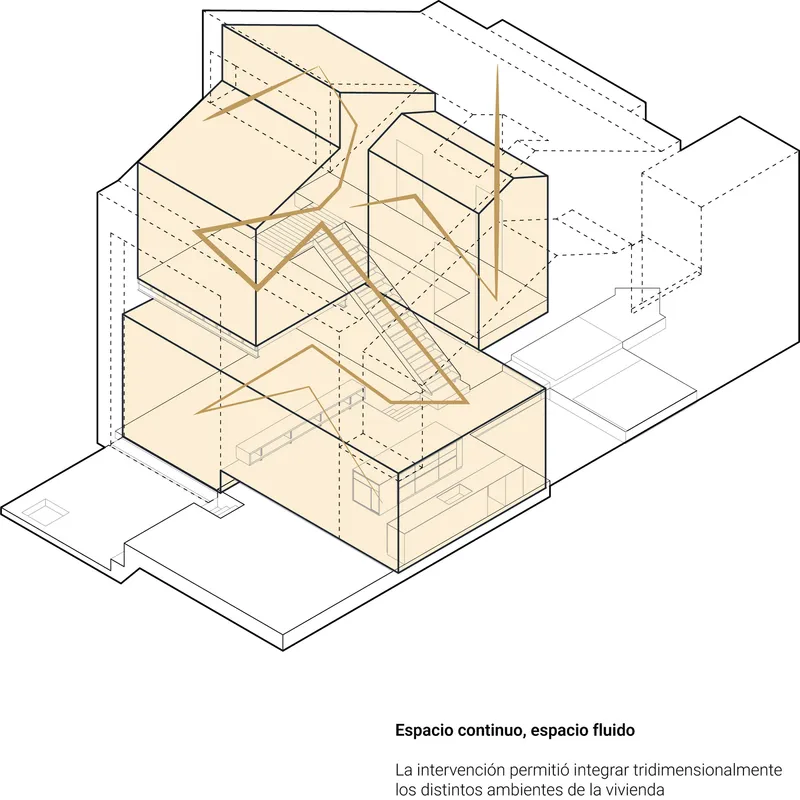
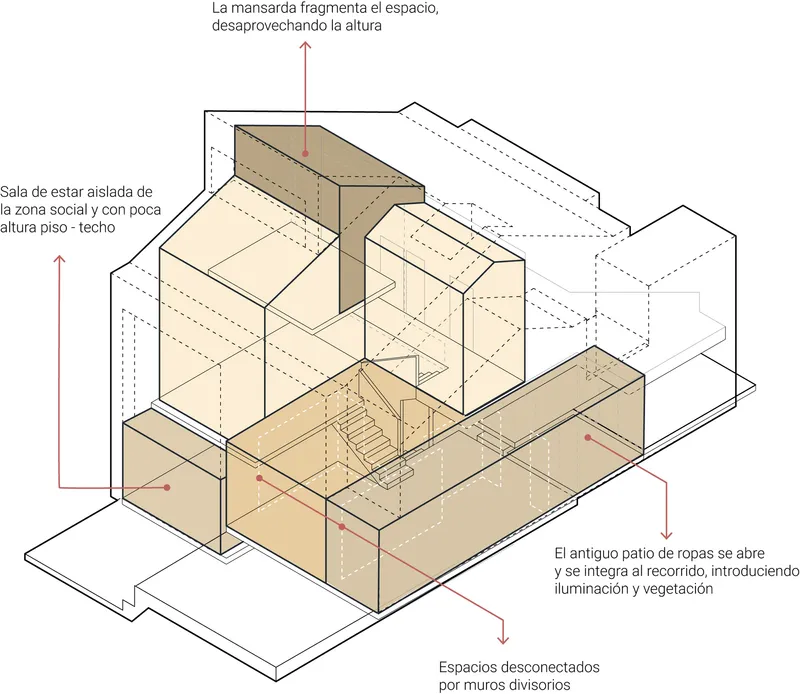

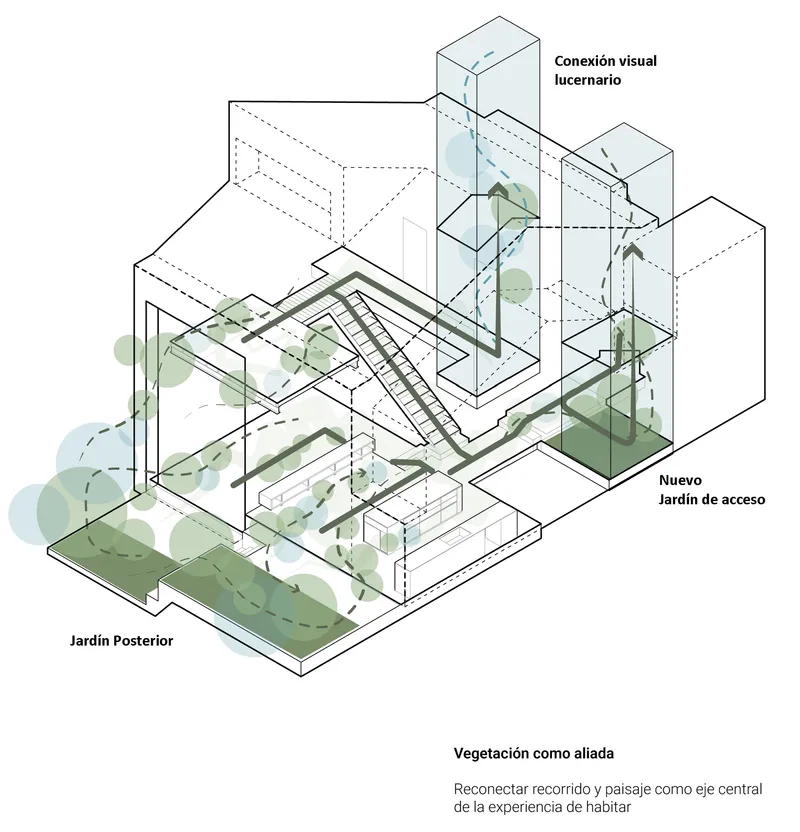
The drawings reveal the logic that the photographs only hint at. The ground floor plan shows garage, living spaces, and outdoor terrace wrapping around tree canopies, while the upper floor clusters bedroom suites around the central staircase. The sections are the most telling documents: they expose the steep descent from street level and the way DARP uses each half-level shift to create distinct spatial zones without partition walls.
The axonometric series is unusually legible. Red arrows trace circulation flow through the central stair across two levels; tan shading highlights the continuous spatial volumes that flow around it; and annotated diagrams map the relationship between isolated and connected living zones. Together, they make a strong case that the staircase is not merely a vertical connector but the organizational heart of the rehabilitation strategy.
Why This Project Matters
Casa P. Colina matters because it demonstrates that rehabilitation, done well, can produce architecture that is more spatially inventive than many new builds. DARP does not treat the existing house as a constraint to overcome. Instead, the hillside topography, the original structure, and the surrounding vegetation become active collaborators in a design that feels both site-specific and conceptually rigorous. In a city like Medellín, where the building stock is aging faster than it is being replaced, this kind of work points toward a more sustainable and culturally respectful approach to housing.
The project also reminds us that a limited palette and a clear organizational idea can accomplish more than a generous budget. A central staircase, three materials, and a persistent connection to the garden: these are not radical moves. But their consistent application across 250 square meters, from the section strategy down to the furniture details, produces a house that is coherent, legible, and genuinely pleasant to inhabit. That is harder than it sounds, and DARP makes it look almost easy.
Rehabilitation of Casa P. Colina by DARP - De Arquitectura y Paisaje (Jaime Cabal, Jorge Buitrago), Medellín, Colombia. 250 m², completed 2025. Photography by Mauricio Carvajal.
About the Studio
Share Your Own Work on uni.xyz
If projects like this are the kind of work you want to make, uni.xyz is a place to publish your own, find collaborators, and enter design competitions.


Popular Articles
Popular articles from the community


graciastudio Turns a Viewless Tijuana Lot Inward Around a Courtyard of Concrete, Timber and Trees
In Tijuana, Jorge Gracia's GA2 House stacks a timber-clad private floor over exposed concrete and replaces a missing view with a planted interior patio.

Cube Design Draws an Ecological Corridor Between Two Shenzhen Hills with the Nankai Building
Beside Shenzhen's container docks, the Nankai Building pairs stacked balconies with a climbing green screen to connect two hillsides across its height.


Singing Woman: An Opera House That Performs Before the Curtain Rises
Ovidiu Cristian Pavel's conceptual opera house translates Estonia's choral identity into a sculpted waterfront landmark facing the Baltic Sea.

Manzana Morphosis: Stretching Barcelona's Grid into a Living Landscape for 2050
A radical reworking of the Eixample manzana turns density into a tool for generous public space, vertical ecology, and environmental performance.

Similar Reads
You might also enjoy these articles

LAVA Architecten Gives Vocational Education a Sawtooth-Roofed Face on a Mechelen School Campus
In Mechelen, Belgium, a 2,053 m² STEM school on a 6×6 m grid turns workshops and classrooms into rooms that can be rearranged as teaching changes.

KEMA Studio Turns a Derelict Marvila Attic into a 60 m² Lighthouse Apartment Above Lisbon
In Lisbon's Marvila district, a rebuilt roof, four skylights and two plywood volumes turn an unlivable attic into a bright home facing the Tagus.

Pixel Gardens: One Repeated Module Stacked Into a Terraced Social Housing Tower for Famagusta
Salem Bader's shortlisted housing tower builds a vertical neighbourhood from one repeated module, offsetting units to carve terraces, light and air.

Bao Huynh Watercolor Atelier: A Serene Art Retreat in Hội An
Bao Huynh Watercolor Atelier in Hội An blends multifunctional art spaces, sustainable design, local materials, and family-friendly living in a serene environment.

Comments (0)
Please login or sign up to add comments
No comments yet. Be the first to comment!