
X11 Design Studio Carves Three Breathing Voids into a Vietnamese Tube House for a Multigenerational Family
De Chill House in Quang Ninh, Vietnam, uses courtyards, chrysanthemum curtains, and vertical voids to cool a dense urban plot.


The Vietnamese tube house is a familiar typology: narrow, deep, walled in on both sides by neighbors, and almost always starved of light and air. In the developing urban fabric of Quang Ninh, where construction density keeps climbing, these elongated lots produce interiors that feel more like corridors than homes. X11 Design Studio, led by architect Tran Tuan Anh, took exactly this constraint as the starting point for De Chill House, a 260 square meter residence designed for three generations of one family. Instead of fighting the tube plan, the team punctured it, inserting three "breathing" spaces at the front, center, and rear of the house to pull daylight and moving air deep into every room.
What makes De Chill House genuinely interesting is the precision of its passive strategy. The central courtyard, a skylight void, planted yards at each end, and a rooftop garden are not decorative gestures. They form a continuous vertical chimney that drives air convection from ground floor to roof. Chrysanthemum curtains, a practical textile choice rather than a romantic one, filter the hot dry west wind and limit heat radiation without sealing out views. The result is a house that stays cool and bright in a climate that punishes both ambitions, and it does so with rendered concrete, timber, and plants rather than a wall of mechanical systems.
A Facade That Filters Rather Than Blocks
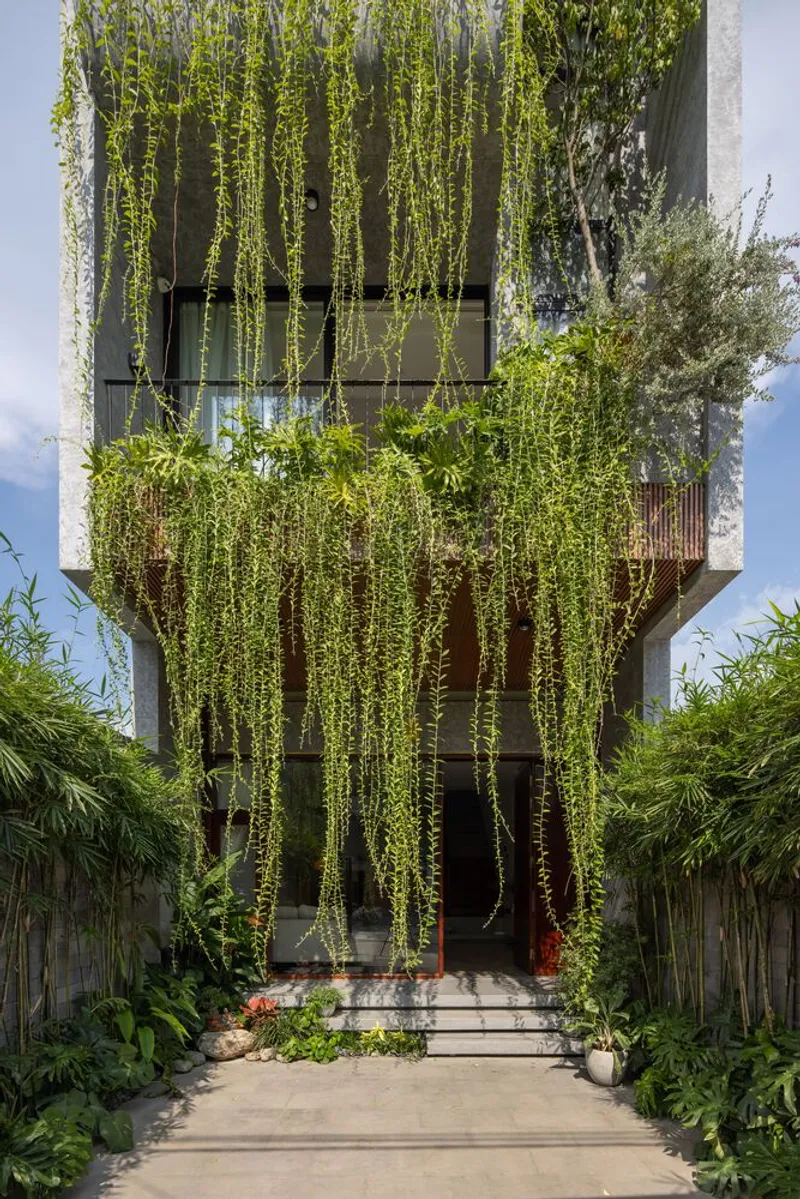
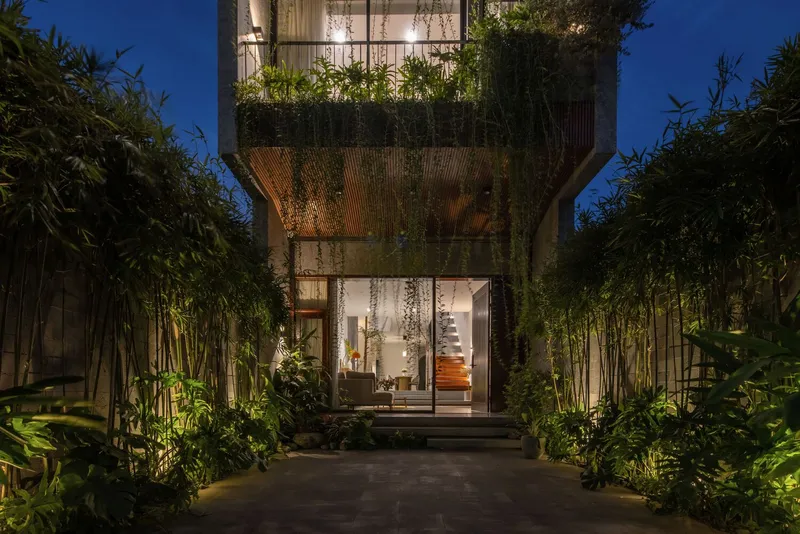
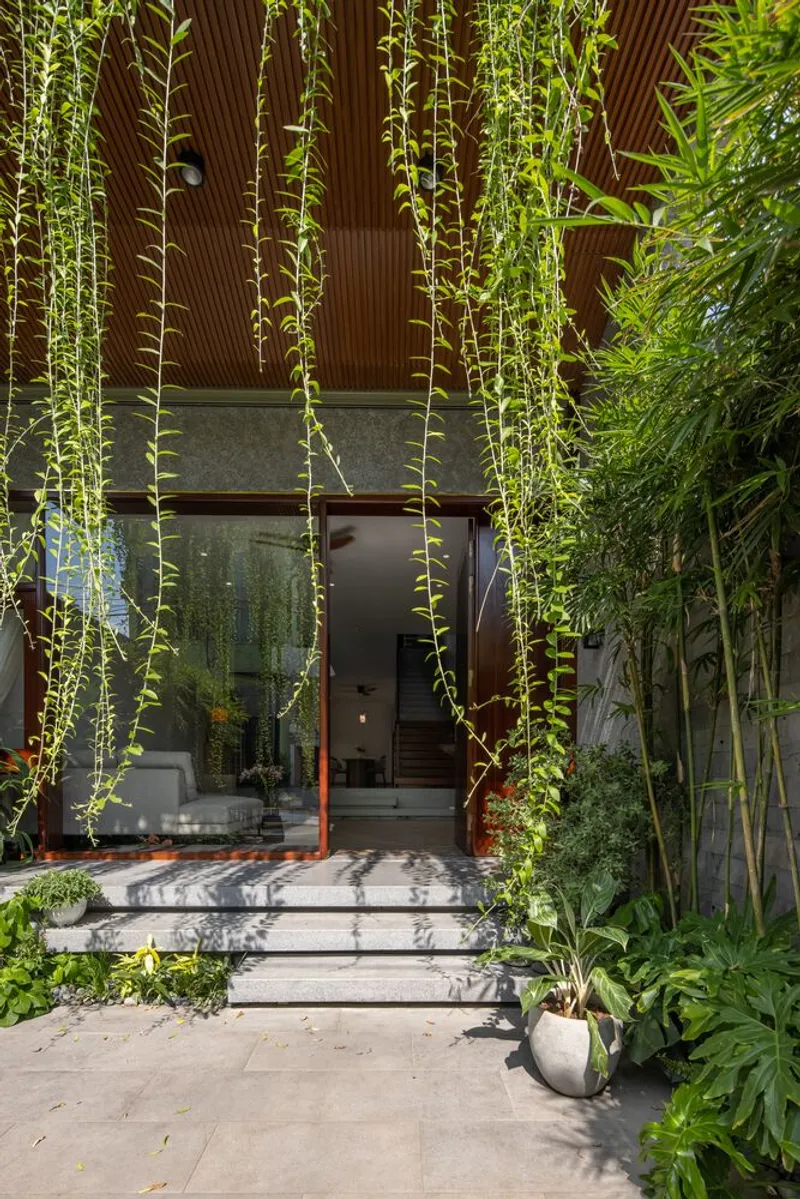
The street elevation is layered rather than flat. Timber slat screens, cantilevered balconies, and cascading vines create a graduated buffer between the public sidewalk and the private interior. At night, the glazed ground floor glows behind a curtain of illuminated bamboo groves, turning the entrance into something closer to a lantern than a wall. By day, the vines draping from the upper balconies soften the sun before it hits the glass, reducing solar gain without resorting to shutters or heavy blinds.
The entrance sequence reinforces this threshold logic. A paved patio with parking doubles as a setback zone, pushing the front door away from the street. You arrive through hanging vines and bamboo, pass beneath timber louvers, and step into the living space already shaded and cooled. It is a simple move, but in a high-density neighborhood it makes the difference between a house that feels exposed and one that feels composed.
The Central Void as Climate Engine
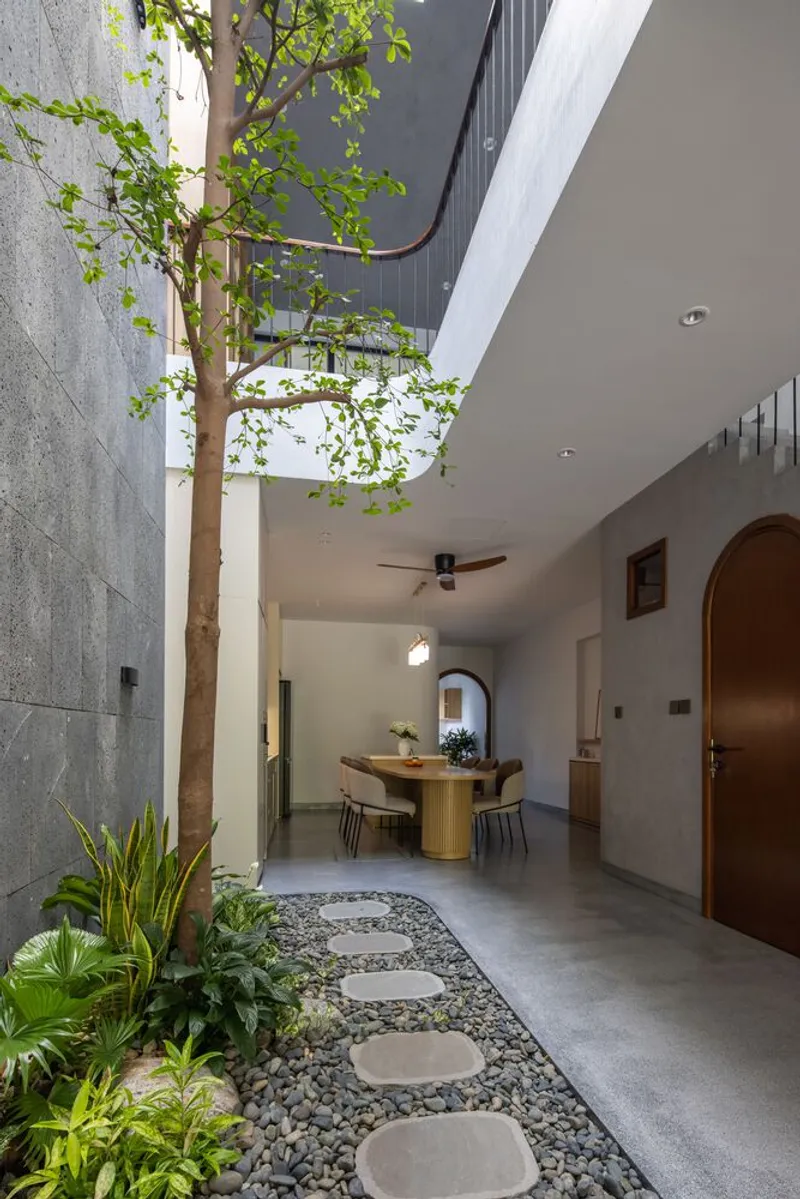
The most consequential design decision is the central courtyard, a slot of open sky punched through the plan at roughly the midpoint of its depth. A tree planted at ground level in a bed of pebbles and stepping stones grows upward through the void, connecting the kitchen level visually and thermally to the bedrooms and landing above. The skylight condition here is not merely aesthetic: it creates a stack effect, pulling warm air upward and drawing cooler air in through the planted yards at the front and rear.
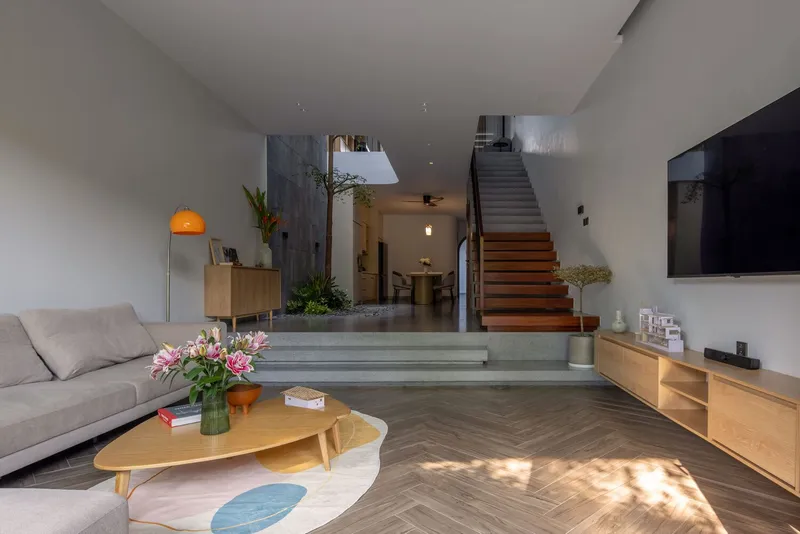
From the living room, the view through the herringbone-floored sitting area, past the timber staircase, and into the courtyard reads as a continuous spatial sequence rather than a series of rooms. The concrete side walls, rendered and windowless in the tradition of shared party walls, remain honest about the constraints of the lot. Light and air arrive vertically, not laterally, and every interior surface is positioned to receive it.
Ground Floor: Kitchen, Dining, and the Long View
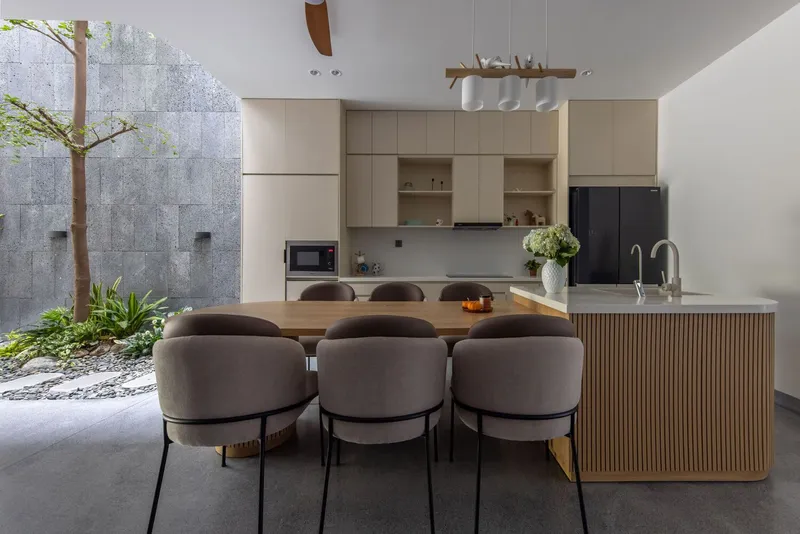
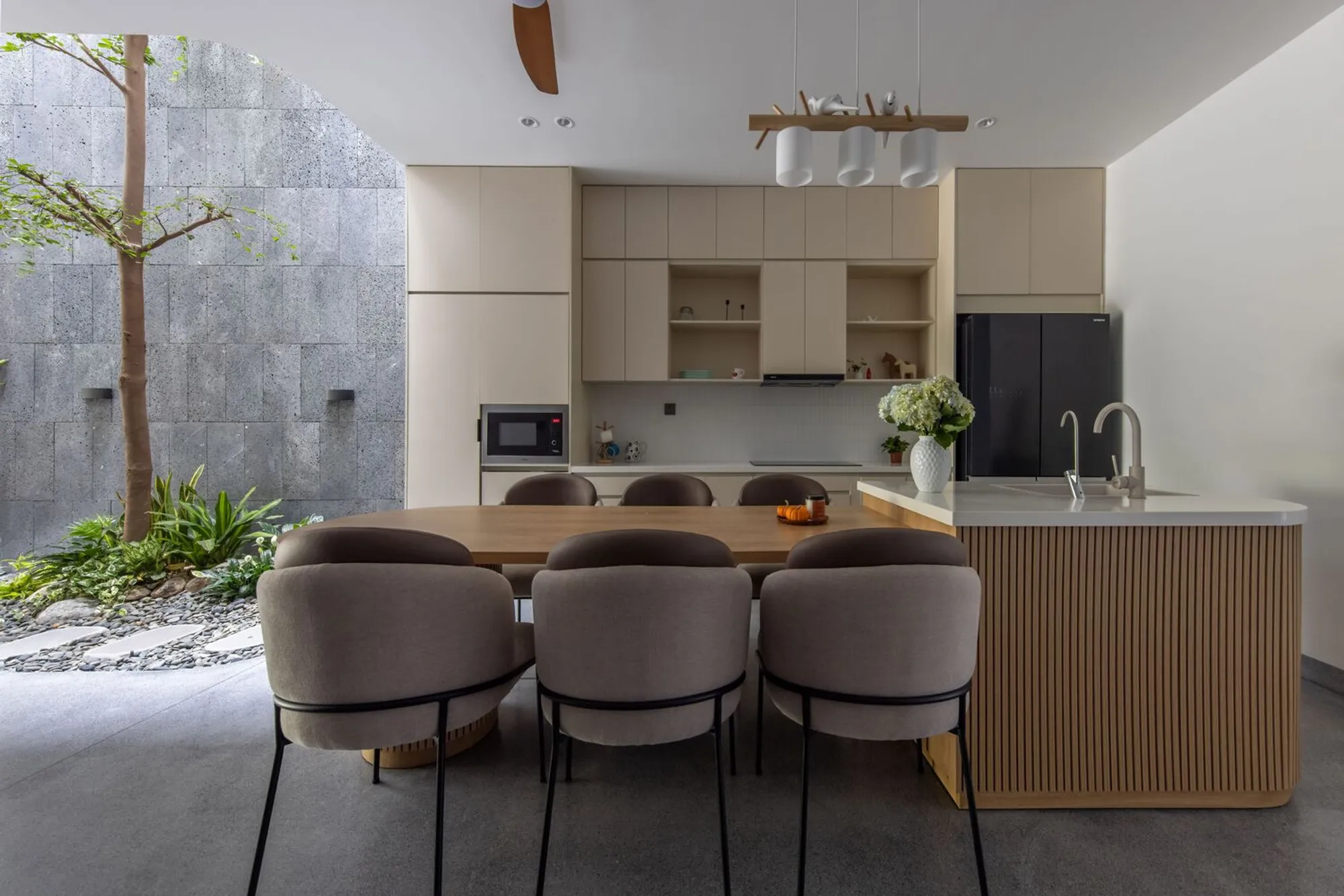
The ground floor stretches almost the entire length of the plan as a single communal volume: kitchen, dining, and living space flowing into one another without hard partitions. A fluted timber island anchors the kitchen zone and faces directly into the courtyard, so the cook works with a planted tree and a column of sky in their peripheral vision rather than a blank wall. The concrete backdrop of the courtyard reads as an honest structural surface, and the contrast between its rough texture and the warm timber of the cabinetry gives the room its character.
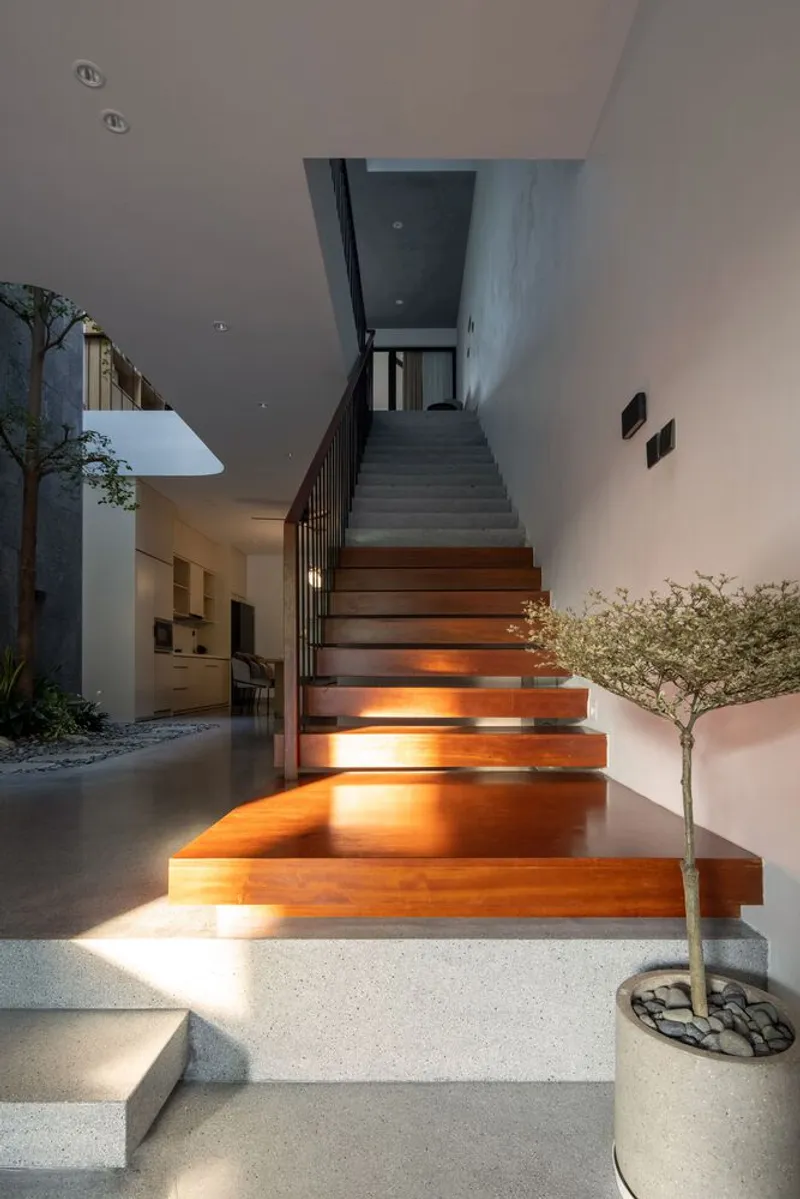
At dusk, the timber staircase with its integrated lighting becomes a sculptural element in its own right. A potted tree in a concrete planter at the stair's base reinforces the house's insistence on bringing living material into every transition space. Even circulation is treated as habitable territory here, not just a means of getting from one floor to the next.
Upper Floors: Light, Books, and Borrowed Views
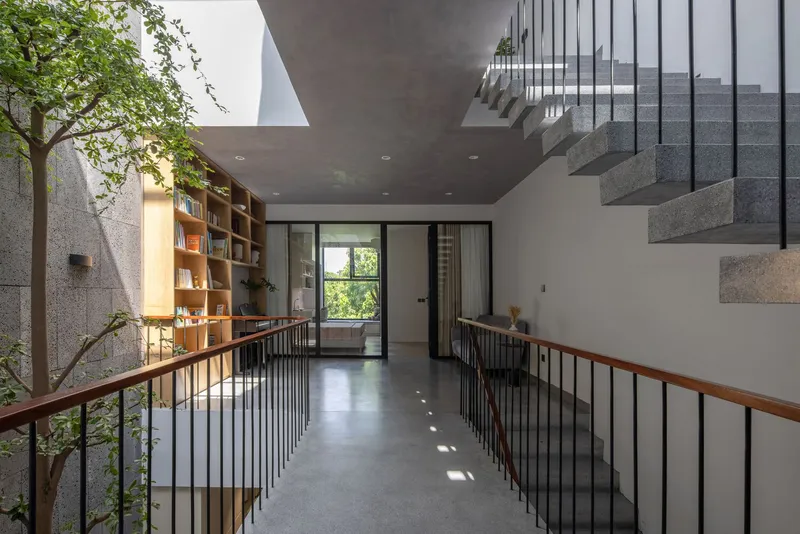
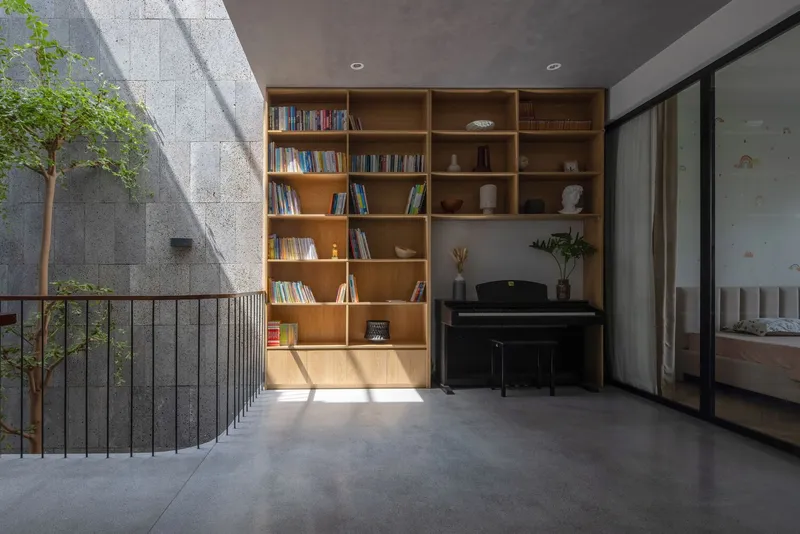
The first floor positions two larger bedrooms on either side of the open communal void, so each room borrows light and air from the central courtyard. The landing between them becomes more than a hallway: a timber bookshelf and black metal railings transform it into a reading gallery that overlooks the tree below. It is a generous use of what would ordinarily be dead square footage.
A mezzanine alcove tucked beside the void houses another bookshelf and a piano. Sharp afternoon light slices in from the courtyard, creating conditions that shift dramatically through the day. The decision to stack library and music functions along the void edge means the most culturally loaded activities in the house happen in its most atmospheric space. For a three-generation family, this kind of shared programmatic territory is more valuable than any additional private room.
The Rooftop as a Third Ground
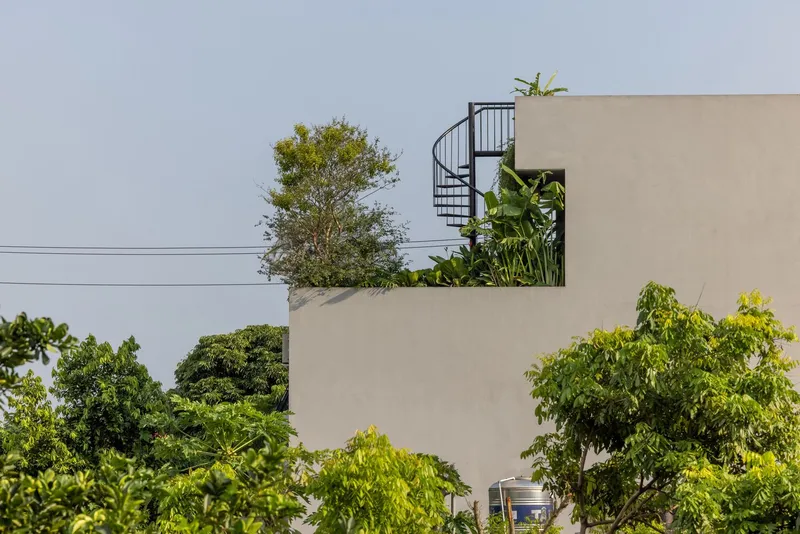
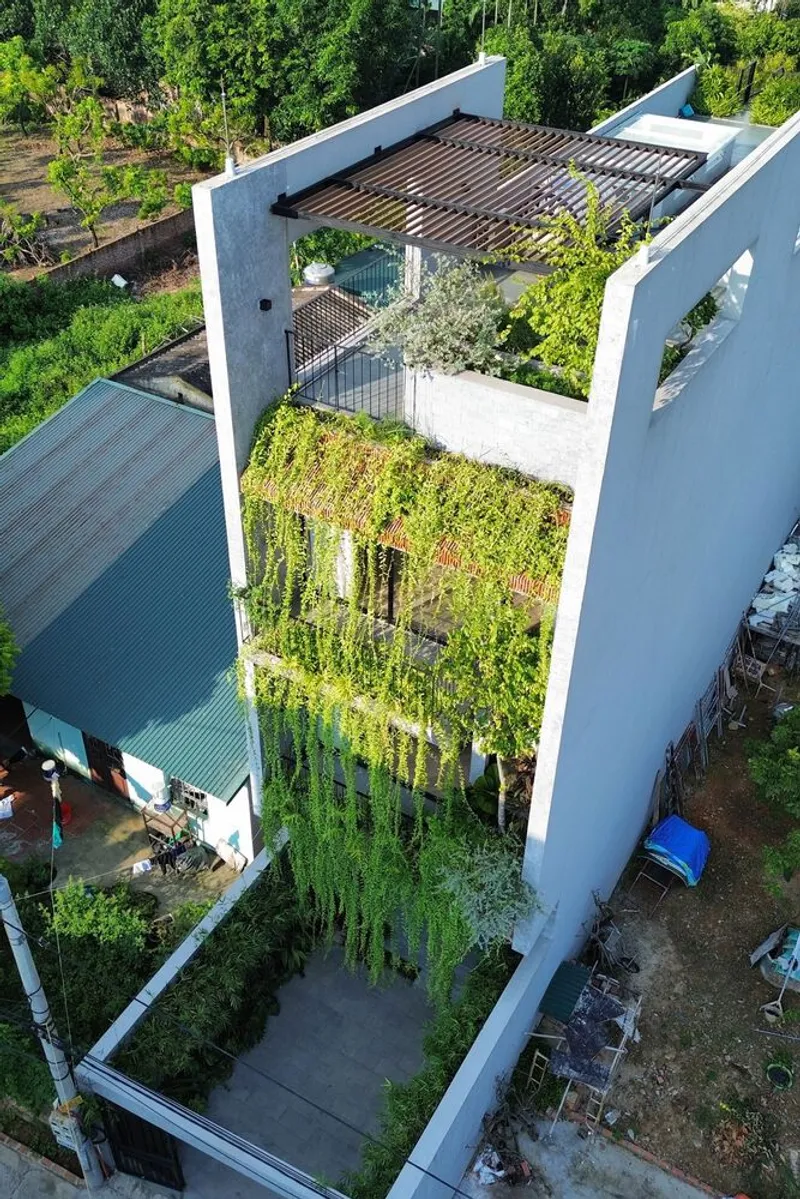
The third floor opens onto a large courtyard that functions as an extension of the interior, a kind of open-air living room elevated above the street and its noise. A black steel spiral staircase winds from this level up to the roof terrace, where a slatted metal canopy shelters planted beds and a timber pergola. Vegetation spills over the cream parapet wall and down the facade, tying the rooftop garden back to the street-level greenery in a continuous vertical loop.
From the aerial view, the roof reads as a productive landscape rather than wasted infrastructure. Planted walls, potted greenery, and the pergola create microclimates that insulate the floors below. The spiral stair, a deliberate formal gesture in glossy black steel against the muted concrete and timber palette, signals that the roof is not an afterthought. It is the climax of the vertical garden sequence that begins at the ground-floor courtyard.
Why This Project Matters
De Chill House does not reinvent the Vietnamese tube house; it corrects its worst tendencies with surgical precision. Three voids, a continuous planting strategy, and a handful of passive climate tools turn a deep, narrow lot into a house that breathes on its own. The approach is replicable. Every decision, from the chrysanthemum curtains to the skylight void, responds to conditions that thousands of neighboring plots share. That scalability is what distinguishes a clever one-off from a genuine contribution to local housing intelligence.
For a multigenerational household, the spatial organization matters as much as the climate strategy. Private bedrooms flank shared voids; communal activities cluster around the courtyard; the rooftop offers a collective retreat. X11 Design Studio has built a house where solitude and togetherness are both available without anyone having to negotiate for them. In a dense urban context where square meters are scarce and families are large, that is perhaps the most valuable thing architecture can deliver.
De Chill House by X11 Design Studio, Quang Ninh, Vietnam. 260 m². Completed 2022. Lead Architect: Tran Tuan Anh. Photography by Hoang Le.
About the Studio
Share Your Own Work on uni.xyz
If projects like this are the kind of work you want to make, uni.xyz is a place to publish your own, find collaborators, and enter design competitions.




Popular Articles
Popular articles from the community


The Earth Pod: 3D Printed Homes for Resilient Refugee Communities
The Earth Pod reimagines refugee housing through 3D printed homes made from clay, combining resilience, self-sufficiency, and rapid shelter.

Riyadh For All: Intergenerational Urban Design for Active Aging in Rabat
Riyadh For All reimagines urban design in Rabat with intergenerational co-living, adaptive courtyards, and Moroccan cultural exchange today.

Co-life: Sustainable Architecture for Age-Friendly Community Living
Co-life reimagines sustainable architecture for seniors through courtyards, rammed earth, shared gardens, and spaces designed for belonging.

The Musturak Paradise: Senior Living Architecture for a Connected Future in Temara, Morocco
The Musturak Paradise reimagines senior living architecture in Temara via private homes, social spaces, culture, community, and shared care.

Similar Reads
You might also enjoy these articles


Hodi-Mandai Geram
Project Function: Preservation and revitalization of the Intangible heritage and socio-spatial identity of the Hodi by Housing, Cultural Memory Center, Sacred Grove, landscape, local tourism economy


Olio Towers: A Mid-Rise for Performers That Fuses Housing, Rehearsal, and Stage
Located blocks from Houston's Theater District, this modular tower stacks living units around a central performance atrium.

Oasis: Modular Green Housing Carved into Dhaka's Urban Fabric
A shortlisted Plugin Housing entry reclaims unauthorized settlements in Dhaka with stepped concrete volumes, green roofs, and ventilation-driven design.

Black Hole: A Floating Megastructure for the Post-Physical Era
Emiliano Mazzarotto envisions a spherical, self-scaling arena where e-sports, digital hotels, and holographic stadiums replace traditional public space.


Explore Housing Competitions
Discover active competitions in this discipline



Challenge to reimagine the Iron Throne


Photograph architecture without architects


Illustrate the lost glory of Angkor Wat - Render Challenge


Design challenge to reuse E-waste
Comments (0)
Please login or sign up to add comments
No comments yet. Be the first to comment!